Introduction
Halyomorpha halys Stål (Hemiptera: Pentatomidae) (also known as brown marmorated stink bug) is native to East Asia, and it is now a serious invasive pest in North America. Halyomorpha halys has an extensive host range of more than 170 plants, including many economically important fruits, vegetables, ornamentals, and row crops (Leskey and Nielsen Reference Leskey and Nielsen2018). Nymphs and adults feed on seed pods, buds, fruit, leaves, or stems of plants, potentially resulting in severe damage and substantial economic loss, even at low H. halys population densities (Kuhar et al. Reference Kuhar, Kamminga, Whalen, Dively, Brust and Hooks2012b; Zobel et al. Reference Zobel, Hooks and Dively2016). Halyomorpha halys also is a significant nuisance pest in urban areas, as it often overwinters in large aggregations in human-made structures (Inkley Reference Inkley2012; Leskey et al. Reference Leskey, Hamilton, Nielsen, Polk, Rodriguez-Saona and Bergh2012a). Since it was initially discovered in the United States of America in the mid-1990s, H. halys has spread to more than 44 states and caused severe economic damage to some agricultural crops in the mid-Atlantic region (Leskey et al. Reference Leskey, Hamilton, Nielsen, Polk, Rodriguez-Saona and Bergh2012a; Anonymous 2017). In Canada, H. halys has been found in British Columbia, Alberta, Ontario, Québec, and Prince Edward Island (Forgain and Graff Reference Fogain and Graff2011; Gariepy et al. Reference Gariepy, Haye, Fraser and Zhang2014; Anonymous 2017). In Ontario, H. halys has since spread across at least 24 provincial counties, with established breeding populations now confirmed in 12 of those counties (H.F., unpublished data). In some fruit orchards and vineyards near these populations, H. halys adults recently have been captured in pheromone traps (baited with Dead-Inn Combo Xtra Lure (AgBio, Westminster, Colorado, United States of America) or Pherocon H. halys attractant + Pherocon GSB (Chinavia hilaris (Say); Hemiptera: Pentatomidae) attractant (Trécé, Adair, Oklahoma, United States of America) and some fruit damage has been observed (H.F., unpublished data). Therefore, growers in Ontario, and elsewhere in Canada, are now at risk of economic loss from H. halys damage.
To mitigate crop damage and economic losses for growers, effective management options for H. halys are crucial. To date, insecticides have been the primary management strategy for H. halys in its native and introduced range (Kang et al. Reference Kang, Huh and Park2003; Toyama et al. Reference Toyama, Ihara and Yaginuma2006; Lee et al. Reference Lee, Short, Joseph, Bergh and Leskey2013a). Laboratory and field studies, and agricultural spray programmes, have demonstrated that carbamate, organophosphate, neonicotinoid, and pyrethroid insecticides are comparatively the most efficacious against H. halys (Funayama Reference Funayama2002, Reference Funayama2012; Nielsen et al. Reference Nielsen, Shearer and Hamilton2008; Kuhar et al. Reference Kuhar, Doughty, Kamminga and Lilliston2012a; Leskey et al. Reference Leskey, Lee, Short and Wright2012b, Reference Leskey, Short and Lee2014; Lee et al. Reference Lee, Wright and Leskey2013b; Bergmann and Raupp Reference Bergmann and Raupp2014; Cira et al. Reference Cira, Burkness, Koch and Hutchison2017). However, many of these older insecticide classes are broad spectrum and may have non-target effects on beneficial organisms. Consequently, the registration of many insecticides from these classes is currently being re-evaluated or suspended in North America. Furthermore, spray recommendations for native Pentatomidae have not consistently provided adequate control of H. halys in some regions of the United States of America, prompting some growers to greatly increase the number of spray applications in an attempt to mitigate H. halys damage (Leskey et al. Reference Leskey, Lee, Short and Wright2012b, Reference Leskey, Short, Butler and Wright2012c). Finally, very few insecticides currently are registered for H. halys in Canada. Therefore, there is a need to identify novel, effective chemical control options for H. halys management in North America.
Our objective was to evaluate the efficacy of 12 insecticides currently used or with potential for H. halys management by determining their direct and residual contact toxicity to H. halys nymphs. Although insecticide efficacy studies with H. halys have been increasing (reviewed by Kuhar and Kamminga Reference Kuhar and Kamminga2017), the majority of those studies have focussed on adults, and only one study to date has assessed the toxicity of insecticides to H. halys nymphs following topical application (Bergmann and Raupo Reference Bergmann and Raupp2014). Immature stages of insects are often more susceptible to insecticides than adults, and previous studies suggest this may be the case for H. halys (Bergmann and Raupo Reference Bergmann and Raupp2014; Morehead and Kuhar Reference Morehead and Kuhar2017). The information generated from our study can help inform H. halys management programmes in North America.
Materials and methods
Test insects
Halyomorpha halys were obtained from colonies maintained at the University of Guelph (Guelph, Ontario, Canada) and the London Research and Development Centre, Agriculture and Agri-Food Canada (London, Ontario, Canada). Late instar (fourth and fifth) nymphs were used in all bioassays. Colonies were maintained at 25 ± 1 °C, 50–60% relative humidity, and 16:8 hour light:dark photoperiod; and fed various combinations of romaine lettuce, raw peanuts, soy bean, carrot, apple, sweet pepper, black plum, peach, and pear, depending on the rearing location and seasonal availability of produce.
Insecticides
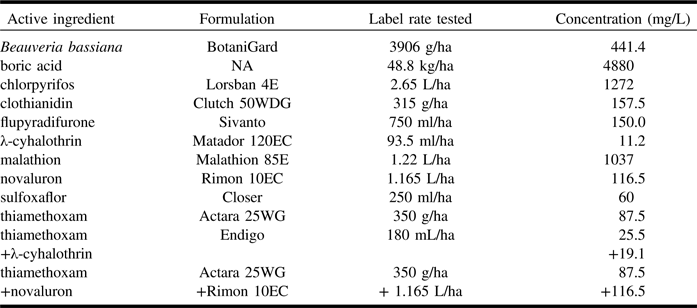
A list of the formulated insecticides tested is provided in Table 1. At the start of the study, malathion, thiamethoxam, and clothianidin were registered for H. halys in Canada. Beauveria bassiana (Balsamo-Crivelli) Vuillemin (Cordycipitaceae) and boric acid were included as potential reduced-risk options for use in residential buildings. Chlorpyrifos and deionised water were used as a positive and negative control, respectively. A paired negative control was included for each insecticide (see Supplementary Table 1).
Formulated insecticides assessed for direct and residual contact toxicity to Halyomorpha halys nymphs. Each insecticide was tested at Canadian label rate for H. halys or a similar sucking insect pest, and at half and twice that rate.

All insecticides were tested at their Canadian label rate for H. halys or for a similar sucking insect pest (Table 1) and at half and twice that rate (boric acid was not tested at twice label rate, because it would dissolve into solution). If a range of rates was present on the label, the median rate was used. The concentration (mg/L) of each insecticide in spray solution at label rate was determined using the following calculation: label rate (g/ha) × concentration of active ingredient (g a.i./L) × spray volume (ha/L) × 1 L/1000 mL × 1 L/1000 g × 1 000 000 mg/L. A standard spray volume of 1000 L/ha was used for all calculations. Each insecticide was dissolved in deionised water to create a stock solution, and serial dilutions were performed to obtain desired concentrations.
The direct contact toxicity of all insecticides listed in Table 1 was determined. However, malathion and boric acid were not included in subsequent residual contact bioassays, as the Canadian government cancelled the registration of most domestic boric acid formulations and deregistered malathion for use against H. halys.
Direct contact toxicity
The direct contact toxicity of the insecticides to H. halys nymphs was determined using a mini spray tower, a scaled-down (1/9th sized spray tube) version of a Potter spray tower (Potter Reference Potter1952). Nymphs were treated in groups of 4–6. Each group was placed in a glass Mason jar and randomly assigned to a treatment. Nymphs were anaesthetised with CO2 for seven seconds and placed dorsal side up in a 5 cm glass Petri dish bottom. The dish was then placed in the tower, and 1 mL of the corresponding treatment was applied. Treated nymphs were transferred to a plastic cup (11.5 diameter × 8.5 cm height) containing a piece of untreated romaine lettuce, two baby carrots, and a braided cotton dental roll (4 cm length) soaked in water. Cups were covered with a piece of craft netting secured with a rubber band and placed in a growth cabinet maintained at 25 ± 1 °C, 50–60% relative humidity, and 16:8 hour light:dark photoperiod. Each treatment was replicated 7–13 times.
Residual contact toxicity
Residual contact toxicity was determined using a leaf dip bioassay. Discs (8 cm diameter) were cut from romaine lettuce leaves, submerged into the corresponding treatment for 10 seconds, and placed on a wire rack in a fumehood until dry (1.5–2.0 hours). Each leaf disc was placed on the bottom of a 9 cm diameter × 6 cm height waxed paper cup, and 4–7 H. halys nymphs were then placed in each cup. A 10 cm plastic Petri dish bottom was placed in the opening of each cup to prevent the nymphs from escaping. The cups were then placed in a growth cabinet maintained at 25 ± 1 °C, 50% relative humidity, and 16:8 hour light:dark photoperiod. Each treatment was replicated 4–6 times.
Data collection and analyses
For both bioassays, the number of dead or severely affected nymphs was assessed at 48 hours. A nymph was considered dead if it did not move when gently probed and severely affected if it was laying ventral side up and twitching involuntarily or if it was lying motionless but moved or twitched when probed. Henderson-Tilton formula was used to correct for mortality in the negative control, which did not overall exceed 9% within a treatment group (see Supplementary Table 1). There were no severely affected nymphs observed in any control, so no correction was applied to those data. Only replicates in which three or more nymphs survived were included in analyses of severely affected nymphs. All data failed to meet the assumption of normality (Shapiro-Wilk normality test, see Supplementary Table 1 for associated statistics) and were arcsine square root transformed prior to analyses. Data were analysed with an analysis of variance in R v3.2.3 (R Core Team 2015). Variance was partitioned into the fixed effects insecticide and rate, and their interaction. Means were compared using Tukey’s tests, and all analyses were performed at a significance level of 0.05.
Results
Direct contact toxicity
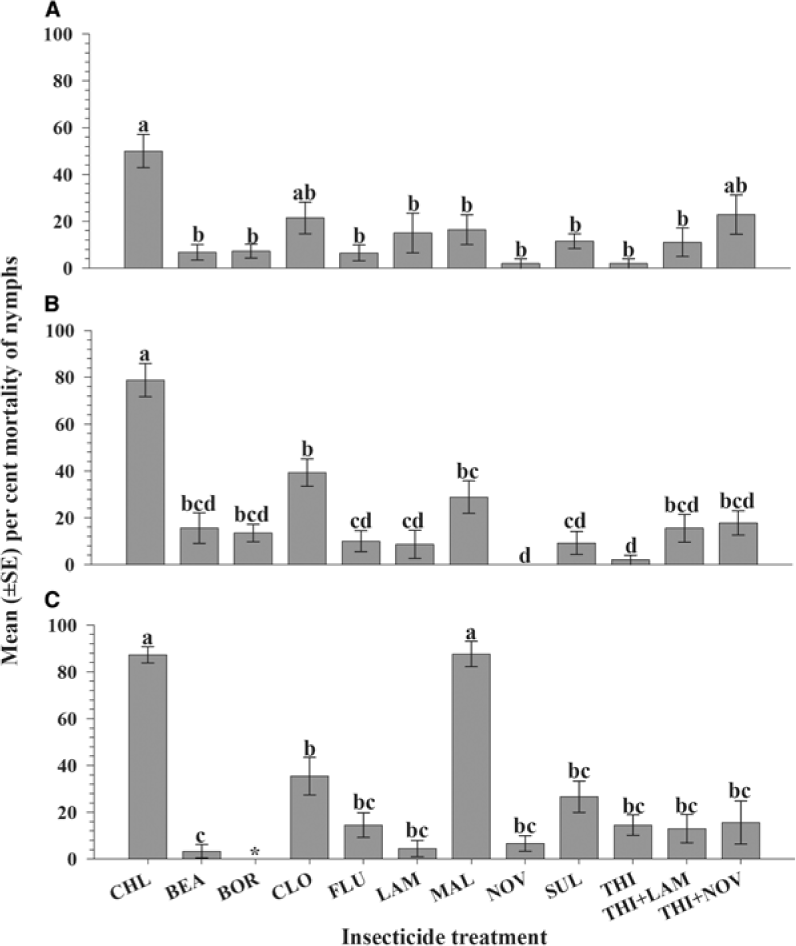
Insecticide (F = 31.2; df = 11; P < 0.0001) and rate (F = 15.0; df = 2; P < 0.0001) had a significant effect on nymph mortality following spray application. The interaction between insecticide and rate also was significant (F = 4.27; df = 21; P < 0.0001). With the exception of chlorpyrifos, nymph mortality following spray application generally was low across all insecticides and rates (Fig. 1A–C). At full and twice label rate, treatment with chlorpyrifos resulted in approximately 80% mortality, which was significantly higher than all other insecticides, with the exception of malathion at twice label rate (Fig. 1B–C). Otherwise, mortality ranged from 0 to 39% (Fig. 1A–C).
Mean (± standard error) percent mortality of Halyomorpha halys nymphs 48 hours after exposure to topical application of formulated chlorpyrifos (CHL), Beauveria bassiana (BEA), boric acid (BOR), clothianidin (CLO), flupyradifurone (FLU), λ-cyhalothrin (LAM), malathion (MAL), novaluron (NOV), sulfoxaflor (SUL), thiamethoxam (THI), a mixture of thiamethoxam and λ-cyhalothrin (THI+LAM), and a mixture of thiamethoxam and novaluron (THI+NOV) at half (A), full (B), and twice (C) Canadian label rate. Columns with the same letter are not significantly different at α = 0.05 (Tukey’s test). Henderson-Tilton formula was used to correct for mortality in the negative control, and means presented were calculated from corrected values.

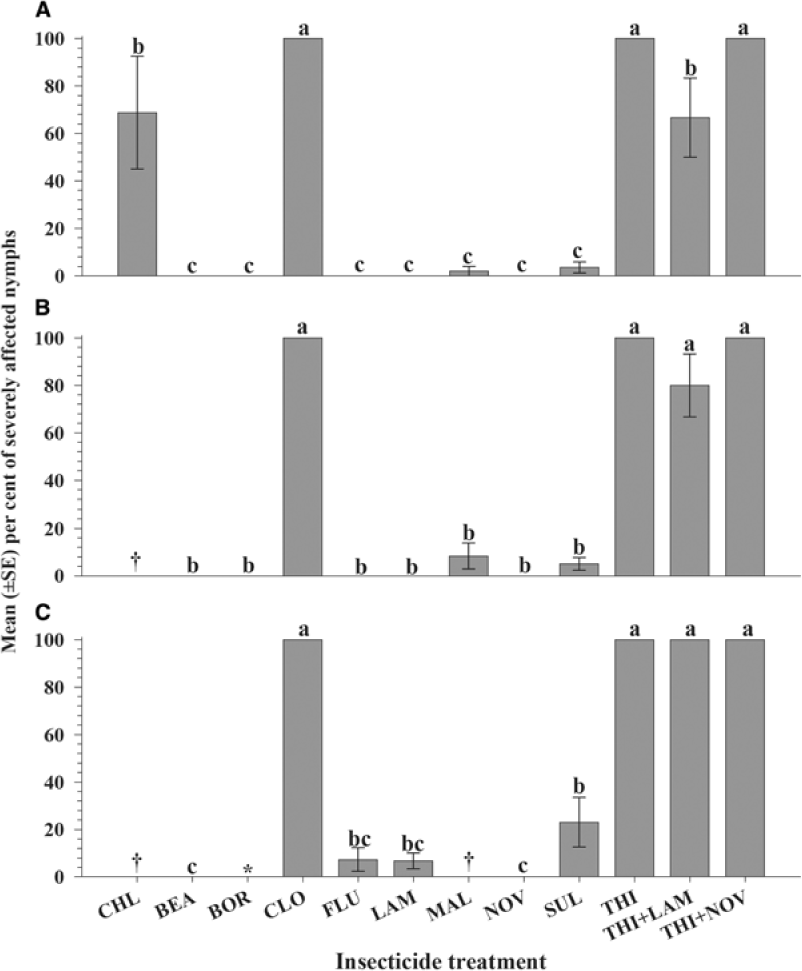
Insecticide (F = 221; df = 11; P < 0.0001) and rate (F = 6.87; df = 2; P = 0.00124) also had a significant effect on the number of severely affected nymphs following exposure via spray application, but the interaction of insecticide and rate was not significant (F = 1.50; df = 18; P = 0.0908). The number of severely affected nymphs following treatment with thiamethoxam, alone and in both mixtures, and clothianidin was significantly higher compared to all other treatments (Fig. 2A–C). All nymphs that survived treatment with clothianidin or thiamethoxam were severely affected at all rates (Fig. 2A–C). Similarly, between 66 and 100% of nymphs treated with thiamethoxam + λ-cyhalothrin or thiamethoxam + novaluron were severely affected. Following exposure to sulfoxaflor at twice label rate, 25% of surviving nymphs were severely affected (Fig. 2C). However, fewer than 10% of surviving nymphs were severely affected following exposure to all other treatments (Fig. 2A–C).
Mean (± standard error) per cent of severely affected Halyomorpha halys nymphs 48 hours after exposure to topical application of formulated chlorpyrifos (CHL), Beauveria bassiana (BEA), boric acid (BOR), clothianidin (CLO), flupyradifurone (FLU), λ-cyhalothrin (LAM), malathion (MAL), novaluron (NOV), sulfoxaflor (SUL), thiamethoxam (THI), a mixture of thiamethoxam and λ-cyhalothrin (THI+LAM), and a mixture of thiamethoxam and novaluron (THI+NOV) at half (A), full (B), and twice (C) Canadian label rate. Columns with the same letter are not significantly different at α = 0.05 (Tukey’s test) (†no value, because all nymphs died; *concentration not tested, because product would not dissolve into solution).

Residual contact toxicity
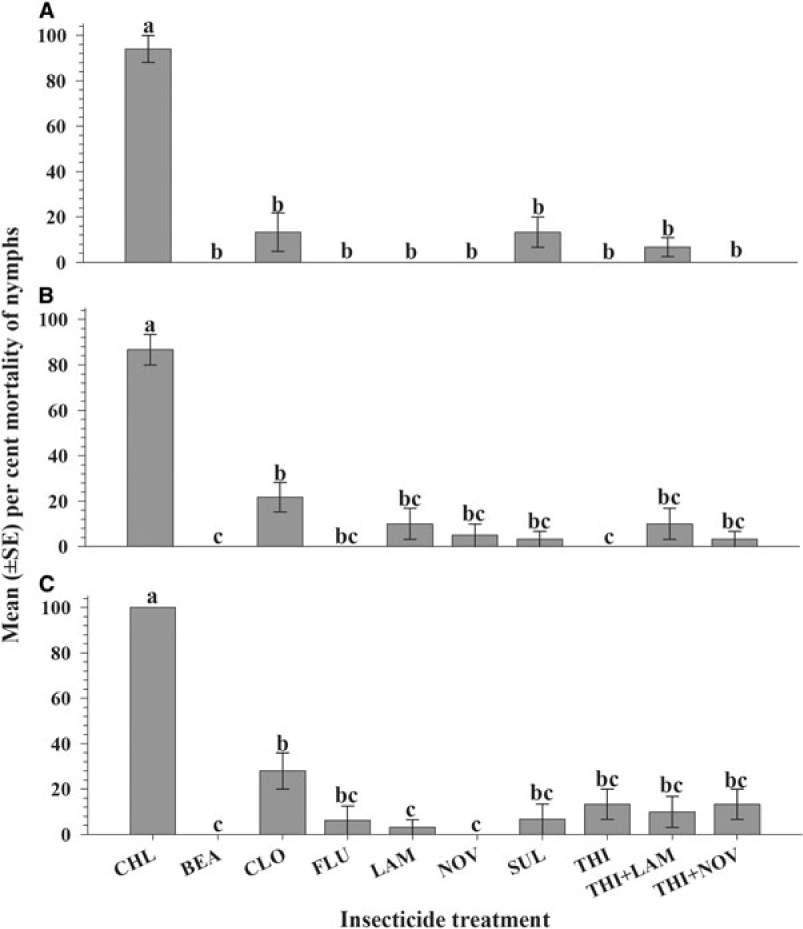
In residual contact bioassays, insecticide (F = 49.3; df = 9; P < 0.0001) and rate (F = 3.18; df = 2; P = 0.0446), but not the interaction between insecticide and rate (F = 1.09; df = 18; P = 0.369), had a significant effect on nymph mortality. Similar to direct contact bioassays, although chlorpyrifos residues were toxic to nymphs, all other insecticides displayed low residual activity at all concentrations (Fig. 3A–C). The next most toxic insecticide, clothianidin, caused 28% mortality at twice label rate (Fig. 3C). Nymph mortality following exposure to the remaining insecticide residues ranged between 0 and 13% (Fig. 3A–C).
Mean (± standard error) percent mortality of Halyomorpha halys nymphs 48 hours after exposure to dried residues of formulated Beauveria bassiana (BEA), chlorpyrifos (CHL), clothianidin (CLO), flupyradifurone (FLU), λ-cyhalothrin (LAM), novaluron (NOV), sulfoxaflor (SUL), thiamethoxam (THI), a mixture of thiamethoxam and λ-cyhalothrin (THI+LAM), and a mixture of thiamethoxam and novaluron (THI+NOV) at half (A), full (B), and twice (C) Canadian label rate. Columns with the same letter are not significantly different at α = 0.05 (Tukey’s test). Henderson-Tilton formula was used to correct for mortality in the negative control, and means presented were calculated from corrected values.

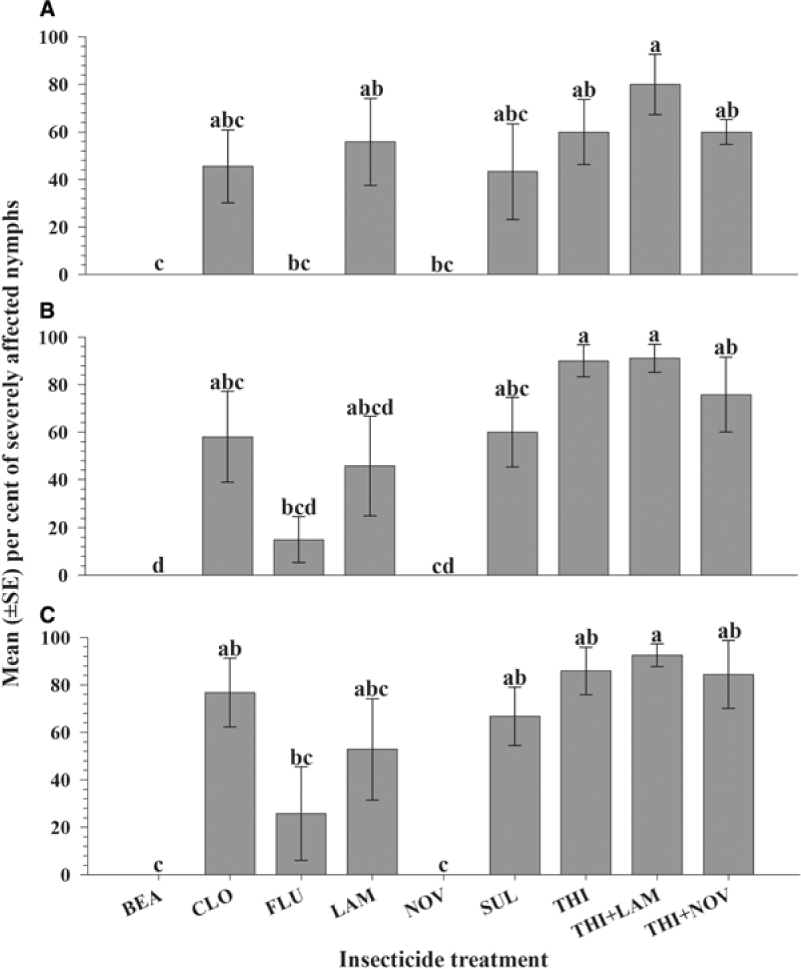
Insecticide (F = 18.6; df = 8; P < 0.0001) and rate (F = 3.15; df = 2; P = 0.0464), but not the interaction between insecticide and rate (F = 0.374; df = 16; P = 0.986), had a significant effect on the number of severely affected nymphs following residual contact exposure. Exposure to clothianidin, thiamethoxam, thiamethoxam + λ-cyhalothrin, and thiamethoxam + novaluron residues generally resulted in a higher number of severely affected nymphs compared to all other treatments, although these differences were significant only compared to novaluron and Beauveria bassiana (Fig. 4A–C). Approximately half of surviving nymphs exposed to λ-cyhalothrin residues were severely affected at all concentrations (Fig. 4A–C). Finally, no nymphs were severely affected following exposure to Beauveria bassiana or novaluron at any concentration tested (Fig. 4A–C).
Mean (± standard error) per cent of severely affected Halyomorpha halys nymphs 48 hours after exposure to dried residues of formulated Beauveria bassiana (BEA), chlorpyrifos (CHL), clothianidin (CLO), flupyradifurone (FLU), λ-cyhalothrin (LAM), novaluron (NOV), sulfoxaflor (SUL), thiamethoxam (THI), a mixture of thiamethoxam and λ-cyhalothrin (THI+LAM), and a mixture of thiamethoxam and novaluron (THI+NOV) at half (A), full (B), and twice (C) Canadian label rate. Columns with the same letter are not significantly different at α = 0.05 (Tukey’s test).

Discussion
Overall, nymph mortality was low (generally < 40%) following direct and residual contact exposure to the insecticides tested in our study, even at the highest tested concentrations. Similarly, previous laboratory studies suggest that H. halys generally displays low susceptibility to many insecticides (reviewed by Kuhar and Kamminga Reference Kuhar and Kamminga2017). We were the first to directly assess H. halys mortality following spray application of the insecticides included in our study; however, previous studies have determined the residual contact toxicity of some of our test insecticides to H. halys adults and nymphs. Although these studies also have observed that H. halys generally is not susceptible to many insecticides, they have reported comparatively higher nymph and adult mortality following residual contact exposure to some of the same insecticides tested in our study. For instance, multiple studies have reported that neonicotinoid and pyrethroid residues were toxic to H. halys adults or nymphs (Funayama Reference Funayama2002, Reference Funayama2012; Nielsen et al. Reference Nielsen, Shearer and Hamilton2008; Kuhar et al. Reference Kuhar, Doughty, Kamminga and Lilliston2012a; Leskey et al. Reference Leskey, Lee, Short and Wright2012b, Reference Leskey, Short and Lee2014; Lee et al. Reference Lee, Wright and Leskey2013b; Bergmann and Raupp Reference Bergmann and Raupp2014; Cira et al. Reference Cira, Burkness, Koch and Hutchison2017). Leskey et al. (Reference Leskey, Lee, Short and Wright2012b) found that dried residues of clothianidin, thiamethoxam, λ-cyhalothrin on glass resulted in 95, 90, and 85% mortality, respectively, of H. halys adults less than 24 hours after exposure. Subsequently, Leskey et al. (Reference Leskey, Short and Lee2014) reported that field residues of clothianidin, thiamethoxam, λ-cyhalothrin, and λ-cyhalothrin + thiamethoxam caused upwards of 95, 100, 86, and 80% mortality, respectively, of H. halys adults, depending on the seasonal timing of application. Similarly, Kuhar et al. (Reference Kuhar, Doughty, Kamminga and Lilliston2012a) observed that λ-cyhalothrin, thiamethoxam, and λ-cyhalothrin + thiamethoxam residues on green bean caused 32, 66, and 75% mortality, respectively, of H. halys nymphs in the laboratory. Higher H. halys mortality also has been observed from exposure to novaluron (Kamminga et al. Reference Kamminga, Kuhar and Wimer2012) and sulfoxaflor (Cira et al. Reference Cira, Burkness, Koch and Hutchison2017) residues.
The comparative lack of mortality we observed in our study could suggest that nymphs were not consistently being exposed to the insecticide residues under our experimental conditions. However, chlorpyrifos caused high mortality of nymphs in our direct and residual contact bioassays, and therefore, a lack of exposure cannot explain our results. Instead, differences in mortality likely are due to methodological differences between ours and other insecticide toxicity studies with H. halys. First, our experimental concentrations were based on Canadian label rates for the test insecticides, which were lower than the concentrations tested in previous studies for λ-cyhalothrin (previously tested range: 187–281 mL/ha) and λ-cyhalothrin + thiamethoxam (previously tested range: 402–438 mL/ha) (Kuhar et al. Reference Kuhar, Doughty, Kamminga and Lilliston2012a, Leskey et al. Reference Leskey, Short and Lee2014), in some cases even when doubled. Second, our residual treatment arena consisted of a treated leaf placed inside an untreated container, which provided nymphs with access to residue-free surfaces. Therefore, insecticide exposure, and hence mortality, may have been lower in our study compared to laboratory studies in which the entire treatment arena surface was treated (Nielsen et al. Reference Nielsen, Shearer and Hamilton2008; Leskey et al. Reference Leskey, Lee, Short and Wright2012b). Third, mortality values reported by Leskey et al. (Reference Leskey, Lee, Short and Wright2012b) include both the number of dead and moribund adults. When the number of dead and severely affected nymphs observed in our study are combined, our results for neonicotinoids and pyrethroids are similar to those reported by Leskey et al. (Reference Leskey, Lee, Short and Wright2012b). Taken together, these three factors likely explain the comparatively low mortality observed in our study.
Although mortality generally was low, many nymphs were severely affected following direct and residual contact exposure to neonicotinoids and λ-cyhalothrin in our study. These results suggest that neonicotinoids and λ-cyhalothrin could be useful for H. halys management in the field, as severely affected or moribund nymphs would be unable to feed and therefore unable to cause crop damage. However, Leskey et al. (Reference Leskey, Lee, Short and Wright2012b) observed that some moribund H. halys adults had recovered up to seven days after exposure to neonicotinoid or pyrethroid residues. Therefore, these insecticides may not be efficacious in the field over time, despite their initial high rate of H. halys knock down in laboratory studies.
Although organophosphate, neonicotinoid, and pyrethroid insecticides are comparatively the most toxic to H. halys (Funayama Reference Funayama2002, Reference Funayama2012; Nielsen et al. Reference Nielsen, Shearer and Hamilton2008; Kuhar et al. Reference Kuhar, Doughty, Kamminga and Lilliston2012a; Leskey et al. Reference Leskey, Lee, Short and Wright2012b, Reference Leskey, Short and Lee2014; Lee et al. Reference Lee, Wright and Leskey2013b; Bergmann and Raupp Reference Bergmann and Raupp2014; Cira et al. Reference Cira, Burkness, Koch and Hutchison2017), these insecticide classes are confirmed or purported to have non-target impacts on a variety of beneficial organisms, and therefore their agricultural use is becoming less desirable. Thus, there is a need to identify novel, reduced-risk insecticides for H. halys management. To address this need, we assessed the toxicity of Beauveria bassiana, boric acid, flupyradifurone, novaluron, and sulfoxaflor. Novaluron (Kamminga et al. Reference Kamminga, Kuhar and Wimer2012) and sulfoxaflor (Cira et al. Reference Cira, Burkness, Koch and Hutchison2017) had each been included in one H. halys study previously, while the other three insecticides had never been studied with H. halys. In our study, mortality and the number of severely affected nymphs was very low (< 20%) following direct or residual contact exposure to all of these insecticides, even at the highest treatment concentrations. Our results therefore suggest that these reduced-risk insecticides are not efficacious against H. halys. However, in contrast to our findings, Kamminga et al. (Reference Kamminga, Kuhar and Wimer2012) reported up to 75% H. halys nymph mortality following exposure to novaluron residues. Similarly, Cira et al. (Reference Cira, Burkness, Koch and Hutchison2017) observed that in addition to causing 70% adult H. halys mortality, exposure to sulfoxaflor residues significantly reduced adult feeding damage and the number of first instars that successfully moulted. Given the lack of studies on these insecticides, and the conflicting results between our and previous studies with novaluron and sulfoxaflor, additional research into their lethal and sublethal effects on H. halys is warranted. In particular, Beauveria bassiana and novaluron can be slow acting, but we did not assess effects beyond 48 hours. Longer assessment periods of this insecticide with H. halys may reveal a higher level of efficacy.
Overall, our results suggest that H. halys is not susceptible to many insecticides at current label rates for use in Canada. These observations generally conflict with previous H. halys laboratory and field studies of some of the same insecticides. However, methodological differences (e.g., insecticide concentrations, exposure durations, assessment endpoints) make it difficult to compare and contrast results among H. halys insecticide toxicity studies. Furthermore, with the exception of our study and Nielsen et al. (Reference Nielsen, Shearer and Hamilton2008), all studies to date have assessed only a single concentration of each insecticide tested. These factors make it difficult to draw conclusions from the existing body of data regarding the effectiveness of many insecticides for H. halys management. Finally, there are many insecticides that remain untested or under tested with H. halys. Therefore, although the number of studies assessing the toxicity of insecticides to H. halys recently has increased, additional studies are needed to better characterise the efficacy of many insecticides and to identify novel options for H. halys management. This knowledge will be crucial for mitigating economic loss from H. halys damage for North American growers.
Supplementary material
To view supplementary material for this article, please visit https://doi.org/10.4039/tce.2018.62.
Acknowledgements
Funding for this research was provided by the Ontario Ministry of Agriculture, Food, and Rural Affairs / University of Guelph Partnership – Plant Production Systems and Emergency Management, Grain Farmers of Ontario, Grape Growers of Ontario, Niagara Peninsula Fruit and Vegetable Growers’ Association, Ontario Apple Growers, Tender Fruit Producers Marketing Board, Valent, and Dow AgroSciences. We thank Dr. Tara Gariepy for providing nymphs for bioassays and Dr. A. Frewin, K. Hunter, G. Reavie, and K. Scaife for technical assistance.