The notion that individuals differ in their developmental plasticity has become a core tenet in psychological science over the last decades, even if not always cast in such terms, with most convincing empirical evidence stemming from work on Temperament × Parenting interactions and the ever-growing research on resilience. The idea that individuals vary in their responsivity to qualities of the environment is generally framed in diathesis–stress (Monroe & Simons, Reference Monroe and Simons1991; Zuckerman, Reference Zuckerman1999) or dual-risk terms (Sameroff, Reference Sameroff and Mussen1983). That is, some individuals are more vulnerable to the adverse effects of negative experiences (i.e., “stress” or “risk 2”) because of their biological, temperamental, and/or behavioral characteristics (i.e., “diathesis” or “risk 1”), whereas others are relatively resilient with respect to them.
A fundamentally different view, even if not competing, of the very same phenomenon is central to Belsky's (1997a, 1997b, 2005) differential susceptibility hypothesis and Boyce and Ellis' (2005) related notion of biological sensitivity to context: individuals vary not only in the degree to which they are vulnerable to the negative effects of adverse experience but also, more generally, in their developmental plasticity (see also Worthman & Kuzara, Reference Worthman and Kuzara2005). More “plastic” or malleable individuals are more susceptible than others to environmental influences in a “for better and for worse” manner (Belsky, Bakermans-Kranenburg, & van IJzendoorn, Reference Belsky, Bakermans-Kranenburg and van IJzendoorn2007), that is, to both the adverse developmental sequelae associated with negative environments and the positive developmental consequences of supportive ones. By contrast, less susceptible individuals are less affected by rearing conditions, whether they are presumptively supportive or undermining of well-being.
One of several unknowns in the differential susceptibility equation concerns the role of nature and nurture in shaping developmental plasticity (Belsky & Pluess, Reference Belsky and Pluess2009b; Pluess & Belsky, Reference Pluess and Belsky2010). Some research clearly suggests that susceptibility to positive and negative experiences is related to certain gene variants (for a review, see Belsky et al., Reference Belsky, Jonassaint, Pluess, Stanton, Brummett and Williams2009) and is thus apparently a function of nature. According to Boyce and Ellis (Reference Boyce and Ellis2005), physiological stress reactivity, which moderates environmental effects in a for better and for worse manner (Boyce et al., Reference Boyce, Chesney, Alkon, Tschann, Adams and Chesterman1995; see also Ellis, Shirtcliff, Boyce, Deardorff, & Essex, Reference Essex, Armstrong, Burk, Goldsmith and Boyce2011 [this issue]; Essex, Armstrong, Burk, Goldsmith, & Boyce, Reference Ellis, Shirtcliff, Boyce, Deardorff and Essex2011 [this issue]; Obradović, Bush, & Boyce, 2011 [this issue]), is likely to be at least a partial function of nurture, possibly including the effects of prenatal experience, that is the central focus of this essay. The same applies to infant difficult temperament (see, e.g., Pluess & Belsky, Reference Pluess and Belsky2010), another empirically established behavioral marker of susceptibility (for a review, see Belsky, Reference Belsky, Ellis and Bjorklund2005; Belsky & Pluess, Reference Belsky and Pluess2009a).
We first delineate the theoretical foundation of the differential susceptibility hypothesis and then summarize illustrative evidence highlighting three sets of susceptibility factors (i.e., genetic, physiological, behavioral) before considering the role of prenatal experience in shaping several physiological and behavioral ones, thereby making the case for the prenatal programming of postnatal plasticity. Finally, we draw some conclusions about the nature and nurture of developmental plasticity, including the evolutionary basis of the fetal programming central to this analysis.
Theoretical Foundation of Differential Susceptibility
Because the future is and always has been inherently uncertain, ancestral parents, just like parents today, could not have known (consciously or unconsciously) what childrearing practices would prove most successful in promoting the reproductive fitness of offspring and thus their own inclusive fitness. As a result, and as a fitness optimizing strategy involving the hedging of bets, natural selection would have shaped parents to bear children varying in developmental plasticity (Belsky, Reference Belsky, Ellis and Bjorklund2005). This way, if an effect of parenting proved counterproductive in fitness terms, those children not affected by parenting would not have incurred the cost of developing in ways that ultimately proved “misguided” when it came to passing on genes to future generations. It is important that, in light of inclusive-fitness considerations, these less malleable children's “resistance” to parental influence would have benefited not only them directly but also their more malleable siblings, albeit indirectly, because siblings, like parents and children, have 50% of their genes in common. In addition, had parenting influenced children in ways that enhanced fitness, then more plastic or malleable offspring would have benefited directly by virtue of parental influence, as would their parents and even their less malleable siblings who did not benefit from the parenting they received, again for inclusive-fitness reasons (i.e., shared genes).
This line of evolutionary argument leads to the prediction that children should vary in their susceptibility to rearing experiences and perhaps to environmental influences more generally. An ever-growing body of evidence suggests that this is exactly the case, as illustrative findings presented in the next section will make clear. (For more extensive review of relevant evidence, see Belsky, Reference Belsky, Ellis and Bjorklund2005; Belsky et al., Reference Belsky, Jonassaint, Pluess, Stanton, Brummett and Williams2009; Belsky & Pluess, Reference Belsky and Pluess2009a.)
Susceptibility Factors
As the articles in this Special Section make clear, characteristics that moderate environmental effects in a manner consistent with the differential susceptibility hypothesis can be subdivided into three categories (Belsky & Pluess, Reference Belsky and Pluess2009a; Obradovic & Boyce, Reference Obradovic and Boyce2009): (a) genetic factors (e.g., short allele of the serotonin transporter linked polymorphic region [5-HTTLPR]), (b) physiological factors (e.g., cortisol stress reactivity), and (c) behavioral factors (e.g., negative emotionality). With regard to the first, consider Taylor and associates' (2006) study of the moderating effect of the serotonin transporter polymorphism (5-HTTLPR) on the association between childhood environment and adult depressive symptomatology in 118 young adults. Those homozygous for the short allele manifest the most depressive symptoms if they experienced, as retrospectively reported, an adverse childrearing history, but the least if they experienced a supportive one (and in comparison to individuals with other genetic variants of the same gene). Exactly the same for better and for worse pattern of results emerged when the predictor variable was positive and negative life events were recently experienced.
Evidence that physiological factors moderate effects of early developmental experience can be found in Obradovic, Bush, Stamperdahl, Adler, and Boyce's (2010) recent study investigating associations between childhood adversity and child adjustment in 338 5-year-olds. Children with high cortisol reactivity were rated by teachers as least prosocial when living under adverse conditions, but most prosocial when living under more benign conditions (and in comparison to children scoring low on cortisol reactivity). Finally, and with respect to behavioral moderation, Pluess and Belsky (Reference Pluess and Belsky2009) reported that the effect of child care quality on teacher-rated socioemotional adjustment varied as a function of infant temperament in 761 4.5-year-olds participating in the National Institute of Child Health and Human Development (NICHD) Study of Early Child Care and Youth Development (NICHD Early Child Care Research Network, 2005). Children with difficult temperaments as infants manifest the most and least behavior problems depending on whether they experienced poor or good quality care, respectively (and in comparison to children with easier temperaments).
It may prove to be that once genetic, physiological, and behavioral moderators of environmental effects are included in the same study, many investigations that focus on measures from only one of these classes of susceptibility factors are actually identifying the same more and less malleable individuals via different means or levels of measurement. After all, the dopamine receptor D4 (DRD4) 7-repeat allele, which has been found to moderate effects of maternal sensitivity on externalizing behavior problems in a for better and for worse manner consistent with differential susceptibility (Bakermans-Kranenburg & van IJzendoorn, Reference Bakermans-Kranenburg and van IJzendoorn2006), has also been associated with infant temperament very early in the first year of life (Auerbach et al., Reference Auerbach, Geller, Lezer, Shinwell, Belmaker and Levine1999). Such findings might be an indication that behavioral susceptibility factors are simply phenotypic markers of underlying genetic characteristics and that developmental plasticity is consequently primarily a function of genetics.
However, it is unlikely that physiological and behavioral susceptibility factors are mere reflections of genetic dispositions, because they are also influenced by early developmental experiences (e.g., see Belsky, Fish, & Isabella, Reference Belsky, Fish and Isabella1991; Ellis, Essex, & Boyce, Reference Ellis, Essex and Boyce2005; Heim et al., Reference Heim, Newport, Wagner, Wilcox, Miller and Nemeroff2002; Kaplan, Evans, & Monk, 2007), clearly suggesting that susceptibility may be “made” (by nurture) as well as “born” (i.e., nature). It is interesting that prenatal experiences have also been found to affect physiological and behavioral markers of susceptibility as made clear below, leading to the core proposition advanced in this essay: there is prenatal programming of postnatal plasticity. The observation that the prenatal environment affects child characteristics is certainly in line with the widely investigated fetal programming hypothesis (Barker, Reference Barker1998; Gluckman & Hanson, Reference Gluckman and Hanson2005), according to which the fetus adjusts its phenotype (e.g., metabolism and stress reactivity) in utero (on the basis of placental transferred maternal nutritional and hormonal cues about the “outside” world) as a means of optimally adapting to the conditions of the postnatal environment. Whether such developmental adjustment on the basis of prenatal “weather forecasts” (Bateson et al., Reference Bateson, Barker, Clutton-Brock, Deb, D'Udine and Foley2004) proves truly adaptive in the postnatal environment is a question that still needs to be addressed empirically (Kaiser & Sachser, Reference Kaiser and Sachser2009). Nevertheless, as the next section indicates, there is extensive evidence that the prenatal environment predicts some of the very susceptibility factors that have been found to function in a manner consistent with the differential susceptibility hypothesis.
Prenatal Programming of Susceptibility Factors
We initially consider the prenatal effects on physiological susceptibility factors, followed by parallel evidence pertaining to behavioral susceptibility factors.
Physiological susceptibility factors
A small number of studies chronicle significant associations between prenatal stress experienced by mothers and child cortisol activity/reactivity (measured at different ages). For example, Gutteling, de Weerth, and Buitelaar (Reference Gutteling, de Weerth and Buitelaar2005) investigated in 29 mother–children dyads associations between indicators of maternal prenatal stress at 15–17 weeks of gestation (i.e., daily hassles, pregnancy-related anxiety, perceived stress, salivary cortisol) and children's salivary cortisol levels on the first day of school at age 4. Children whose mothers had higher morning levels of cortisol in pregnancy showed generally higher levels of cortisol on school days compared to children whose mothers had lower morning cortisol levels during pregnancy. In addition, maternal prenatal psychosocial stress measured by their reported level of fear of bearing a handicapped child also predicted elevated school-day cortisol levels of the children.
Similarly, O'Connor and associates (2005) detected a significant association between prenatal maternal anxiety and children's cortisol levels at age 10 years in a sample of 74 mother–child dyads. Mothers' anxiety and depression at 32-week gestation and after delivery through 33 months postpartum were used to predict children's salivary cortisol at home upon awakening, 30 min after waking, and at 4:00 and 9:00 p.m. on three consecutive school days. Results showed that high levels of maternal anxiety during pregnancy predicted elevated awakening cortisol in children, which was true after controlling for postnatal maternal anxiety and depression.
Taking advantage of a natural experiment, Huizink and associates (2008) detected an association between maternal exposure to the Chernobyl disaster during pregnancy and cortisol levels in children 14 years after birth in a Finnish study of 242 families. Children's salivary cortisol levels were collected before and after a structured interview at school before noon. Cortisol levels were significantly elevated in children whose mothers were pregnant when the Chernobyl disaster occurred compared to a reference group of adolescents of nonexposed mothers.
Applying the Trier Social Stress Test, Entringer, Kumsta, Hellhammer, Wadhwa and Wüst (Reference Entringer, Kumsta, Hellhammer, Wadhwa and Wüst2009) investigated differences in cortisol reactivity in 61 young adults (mean = 25 years), half of whom were exposed to prenatal stress, operationalized as number of stressful life events during pregnancy. Individuals exposed to prenatal stress in utero manifested a greater increase in cortisol in response to the stress test than those not so exposed (and did not differ with respect to basal diurnal cortisol levels).
Finally, shedding some light on potential underlying mechanisms linking prenatal stress and physiological indicators of susceptibility to environmental influence, Oberlander et al. (Reference Oberlander, Weinberg, Papsdorf, Grunau, Misri and Devlin2008) examined effects of maternal depression and anxiety during pregnancy on epigenetic changes in infants' hypothalamic–pituitary–adrenal axis related genes, as well as associations between these changes and infant cortisol stress response at 3 months postpartum in a sample of 82 mother–child dyads. Cortisol stress reactivity was assessed during a habituation–information processing task. Maternal prenatal depression and anxiety were associated with increased neonatal methylation levels at a specific site in the genome (NR3C1 at CpG3). Infants who responded with increased cortisol levels at 3 months also showed significantly higher methylation levels at exactly this site, clearly suggesting that prenatal maternal depression and anxiety affected infant hypothalamic–pituitary–adrenal reactivity through epigenetic processes. Considered together, these findings are clearly consistent with the proposition that postnatal plasticity, at least as demarcated by physiological reactivity, is susceptible to prenatal programming.
Behavioral susceptibility factors
Effects of the prenatal environment on infant temperament and behavioral outcomes have been studied more extensively than those on physiological stress reactivity. For example, maternal psychological stress during pregnancy has been linked to irregularity of eating and sleeping behaviors at 6 months of age and inhibition and negative emotionality at 5 years of age (Martin, Noyes, Wisenbaker, & Huttunen, Reference Martin, Noyes, Wisenbaker and Huttunen1999), negative life events during pregnancy with infant fussing and crying at 3 and 6 months postpartum (Wurmser et al., Reference Wurmser, Rieger, Domogalla, Kahnt, Buchwald and Kowatsch2006), and elevated maternal cortisol levels during pregnancy with greater infant negative emotion and activity at 7 weeks postpartum (de Weerth, van Hees, & Buitelaar, Reference De Weerth, van Hees and Buitelaar2003). These investigations did not control for maternal postnatal depression/anxiety, which can influence maternal reports of infant temperament; this leaves open the possibility that such confoundment inflated the detected prenatal stress effects. Another complicating factor is that the associations just highlighted may be a function of shared genes and thus heritability, with mothers more easily distressed during pregnancy bearing children who inherit the same propensity to experience stress more readily than others (Rice, Jones, & Thapar, Reference Rice, Jones and Thapar2007; Van den Bergh, Mulder, Mennes, & Glover, Reference Van den Bergh, Mulder, Mennes and Glover2005).
Fortunately, a number of well-designed studies include relevant controls, thereby providing more convincing evidence of prenatal programming of possible postnatal plasticity, or at least of behavioral susceptibility indicators of such. Consider the work of Huizink, de Medina, Mulder, Visser, and Buitelaar (Reference Huizink, de Medina, Mulder, Visser and Buitelaar2002) who repeatedly assessed frequency of daily hassles, pregnancy-related anxiety, and perceived stress during the pregnancies of 170 women. Observer-rated attention regulation of infants and maternal reports of infant difficult behavior and inadaptability were assessed at 3 and 8 months postpartum. Greater anxiety during pregnancy predicted decreased infant attention regulation at both ages of measurement, whereas higher levels of stress during pregnancy predicted greater mother-reported difficult temperament at both assessment occasions. It is important that these findings emerged even with postnatal anxiety and stress controlled. An additional analysis using a subsample of 43 women from the same project yielded an association between elevated maternal ACTH assessed at 24 weeks of gestation and greater difficulty and lower adaptability at 8 months, again with postnatal maternal depression and stress controlled (Buitelaar, Huizink, Mulder, de Medina, & Visser, Reference Buitelaar, Huizink, Mulder, de Medina and Visser2003).
Similar results emerged in a study investigating the effects of self-reported maternal anxiety and depression of 22 pregnant women at the 32nd week of gestation on child temperament 8 weeks after delivery (Davis et al., Reference Davis, Snidman, Wadhwa, Glynn, Schetter and Sandman2004). Infant negative behavioral reactivity, a composite of motor activity and crying, was assessed observationally at age 4 months. Greater prenatal anxiety, as well as greater depression, predicted greater infant negative behavioral reactivity at 4 months when postnatal measures of the predictors were controlled; the postnatal measurements of depression and anxiety themselves failed to predict the infant outcome under investigation.
In a further study Davis and associates (2005) collected blood samples from 248 pregnant mothers at 19, 25, and 31 weeks of gestation in order to assess placental corticotropin-releasing hormone concentrations. Mothers reported infant temperament and maternal depression and state anxiety 8 weeks after delivery. Elevated corticotropin-releasing hormone at 25 weeks of gestation predicted greater infant fear and distress even with postnatal maternal depression and anxiety controlled. Drawing on the same data set, associations emerged between prenatal maternal cortisol, anxiety, depression, perceived stress, and infant temperament at 8 weeks postpartum (Davis et al., Reference Davis, Glynn, Schetter, Hobel, Chicz-Demet and Sandman2007). Elevated maternal cortisol at 31 weeks of gestation and prenatal depression averaged across all three assessment points independently predicted increased infant negative reactivity, even with postnatal maternal anxiety, depression, and perceived stress controlled.
A significant association between prenatal maternal psychological functioning and infant temperament also emerged in a large-scale inquiry by Austin, Hadzi-Pavlovic, Leader, Saint, and Parker (Reference Austin, Hadzi-Pavlovic, Leader, Saint and Parker2005). This work evaluated associations between self-reported prenatal maternal trait anxiety, depression, stressful life events, and parental reports of infant temperament at 4 and 6 months in 970 woman–child dyads. Greater trait anxiety at 32nd week of gestation, but not depression or life stress, predicted greater infant difficult temperament at both postnatal times of measurement with controls implemented for postnatal depression.
Similar effects of maternal stress during pregnancy on mother-rated infant temperament at 6 months emerged in Pesonen, Räikkönen, Strandberg and Järvenpää's (2005) research in which 319 mothers rated prenatal psychological stress on a visual analogue scale ranging from no stress to maximal stress shortly after giving birth. At 6 months postpartum mothers also reported perceived stress, depression, and infant temperament. After controlling for change in stress from first to second time of measurement and maternal postnatal depression, greater prenatal stress predicted greater infant negativity. In addition, a greater increase of stress over time predicted greater infant negativity, controlling for maternal postnatal depression.
Finally, Bergman, Sarkar, O'Connor, Modi, and Glover (Reference Bergman, Sarkar, O'Connor, Modi and Glover2007) had 106 mothers, who were recruited at an amniocentesis clinic during pregnancy, report retrospectively on stressful life events during pregnancy when their healthy children were 17 months old. More such events predicted greater observed toddler fearfulness even after controlling for postnatal trait anxiety, depression, and social support; it is important that no such links emerged when the predictor was stressful life events experienced after the child was born.
Even though the considered findings are consistent with the view being advanced that physiological and behavioral child characteristics, which have both been linked to heightened susceptibility in other studies using different data sets, may be shaped by the prenatal environment, it needs to be emphasized that no investigation to date has tested in a single data set whether these possibly prenatally programmed susceptibility factors actually moderate effects of the postnatal environment in a for better and for worse manner as the differential susceptibility hypothesis stipulates. To address this lacuna, we extended our own work on a large longitudinal study to determine whether such additional evidence would emerge for the fetal programming of developmental plasticity.
Empirical Evidence for Fetal Programming of Developmental Plasticity
Previous analyses of data from the NICHD Study of Early Child Care and Youth Development has shown that infant difficult temperament, measured in the first half year of life, moderates the effect of both parenting and child care quality experienced across the opening years of life on children's social–emotional adjustment just before and/or after the start of school. Bradley and Corwyn (Reference Bradley and Corwyn2008) found that sensitive parenting predicted teacher-rated behavior problems in first grade more strongly in children who were regarded as temperamentally difficult as infants than those who were not. However, Pluess and Belsky (Reference Pluess and Belsky2009) reported the same to be true when the predictor was child care quality, parenting quality was controlled, and the outcomes were caregiver-rated behavior problems and social competence at age 4.5 years. Simple slopes between rearing predictors and behavior problems were significant for children with difficult temperament, but not for children with easy temperaments, thereby showing that children with difficult temperaments functioned most poorly of all children when rearing circumstances were poor but most competently when they were good. It is important that child temperament proved unrelated to predictor or outcome measures, thus fulfilling all criteria for the testing of differential susceptibility (Belsky et al., Reference Belsky, Bakermans-Kranenburg and van IJzendoorn2007).
In view of these findings and using the same NICHD study sample, the question arose as to whether difficult temperament in infancy could be predicted using some indicator of prenatal stress. If this were true, it would show for the first time that prenatal stress predicts a putative susceptibility factor that, in the same study, functions in a for better and for worse manner consistent with differential susceptibility. Because the NICHD study did not enroll families during pregnancy or collect (retrospective) data on pregnancy stress, it was necessary to identify a putative prenatal-stress marker. Fortunately, a known correlate of prenatal stress was available in the data set: birth weight.
Multiple studies show that the same prenatal stressors found to predict infant temperament/physiological stress reactivity (see above) are also linked to lower birth weight (Diego et al., Reference Diego, Field, Hernandez-Reif, Schanberg, Kuhn and Gonzalez-Quintero2009; Khashan et al., Reference Khashan, McNamee, Abel, Pedersen, Webb and Kenny2008; Lobel, Dunkel-Schetter, & Scrimshaw, Reference Lobel, Dunkel-Schetter and Scrimshaw1992; Lou et al., Reference Lou, Hansen, Nordentoft, Pryds, Jensen and Nim1994; Paarlberg et al., Reference Paarlberg, Vingerhoets, Passchier, Dekker, Heinen and van Geijn1999; Paarlberg, Vingerhoets, Passchier, Dekker, & Van Geijn, Reference Paarlberg, Vingerhoets, Passchier, Dekker and Van Geijn1995; Rahman, Bunn, Lovel, & Creed, Reference Rahman, Bunn, Lovel and Creed2007; Rondo et al., Reference Rondo, Ferreira, Nogueira, Ribeiro, Lobert and Artes2003). Birth weight has recently been shown to reflect effects of prenatal stress independent of inherited influences shared between mother and child (Rice et al., Reference Rice, Harold, Boivin, van den Bree, Hay and Thapar2010). It can therefore serve as a marker for prenatal environmental quality, in which lower versus higher birth weights represent a history of more versus less exposure, respectively, to an adverse prenatal environment. Thus, after showing that difficult temperament functions as a susceptibility factor, the empirical question became whether birth weight predicts difficult temperament within the NICHD study. There was reason to believe that it would from prior work showing that lower birth weight is associated with temperamental negative affectivity in 5-year-old children (Pesonen et al., Reference Pesonen, Raikkonen, Kajantie, Heinonen, Strandberg and Jarvenpaa2006).
Based on the hypothesis that the prenatal environment shapes infant temperament and thereby differences in developmental plasticity, we used NICHD study data to test the straightforward prediction that lower birth weight would predict more difficult infant temperament. To eliminate the potentially biasing effects of extreme scores, only healthy babies with a normal birth weight (>2500 g) and born at term (37–42 weeks gestation) were included (n = 1,269 out of possible 1,364). To account for confounding factors known to be associated with birth weight and/or infant temperament, we controlled for infant gender, gestational age, parity, and ethnicity; maternal smoking during pregnancy; maternal depression, neuroticism, education, and marital/partner status; and family income. Details about all data collection procedures are documented in the Manuals of Operation of the study (http://public.rti.org/secc/).
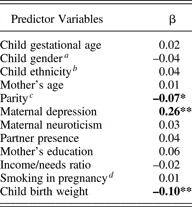
After including all of the covariates as well as birth weight in a multiple regression model, only parity, maternal depression, and birth weight predicted infant temperament scores (see Table 1). It is of the most importance and confirms our hypothesis that lower birth weight predicted greater infant difficulty (β = −0.10, p < .01, 95% confidence interval [CI] of β = −0.17 to −0.04).
Summary of multiple regression analysis (N = 1,078)

Note: Adjusted R 2 = .09**. The β values are for infant temperament at Months 1 and 6.
a1 = male, 2 = female.
b1 = White, 2 = other.
c1 = primiparae, 2 = multiparae.
d1 = no, 2 = yes.
*p < .05. **p < .01.
The coupling of this result with previous ones from the same study showing that infant difficulty moderates both parenting and child care quality effects in a for better and for worse manner means that there is now even stronger suggestive evidence that the prenatal environment shapes postnatal plasticity by apparently influencing infant temperament. Clearly, the evidence that is presented is not without limits. For instance, low birth weight may have been shown to be associated with both prenatal adversity and maladaptive developmental outcomes, but the extent to which effects of prenatal stress are mediated by birth weight on postnatal outcomes is less clear, given the findings that associations between prenatal stress and infant outcomes persist even after controlling for birth weight (e.g., Buitelaar et al., Reference Buitelaar, Huizink, Mulder, de Medina and Visser2003). Further, the NICHD study data set did not allow us to control for maternal weight and height that influences birth weight (Neggers, Goldenberg, Cliver, Hoffman, & Cutter, Reference Neggers, Goldenberg, Cliver, Hoffman and Cutter1995), and infant temperament was based only on maternal reports. Moreover, as in the findings summarized above, these new NICHD study findings are exclusively correlational in nature, which precludes strong causal inference. Like the other cited research, the NICHD study design does not afford the opportunity to discount genetic effects, although some effort was made in this regard by statistically controlling for a variety of factors, including maternal neuroticism and depression, which are substantially heritable (Plomin, Owen, & McGuffin, Reference Plomin, Owen and McGuffin1994; Sullivan, Neale, & Kendler, Reference Sullivan, Neale and Kendler2000). Ultimately, we would like to see evidence that measures of prenatal stress obtained in pregnancy predict birth weight, which predicts temperament, which moderates rearing effects in a manner consistent with differential susceptibility in a single data set. Even more ideally, we would like to detect such evidence in some kind of natural experiment in which prenatal stress is more or less randomly allocated to some but not to others to feel confident that indisputable environmental effects are being detected. Until such work is conducted, the new data presented here, coupled with the previously reported NICHD study findings summarized above, provide the strongest indication that prenatal programming of postnatal plasticity may be operative in human development.
Discussion
Evidence from many Gene × Environment (G × E) interaction studies that specific gene variants heighten susceptibility to both negative and positive environmental effects raises the prospect that differential susceptibility (and therefore developmental plasticity) may be strongly influenced by genotype (for a review, see Belsky et al., Reference Belsky, Jonassaint, Pluess, Stanton, Brummett and Williams2009; Belsky & Pluess, Reference Belsky and Pluess2009a). In agreement with, but by no means confirming this view, there is animal research showing that plasticity is heritable in many species (Bashey, Reference Bashey2006; Pigliucci, Reference Pigliucci2007). However, fetal-programming studies indicate that prenatal stress predicts several physiological and behavioral susceptibility markers, which clearly suggests that developmental plasticity is also a function of nurture (Belsky & Pluess, Reference Belsky and Pluess2009b; Boyce & Ellis, Reference Boyce and Ellis2005). In addition, new empirical evidence from the NICHD Study of Early Child and Youth Development presented here is consistent with the fetal programming of postnatal plasticity: low birth weight, which is a marker for adverse prenatal environment, predicted infant difficult temperament, an empirically established marker within the NICHD study of heightened susceptibility to both negative and positive effects of rearing experience (Bradley & Corwyn, Reference Bradley and Corwyn2008; Pluess & Belsky, Reference Pluess and Belsky2009). It is thus reasonable to conclude that developmental plasticity is a function of both nature and nurture.
It also seems appropriate to hypothesize that some fetuses will prove more susceptible to prenatal-stress effects, because of their genetic make-up (Belsky & Pluess, Reference Belsky and Pluess2009b). The first evidence of genetic susceptibility to prenatal experiences emerged in a reanalysis of data from Neuman and associates' (2007) G × E study of the effects of maternal smoking during pregnancy on attention-deficit/hyperactivity disorder in childhood (Pluess, Belsky, & Neuman, Reference Pluess, Belsky and Neuman2009). Children carrying the DRD4 7-repeat allele, which is a putative genetic marker of susceptibility, proved most and least likely of all who were studied, including those not carrying this allele, to develop attention-deficit/hyperactivity disorder, depending on whether their mothers did or did not smoke during pregnancy. A recent G × E study based on data from a large Dutch cohort study chronicled genetic moderation of prenatal stress effects on a behavioral susceptibility factor (negative emotionality) and thereby potentially on postnatal plasticity (Pluess et al., Reference Pluess, Velders, Belsky, van IJzendoorn, Bakermans-Kranenburg and Jaddoein press). Maternal anxiety during pregnancy significantly predicted negative emotionality at 6 months in infants carrying one or more copies of the 5-HTTLPR short allele, but not in those homozygous for the long allele, suggesting that individuals carrying certain genotypes who are exposed to specific prenatal environments are more likely than those not carrying such alleles or not so exposed to prove susceptible to postnatal environmental influences.
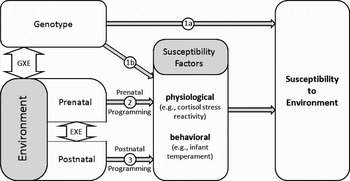
In this discussion of the determinants of developmental plasticity highlighting genetic factors and prenatal stress, we should not ignore the evidence that postnatal experiences also shape physiological and behavioral susceptibility factors (e.g., see Belsky, Fish, et al., 1991; Boyce & Ellis, Reference Boyce and Ellis2005; Francis, Diorio, Liu, & Meaney, Reference Francis, Diorio, Liu and Meaney1999; Heim et al., Reference Heim, Newport, Wagner, Wilcox, Miller and Nemeroff2002; Kaplan et al., 2007). Even though we only briefly consider such effects below, given our primary focus here on the prenatal programming of postnatal plasticity, these should not be disregarded. Figure 1 represents a schematic model outlining multiple means and pathways by which plasticity is likely regulated, including (a) direct genetic contributions to susceptibility, (b) indirect genetic contributions mediated by susceptibility factors, (c) prenatal and (d) postnatal environmental effects on susceptibility factors, (e) G × E interactions involving the prenatal and (f) postnatal environment, and (g) interactions between the prenatal and postnatal environment in shaping susceptibility factors.
Nature, nurture, and differential susceptibility: a process model. Line 1a shows the direct genetic contribution to general susceptibility (nature); Line 1b indicates the genetic contribution mediated by susceptibility factors (nature); Line 2 shows the prenatal environment shapes susceptibility factors (nurture); and Line 3 demonstrates that the postnatal environment shapes susceptibility factors (nurture). In addition, the Gene × Environment (G × E) genotype interacts with both prenatal and postnatal environment and the Environment × Environment (E × E) prenatal environment interacts with the postnatal environment in shaping susceptibility factors.

Empirical evidence for the moderating effect of postnatal experiences can be found in Bergman, Sarkar, Glover, and O'Connor's (2008) longitudinal study of 123 mother–child dyads. The association between prenatal stress (i.e., stressful life events during pregnancy) and observed child fearfulness at 17 months postpartum, which is a behavioral susceptibility factor, proved to be moderated by attachment security that can be considered a marker for the quality of the rearing environment given the well-established, even causal, connection between maternal sensitivity and attachment security (Belsky & Fearon, Reference Belsky, Fearon, Cassidy and Shaver2008). The effect of prenatal stress on child fearfulness was strongest in children with an insecure/resistant attachment, suggesting that prenatal experiences interact with early postnatal experiences in regulating developmental plasticity. Although focusing on the prediction of depression, Costello, Worthman, Erkanli, and Angold (Reference Costello, Worthman, Erkanli and Angold2007) found that low birth weight, an indicator for prenatal stress, predicted adolescent depression more strongly in girls with a history of adverse postnatal experiences, which suggest that the effects of prenatal experiences are conditional on the postnatal environment.
Because the differential susceptibility hypothesis was derived from an evolutionary analysis of rearing influences (Belsky, Reference Belsky1997b, Reference Belsky1997a, Reference Belsky, Ellis and Bjorklund2005; see also Boyce & Ellis, Reference Boyce and Ellis2005), it seems appropriate to wonder whether prenatal programming of postnatal plasticity is itself adaptive. According to the original fetal programming hypothesis, the fetus adapts its phenotype to the anticipated postnatal environment based on maternal cues regarding the quality of the outside world (Barker, Reference Barker1998; Bateson et al., Reference Bateson, Barker, Clutton-Brock, Deb, D'Udine and Foley2004; Gluckman & Hanson, Reference Gluckman and Hanson2005) in order for optimal functioning in that specific environment. Hence, Gluckman and Hanson (Reference Gluckman and Hanson2005) speak of “predictive adaptive responses” that, when the actual environment ends up being different from that anticipated, result in a mismatch between the programmed phenotype and environment. Consequently, the prenatally programmed characteristic proves dysfunctional rather than adaptive (Bateson et al., Reference Bateson, Barker, Clutton-Brock, Deb, D'Udine and Foley2004). For example, what would have been an appropriately “thrifty” phenotype (i.e., small) prepared by poor fetal nutrition and/or prenatal stress for a food-limited and precarious postnatal world instead engenders elevated risk of obesity and middle-age metabolic diseases in a contemporary world rich in nutrients, especially fatty ones. It is thus not surprising that most fetal-programming research carried out in the health sciences focuses on such dysfunctional effects of presumably predictive adaptive responses “gone wrong” (e.g., see Barker, Bagby, & Hanson, Reference Barker, Bagby and Hanson2006).
This raises the question of whether positive effects of prenatally programmed adaptive responses can be observed and especially whether prenatal stress effects on sequelae like difficult temperament or physiological reactivity should be regarded as adaptive or maladaptive. We propose that the prenatal programming of postnatal plasticity may be an adaptive response such that (a) stressful environmental experiences during pregnancy contribute to (b) the fetal programming of developmental plasticity to (c) enhance adjustment to the postnatal environment. From this perspective, what stressful prenatal environments do functionally is direct the developing individual, especially if he/she is genetically susceptible to such fetal programming (i.e., G × E), to defer some developmental “decision making” until he/she can evaluate the nature of the postnatal world into which he/she was born. When considered from this perspective, it is even imaginable that the reason why temperamental difficulty and/or physiological reactivity emerge as moderators of environmental influences is because they pose a challenge to the caregiving environment, amplifying the developing individual's capacity to “read” the environment: if especially challenging behavior provokes neglect or harsh treatment, he/she develops one way; if it evokes sensitive care and attention, he/she develops another way. Kaiser and Sachser's (2009) recent research on the effects of prenatal social stress on offspring in guinea pigs is perfectly in line with this adaptational rather than disease-oriented analysis of at least some fetal programming effects (e.g., on temperamental difficulty). They suggest that the behavioral effects of prenatal stress are not necessarily nonadaptive consequences of adverse social conditions but instead are adaptive adjustments to the specific characteristics of the environment with the ultimate goal of optimizing reproductive success. Contrary to common interpretation of negative outcomes in response to prenatal stress and based on an evolutionary theory of socialization (Belsky, Reference Belsky, Dunbar and Barrett2007; Belsky, Steinberg, & Draper, Reference Belsky, Steinberg and Draper1991), we therefore propose that putatively negative outcomes like behavior problems fostered in malleable individuals by an adverse rearing environment (e.g., low-quality parenting and child care) are adaptive responses that in ancestral times, even if not today, would have fostered survival and reproduction (i.e., reproductive fitness). As a forecast of the postnatal environment, prenatal stress promotes developmental plasticity, perhaps particularly in individuals carrying “plasticity genes,” and thereby leads to “negative” behavioral outcomes when the postnatal environment proves harsh, unpredictable, uncaring, or otherwise adverse. If prenatally programmed plastic individuals encounter a positive environment instead of the predicted negative one, these children would develop dramatically differentially, but in the service of the same ultimate fitness goals. Prenatal programming of postnatal plasticity can therefore be understood as an adaptive response designed to increase reproductive fitness in different ways in different environments (see also Worthman & Kuzara, Reference Worthman and Kuzara2005).
Even though no empirical support for the positive effect of developmental plasticity on fitness is available in human studies, some evidence in animal and modeling studies suggests that developmental plasticity is related to increased fitness. For example, one wild bird population shows evidence that selection favoring individuals who are highly plastic with regard to the timing of reproduction has intensified over the past three decades, perhaps in response to climate change causing a mismatch between the breeding times of the birds and their caterpillar prey (Nussey, Postma, Gienapp, & Visser, Reference Nussey, Postma, Gienapp and Visser2005). Suomi (Reference Suomi2006) observed that the presence of the 5-HTTLPR short allele, a putative plasticity gene, distinguishes the two “weed” species of primates that fill multiple niches around the world (humans and macaques) from all others that inhabit singular and rather narrow ones. Finally, a recent simulation study seeking to determine whether plasticity could evolve, with some individuals being more responsive to environmental conditions than others, yielded evidence in favor of this possibility (Wolf, van Doorn, & Weissing, Reference Wolf, van Doorn and Weissing2008).
Conclusion
More work is clearly necessary before the proposition advanced here is empirically substantiated: there is prenatal programming of postnatal plasticity in humans, or some of them, which is a developmental process that was evolutionarily selected for fitness-enhancing reasons.