On April 11, 1900, a new financial law was adopted that stipulated the principle of financial independence of all the colonies under French rule. As a consequence, the new capitation tax, owed by all Natives, became one of the main budgetary resources of the French Colonial Empire. Between 1907 and 1930, this tax alone represented 60 percent of the budget of the eight territories within French West Africa.Footnote 1 In the colony of Dahomey, as in all the other territories that comprised the Afrique Occidentale Française (AOF),Footnote 2 such a tax was not welcomed by the population, who tried to counter it in many ways: refusal to pay, individual or collective fleeing, and false declarations, among many other things. Initially, resistance clearly lacked a strong organization capable of channeling individual protests. The economic crisis of the 1930s enabled a meeting between the population and the so-called group of “évolués,” who started to increase their political activities. In 1931, the governor noticed that a considerable part of the population in the southern territories was not paying their taxes anymore. It did not take long to realize that the consequences of the economic crisis were not the only reason as resistance did not stop and took so many different forms. The Commandants de cercles in charge of the territories used fines or even imprisonment to cope with the situation. The French government had no choice but to vote for fiscal reforms to improve the situation.
If the Dahomean uprising of the 1930s was seen as the logical consequence of the people’s rejection of French colonial exigencies, the social group of évolués played a major role. The group took over the tax issue as a way to obtain more political power. Inspired by their Western education and their links to metropolitan associations, the évolués became the voice of the popular uprising. The various newspapers that emerged between 1930 and 1934 were instrumental in gaining support for the revolt against colonial power.
This reluctance to pay taxes was without a doubt a clear indicator of the tensions that existed between the state and the colonized. It was a crucial factor allowing historians to grasp the “colonial situation”—in Georges Balandier’s own words—wherein the administration was trying to force its sovereignty onto Native subjects that were not citizens of the Empire.Footnote 2 If many researchers have studied the revenues of the colonial system, in particular the commercial and financial networks between metropolis and overseas territories, few of them have focused on the fiscal system.Footnote 3 In colonial Africa, if the literature on forced labor and the exploitation of plantations is important,Footnote 4 works studying the fiscal system are scarce and often quite old.Footnote 5 Some books deal with taxation as part of larger economic studiesFootnote 6 or with bureaucratic policies.Footnote 7 In such cases, the capitation tax is described as a tool to face the lack of natural resources, which entailed many important changes, including monetarization of the economy, the introduction of large-scale plantations, and deep political and social mutations. Gilchrist Anicet Nzenguet Iguemba’s recent worked revises such a framework by insisting on the way Gabonese taxpayers had supported the tax burden during the colonial period. The author insists in particular on the taxpayers’ “passivity” as the unique, only means of opposition.Footnote 8 But the fiscal uprisings are largely neglected by historians, especially in Dahomey.Footnote 9
This article sheds new light on major problems of colonial studies, notably the agency of people and their consent to French sovereignty overseas. I analyze the fiscal crisis as a key moment that accelerated a shift from a system of passive and nonorganized action to one of structured contest giving birth to future national exigencies.
Fiscal Demands on the Taxpayer
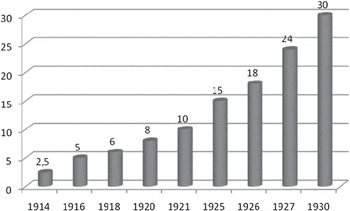
The capitation tax was introduced in the colony of Dahomey by a decree on June 28, 1899, which required every man, woman, and child older than ten to pay an amount between 1.25 and 2.25 francs.Footnote 10 The tariff system provides considerable important financial resources as well, but it depended to a certain extent on economic trends. Before World War I, when it increased constantly, the capitation tax was relatively stable. In the southern cercles, it started growing in 1914 on the eve of the great crisis (Figure 1).
Evolution of the capitation tax in the South-Dahomey Cercles (francs)Footnote 11.
Source: Archives Nationales du Sénégal (ANS), Annual Political Reports.

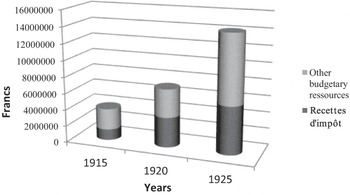
This regular increase was aimed at pushing the Natives to use cash money that were later to be introduced into the capitalist circuits of production. The commerce boom of the 1920s brought with it a constant increase in the capitation tax and in the colony budget (Figure 2).
Evolution of the capitation tax income in the budget of Dahomey (1915–1925).
Source: Hélène d’Almeida-Topor, Histoire économique du Dahomey 2:125–40.

Actually, the tax was levied by the African chiefs—chefs de village and chefs de canton—who received a part of the collected money.Footnote 12 Thus, the capitation tax could also be seen as a way to enroll local leaders in the colonial administrative apparatus. The basic principle of taxing the weakest moved toward the creation of a genuinely cooperative offer. Such a “profit-sharing” system in the tax collection, which contributed to the personal enrichment of African chiefs, made the border between public and private spaces particularly porous. This system obviously caused a good deal of fraud, as historian René-Pierre Anouma has emphasized when he explained that “financial independence led the colonizers into practicing over-taxation . . . while at the same time going on with chasing the taxpayers.”Footnote 13 The amounts perceived changed from one village to another. Moreover, census reports were not up to date and the French administration could not control the village chiefs. Some collected from the taxpayers more than they actually owed.
When the chiefs faced problems with tax collection, the French administrators, the Commandants de cercle, had to collect the remaining sums. The repressive measures in place under the indigénat allowed them to punish recalcitrant taxpayers either by fining them 100 francs or by sentencing them to fifteen days in prison for “nonpayment of their taxes,” “nonaccomplishment of forced labor,” and “false declaration concerning their income census.”Footnote 14
Taxpayers Rebel
Under colonial rule, more and more people refused to pay their taxes. The phenomenon rose slightly during the introduction of the system, as well as during World War I, when an outburst of uprisings occurred.Footnote 15 But these spontaneous events were sporadic and rarely coordinated. Politically speaking, there were no guidelines that would allow protesters, in the long run, to negotiate and to debate with the power in place. The first demonstration that met these criteria broke out in the capital city, Porto-Novo, in 1923.Footnote 16 Everything started on February 11, when the main leaders of the city and the members of the French division of the Ligue des Droits de l’Homme took advantage of a representative of the Colonial Superior Council’s presence in order to publicly give him a notebook of complaints.Footnote 17 Achille Béraud, the police superintendent, was being accused of having hanged a man because of the capitation tax.Footnote 18 The delegation also gave him a letter stipulating many requests, among which the most important was “the suppression of payments in kind and in cash” and the “maintaining of the capitation at the 1922 rate, i.e. 2.25 Francs.”
In the following days, the main members of the delegation were arrested by fifty-six guards and sent to prison. A massive demonstration took place to denounce such an arrest and continued the next day; by February 19, the demonstrators took control of all the town streets. The whole population—women in particular—decided to boycott the official markets. The city’s economic activity came to a standstill and the movement spread to the villages nearby. This resistance was a direct consequence of the people’s refusal to pay the capitation tax. On March 20, only 12 percent of the expected amount had been collected. The result was severe administrative repression. The Governor General of the AOF authorized the Governor of Dahomey to proclaim a state emergency on the whole Porto-Novo territory. The main leaders were judged and received jail sentences of up to ten years, while two companies of Senegalese tirailleurs managed to restore peace in the region.
Despite repression, the number of the évolués, as well as their spheres of influence, continued to increase.Footnote 19 They decided to face the taxation problem through the Administration Council of the colony. This institution, which had been restored only recently, was in charge of voting on the local budget and the revenues of the colony. Representatives of the people were also elected to the council, but their power was only consultative.Footnote 20 During the 1928 election, competition was fierce and the tax issue played an important role. La Voix du Dahomey warned the power in place of the unbearable nature of the “fiscal demands that automatically increase each year, while the Native’s capacity to pay becomes more and more reduced.”Footnote 21 Fiscal burdens became a source of great discomfort. More important, though, the conditions under which the collection took place were being questioned: “The native does not remonstrate against the institution that is this personal tax, nor against the idea of taxation in general. What brings along the discontent of the taxpayers are the offensive strategies of a clumsy and troublesome fiscal system.”Footnote 22 Thus, the elites were not protesting against the capitation tax itself but against the abusive practices of the village chiefs. In their articles, one could read that “children under the consented age [were] forced to pay and even eighty-year-old people had to do so. Some indigenous heads of families [kept] paying the tax for members that [were] deceased.”Footnote 23 Such discontent intensified at the end of the decade when a brutal rise in fiscal demands and the consequences of the economic crisis dragged the south into an unprecedented wave of dissent.
The Rise of Fiscal Demands and the World Economic Crisis in 1930
In 1929, a new decree suddenly increased the capitation tax in southern Dahomey from 24 francs the previous year to 30 francs. The administration updated the population census and, between 1929 and 1930, the population in some regions suddenly increased by 100 percent.Footnote 24 The chefs de canton and chefs de village were still being paid according to the capitation tax they collected.Footnote 25 In 1930, an important reform reorganizing the indigenous commandment in 1930 maintained these laws.Footnote 26 The canton and sector chiefs were no longer paid depending on what they collected. They had a fixed income and thus the village chiefs were the only ones financially motivated by the tax collection. These changes occurred at a time when the effects of the economic crisis had a deep impact on the Dahomey province. It had a strong influence in the regions of Porto-Novo and Mono.Footnote 27 Consequently, new forms of protest against the capitation tax developed when hundreds of women from the Mono region came to manifest their anger in front of the administrators’ offices of the cercle.
Tax Protests from the Women of Mono
At the end of 1931, the Commandant of the Mono’s cercle pointed out that many delegations of women, accompanied by their children, were demanding a deduction of the capitation tax. The administration did not respond to these requests. As a result, protests increased. Between February and April 1932, hundreds of women protesters threatened to “leave for the place where the women [did] not pay taxes,” that is, the neighboring colony of Togo.Footnote 28 Women’s role in the commercial exchanges exposed them more to an increase in fiscal pressure.Footnote 29 The presence of women in the process of contesting the tax was not harmless. The historiography of colonial fact has shown how the nationalist parties often tried to recruit women. Their role was important in the mobilization, the propaganda, and the coordination of political protests.Footnote 30 In Dahomey, in 1926, tensions increased when the amount of their personal tax rose brutally and became as high as that of their male counterparts.Footnote 31 This fiscal inequality between Dahomey and Togo created tensions in the border regions.
Colonial authorities refused to believe that this was a spontaneous protest. The French governor Louis Blacher opened an investigation in order to identify the potential leaders of this wave of departures.Footnote 32 The main suspect was Pierre Johnson, a representative of the colony at the Administration Council. Actually, the women of Mono had probably been initiated by some évolués from Mono and Porto-Novo, who were members of the La Voix du Dahomey’s editorial offices. Women played a major role for the newspaper.Footnote 33 Some of them could have been in charge of organizing the demonstrations. Moreover, at the end of 1929, women were exempted from the disciplinary sanctions in practice under the indigénat and could no longer be sentenced to prison by the administrator for nonpayment of their taxes. This coincidence between the softening of the suppressive laws and the protest of the women of Mono was undoubtedly not fortuitous. The extent of the popular uprisings raised concerns among the administration. Governor Blacher went to Grand-Popo, Ouidah, and Athiémé to negotiate with a group of women protesters. Women of Mono were thus allowed to pay their taxes at two different times and had the right to circumvent the chefs de canton. A decree dating from February 2, 1932, decreased the capitation tax from 30 to 28 francs for the first time in the history of the southern colonies.Footnote 34 A second decree from April 30, 1932, allowed payment in two installments. In a bill from April 30, 1932, the governor urged administrators to be more moderate.Footnote 35
These softening measures were highly criticized by the higher-ranking civil servants because of their psychological effects on the population. Blacher’s successor, Governor Louis Aujas, judged that the decrease of the capitation tax “could be interpreted as the hope toward a total exemption or a delay toward new deductions in the future. This state of mind was rapidly used and kept in place by a minority of native évolués. Footnote 36 Blacher was equally accused of having hastily modified the collection system. His objective was to push for a total suppression of the intervention of the village chief, thus allowing the heads of families to collect and pay their capitation tax themselves. This new system was applied after the decree of August 26, 1932. It was criticized for its pernicious aftermath since the head of the family who “[became] the collectors of their group of relatives” were being accused of misappropriating the money they gave.Footnote 37 Because of these successive reforms, things worsened in 1932, and the budgetary deficit went from 2.3 million to 9.5 million francs.
“Passive Manifestation”
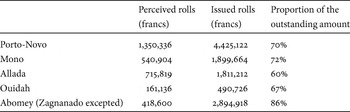
In 1932, the administration noticed that the phenomenon of “passive manifestation” spread from Mono and the Porto-Novo to the rest of the colony. Tax resistance took on different forms. First of all, some people decided to migrate in order not to pay the tax. The new governor, Marcel de Coppet, stated in his 1933 political report that “entire villages were running away as soon as a chief or guard was announced.”Footnote 38 Violent outbursts also broke out against some tax collectors.Footnote 39 The most common way to protest was through nonviolent actions and refusal to pay the tax. For the first time, the French administration had to face a generalized boycott. On December 31, 1932, the remaining tax amount was 3.5 million francs, due mainly to the South-Dahomean cercles (Table 1).
Proportion of the remaining tax amount in the South-Dahomean Cercles, 1932

Source:
ANS, 2G32/15, 1932 annual political report.
In 1933, only 57 percent of the amount expected for the year had been collected.Footnote 40 Collection slightly improved by 1934, even though the population in some areas such as Allada, Ouidah, and Porto-Novo above all still refused to pay the tax. On April 30, 1934, the capital city had only paid 9.82 percent of its tax.Footnote 41 Governor de Coppet considered the “bad taxpayers” of Porto-Novo to be “wealthy people,” “évolués.” Thus he decided to lower local civil servants’ salaries in order to force them to pay all their capitation tax.Footnote 42 The economic crisis alone was not the only cause of the fiscal deficit. In 1921–22, the colony had already been affected by a great depression that had not had an impact on tax collection. Governor de Coppet claimed that there was a “passive, consensual resistance” of people who “had enough money, but refused to pay.”Footnote 43 As a result, the administration made the distinction between two kinds of taxpayers: those who were willing and those who were unwilling to pay, and it accused many newspapers in the colony of encouraging the latter.Footnote 44
The “Évolués” Speak for the Dahomeans
In 1930, only two newspapers existed in the colony; four years later, their number reached eleven.Footnote 45 In his 1932 annual report, Governor Aujas linked the fiscal deficit to their influence and explained that “one of the consequences of this campaign [was] a remaining tax amount difficult to appreciate.”Footnote 46 As the situation worsened in 1933, Governor de Coppet castigated “the press campaign against the capitation tax,” led by these “few leaders.”Footnote 47 Such criticism can also be explained by the fact that to a great extent the new évolué elite had been touched by the crisis. Among the new editors one could identify many former business agents working as intermediaries for large commercial companies that had greatly suffered from the downfall of price commodities. It also explains why Governor de Coppet claimed that the “journalistic career” was the only one not affected by the crisis.Footnote 48 However, the categorical interests of the évolués soon turned to the defense of the general interest.Footnote 49 Starting with the end of 1932 and until 1934, the articles dealt mainly with the crisis, its consequences on the population, and the ways the capitation tax was collected.
Taking advantage of the lack of representative systems, journalists explained that they had a “primordial duty . . . in representing and defending the general interests of the native taxpayers facing the tax office.”Footnote 50La Voix du Dahomey’s editorial staff believed that the colony budget should match the income of its population. Budgetary cuts and savings were necessary in order to lower the fiscal pressure.Footnote 51 The local administration was accused of having increased its spending and was criticized for not having reduced the capitation tax.Footnote 52 Many African chiefs were regularly blamed for violent and abusive behaviors. In the Etoile du Dahomey, Eugène Tossou d’Almeida claimed that it was the “greatest scourge in the country.”Footnote 53 In September 1934, Le Courrier du Golfe du Bénin published an article that caused a great stir among the population. It blew the whistle on the violence, the double payments, and these “rotten officers that were always trying to mislead their administration and who were undoubtedly the determining cause of the country’s sufferings.”Footnote 54
If one can qualify the influence of the French-written press on a colony wherein 99 percent of the people were illiterate, Governor de Coppet was convinced that it was powerful and dangerous and claimed that “each sheet was written in the villages, each article perfidiously spread and commented upon in the huts.”Footnote 55 A teacher wrote to the Voix du Dahomey to testify that copies of the newspapers made it into the villages and were often translated into the local dialect.Footnote 56 It was also because the évolués wrote to serve their citizen fellows that their influence was so strong. Their most common action was the dispatching of anonymous letters addressed to the administrators and governors. They questioned the chefs de canton or the commandants de cercle’s methods of tax collection. In 1933, the subdivision chief of the Porto-Novo cercle received a letter containing death threats: “If I keep going into these villages to bother them with my guards regarding their taxes, I will be turned into a corpse.” This letter shows that the campaign of the Dahomean press paid off and that some readers were no longer hesitating to go from blackmail to menacing the authorities.”Footnote 57
Many complaints were equally brought about in the courts of law. In 1932, a man named Vodounon Kpôton pressed charges for aggravated assault against his neighborhood chief in relation to the tax collection.Footnote 58 The plaintiff was arrested by the cercle administrator. The Porto-Novo press denounced this situation in its October 1933 issue, as well as its general manager, who warned the Ligue des droits de l’Homme in Dakar.Footnote 59 The director of the Courrier du Golfe du Bénin, Blaise Kuassi, also intervened and sent a letter to the Commandant de cercle. He advised Vodounon Kpôton’s family to press charges with the public prosecutor of the French Republic.Footnote 60 The plaintiff was finally sentenced to one month by the tribunal of the cercle for “calumnious denunciation.”Footnote 61
Indeed, the administration still had trouble to find out solutions to cope with the protests. The government lowered the capitation tax again in 1932, down to 26 francs. The amounts in the registers diminished by 13.55 percent between 1931 and 1933, but the people still refused to pay. Convinced that “the reluctance to pay one’s taxes would always end up by waning when faced with violent actions,” the administration put into practice an extremely repressive policy from the very beginning.Footnote 62
The Colonial Administration Seeks a Solution
Punishing the Debtors
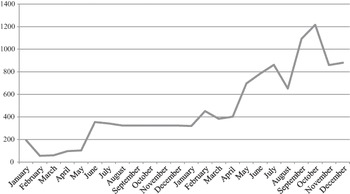
In early 1932, criticism against Governor Blacher’s policy did not take long to be expressed. In May, he had to answer to growing concerns and demanded that the remaining amount be collected.Footnote 63 In his yearly political report, the administrator of the Allada cercle claimed that he was “trying the impossible” in order to “stimulate” the people by using the sanctions under the indigénat. Footnote 64 In the southern part of the colony, the number of reprimands increased and reached 2,829 for the year. Between January and July 1932, 71 percent of the arrests were related to the “hindrance or bad-will” in the payment of taxes. This trend peaked in 1933 at 8,700. In 1934, there were still 7,500 punishments, which meant that almost 2 percent of the Dahomeans were sentenced under the indigénat (around 400,000 people) (Figure 3).Footnote 65
Increase in the number of disciplinary punishments in the colony of Dahomey (January 1932–December 1933) Source: ANB, 2F85 and ANS, 17G97.

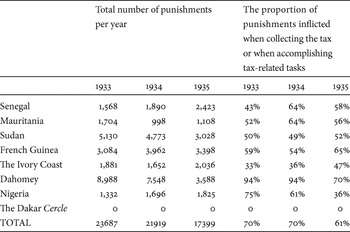
In other AOF colonies, disciplinary punishments related to economic factors were also important, but the number of sanctions inflicted was lower. Historian Georges Mondongou points out that even though the economic crisis also had a deep impact in Oubangui-Chari, it did not cause a drop in the fiscal income (Table 2).Footnote 66
The proportion of punishments inflicted when collecting the tax or when accomplishing tax-related tasks

Source:
ANS, 17G97, Indigénat . . . , Statistical information based on the last three years, Director of Political and Administrative Affairs of Afrique occidentale française, Rougier to M. Labouret, October 29, 1935.
The exceptional nature of the Dahomean mobilization was undoubtedly the result of the influence of the évolués, who led an active campaign in their relationship with the Métropole in order to denounce the attitude of the administration.
Echoes of the Crisis on the Continent
The current mobilization of the évolués raised concerns in France. In 1933, one of Governor de Coppet’s projects was met with much criticism. In August, he allowed the “peaceful and rapid demonstration of the tirailleurs detachments” to join administrators during the tax collection.Footnote 67 In November, he considered the permanent stationing of troops in the southern part of the colony.Footnote 68 Newspapers in Dahomey strongly criticized such hasty project.Footnote 69
A common unity took shape between the évolués in the regions neighboring the Gulf of Guinea.Footnote 70 The Dahomean elite networks were extending as far as Metropolitan France, where the echoes were first heard in 1934. La Défense derided the authorities’ project to use troops for tax collection.Footnote 71 Albert Nègre, the French representative of Dahomey at the Superior Council, sent a letter to the governor general whereby he defended the population’s attitude against the authorities. He wrote that it did not stem from a “bad will” or a “contradictory attitude,” but from the population’s “impossibility to pay.”Footnote 72 On January 11, 1934, two Communist deputies, Lucien-Henri Monjauvis and Arthur Ramette, wrote five questions to the minister of the colonies.Footnote 73 Monjauvis wondered whether it was true that the Dahomey natives were forced to pay the taxes due by deceased relatives or by relatives who had left the country. He also explained that he had been overwhelmed with emotion when he read in the press that the French governor of Dahomey had requested the use of 350 tirailleurs from Abidjan in the Ivory Coast to collect the tax. He asked how many natives had been brutalized and imprisoned in 1933. The minister of the colonies took the matter very seriously since it was not usual for the national assembly to interfere in colonial matters. Therefore, all colonial authorities had to send statistics of the number of natives sent to prison or fined, but the minister did not communicate these figures in his answer to the deputies.Footnote 74 He stated that sending a detachment from the Ivory Coast to Dahomey had nothing to do with the fiscal situation of the colony and that it was a mere rebalancing of the forces deployed in the AOF.
As a consequence of such metropolitan concerns, repressive measures inflicted by the administration started to soften. In a letter sent on March 7, 1934, the governor general asked the governor of Dahomey to invite his administration to give “it more thought when enforcing administrative sanctions.”Footnote 75 The administration’s course of action was first of all meant to unsettle the newspapers.
The End of the Newspapers’ Campaign
Newspapers benefited from a lax regime and the only infraction that the colonial authorities could accuse them of was “the lack of respect toward the French authority.”Footnote 76 Rather than confronting the press on legal grounds, Governor de Coppet led a different strategy. On September 28, 1933, a new bill urged his Commandants de cercle to create an “official newspaper.”Footnote 77 The bill was published the following month in most of the Dahomean press, which made fun of the governor’s decision.Footnote 78
In the early months of 1934, the administration managed to persuade some journalists to collaborate with them.Footnote 79 Newspapers such as the Phare du Dahomey, the Tribune Sociale du Dahomey, and even the Presse porto-novienne “willingly” published “the general or economic interest articles” that the administration sent to them.Footnote 80 De Coppet’s successor, Jean Desanti, announced in September 1934 the birth of two new complacent newspapers: Le Coeur du Dahomey and Vers la suprême sagesse. Footnote 81
Another part of the administration’s strategy was more clear-cut. De Coppet sent out instructions for a campaign designed to press charges against editors and newspapers’ managers who were making reprehensible comments. Every time a chef de canton or a civil servant was to be discredited in a newspaper, he was supposed to attack the periodical.Footnote 82 In the summer of 1934, many individuals pressed charges against L’Echo des cercles du Dahomey and the Courrier du Golfe du Bénin. Blaise Kuassi was arrested and sentenced to prison on June 6. The administration itself also sued the L’Etoile du Dahomey. As for the La Voix du Dahomey, its offices were searched in September 1934 and its editors were arrested in October. The reason: two short items published in the June–July and August issues suggesting that capitation tax funds were being embezzled and that “a sum of 14,000 Francs was given to a high civil servant by some of the chefs de canton.”Footnote 83 In 1935, the leaders of the Presse porto-novienne, Idéal et réalité, and the Courrier du Golfe du Bénin were sentenced to imprisonment ranging from three months to one year for “infringement of the French authorities” or “for offenses and vilification.”
In 1935, fiscal reforms improved the situation. The political report pointed out that the natives’ state of mind had “improved greatly.”Footnote 84 Collection of the capitation tax went faster, a phenomenon that was confirmed in 1936, as shown in Table 3.
Rate of the capitation tax collection (1934–1935)

Source:
ANS, annual political reports.
Indeed, it was the consequence of improvement of two convergent elements: first, the improvement of the economic; second, the 1935 tax reforms. The tax rate grew from 23 to 26 francs in the southern cercles and diminished in some poorer regions. The tax was henceforth due for payment throughout the year and could be paid in installments.Footnote 85 The establishment of a fiscal card also improved the performance of the system. The card set up a system requiring the use of fiscal stamps. This system allowed the great majority of taxpayers, who were illiterate, to check for themselves that the sum they had paid corresponded to what they really owed. “The Native knows that he pays what he owes and nothing more.”Footnote 86 Eventually, in order to improve the tax collection, new census operations were also implemented.Footnote 87
Conclusion
The economic crisis of the 1930s and the intensity of the repression of the tax protest demonstrate that the fiscal system was the cornerstone of all colonial administrative actions. The strength of resistance, in contrast, emphasizes a deeper crisis in the system and the frailty of the French enterprise. Reluctance to pay the capitation tax shows that the French sovereignty was not well settled in the AOF. Forms of resistance by the natives (flight to the agricultural villages, false declaration, etc.) provided them with a way to escape from directly conflicting with the administration. Past events had shown that any attempt to oppose the power in place would be severely punished. Nevertheless, the turn of events gave the local population the opportunity to show their discontent toward French exigencies. Newspapers, often in the hands of the évolués, helped organize the popular unrest, applying both their legal knowledge and political capacity. Their mobilization fit the emergence of an anticolonial movement in Metropolitan France, particularly prone to denounce in the newspapers violent acts of inspection and administrative abuses. The fiscal matter was the battlefield where Natives and the new elites met, and the demands they formulated at the beginning of the 1930s can be seen as the first movement of a national political union. Men and women alike from Mono, Porto-Novo, Cotonou, Abomey, and Ouidah fought together for the same political project, which was met with success: the amount of the capitation tax was lowered, the collection strategies were stabilized, and the violent chiefs were punished. These events were a fruitful political battleground for the évolués, and the aggressive measures adopted by the administration did not discourage them. Once his six-month jail sentence was over, Vincent Pinto took over the leadership of La Presse porto-novienne. The light sentences received by the editors of the Voix du Dahomey were seen as a success. The newspapers continued to warn the public against the chefs de canton’s violent behavior. Their disappearance from the political scene would allow the évolués to make themselves heard in the aftermath of World War II.Footnote 88