Introduction
Domestic violence (DV aka domestic abuse aka abuse) is a significant social and human rights issue in most countries and more so in low- and middle-income countries (LMICs). Nepal, one of the countries in South Asia, has a high prevalence of violence against women and girls with about one in three women reporting abuse in their lifetime (Pun et al., Reference Pun, Tjomsland, Infanti and Darj2020). Studies report a prevalence of 26% but there is a wide variation between urban and rural areas (Oshiro et al., Reference Oshiro, Poudyal, Poudel, Jimba and Hokama2011). Numerous studies identify age, education, age at marriage, religion, employment, and urban or rural residency as important factors that initiate and perpetuate DV in married women (Bender & Chalise, Reference Bender and Chalise2018; Clark et al., Reference Clark, Ferguson, Shrestha, Shrestha, Oakes, Gupta, McGhee, Cheong and Yount2018; Ong, Reference Ong2019; S. Paudel, Reference Paudel2011; Uprety, Reference Uprety2016). One factor having a direct bearing on women experiencing violence is their perception of violence i.e., whether women justify violence by husband and/or family members for certain actions/inactions. Acceptability of wife-beating among women is linked to women’s empowerment and the social and cultural norms; and reflects the intergenerational impact of exposure to DV in their childhood. A study found about 29% of women accepted wife-beating as normal in Nepal whereas more men were likely to justify wife-beating (Rani & Bonu, Reference Rani and Bonu2009). A change in perceptions indicates a shift in cultural norms as a community’s attitudes and a woman’s attitudes are intertwined. Studies show that women who live in communities with permissive attitudes towards wife-beating are more likely to justify violence and more likely to experience DV (Dasgupta, Reference Dasgupta2019; Jesmin, Reference Jesmin2015; Samuels, Reference Samuels2020; Shrestha & Gartoulla, Reference Shrestha and Gartoulla2015).
Studies have linked perceptions of wife-beating to patriarchal gender norms. But they also indicate women justifying DV more often than men (Rani & Bonu, Reference Rani and Bonu2009; Uprety, Reference Uprety2016). Like many other countries in South Asia, traditional patriarchal norms in Nepal expect a married woman to greet her husband and in-laws and eat from the plate of her husband (S. Paudel, Reference Paudel2011; Prajapati & Sweden, Reference Prajapati and Sweden2008). Men, in Nepal, dominate in nearly all activities of daily life, including decisions related to household finances. Acceptance of such patriarchal characteristics serves as a precursor for justification of violence and experiences of DV in Nepal (Anuragi, Reference Anuragi2019; Ong, Reference Ong2019).
Intervention programs directed towards DV need continuous evaluation and feedback. Studies analyzing changes in the factors perpetrating DV are beneficial for assessing the efficacy of policies and programs. This study adds to the knowledge on the nature and magnitude of justifying violence among women and men in Nepal and changes in these beliefs over time using repeated national health surveys (NDHS 2001, 2006, 2011, and 2016). This is the first study conducting trend analysis of acceptance of wife-beating in Nepal.
Background
Studies indicate that more women than men justify violence (Krause et al., Reference Krause, Gordon-Roberts, VanderEnde, Schuler and Yount2016). An image of a ‘good wife’, a ‘good mother’, a ‘good daughter-in-law’ of a respectable family is so ingrained in women in rigid patriarchal societies that when they feel that they do not conform to this persona they accept being beaten as a reprisal for ‘disobedience’ and for not living up to the expectations of the family and the society (Shrestha & Gartoulla, Reference Shrestha and Gartoulla2015).
In Nepal, like many LMICs, the living pattern is patrilocal (couple settling in husband’s house after marriage) with multigenerational households a common phenomenon (Cultural Atlas, n.d.). Respect for the elderly is strongly followed in patriarchal family settings and a young bride has rules to adhere to before she climbs rungs of the hierarchy. The eldest male member of the family has control over all resources and most decision-making in the family. Second in command to the eldest male member (mostly the father-in-law) is the mother-in-law. She has a command over women and children in the family. Day-to-day activities and household decisions come under her purview. Any act appearing to be disrespectful to either of these members is considered a transgression of norms and would likely result in DV (Bender & Chalise, Reference Bender and Chalise2018; Ghimire & Samuels, Reference Ghimire and Samuels2017; Gupta & Samuels, Reference Gupta and Samuels2017; Rani & Bonu, Reference Rani and Bonu2009).
Ancestor worship (patrilinear ancestor worship) is followed in certain parts of Nepal. The effect of this ritual is valuing men over women and establishing the superiority of men (Schlemmer, Reference Schlemmer2019). Young girls are socialized to concede authority to men and elders of the family. The in-laws become the most important members of their ‘new family’ (Luitel, Reference Luitel1970). In Hindu families, older women are subordinate only to men in the family, but a young daughter-in-law is subordinate to both men and older women. Older women are more likely to justify wife-beating as they see it deemed fit for a younger woman who does not conform to the proscribed gender roles. Male member/s is the caretaker of the family and the one who controls the male wields power over the family. Both wife and mother-in-law vie for attention from the son and due to the practice of respecting the elders, the mother-in-law wins in many situations. It appears that women are more accepting of spousal violence if another woman transgresses societal, familial, or cultural norms (Clark et al., Reference Clark, Ferguson, Shrestha, Shrestha, Oakes, Gupta, McGhee, Cheong and Yount2018; Ghimire & Samuels, Reference Ghimire and Samuels2017; Rani & Bonu, Reference Rani and Bonu2009).
Women’s attitudes towards wife-beating are a proxy for real-life abuse since actual experiences of DV are underreported but women may be more open to expressing their attitudes and beliefs. A better understanding of factors that are antecedents of DV such as acceptability of wife-beating, the status of women in the family and community, prevalent gender norms, and dynamics of husband-wife and daughter-in-law-mother-in-law relationships is essential to trace the pathway of DV. It is also important for designing interventions to address this issue. Family violence is often considered normal and legitimate in patriarchal societies and though societal beliefs are important factors in the perpetuation of violence, familial norms are more closely linked to the initiation of DV against women and children in the family (Hilberman, Reference Hilberman1980).
A cross-country study of attitudes towards wife-beating in Asia found acceptance of wife-beating was about 29% in Nepal and was associated with low literacy rates. These attitudes didn’t change with employment. The reason is if women face the same patriarchal structures at their workplaces with similar patterns of gender inequality it is highly unlikely that their impressions of male superiority will be challenged (Rani & Bonu, Reference Rani and Bonu2009). Another study found that as a woman’s participation in household decision-making increased, there was a change in her acceptance of DV and a decrease in the experience of DV (Kim et al., Reference Kim, Atteraya and Yoo2019). A multi-country study on perceptions of wife-beating among men in South Asia revealed that men in these countries have greater access to resources and women are underprivileged. Men as caretakers of the family wield power to control their wives through gender hierarchy. This study found factors for higher acceptance of wife-beating among women to be a rural residency, low educational attainment, low economic status, being unemployed, and witnessing domestic abuse during their childhood (Dalal et al., Reference Dalal, Wang and Svanström2014).
Bender and Chalise (Reference Bender and Chalise2018) suggest that internalization of cultural norms reaches a level where women, on becoming mothers-in-law, support and participate in the same DV they once experienced and abhorred when they were young brides themselves. Their study found acceptance of wife-beating to be lowest for ‘burning food’ and ‘refusing sex’ and highest for ‘neglecting children’. They also found women residing in rural areas to be more ‘tolerant’ of wife-beating compared to women from urban areas. This they attribute to lack of education, low economic opportunities, and being exposed to a conservative culture at home. Women who accept being beaten for burning food have internalized the norms to a large extent and are thus disempowered. Such women are also less likely to seek help for DV.
Methods
Data from four consecutive national health surveys of Nepal (2001, 2006, 2011, and 2016) was used for this study (New ERA & ICF International, n.d., 2012, 2017; New ERA & ORC Macro, 2002). The Nepal Demographic Health Surveys (NDHS) are a part of the worldwide Demographic Health Surveys Program conducted by the Ministry of Health and Population with technical support from the Inner City Fund (ICF) International and financial help from the United States Agency for International Development (USAID). The national surveys include topics on women and child health, women’s empowerment, and information on women facing types of domestic violence (NDHS 2011 and 2016). The primary objective is to provide data on different issues related to population and health, which guides planning, implementing, monitoring, and evaluating health programs in Nepal.
The 2001 NDHS included a sample of 8,726 women aged 15-49 years and 2,261 men aged 15-59 years. The 2006 NDHS included 10,793 women aged 15-49 years and 4,397 men aged 15-59 years. The 2011 NDHS collected information from a nationally representative sample of 12,674 women aged 15-49 and 4,121 men aged 15-49. The 2016 NDHS collected information from a sample of 12,862 women aged 15-49 and 4,063 men aged 15-49. A domestic violence module was included in the 2011 NDHS for the first time to address the serious issue of gender-based violence in Nepal. A subsection of women selected for NDHS 2011 was interviewed for the DV module (N = 4,197). The questionnaire for DV was based on the Shortened and Modified Conflict Tactics Scale (CTS). Spousal violence being the most common form of violence against women the questions were focused on violence by husband/partner than other family members. The 2016 NDHS also included a module on DV and a subsample of 4,444 women completed the DV module interview.
The reasons for justifying wife-beating and experience of DV were the main outcomes. In all surveys, women, and men were asked whether they justified wife-beating for five different reasons: ‘if the wife goes out without telling her husband’, ‘if the woman neglects her children’, ‘if the woman argues with her husband’, ‘if she burns food’, and ‘if she refuses sex with her husband’. Answers to these questions were coded to form two categories- ‘yes’ and ‘no’. In 2016 NDHS an additional question on ‘justifying wife-beating for not getting enough dowry’ was included. A combined binary variable ‘justify wife-beating for any reason’ was formed from all the above categories. The DV module of 2011 and 2016 NDHS asked women whether they had experienced any act of physical, emotional, and sexual violence in the preceding 12 months of the survey. These experiences were coded to form a binary variable for physical, emotional, and sexual DV. We also created a combined DV variable for the experience of any type of DV as we believe women usually experience more than one type of violence. The 2011 and 2016 NDHS asked women reporting DV whether they had approached anyone for help for their abuse. We combined the options of help-seeking agencies into two main categories- informal (own or husband’s family, neighbor, friend, religious leader) and formal (social service organization, police, lawyer, doctor). We found very few women had approached formal agencies for help hence we created a combined variable for any help sought.
The socioecological model emphasizes multiple levels of influence (individual, interpersonal, organizational, community, and public policy) and the idea that behaviors both shape and are shaped by the social environment (Jesmin, Reference Jesmin2015). Bandura’s social learning theory posits that conflict resolution methods are learned during childhood witnessing behaviors of elders and peers. Victims and perpetrators are thought to have witnessed/experienced abuse as children resulting in tolerance or acceptance of violence within the family (Devenish et al., Reference Devenish, Hooley and Mellor2019; Uthman et al., Reference Uthman, Moradi and Lawoko2011). A combination of these two models formed the basis of our conceptual framework to understand the pathway between the demographic characteristics of respondents, their perceptions of wife-beating, an experience of DV, and the help-seeking behavior of the victims. These models also guided our choice of covariates which included respondent’s age, religion, caste, education, employment status, household wealth index, urban/rural residence, region residing in, age of respondent at marriage, involvement in household decision-making, childhood experience of DV (whether they had seen their father beat their mother), and their exposure to mass media and technology (newspaper, radio, TV, and internet). The survey included multiple categories for respondents’ religion and caste. The religion of the respondent was coded as Hindu, Buddhist, and others (including those practicing Tribal/Shamanism, Animism, Islam, Christianity, etc.). We combined the caste categories into 5 major categories- Brahman/Chhetri, Other Terai castes, Dalit, Newar/Janajati, and Other castes (includes Muslim, Marwari, Bangali, Jain, Punjabi/Sikh, and Unidentified Others), as mentioned in a report based on the DHS survey (Bennett et al., Reference Bennett, Dahal and Govindsamy2008).
The Nepal Multiple Indicator Cluster Surveys (MICS) are part of Global MICS developed by the United Nations International Children’s Emergency Fund (UNICEF) to collect internationally comparable data on a variety of indicators about children and women. The data is used in policies, programs, and national development plans and to monitor progress towards Sustainable Development Goals (SDG). The NMICS 2010 is a subnational survey of 7,372 women aged 15-49 years from households in Mid- and Far-Western regions of Nepal. The MICS 2014 is a national survey with a sample of 14,162 women and the MICS 2019, a national survey included 14,805 women and 5,501 men aged 15-49 years. The surveys included questions on attitudes towards wife-beating for both women and men and were similar to those in the DHS surveys. We compiled MICS reports to support our analysis of DHS data.
Statistical Analyses
We aimed to study the change in the prevalence of perceptions of wife-beating among women and men in Nepal over 15 years and its relationship with DV among married women in Nepal using waves of NDHS. The descriptive statistics identify differences in justifying wife-beating based on the demographics of the respondents. We then examined the association between perceptions of wife-beating, the experience of DV among married women, and help-seeking by victims through multivariate logistic regression models. All models were survey-weighted with sample weights provided by DHS and bootstrapped errors were obtained with 200 repetitions. Statistical software Stata/SE version 15.1 (StataCorp, LP, and College Station, Texas, United States) was used for analysis. As the DHS datasets are publicly available and have been deidentified no IRB (Institutional Review Board) review was indicated. We received permission to download datasets from the website from DHS.
Results
Fig. 1 indicates that in 2001 about 12.2% of women justified wife-beating if a woman goes out without telling her husband, about 25.2% for neglecting the children, 8.7% if she argues with her husband, 3.1% if she refuses to have sex with her husband, and 5.0% if she burns the food. In 2006 about 8.8% justified violence for going out without the permission of her husband, 19.9% for neglecting children, 8.2% arguing with her husband, 2.5% for refusing sex, and about 3.0% if she burns food. We found that the entire sample of women and men in NDHS 2011 were not asked the questions on perceptions of wife-beating and among those who had responded the prevalence values do not conform to any trend. Hence, we excluded 2011 survey data for descriptive analysis. In 2016 about 12.4% of women accepted wife-beating for going out without permission, 24.9% for neglecting children, 9.4% for arguing with husband, 3.2% for refusing sex, and 3.5% if she burned the food. Another variable was added in 2016- justify wife-beating for bringing no or less dowry. About 1.1% of women justified violence if this was true.
Percentages of women and men justifying wife-beating- Nepal Demographic Health Surveys (2001, 2006, 2016).

In 2001, 16.4% of men had justified wife-beating if his wife went out without telling him, 27.4% if the wife was found neglecting children, 17.4% for arguing with him, 8.5% if she refused sex, and 3.4% if wife burned the food. In 2006, 7.6% accepted wife-beating was justified if the wife went out without permission, 15.3% for neglecting children, 9.1% for arguing with him, 3.2% for refusing sex, and about 2.9% for burning food. In 2016 about 9.4% justified violence if the wife goes out without his permission, 18.6% if found neglecting the children, 8.8% for arguing with him, 3.8% for refusing sex, and 1.6% for burning food. Less than 1% justified violence if she did not bring enough dowry.
Justifying wife-beating
Table 1 provides results of descriptive analysis for the combined variable of wife-beating for any reason, prevalence of any type of domestic violence among married women, and if the DV victims sought help from any source stratified by the demographic characteristics. In 2001 about 291.% of women had justified wife-beating for any reason. In 2006 this number reduced to 24.2% but in 2016 the number increased to 29.1%.
Characteristics of ever married women in Nepal- Nepal Demographic Health Surveys (2001, 2006, 2011, 2016)

Justifying wife-beating for any or all the actions/inactions.
Any DV- experience of any type of DV i.e., physical, sexual and/or emotional DV
Any help- seeking - help from informal and/or formal sources.
Column percentages reflect percentage of women within that category justifying wife-beating, experiencing any DV or seeking any help for abuse.
Women between ages 15-29 years (2001), 35-49 years (2006), and 15-19 and 35-39 (2016) were more likely to justify violence. Women married before the legal age of marriage (20 years) were more likely to justify abuse than those married at or after the legal age. Women from the terai region, belonging to the other religions, and of other castes formed a greater proportion of those who justified violence. Though in 2001 and 2006 women from urban areas formed the majority, in 2016 greater number of women from rural areas justified wife-beating. In 2006 and 2016 fewer women with higher education justified DV. Socioeconomic status had no bearing on justifying abuse. Women involved in administrative professions formed a smaller group of those who accepted wife-beating compared to the unemployed and those involved in manual labor.
Domestic violence
In 2011 about 32.4% of married women had experienced any type of DV in the preceding 12 months of the survey. The age group most affected by DV was 40-49 years. Women married as adolescents, residing in the terai region, rural areas, uneducated, belonging to ‘other’ religions, and other castes formed a greater percentage of women who experienced DV in 2011. A greater number of abused women belonged to poor socioeconomic status, were involved in manual work, and had no exposure to mass media.
In 2016 about 28.0% of women reported any type of abuse. Most abused women belonged to the age group of 30-39 years, were married before the legal age of 20 years, resided in the terai region, in rural areas, were uneducated, belonged to ‘other’ religions and other castes, were involved in manual work, and had no exposure to any media.
Help-seeking for DV
About 21.8% of abused women sought help in 2011. Women aged 30 to 34 years, with secondary+ education, and those exposed to mass media were more likely to seek help.
In 2016 about 25.8% of those who experienced any DV sought any help. Women aged 45 to 49 years, residing in hilly regions, living in urban areas, belonging to Dalit or Newar/Janajati castes, and involved in agricultural activities were more likely to seek help.
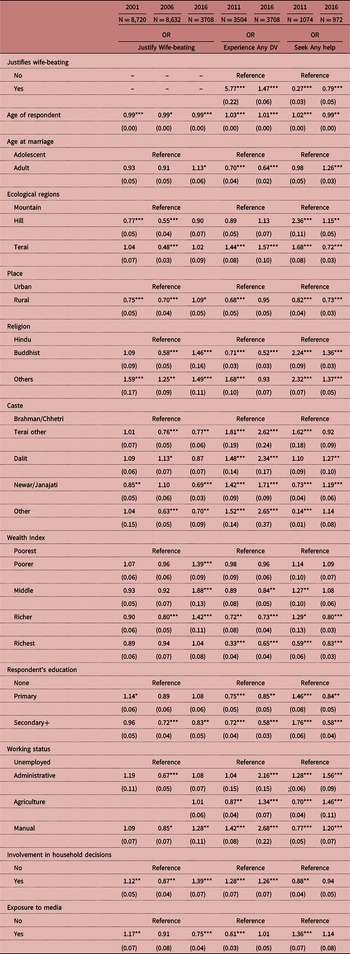
The multivariate regression table (table 2) has models for wife beating (columns 1,2, and 3), experience of any DV (columns 4 and 5) and seeking any help (columns 6 and 7). The age of respondents was found to be inversely related to perceptions of wife-beating. Women residing in the hills and the terai regions (except in 2001) were less likely to justify wife-beating compared to those in mountain regions of Nepal. Women from rural areas were less likely to justify violence than those in urban regions except in 2016 the relationship reversed. Women belonging to Buddhist and other minority religions were more likely to accept wife-beating compared to Hindu women. Women belonging to other castes from the terai region, Newar/Janajati caste, and other minority castes were less likely to accept wife-beating compared to those from Brahman and Chhetri castes. Women from higher socioeconomic status were more likely to accept violence compared to those from the poorest group in 2016. A higher level of education was associated with a lesser probability of justifying violence. Women involved in manual labor were more likely to accept violence compared to unemployed women in 2016. Also, women who were involved in household decisions were more likely to justify violence in 2001 and 2016.
Multivariate regression analysis for perceptions of wife-beating, domestic violence and help-seeking among married women in Nepal (NDHS 2001, 2006, 2011, 2016)

Data from Nepal Demographic Health Surveys 2001, 2006, 2011, 2016.
Exponentiated coefficients; Standard errors in parentheses.
*p < 0.05 **p < 0.01 ***p < 0.001.
Regression models for the experience of DV indicate that in 2011 women who justified violence had higher odds of experiencing DV (OR 5.8, p < 0.001). The odds were high in 2016, too (OR 1.5, p < 0.001) compared to those who did not justify wife-beating. The age of the respondent was directly proportional to the probability of experiencing any type of DV. Women married after age 20 were less likely to experience abuse than those married in adolescence. Women from terai region were more likely to experience violence compared to those in mountains. Women from the Buddhist religion were less likely and those from other minority religions were more likely to be abused compared to Hindu women. Compared to women from Brahman and Chhetri castes women belonging to all other castes were more likely to experience any DV in 2011 and 2016. The wealth index and education level of the respondent had an inverse relationship with DV. Women involved in administrative and manual work were more likely to be abused compared to unemployed women. Women with higher involvement in household decisions were more likely to experience abuse in 2011 and 2016.
The regression models for help-seeking show that women who justified violence were less likely to seek help for abuse in both 2011 (OR 0.3, p < 0.001) and 2016 (OR 0.8, p < 0.001). In 2011 women from the richest class were least likely to seek help followed by those from the poorest class. In 2011, women with higher education were more likely to experience DV. However, in 2016, the direction of the relationship was reversed. Women involved in administrative work were more likely during both survey periods to seek help. Compared to unemployed women those involved in manual labor were more likely to reach out for help. In 2016 women married as adults were more likely (OR 1.3, p < 0.001) than those married under age 20 years; those from hills were more likely than from mountain regions; and those belonging to Buddhist and other minority religions were more likely than those from Hindu religion to seek help for abuse. Women from the rich class were less likely to seek help compared to women from the poor socioeconomic status in 2016.
Discussion
In this study, we analyzed the change in prevalence of married women justifying wife-beating in Nepal using repeated national health surveys. In 2011 questions on justifying violence were not asked to all women in the sample and the numbers do not follow a trend so we did not include them in our descriptive analysis. Acceptability of wife-beating decreased from 2001 to 2006 but went back to its original levels in 2016. The prevalence of any DV decreased from 2011 to 2016. In 2011 about four in five women who justified wife-beating reported experiencing DV but in 2016 about one in three women justifying violence experienced DV. There was an increase in the number of women seeking help for abuse in 2016 compared to 2011. And like DV very few women who sought help for abuse justified wife-beating in 2011 but in 2016 about one in three women who approached for help for abuse justified wife-beating.
Women who justified wife-beating were about six times more likely to experience DV in 2011 and about twice as likely in 2016 than those who did not. At the same time, women justifying violence were less likely to seek help in 2011 and 2016.
Most research on domestic violence focuses on the health effects of DV. But it is important to understand the social context in which DV occurs including gender norms and how these are related to the status of women, their beliefs and perceptions, and relationship dynamics not just with the husband but also with family members especially in countries like Nepal where the extended and multigenerational family system is prevalent (Luitel, Reference Luitel1970). This is important not just to trace the pathway to DV and help-seeking but also to design policies and programs to address the issue of DV. Studies show communities, with a greater acceptance of DV and an inclination to family reconciliation as a strategy for domestic conflicts, cause women to exhibit greater tolerance of wife-beating (Shrestha & Gartoulla, Reference Shrestha and Gartoulla2015).
A qualitative study on community perceptions on DV by Pun et. al (Reference Pun, Infanti, Koju, Schei and Darj2016) found forms of violence such as forcing pregnant women to do hard physical work, denial of food, and other emotional abuse are initiated by family members, especially mother-in-law. A young bride is considered an ‘extra pair of hands’, and the mother-in-law expects her to work the same way she did in her young days. The sample of men interviewed in this study opined that mothers-in-law are the main cause of violence against their daughters-in-law. In Nepal, along with the eldest male member of the family, control over domestic affairs rests with the mother-in-law and she exercises decision-making power over the allocation of resources and duties on other female members of the family especially the daughter-in-law (Luitel, Reference Luitel1970).
Another study (Pun et al., Reference Pun, Tjomsland, Infanti and Darj2020) found men in Nepal have firm beliefs about the role of men in society, their importance in religious ceremonies, and patriarchal norms of masculinity. Men prefer women to be economically dependent on them and any situation that allows women to become self-sufficient or less dependent is undesirable. This could be why neglecting children was found to be the most important reason to initiate wife-beating and so also was burning food. If a woman were to be engaged in work out of home, the children could be left on their own or become a responsibility of elders in the family, especially the mother-in-law. Women can work for pay only if they can balance home and work with the same level of energy and success. When all reasoning fails, men blame it on fate- it is a woman’s fate whether she lands in a better house or in one where she must suffer. Men mentioned experiencing stress trying to balance expectations of parents, siblings, wife, and children, and in the process, wives get beaten up (Sardinha & Nájera Catalán, Reference Sardinha and Nájera Catalán2018; Shrestha & Gartoulla, Reference Shrestha and Gartoulla2015).
Patrilineal ancestor worship (veneration of the dead, including one’s ancestors) is practiced in some parts of the country especially among the Tibeto-Nepalese group in eastern Nepal (Schlemmer, Reference Schlemmer2019). Ancestor worship seals the bonds within the patrilineage, binding men together in rituals honoring their male ancestors and significantly lessening the importance of females. Traditional beliefs of masculinity are deeply ingrained in both women and men. Many women agree that ‘men are naturally aggressive’ and women are supposed to be tolerant and forgiving in nature (Schlemmer, Reference Schlemmer2019; Uprety, Reference Uprety2016). In such societies men and women are socialized differently since birth, boys learn to become aggressive and use violence as conflict resolution and girls learn tolerance and endurance. Girls are taught to concede authority to males- as fathers, brothers, husbands, male-in-law, etc. Discrimination against women in education and employment further deepens their beliefs that men are superior and have every right to resources (Luitel, Reference Luitel1970; S. Paudel, Reference Paudel2011).
The internalization of patriarchal gender norms by women inadvertently helps maintain a status quo with mothers-in-law justifying violence against new brides (Bender & Chalise, Reference Bender and Chalise2018). In Nepal, we see both types of patriarchy- familial and social. Familial patriarchy rests upon and expects a wife’s obedience, respect, loyalty, dependency, and sexual fidelity. Social patriarchy extends these concepts to community and areas of community engagement where males predominate in roles of political leadership, moral authority, and social privilege and decide upon roles women should play (Sardinha & Nájera Catalán, Reference Sardinha and Nájera Catalán2018; Shrestha & Gartoulla, Reference Shrestha and Gartoulla2015). Media also portrays women in ascribed roles such as mothers feeding babies, pregnant or lactating, cooking and cleaning, dealing with children’s illnesses, or at most growing food in home gardens and rarely in any other (Prajapati & Sweden, Reference Prajapati and Sweden2008).
Age of marriage, education, urban or rural residence, caste/ethnicity, and employment status have been cited as important determinants of acceptability of wife-beating (Rani & Bonu, Reference Rani and Bonu2009). Women with a higher level of education were found to be less tolerant of violence. But higher education was also found to be associated with a higher risk of DV. A similar effect was seen in women who were employed (Bender & Chalise, Reference Bender and Chalise2018). Women involved in economic activities may be seen as challenging the women’s decency and modesty and the gendered norms of a male-dominated society (Lamichhane et al., Reference Lamichhane, Puri, Tamang and Dulal2011). But these women were more likely to seek help for abuse in 2016. Women from rural areas were more likely to justify violence and less likely to seek help for abuse compared to those from urban areas (Bender & Chalise, Reference Bender and Chalise2018; G. S. Paudel, Reference Paudel2007; Rani & Bonu, Reference Rani and Bonu2009). Women who had greater involvement in household decision-making were more likely to report experiencing DV. A woman’s decision-making can be a measure of her agency freedom that gives her the ability to use her voice (power) to report DV than women who are less involved in household decisions (Kim et al., Reference Kim, Atteraya and Yoo2019). At the same time studies show that women who are empowered will not allow being dictated by their husbands thus resulting in DV (Ahinkorah et al., Reference Ahinkorah, Dickson and Seidu2018).
We found that in 2016 women belonging to the middle socioeconomic status were more accepting of wife-beating than those from the poorest and the richest groups. We did not find any study that reported a similar finding, but we speculate that the middle class is generally, caught between the financial realities of life and its desire to emulate the richer class. This can lead to episodes of discord between the partners, thus increasing the chances of violence. Post-earthquake of 2015 many women had to step out of their homes to support their families giving rise to greater chances of conflict and DV at home.
The Hindu varna system is followed in Nepal (Cultural Atlas, n.d.) and lower castes/ethnicities lack access to rights (justice and political representation), public services (health and education), and opportunities (employment). Social exclusion and discrimination are openly seen against Dalits, Janajati, Muslims, and Madhesi, and women from these castes/religions form the lowest rung of the society. They have the lowest literacy rates and are most vulnerable to violence (Bennett et al., Reference Bennett, Dahal and Govindsamy2008). In Nepal, the Brahmin/Chhetri castes have a higher level of literacy compared to the other castes. But women from these ethnic majorities also tend to follow traditional and cultural values, adhere to strict social norms (such as mobility and socialization), and have deep-rooted patriarchal beliefs of protecting family name and honor superseding individual justice and personal freedom, and are less likely to talk about abuse experiences and respect decisions made by the menfolk. These factors may have contributed to the lower reporting of DV (Ghimire & Samuels, Reference Ghimire and Samuels2017; Lamichhane et al., Reference Lamichhane, Puri, Tamang and Dulal2011; G. S. Paudel, Reference Paudel2007).
Acceptability of violence is linked to access to and control over resources. Men in Nepal are entitled to family property by birth, but a woman acquires rights to her husband’s property through marriage (S. Paudel, Reference Paudel2011). Most women are economically dependent on their husbands. Patriarchal social norms further weaken a woman’s intrahousehold bargaining power for subsistence by restricting her movement in the community, discouraging working outside, limiting the range of activities she can perform, undervaluing her work, limiting her responsibility to caring and rearing, and constructing her as ‘dependent’ and man as ‘caretaker’ of the family (G. S. Paudel, Reference Paudel2007). Norms also affect her ‘exit’ options i.e., there is the lower social acceptability of divorced and widowed women, and women with children (Francoeur et al., Reference Francoeur, Noonan and Opiyo-Omolo2004; Prajapati & Sweden, Reference Prajapati and Sweden2008).
Kandiyoti (Reference Kandiyoti1988) describes a term ‘classic patriarchy’ where girls are married at a young age, into families chosen by their father and with similar cultural beliefs, with no claims on father’s property after marriage, and who have to establish their value and place in the new family only by the birth of a male child. A young bride undergoes all hardships with the knowledge that someday she will supersede control and authority over her daughter-in-law. Slowly she internalizes patriarchal beliefs. In the process she gains some and loses some- loses control over men but gains control over other women.
The Nepal Multiple Indicator Cluster Survey (MICS) included questions on whether women justified violence not just from their husbands but also their mother-in-law. We compiled reports from these surveys and found that in 2010 about 47.5% justified wife-beating by husband and about 62% of women justified verbal abuse or being threatened by mother-in-law. In 2014 about 42.9% justified violence by husband and about 63.7% by the mother-in-law, whereas in 2019, 29.5% justified wife-beating by husband, and about 46.5% accepted verbal abuse and being threatened by mother-in-law (Fig. 2) (Central Bureau of Statistics & UNICEF Nepal, 2012, 2015; Central Bureau of Statistics & UNICEF Nepal., 2020).
Percentage of women justifying abuse by husband and mother-in-law- Multiple Indicator Cluster Surveys 2010, 2014, 2019.

This study found that various sociodemographic factors that had a direct correlation with wife-beating and an experience of DV in 2011 had a reversed relationship in 2016. Women from rural areas were less likely to justify violence in 2011 than urban women but the relationship reversed. A similar effect was seen in women with higher education. We hypothesize that the earthquake in 2015 may have led to these changes. There was a massive impact on the socio-economic structure of Nepal. More than eight million people (more than one-fourth of the population of Nepal) were affected. The economic impact was to the tune of about USD 10 billion, equivalent to one-third of the country’s GDP. People from urban areas moved back to their families in the rural regions which caused a huge strain on the already heavily burdened agriculture and people’s livelihood (Reid, Reference Reid2018). All these may have led to heightened stress increasing DV but at the same time women were accepting of the violence.
Limitations
All data mentioned here are self-reported. The cross-sectional nature of the study design prevents inference of causal or temporal ordering of the associations. Women seldom reveal their abuse experiences and under-reporting is a persistent issue. We accept that prevalence reported is likely to be underestimated. Questions on perceptions and relationships are subject to an individual’s characteristics and behavior and responses are subject to recall biases. Notwithstanding the limitations, there are strengths in this study. All the surveys are nationally representative and use a consistent questionnaire and measurement scale. The period between the surveys is constant and this helps to understand trends in perceptions of wife-beating, DV, and help-seeking. Though the 2011 survey had to be excluded from some analysis compiled MICS reports with similar questionnaires support our findings.
Conclusion
A woman’s attitudes serve as a marker for the acceptability of wife-beating in her society. Her beliefs about the normality of brutality are due to being raised in violent families; rationalizing violence as an outcome of husband’s stress, alcoholism, or unemployment; belief that the woman deserves it because she is bad, has provoked her husband by not being a ‘good wife’, a ‘good mother’; or violence is controllable if she is patient, quiet and compliant. Religion, ethnicity, culture, laws, history, and social attitudes all place severe restrictions on the participation of women in public and personal life and are factors for the subservient position of women in society. Widespread acceptance of gender inequality is a barrier to the empowerment of women and the uptake and success of many health programs for women.
Perceptions are subject to change and so are norms. Women’s attitudes may change if they are presented with viable alternatives and assured of access to resources. As civilizations evolve, we may be faced with a situation where on one hand we have egalitarian societies and on the other societies where women are holding on to gender norms more tightly than ever due to deep social learning. Both individual and wider societal-level acceptance of violence needs to be addressed simultaneously.
On April 25, 2015, an earthquake of magnitude 7.8 Richter shook Nepal and resulted in massive damage to life and property. The following days saw a huge economic impact and slowed down the growth of the country. It is known that natural and/or human-made calamities increase stress through unemployment and financial hardships. Domestic relations are affected and studies have shown increased incidences of violence against women in these times (Sharma, Reference Sharma2020). The prevalence estimated in the 2016 survey may be influenced by residual effects of the earthquake, but compiled MICS data supports our analysis.
Funding
This research received no specific grant from any funding agency, commercial entity or not-for-profit organization.
Ethical Approval
The authors assert that all procedures contributing to this work comply with the ethical standards of the relevant national and institutional committees on human experimentation and with the Helsinki Declaration of 1975, as revised in 2008.