

Introduction
A major early childhood milestone is attaining intelligible speech. While descriptions of phonemic and phonological development abound (see McLeod, Reference McLeod, Bernthal, Bankson and Flipson2009), less is known about what factors influence the speech acquisition process. Historically, studies have investigated individual components of the speech processing chain, including input processing (Hearnshaw, Baker, & Munroe, Reference Hearnshaw, Baker and Munroe2018), oro-motor skills (Walsh, Smith, & Weber-Fox, Reference Walsh, Smith and Weber-Fox2006), and lexical representations (Claessen, Leitao, & Barrett, Reference Claessen, Leitao and Barrett2010). Jacquemot and Scott (Reference Jacquemot and Scott2006) proposed an interface between the speech processing chain and domain-general phonological memory processes. This study compares the phonological short-term memory (pSTM) and phonological working memory (pWM) abilities of 50 children aged between 3;6 and 5;11 with typically developing speech and percentage consonant correct (PCC) standard scores of between 8 and 11, and of 12 and above. We report the relative contribution of pSTM and pWM processes to speech accuracy.
Typical speech development
Speech accuracy gradually improves with age and is marked by an increase in correctly used speech sounds and a decrease in systematic error patterns (Bowen, Reference Bowen2015). Dodd, Holm, Hua, and Crosbie (Reference Dodd, Holm, Hua and Crosbie2003) reported significant differences in children's PCC and percentage phonemes correct (PPC) at three distinct age brackets (3;0–3;11, 4;0–5;5, and 5;6–5;11). What processes underlie improvements in children's speech? Do domain-specific or domain-general cognitive abilities underpin changes in children's speech production ability? A psycholinguistic approach allows hypotheses about cognitive-linguistic processes that may underpin developmental changes (e.g., input processing, phonological decoding, phonological encoding, motor planning and programming, attention, phonological memory), to be tested.
Models of speech production
There is no single, universally agreed upon speech production model. Two distinct speech processing model types have been proposed (Baker, Croot, McLeod, & Paul, Reference Baker, Croot, McLeod and Paul2001), namely, Serial Processing Models (e.g., Fromkin, Reference Fromkin1973; Garrett, Reference Garrett and Bower1975; Levelt, Reference Levelt1999), and Parallel Processing (Connectionist) models (the most influential being Dell; for a review, see Dell, Chang, & Griffin, Reference Dell, Chang and Griffin1999). Serial models consist of feedforward boxes-and-arrows with stepwise processes, while Connectionist models rely on the interactive activation of across processes level nodes (Dell et al., Reference Dell, Chang and Griffin1999). In this study, we employed the Duggirala and Dodd (Reference Duggirala and Dodd1991) serial model rather than a computer-driven, time-intensive connectionist model. The Duggirala and Dodd serial speech processing model was selected because it is a comprehensive (includes perceptual, motor, and cognitive components of speech production), speech-specific, evidence-based model that also accounts for typical, delayed, and disordered speech development (see Dodd & McCormack, Reference Dodd, McCormack and Dodd1995, for an extensive discussion of the evidence base). Other child-oriented speech processing models considered but later rejected, included Stackhouse and Well's (Reference Stackhouse and Wells1997) psycholinguistic speech processing framework and Nijland, Terband, and Maassen's (Reference Nijland, Terband and Maassen2015) Levelt-based child speech processing model. These two models were rejected due to limited detail regarding psycholinguistic storage operations, and how ‘realization rules’ influence downstream phonetic plans/programmes.
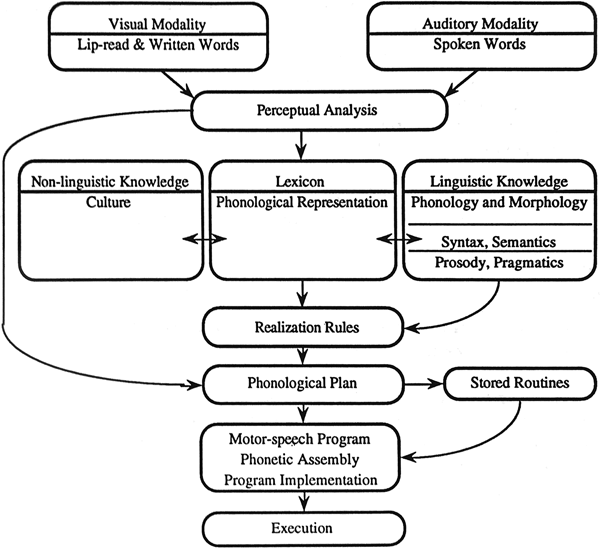
According to the Duggirala and Dodd (Reference Duggirala and Dodd1991) speech processing model (see Figure 1), a child analyses incoming visual (lip-reading) and auditory (spoken words) data to form the basis of the phonological system; that is, the lexically based phonological representations. The phonological representations comprise adequate detail to differentiate a heard word from other auditorily comparable words (e.g., /ɗʌɡ/ vs. /ɗɪɡ/; /ɗɪɡ/ vs. /fɪɡ/). In a two-way information exchange, phonological representations provide the data for the abstraction of linguistic knowledge (including the contrasts and syllable constraints of the ambient language) while using linguistic knowledge to aid the laying down of accurate phonological representations. From the lexicon, a word is filtered through ‘realization rules’ which are a set of mental processes that govern the construction of the phonological plan. For example, a child may have a realization rule that dictates ‘delete /n/ at the start of a word’ (atypical rule) or ‘replace all fricatives for stops’ (a typical rule that resolves by age 3;6). The phonological plan drives the phonetic program which is developed at the motor-speech level. The motor-speech and phonetic assembly level is responsible for assembling the required phonemes and their gestural movements in the correct order before the individual speech sounds are physically produced in the vocal tract (execution).
Duggirala and Dodd model of speech processing. Source: Dodd, B. and McCormack, P. (Reference Dodd, McCormack and Dodd1995). A model of speech processing for differential diagnosis of phonological disorders. In B. Dodd (Ed.), Differential diagnosis and treatment of children with speech disorder (p. 67). London: Whurr. Reproduced with permission from John Wiley and Sons Limited.

A unique aspect of the Duggirala and Dodd (Reference Duggirala and Dodd1991) model is the inclusion of ‘stored routines’ which are established, automated plans for high-frequency utterances. The stored routines component explains why children make the same mistakes over and over (access ‘old’ errored phonological plan). The stored routines component also explains why a child can improve their production on imitation (i.e., bypass the lexicon and the realization rules to create a new phonological plan) but then return to the same error when producing the word spontaneously (i.e., access lexicon, faulty realization rules and resulting ‘old’ erroneous phonological plan). Unfortunately, the Duggirala and Dodd speech processing model does not explicitly include domain-general processes recently implicated in language (including phonological) development.
Other psycholinguistic processes and speech
During the last decade, there has been a shift towards exploring spoken language development through the wider lens of general cognitive development (Nijland et al., Reference Nijland, Terband and Maassen2015). Researchers have suggested that higher-level cognitive processes, including executive functions (rule abstraction, cognitive flexibility, and inhibition; Crosbie, Holm, & Dodd, Reference Crosbie, Holm and Dodd2009; Torrington Eaton & Ratner, Reference Torrington Eaton and Ratner2016), and phonological memory (Jacquemot & Scott, Reference Jacquemot and Scott2006) may underpin or perhaps interface with the speech processing chain. Numerous researchers, including Pierce, Genese, Delcenserie, and Morgan (Reference Pierce, Genesee, Delcenserie and Morgan2017) and Jacquemot and Scott (Reference Jacquemot and Scott2006), propose that a key cognitive system, like Baddeley's (Reference Baddeley2003) phonological working memory model, is highly likely to be involved in the speech acquisition process. Pierce et al. (Reference Pierce, Genesee, Delcenserie and Morgan2017) assert that the working memory system is designed to support language (including phonological) learning because the key processes of the working memory system – analyzing, storing, detecting, and utilizing phonological patterns – are a perfect match with the fundamental requirements of learning speech and language. It is worth noting that Pierce et al. also assert that early language experiences could influence phonological working memory processes.
Phonological memory and speech
Baddeley and Hitch's (Reference Baddeley, Hitch and Bower1974) multi-component working memory system is the most influential working memory model. This model consists of three distinct but connected components. First, the visuospatial sketchpad which is responsible for holding and manipulating visual input (Baddeley, Reference Baddeley1992). Second, the phonological loop, which comprises the phonological store (which is responsible for the short-term ‘holding’ of verbal information and corresponds to pSTM) and the subvocal rehearsal mechanism (for refreshing verbal information). Finally, the central executive (Baddeley & Hitch, Reference Baddeley, Hitch and Bower1974), which controls and coordinates the two ‘slave’ subsystems partly by actively holding and manipulating stored phonological information (Diamond, Reference Diamond2013).
Jacquemot and Scott (Reference Jacquemot and Scott2006) assert that the phonological store potentially overlaps with speech perception (or ‘perceptual analysis’ in the Duggirala and Dodd (Reference Duggirala and Dodd1991) model), given its role in the short-term handling of phonological input, while the subvocal rehearsal mechanism overlaps with the speech production system. Few studies have explored the possible contribution of pSTM and pWM to speech output, even though a close association between phonological memory processes and speech production is posited, particularly during the preschool years (Gathercole & Adams, Reference Gathercole and Adams1993). Gathercole and Baddeley (Reference Gathercole and Baddeley1993) argue that this is because no studies with either typical adult speakers or with adult patients with neurological damage have demonstrated a direct association between speech output and immediate memory. However, given that speech is not automatic in young children as it is in adults, the working memory system might play a key supporting function in speech acquisition in young children.
pSTM and speech output
Evidence suggests that pSTM has an important function in new word learning, in both monolingual and bilingual individuals (e.g., Masoura & Gathercole, Reference Masoura and Gathercole2005). Gathercole and colleagues propose that pSTM provides a scaffold for learning the target language's phonological structure. Gathercole and colleagues describe a process whereby the “phonological representations of brief and novel speech generated in short-term memory mediate the construction of more durable phonological entries in the lexical store of long-term memory” (Archibald, Reference Archibald2006, p. 35). According to this hypothesis, pSTM deficits lead to inaccurate phonological representations, reduced vocabulary size, and, by extension, templates that lead to speech output errors. An inherent problem with assuming that the children's speech errors reflect their phonological representations of words is that children only recognize their own productions of words when they very closely resemble the adult pronunciation (Dodd, Reference Dodd1975). Further, in therapy, children with phonological disorders readily detect erroneous productions of words that mimic their errors, and error patterns are suppressed not word-by-word but in all relevant contexts (Crosbie & Holm, Reference Crosbie, Holm, Dodd and Morgan2017).
pWM and speech output
pWM is the ability to briefly hold and mentally manipulate information and is often considered an ‘updating system’ (Diamond, Reference Diamond2013). Torrington Eaton and Ratner (Reference Torrington Eaton and Ratner2016) hypothesize that pWM may be involved in correcting early-developing sound error patterns in words before motor execution, (i.e., in the Duggirala and Dodd (Reference Duggirala and Dodd1991) model, this would equate to either the realization rules or the phonological plan), leading to adult-like speech production. Moreover, it is possible that the mental manipulation component of pWM, over and above storage capacity, may be fundamental to speech accuracy. Theoretically, pWM ability may be key to a child being able to isolate differences between his/her production and the adult target representation (following internal feedback and/or internal and external self-monitoring), which then leads to the updating of realization rule(s). For example, on saying /ta/ instead of /ka/ and /dəʊ/ instead of /gəʊ /, a child may ‘hold’, then compare and contrast the productions within the phonological working memory system, using linguistic knowledge to determine that a ‘back’ sound (e.g., /k/ or /g/) rather than a ‘front’ (e.g., /t/ or /d/) sound needs to be used. Then, the existing realization rule is updated, leading to a modification in the phonological plan, a new phonetic template, and the correct motor execution in a range of words containing ‘back’ sounds. Thus, underdeveloped pWM ability could conceivably hamstring speech sound change.
Evidence for the relation between phonological memory and speech
Adams and Gathercole (Reference Adams and Gathercole1995) investigated the association between pWM and spoken language development in 38 children with typical language development aged between 34 and 37 months. Two groups of 19, one with low phonological working memory and the other with high phonological working memory, were established based on a combined phonological memory score (nonword repetition, auditory digit span). Speech output was measured using a single word repetition task (to establish articulation rate), and qualitative analysis of the first 75 words from a language sample was completed to establish speech accuracy. Among other findings, Adams and Gathercole reported that there was a trend for preschool children with typically developing language skills and poorer phonological memory skills to make more speech errors than their peers with stronger phonological memory skills.
More recent evidence associating phonological memory skills and speech output abilities comes from a study of preschool-aged children with mixed speech abilities. Torrington Eaton and Ratner (Reference Torrington Eaton and Ratner2016) reported a positive correlation between pSTM and speech production in 62 children aged 4;0 to 5;11 with broad-ranging speech skills (i.e., high-average, low-average, and delay/disordered speech). Specifically, Torrington Eaton and Ratner reported that children who could repeat more digits during a forward digit span task had greater speech sound accuracy as measured by PCC. This finding further supports the consensus that children with speech sound disorder (SSD) have deficits in short-term memory capacity (Waring, Eadie, Rickard Liow, & Dodd, Reference Waring, Eadie, Rickard Liow and Dodd2017). Interestingly, Torrington Eaton and Ratner (Reference Torrington Eaton and Ratner2016) did not find a similar correlation between pWM and speech sound accuracy. However, this was likely due to the impact of floor effects on pWM task results (spoken digit reverse span task).
Netelenbos, Gibb, Li, and Gonzalez (Reference Netelenbos, Gibb, Li and Gonzalez2018) also investigated the association between working memory, in the wider context of executive function (EF), on articulation ability in 33 randomly selected preschool-aged children aged between four and six years. Using the Behaviour Rating Inventory of Executive Function (BRIEF) (Gioia, Isquith, Guy, & Kenworthy, Reference Gioia, Isquith, Guy and Kenworthy2000), which is a standardized parental rating questionnaire, the working memory sub-score significantly correlated with children's differentiated productions of /s/ and /ʃ/. Specifically, children with better speech production skills had better working memory scores. This pattern held across all BRIEF EF measures. Unlike Torrington Eaton and Ratner (Reference Torrington Eaton and Ratner2016), Netelenbos et al. (Reference Netelenbos, Gibb, Li and Gonzalez2018) relied on parental reporting of working memory ability in everyday settings. How comparable the BRIEF working memory score is to cognitive performance-based in-lab measures is questionable given the low correlations between the two assessment types (Mahone & Hoffman, Reference Mahone and Hoffman2007). The Netelenbos et al. (Reference Netelenbos, Gibb, Li and Gonzalez2018) study supports the growing evidence of interrelatedness between EF, including pWM, and the speech processing system. Moreover, the Netelenbos et al. study highlights the inherent difficulty of how best to measure pWM memory in young children.
A potential association between long-term memory, pSTM, and pWM also needs to be considered. Evidence suggests that lexical variables (e.g., real words versus nonwords; concrete versus abstract words; low versus high frequency; and neighborhood density) impact pWM performance and may influence the number and types of errors made (Hulme, Roodenrys, Schweickert, Brown, Martin, & Stuart, Reference Hulme, Roodenrys, Schweickert, Brown, Martin and Stuart1997; Vitevitch, Reference Vitevitch1997; Walker & Hulme, Reference Walker and Hulme1999). Evidence supports a significant association between nonword repetition (NWR) tasks (a multidimensional measure that in part taps pSTM and pWM) and vocabulary knowledge (a proxy measure of long-term memory (LTM)) for children between four and six years of age, but not after eight years of age (Gathercole, Willis, Emslie, & Baddeley, Reference Gathercole, Willis, Emslie and Baddeley1992). Interestingly, the association direction appears to change with age, with NWR scores at four years predicting vocabulary at five years, but, from five years of age, vocabulary scores predict NWR scores (see Gathercole, Reference Gathercole2006). Thus, LTM could be influencing pSTM and pWM, and in turn speech accuracy.
Problems with phonological memory assessments
A major problem with previous phonological memory skills studies with children (with typical speech and SSD) is that frequently studies only examined pSTM (phonological loop) performance (Afshar, Ghorbani, Rashedi, Jalilevand, & Kamali, Reference Afshar, Ghorbani, Rashedi, Jalilevand and Kamali2017). Moreover, a shift from traditional span tasks (i.e., serial recall of sentences, random word lists, and digits) to nonword repetition tasks has occurred over time. Nonword repetition tasks are commonly regarded as tapping the phonological loop. However, NWR tasks are complex, incorporating speech processing components such as speech perception, phonological encoding, long-term memory, working memory, and oro-motor planning, and execution (Moore, Reference Moore2018). Thus, reported differences in pSTM performance could be task related.
Selecting suitable phonological memory tasks for preschool-aged children is fraught with difficulty. Carlson (Reference Carlson2005) demonstrated how young children's ability to complete executive function tasks is closely associated with age. Another difficulty associated with measuring phonological memory is type-of-response. Tasks requiring a spoken response, by their very nature, also involve phonetic planning and execution abilities, which in a population with known developmental speech errors (at a minimum) may lead to speech errors confounding results (Wells, Reference Wells1995). Finally, employing working memory tasks which overly tax preschoolers’ storage capacity, such as auditorily only presented reverse digit span tasks, may mean that the child's ability to manipulate phonological information may be compromised and their ability level under-reported (Roman, Pisoni, & Kronenberger, Reference Roman, Pisoni and Kronenberger2014). Careful task selection was a critical aspect of this study. This study employed both pSTM and pWM tasks that were presented simultaneously visually and auditorily, and required a non-verbal (pointing) response to overcome these significant methodological issues.
Research aim, questions, and hypotheses
This study aimed to investigate whether pSTM ability and pWM ability contribute to speech accuracy in monolingual English-speaking preschool-aged children. This study is one of the first investigations to determine whether pSTM and/or pWM account for speech accuracy variation in a group of preschool children with typical speech development. Moreover, this study is a logical extension of research that suggests that some children with speech impairements have pSTM and pWM deficits.
Our first question was: Do preschool children with typical speech, but varying speech accuracy for their chronological age – i.e., PCC standard scores of 12 and above, and PCC standard scores of between 8 and 11 – perform differently on pSTM and pWM tasks? We hypothesized that children with typical speech skills but PCC standard scores of 12 and above would perform better than children with typical speech but PCC standard scores of between 8 and 11, on both pSTM and pWM tasks. Our second question was: Are pSTM and pWM ability associated with speech accuracy, as measured by PCC? Our final question was: Does pSTM and/or pWM ability uniquely contribute to overall speech accuracy, once age, auditory discrimination, and receptive vocabulary are controlled for? We expected pSTM and pWM to contribute differently to speech accuracy, with pWM contributing more to speech accuracy given its hypothesized importance in updating phonological rules.
If pSTM and pWM do contribute to speech acquisition, there will be clinical implications for both children with typical and with atypical speech development. A positive finding would add to the growing evidence that phonological memory performs a critical function in multiple aspects of child development, including early cognitive, language, and literacy development.
Methodology
Participants
The University of Melbourne Human Research Ethics Committee and the National University of Singapore Institution Review Board both granted ethics approval for this study. Participants volunteered for the study after reading advertisements placed in expatriate magazines, schools, and venues, and word-of-mouth recruitment. Interested families participated in a pre-screening telephone interview to rule out:
1. any prior diagnosed neurological disability (e.g., cerebral palsy, dysarthria, dyspraxia), intellectual disability (IQ less than 70), physical disability (e.g., Down syndrome, cleft lip and/or palate, hearing impairment, visual impairment), significant psychological diagnosis (e.g., developmental delay, global developmental delay, pervasive developmental delay, autism, selective mutism, attention deficit disorder, attention deficit hyperactivity disorder), or medical condition (e.g., traumatic brain injury);
2. history of middle ear infections (i.e., more than three ear infections requiring antibiotics and/or grommets between the ages of 1;6 and 4;0);
3. prematurity (i.e., born before 36 weeks gestation) and/or of low birth weight (less than 2.5 kg);
4. prior speech therapy; and/or
5. Colloquial Singapore English (CSE) speakers.
To be included in the study, not only did each child need to meet the pre-screening criteria, they also needed to have written parental consent, and have met the following eight inclusion criteria:
1. monolingual language status on a modified version of the National University of Singapore ‘Language Background Questionnaire’. Within the Singapore context this meant children spoke only English at home and at school but may have had some incidental and limited exposure to Mandarin, Malay, and/or Tamil;
2. passed a pure tone audiometric hearing screening on the first assessment day;
3. obtained a standard score of 85+ on the Clinical Evaluation of Language Fundamentals Preschool – 2 Australia and New Zealand (CELF-P2; Wigg, Secord, & Semel, Reference Wigg, Secord and Semel2006) receptive language index, the Peabody Picture Vocabulary Test – Fourth Edition (PPVT-4; Dunn & Dunn, Reference Dunn and Dunn2007), and the spatial relations subtest from the Woodcock-Johnson Tests of Cognitive Abilities (WJ-III COG; Woodcock, McGrew, & Mather, Reference Woodcock, McGrew and Mather2003, Reference Woodcock, McGrew and Mather2007);
4. obtained a standard score of 7+ on the Diagnostic Evaluation of Articulation and Phonology (DEAP; Dodd, Hua, Crosbie, Holm, & Ozanne, Reference Dodd, Hua, Crosbie, Holm and Ozanne2002) Oro-motor Assessment;
5. obtained an inconsistency score of <50% on the DEAP Diagnostic Screen repeated naming task;
6. have a complete phonetic inventory for chronological age according to DEAP norms;
7. have no or only age-appropriate speech sound errors (i.e., no atypical error patterns or delayed error patterns) as measured by the DEAP; and
8. have a Percentage Consonants Correct (PCC), Percentage Vowels Correct (PVC), and Single Versus Connected Speech Agreement standard score of 8 or above on the DEAP Phonology subtest.
Sixty-nine families volunteered for the study. Fifty monolingual English-speaking children with typically developing speech (n = 25 females; n = 25 males) met the study criteria, along with one parent/guardian, and participated in the study. All fifty children completed the full research assessment protocol. The children were aged between 3;6 and 5;11 (mean = 4;5; SD = 7.95) and all resided in Singapore (mean length of residency = 2;11, range = 0;5 to 5;8) and attended at least three and a half days of formal preschool. All the children were from intact upper-middle socioeconomic status (SES) family units based on fathers’ employment and mothers’ education. A breakdown of parent education, employment, and country of origin appears in Table 1.
Demographic variables

Group assignment
To investigate whether differences in typically developing speech accuracy were associated with differences in pSTM and pWM ability, children were assigned to one of two groups based on the DEAP PCC standard scores. Standard scores were employed to overcome age effects on PCC raw scores. We operationally defined group one as children with typical speech development who obtained a DEAP PCC standard score of between 8 and 11 (i.e., percentile rank between 25 and 63) and group two as children with typical speech development who obtained a DEAP PCC standard score of of 12 or above (i.e., percentile rank of 75 or above). According to standardized test classification ratings, group one would be termed ‘average’ and group two ‘high-average’.
The mean age for children in group one (PCC 8–11) was 52 months (42–68 months) and comprised eleven girls and seventeen boys (n = 28). The mean age for children in group two (PCC 12+) was 54 months (42–70) and comprised fourteen girls and eight boys (n = 22). There was a statistically significant difference in the mean standard score on the DEAP PCC measure (t(48) = 9.853, p <.001). When a Bonferroni adjusted alpha of p =.005 was set, there was no statistically significant difference in the mean standard scores on any of the oro-motor, language, or cognitive measures. Although the mean CELF-P2 total receptive language score was lower for group one (DEAP PCC standard score of 8–11) than group two (DEAP PCC 12+), this difference did not reach adjusted statistical significance (t(48) = 2.722, p = .009) . Thus, the two groups were distinct and non-overlapping based on speech accuracy (PCC score) but were similarly matched on receptive vocabulary, receptive language, and cognition (auditory processing and spatial relations) standardized scores. Table 2 provides descriptive statistics for all speech, language, and cognitive assessment measures.
Descriptive statistics for age and all speech, language, and cognitive assessment measures

Notes. DEAP-PCC = Diagnostic Evaluation of Articulation and Phonology – Percentage Consonants Correct; DEAP-DDK = Diagnostic Evaluation of Articulation and Phonology – diadochokinetic; DEAP-IM = Diagnostic Evaluation of Articulation and Phonology – Isolated Movements; DEAP-SM = Diagnostic Evaluation of Articulation and Phonology – Sequenced Movements; PPVT-4 = Peabody Picture Vocabulary Test – Edition 4; CELF-P2 = Clinical Evaluation of Language Fundamentals – Preschool Edition 2; WJ-III = Woodcock Johnson Test of Cognitive Abilities 3; RS = Raw Score; SS = Standard Score; 10 = mean for clinical subtests (DEAP); 100 = mean for full assessments (WJ-III; PPVT-4; CELF-P Total Receptive Score; * = statistically significant at Bonferroni corrected alpha p < .005.
Measures
An initial speech, receptive vocabulary, receptive language, and hearing assessment was conducted to determine a child's eligibility. Then, approximately one week later, eligible children participated in the experimental assessment sessions.
Hearing screening
An external ear canal visual inspection and a pure tone screening at 25db at 500Hz, 1000Hz, 2000Hz, and 4000Hz was completed.
Speech
Three subtests from the DEAP were administered to confirm typical speech status. All DEAP subtests were video- and audio-recorded. Responses were transcribed on-line, using broad IPA transcription, and then reviewed by the first examiner within 48 hours.
First, the Diagnostic Screening test, which required the child to name ten pictures twice with a speech sound stimulability and an oro-motor assessment separating the two naming trials, was administered. The Oro-Motor Assessment, which measured the integrity of the oro-motor system, consisted of two parts: (a) a Diadochokinetic task (DDK) which required the child to say ‘pat-a-cake’ five times (i.e., assessing /p, t, k/ sequence); and (b) an Isolated Movements (I-M) and Sequenced Movements (S-M) task which required the child to copy four isolated tongue and lip movements and three sequenced volitional movements, respectively.
The Phonology Assessment examined the child's phonological ability (i.e., the ability to produce speech sounds in words) and consisted of two parts: (a) Phonological Picture Naming, which required the child to spontaneously name 50 pictures that covered all English consonants and vowels; and (b) a Picture Description task which required the child to explain why three ‘funny’ pictures, containing fourteen items selected from the phonological picture naming task, are amusing. The child is expected to use the fourteen items previously elicited in the single-word context in connected speech.
Receptive language
To ensure that each participant had age-appropriate receptive language skills, three receptive language subtests (i.e., Sentence Structures, Concepts and Directions, and Basic Concepts or Word Classes (age dependent)) from the CELF-P2 were administered. The CELF-P2 is an individually administered standardized test used by speech pathologists to identify language impairments in young children. All subtests required the child to point to a picture that best matched the words/sentences spoken by the assessor. A receptive language composite score was calculated for each child from the three receptive language tasks.
Vocabulary
The PPVT-4 (form A) was administered to assess receptive vocabulary. In this task, the examiner says a word and asks the child to point to the matching picture from four options. The test consists of 228 target words grouped into 12 item sets of increasing difficulty. Basal and ceiling rules are employed to ensure that only sets within the examinee's vocabulary level (critical range) are administered.
Auditory processing
The Sound Patterns (Voice) (test 23) from the WJ-III COG was administered to measure auditory processing and, specifically, sound discrimination ability. The subtest required the child to listen to a pair of human-like speech patterns through speakers attached to an iPhone. The pairs were either identical or differed in pitch, rhythm, or sound content. The child was required to determine if each pair was identical or not.
General intellectual ability
The Spatial Relations (test 3) from the WJ-III COG was administered to provide a proxy measure of general intelligence. The Spatial Relations subtest assessed a child's ability to detect visual feature differences, manipulate visual images, and match visual images. The task required the child to identify the subset of pieces to form a complete shape.
Phonological Short-Term Memory (pSTM)
Given the objectives of this study, ‘pure’ phonological memory tasks that were not ‘contaminated’ with speech (i.e., require motor planning and execution) were required. Commonly employed pSTM tasks, such as spoken digits forwards were unsuitable, meaning a pointing task was needed. No standardized pointing pSTM tasks suitable for ages 3;0 to 6;0 could be found, so the Items Forwards pSTM task constructed and described by Waring et al. (Reference Waring, Eadie, Rickard Liow and Dodd2017) was administered.
The Items Forwards task is an adapted forward picture recall pointing task created to measure pSTM using a conventional forward span recall format without speech. The task consists of ten black-and-white drawings of monosyllable nouns from three semantic categories (i.e., animals, clothing, and transport) that all start with a different initial sound, and that are found in children's early visual dictionaries.
To begin, the examiner (first author) showed and named the ten pictures individually to the child to ensure that the child knew each picture. He/she was encouraged to say the name of each picture after the examiner. Next, the child was asked to listen carefully as the examiner said some words, and then point to the pictures in the same order. A trial page (measuring 29.5cm × 21cm, i.e., A4 page) consisting of two pictures (4cm × 4cm in size) and two blank spaces in a four-picture grid was placed in front of the child, covered by a sheet of black cardboard. Speaking at one word per second, the examiner spoke a two-item trial sequence, removed the black cover, and indicated to the child to point to the target pictures. The child was given up to ten seconds to respond before a no-response was recorded. Every child completed four practice trials and up to twenty-five test items. No child proceeded to the test items until he/she demonstrated that they understood the task (i.e., correctly answered three out of four practice trials). The test trial pages varied from a picture grid of two to eight target pictures and zero to four foils. Picture size and position remained the same across all trial items and the number of items the child was required to recall increased incrementally from two to eight. Testing ended after the child made six consecutive errors. Non-specific encouragement and stickers (if required) were provided to maintain attention and motivation. The Items Forwards task appears in ‘Appendix A’ (available at < https://doi.org/10.1017/S0305000919000035 > .
Phonological working memory (pWM)
pWM was measured using Items Reversed (Waring et al., Reference Waring, Eadie, Rickard Liow and Dodd2017), which is a reverse picture recall pointing task with a similar design format to Items Forwards. Items Reversed employed ten new picturable familiar words, and the children were required to point to the test pictures in reverse order to tap the ‘holding’ and ‘manipulating’ components of working memory (Diamond, Reference Diamond2013). Like Items Forwards, the child was first familiarized with the ten new fine-line drawings. Next, the examiner explained that she would say some words (at one word per second) and that she would point to the pictures mentioned, in backward order, once the picture grid was uncovered. Again, the child was given four practice items, including verbal feedback, to ensure he/she understood the concept of ‘backward’. Test items commenced with a two-item sequence with three pictures (one foil) and incrementally increased to a maximum of an eight-item sequence with zero to four foils. Again, children were given up to ten seconds to respond. Testing concluded after six consecutive incorrect responses. In all instances Items Reversed was administered after Items Forward, but always with another (non-study related) task in between. The Item Reversed task appears in Appendix A.
Parent participants
During the speech and language eligibility assessment, one parent per child completed a Case History Questionnaire. This questionnaire covered pregnancy and birth history, developmental history, family history, and socioeconomic status.
Procedure
Children were assessed by the first author individually in their own homes over four separate days within a three-week period. Each child first participated in a speech and language eligibility assessment (60 minutes), followed by the cognitive assessment, which took three sessions of 40 minutes or four sessions of 30 minutes (depending on the age and attention abilities of each child). The cognitive tests were counterbalanced to control for order effects (including time-related effects) and carry-over effects which can confound experimental results. The two domains (intelligence; phonological memory) were fully counterbalanced. The pSTM and pWM tasks were pseudo-randomly administered, with the forward recall task completed before reverse recall task.
Results
Differences in pSTM and pWM
To examine the difference in pSTM performance between the typical speech production with DEAP PCC standard scores of the 12 and above group (n = 22) and the typical speech production with DEAP PCC standard scores of the between 8 and 11 group (n = 28), a one-tailed independent samples t-test was conducted.
The typical speech with DEAP PCC standard scores of the 12 and above group was associated with a mean Items Forward performance of M = 10.27, while the typical speech with DEAP PCC standard scores of the between 8 and 11 group obtained a mean Items Forward score of 8.04. This difference was not statistically significant (t(48) = 1.594, p = .06). Cohen's d was estimated at .45 which, based on Cohen's (Reference Cohen1992) guidelines, is a small-to-moderate effect size.
In contrast, a separate one-tailed independent samples t-test revealed a statistically significant difference between the group means on the Items Reversed task, which measured pWM. The typical speech with DEAP PCC standard scores of the 12 and above group (n = 22) was associated with a mean Items Reversed performance of M = 4.64 (SD = 3.62). By comparison, the typical speech group with DEAP PCC standard scores of the between 8 and 11 group (n = 28) was associated with a numerically smaller Items Reversed performance of M = 2.68 (SD = 2.46). Given a violation of Levene's Test for Equality of Variances (F(48) = 4.75, p = .034), a one-tailed t-test not assuming homogeneous variance was calculated. The one-tailed independent samples t-test was associated with a statistically significant effect (t(35.44) = 2.172, p = .019). Thus the typical speech with DEAP PCC standard scores of the 12 and above group were associated with a statistically significant better Items Reversed performance than the typical speech with DEAP PCC standard scores of the between 8 and 11 group. Cohen's d was estimated at .63 which, based on Cohen's (Reference Cohen1992) guidelines, is a moderate effect size.
Relationship between predictors and speech accuracy
First, to determine the relationship regression (Table 4) between the variables, partial correlations (controlling for age) were conducted among outcome, explanatory, and predictor variables. Table 3 shows partial correlations among the variables. A significant correlation was obtained for PCC and Items Reversed (pointing), suggesting the ability to ‘hold and manipulate’ (pWM) verbal information is positively correlated with accurate speech output. A second significant positive correlation was obtained for Items Reversed (pWM task) and Items Forward (pSTM task). This result was unsurprising given that pWM and pSTM both have a ‘holding’ requirement.
Partial correlations controlling for age

Notes. pSTM = phonological short-term memory; pWM = phonological working memory; * p < .05; df = 47.
Hierarchical regression predicting speech accuracy (PCC)

Notes. N = 50 children with typical speech development; pSTM = phonological short-term memory; pWM = phonological working memory; * p < .05.
Next, a hierarchical multiple regression (Table 4) was conducted to assess the ability of pSTM performance and pWM performance to predict speech accuracy after controlling for the influence of age, receptive vocabulary performance, and auditory discrimination. These variables were controlled for because: (a) speech improves with age; (b) phonological representations (mental lexicon) are hypothesized to play a critical role in driving phonetic plans; and (c) auditory discrimination ability has been implicated in the accurate laying down of phonological representations. Preliminary analyses indicated no violation of normality, linearity, multicollinearity, and homoscedasticity assumptions.
Age was entered into Step 1 as evidence suggests age-in-months has a significant impact on PCC. A significant regression equation was found (F(1,48) = 28.936, p < .001), with an R square of .376. Thus age explained 37.6% of the variance in PCC. Next, PPVT-4 raw score and Sound Pattern-Voice raw score were entered into Step 2. Entry of these two variables resulted in no statistically significant change in the total variance explained by the model (F(2,46) = 1.960, p = .152). Finally, entry of the pSTM value (Items Forward) at Step 3 resulted in no statically significant change in the total variance explained by the model (F(1,45) = 1.732, p = .195).
A second model (Model 2) was then run. Age was entered into Step 1 and again explained 37.6% of the variance in PCC, and the overall relationship was significant (F(1,48) = 28.936, p < .001). Next, PPVT raw score and Sound Pattern-Voice raw score were entered into Step 2 and again resulted in no statistically significant change in the total variance explained by the model (F(2,46) = 1.960, p = .152). The pWM value (Items Reversed) was entered into Step 3 of the model. After entry of Items Reversed at Step 3, the total variance explained by the model was 43.2% (F(1,45) = 4.571, p = .038). Items Reversed (the pWM measure) explained an additional 5.3% of the variance in PCC, after controlling for age, receptive vocabulary, and auditory discrimination (R squared change = .053, F change (1,45) = 4.571, p = .038). In sum, Model 2 was statistically significant, with the Items Reversed score recording a beta value of .365 (p = .038).
Discussion
Traditionally, speech development has been studied through the speech processing chain lens, with a focus on domain-specific theories of speech perception, phonological representations, and output (Jacquemot & Scott, Reference Jacquemot and Scott2006). Less attention has been paid to domain-general but language-specific cognitive processes, including pSTM and pWM. This study compared the pSTM and pWM ability of 50 preschool children aged between 3;6 and 5;11 with typical speech development and DEAP PCC standard scores of 12 and above (n = 22) and typical speech development and DEAP PCC standard scores of between 8 and 11 (n = 28). We also examined whether pSTM and/or pWM ability can predict speech accuracy in preschoolers with typically developing speech when controlling for chronological age, receptive vocabulary performance, and auditory discrimination ability. Children with above average speech production for their chronological age (i.e., standard score 12+ / percentile rank 75+ on the DEAP PCC) performed significantly better than children with average speech production for their chronological age (i.e., standard score 8 to 11 / percentile rank between 25 and 63 on the DEAP PCC) on the pWM task. There was no statistically significant difference between the groups on the pSTM task. Partial correlation analysis revealed a relationship between PCC and pWM, and pSTM and pWM when adjusting for age. Hierarchical multiple regression showed that pWM accounted for an additional 5.3% of the variance in speech accuracy (PCC) when chronological age, receptive vocabulary, and auditory discrimination were controlled for, with the combined model accounting for 43.2% of the variance.
Phonological working memory and speech accuracy
Overall, results suggest pWM ability makes a unique contribution to speech accuracy in preschool-aged children with typically developing speech. Simply put, the better a participant's ability to hold and mentally manipulate spoken words, the more accurate their speech production, above and beyond the influence of chronological age, vocabulary size, and auditory discrimination ability. This finding aligns with more general evidence from children with a history of phonological delay / phonological disorder who reportedly have poorer pWM skills than their typically developing peers (Afshar et al., Reference Afshar, Ghorbani, Rashedi, Jalilevand and Kamali2017; Cabbage, Farquharson, & Hogan, Reference Cabbage, Farquharson and Hogan2015; Waring et al., Reference Waring, Eadie, Rickard Liow and Dodd2017, Reference Waring, Eadie, Rickard Liow and Dodd2018).
Like Torrington Eaton and Ratner (Reference Torrington Eaton and Ratner2016), we hypothesize that the ability to mentally ‘hold’ and ‘manipulate’ phonological information may be involved in facilitating sound change. Theoretically, a child may employ pWM ability to compare his/her production of a word with the adult target, and then override phonological rule(s) to construct accurate phonological templates/plans downstream. Even subtle underdevelopment in pWM ability may be enough to slow the updating system, leaving a child with speech accuracy on the lower end of the typical range. Of course, this hypothesis requires further investigation, given that we investigated the association between speech accuracy and immediate phonological memory and not causation.
An alternative possibility is that reduced speech accuracy might lead to weaker pWM ability. Similar to Galantucci, Fowler, and Turvey's (Reference Galantucci, Fowler and Turvey2006) motor theory of speech perception, where better speech sound production is proposed to enhance auditory perceptual skills, more accurate speech output during the first two years of life (i.e., the sensitive period of phonological development) could lead to more efficacious subvocal rehearsal and storage (Pierce et al., Reference Pierce, Genesee, Delcenserie and Morgan2017). More efficacious subvocal rehearsal and storage, in turn, may lead to faster and more accurate mental manipulation of phonological material from three years of age onwards. Thus, early variations in speech output could lead to systematic differences in later pWM ability. Support for this position comes from Keren-Portney, Vihman, DePaolis, Whitaker, and Williams (Reference Keren-Portnoy, Vihman, DePaolis, Whitaker and Williams2010), who found that fifteen 26-month-old children did better on a nonword repetition task with stimuli whose component phones they had been producing for a longer time compared to consonants not yet in their repertoire.
A third alternative is that a bi-directional or reciprocal association exists between pWM and speech accuracy, such that early speech output might influence the development of pWM during the early years, but then variations in pWM ability may go on to impact speech accuracy after a critical language-learning (including phonological development) period. Support for this position comes from studies comparing children exposed to one or more languages from birth with children who acquired L2 later in childhood (e.g., Delcenserie & Genesee, Reference Delcenserie and Genesse2017; see Pierce et al., Reference Pierce, Genesee, Delcenserie and Morgan2017, for a detailed discussion). Future research, including longitudinal studies, which can document the changing relations between speech accuracy and immediate phonological memory, are needed to tease apart the relationship between speech accuracy and pWM. Thus there are at least three ways pWM might impact speech accuracy, with subtle underdevelopment of pWM ability potentially being either causally or consequentially related to PCC.
Phonological short-term memory and speech accuracy
In this study, the Items Forwards task (a measure of pSTM) was not correlated with PCC, unlike the Torrington Eaton and Ratner (Reference Torrington Eaton and Ratner2016) study that reported the opposite. Moreover, pSTM ability did not differentiate children with average speech for their chronological age (i.e., DEAP PCC standard scores of 8 to 11) from children with high-average speech production (i.e., DEAP PCC standard scores of 12 and above), nor did pSTM provide a unique predictor of PCC in preschool children with typically developing speech. Perhaps differences in pSTM ability do not become statistically significant until children with speech impairments are compared to children with high-average typically developing speech (e.g., Afshar et al., Reference Afshar, Ghorbani, Rashedi, Jalilevand and Kamali2017; Torrington Eaton & Ratner, Reference Torrington Eaton and Ratner2016). The combined results suggest that it is the ‘manipulating’ component, above and beyond ‘holding’ that is associated with PCC. Perhaps pSTM ability is a unique predictor of PCC for preschool children with some subtypes of SSD. Further investigation is required.
Accounting for the remaining variance
Unsurprisingly, given the children's wide age range (3;6 to 5;11) in this study, age accounted for the bulk (37.6%) of the variance in PCC. pWM accounted for a small, but statistically significant, 5.3%; leaving approximately 56% of the variance in PCC unaccounted for. Numerous factors including genetics (Morgan, Reference Morgan2013), gender, cognitive abilities, family position, socioeconomic status, and parenting style (Dodd et al., Reference Dodd, Holm, Hua and Crosbie2003) have been identified as potentially influencing speech acquisition. However, no one study can measure and report on all possible variables and their interactions.
In this study, SES influence was diminished, given the homogeneous nature of the sample. The impact of gender was also limited, given that compelling evidence suggests that age and gender interact in the later preschool period, i.e., from 5;6 (Dodd et al., Reference Dodd, Holm, Hua and Crosbie2003) and only four children were in this later preschool range. Other factors needing consideration include executive functions, specifically rule abstraction and cognitive flexibility, since these constructs may interact with pWM and are reportedly reduced in children with speech sound disorders (e.g., Crosbie, Holm, & Dodd, Reference Crosbie, Holm and Dodd2009; Torrington Eaton & Ratner, Reference Torrington Eaton and Ratner2016).
Clinical implications
Phonological memory ability, particularly pWM ability, has been implicated in language learning (e.g., Masoura & Gathercole, Reference Masoura and Gathercole2005), speech sound disorders (e.g., Torrington Eaton & Ratner, Reference Torrington Eaton and Ratner2016), and literacy development (e.g., Rohl & Pratt, Reference Rohl and Pratt1995). Results from this study also suggest pWM may help to predict speech accuracy in typically developing children. In many ways, pWM is akin to the ‘canary down the mineshaft’ – reduced pWM ability can serve as an early warning signal to potential interruptions in numerous language-based skills. Perhaps clinicians (psychologists, speech-language pathologists) should consider PCC scores at the lower end of the typical range as a ‘red flag’ and screen pWM as a precautionary measure. Additionally, thought needs to be given to investigating whether addressing pWM ability might lead to improvements in speech accuracy. To date, little attention has been paid to this type of intervention. Finally, results highlight the importance of looking beyond surface-level speech sound errors and investigating the involvement of both domain-specific and domain-general cognitive skills in the speech processing chain.
Study limitations and possible future directions
This study has several limitations. We acknowledge that with a sample size of n = 50 the confidence interval around the model R2 in the prediction of PCC is relatively large (R2 = .478, 95% CI = .029 to .981). Replication, using a larger sample size, is recommended to help further clarify the relationship between PCC and pWM. Moreover, pWM explained a small amount of the additional variance in PCC compared to age-in-months; suggesting a small effect size. However, given that pWM contributed a statistically significant amount of variance to the model, and that there are theoretical grounds to include pWM (i.e., thought to be involved in updating speech errors), the model has some utility in explaining PCC variance for children with typical speech development. However, care should be taken when interpreting these results to the wider cohort of children with typical speech development. It is important to be mindful that this study consisted of expatriate children from middle-class, monolingual backgrounds who reside in a multilingual country with inevitable exposure to a range of Asian languages which may have influenced their speech processing skills (including phonological memory abilities) and executive function skills. Also, these results may not apply to bilingual/multilingual children or children from lower socioeconomic backgrounds. Future work, exploring whether results are replicable in these populations, is recommended.
Finally, it is unlikely that the phonological memory system is the sole ‘domain-general’ mechanism associated with speech acquisition. Further research investigating whether visuospatial working memory predicts speech accuracy would help to determine whether general memory mechanisms (i.e., memory not specific to language), as opposed to specific phonological memory, influences speech development. Further, phonological memory (including the pSTM and pWM subcomponents) does not operate in isolation and is part of a broader set of executive function(s) including attention, cognitive shift, and inhibition (Diamond, Reference Diamond2013). How these EFs work together needs to be considered for both children with typical speech development and children with speech impairments to fully understand the potential association of mental processes outside the speech processing on speech acquisition.
Conclusion
Historically, pSTM and pWM have been afforded little weight in the speech processing chain (Jacquemot & Scott, Reference Jacquemot and Scott2006). This study contributes to the emerging body of evidence that shows an association between pSTM, pWM, and speech, but whether memory influences speech or speech influences memory needs untangling.
Author ORCIDs
Rebecca WARING, 0000-0002-0955-6318
Supplementary Materials
For supplementary materials please visit <https://doi.org/10.1017/S0305000919000035>.
Acknowledgements
A heartfelt thank-you to the parents and children who gave us their time and showed such commitment to participate in this study. This research received support through an Australian Government Research and Training Program Scholarship.