




Introduction
This article discusses the experience of illness by humans in the pre-imperial late classical era of around the late fourth century bce. Specifically, the afflicted body is contrasted with the ideal body, as protected by divinities as laid out in two diagrams described in words or depicted in an image in two bamboo manuscripts preserved from the fourth century bce, the *Wu ji 五紀 (The Five Guidelines)Footnote 1 and *Shi fa 筮法 (Stalk Divination),Footnote 2 both preserved at Tsinghua University. In each document, sets of divine agencies are linked to parts of the body as governors or mantic signs of supernatural influence. These agencies have a double function. They, like the royal ancestral spirits of the ancient Shang kings, could help preserve the lives they influence or curse them. Although by the fourth century bce, the names of the spiritual agencies had changed, the double-faced role of divine protector and demonic destroyer remained. One major difference is that the entities behind the two roles are more often than not separated in the texts, with divine agencies the source of omens and object of prayers, while demonic agencies are listed as sources of sui 祟 (supernatural harm) to be exorcised or expelled. We learn from the *Wu ji that they are two different but connected forces in a cosmic spirit bureaucracy. The divinities in charge of the human body report up the cosmic hierarchy on the behavior of the person. If the person’s behavior is unsatisfactory, they employ demonic agencies (lower in the hierarchy) to afflict specific body areas as punishment. In the *Shi fa, the divine agencies assigned to areas of the body are represented by named mantic signs (gua 卦) that can be “read” through divination, and correlated to specific sets of culpable demonic forces.
The two manuscripts have many shared and different attributes, while being also part of the same collection—possibly from the same tomb, cemetery, or, at least, region as they arrived together packed in ancient mud at Tsinghua, rescued from the Hong Kong antiquities market.Footnote 3 Based on what we know of the collection—drawing from archaeological evidence of the scientifically excavated manuscript collections dating from the fifth century bce through first century ce combined with scribal evidence and C14 data—the site of origin was most likely located north of the middle Yangtze River valley (modern Hubei and Henan) and politically connected to the ancient state of Chu. Out of about 1,800 bamboo slips, dozens of separate texts have been isolated and two of them specifically focus on Chu 楚 lineage history and the political role of Chu in the larger central plains centered contest of Warring States powers. Since many other texts include versions of philosophical texts that have appeared in later transmitted classics, scholars understand the collection to represent the library of a mid-Warring States elite man with access to manuscripts from other cultural contexts of literary production such as represented by the states of Qin 秦 or Qi 齊.Footnote 4
The *Wu ji might be a Chu copy of a Qi product; whereas the *Shi fa likely originated in Chu.Footnote 5 Like all the other manuscripts in the collection, neither the *Wu ji nor the *Shi fa mention an author, and, in fact, both manuscripts seem to be composites of material copied from earlier sources. The copy errors, corrections, formatting, and multiple ways to write a single word in both the *Wu ji and the *Shi fa confirm the impression of different calligraphic hands, especially in the *Wu ji.Footnote 6
The *Wu ji text is 130 slips long and includes sections describing the rebuilding of the cosmic order as commanded by a Houdi 后帝 (also referred to as Huang Hou 皇后, or simply as Hou), likely the legendary god-emperor Huangdi 黃帝,Footnote 7 after an apocalypse (a flood that threatened those “up above” 于上), with sections on the recreation of the sky, earth, and human realms.Footnote 8 Most of these sections are framed as the words or commands of Hou: “Hou yue” 后曰, but beginning with slips 96–97, the narrative slips into third person. Going back before the apocalypse, it explains how “Huangdi’s body was spread throughout the world, instituting states and rulers” (黃帝之身溥有天下,始有樹邦,始有王公), but that a rebellion by his son, Chi You 蚩尤 (written as 寺蚘 in the *Wu ji), disrupted civilization and cosmic order. It proceeds to describe how Huangdi and his army of cosmic warriors win the battle, dismember Chi You, and reinstitute order in the Sky and well as on Earth.Footnote 9 Over the course of the entire manuscript it becomes apparent the ideal cosmic pattern is in fact the “body” of Huangdi.
The *Shi fa text is sixty-three slips long and includes about thirty different sections, consisting of text, charts, and diagrams, with one depicting a human body.Footnote 10 These sections focus on determining fate and fortune in the different spheres of ordinary elite life such as a government or military career, marriage, household relations, sickness, and so forth. Whereas the *Wu ji might be considered a moral parable emphasizing social order, the *Shi fa is a technical instrument for interpreting the results of divination, by stalk manipulation or perhaps dice.Footnote 11 If we assume that a single person was responsible for collecting both of these texts, then we have a picture of someone with enough technical know-how to diagnose his own illness (by himself or with the help of a diviner specialist) as well as enough literary background to appreciate the tale of Huangdi and to respect—if not be confounded by—the unfolding of such a geometrically complex model of the cosmos. In both cases, the human-shaped bodies are embedded in cosmic patterns of circles and squares shaped or influenced by arrays of astral, terrestrial, spatial, temporal, and other supernatural agencies. These patterns suggest early versions of diviner boards that appear in Han tombs: astrolabes, shi 式 or “cosmograms.”
Cosmograms
In both texts, the human body is defined in terms of cosmic deities, but they differ in complexity. Both texts enmesh the body in multi-dimensional webs of spatial, temporal, natural, and human spirits, but the *Wu ji has a much more detailed and vast bureaucratic accounting of both the spirit pantheon and parts of the body named; it also includes astral gods not mentioned in the *Shi fa.Footnote 12 The difference in complexity is also reflected in the numerology. For the *Shi fa, there are six numbers from 1–9 (not including 2 and 3, 1 and 7 were used alternatively) forming eight male and female mantic trigrams which function as divinities. In the *Wu ji, the five Sky ji (“guidelines”) are entangled into multiple intersecting dimensions of all conceptual and visual aspects of manifested reality by mantic sets of five. Divinities that make up the spiritual bureaucracy are identified with each node and number. I briefly describe the cosmogram dimensions of each manuscript in the following sections.
The *Shi fa Cosmogram
Among the thirty sections of the *Shi fa, Section 24, in the upper left of the entire unrolled manuscript, includes a drawing of the human body (see Figure 1). Here the inside of the body is marked with female trigrams (mouth, chest, abdomen, groin) and the outside with male trigrams (top of head, ears, hands, feet).Footnote 13 The body diagram is placed inside a square, which could represent Earth, and an encircling set of eight trigrams might represent Heaven. The encircling trigrams are framed with inscriptions indicating the four directions (with colors and elemental phase xing 行 agents), four agricultural divine officers (“supervisors,” si 司), and four seasons. Below Section 24, are charts outlining the correlations between the eight trigrams and the ten Stem and twelve Branch Day signs of the sexagenary calendar. The body in *Shi fa is simply defined and the correlations optional and barely intertwined. While the *Wu ji also suspends the human body in the cosmic juncture between the round Sky and square Earth, it is so complex that no picture can capture all its dimensions.Footnote 14
Adapted from Section 24 of the *Shi fa, as found in Brandon Dotson, Constance A. Cook, and Zhao Lu, Dice and Gods on the Silk Road (Leiden: Brill, 2021), 144, fig. 9.

Figure 1 Long description
Panel A: The illustration features a central human figure with various symbols and text around it. The figure is labeled with different numbers and symbols such as 116=Xun, 616=Kan, 666=Kun, 661=Zhen, 611=Dui, 166=Gen, 161=Li, and 111=Qian. Each label is associated with a specific direction, element, and color, such as South, Fire, Red for Kan, and East, Wood, Green for Zhen. Panel B: The text around the figure explains the meanings behind the labels, such as ‘Why is it called Kan? The Supervisor of planting is the reason it is called Kan.’ and ‘Why is it called Zhen? The Supervisor of Thunder is the reason it is called Zhen.’
The *Wu ji Cosmogram
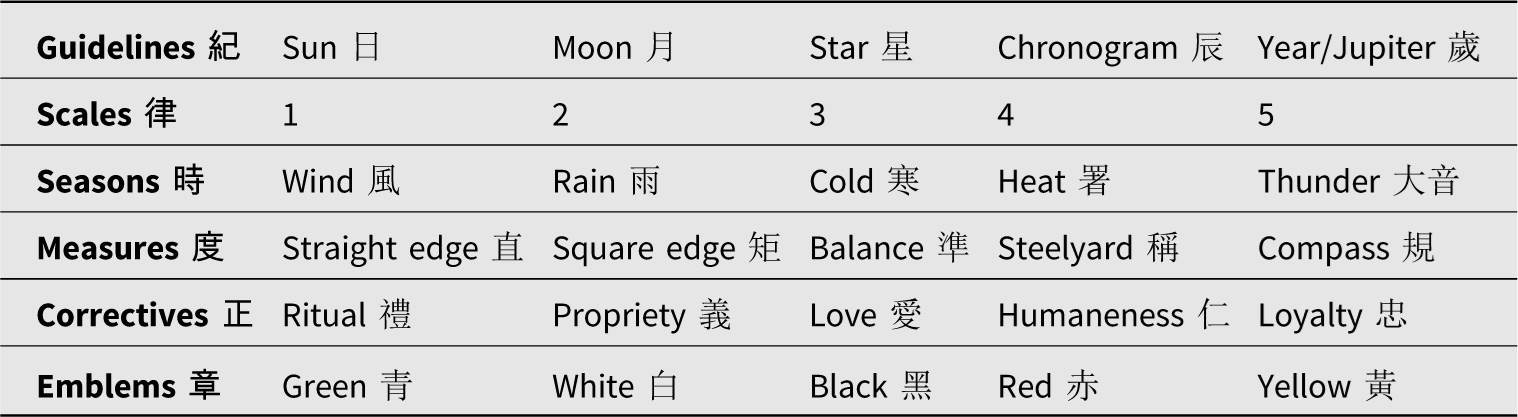
The five ji (“guidelines”) are listed at the beginning of the manuscript (slip 3) as the Sun, Moon, Star (xing 星), Chronogram (chen 辰), and Year or Jupiter (sui 歲), and are later specified (slips 62–69) as Sun, Moon, Northern Dipper (Beidou 北斗), South Gate (Nanmen 南門), and Establishment Star (Jianxing 建星).Footnote 15 Later, on slips 79–86, where parts of the body are correlated to specific spirits, the Five Guideline spirits are mentioned among a host of other astral, spatial, and heroic spirits to monitor ribs, viscera, and openings (such as the nose and eyes). Returning back to the beginning of the manuscript, we see the Guidelines correlated to abstract concepts which also represent spiritual presences. These spirits are classed in five cosmic categories (tonal scale 律, season 時, measurement 度, corrector 正, and emblem 章) and correlated with five moral virtues (loyalty 忠, humaneness 仁, love 愛, propriety 義, ritual 禮). See Table 1.
From *Wu ji Slips 1–5

Table 1 Long description
Panel A: Table with guidelines including Sun, Moon, Star, Chronogram, and Year/Jupiter. Panel B: Scales listed as 1, 2, 3, 4, and 5. Panel C: Seasons include Wind, Rain, Cold, Heat, and Thunder. Panel D: Measures are Straight edge, Square edge, Balance, Steelyard, and Compass. Panel E: Correctives include Ritual, Propriety, Love, Humaneness, and Loyalty. Panel F: Emblems are Green, White, Black, Red, and Yellow.
Then, over the course of the manuscript, more correlations are added in increasingly complex dimensions (including even more sets of five), but we focus here on those that seem most directly related to the structure of the human body. Importantly, there are five sets of five (sometimes six) divinities assigned by Hou to Tonal Scales (lü 律), Seasons (shi 時), Measures (du 度), Correctives (zheng 正), and Emblems (zhang 章) to watch over the performance of the Five Virtues by the people (min 民). These divinities, thirty in number, are combined with fourteen of the directional divinities of spatial construction (the Four Borders 四介,Footnote 16 the Four Pillars 四柱, the Four Cords 四維), and a selection of ten asterism divinities, to monitor specific sites on the body. Each site (head, spine, ribs, shoulders, hips, upper and lower arms and leg, ears, eyes, nose, mouth, heart, lungs-and-liver, kidneys, urethra, anus, spleen, and the five bones of each foot) is also matched with a specific temporal spirit, all the days of the sixty-day calendar (except days 41–50), and the twelve Branch signs.Footnote 17 A summary of some of the correlations in sets of five are found in Tables 1 and 2.
From *Wu ji Slips 6–12 a

Table 2 Long description
A table with three rows and five columns. The columns are labeled Scales, Seasons, Measures, Correctives, and Emblems. The row labels are Loyalty, Humaneness, and Heart. Row 1: Scales, Loyalty, Heart; Seasons, Humaneness, Nose; Measures, Love, Ears; Correctives, Propriety, Mouth; Emblems, Ritual, Eyes.
a Similar wording is found on slip 88.
The divine bureaucracy correlated to the mantic sets of five also govern the human body, as described in slips 79–86, from top to bottom, head to feet (see Table 6). Days 1–30 are correlated to divinities marking bones in the inner core of the upper half of the body: head and spine (ten spirits); right rib cage (ten spirits); left rib cage (ten spirits). Most of the spirits named in this section first appear in the manuscript in categories correlated with the Five Guidelines mentioned in Table 1. In slip 26–27, the first three spirits (head and top of the spine), Sky, Earth, and Four Outskirts (Sihuang 四荒), are introduced as leading a group of eighteen spirits that also include Four Borders 介, Four Pillars 柱, and Four Cords 維.Footnote 18 These latter twelve spirits correlate to the twelve Branch signs and to the “big bones” (dagu 大骨) of the body, thus connecting the round Sky to the square Earth through the body. These larger outlining bones of the body are divided left and right (shoulders, hips, upper and lower arms). Days 31–40 are correlated to divinities of a selection of Astral Lodges and stars which govern openings and viscera (eyes, nose, mouth, heart, lungs-and-liver, kidneys, urethra, anus, and spleen). Days 51–60 correlate to two Cord deities and the feet. Each foot has five Day signs, presumably to represent the ten smaller bones in the feet.
South Gate and the Northern Dipper
Interestingly, of the Five Guidelines, South Gate (Nanmen 南門) overseeing the Nose and Northern Dipper (Beidou 北斗) for the Heart (an opening and viscera)Footnote 19 seem to have pivotal roles in the body, functioning as the operative mechanisms for the cosmic body as a whole (see slip 84; Table 6): “The [space or line] in between the [twin towers of] South Gate is the Nose” (南門之間為鼻) and “Northern Dipper is the Heart” (北斗為心).Footnote 20 Elsewhere (on slip 27), we learn that the South Gate is the one who “activates the Correctors” (施正南門), the zheng 正 which we see in Table 1 are linked to the five virtuous behaviors; and the Northern Dipper functions as the “Sky Compass” (tiangui 天規北斗), where it circumscribes the Sky (as on later diviners’ boards).Footnote 21 This is described in terms of the numbers of spirits linked to each dimension in slips 26–27:





Hou said: “Heaven and Earth, the Four Outskirts, the Four Borders, the Four Pillars, the Four Cords constitute a group of 18 divinities. [These] six supervisors of the DirectionsFootnote 23 [also] include a group of 24 earth-spirits. Facing the Seven VirtuesFootnote 24 is a group of 28 divinities [the Astral Lodges]. Activating the Correctors [zheng] is the South Gate, and acting as the Sky Compass is the Northern Dipper.”
While the Heart as a round center is not hard to imagine, the image of the Nose occupying the space between two towers of a gate is harder to reconcile. Perhaps it suggests the center of the face or the image of the asterism itself.Footnote 25 There is little record of South Gate in early texts, but an asterism labeled “South Gate” is drawn in a medieval Dunhuang sky map as two dots connected by a line under the Arsenal (Kulou 庫樓) Astral Lodge, but other texts locate it near different lodges.Footnote 26 The Shi ji places it in Horn (角) where it is the southern gate of the Heavenly Emperor’s Court (天王帝庭), between Astral Lodges Kang 亢 and Di 氐, the spirits of which oversee sickness and epidemics.Footnote 27 A millennium later, the South Gate was depicted in popular fiction as where spirits and demons flowed in and out of the Heavenly Court; but in earlier times the South Gate of a city was defined as a Gate of Law (法門).Footnote 28 It is perhaps in this latter sense that it appears in the *Wu ji, where South Gate is a spirit officer in charge of the Correctors (正), which investigate the Five Virtues of human behavior (to be punished by the spirits). Hence, it is involved with the judgment of the individual and of human behavior.
The roles of some of the divinities, including South Gate and Northern Dipper, are further explained in a section (slips 36–41) which outlines the assignment of Day signs to the eighteen divinities by Shangjia 上甲 (the first Jia day of the first Jia set in the sixty-day calendar; also possibly a reference to the Shang ancestor Shang Jia Wei 微).Footnote 29 Many of the divinities go by a variety of names, some of which seem to clarify their function.Footnote 30 After explaining Sky, Earth, the Four Outskirts, Borders, Pillars, and Cords, it notes the roles of the Four Directions (and Day groups they are assigned). Lastly are the primary operators of the entire cosmological mechanism, South Gate and Northern Dipper, and their connection to human behavior:




South Gate is called Sky Gate and Sky OpeningFootnote 31 as it establishes [the offices of] the Correctors [zheng] and taking up [the human behavior of] Humaneness puts into position the successive order and arrangement of the recruited [spirit] soldiers along the left and right [of Hou], and [Shangjia thus assigns them] such-and-such days. Northern Dipper is called Northern Temple and Sky Compass as it establishes the [the offices of the] Constants and taking up [the human behavior of] Love, places All Under Heaven [in their proper positions], adjusting [zheng] the Four Positions,Footnote 32 and [Shangjia thus assigns them] such-and-such days.
We see here that South Gate established the Correctors (Zheng) and Northern Dipper established Constants (Chang). In slips 42–43, the word zheng refers to the process of adjusting and making correct the Square and Circle by means of the Four Directions. Slips 43–46 go on to explain their relationship via divinities to humankind.













Hou said: When initiating Above and Below, all is mighty and great, and the Square and the Circle, radiant and vast, are held upright [zheng] by means of the Four Directions. The group of divinities each have their positions to supervise and look for anything infelicitous. They appear as patterns, awe-inspiring and divine in their intense illumination. Spring, Summer, Autumn, and Winter divide into Yin and Yang [influences]. The Sun, Moon, Star [xing], and Chronogram [chen], advancing and retreating grow shorter and longer; [they are] named the Harmonious Asterisms, they are calculated in terms of guidelines-and-rules [jigang].Footnote 33 Seasonally they send down proliferation so that myriad beings have that which to gaze upon, [such as] the five crops and six domestic animals and the [products of the] mutual processes of water and fire. The common people thereby submit [the products as sacrifices] so that the divinities and ghosts then savor them. [The people] set up nations and households, with shrines to near and distant ancestors, ditches and byways, roads and transport, and properly governed [zheng] communities. With the establishment of nations and households, grasses and trees flourish. Compass and Square and the Five Measurements are how the world operates. Ritual, Propriety, Love, Humaneness, and Loyalty work together, with Hou Huang matching them so that the High Two [the Square and the Circle?] understand and Hou is thereby luminous. The Way of Heaven is unchanging, eternal, and long-lasting. When All Under Heaven possess virtue, the Compass and Square will make no mistakes.
In slip 63, zheng is the rectification of the Compass and Square (both tools and spiritual entities equaling the Square and the Circle) and of tools for measurement and balance, metaphors in early transmitted literature for the master craftmanship-like knowledge of virtuous sages. Slips 62–69 define the “virtues” (de) of the Sun, Moon, South Gate, Northern Dipper, and Establishment Star and show that while they are put into place by Hou, they are at the same time part of Hou himself. These five astral bodies oversee the enactment of these virtues by the people below:






Hou said: Once the Five Guidelines are arrayed, luminous banners in threes and fives shine so brightly and untiringly as the Three Radiant Ones glow. The Sun comes out in the East and enacts Ritual [behaviors] luminously. The Moon comes out in the West, aligning [behaviors of] Propriety as constants. To the South are brought about the Four Poles: Spring, Summer, Autumn, and Winter, entrusting to them [the modes of] Yin and Yang, so that the Center is rectified [zheng] by Compass and Square, and the Balance and Steelyard are rectified [zheng] by the balanced scales.




As for the Sun’s virtue, [he] says: We shall practice Ritual at particular times to start up the seasons, so the gathered groups [of spirits]Footnote 36 may provide advice on plans, for [those] All Under Heaven to anxiously examine.Footnote 37 As it is the virtue of the Sun to be brilliantly discriminating, so too is Hou brilliantly discriminating.




As for the virtue of the moon, [he] says: We shall take up Propriety and hold up for correction [zheng] all that is declining and so conform All Under Heaven to the model, providing offerings when it does not move [correctly]. As it is the virtue of the Moon to inspect while going through its paces, so too is Hou inspecting while going through the paces.



As for the virtue of the South Gate, [he] says: We shall put into proper place Humaneness so that the four seasons arrive in proper sequential order, and, when we overlook the world below, shall project the Guidelines [down from] the Brilliant Sky. As it is the virtue of the South Gate to position [the Guidelines and seasons] into proper succession, so too is Hou positioning [them] into proper succession.




As for the Virtue of the Northern Dipper, [he] says: We shall take up Love and propose the [proper] positions for the people, placing All Under Heaven [where they belong] and adjusting [zheng] the Four Positions. As it is the virtue of the Northern Dipper to correct [zheng] the sentiment and evaluate the life spans [of the people], so too is Hou correcting sentiments and evaluating life spans.



As for the Virtue of the Establishment Star, [he] says: We shall enact Loyalty to align the Sun and Moon to fill out the Year, increasing All Under Heaven, and accounting for it at the end [of the year]. As it is the virtue of the Establishment Star is to count and evaluate, so too is Hou over the longue durée counting and evaluating.
This section of text on the virtues of the Five Guidelines is an expansion of the section involving Shangjia laying out the responsibilities of the temporal agents, but the emphasis shifts from the design of the spirit bureaucracy to how the Five Guidelines oversee the human world as part of the cosmic body of Hou (Table 5). South Gate fixes the positions and temporal order of the seasons. Northern Dipper rectifies (zheng) human sentiment and determines life spans. If we understand that South Gate has a double function of maintaining celestial order and judging human behavior, then we see that it is the Northern Dipper that is responsible for sending down the punishment in terms of lengthening or shortening human life.
Each of the five astral gods are also assigned key parts of the human body. The Sun and Moon were on the left and right sides of the ribs. The Establishment Star was assigned the eyes. While the significance of the link between the South Gate and the human nose is not obvious (perhaps as a prominent portal of qi?), the link between the Northern Dipper and the Heart is. The Heart by this time was already evolving to represent the “center” (zhong 中) of the human body and the ruler of its internal processes.Footnote 40
The Two Cosmograms Compared
The two cosmograms, either complex or simple, reflect the needs of the practices in which they are embedded. The *Shi fa was a tool for interpreting auspicious and inauspicious actions and to nail down which demonic agents might be afflicting an individual who had access to a team of diviners. The *Wu ji was a moral treatise generalized to the human condition. It reinforced social and ritual behaviors with the threat of cosmic collapse and a coercive divine will so powerful it could control individual bodies within a larger population. The cosmic system of the *Shi fa was a simplified “handy” version of systems circulating during the Warring States era. The system of the *Wu ji incorporated elements drawn from a much vaster base of astrological, medical, and historical knowledge.
The social hierarchy reflected in *Shi fa is the household of the elite married man, whereas the *Wu ji reflects a government bureaucracy arranged much like we see adapted into the Zhou li 周禮, where governing functionaries are cosmically divided into Sky, Earth, and the Four Seasons. Also like the Zhou li, the *Wu ji reflects a bureaucracy dedicated to ensuring that the people obey the ritual codes and laws. The difference is that the enforcers are divinities in the *Wu ji and human officers in the Zhou li. In the Zhou li, “virtuous actions” (dexing 德行) of the people are corrected by the offices of the Palace Corrector (Gongzheng 宮正); but there were six types of de, xing, and yi 藝 (“arts”), only some of which overlap with the Five Virtues in *Wu ji Footnote 41 (interestingly, the Shi ji traces texts concerned with the Five Virtues back to the Qi court).Footnote 42 Both the *Wu ji and the Zhou li show a fascination with numbering, although the numerological obsession with sets of five is not evident in the Zhou li, suggesting some overlap in aspects of the two texts but ultimately different production milieus. Generally, it seems that the *Wu ji required a highly literate bureaucrat to interpret and apply the message of the text, whereas the *Shi fa did not. Indeed, the ability to calculate numerical sequences for the users of the *Shi fa may have been more important than reading.Footnote 43
The Body and Illness in Context
The ideal or cosmic body described in the *Wu ji clearly reflects the early concept that the human body is not just a microcosmic reflection of the larger cosmic structure, but is in fact the very embodiment or manifestation (xiang 象) of the unseen reality. Just as Nathan Sivin pointed out in the 1990s, based on evidence in transmitted texts, the organization and operation of the body was understood as a simulacrum of the bureaucratic state.Footnote 44 In the *Wu ji, a supreme being, like a god or emperor, reassembled the world after an apocalypse, putting all the deities of time and space back in order with assigned duties, much in the style of the descriptions of duties for officers in the idealized Zhou li, albeit a tad more chaotic (not having passed through the hands of Han editors as did the Zhou li). A smooth-running bureaucratic system depends on the good behavior of its constituent parts, especially the humans that form the economic base. As with chief officers in the Zhou li, the divinities are charged with the supervision and evaluation of this behavior. Instead of fines or imprisonment enforced by officers as in the Zhou li, illness is the punishment inflicted by demonic forces in the *Wu ji.
This moral dimension is not so obvious in the *Shi fa. The behaviors of the subjects are not discussed; only the likely demonic causes or likely outcomes. Unlike the multiples of interlinked spirits in the *Wu ji, there are only eight divine signs, which function like spirits and relate to each other like members of a large family. These eight divine signs are also linked to sites on the human body and like the deities assigned in the *Wu ji can direct diviners to the most likely demonic sources of “supernaturally induced affliction” (sui).
Illness caused by supernatural affliction or a kind of curse (sui) has a well-established history in China and has been explored at length by many scholars, such as Donald J. Harper.Footnote 45 Bamboo manuscripts from excavated fourth century bce tombs in Hubei and Henan include records of prayer and sacrifice (essentially divination records kept for three years and then buried with the patients; hereafter referred to as Chu tomb records) concerning the exorcism of sui-derived illnesses suffered by the individuals buried in the tombs.Footnote 46 Although a larger pantheon of spirits and demons are mentioned in them than in the *Shi fa, there is overlap and even hints that the diviners and healers who made those records had used a *Shi fa-like manual.Footnote 47 Overlap between these divine and demonic Chu pantheons also occurs with the *Wu ji but to a much more limited degree. Some sky, earth, and directional spirits are shared. The *Wu ji does not include ancestorial spirits (as these would be individualized to the patients); both include legendary figures, but different ones. There are a greater number of astral deities in the *Wu ji. There are also a handful of divinities in the *Wu ji who are unknown in other texts and difficult to identify. The sense is that the two manuscripts reflect a common religious view but that the *Wu ji includes a more complex pantheon.
The *Wu ji makes it clear that illness is caused by the supernatural affliction of parts of the body as punishment for not obeying the ritual laws. The focus on the skeletal structure, openings, and viscera is unique for the fourth century bce and hints at a more sophisticated medical tradition than reflected in the *Shi fa with its generalized mapping of the body. In both cases, the source of ill health is primarily demonic agency, which distinguishes these texts from Han theoretical texts featuring a natural system of Yin and Yang “channels” (mai 脈) of qi and a belief in self-cultivation and of the concern with personal transformation of self into a “jade body” as explored by many scholars, including Michael Puett, Mark Csikszentmihalyi, and Vivienne Lo.Footnote 48
There is no specific proof of the channel theory in Warring States manuscripts, despite the legendary Bian Que 扁鵲, presumably a late fourth-century bce man of Qi, whose miraculous understanding of bodily qi is documented in the Shi ji. The *Wu ji does point to certain medical conditions as being the result of different types of qi, which are explained in terms of channels in later transmitted texts: hot (shure 暑熱), “cojoined” (hui 會), and “aggressive” (han 悍), “reverse” (ni 逆) or “shallow” (shao 少) qi are symptoms of the patient’s severe illness in the Chu tomb records, and Wind (feng) and Heat (re) are listed as possible sources of demonic sui in the *Shi fa (Table 4).Footnote 49 By the end of the Han era, hot, cold, and wind would be factors of “evil qi” (xieqi 邪氣), indicating environmental influences with demonic attributes that entered the body and afflicted the Yin and Yang channels. In the Shi ji biography of Bian Que, an accumulation of evil qi was at first believed to be the cause of the death of an Heir Apparent: his blood and qi were out of synch, causing an eruption of sores on his outer body and harm to his inner body; such that, his spirit (jingshen 精神) couldn’t stop the intrusion of evil qi, slowing down his Yang qi and speeding up his Yin qi. In another case, “cojoined qi” (hui qi), understood as the improper mixing of the two types of qi, caused a lack of circulation and “blockage” (bi 閉), a potentially fatal condition.Footnote 50 “Aggressive qi” (hanqi 悍氣) is described in transmitted medical texts as a type of qi that moves too quickly for the channels and gets caught between the skin and muscles, also resulting in a blockage.Footnote 51 We have no idea how well the definitions provided in later texts might apply to similar terms used in the early manuscripts. Chu and Qi healers in the fourth century bce may have shared some vision of a rudimentary channel system even though the word “channel” is not mentioned in the manuscripts. Nevertheless, all three types of text—the Chu tomb records, the *Shi fa, and the *Wu ji—prioritize demonic forces (gui 鬼).
Affliction and Demonic Cursing in the *Wu ji
As the *Wu ji explains on slip 95, “If people are not paying their respects [to the spirits through the performance of proper rituals], then the divine and earthly spirits will not be good to them” (民之不敬, 神祗弗良). The spirits will, the text then explains on slip 96, “send down calamities (boogies, goblins)” (zuo nie 作孽)Footnote 52 as their “punishment” (fa 罰). This statement explains the creation of curses in the form of afflictions of the human body laid out just previously in slips 91–95. This carefully divides the body into sections, so that healers know which set of spirits were responsible for each ailment (these spirits are specified by body part in slips 79–86, see Table 6):













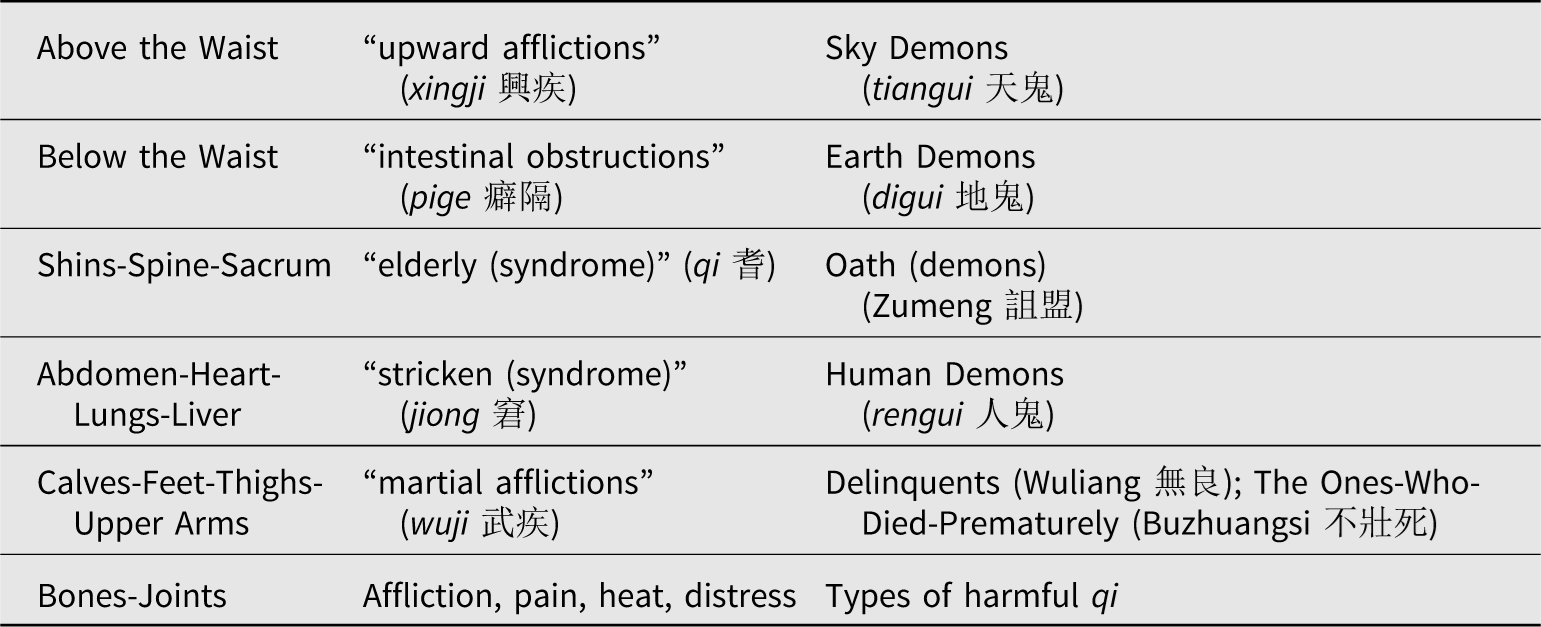
The Hundred Curses are created to emerge among humans. When prognosticating on afflictions among the people [addressed] to the groups of divine and earthly spirits, consider whether the locations [of the afflictions are] in the upper or lower [body], the left or right, in the limbs or intersecting areas, then match [the site] to its astral sign [chen 辰] and day. For all human afflictions, those above-the-waist are called “upward afflictions” [xingji 興疾], and are the curses from Sky Demons [Tiangui 天鬼]. Those below-the-waist are called “intestinal obstructions” [pige 癖隔], and are the curses from Earth Demons [Digui 地鬼]. Afflictions located in the shins, spine, or sacrum are called “elderly [syndrome]” [qi 耆], and are the curses from Oath [demons] [Zumeng 詛盟].Footnote 53 Afflictions located in abdomen, heart, lungs, or liver are called “stricken [syndrome]” [jiong 窘],Footnote 54 and are the curses from [once-]Human Demons [Rengui 人鬼]. Afflictions located in the calves, feet, thighs, or upper arms in the four limbs are called “martial afflictions” [wuji 武疾], and are curses from the [demonic] Delinquents [Wuliang 無良]Footnote 55 or The Ones-Who-Died-Prematurely [Buzhuangsi 不壯死]. Whenever people have afflictions in their skeletons or joints [baiti baijie 白體百節], whenever feeling afflicted and in pain, heated and in distress, [in a situation of] cojoining qi [huiqi 會氣] causing insanity, or of aggressive qi [hanqi 悍氣] causing itching sores, that swell and suppurate endlessly covering all over, then [it is due to] some particular Virtue [de] being impure and the destruction of the Hundred Curses!
Just as Confucius emphasized (as cited in Mengzi quoting the “Tai Jia” 太甲, presently a chapter of the Shang shu 尚書), people can be the causes of their own calamities, which unlike natural disasters cannot be dodged.Footnote 56 These “supernatural afflictions” or “curses” emerge among humans and are dealt with by healers who work with diviners, who, as we know from the Chu tomb records, used different types of divination tools—shells, stalks, dice, etc.—to determine the supernatural force behind the calamity. The supernatural forces in the Chu tomb records do not seem to correlate to sections of the body as clearly as they do in the *Wu ji or the *Shi fa, but this could be a reflection of the type of records they are, as they are limited to a particular patient and not a theoretical treatise or manual.
In the translated *Wu ji section on the Hundred Curses, the body is divided into six divisions: Above-the-Waist, Below-the-Waist, bones such as Shins-Spine-Sacrum, soft areas such as Abdomen-Heart-Lungs-Liver, areas of the limbs including Calves-Feet-Thighs-Upper Arms, and Bones-Joints generally. Each section is matched to a symptom or ailment that is suffered and then to a class of demonic spirits or evil influences that causes it (see Table 3).
Classification of ailments by body location and source, *Wu ji slips 91–95

Table 3 Long description
A table categorizing ailments by body location and associated demonic influences. The table has six rows and four columns. The columns are labeled ‘Body Location’, ‘Ailment’, ‘Translation’, and ‘Demon Type’. Row 1: Body Location, Above the Waist; Ailment, upward afflictions; Translation, xingji 腥疾; Demon Type, Sky Demons tiangui 天鬼. Row 2: Body Location, Below the Waist; Ailment, intestinal obstructions; Translation, pige 痞隔; Demon Type, Earth Demons digui 地鬼. Row 3: Body Location, Shins-Spine-Sacrum; Ailment, elderly (syndrome); Translation, qi 夷; Demon Type, Oath (demons) Zumeng 诅盟. Row 4: Body Location, Abdomen-Heart-Lungs-Liver; Ailment, stricken (syndrome); Translation, jiong 窘; Demon Type, Human Demons rengui 人鬼. Row 5: Body Location, Calves-Feet-Thighs-Upper Arms; Ailment, martial afflictions; Translation, wuji 武疾; Demon Type, Delinquents (Wuliang 無良); The Ones-Who-Died-Prematurely (Buzhuangsi 不壮死). Row 6: Body Location, Bones-Joints; Ailment, affliction, pain, heat, distress; Demon Type, Types of harmful qi.
*Shi fa classification of the Eight Divinities, Body sections, and Demons a

Table 4 Long description
A table mapping body sections to associated divinities and demons. The table has 8 rows and 3 columns. The columns are labeled ‘Shi fa classification of the Eight Divinities’, ‘Body sections’, and ‘Demons’. Row 1: Top of head, Wrecked shrines, mountains, unburied father, middle of a room, father. Row 2: Ears, Wind, elder who died prematurely, killed by a sword, a male boar, someone hanged, someone dismembered. Row 3: Lower arms and hands, A burial, boar, drought demon. Row 4: Legs below the knee and feet, Dawn, East, Bright Sky, White Sky, Rain Master, an insane person, door. Row 5: Orifices in face, Girl who died of fright from a big headed (demon), an elder daughter who became a concubine and died. Row 6: Chest or heart, Gate, passageway, mother, dead female slave, western sacrifice, someone hanged. Row 7: Abdomen, Heat, someone drowned, someone hanged, elder sister who died prematurely, someone dismembered. Row 8: Thighs and groin, Someone who died prematurely in childbirth, a wu-shaman, someone split open delivering twins, an insane person, someone hanged.
a Cook and Zhao, Stalk Divination, 136–39.
These body divisions listed in slips 91–95 do not perfectly line up with the way the body is parsed in terms of the areas assigned to spirits in slips 79–86 (Table 6), which is much more detailed (including separate sections for head, spine, right and left rib cages, shoulders, hips, upper and lower arms, upper and lower legs, as well as the ears, eyes, nose, mouth, heart, lungs-and-liver, kidneys, urethra, anus, spleen, and right and left feet). Curiously, both *Wu ji lists skip over “hands” (shou 手), although this division is indicated in the *Shi fa.
The *Shi fa does not include ailments or symptoms; demonic forces are listed in a separate section of the text and presumably responsible for problems in other areas of a client’s life as well as physical ailments. See Table 4 for these correlations. Instead of seeing clear categories of Sky, Earth, Human, or other types of demons, the types are generally mixed in the *Shi fa. The *Shi fa features division by gender in terms of both the divinities and the sets of demonic forces they control (or influence). The first four listed in Table 4 are male and represent the outside of the body and the second four are female and represent the inner spaces of the body. The only group of demonic forces that is common to the *Wu ji, the *Shi fa, and the Chu tomb records is that of “those who died prematurely.” Some of the demonic forces listed in the *Shi fa appear as divinities in the *Wu ji (indicated in bold) or in the Chu tomb records (italicized).
Fear of demons was fundamental to *Wu ji’s promotion of the Five Virtues of Ritual 禮, Propriety 義, Love 愛, Humaneness 仁, and Loyalty 忠. Although the predilection to sets of five (guidelines, sounds, colors, measurements, corrections, and much else) explains this specific list, it is also interesting to note that in pre-Han transmitted texts, this list of Five Virtues only appear together in the Xunzi 荀子 and the Li ji 禮記, and often appear along with other virtues, such as Trustworthiness (xin 信). Xunzi, a third-century-bce philosopher, spent time in Qi, which was famous as a site of learning and innovative philosophical approaches, early forms of which might be reflected in the *Wu ji.
The Jixia 稷下 academy, located in modern Zibo 淄博, Shandong, was active in the fourth and third centuries bce. It attracted scholars, including Zou Yan 鄒衍 (305–240 bce), credited with advocating the correlative philosophy of yinyang wuxing 陰陽五行, the fundamental ideology involving different modes of qi applied in later medical texts, such as the Huangdi neijing 黃帝內經. The academy was also possibly the source of the Huangdi-Laozi (Huanglao) school of Daoism.Footnote 57 During the second century bce, Qi was apparently a center of medical knowledge, as some of the medical manuscripts buried with a doctor in Tomb 3 excavated in Laoguanshan 老關山, Tianhui 天回, Sichuan, can be traced back to a Bian Que tradition of medicine possibly based in Shandong.Footnote 58 These manuscripts linked to Bian Que focus on qi in Yin and Yang channels of the body.Footnote 59
The Chu materials appear much more provincial than the *Wu ji, which reveal a stronger scientific (medical and astronomical) knowledge base. We will now examine in more detail what we term the cosmic body, that is the human body as a copy of the celestial body, and how it is supervised by divinities.
Construction of the Body and the Spirit Bureaucracy
The *Wu ji as a whole is not primarily concerned with the human body. It is a document designed to narrate how the world was set back on its correct course after an apocalypse and the critical role of human behavior in keeping it that way. Huangdi 黃帝 creates cosmic order by establishing a hierarchical divine bureaucracy. Although the construction of the human body is not described until slip 79, it is clear that the ideal human body was imagined as integrated into a multidimensional cosmic model, where the compass-drawn circle of the Sky (Tian 天) met the square-measured Earth (Di 地) structured with Four Pillars (Si Zhu 四柱) in the corners, Four Outskirts (Si Huang 四荒) between the edges of the circle and the square, Four Borders (Si Jie 四介) of the square, and Four Cords (Si Wei 四維) outlining directional regions inside the area defined by the circle and square.Footnote 60 Huangdi’s body represented the macro and microcosmos; it was the pattern for human sociopolitical hierarchy.Footnote 61 The human body and the cosmic structures were configured to “match God’s body” (配帝身) (slip 109).Footnote 62
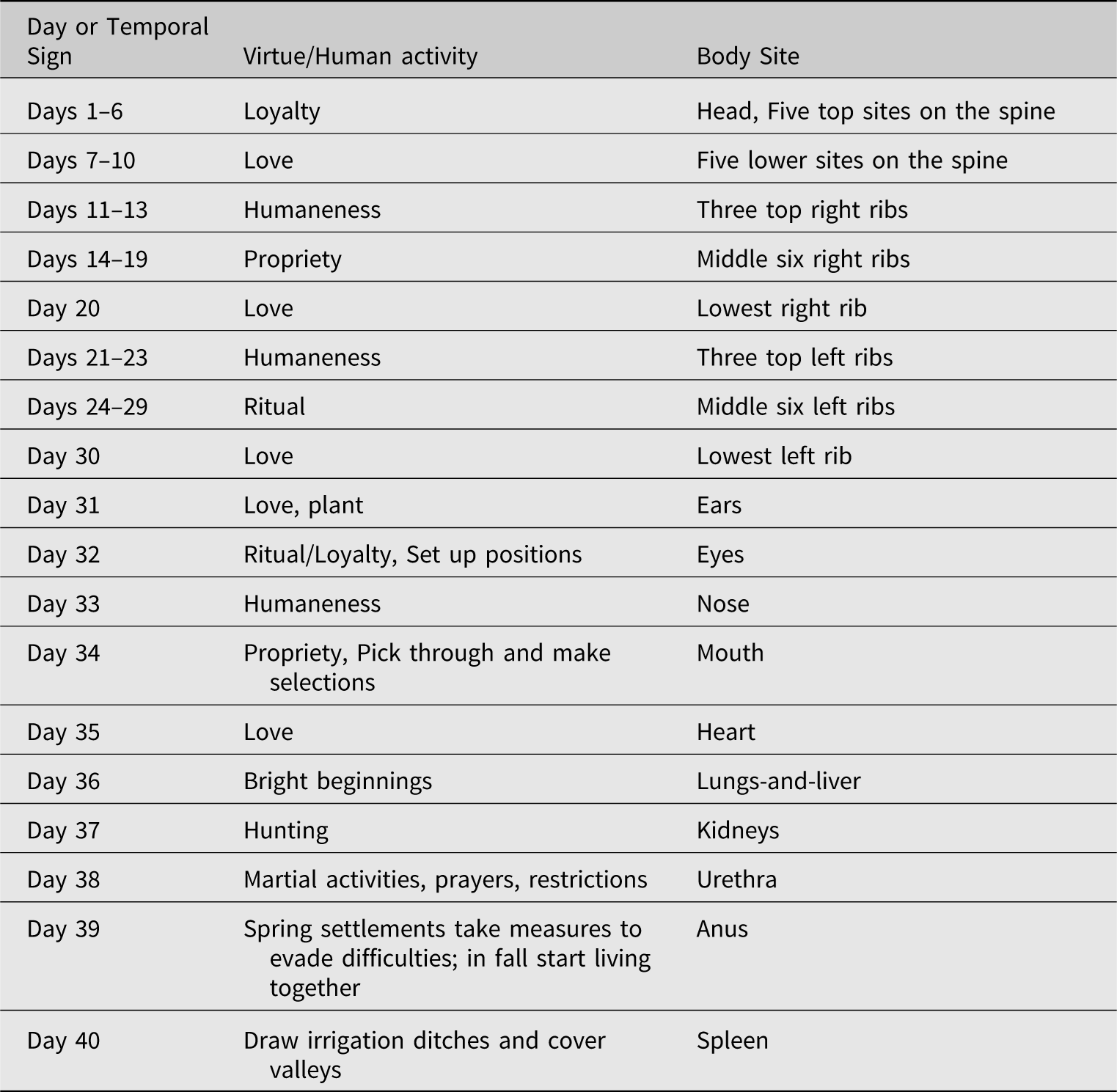
The section describing the manifestation of the human body and spiritual bureaucracy in charge of all its pieces (slips 79–86) begins with the explanation that “Hou’s work was completed as he set up the rules for the operation and manifestation of all living things” (后事鹹(咸)成,萬生行象則之). Modern scholars Jia Lianxiang 賈連翔 and Li Junming 李均明, both explain how the manifestation (xiang 象) and rules (ze 則) for the generation of all living things (wansheng 萬生) by Hou (Huangdi) were operated (xing 行) by the spiritual bureaucracy and connected to the numerological and temporal-spatial layout of the cosmos described in the first half of the manuscript.Footnote 63 The manifestation or creation of a visible human body and its corresponding spirits as described in slips 79–81 (Table 6), begins with the head and ends with the feet. The hierarchy of spiritual control over the manifested human body is first Hou Di (Huangdi), then Time, represented by the Stems-and-Branches days (minus days 41–50) and the 12 Stems (used to measure hours and other aspects of time), and then Sky and Earth spirits. The sense is that on specified days, the spirits would be responsible for reporting on human behavior. If we correlate the sets of divinities assigned to the Five Virtues in the beginning of the manuscript to the temporal markers and body sites mentioned later, we see the following schedule for inspecting and influencing human behavior through punishment:
*Wu ji Correlation of Time, Virtue, and Body

Table 5 Long description
A table with three columns: Day or Temporal Sign, Virtue/Human activity, and Body Site. The table has 15 rows, each detailing specific days or temporal signs, corresponding virtues or human activities, and associated body sites. Row 1: Days 1–6, Loyalty, Head, Five top sites on the spine. Row 2: Days 7–10, Love, Five lower sites on the spine. Row 3: Days 11–13, Humaneness, Three top right ribs. Row 4: Days 14–19, Propriety, Middle six right ribs. Row 5: Day 20, Love, Lowest right rib. Row 6: Days 21–23, Humaneness, Three top left ribs. Row 7: Days 24–29, Ritual, Middle six left ribs. Row 8: Day 30, Love, Lowest left rib. Row 9: Day 31, Love, plant, Ears. Row 10: Day 32, Ritual/Loyalty, Set up positions, Eyes. Row 11: Day 33, Humaneness, Nose. Row 12: Day 34, Propriety, Pick through and make selections, Mouth. Row 13: Day 35, Love, Heart. Row 14: Day 36, Bright beginnings, Lungs-and-liver. Row 15: Day 37, Hunting, Kidneys. Row 16: Day 38, Martial activities, prayers, restrictions, Urethra. Row 17: Day 39, Spring settlements take measures to evade difficulties; in fall start living together, Anus. Row 18: Day 40, Draw irrigation ditches and cover valleys, Spleen.
*Wu ji Construction of the Cosmic Human Body and Supernatural Agents (Slips 79–85)

aThe Four Outskirts appears in the Shanghai text *San De 三德, slip fragment 22 in the phrase “Inside the Four Huang is the X of Di” … (四荒之內是帝之X); see Ma Chengyuan, ed., Shanghai bowuguan cang Zhanguo Chu zhushu (wu), 303. The “three virtues” (san de) of the title are the De of the Sky, Earth, and Man.
bThere are five domestic spirits that appear in Chu tomb records and on tablets in tombs: Chamber (Shi 室), Stove (Zao 竈), Gate (Men 門), Door (Hu 戶), and Passageway (Xing 行). See Harper and Kalinowski, eds., Books of Fate and Popular Culture: The Daybook Manuscripts of Warring States, Qin, and Han (Leiden: Brill, 2017), 226.
cZhuanxu is one of the Five Emperors often correlated to the Five Agents (wuxing). The Kongjiapo Daybook (rishu) slip 437 linked Zhuanxu to the West 西方. On strip 436 Hao is linked to the East and Shu Di 叔帝 to the South. On slip 435, Huangdi is in the Center. In the Lushi Chunqiu and the Li ji “Yueling” the Five Di (mythical emperors) (五帝) are East=Tai Hao 太昊 (皞), West=Yan Di 炎帝, Center=Huang Di, West= Shao Hao 少昊(皞), and North= Zhuanxu. See the discussion in Wang Qiang 王強, “Kongjiapo Han mu jiandu jiaoshi” 孔家坡漢墓簡牘校釋, M.A. thesis (Jilin University, 2014), 154. Li Ling in his recent study of the Chu Silk Manuscript has laid out the wuxing charts for Liji “Yueling” and Lüshi Chunqiu (chart 2), Guanzi, “Youguan” (chart 3), Guanzi, “Wuxing” (chart 4), Huainanzi, “Tianwen” (chart 5), and the Huainanzi, “Shize” (chart 6), “other old books” (chart 7), Mawangdui “Xingde” (chart 8), and the Kongjiapo “Rishu” (chart 9), Zidanku boshu, vol. 2, 99–103. The greatest correlation to the body spirits found in the *Wu ji is in the Lüshi Chunqiu (chart 2); notably, although the charts are correlated to five seasons, the *Wu ji is not. In chart 2, Tai Hao correlates with Spring, Gou Mang 勾芒, Scaley Critters (鱗蟲), and Door (戶); Yan Di with Summer, Zhu Rong, Feathered Critters (羽蟲), and Stove; Shao Hao with Fall, Rushou 蓐收, Furry Critters (毛蟲), and Gate (門); Zhuanxu with Winter, Xuan Ming 玄冥, Shelled Critters (介蟲), and Passageway (行). The Mawangdui “Xingde” (chart 8) includes the same Five Di but links them to different spirits according to elements: Wood, Da Hao, Fenglong 豐隆; Fire, Yan Di, Feng Bo 風伯; Soil, Huang Di, Da Yin 大音; Metal, Shao Hao, Lei Gong 雷公; Water, Zhuanxu, Yu Shi 雨師. For a discussion of the evolution of Five Di worship in late Zhou religion and how the Five Di remained lower in status to Shangdi 上帝, see Luo Xinhui 羅新慧, Zhoudai de xinyang: Tian, Di, zuxian 周代的信仰:天、帝、祖先 (Shanghai: Shanghai guji, 2023), 560–79.
dGreat River appears as a spirit in the Xincai Geling Chu bamboo divination inscriptions, Jia san 甲三 21, Ling 零 198、203, Ling 零 9、Jia san 甲三 23、57; see Henansheng wenwu kaogu yanjiusuo, ed., Xincai Geling Chu mu.
eLou might possibly be an agricultural god in the guise of a mole-cricket (螻), see Li Junming, 86.
fQuangong is unknown. It was possibly pronounced similarly to *N-kro[n]-k(r)uŋ and should be considered as a loan. Huang Dekuan transcribes this spirit as Qiong 窮 for slip 7 (“Qinghuajian Wuji pian jiangou de tianren xitong,” (6–7). It is probably not the Chu god Zhurong 祝融*[t]uk*luŋ (? < *lum) as listed in the Li Ling Chart 2, but perhaps a kind of Critter (蟲) *C.lruŋ, or perhaps Fenglong 豐隆 *pʰ(r)oŋ- *[r]uŋ (< * -[u]m) in Chart 8 (Zidanku boshu, vol. 2, 99, 102). Historical phonetic reconstructions from Baxter-Sagart Old Chinese reconstruction, version 1.1 (20 September 2014). William H. Baxter (白⼀平) and Laurent Sagart (沙加爾) order: by Mandarin and Middle Chinese. https://sites.lsa.umich.edu/ocbaxtersagart/wp-content/uploads/sites/1415/2025/03/BaxterSagartOCbyMandarinMC2014-09-20.pdf. Accessed January 9, 2026.
gThere is some question whether the graph
 transcribed as the name Hao 昊 should in fact be read as shu 署 or re 熱 (but these two words are distinguished from hao on slip 94 as shu
 and re
 ). As to whether it was for the ancient god-king Tai Hao 太皞 or Xuan’ao 選囂 (as in the Jin period Diwang shiji 帝王世紀), see Yuan Qing 袁青, “Qinghua jian Wuji ke cheng zuo Huangdi shu” 清華簡⟪五紀⟫可稱作黃帝書, written 10–9-2022 and posted on 3–11–2024 on Geren tushuguan 個人圖書館 http://www.360doc.com/content/24/0611/11/410279_1125891851.shtml, accessed 4–25–2025; for whether it might represent seasonal directions as appears on a later cosmic divination board, see Cheng Shaoxuan 程少軒, “Taijishi shenmeng ‘Tai Hao’ kao” 太乙式神明‘太昊’考, Zhongshan daxue xuebao 中山大學學報 1012.1: 153–55.
h嚴*ŋ(r)am was perhaps for 炎 *[ɢ]ʷ(r)am, possibly for Yan Di 炎帝. Yan Di is one of the Five Di listed in the Liji “Yueling” and Lüshi Chunqiu as presented by Li Ling, Zidanku boshu, vol. 2, 99.
iJini was perhaps pronounced *[ts]ək-nr[ə]k, possibly for Lord Millet 后稷.
jGui days in the sixty-day calendar are days 10, 20, 30, 40, 50, and 60. The Middle ones would be 30 and 40.
kFour officials are listed—Si Meng 司盟, Si Lu 司祿, Si Ming 司命, and Si Jiao 司校—all seem to exist in other texts except the last. It seems likely that jiao 校 is misread and should stand for another office, possibly Si Jiu 司救, found in the Earth Officers section of the Zhou li. Si Lu is also in that section (although the description of duties is missing), but Si Meng is in the Autumn Officers section. Si Ming does not appear in the Zhou li as a human officer but as an object of worship along with Si Zhong 司中, Feng Shi 風師, and Yu Shi 雨師 in the Spring Officers section. Interestingly, Li Ling’s wuxing charts for Guanzi (chart 3) and Huainanzi (chart 6) include a variety of officer names, including some si, but different ones (Si Tu 徒, Si Ma 馬, Si Kong 空) (Zidanku boshu, vol. 2, 100–101).
lThe fact that the jie 介 are the shoulders and hips suggests angles such as we might find on a Di pan of an astrolabe.
mThis word 髀 bi could be interpreted as either thigh or hip in transmitted texts. In the Xincai Geling Chu tomb records, it is used in the name of a divination method and most likely refers to a hip bone. See Henansheng wenwu kaogu yanjiusuo, ed., Xincai Geling Chu mu, 198, Jia san 甲三 301-2, 301-1.
nFor a comparative study of the names for the Astral Lodges in different ancient texts, see Shi Xiaoli 石小力, “Qinghua jian *Wu ji zhong de ershiba su chutan” 清華簡⟪五紀⟫中的二十八宿初探, Wenwu 2021.9, 82–86. English translations for the names vary. See Tseng, Picturing Heaven in Early China, 309, Harper and Kalinowski, eds., Books of Fate and Popular Culture, 166, and Pankenier, Astrology and Cosmology in Early China, 269–70.
oThe commentary, Qinghua daxue chutu wenxian yanjiu yu baohu zhongxin, 118n16, suggests that since this section is informed by the traditional medical categories of nine openings (two eyes, two ears, two nose holes, mouth, urethra, anus) and five viscera (heart, lung, liver, spleen, kidneys), that this mystery word
 must be a mistake for “spleen” (pi 脾*m-[p]e). In the Mawangdui writing of the graph for pi
 (not interpreted as “spleen” but as a loan for bi 髀, hip or back part of the thigh), we see that the phonetic element 卑 on the right could indeed have been written in a way confusing to a copyist, the upper 田 misunderstood as 直 and the “hand” element underneath as a “heart” element. Han Tianshan suggests reading the graph as 植*m-tək (plant, for pole, penis?). For the Mawangdui manuscripts, Donald J. Harper translates kao 尻 “buttock,” zui 脧 “penis,” zhi 䐈 “rectum”; see Early Chinese Medical Literature: The Mawangdui Medical Manuscripts (London: Keegan Paul International, 1998), 513, 522, 523; 195n8 for bi as “back part of the thigh.” One problem with relying on the traditional list of five viscera is that the spleen was not always included. For example, on the lacquerware figurine discovered at Tianhui, Laoguanshan, Sichuan the list of acupoints for the viscera written down the spine go from top to bottom: heart, lungs, liver, stomach (胃), kidneys. In the Lingshu (edited much later), spleen replaces stomach; see Tianhui yijian zhenglizu, Tianhui yijian, reprint (Beijing: Wenwu, 2023), vol. 2, 183–84. The two examples of graphs read as pi in one of the channel texts are not clear; see vol. 1, 144, 165, Xiajing 下經, slips 35, 248.
The Virtues and human activities cannot be easily correlated to the directional deities of Borders, Pillars, and Cords. These deities are connected to the basic structure of the body (shoulders, hips, arms, legs, feet) and may be of a higher bureaucratic order than the individual deities that supervise the smaller bones, openings, and organs of the body core. Even so the directional deities are also subject to time and linked to the twelve Branches and Days 51–60. There is an even higher order of celestial ministers than time under Huangdi hinted at in the *Wu ji, spirits named Triaster (Can 參), Calculation (Suan 算), and Shangjia 上甲, but the reconstruction of the full cosmic hierarchy suggested by the *Wu ji remains an issue for debate and beyond the context of this study, which focuses on the body.
The body as governed by spirits in the *Wu ji, as pointed out by Li Junming, has a strong left-right alignment within the four directions. If we look for binary relationships left and right (versus the inner and outer of the *Shi fa), there seem to be some clear opposites, again with hints of a subtle pattern of Yin and Yang. Rib 4 on the right is governed by the Moon and Rib 4 on the left by the Sun; Rib 7 on the right, by Lesser Hao (Shao Hao), and Rib 7 on the left, Great Hao (Da Hao 大昊). That seems to suggest a Yin right and Yang left. But there are no clear parallels elsewhere. In each of the three sets of ten spirits on the body (spine and two ribs), there is a mix of astral, nature, legendary emperor, spatial, and other types. These make up the government of “above-the-waist.” The left–right alignment continues into the next category of “big bones,” that is the four main bones making up the square of the torso, the shoulder and hip bones, and moves on to the four limbs each divided into two sections and left and right. The torso and limbs are all governed by directional deities. Directional deities govern the left and right feet but five different temporal deities per foot are assigned to the ten individual bones.
The idealized body in the *Wu ji floats in a geometrically envisioned cosmos that is clearly ancestral to Han period astrolabes (shi 式) which also feature the Big Dipper, Astral Lodges, Stem-and-Branch day signs, and directions as mantic powers determining fate. While many of the ghosts and spirits mentioned are also found in the Chu pantheon, the vaster more technically intertwined *Wu ji pantheon seems to reflect a readership with greater knowledge and literacy.
After the section detailing the order in Table 6, the text in slips 86–91 goes on to describe the integration of the Five Virtues, including a reminder about South Gate and Northern Dipper’s roles, warnings about proper behavior, and the movement of the body as it begins to unfold in numerologically measured ways (reaching the number 10). Humans are warned not to skimp on the rituals or act in a wayward manner. This warning will be later illustrated by the tale of Chi You’s rebellion against Huangdi (whose body represents the cosmos) causing “reverse qi,” niqi 逆氣 (a sign of fatal illness in humans) and halos in the sky (slip 100). Chi You, described as Huangdi’s son, was finally killed by Huangdi’s spirit army at his father’s command. Chi You’s body was then dismembered and served up as a celebratory feast in what we might understand as a symbolic exorcism. Leftover parts of his body (hair, eyebrows, eyes, nose, mouth, etc.) were transformed into herbs, drums, bird cages, and other items that might be considered useful to a local diviner or healer (slips 109–11).Footnote 64 Essentially, the original cosmic order which had once formed Huangdi’s body was corrupted when his son rebelled; but then it was restored when the disorder was quelled and the demon exorcised. And, so, as the world was reconstituted, the human body was formed out of and in the model of Huangdi’s body, the cosmic body. Bad behavior, like the rebellion of Chi You, had to be punished. The demons that infect the human body would likewise have to be exorcised.
The mapped human body of the Wu ji, with its temporal signs, divinities, and demons, could, like that in the *Shi fa divination manual, be used to diagnose an illness. *Wu ji slips 46–50 mention the importance of different divination methods (“Heaven works through stalks and divinities work through turtles” [天為筮, 神為龜]) for seeking aid and resolving doubts. In the context of presenting symbolic sacrifices (parts representing the whole),Footnote
65
the text also brings up methods found in the Chu tomb records and Qin texts for dealing with demons and healing the human body: “exorcism, invocations, purifications, sequestering, sacrifices, prayers, expulsions, and gifts” (
 ; slip 53).Footnote
66
These rituals enabled the humans “to match in style the models provided by the spirits” (slip 50: 畏(鬼)神又(有)弋(式),天下同義(儀)).
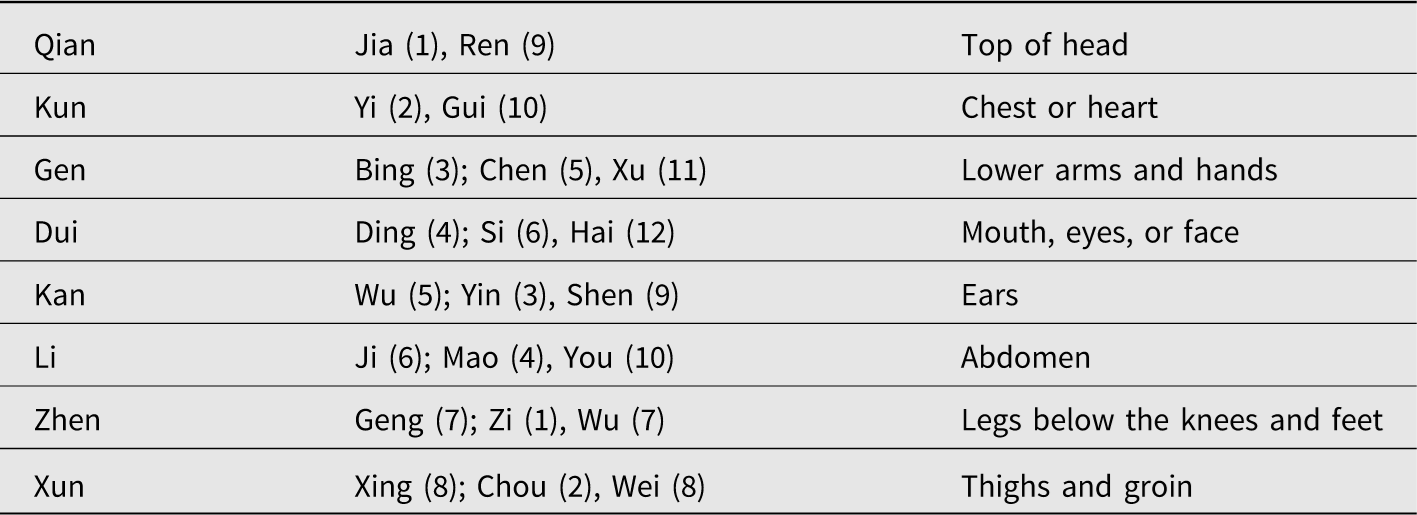
There is no question that control over the body by deities of time was a popular concept throughout the early Chinese world. The mantic power of time and the divinities associated with Stem-and-Branch signs appear in Qin and Han Daybook body diagrams for determining birth outcomes and in later texts that control taboos regarding the practice of acumoxa on parts of the body where the soul is residing at various time.Footnote 67 Although souls are not mentioned in the *Wu ji or *Shi fa, spirits of time and their mechanistic connections to other spiritual signs were intricately linked to the health of the different sections of the body. Stem-and-Branch signs in the *Shi fa are linked to particular trigrams and parts of the body (see Table 7; listed by trigram in the order found in the manuscript under Section 24).
*Shi fa Trigram, Stem, Branch, Body Part

Table 7 Long description
A table with three columns and eight rows. The columns are labeled ‘Qian’, ‘Jia (1), Ren (9)’, and ‘Top of head’. The rows list different trigrams, their associated stems and branches, and corresponding body parts. Row 1: Qian, Jia (1), Ren (9), Top of head. Row 2: Kun, Yi (2), Gui (10), Chest or heart. Row 3: Gen, Bing (3); Chen (5), Xu (11), Lower arms and hands. Row 4: Dui, Ding (4); Si (6), Hai (12), Mouth, eyes, or face. Row 5: Kan, Wu (5); Yin (3), Shen (9), Ears. Row 6: Li, Ji (6); Mao (4), You (10), Abdomen. Row 7: Zhen, Geng (7); Zi (1), Wu (7), Legs below the knees and feet. Row 8: Xun, Xing (8); Chou (2), Wei (8), Thighs and groin.
In the Section 24 diagram (see Figure 1), written around the outer square (which encloses the circle of celestially positioned trigrams which in turn enclose the square occupied by the human figure), we see that four trigrams (two male—Kan, Zhen, and two female—Dui, Li) were correlated to other mantic agencies: directions, bureaucratic divinities of agriculture, elemental phases and colors (see Table 8). Of these, the bureaucratic divinities or “supervisors” (si 司) are notable as they occur in both the Chu and *Wu ji pantheons. This official title was already ancient by the fourth century bce, dating back through Zhou to the Shang. But the earliest evidence for its application to a spirit and not a living official might be in a Spring and Autumn-era Qi state bronze inscription, sponsored by the daughter-in-law of a deceased Qi ruler. The inscription records sacrifices in his honor to spirits: the Great Dancer (大無(舞)), the Great Oath (spirit) (大誓), and the Great Supervisor of Lifespans (大司命) in the Southern Palace (南宮).Footnote 68 The Supervisor of Lifespans (Siming) appears in Chu tomb records as both a source of aid and curses (see list of demons and divinities in the next section). It is also notable that the use of “Great” (da 大) before a spirit’s name is common in the *Wu ji but appears only once in the Chu tomb records (see list) in the name of one of the spirits shared with *Wu ji, the Great Hao.
*Shi fa Spirits of Trigrams, Agriculture, Direction, Element, Color

Table 8 Long description
A table with four rows and five columns. The columns are labeled Kan, Zhen, Dui, and Li, representing different trigrams. The headers are Supervisor of Planting, Supervisor of Thunder, Supervisor of Harvesting, and Supervisor of Storage. The table also includes columns for Direction, Element, and Color. Row 1: Kan, Supervisor of Planting, South, Fire, Red. Row 2: Zhen, Supervisor of Thunder, East, Wood, Green. Row 3: Dui, Supervisor of Harvesting, West, Metal, White. Row 4: Li, Supervisor of Storage, North, Water, Black.
The exact relationship between the supernatural agencies of direction, time, etc. with the trigrams marking the body is not specified in the *Shi fa. What is the relationship between an agricultural deity, the trigram, and a particular day? The manual does not come with instructions or even a semblance of narrative rationale, unlike the *Wu ji. Nevertheless, the shared principle of a cosmically controlled body which can be punished by demons is suggested. Underneath the diagram of Section 24, each trigram is assigned to a list of sui-inflicting ghosts and demons that a diviner could consult (see Table 4).
Ghosts and Spirits
Some of the divinities and demons that appear in the Chu tomb records, the *Shi fa, and the *Wu ji are shared and represent a common belief, such as the oath demons or the ghosts of those who died violently, but each text also includes unknown spirits. The Chu tomb records appeal to personalized lists of ancestral figures since they are written for specific individuals, unlike either the *Shi fa or the *Wu ji. The pantheons of all three include astral, earth, and structural deities as well as legendary figures and various supervisors (si). Ghosts and demons include those who died prematurely, deceased parents, demonic animals, old temples, demons of events and places, and many more. The division between divine and demonic spirits in the Chu tomb records is evident by the types of rituals directed to them. Divine spirits are prayed to, offered sacrifices, and have names. Demonic spirits are subject to “attack” (gong 攻) through exorcism and generally anonymous. In some cases, a sui curse is “seen” or “visible” (jian/xian 見/現) in a group of otherwise beneficial divinities, which causes them to be placed in the demonic category as well, revealing a slipperiness between the divine and demonic functions of some of these spirits at least for the Chu people.Footnote 69
The idea that the *Wu ji represents a non-Chu system is supported by the fact that, while the names of some deities are shared, they seem to be differently correlated to the human body—although this is not always easy to determine. The site of the body afflicted by sui in the Chu records is rarely specified, so it is not possible to precisely delineate a hierarchy of body parts, spirits, and days as shown in Table 6 for the *Wu ji. On the rare chance that a record does include this information, it does not match. For example, slip 9 of the Tianxingguan 天星觀 Tomb 1 divination and sacrifice records note that on a Gengchen day (day 17), a foot was afflicted, and sacrifices were made to Dao 道, a road spirit, and exorcisms performed to remove the influence of the ghost of someone who had died by force, qiangsi 強死. As we can see for the *Wu ji, the Gengchen day influences the seventh rib down on the right side of the body, which is overseen by the spirit and legendary emperor Shao Hao 少昊 (Lesser Hao).
Other body parts mentioned in the Chu tomb records include the “heart” (xin 心) and “back” (bei 肧(背))—which at that time seem to refer generically to the front and back of the trunk of the body (at least for the Chu people). Illness was also recorded as affecting the “heart-and-abdomen” (xinfu 心腹 or fuxin), referring to the front core of the body, above and below the waist.Footnote 70 In the Tianxingguan Tomb 1 manuscript, slips 40–41 mention both back and heart as afflicted with sui possibly connected with the ghost of someone hanged (yisi 縊死), that should be exorcised on a Jiawu day (day 31). Day 31 in the *Wu ji is connected to the ear. Tianxingguan slip 44 records sacrifices to the spirit of Bright Morning (Baichao 白朝), which somewhat connects to the rib spirit of Dawn-and-Dusk in the *Wu ji.
Even if we consider that the spirits and demons mentioned in the Chu records played protective and punishing roles as in the *Wu ji, the correlations are simply not aligned. The *Wu ji body gods in number and specificity of assignment reflect a more developed medical tradition. The “heart” in the *Wu ji may in fact be an early reference to one of the recognized viscera instead of just the chest, as we see it named along with lungs-and-liver (fei gan 肺肝), kidneys (shen 腎), and possibly the spleen (pi 脾). Instead of a reference to the “back” in the *Wu ji, there is reference to the “spine” (ji 脊) and ten sites along it, each with the name of a different spirit and associated date. The protective spirit of the heart in *Wu ji was the Northern Dipper (Beidou 北斗) and the top spirit in charge of the spine was Earth. Unspecified Sky demons are associated with the afflictions above the waist. People who died before their time or violently are “ghosts” (rengui) and thereby implicated in afflictions in the limbs.
The *Wu ji includes Astral Lodges as divinities; this level of astrological knowledge does not appear in the Chu records or the *Shi fa. There is also greater attention to the calendar in the *Wu ji. On the day Jiawu (day 31) in the *Wu ji, the spirit of the first Astral Lodge, Great Horns (Dajiao 大角), is active and assigned to the ear (er 耳) (one of six openings mentioned: four on the head: ears, eyes, nose, and mouth; and two in the crotch: the anus and urethra). The day Jiawu is the supervising official in charge of all ten days including itself up to day 40 Guimao. All the viscera and openings were governed by Astral Lodge deities and active during this day set. This level of bureaucratic organization for the spirit and demon pantheon is not evident in the Chu records.
The gendered trigrams marking the inner and outer realms of the human body in the *Shi fa (see Figure 1) roughly correlate to gendered lists of demonic forces, including people who died by hanging, drowning, and dismemberment.Footnote 71 The eight lists also include spirits of nature, time, and space, such as Mountain (Shan 山), Gate (Men 門), Passageway (Xing 行), Wind (Feng 風), Heat (Re 熱), the sky at various times of the day, and others. In terms of any correlation to Stem-and-Branch terms, we see only sets of correlations to individual Stem signs or Branch signs and not to any days of the sexagenary cycle. The *Shi fa system does not seem to be as bureaucratically organized as in the *Wu ji. *Shi fa cosmic spirits that appear in the diagram (Figure 1) are not implicated in the curses (sui) section (Table 4). It is notable, these cosmic deities appear in groups of four not five (four xing 行 not five). The gender assignments do however correlate to the Yang and Yin binaries of Qin and Han times, but are not defined as such in the manuscript.
The divinities and demons mentioned in the Hubei and Henan Chu tomb records suggest a larger pantheon than evident just in the *Shi fa, which we consider also a Chu document. In the list below, those marked with a plus-sign “+” are appealed to for help, with a minus-sign “–” are the subjects of exorcisms, with an asterisk “*” if there is a *Wu ji equivalent, and a dollar-sign “$” for the *Shi fa.
Ancestors/Royal Lineage
+− Ancestors (Chu royal)
+ Blood Father, Blood Mother (新(親)父、新(親)母)
− Father (by blood) (新(親)父)
− Father (by lineage rank?) (父(太))
+ Five Generations of Kings, Grandfather, Grandmother (五世王王父王母)
− Three generations of grandfathers down to blood father (named, aka Gathered Adult Lords [集壯君])
− Grandfather (新(親 )王父)
+ Jing kings (alternative for Chu kings) (荊王) (named founder kings)
− Blood uncles and aunts/in-laws (named)
Mythical Founders
+− Chu Founders, Lao Tong, Zhu Rong, and Yu Yin (楚先, 老童, 祝融, 毓酓 (鬻熊))
+* Da Hao (Grand Open Sky) (
 )
Human Kin or Others who Died Prematurely or by Violence
+ Brothers who Died Without Heirs (兄弟無後)
+$ Female Prematurely Dead (女殤)
+ Three generations of prematurely dead (relatives, named)
− Died by Force (強死)
−$ Drowned (溺人)
− Floaters (水上)
−$ Hanged (縊死)
− Human Harm (人禹 (害 ))Footnote 72
− Innocents (不㱠(辜))
− Prematurely Dead (殤)
− Those Cut Off Without Heirs (絕無後者)
− War Dead (兵死)
Human and Cosmic Professionals
+− Wu-shaman (巫)
+ Soul Lord (靈君子)
+ Supervisor of Disaster (司禍)
+− Supervisor of Lifespans (司命)
Sky Spirits
+ Eclipsed Grand One (蝕太)
+− Grand One (太一)
+ Grand Spirit Brilliance (大神有皇)
+ Grand Spirit Eclipsed Grand One (大神蝕太)
− Cloud Lord (雲君)
−* Sun and Moon (日月)
Directional
+− North (北方)
+ Sire North (公北)
− South (南方)
Temporal
+ Bright Morning (白朝)
+ Night Affairs (夜事)
− Year/Jupiter (歲)
Earth Spirits
+ Altar to the Soil (社)
+ Earth Lord of the Residence (宮地主/宮后土)
+ Earth Lord of the Wilds (野地主)
+ Earth Lord (后土)
+ Earth Lord (地主)
+− Five Mountains (五山)
+−* Great Water (大水)
+ High Hill and Low Hill (高丘,下丘)
+ Hill (丘)
+ Mount Wei (佹山)
+− Two Sons of Heaven (二天子) (mountains?)Footnote 73
Built Space Spirits
+ Door (戶)
+* Gate (門)
+ Great Gate (大門)
+ Millet Hall (黍京) (?)
+ Northern Temple (北宗)
+* Passageways (行)
+ Residence Passageway (宮行)
+ Residence wu (sacred space?) (
 )
+ Roadway (道)
+ Walkway (步)
− Ancestor/Phallus Tablet/Stand (?) (
 )Footnote
74
− Splitwood Tablet/Spirit Stand/Asterism (?)((漸/斬/析?)木立(位 ))Footnote 75
− Residence Chamber (宮室)
− The Place of the Lord (君之所)
Other Demons
+ Cockscomb Pestilence Demon (葙厲)
− Pestilence Demon (厲)
− Group of Terrors/Ghosts (眾畏(鬼))
−* Oath Spirits (盟詛)
The affliction of the human body by demonic sui is found in the *Wu ji, the *Shi fa, and the Chu tomb records. This seems to be a shared understanding between the people in the cultural production zones of these texts. However, the slipperiness between the benign and malign forces seen in the Chu records does not appear in the *Wu ji. There, divinities and demons are hierarchically separate. The dirty work of infliction is left to a lower class of anonymous demonic forces. The Chu texts seem to represent a less rigidly bureaucratic society, perhaps representing the local elite rather than officials in a more central court.
The introduction of precursors of evil qi (xieqi)—heat, cojoined, aggressive—into the *Wu ji might possibly reflect the influence of a medical tradition of channel theory that at some point became entwined with a Bian Que medical tradition. The circulation of knowledge from the northeast into the Yangtze River Valley and points west during the late Warring States seems to be reflected in the appearance of the earliest preserved channel theory manuscripts, dated to the second century bce, excavated from modern Changsha, Hunan, Jiangling, Hubei, and Chengdu, Sichuan. While the movement of qi was certainly noted by Chu healers in the Chu tomb records, it is unclear if it was understood to move in Yin and Yang channels in the body. On the other hand, the *Wu ji mention of “cojoined qi” suggests an internal state of mutually affecting or conflicting types of qi. “Heat” which appears in both *Wu ji and *Shi fa could represent an environmental or external influence, suggesting again some common understanding between the two groups who produced these manuscripts.Footnote 76 Nevertheless, the *Wu ji conception reflects a more sophisticated viewpoint.
Conclusion
The two Tsinghua manuscripts, the *Shi fa and the *Wu ji, represent a shared mindset that illness was caused by demonic forces, which could be identified through divination and healed through exorcism. They also are the earliest precursors of the much later Daoist idea of body gods in the basic sense that specific divine entities had control over different parts of the human body.Footnote 77 Although there are overlaps in some of the deities and larger conceptions of illness in the *Shi fa and the *Wu ji, the latter text reflects a more complex knowledge of astrology, medicine, and bureaucracy. They seem to both date to the fourth century bce and to have been collected by the same person, but their contents appear to have originated in different social contexts. The *Shi fa was a manual used by diviners, possibly local to the ancient state of Chu, whereas the *Wu ji was a treatise for educated officials, possibly in the Qi state sphere of influence.







 Open access

