Like other Central and East European countries, Romania embarked on health reforms immediately after the collapse of communism at the end of 1989. The main legacies of the former communist regime were: highly centralized planning and financing, under-funding and lack of new investment, a demotivated work-force, and poor performance. The transition period added to these problems: an escalation in costs due to the increased use of new technologies, an aging population, and rapid health sector price inflation (Reference Scîntee, Trăistaru, Feachem, Hensher and Rose1). Unlike in the other countries the pace of health reforms in Romania was very slow. The main change involved replacing the national health financing system with social health insurance, introduced by the Social Health Insurance Bill in 1997, but implemented only in 1999. The switch to social health insurance was driven by the need for increased transparency and efficiency in healthcare spending.
There were also some initiatives aimed at decentralization. Initially, the National Health Insurance Fund (NHIF) was an independent, autonomous institution, with 44 branches (district health insurance funds, DHIFs) that raised insurance contributions locally and used 75 percent of the funds collected, 25 percent being sent to the NHIF for redistribution. Since 2002, the contributions have been collected at national level, by the Ministry of Finance, into one single fund. Between 2002 and 2005, the NHIF was under the coordination of the Ministry of Health (MoH). In 2005, the NHIF regained its independent status (Reference Vlădescu, Scîntee, Olsavszky, Allin and Mladovsky2). Still, the system remains highly centralized, with administrative regulation and financial control concentrated in the main national level institutions: the MoH, as central administrative authority in the health sector, responsible for stewardship of the system and its regulatory framework, including regulation of the pharmaceutical sector, and the NHIF, which administers and regulates the statutory health insurance system and contracts services from public and private providers through its district branches.
The latest reforms have introduced cost-saving emergency measures, including attempts to increase the cost-sharing for health technologies between the state, drug producers (through claw-back mechanism), and the population (through co-payments in different forms) and also introducing new ways of defining the basic benefit package (including HTA).
FINANCING HEALTH TECHNOLOGIES
The Romanian health system is financed from four main sources: NHIF, state budget, local budgets, and out-of-pocket payments. The most important source is the NHIF (65.8 percent), followed by out-of-pocket payments (18.7 percent), with the state budget covering 10.6 percent of total health expenditure (THE) (2013 data) (3).
Although the health insurance system is mandatory for every Romanian citizen, only approximately 85 percent are covered. Some categories, such as children and pregnant women are insured with no payment obligation. Insured persons are entitled to a comprehensive benefit package, while the uninsured receive a minimal benefit package, including emergency care, services related to prevention of epidemics, etc. The benefit packages and the contracting rules for each type of provider are included in the Framework Contract developed by the NHIF, agreed by the MoH, and approved by the Government. The contracts concluded by the DHIFs with public and private providers are based on the Framework Contract provisions.
Family physicians are organized as independent or group practices (5,688 in 2014) (4). They are paid by a mix of age-weighted capitation and fee for service. Specialized ambulatory care, provided through a network consisting of 77 hospital outpatient departments, 597 independent ambulatory clinics, and 9,109 specialist offices (2014 data) (4), is paid fee for service. The hospitals receive prospective payments consisting of a mix of payment methods: Diagnosis Related Groups (DRGs), case payment, day tariffs, and lump sums (e.g., covering drugs and medical supplies under national health programs). The total number of hospitals reporting in the DRG national system in 2014 was 594.
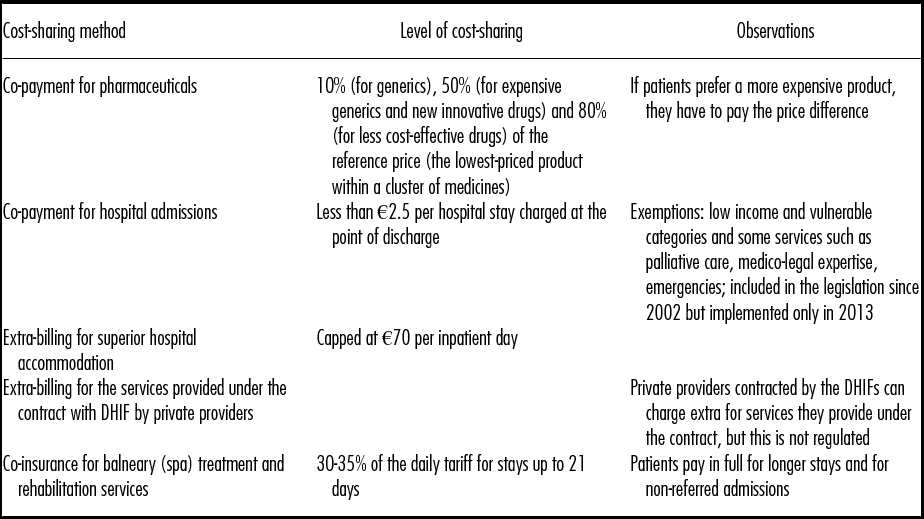
Pharmacies (7,421 in 2014) (4) are reimbursed on the basis of an annual contract. Pharmaceuticals reimbursed are included on specific lists in accordance with the percentage of cost covered by the NHIF (100 percent, 90 percent, 50 percent, or 20 percent). The difference is shared by the patient. There are six positive lists. List A contains mainly generics (around 148) for which the patient must pay 10 percent of the reference price. List B includes expensive generics and branded names (around 215 drugs) for which the patient must pay 50 percent of the reference price. List C has three parts: C1, a list of specialty drugs, mainly for severe and chronic diseases, disbursed through community pharmacies on the basis of a special medical prescription; C2, a list of drugs prescribed within the national treatment programs, disbursed through hospital pharmacies; and C3, a list only available to children, students. and pregnant women; totaling over 870 drugs, reimbursed 100 percent by health insurance. The newly established list D contains 21 drugs that were removed from the other lists to a lower level of compensation by applying HTA. For drugs on list D, the patient must pay 80 percent of the reference price. The reference prices are based on the lowest-priced product within a cluster of medicines, based on the generic substance, the pharmaceutical form, and strength. If a patient prefers a more expensive product, they will also have to pay the difference between the price of the lowest-priced product and the preferred drug (Reference Vlădescu, Scîntee, Olsavszky, Hernández-Quevedo and Sagan5).
The State budget funds disease prevention programs, emergency services and investments. Local budgets pay for maintenance and repairs. Out-of-pocket payments consist mainly of direct payments for services offered by private providers, co-payments for drugs and other services, and informal payments.
With the lowest share of GDP spent on health care among the European Union (EU) Member States (5.6 percent in 2014 according to WHO Global Health Expenditure data), Romania situates among the countries with the highest spending on hospital care as percentage of THE. The other major category of spending is medical goods, mainly pharmaceuticals (Reference Vlădescu, Scîntee, Olsavszky, Hernández-Quevedo and Sagan5). According to the Organisation for Economic Co-operation and Development (OECD), in 2012 Romania ranked fifth in terms of the share of THE spent on drugs among twenty-three EU countries (without Bulgaria, Ireland, Italy, Malta, and the United Kingdom), and had the highest average annual growth in pharmaceutical expenditure per capita (6.1) since 2000 to 2012. Nevertheless, pharmaceutical expenditure per capita in Romania, at €216 in 2012, is still low compared with the average for twenty-five EU countries, as presented by an OECD report (6).
Cost Sharing
User charges were introduced to reduce inappropriate demand, to contain costs and to raise revenue. The main cost-sharing methods practiced in the Romanian health system are presented in Table 1.
User Charges for Healthcare Services

Evidence-Based Practice and Decision Making
Romania is a step behind other European countries that have made a good progress in adopting evidence based medicine and decision making. Both medical specialists and decision makers try to use the experience of others by adopting practices and models tested and successfully implemented in other countries, but without adapting them to the national context. Evidence-based practice in Romania is not yet fully adopted, and the need to base both medical practice and decision making on scientific evidence of efficacy is not universally (Reference Evidence7).
However, the trend is encouraging. Healthcare practice in Romania is no longer based solely on individual knowledge and personal experience. Dissemination of scientific evidence has increased in recent decades with the increasing number of scientific journals and publications, national and international events, memberships in European and international networks and collaborations, participation in European and international research projects, access to international data bases, etc. Collaboration within research projects and networks gives a major impetus to behavior change. Physicians are looking for best practice in a particular medical area. Decision makers are looking for evidence-based criteria for reimbursement/practice guidelines, already partially included in the health legislation.
Transitional HTA System
The implementation of HTA in Romania started in 2012, following numerous attempts to introduce it from the early 1990s. What speeded the process was the need to pass EU Directive 2011/24/ on the application of patients’ rights in cross-border health care into Romanian law.
A national competent authority for HTA was established as a unit within the MoH. Its main mission was to develop a methodology for the rapid assessment of drugs and to verify the files submitted by pharmaceutical companies for the drugs proposed for reimbursement. The methodology, approved by the MoH Order 724/2013, consisted of a scorecard system, with six criteria: the results of evaluations done in France (Reference Scîntee, Trăistaru, Feachem, Hensher and Rose1), the results of evaluations done in Great Britain (Reference Vlădescu, Scîntee, Olsavszky, Allin and Mladovsky2), the number of EU member states that reimburse the drug (3), evidence based relative efficacy (4), relative safety (Reference Vlădescu, Scîntee, Olsavszky, Hernández-Quevedo and Sagan5) and patient reported outcomes (6).
In 2014, the HTA structure became a department under the National Agency for Medicines and Medical Devices (NAMMD), and the evaluation methodology was changed several times trying to remedy previous weaknesses. Thus, a few more evaluation criteria have been added (the results of evaluations done in Germany, the development of a local Real-World Data [RWD] study, and a budget impact assessment), two thresholds have been set for inclusion on the reimbursed drug list by introducing the “conditional inclusion” (the condition for the applicant for having the International Nonproprietary Name [INN] on the list is to close a cost-volume/cost-volume-results agreement with the NHIF or other types of agreements for facilitating patients’ fast access to the treatment), specific criteria were set for evaluating orphan drugs and infectious diseases drugs, and criteria have been included for the exclusion of drugs already reimbursed (Reference Radu, Chiriac and Pravat8–Reference Morega10).
Also the Health Reform Law 95/2006 that regulates pharmaceuticals was modified in 2014 to include all the provisions of the EU Directive 89/105/EEC relating to the transparency of measures regulating the pricing of medicinal products for human use and their inclusion in the scope of national health insurance systems. Other additions included making HTA the main tool for compiling and regularly updating the list of medicines to be reimbursed.
As a result of the HTA activities, the list of the INNs reimbursed by health insurance has been modified six times during 2014–2016. Thus, approximately 40 new molecules were included in 2014 (17 by the Government Decision 389/2014 and 23 by the Government Decision 996/2014). The new drugs correspond to the following therapeutic areas: oncology, cardiology, endocrinology, gastroenterology, hematology, infectious diseases, nephrology, ophthalmology, pulmonology, psychiatry, rheumatology, urology, diabetes mellitus (11). In 2015, over ten new drugs were included on the list, but another sixteen were delisted and another twenty-one were moved to a lower level of reimbursement (20 percent) (Reference Radu, Chiriac and Pravat8) by three Government Decisions: 741/2015, 799/2015, and 877/2015. In 2016, the Government Decision 552/2016 included, removed to other reimbursement level, or delisted another 25 INNs.
Pricing of Pharmaceuticals
Prices of authorized medicines are set by the MoH, except over the counter medicines. For them, the market authorization holder has to notify the MoH of the price within 30 days of their release onto the market. Producers and importers have to present the manufacturer's price to the MoH. This price is compared with prices for the same product already on the market in twelve countries (Czech Republic, Bulgaria, Hungary, Poland, Slovakia, Austria, Belgium, Italy, Lithuania, Spain, Greece, and Germany) to ensure that the price in Romania is lower than or equal to the lowest price among these countries. If the drug is not registered in the comparison countries, the price in the country of origin is used as reference. The price of a new generic cannot exceed 65 percent of the price of its original reference. The formula to calculate the maximal retail price takes into account the producer price, wholesale price, and a 9 percent value-added tax. The mark-up of the wholesalers and pharmacies varies from 10 percent for prices up to 300 lei (around €67) and 24 percent for prices below 25 lei (around €6). For drugs priced at over 300 lei, the mark-up becomes a flat rate of 30 lei (around €7) for the wholesaler and 35 lei (around €8) for the retailer (Reference Vlădescu, Scîntee, Olsavszky, Hernández-Quevedo and Sagan5).
For approved prices, the MoH will issue an order within 90 days as of the receipt of the full documentation. If the proposed price does not comply with the pricing methodology, the MoH will issue and send the applicant a letter stating the reasons for rejection of the price proposed, and the MoH will set a price in accordance with the methodology. If the applicant does not agree the price set by the MoH, he can sell the medicines at the previous price until existing stocks are exhausted, but not longer than 6 months from date of rejection. Retail prices are published in a Drug Catalogue that is updated quarterly (12).
Reimbursement for Health Procedures and Drugs
HTA is used only for the reimbursement of drugs. No methodology has been developed for the assessment of other technologies (i.e., diagnostic procedures, surgical interventions, screening, etc.). Usually, decisions on the technologies to be included in the social health insurance benefit packages or in the national health programs are taken by the NHIF and the MoH, through the specialized departments, based on consultations with different actors (i.e., specialty commissions in the MoH, providers’ professional organizations, patients’ associations, etc.) without having clear and transparent inclusion/exclusion criteria. One exception to this rule is the minimal package for uninsured persons, based on three main criteria: life-threatening emergencies, epidemic prone/infectious diseases, and childbirth.
All insured persons have access to reimbursed pharmaceuticals with or without co-payment that are included in specific lists elaborated by the HTA department of the NAMMD in cooperation with NHIF and MoH, based on the methodology discussed above. The list of applications submitted, evaluation reports, and list of contesters are published on the NAMMD Web site.
DISCUSSION
The implementation of HTA, even at a very early stage, enabled the reimbursed drug lists to be updated twice in 2014, three times in 2015, and once in 2016, including new drugs, and removing to other reimbursement level or delisting old ones. As the lists were last updated in 2008, Romanian patients were deprived in this period of the benefits of new, innovative treatments. Although far from perfect, incompletely applied (e.g., there is no methodology for local RWD study) and limited to pharmaceuticals, the current transitional HTA system is a first step toward a comprehensive, effective HTA system.
HTA development is following the recommendations of foreign consultants, to take small steps, consider the limited resources, and start with a quick HTA mechanism (based on a score-card system) until the required capacities are in place to support a full HTA process (Reference Ruiz, Lopert and Chalkidou13).
Besides gaps between policy formulation and policy implementation typical of policy making in Romania, the main obstacle to implementation of HTA was the lack of technical and financial resources. Within these limits, the MoH supports different projects for HTA capacity building.
HTA, a current and worldwide issue, has rapidly become a concern for all stakeholders and actors in the Romanian health system, each with different expectations/interests: decision makers are interested in cost-containment, patients in obtaining the best care, and producers in receiving acceptable reimbursement. Alongside the EU requirements, these will be the driving factors that will push forward the implementation of a proper HTA system in Romania.
CONCLUSIONS
The steps taken to date in the development of an HTA system in Romania show the political will to further develop the system and to use HTA as a tool for increasing the effectiveness of medical practice and decision making. Full HTA implementation will require political stability and the release of necessary funds.
International collaboration is also encouraging HTA development in Romania, because, as part of the EU community, it has to keep pace with the other EU countries that are increasingly using HTA to inform decision and policy making in the healthcare sector.
CONFLICTS OF INTEREST
We have no conflict of interest to declare.