Probability of survival to hospital discharge among infants and children requiring extracorporeal membrane oxygenation for cardiac failure due to medical conditions or post-surgical complications is lower compared with that of similarly aged patients treated with extracorporeal membrane oxygenation for respiratory failure or sepsis.Reference Bartlett, Roloff, Custer, Younger and Hirschl 1 Hospital survival rates for the paediatric cardiac population reported from single-institution studies and the Extracorporeal Life Support Organization registry range from 35% to 50%.Reference Aharon, Drinkwater and Churchwell 2 – Reference da Cruz, Beghetti and Kalangos 8 Similarly, long-term outcomes in neonates and infants are more favourable among non-cardiac and respiratory extracorporeal membrane oxygenation patients, although neurodevelopmental co-morbidity exists in all children who require extracorporeal membrane oxygenation support.Reference Bohn 9 – Reference Schoeman, Pierro, Macrae, Spitz, Kiely and Drake 15 There are limited data on the long-term outcome of paediatric survivors of extracorporeal membrane oxygenation instituted for cardiac indications,Reference Ibrahim, Duncan, Blume and Jonas 16 , Reference Fenton, Webber and Danford 17 and little is known about re-hospitalisation or the need for additional surgeries in this patient cohort.Reference Jen and Shew 18
The purposes of this study were to investigate extended survival rates among paediatric patients requiring extracorporeal membrane oxygenation initiated for cardiac indications and assess the frequency and causes of re-hospitalisation in these patients.
Material and methods
Study population
Following Institutional Review Board approval, data were obtained on all paediatric patients at Children's Hospital Colorado treated with extracorporeal membrane oxygenation for primary cardiac dysfunction between January 1, 2003 and December 31, 2007. Patients treated with extracorporeal membrane oxygenation for respiratory indications or sepsis were excluded.
Data collection
Data were extracted from patient medical records and from billing information. Variables collected included demographic information, diagnosis, clinical support details, complications, patient outcomes, and re-hospitalisations. Primary outcome measures were defined as survival following extracorporeal membrane oxygenation decannulation and survival to hospital discharge. Extended outcomes considered were survival following index extracorporeal membrane oxygenation hospitalisation, hospital re-admission, and indications for hospital re-admission, including the need for repeat cardiac surgery.
Data categorisation
Patients were categorised into two groups on the basis of the primary indication for extracorporeal membrane oxygenation. The surgical group consisted of patients cannulated for extracorporeal membrane oxygenation because of circulatory insufficiency following open or closed cardiac surgical procedures and including primary graft failure after orthotopic heart transplant. The medical group consisted of patients with primary circulatory insufficiency not associated with prior cardiac surgery during the index admission. The surgical group included data such as aortic cross clamp time, cardiopulmonary bypass time, and circulatory arrest time. Comprehensive Aristotle scores for the surgical group were also included. The Aristotle Score is a complexity-adjusted method to evaluate surgical results for congenital cardiac surgery.Reference Lacour-Gayet, Clarke and Jacobs 19 The indications for extracorporeal membrane oxygenation in the surgical group were classified as: (a) failure to wean from cardiopulmonary bypass, (b) post-operative low cardiac output, (c) post-operative cardiac arrest requiring cardiopulmonary resuscitation, or (d) post-operative intractable arrhythmia. The indications in the medical group were classified as: (a) cardiac arrest requiring cardiopulmonary resuscitation, (b) cardiac dysfunction due to myocarditis, c) low cardiac output due to cardiomyopathy, (d) cardiac dysfunction due to heart transplant rejection, (e) intractable arrhythmia, and (f) primary graft failure after orthotopic heart transplantation. Patients were also classified by single or bi-ventricular anatomy or physiology based on anatomic diagnosis.
Re-hospitalisation diagnosis was determined from admission documentation and classified as (a) respiratory – pneumonia, bronchitis, non-cardiogenic respiratory distress, asthma; (b) cardiac – congestive heart failure, pulmonary hypertension, heart transplant rejection, arrhythmias, repeat surgeries; or (c) others – infectious, gastrointestinal, haematologic, or psychiatric pathology, and non-cardiac elective surgery.
Index hospitalisation was defined as the hospitalisation associated with the initial extracorporeal membrane oxygenation run and excluded re-admissions or additional extracorporeal membrane oxygenation runs.
Statistical analysis
SAS 9.2 was used for statistical analysis. The two-sample t-test and the chi-square t-test were used to compare continuous and categorical variables, respectively. Logistic regression analyses were used to identify significant factors for mortality during extracorporeal membrane oxygenation and subsequent hospital mortality. This process started with a univariate analysis using a p-value equal to 0.15 as cutoff for significance, and then a multiple logistic regression analysis was run using backward selection methodology to determine factors significant at 0.05 level. Kaplan–Meier curves were generated to estimate survival and time to first re-hospitalisation. Poisson regression analysis with the logarithm follow-up years adjusted as an offset was used to compare the number of re-hospitalisations between surgical and medical groups.
Results
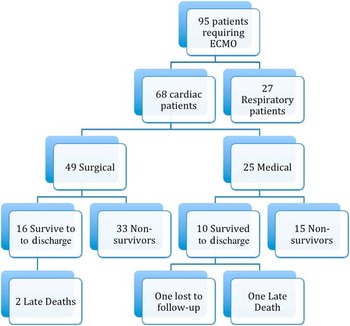
During the 5-year study period, 74 out of a total of 101 extracorporeal membrane oxygenation runs (73%) performed at our institution were indicated for primary cardiac dysfunction (Fig 1). These 74 cardiac extracorporeal membrane oxygenation runs were performed in 68 patients, of whom six – four surgical and two medical – underwent two extracorporeal membrane oxygenation runs. Of these six patients, five underwent a second run during the index extracorporeal membrane oxygenation hospitalisation; one patient underwent a second extracorporeal membrane oxygenation run during a subsequent hospital admission. Of the 68 study patients, one was transitioned from extracorporeal membrane oxygenation to a bi-ventricular assist device and is included in the analysis (Table 1).
Extracorporeal membrane oxygenation run profile. ECMO = extracorporeal membrane oxygenation.

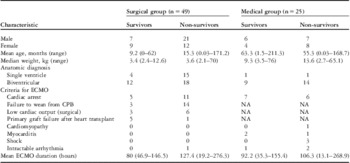
Patient characteristics for survival to discharge.

CPB = cardiopulmonary bypass; ECMO = extracorporeal membrane oxygenation; NA = not applicable for non-surgical patients
Hospital survival and predictors of mortality
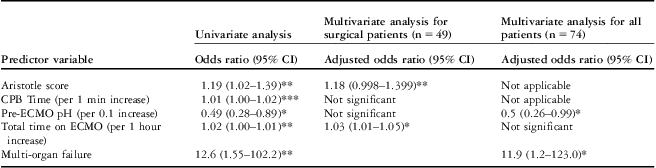
Survival to extracorporeal membrane oxygenation decannulation was seen in 69% of patients (95% confidence interval: 57–79%). Overall survival to hospital discharge was 37% (95% confidence interval: 26–49%), with no significant difference between the medical and surgical groups (Table 1). Statistically significant factors predicting mortality during extracorporeal membrane oxygenation and mortality from end of extracorporeal membrane oxygenation to discharge are included in Table 2.
Logistic regression analysis of risk for mortality during hospitalisation (n = 74).

CPB = cardiopulmonary bypass; ECMO = extracorporeal membrane oxygenation; NA = not applicable for non-surgical patients
Extended survival
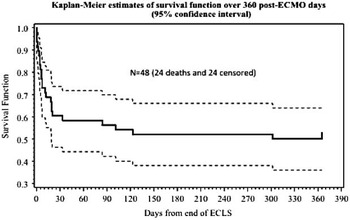
The extended survival for 48 cardiac extracorporeal membrane oxygenation hospital survivors is estimated in Figure 2. Out of the 48 children, 26 survived to discharge and were followed up for a median of 5.4 years (ranging from 3 to 7.6 years). One patient was lost to follow-up. There were three late deaths at 5 months, 20 months, and 6.8 years following discharge from the index extracorporeal membrane oxygenation hospitalisation.
Kaplan–Meier estimate of overall survival to 1 year after extracorporeal membrane oxygenation. ECMO = extracorporeal membrane oxygenation; ECLS = Extracorporeal life support.

Re-hospitalisations
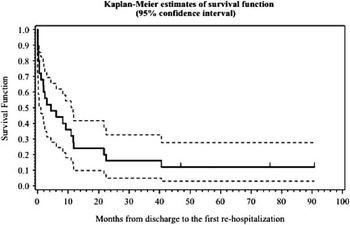
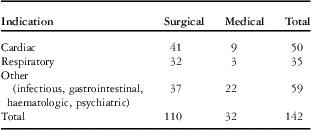
At a median follow-up of 5.4 years (ranging from 3 to 7.6 years), 88% (95% confidence interval: 67–98%) of patients had at least one hospital re-admission. There were a total of 142 re-hospitalisations in 25 survivors with a median of 0.62 (ranging from 0 to 4.9) re-admissions per year per patient. The median time to the first re-admission was 11 months (Fig 3). In our cohort, seven patients were re-admitted within 1 month of discharge from the extracorporeal membrane oxygenation index hospitalisation. Of the 142 re-hospitalisations, 110 were for the 16 patients in the surgical group and 32 for the 9 patients in the medical group. In Poisson regression analysis, the estimated average number of re-hospitalisations per patient per year was 1.3 in the surgical group and 0.7 in the medical group (p < 0.001). The most common cause for re-admission was a cardiac indication (63%), followed by respiratory, infectious, and gastrointestinal diagnoses (Table 3).
Kaplan–Meier estimate of time to re-hospitalisation.

Primary reason for re-hospitalisation (n = 142Footnote *).

* Total number of hospitalisations for 25 patients (16 surgical, 9 non-surgical) over a median follow-up period of 5.4 years (ranging from 3 to 7.6 years) after initial extracorporeal membrane oxygenation
Surgical versus medical group
Survival to decannulation for the surgical and medical groups was 67% and 72%, respectively. Survival to discharge for the surgical and medical groups was 33% and 40%, respectively (Fig 1). Cardiopulmonary bypass time and Aristotle comprehensive scores were significantly correlated with survival to discharge for surgical patients (Table 2).
Among the hospital survivors, 38% were re-admitted for surgical procedures – 12 of 16 surgical patients, and 2 of 9 medical patients for heart transplantation. Of the three patients who died late, two were originally placed on extracorporeal membrane oxygenation for post-surgical indications (the surgical group), and one was placed on extracorporeal membrane oxygenation as a bridge to orthotopic heart transplant (the medical group).
Multiple extracorporeal membrane oxygenation runs
One patient was transitioned from extracorporeal membrane oxygenation to a bi-ventricular assist device as a bridge to transplant but did not survive to transplant. In all, six patients had multiple extracorporeal membrane oxygenation runs – four surgical and two medical patients – of whom five patients had a second extracorporeal membrane oxygenation run during the index hospitalisation. The other patient underwent a second extracorporeal membrane oxygenation run at a subsequent hospitalisation that occurred 9 months after discharge from the index hospitalisation. Another multiple run patient was originally bridged to transplant with extracorporeal membrane oxygenation after a failed cardiac surgical procedure and survived a second extracorporeal membrane oxygenation run for immediate graft failure. This patient was re-admitted 6 years later and did not survive a third extracorporeal membrane oxygenation course instituted for overwhelming sepsis.
Duration of intensive care unit and hospital stay
The mean stay in the Intensive Care Unit was 18.9 (plus or minus 22.6) days and the mean hospital stay was 28.1 (plus or minus 36.3) days after cannulation. No statistical difference in Intensive Care Unit and hospital lengths of stay was apparent between surgical (18 and 25 days) and medical patients (20 and 32 days).
Discussion
Limited data are available on hospital re-admissions in children with congenital heart disease undergoing surgical interventions. We examined a cohort of the most critically ill children with cardiac disease, those requiring extracorporeal membrane oxygenation support, and found re-hospitalisation to be quite common. Nevertheless, despite the frequency of re-admissions, most paediatric cardiac patients who survive extracorporeal membrane oxygenation support to hospital discharge may be successfully medically managed outside the hospital.
To our knowledge this is the first study to examine extended survival and re-admission outcomes in a cohort of exclusively paediatric patients suffering from congenital and acquired cardiac disease. Jen and ShewReference Jen and Shew 18 recently described hospital re-admissions and survival after extracorporeal membrane oxygenation support for non-neonatal paediatric patients with acquired cardiac and respiratory disease over a median period of 3.7 years. The researchers found a greater than 60% re-admission rate and late deaths in 5% of the patients. In our study, 88% of the patients surviving to discharge were re-admitted for medical management or subsequently scheduled surgical interventions within 5.5 years of discharge. As expected, surgical patients had twice the number of re-hospitalisations as did medical patients, and repeat surgical intervention was the most common reason for re-hospitalisation among the surgical extracorporeal membrane oxygenation survivors. The most common reasons for re-hospitalisation in the medical extracorporeal membrane oxygenation survivor group were for non-cardiac aetiologies, including gastrointestinal, infectious, haematologic, or psychiatric pathology. Interestingly, surgical survivors were more likely to be re-admitted for respiratory infection compared with medical survivors. There may be some evidence that children with congenital heart disease are more susceptible to respiratory illnesses given the co-morbid states of congestive heart failure, pulmonary oedema, hypoalbuminaemia, and reduced airway clearance.Reference Mackie, Ionescu-Ittu, Pilote, Rahme and Marelli 21
The survival rate to hospital discharge for paediatric patients requiring extracorporeal membrane oxygenation for myocardial dysfunction at our centre falls within the range reported in previous studies.Reference Lequier 20 – Reference Taylor, Cousins and Butt 27 Certainly survival to hospital discharge for these patients is heavily influenced by the pathophysiology that determined their being placed on extracorporeal membrane oxygenation. It is indeed variable: higher for paediatric patients with myocarditis and more guarded after cardiac surgery and in cases of primary graft failure after orthotopic heart transplant.Reference Tissot, Buckvold and Phelps 28 – Reference Mitchell, Campbell, Bielefeld and Doremus 29 However, within the paediatric extracorporeal membrane oxygenation for cardiac failure literature, survival to discharge is commonly described, but long-term outcomes for these patients are poorly characterised. Ibrahim et al described a single-centre cohort of 37 paediatric patients supported with 26 extracorporeal membrane oxygenation runs and 11 ventricular assist device implantations. These patients were followed up for a median follow-up of 42 months after mechanical support – after extracorporeal membrane oxygenation or ventricular assist device implantation – with only one extracorporeal membrane oxygenation-supported patient death during that time period.Reference Ibrahim, Duncan, Blume and Jonas 16 Of the patients for whom neurologic follow-up was available, they found moderate-to-severe neurologic impairment to be more common among survivors of extracorporeal membrane oxygenation than among survivors of ventricular assist device-supported patients. In comparison, in our study, there were three late deaths over a slightly longer follow-up period. Two of the three late deaths in our study were associated with disease complications that required subsequent extracorporeal membrane oxygenation therapy at secondary hospital admissions. Paediatric patients requiring a second course of extracorporeal membrane oxygenation during their index hospitalisation demonstrated survival statistics similar to those in the first run; however, survival rates after a second run were lower in paediatric cardiac patients following cardiac surgery.Reference Fisher, Stolar and Cowles 30 , Reference Shuhaiber, Thiagarajan, Laussen, Fynn-Thompson, Del Nido and Pigula 31
The importance of re-hospitalisation for paediatric cardiac patients who survived extracorporeal membrane oxygenation therapy is two-fold. First, the frequency and indications for re-hospitalisation provide a surrogate, albeit limited, indicator for the quality of life of survivors. Given the relative paucity of long-term quality-of-life assessments for these patients, re-hospitalisation data provide insight into the chronicity of this disease. The incidence of cognitive delays, learning disabilities, and school performance and graduation rates, as well as self-reported quality-of-life measures, should be additional data collected to better characterise the life of the extracorporeal membrane oxygenation survivor. Second, subsequent re-hospitalisation data indicate that the cost of ongoing medical care in this patient population is not limited to the index extracorporeal membrane oxygenation hospitalisation.
Limitations of this study include a single-centre experience, a small sample size, and the nature of retrospective studies. We recognise the possibility that some patients may have sought care at hospitals that are not within the network of the Children's Hospital Colorado, and we may therefore have underestimated the re-hospitalisation rates. Nevertheless, as our institution is the primary paediatric referral centre for the Rocky Mountain region, it is likely we were able to capture a majority of, if not all, re-hospitalisations.
Conclusions
Extended outcomes for paediatric patients requiring extracorporeal membrane oxygenation to treat primary cardiac dysfunction are favourable for patients who survive to hospital discharge. Re-hospitalisation is common in this patient cohort; however, mortality during subsequent hospitalisation is low. Not surprisingly, many survivors will require repeat surgical intervention related to congenital cardiac lesions or long-standing myocardial dysfunction. The extended survival data underscore the chronic nature of primary cardiac dysfunction and warrant further studies to better understand the quality of life for these patients and their families.
Acknowledgements
The authors acknowledge Deborah H. Batson, Department of Clinical Informatics, for assistance with data collection and Kathleen Butler, Registered Nurse, for her review of the manuscript.