Milk ejection is a continuous process during milking as demonstrated in dairy cows (Bruckmaier et al., Reference Bruckmaier, Schams and Blum1994). In dairy cows, udders that are less filled with milk, i.e. after a short milking interval or during late lactation, experience delayed milk ejection (Bruckmaier et al., Reference Bruckmaier, Schams and Blum1994; Bruckmaier and Hilger, Reference Bruckmaier and Hilger2001). Furthermore, inadequate pre-stimulation of teats is another factor that may result in delayed milk ejection. This is due to the delayed release of oxytocin, the nonapeptide hormone critical for milk ejection from the mammary epithelial cell and alveoli. Moreover, completely omitting the pre-stimulation process results in a bimodal milk curve because there is insufficient milk present in the cisternal fraction to sustain milk flow until the alveolar fraction becomes expressed (Bruckmaier et al., Reference Bruckmaier, Paul, Mayer and Schams1997). Therefore, adequate pre-stimulation, along with a latent period to allow expulsion of alveolar milk and intramammary pressure to rise, is critical for optimizing milking characteristics such as milking time and milk flow.
In ewes, the Sarda breed (Nudda et al., Reference Nudda, Pulina, Vallebella, Bencini and Enne2000) and the highly genetically selected Lacaune breed (Hassoun et al., Reference Hassoun, Allain, Marnet, Gonzalez-Garcia, Larroque, Vanbergue, Dessauge, Dzidic, Autran, Portes, Guitard, Lagriffoul, Tesniere, Morin, De Boissieu, Moulin, Lurette and Barillet2016), can have up to 80% of milk stored in the cisternal compartment of the udder, whilst other breeds generally have around 50% of the total milk stored here (Caja et al., Reference Caja, Such, Ruberte, Carretero, Navarro, Barillet and Zervas1999; McKusick et al., Reference McKusick, Thomas, Romero and Marnet2002b). Given this distribution of milk fractions, changes in milk constituents and milking characteristics within a milking (and hence between different milk fractions) may be expected. Fractionized milk composition during milk removal in cows reveals changes in milk fat distribution, with milk fat percent increasing from the cisternal to the alveolar milk fractions. Furthermore, milk protein and lactose percent and SCC show variable changes throughout the milk fractions measured (Ontsouka et al., Reference Ontsouka, Bruckmaier and Blum2003). Moreover, Bruckmaier et al. (Reference Bruckmaier, Ontsouka and Blum2004) observed differences in milk fat percent and SCC in different milk fractions of dairy cows with infected quarters. Additionally, milk fat contents increased throughout milk fractions in healthy quarters of dairy cows.
Altering the milking interval, which is the time between milking events, is known to affect milk constituents of dairy animals. Increasing the milking interval of cows from 8 to 24 h increased milk fat content (Delamaire and Guinard-Flament, Reference Delamaire and Guinard-Flament2006). Salama et al. (Reference Salama, Such, Caja, Rovai, Casals, Albanell, Marin and Marti2003) detected an increased milk fat content in goats milked once-daily (1×) vs. twice-daily (2×; 8 and 16 h milking intervals). Furthermore, McKusick et al. (Reference McKusick, Thomas, Berger and Marnet2002a) observed decreased milk fat content and SCC and increased milk protein percent as milking interval increased from 4 to 24 h in East-Friesian ewes.
The main objective of this experiment was to evaluate the effect of two milking intervals (8 and 16 h) on milk constituents (fat, protein, lactose, and dry matter percent, and log10 SCC) in different milk fractions of Istrian × Awassi × East-Friesian crossbred ewes. Furthermore, we sought to determine the effect of the two milking intervals on various milking characteristics which included average and peak milk flow rates, machine-on time, milk yield per milking and milk production rate. Finally, we tested whether each milk constituent within each milking interval is best described by a linear, quadratic, or cubic function. Our hypothesis is that multiple mathematical functions are necessary to characterize milk constituents during different milking intervals (8 and 16 h). Characterization of milk constituent curves within a milking may offer insight for the proper collection of milk samples from ewes for analytical purposes.
Materials and methods
Animals and milking
Nineteen crossbred ewes (Istrian × Awassi × East-Friesian) were enrolled in this experiment. The ewes were on average 39 ± 15 (mean ± sd) DIM and ranged from 1st to 9th lactation. The animals were kept on pasture and changed their grazing lot every 3 days. The ewes were kept with their lambs until day 30 after lambing in a mixed rearing system. At milking time, animals were brought to the stable for 2 h. During milking, ewes received grain pellets ad libitum. Milking was performed twice daily at 8 a.m. and 4 p.m. The low line parallel milking parlor was designed for forty animals at a time. The ewes were milked with six milking units (teat cup shell 961404-01, teat cup liner 961403-01, De Laval, Tumba, Sweden) at a milking vacuum of 37 kPa, pulsation ratio of 50:50 and pulsation rate of 120 cycles/min. Milk was collected in buckets. The milking routine consisted of attachment of teat cups without previous touching of the udder. Machine stripping consisted of manual udder massage and pulling up of the lowest part of the udder to have teats at the lowest position while teat cups remained attached. Machine stripping started when milk flow rate dropped below 100 g/min.
Experimental design
During the main milking phase, a milk sample pooled from the two udder halves was collected each time 100 g of milk was removed from the udder, as previously described for cow quarters (Sarikaya et al., Reference Sarikaya, Werner-Misof, Atzkern and Bruckmaier2005). Based on the actual total milk yield, the samples were mixed to represent milk fractions corresponding to 0–25, 25–50, 50–75 and 75–100% of removed milk from the main phase of milking. Machine stripping (MS) milk samples were collected when the milk flow dropped below 100 g/min. Milk constituents (fat, protein, lactose, and dry matter (DM) content) were determined by infrared spectroscopy (Bently 150; Chaska, USA). SCC was determined using the fluoro-opto-electronic method (Fossomatic 90; Hillerod, Denmark). Milk flow was continuously recorded by a mobile unit (Lactocorder, WMB AG, Balgach, Switzerland) calibrated for ewe milking. The following milking characteristics were calculated by LactoPro software (version 6.0.35, WMB AG): total milk yield (TMY; kg), machine-on time (MOT; min), average milk flow (AMF; calculated by TMY/MOT; kg/min) and peak flow rate (PFR; maximum milk flow maintained or exceeded for at least 22.4 s; kg/min) for each ewe. Milk production rate (MPR; kg/h) was calculated by dividing TMY by the milking interval.
Statistical evaluation
The data were analyzed using the MIXED procedure of SAS (version 9.4, SAS/STAT, SAS Institute Inc., Cary, NC).
The following repeated measures model was used:
 $$y_{ijk\ell n} = \mu + P_i + \sum\limits_{m = 1, 2, 3} {\beta _m( {DIM_j^m } ) } + MI_k + MF( {MI} ) _{\ell k} + \varepsilon _{ijk\ell n}$$
where y ijkℓn is the particular measurement of ewe n; μ is the overall mean; Pj the effect of lactation number (j = 1–9);  $\sum\nolimits_{m = 1, 2, 3} &eqbreak;{\beta _m( {DIM_j^m } ) } $ is the cubic polynomial function describing the effect of days in milk (DIM); MIk is the effect of milking interval (k = 8 or 16 h); MF(MI)ℓk is the effect of milk fraction ℓ within milking interval k; ɛ ijkℓn is the random error between fraction measurements within ewe n and within milking interval k with the ante-dependence covariance structure.
Pairwise differences between milk fraction measurements and between measurements of different milk fractions within the 8 or 16 h milking interval were analyzed using the Tukey–Kramer test with multiple comparison adjustment. The nonlinearity between fractions was analyzed by using linear, quadratic, and cubic polynomial contrasts.
Results
Milking characteristics
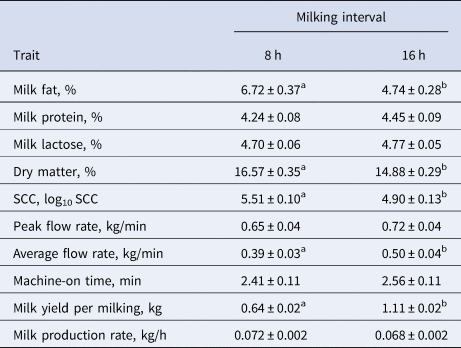
Least square means and standard errors of milking characteristics during the 8 and 16 h milking intervals are presented in Table 1. There was no difference in PFR, MOT, or MPR between the 8 and 16 h milking intervals. AMF and TMY were decreased (P < 0.05) during the 8 h milking interval compared to the 16 h milking interval.
Least square means and standard errors of milk constituents for milk fractions and milking characteristics at 8 and 16 h milking intervals, n = 19 milkings each

a,bLeast square means without a common superscript within row are significantly different (P < 0.05).
Milk constituents – milking intervals
Least square means and standard errors of milk constituents during the 8 and 16 h milking intervals are presented in Table 1. Milk fat and DM percent increased (P < 0.05) during the 8 h milking interval compared to the 16 h milking interval. Furthermore, log10 SCC increased (P < 0.05) during the 8 h milking interval compared to the 16 h milking interval. There was no difference in milk protein or lactose content between milking intervals.
Milk constituents – milk fractions
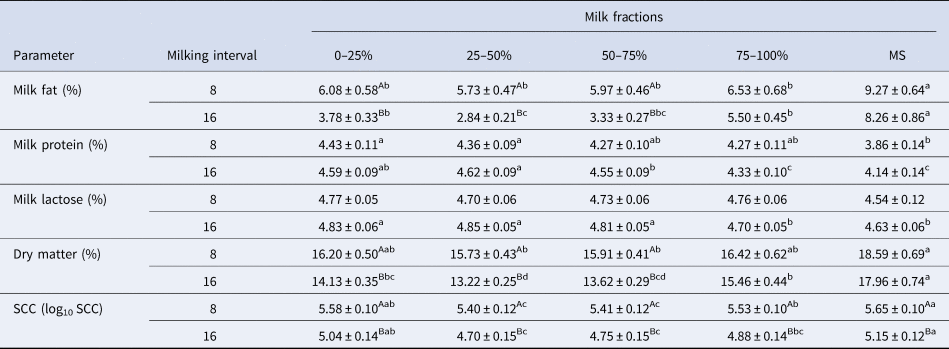
Least square means and standard errors of milk constituents in different milk fractions during the 8 and 16 h milking intervals are presented in Table 2. Milk fat percent increased (P < 0.05) in the MS fraction compared to all other fractions for both milking intervals. For the 0–25, 25–50, and 50–75% fractions, milk fat percent increased (P < 0.05) during the 8 h milking interval compared to the 16 h milking interval. There was no difference for milk fat content in the 75–100% and MS fractions between milking intervals. During the 8 h milking interval, milk protein percent was lowest (P < 0.05) in the MS fraction. However, during the 16 h milking interval, milk protein percent was lowest (P < 0.05) in the 75–100% and MS fractions. Milk lactose percent was not different between milk fractions for the 8 h milking interval. For the 16 h milking interval, milk lactose percent was lowest (P < 0.05) in the 75–100% and MS fractions. Milk DM percent was numerically highest during the MS fraction for the 8 h milking interval, although it was not significantly different from the 0–25 and 75–100% fractions. However, milk DM percent was increased (P < 0.05) in the MS fraction compared to all other fractions during the 16 h milking interval. Similar to milk fat percent, milk DM percent was increased (P < 0.05) in the 0–25, 25–50, and 50–75% fractions for the 8 h milking interval compared to the 16 h milking interval.
Least square means and standard errors of milk constituents in different milk fractions at 8 and 16 h milking intervals, n = 19 milkings each

A,BLeast square means without common superscript within column parameter are significantly different (P < 0.05).
a,b,c,dLeast square means without common superscript within row are significantly different (P < 0.05).
Orthogonal polynomial contrasts
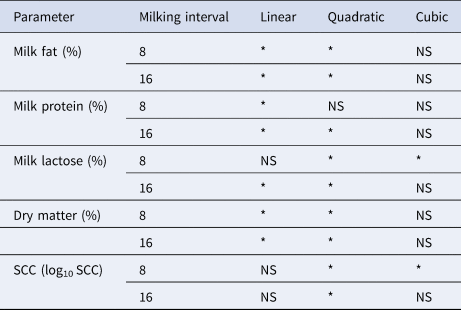
Linear, quadratic, and cubic polynomial contrasts for each milk constituent within each milking interval were analyzed. The significance of each contrast is presented in Table 3. The linear contrast was significant (P < 0.05) for all constituents except milk lactose percent during the 8 h milking interval and log10 SCC during both milking intervals. The quadratic contrast was significant (P < 0.05) for all constituents except milk protein percent during the 8 h milking interval. The cubic contrast was significant (P < 0.05) only for milk lactose percent and log10 SCC during the 8 h milking interval.
Orthogonal polynomial contrasts for linear, quadratic and cubic polynomial for different milking interval

NS, not significant.
*P < 0.05.
Discussion
In this experiment, we sought to determine the effect of two milking intervals (8 and 16 h) on milk constituents and milking characteristics of ewes. Milk constituent data consisted of milk fractions representing 0–25, 25–50, 50–75, and 75–100% of milk removal, along with milk removed by machine stripping (MS). The milking characteristics of interest included AMF, PFR, MOT, and TMY. Machine-on time is of particular interest, as decreased average machine-on time may increase throughput or production of a milking herd as long as other milking characteristics are unaffected.
Milking characteristics
To our knowledge, limited data exist determining the effect of different milking intervals on certain milking characteristics (AMF, PFR, MOT) in ewes. The increased AMF observed during the 16 h milking interval compared to the 8 h milking interval is potentially a function of udder fill and intramammary pressure as observed previously (Marie-Etancelin et al., Reference Marie-Etancelin, Manfredi, Aurel, Pailler, Arhainx, Ricard, Lagriffoul, Guillouet, Bibé and Barillet2006). As milk stored in the udder increases with milking interval, intramammary pressure also increases, allowing for the maximum milk flow rate to be sustained for longer so as to increase the average milk flow rate. Additionally, when the milking interval increases from 8 to 16 h, the proportion of milk stored in the cisternal fraction of ewes increases due to redistribution of milk from the alveolar fraction. McKusick et al. (Reference McKusick, Thomas, Berger and Marnet2002a) determined that the proportion of milk stored in the cisternal fraction of ewes increased from 37.8% in the 8 h milking interval to 52.4% in the 16 h milking interval. Milk stored in the alveolar fraction must be released via oxytocin-mediated contraction of the myoepithelial cells to be available for milking, whereas milk in the cisternal fraction does not (Bruckmaier, Reference Bruckmaier2001). Therefore, a higher proportion of milk is readily available at the onset of milking during a 16 h milking interval, which also may increase the AMF as observed in the present experiment.
In Hogeveen et al. (Reference Hogeveen, Ouweltjes, de Koning and Stelwagen2001), the association between milking interval and milk flow rate was determined for cows milked in an automatic milking system. A rapid increase in milk flow rate was observed from a 2 h milking interval to a 6 h milking interval. Thereafter, milk flow rate steadily increased until the 16 h milking interval. This finding is consistent with the increased AMF observed in the present experiment for ewes subjected to the 16 h milking interval compared to the 8 h milking interval.
While MOT was not directly measured in McKusick et al. (Reference McKusick, Thomas, Berger and Marnet2002a), the time that ewes spent in the milking parlor, which consisted of time for parlor entry, machine milking, and parlor exit, was determined for 12 and 16 h milking intervals. These researchers observed no difference in parlor time between milking intervals. From this, it can be assumed that the milking time was not different between the milking intervals, as entry and exit time is unaffected by milking interval. While the milking intervals of interest in the present experiment were 8 and 16 h, the lack of difference of milking time due to milking interval is consistent between experiments.
In the present experiment, the 16 h milking interval increased TMY compared to the 8 h milking interval. Increased TMY with increased milking interval is expected as a prolonged milking interval affords the mammary gland additional time for milk synthesis and accumulation. However, when analyzing milk yield during the experiment as an hourly rate, there was no difference between milking intervals. The 8 and 16 h milking intervals resulted in MPR of 0.72 and 0.68 kg/h, respectively. Consistent with the present experiment, McKusick et al. (Reference McKusick, Thomas, Berger and Marnet2002a) observed a linear secretory rate when milking interval was increased in 4 h increments from 4 to 20 h in East-Friesian crossbred dairy ewes. By contrast, when comparing 1× milking (24 h milking interval) to 2× milking (12 h milking interval), increased milk yield ranging from 15.4 to 34% is typically observed in ewes milked 2× (Negrao et al., Reference Negrao, Marnet and Labussiere2001; Nudda et al., Reference Nudda, Bencini, Mijatovia and Pulina2002; Koutsouli et al., Reference Koutsouli, Smitzis, Theodorou, Massouras, Bizelis and Politis2017). Furthermore, milk yield increases of 15.2 to 34.5% have occurred when increasing from 2× milking (12 h milking interval) to thrice-daily milking (3×; 8 h milking interval) in ewes (Negrao et al., Reference Negrao, Marnet and Labussiere2001; Thomas et al., Reference Thomas, Berger, McKusick and Mikolayunas2014).
Milk constituents – milking intervals
Few experiments have compared the effect of 8 and 16 h milking intervals on milk constituents in ewes. In McKusick et al. (Reference McKusick, Thomas, Berger and Marnet2002a), East-Friesian crossbred dairy ewes were subjected to milking intervals ranging from 4 to 24 h. Like the present experiment, McKusick et al. (Reference McKusick, Thomas, Berger and Marnet2002a) compared milking intervals of 8 and 16 h. In the previous experiment, ewes subjected to the 8 h milking interval had increased milk fat percent and decreased milk protein percent and log10 SCC compared to the 16 h milking interval. While the results from McKusick et al. (Reference McKusick, Thomas, Berger and Marnet2002a) pertaining to milk fat percent and log10 SCC are consistent with the present experiment, there was no difference in milk protein percent observed in the present experiment.
Contrary to the results of the present experiment, Castillo et al. (Reference Castillo, Such, Caja, Casals, Albanell and Salama2008) observed no difference in milk fat percent or log10 SCC in either Manchega or Lacaune ewes subjected to an 8 or 16 h milking interval. However, Castillo et al. (Reference Castillo, Such, Caja, Casals, Albanell and Salama2008) also did not observe a difference in milk protein or lactose percent, which is consistent with the findings of the present experiment.
Other experiments have sought to determine the effect of different milking intervals on milk constituents in ewes. These experiments have observed mixed results for each milk constituent. In Negrao et al. (Reference Negrao, Marnet and Labussiere2001), no difference in milk fat or protein percent was observed in Lacaune ewes subjected to milking intervals of 8, 12, or 24 h. Nudda et al. (Reference Nudda, Bencini, Mijatovia and Pulina2002) observed decreased milk fat and protein percent, increased milk lactose percent, and no difference in log10 SCC in unilateral half-udders of Awassi and Merino ewes milked 2× using a 12 h milking interval compared to 1× milking. Furthermore, 2× milking of unilateral half-udders in Sarda ewes decreased milk protein percent and log10 SCC but had no effect on milk fat or lactose percent. Comparing 1× and 2× milking in Lacaune and Manchega ewes, Castillo et al. (Reference Castillo, Such, Caja, Salama, Albanell and Casals2005) observed no difference in milk fat percent or log10 SCC. Koutsouli et al. (Reference Koutsouli, Smitzis, Theodorou, Massouras, Bizelis and Politis2017) detected no difference in milk fat, protein, or lactose percent, but increased log10 SCC in Chios and Karagouniko ewes milked 2× compared to 1×.
Milk constituents – milk fractions
While the effect of various milking intervals on milk constituent has been described, there is limited information about the different milk fractions. In the present experiment, Istrian × Awassi × East-Friesian ewes milked with an 8 h milking interval displayed increased milk fat percent and log10 SCC and no difference in milk protein or lactose percent compared to a 16 h milking interval. Using Murciano-Granadina dairy goats, Salama et al. (Reference Salama, Such, Caja, Rovai, Casals, Albanell, Marin and Marti2003) determined the effect of 1× vs. 2× milking on milk composition. Similar to the present experiment, milk fat percent decreased with more frequent milking (4.62% for 2× milking vs. 5.10% for 1× milking) while there was no difference in milk protein percent. However, Salama et al. (Reference Salama, Such, Caja, Rovai, Casals, Albanell, Marin and Marti2003) observed no difference in log10 SCC. Variability in the log10 SCC concentrations between milk fractions has been observed in ewes. Using Manchega ewes in their 9th week of lactation, Peris et al. (Reference Peris, Molina, Fernandez, Rodriguez and Torres1991) observed increased SCC in the stripping fraction compared to the foremilk and machine milk fraction for both healthy and infected udders. No difference was observed between the foremilk and machine milk fractions.
Fractionized milk removal has been characterized in Red Holstein × Simmental dairy cows at week 4 of lactation (Ontsouka et al., Reference Ontsouka, Bruckmaier and Blum2003). In Ontsouka et al. (Reference Ontsouka, Bruckmaier and Blum2003), milk fat percent was lowest in the cisternal milk fraction and increased throughout the remaining milk fractions (0–25, 25–50, 50–75, 75–100%, and residual milk). Similarly, the present experiment observed the highest concentration of milk fat in the machine stripping milk fraction. One potential explanation for this phenomenon may be associated with the oxytocin-mediated release of milk fat globules from the apical membrane of the mammary epithelial cell. After administration of intraperitoneal injections of oxytocin in mice, Mather et al. (Reference Mather, Masedunskas, Chen and Weigert2019) demonstrated a nearly complete expulsion of lipid droplets associated with the apical membrane of mammary epithelial cells in less than 7 min. This delay in expulsion may explain the dramatic increase in milk fat percent typically observed during the 0–25% milk fraction, which is largely composed of cisternal milk, and the latter milk fractions, such as 100% and stripping milk. Moreover, delayed expulsion of milk fat globules from the mammary epithelial cells may be why increased milk fat percent was observed for the 0–25, 25–50, and 50–75% milk fractions of the 8 h interval compared to the 16 h interval. Compared to the 8 h milking interval, the 16 h milking interval is assumed to have resulted in a cisternal milk fraction with a diluted amount of milk fat. This discrepancy would theoretically not be remedied until the oxytocin-mediated milk ejection reflex which is characteristic of routine milking. Indeed, by the 75–100% milk fraction, milk fat percent was not different between milking intervals.
In Ontsouka et al. (Reference Ontsouka, Bruckmaier and Blum2003), milk protein concentration was lowest in the machine residual milk fraction. Similarly, the present experiment observed the lowest milk protein concentration in the stripping milk fraction. While Mather et al. (Reference Mather, Masedunskas, Chen and Weigert2019) characterized the relationship between oxytocin and milk lipid expulsion, Lollivier et al. (Reference Lollivier, Marnet, Delpal, Rainteau, Achard, Rabot and Ollivier-Bousquet2006) demonstrated the effect of oxytocin on milk casein in lactating rabbit mammary epithelial cells. After one minute of incubating mammary explants in oxytocin, casein accumulated near the apical membrane and in the lumens of acini. After seven minutes of incubation in oxytocin, a significant number of myoepithelial cells were constricted. Collectively, these results demonstrate that transport of caseins to the apical membrane precedes myoepithelial cell contraction.
In Ontsouka et al. (Reference Ontsouka, Bruckmaier and Blum2003), milk lactose percent was decreased in the 100% and residual milk fractions compared to all other milk fractions. This observation is consistent in the present experiment for only the 16 h milking interval, as there was no difference in milk lactose percent between milk fractions of the 8 h milking interval.
While no difference in log10 SCC was observed between milk fractions at week 4 of lactation in Ontsouka et al. (Reference Ontsouka, Bruckmaier and Blum2003), log10 SCC was lowest in the 25–50 and 50–75% fractions for the 8 h milking interval and 25–50, 50–75, and 75–100% milk fractions for the 16 h milking interval for the present experiment.
Using Red Holstein × Simmental, Brown Swiss, and Holstein dairy cows, Bruckmaier et al. (Reference Bruckmaier, Ontsouka and Blum2004) showed milk fat percent progressively increased from the cisternal milk fraction to the residual milk fraction in milk samples collected from healthy quarters. However, in the present experiment, milk fat percent was only increased in the MS fraction for the 8 h milking interval and 75–100% and MS fractions for the 16 h milking interval. Furthermore, no difference was observed in the previous experiment for milk protein or lactose percent, or milk SCC between the different milk fractions of healthy quarters, which is different to the results of the present experiment.
In Simmental, Brown Swiss, and Holstein–Friesian dairy cows, Sarikaya et al. (Reference Sarikaya, Schlamberger, Meyer and Bruckmaier2006) revealed the effects of different milk fractions (cisternal, first 400 g of alveolar milk, and remainder of alveolar milk) on milk constituents. While Sarikaya et al. (Reference Sarikaya, Schlamberger, Meyer and Bruckmaier2006) found increased milk fat percent as milk was progressively removed from the udder, the present experiment observed an increase in milk fat percent only at the 75–100% and MS fractions for both milking intervals. Milk fat percent was highest in the last milk fraction in both experiments. For milk protein percent, Sarikaya et al. (Reference Sarikaya, Schlamberger, Meyer and Bruckmaier2006) observed no difference between milk fractions, whereas we found milk protein percent to be lowest in the MS fraction. In our experiment, we observed no difference in milk lactose percent between milk fractions of the 8 h milking interval. However, milk lactose percent was decreased in the MS fraction for the 16 h milking interval. In contrast to these findings, Sarikaya et al. (Reference Sarikaya, Schlamberger, Meyer and Bruckmaier2006) found a transient increase in milk lactose percent in the first 400 g of alveolar milk before it decreased throughout the rest of milking. Lastly, the results for milk SCC differed between experiments. While in Sarikaya et al. (Reference Sarikaya, Schlamberger, Meyer and Bruckmaier2006) there was no difference observed between milk fractions, the present experiment found milk log10 SCC to be lowest in the 25–50 and 50–75% milk fractions.
Orthogonal polynomial contrasts
Polynomial contrasts are useful for describing the relationship that milking constituents have with other variables such as milk fraction, as was performed in the present experiment. The polynomial contrasts analyzed herein included linear, quadratic, and cubic contrasts. A linear contrast indicates a constant positive or negative association between milking constituent and milk fraction, whereas a quadratic or cubic contrast indicates that one or two inflection points, respectively, are necessary to accurately represent the relationship. The results of the present experiment indicate that utilization of all three contrasts is necessary to describe the relationships of all milk constituents for the 8 and 16 h milking intervals. For milk fat and DM percent, the quadratic contrast was the appropriate. The same contrast to describe milk fat and DM percent is expected from our results as the change in milk fat percent mirrored the change in milk DM percent throughout milking. Interestingly, the appropriate contrast to describe milk protein and lactose percent and log10 SCC depended on the milking interval. The linear contrast appropriately described milk protein percent during the 8 h milking interval, the quadratic contrast appropriately described milk protein and lactose percent and log10 SCC during the 16 h milking interval, and the cubic contrast appropriately described milk lactose percent and log10 SCC during the 8 h milking interval.
In conclusion, milking interval exerted a significant effect on milk fat and DM contents, SCC, average milk flow rate, and milk yield per milking. Additionally, milking interval altered the concentration of milk constituents across milk fractions. Changes in milk constituents between milking fractions should be considered when collecting milk samples for analytical purposes. Moreover, the present experiment demonstrates the necessity of multiple polynomial contrasts to adequately describe the relationship between milk constituents across milk fractions.
Acknowledgement
The authors wish to thank the Radosevic family (Brtonigla, Croatia) for their assistance and cooperation during the animal experiments