Introduction
Melancholic symptoms of depression are often thought to respond particularly well to electroconvulsive therapy (ECT). A problem in routine clinical practice has been to construct a relatively short, standardised method for melancholia ascertainment. Versions of the Hamilton Rating Scale for Depression (HamD) Reference Williams(1) have been used to assess melancholia. Thase et al. Reference Thase, Hersen, Bellack, Himmelhoch and Kupfer(2) expounding on the work of Kovacs et al. Reference Kovacs, Rush, Beck and Hollon(3), Endicott et al. Reference Endicott, Cohen, Nee, Fleiss and Sarantakos(4), Overall and Rhoades Reference Overall and Rhoades(5) and Klein Reference Klein(6) established what they termed the Hamilton Endogenomorphy Scale (HES) based on several HamD items. They found that melancholic classification based on the HES correlated closely with that determined by standardised diagnostic interviews. Additionally, the distribution of HES scores seemed bimodal, thus lending support to the idea that it separates out qualitatively distinct melancholic and non-melancholic populations.
Prudic et al. Reference Prudic, Devanand, Sackeim, Decina and Kerr(7) using three separate HamD-derived melancholia scales (based on the HES described above, the Research Diagnostic Criteria Reference Spitzer, Endicott and Robins(8), and the DSM-III (9)), found no correlation between severity of melancholic symptoms and ECT response.
There have been numerous speculations about what kinds of differences there might be between melancholic and non-melancholic patients Reference Taylor and Fink(10). We wanted to test the clinical and research utility of HamD-based melancholia subscales in depressed in-patients in whom the HamD24Reference Williams(1) was administered at admission and upon discharge. We investigated whether two HamD24-based melancholia subscales were associated with outcomes in general patients and in those patients receiving ECT, and finally to see if bimodal distributions of these subscales occurred.
Methods
We reviewed the records of 201 depressed patients admitted consecutively in 2007 to our in-patient mood disorders unit. The unit is designed for non-psychotic patients who can participate in the cognitive behavioural therapy format of the milieu. Structured diagnostic interviewing is not performed. Thus, any inference the treating psychiatrist makes about distinguishing bipolar from unipolar depressive episodes is impressionistic. Most patients are treated with various psychopharmacologic agents, and ECT is commonly utilised. Worth noting is that the decision to treat with ECT was not random but was made at the discretion of the attending psychiatrist. Over the time period represented by this study population, there were numerous psychiatrists rotating on the service, and it is unlikely the effects of any one particular clinician affect our results.
ECT technique consisted of either bitemporal or bifrontal electrode placement at 1.5 times threshold or right unilateral electrode placement at 5–6 times threshold. As the sample sizes of these would be prohibitively small, we did not analyse separately according to electrode placement. Anaesthesia was induced with thiopental.
The HamD24 is performed on the first morning of admission and on discharge day by a nurse trained in the use of this instrument by research study coordinators, although inter-rater reliability data are not available. Overall outcome in this study is improvement in total scores on the HamD24 from admission to discharge.
We used two melancholia subscales based on the HamD24. The first is the HES used by Thase et al. Reference Thase, Hersen, Bellack, Himmelhoch and Kupfer(2) and consists of the sum of the scores on the following items: middle and late insomnia (items 5 and 6), work and activities (item 7), retardation (item 8), agitation (item 9), loss of weight (item 17), diurnal variation with AM worsening (item 18) and hopelessness (item 23). The second was devised by us to attempt to reflect as closely as possible the Diagnostic and Statistical Manual of Mental Disorders- Fourth Edition, Text Revision (DSM-IV TR) (11) melancholia criteria and consists of the sum of the scores on the following items: guilt (item 2), delayed insomnia (item 6), work and interests (item 7), retardation (item 8), agitation (item 9), loss of appetite (item 12), libido (item 14), weight loss (item 17) and AM diurnal mood variation (item 18). For item 18 (diurnal variation), in the calculation of these subscales, we used only scores for AM worsening, if present. If the patient had no diurnal variation in mood or PM worsening, this was scored as a zero for the two melancholia subscales. However, in the calculation of total HamD24 scores, no differentiation was made for AM or PM worsening of mood on item 18.
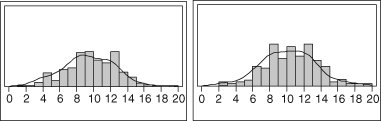
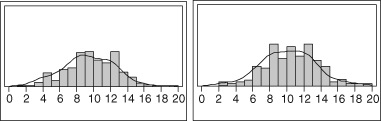
Thase et al. Reference Thase, Hersen, Bellack, Himmelhoch and Kupfer(2) postulated that the HES may actually reflect two qualitatively distinct subtypes of depression and reported that the distribution of scores appeared bimodal. We report the distributions of each of our subscales in Fig. 1 and performed statistical tests on the hypothesis that they reflected normality.
Admission Hamilton Endogenomorphy Scale (left) and DSM melancholia score (right) distributions
Finally, as ECT has been postulated to be particularly helpful for melancholic depression, we performed ECT status into the statistical analyses to see if the relationship of melancholia to clinical outcome was influenced by this treatment modality.
Statistical analyses
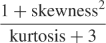
Data are presented as number (percentage) for categorical variables and mean (±SD) for continuous variables. The coefficient of bimodality was used to assess the distribution of Thase and DSM melancholia scores:
Analysis of covariance was used to test the relationship between admission melancholia and the change in total HamD24 score at discharge, where baseline HamD24 score, age, gender, length of stay and ECT were entered as covariates. The model was also considered with the addition of a melancholia-by-ECT interaction. For the purpose of display, patients were categorised by whether the DSM (11) or the HES2 melancholia score was > 10 at admission, however, all models treat these as continuous variables. P-values less than 0.050 were considered statistically significant.
Results
The sample consisted of 133 (66%) females and 68 (34%) males. Mean age was 41.8 (±12.9) years with a range of 18–72. Mean admission HamD24 score was 31.5 (±8.4) whereas that for discharge was 11.9 (±7.9). Length of stay ranged from 2 to 30 days with a mean 8.8 (±5.3). There were 40 ECT patients (20% of the total sample). The percentage of females receiving ECT was 21.8% (i.e. 29 out of 133 women received ECT), whereas that for males was 16.2% (i.e. 11 out of 68 men received ECT). This difference was not statistically significant by chi-square analysis. Age (± standard deviation) of ECT-treated patients was higher than that for non-ECT patients (48.3 ± 10.5 years vs. 40.3 ± 13.0 years, respectively), a difference significant by t test (p < 0.001). Length of stay in those receiving ECT was 14.8 ± 6.2 days and in those not receiving ECT was 7.3 ± 3.8 (t test p < 0.001). In the 40 ECT patients, electrode placement was bitemporal in 14, right unilateral in 20 and bifrontal in 4. Additionally, one patient was switched from bifrontal to bitemporal and another from bifrontal to right unilateral during the course of treatments.
The distributions of baseline HES2 and DSM-IV (11) melancholia scales are presented in Fig. 1. Mean (SD) baseline-to-discharge HES2 subscales are 9.33 (±3.1) and 3.2 (±2.5), respectively. Scores for the DSM-IV-based melancholia subscale are 10.2 (±3.2) and 3.7 (±2.7), respectively. Thus, patients experienced substantial improvement both in the total HamD24 ratings and the specific melancholia subscales. Length of stay in those classified as melancholic by the DSM-IV-based melancholia subscale was slightly longer than the stay in non-melancholic patients (9.6 ± 5.6 vs. 8.0 ± 5.0 days, p = 0.040).
Does baseline melancholia score correlate with total improvement?
There is a trend for a significant relationship between baseline HES2 score and change in total HamD24 score, after adjusting for baseline HamD24 score (p = 0.054). However, when age, gender, length of stay and ECT status are included as covariates, the p value increases to 0.074.
For the DSM-IV-based melancholia subscale, the p value for the relationship as described above is 0.002 regardless of whether the covariates are included; where the higher the melancholia score, the greater the improvement in total scores. Thus, the relationship between the DSM-IV-based melancholia score and total improvement is not resultant from higher baseline total scores for the HamD24.
Does melancholia score affect the relationship of ECT treatment to outcome?
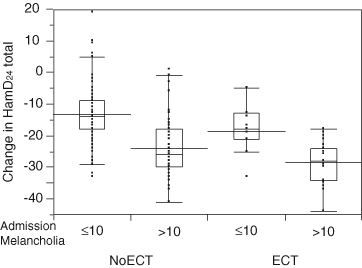
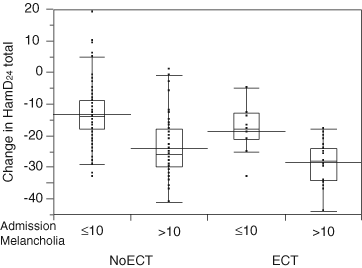
Figure 2 presents the changes in HamD24 scores as a function of ECT treatment status broken down by high versus low melancholia scale scores. There is some evidence that ECT treatment is related to a larger decrease in total HamD24 scores across the hospitalisation after adjusting for baseline scores, age, gender, and length of stay (p < 0.001). However, there is no evidence that melancholia score moderates this relationship (p value for the interaction between ECT status and melancholia subscale using the HES2 is 0.479, whereas that for the DSM-IV-based scale is 0.619). Thus, according to these data, ECT is not more helpful as a function of higher melancholia ratings.
Change in 24-item Hamilton Rating Scale for depression score by admission melancholia score, ECT status and outcome. Ordinate represents the change in HamD24 scores over the hospitalisation, whereby a positive score indicates worsening and a negative score indicates improvement. Boxplots present the first and third quartiles and the median. The whiskers extend from the quartiles to 1.5 times the interquartile range. Horizontal lines intersect the boxplots at the mean. Points beyond the whiskers represent possible outliers. Abscissa represents baseline melancholia score divided into those less than or equal to 10 versus those greater than 10 (using either DSM or HES2 score either ≤ or > 10 at admission). These are further subdivided into the group of ECT patients versus the non-ECT patients.
Does the distribution of melancholia subscales follow a unimodal or bimodal distribution?
The distributions of both the HES2 and DSM-IV-based melancholia scales are presented in Fig. 1. Both distributions appear to be approximately normal and, in particular, do not appear to follow a bimodal distribution as suggested by Thase et al. Reference Thase, Hersen, Bellack, Himmelhoch and Kupfer(2). The coefficient of bimodality is 0.33 for the Thase et al. Reference Thase, Hersen, Bellack, Himmelhoch and Kupfer(2) and 0.31 for the DSM-IV-based melancholia scales. Values above 0.555 are suggestive of a bimodal distribution but this was not observed in this sample.
Discussion
Whether melancholia subtyping of depressive episodes has clinical utility or even construct validity has been a challenge of modern research. One difficulty has been not only to develop a set of definitional features (e.g. DSM), but also to devise a standardised method for assessing the presence versus absence of each of the defining features. The HamD-based scales, if valid, would offer ease of melancholia subtyping. A problem with this technique is that there is no specific HamD item for each DSM-based melancholia feature. For example, distinct qulity of mood and lack of mood reactivity are not explicitly represented in the HamD. Although it is true that psychomotor agitation and retardation are assessed with one item each in the HamD, other research indicates that one must perform extensive interviews to appreciate subtleties of psychomotor behaviour Reference Parker and Hadzi-Pavlovic(12). Thus, one may question whether the full complexities and nuances of melancholia can be sensitively detected by the relatively short HamD-based interview.
We found that the HES2 did not correlate with total improvement in the HamD24, although the relationship just missed statistical significance. However, our DSM-IV-based subscale robustly correlated with total improvement, even adjusting for severity of baseline total score. This subscale was developed prior to any statistical tests and was not the result of an exploration of the data. We should point out that our mood disorders unit has a strong multimodal approach. Every patient receives a cognitive behaviour therapy approach, and virtually every patient is prescribed psychotropic medications, even those receiving ECT. The medications used in our sample were so varied, with tapering off of admission medications interspersed with tapering up of new medications and addition of adjunctive symptomatic agents (e.g. benzodiazepines, hypnotics, ‘mood stabilisers') that it would be impossible to tease out any relationship between melancholia ratings and response to any particular pharmacotherapeutic strategy. In sum, one cautious conclusion of our study is that at least one HamD-based melancholia subtyping method (i.e. DSM-IV based) correlates with total improvement. The next question involves whether either of these subtyping method scores correlates with response differentially to ECT.
Although ECT treatment was associated with greater overall improvement, the presence of melancholic symptoms as assessed by the melancholia subscales did not modulate ECT outcome. This is in line with the data of Prudic et al. Reference Prudic, Devanand, Sackeim, Decina and Kerr(7), who also found that HamD-based melancholia severity did not predict ECT outcomes. Furthermore, in a recent report from the Consortium for Research on ECT, melancholia subtyping based on the Structured Clinical Interview for DSM-IV Reference Fink, Rush and Knapp(13) also did not predict ECT outcomes, and in fact, non-melancholic patients even had a slightly greater chance of remitting with acute ECT Reference First, Spitzer, Gibbon and Williams(14). Thus, it would seem to be a fairly robust finding in modern ECT research that structured interview-based rating scales of melancholic symptomatology are not clinically useful in predicting ECT outcomes. This is in contrast to the in-depth assessment of psychomotor activity studied by Parker and Hadzi-Pavlovic Reference Parker and Hadzi-Pavlovic(12), in which psychomotor abnormalities, as opposed to other traditionally melancholic symptoms, do correlate with ECT outcomes. In the other studies mentioned, including ours, focus was on a broad array of potentially melancholic symptoms and not specifically on psychomotor activity, which as mentioned is assessed very briefly by the HamD.
Finally, there was no evidence of a bimodal distribution for either of the melancholia subscales. This provides further evidence that HamD-based assessments are not particularly useful either clinically or in melancholia research.
Limitations of our study include relatively small sample size of ECT patients and the exclusion of those who are often considered the most classically melancholic patients, namely, psychotic depressives or those who are so plagued by psychomotor abnormalities that they were not admitted to this particular unit in our hospital. Perhaps the melancholia rating scales we used may be more predictive of various outcome relationships in those patients. Additionally, another limitation is the impressionistic classification of patients as depressed without using a structured diagnostic inventory. If the latter had been used, a more homogeneous population might have been identified in which significant associations with melancholia status might have occurred. Along those lines, we do not have depressive subtyping according to polarity (i.e. unipolar vs. bipolar), nor do we have data on the presence of axis II features or pre-index episode illness demographics (such as duration of episode or number of prior episodes) which may have impacted on ECT response. Length of stay was of course variable and may impact outcome, although we used this as a covariate in the analyses. Also, even though the staff who performed the HamD24 interviews were well trained, there was no effort made to train them to a specified level of inter-rater reliability, as is the case in most funded research endeavours. Finally, electrode placement was not controlled, but the three techniques used (i.e. suprathreshold bifrontal or bitemporal and markedly suprathreshold right unilateral) have all been shown to be highly effective in controlled trials Reference Bailine, Rifkin and Kayne(15,Reference Sackeim, Prudic and Devanand16). However, it is possible that differences because of electrode placement might have occurred if the sample size was big enough to assess this factor. Also, we did not assess total number of ECT treatments in the patients' series but rather the number of in-patient treatments. It is possible that had we been able to analyse data from combined in-patient and continued out-patient treatment, the results may have been different. Nevertheless, our data set represents a ‘real world’ busy mood disorders unit, and we believe our data offer clinically relevant perspectives on the use of the melancholia scales described. Worth noting is that we are not claiming that the concept of melancholia is invalid, but only that structured interview-based assessments of it, as represented by the HamD24, seem relatively week methods of melancholia ascertainment.