


Background
At present, most scientists accept the dogma that at the beginning of life all oogonia [the female germline stem cells (GSCs)] reserves are depleted as a result of their differentiation into oocytes. However, throughout the last 150 years, there has been controversial discussion among scientists about neo-oogenesis in adult mammals. In 1870, Waldeyer-Hartz claimed that in adult mammalian species and birds, there is no possibility of new oocyte production, but that the oocytes arise from the ovarian surface epithelium (OSE; germinal epithelium) during a limited period of early life (Waldeyer-Hartz, Reference Waldeyer-Hartz1870). However, in 1917, Kingery claimed that all oocytes that degenerated during fetal life were restored by oocytes that developed in the adult ovarian germinal epithelium (Kingery, Reference Kingery1917). This hypothesis was supported by an argument that new oocytes arise from the germinal epithelium as a result of mitotic division (Allen, Reference Allen1923; Allen & Creadick, Reference Allen and Creadick1937). However, in 1921, Pearl & Schoppe asserted that there was no increase in the supply of primary oocytes during the life of the individual (Pearl & Schoppe, Reference Pearl and Schoppe1921). The discussion of neo-oogenesis in the adult mammalian ovary was almost ended by the studies of Zuckerman; this work resulted in the basic doctrine of reproductive biology, arguing that most mammalian females have the potential of generating a limited reserve of oocytes during fetal development only, oocytes enclosed by somatic cells (granulosa cells) that are described as ovarian follicles (Zuckerman, Reference Zuckerman1951; Zuckerman & Baker, Reference Zuckerman, Baker, Zuckerman and Weir1977). In spite of some criticism (Pansky & Mossman, Reference Pansky and Mossman1953; Vermandevaneck, Reference Vermandevaneck1956; Artem'eva, Reference Artem'eva1961), in 1951 Zuckerman put an end to the argument in favour of a definite quantity of oocytes at birth, concluding that during the lifetime there is no increase in the number of primary oocyte reserve beyond those cells initially present when the ovary developed (Zuckerman, Reference Zuckerman1951). In parallel with this theory, Peters’ group demonstrated that in mouse ovaries oocyte generation took place only during a limited prenatal period, the pre-meiotic S phase, and that these oocytes remained throughout adulthood (Peters et al., Reference Peters, Levy and Crone1962). Accordingly, a central dogma of mammalian reproductive biology was introduced based on this principle: female mammals are born with a limited, non-renewing supply of germ cells, all of which are arrested in meiosis I and are described as follicles (Zuckerman, Reference Zuckerman1951; Borum, Reference Borum1961; Franchi et al., Reference Franchi, Mandl, Zuckerman and Zuckerman1962; Peters, Reference Peters1970; McLaren, Reference McLaren1984; Anderson & Hirshfield, Reference Anderson and Hirshfield1992). Oocyte numbers constantly decrease during post-natal life (Faddy et al., Reference Faddy, Jones and Edwards1976, Reference Faddy, Telfer and Gosden1987; Faddy, Reference Faddy2000) through mechanisms involving apoptosis (Perez et al., Reference Perez, Robles, Knudson, Flaws, Korsmeyer and Tilly1999; Tilly, Reference Tilly2001). In humans, exhaustion of the oocyte pool takes place until 50 years of age, resulting in menopause (Richardson et al., Reference Richardson, Senikas and Nelson1987). Although this dogma is established (Gougeon & Notarianni, Reference Notarianni2011), recent studies (Virant-Klun et al., Reference Virant-Klun, Stimpfel and Skutella2011c; Woods & Tilly, Reference Woods and Tilly2012; Woods et al., Reference Woods, White and Tilly2013) have provided some evidence that may challenge the validity of this widespread doctrine, which represents the foundation of reproductive biology.
Controversy over limited and non-renewable ovarian follicles after birth
In the last 10 years, in contrast with the classic idea that oogenesis does not occur in post-natal mammalian ovaries, the concepts of ovarian stem cells (OSC) and neo-oogenesis, which can restore the ovarian reserve in post-natal mammals, have led to this controversial debate in reproductive biology being reopened. Primary studies have reported ex vivo oogenesis in the culture of mouse embryonic stem cells (ESCs; Hubner et al., Reference Hubner, Fuhrmann, Christenson, Kehler, Reinbold, De La Fuente, Wood, Strauss, Boiani and Scholer2003), and mitotically active germ cells have been observed in the ovaries of adult prosimian primates (Ioannou, Reference Ioannou1967) and mice (Johnson et al., Reference Johnson, Canning, Kaneko, Pru and Tilly2004). In the ovarian tunica albuginea, mesenchymal cells have been found to develop into surface epithelium and contribute to follicular renewal in adult human females (Bukovsky et al., Reference Bukovsky, Keenan, Caudle, Wimalasena, Upadhyaya and Vanmeter1995, Reference Bukovsky, Caudle, Svetlikova and Upadhyaya2004). These reports have resulted in controversy about the defined dogma on the fetal origin of mammalian oocytes (Bazer, Reference Bazer2004; Gosden, Reference Gosden2004; Oktem & Oktay, Reference Oktem and Oktay2009). In 2004, Johnson and colleagues’ demonstration about the existence and proliferation of GSCs in post-natal mouse ovaries has led to an argument on the possibility of post-natal oogenesis (Johnson et al., Reference Johnson, Canning, Kaneko, Pru and Tilly2004). Another study based on the mouse model revealed that there is no decline in the number of primordial follicles per ovary between day 7 to day 100 after birth, and that a significant reduction only takes place 200 days after birth (Kerr et al., Reference Kerr, Duckett, Myers, Britt, Mladenovska and Findlay2006). Hence, it was suggested that immature putative germ cells in the adult may lead to the de novo generation of oocytes in appropriate circumstances. In contrast with these studies, Liu and collaborators reported the absence of early meiotic-specific or oogenesis-associated mRNA (SPO11, PRDM9, SCP1, TERT and NOBOX) and a lack of early meiocytes and proliferating germ cell markers (SCP3, Oct4/3 and c-KIT) in healthy adult human ovaries (28–53 years), and concluded that neo-oogenesis does not occur in the adult human ovary (Liu et al., Reference Liu, Wu, Lyu, Yang, Albertini, Keefe and Liu2007). Furthermore, using statistical analyses and mathematical modelling, other groups have shown that mammalian females produce a limited number of oocytes in the prenatal phase of life, and that this production ceases after birth (Bristol-Gould et al., Reference Bristol-Gould, Kreeger, Selkirk, Kilen, Mayo, Shea and Woodruff2006; Faddy & Gosden, Reference Faddy and Gosden2009; Wallace & Kelsey, Reference Wallace and Kelsey2010). In parallel with these studies, Zhang et al. (Reference Zhang, Lv and Xing2010, Reference Zhang, Zheng, Shen, Adhikari, Ueno and Liu2012) failed to demonstrate the presence of large ovoid germ cells that expressed the VASA/DDX4 gene, the transcription of the meiotic-specific genes SCP1, SCP3, SPO11 and the translation of DMC1, STRA8, SCP3 in the surface epithelium of adult rat ovaries (Zhang et al., Reference Zhang, Lv and Xing2010, Reference Zhang, Zheng, Shen, Adhikari, Ueno and Liu2012). Byskov and collaborators were also unable to confirm the existence of GSCs by staining with pluripotent pre-meiotic germ cell markers (SSEA-4, Oct4, Nanog or MAGE-A4) and oogonia (by morphology) in the post-natal human ovary after final clearing of these cells during the first 1 or 2 years of early life (Byskov et al., Reference Byskov, Hoyer, Andersen, Kristensen, Jespersen and Mollgard2011). In other reports, neo-folliculogenesis failed in mice after sterilization by chemicals [doxorubicin (DXR)] or γ-irradiation (Kerr et al., Reference Kerr, Brogan, Myers, Hutt, Mladenovska, Ricardo, Hamza, Scott, Strasser and Findlay2012), and the existence of both GSCs and in vivo neo-oogenesis were not confirmed in adult mouse ovaries (Lei & Spradling, Reference Lei and Spradling2013). Recently, Yuan et al. (Reference Yuan, Zhang, Wang, Liu, Mao, Yin, Ye, Liu, Han and Gao2013) were also unable to confirm the presence of proliferative GSCs and germ cell renewal (lack of Sox2, LIN28, VASA and DAZL genes) in adult monkey and mouse ovaries (Yuan et al., Reference Yuan, Zhang, Wang, Liu, Mao, Yin, Ye, Liu, Han and Gao2013). Unexpectedly, they found cells with characteristics of non-germline somatic stem cells in adult ovaries. As mentioned above, during the last decade the concept of neo-oogenesis has resulted in intense controversy. Some studies that either support or refute the possibility of post-natal oogenesis in mammals are summarized in Table 1.
Some experiments that support and refuse the putative post-natal oogenesis in female mammals

Renewal of follicles and neo-oogenesis in the post-natal ovary
Approximately 10 years ago the hypothesis that oocyte and follicle renewal may occur in the post-natal mouse ovary was addressed by several experimental approaches (Johnson et al., Reference Johnson, Canning, Kaneko, Pru and Tilly2004). Mitotically active germ cells were supposed to exist in the ovaries of both young and adult mice; depending on the amount of oocyte atresia and depletion, these cells are required to continuously replenish the follicle pool. Prepubertal female mice were treated with the mitotic germ cell toxicant (busulphan), which is known to eradicate the primordial follicle source (Hemsworth & Jackson, Reference Hemsworth and Jackson1963; Burkl & Schiechl, Reference Burkl and Schiechl1978; Pelloux et al., Reference Pelloux, Picon, Gangnerau and Darmoul1988; Meirow et al., Reference Meirow, Lewis, Nugent and Epstein1999; Shirota et al., Reference Shirota, Soda, Katoh, Asai, Sato, Ohta, Watanabe, Taya and Shirota2003; Jiang et al., Reference Jiang, Zhao, Qi, Li, Zhang, Song, Yu and Gao2013) without stimulating atresia. After treatment with busulphan, cells expressed the meiotic entry marker (SCP3) in juvenile and adult mouse ovaries. However, the ovaries of females that were treated with busulphan included <5% of the normal primordial follicle pool. These data supported the theory that proliferative germ cells do not only reside in the post-natal ovary but are also needed to restore the follicle source. Subsequently, wild-type ovaries have been grafted into transgenic female mice that expressed green fluorescent protein (GFP). Grafted wild-type ovarian fragments penetrated into the GFP-positive ovarian tissue and follicle-enclosed wild-type germ cells and eventually became indistinguishable from the GFP-positive germ cells that formed follicles. Previous studies have suggested that mammalian stem cells migrate to their natural niche after introduction into a host (Nagano, Reference Nagano2003; Oh et al., Reference Oh, Bradfute, Gallardo, Nakamura, Gaussin, Mishina, Pocius, Michael, Behringer, Garry, Entman and Schneider2003; Szilvassy et al., Reference Szilvassy, Ragland, Miller and Eaves2003; Torrente et al., Reference Torrente, Camirand, Pisati, Belicchi, Rossi, Colombo, El Fahime, Caron, Issekutz, Constantin, Tremblay and Bresolin2003). These data provided remarkable evidence for the presence of proliferative germ cells that maintain oocyte and follicle production in the post-natal mammalian ovary. Accordingly, the hypothesis that GSCs exist in adult mammals has been strengthened by detection of germ cell markers [OCT-3/4, mouse VASA homologue (MVH), SCF-R and SSEA-1] and meiotic markers (DMC1 and SCP3) in specific cells that aggregate in the periphery of adult mouse ovaries (Zhang et al., Reference Zhang, Fouad, Zoma, Salama, Wentz and Al-Hendy2008). Pacchiarotti et al. (Reference Pacchiarotti, Maki, Ramos, Marh, Howerton, Wong, Pham, Anorve, Chow and Izadyar2010) reported the isolation and characterization of GSCs in post-natal mouse ovaries using transgenic mice that expressed GFP under the control of the Oct4 promoter (Pacchiarotti et al., Reference Pacchiarotti, Maki, Ramos, Marh, Howerton, Wong, Pham, Anorve, Chow and Izadyar2010). Two different populations of GFP–Oct4-positive cells were found in mouse ovaries, dependent upon their distribution and size; a small group of cells (10–15 μm) was located at the OSE and larger oocyte-like cells (50–60 μm) were enclosed by follicular structures. These ovarian GSCs sustained their stem cell characteristics, high telomerase activity, and normal karyotype after many passages for more than 1 year. They produced embryoid body-like structures with differentiation into all three germ cell layers. Meanwhile, Gong et al. (Reference Gong, Lee, Lee, Kim, Lee, Chi, Ryu, Lee, Yum, Lee, Han, Tilly and Lim2010) isolated two pluripotent colony-forming cell lines from adult ovarian stromal cells, which also formed embryoid bodies and teratomas after injection into non-obese diabetic/severe combined immunodeficient (NOD/SCID) mice. Gong et al. (Reference Gong, Lee, Lee, Kim, Lee, Chi, Ryu, Lee, Yum, Lee, Han, Tilly and Lim2010) also reported that a small subgroup of the isolated cells from adult ovaries is immunoreactive for Oct4 and Nanog. Reverse transcription polymerase chain reaction (RT-PCR) results also revealed the presence of transcripts for both Oct4 and Nanog in adult ovaries (Gong et al., Reference Gong, Lee, Lee, Kim, Lee, Chi, Ryu, Lee, Yum, Lee, Han, Tilly and Lim2010). In another study, scientists isolated OSCs from a newly born piglet with expression of transcription factors such as Oct-3/4, Nanog, and Sox2 (Song et al., Reference Song, Kumar, Kang, Lee, Kim, Ock, Lee, Jeon and Rho2011). These cells displayed a remarkable ability to differentiate into putative oocyte-like cells (OLCs) in vitro and expressed VASA, DAZL and ZPC. Furthermore, putative GSCs from neonatal and adult mouse ovaries formed compact round colonies with unclear borders, ESC characteristics, alkaline phosphatase (AP) activity, and expression of a germ cell marker (VASA) and stem cell markers (Oct4, Klf4, c-Myc, Nanog, CD49f, Sox2, CD133, SSEA-1 and SSEA-4). These cells also had the ability to differentiate into OLCs in vitro following porcine follicular fluid treatment and form embryoid bodies, which expressed specific markers for all three germ layers (Hu et al., Reference Hu, Bai, Chu, Wang, Wang, Yu, Lian and Hua2012). In an outstanding study, White et al. (Reference White, Woods, Takai, Ishihara, Seki and Tilly2012) reported that a rare population of mitotically active oogonial stem cells (OSCs) can be isolated by fluorescence-activated cell sorting (FACS) with DDX4 expression on the cell surface of adult mouse ovaries and human ovarian cortical tissues. The OSCs were expanded for months on mouse embryonic fibroblast (MEF) feeders and formed spontaneously oocyte-like structures, based upon morphology, gene expression (expression of DDX4, KIT, NOBOX, LHX8, GDF9, ZP1, ZP2, and ZP3) and haploid status. Injection of the OSCs into human ovarian cortical biopsies led to formation of follicles that containing oocytes 1–2 weeks after xenotransplantation into immunodeficient female mice (White et al., Reference White, Woods, Takai, Ishihara, Seki and Tilly2012). Additionally, cultured OSCs besides sustaining their germline gene expression profile (Blimp1, Stella, Fragilis, DDX4, and DAZL) obtained expression of pluripotency-associated transcripts (Oct4, Nanog, and Sox2) and the meiotic marker STRA8. Expression of the meiotic commitment gene STRA8 in cultured OSCs and the absence of STRA8 in freshly isolated OSCs revealed the undifferentiated (pre-meiotic) situation of these germ cells before in vitro development (Imudia et al., Reference Imudia, Wang, Tanaka, White, Woods and Tilly2013).
Esmaeilian et al. (Reference Esmaeilian, Gur Dedeoglu, Atalay and Erdemli2012) reported the presence of three well known pluripotent stem cell markers, Oct4, Nanog and Sox2, in the mRNA and protein levels in 2-week-old (pre-puberty) and 8-week-old (adult) mouse ovaries (Esmaeilian et al., Reference Esmaeilian, Gur Dedeoglu, Atalay and Erdemli2012). Expression of these transcripts was observed in the ovaries of two different age groups by real-time quantitative RT-PCR (qRT-PCR), and immunohistochemistry results showed the presence of both Sox2 and Oct4 proteins in the cytoplasm of ovarian epithelial cells, granulosa cells, oocytes and theca cells. Nanog protein was observed only in the nucleus of the oocytes, and the expression of this protein was higher in 8-week-old samples compared with 2-week-old ones according to qRT-PCR results. As Oct4, Nanog and Sox2 have transcriptional regulator functions, they are expected to be found in the nucleus of the cells, however in several studies (Avilion et al., Reference Avilion, Nicolis, Pevny, Perez, Vivian and Lovell-Badge2003; Cauffman et al., Reference Cauffman, Van de Velde, Liebaers and Van Steirteghem2005; Parte et al., Reference Parte, Bhartiya, Telang, Daithankar, Salvi, Zaveri and Hinduja2011; Esmaeilian et al. Reference Esmaeilian, Gur Dedeoglu, Atalay and Erdemli2012; Hu et al., Reference Hu, Bai, Chu, Wang, Wang, Yu, Lian and Hua2012) Oct4 and Sox2 proteins have been observed in the cytoplasm of adult ovary cells. During localization of these proteins in the cytoplasm of cells, pluripotential capacity of these cells can be questionable. Nevertheless, dependent on their cellular regulation, transcription factors can pass from the cytoplasm to the nucleus using a nuclear localization sequence (NLS) and pass in the opposite direction through the nuclear export sequence (NES; Whiteside & Goodbourn, Reference Whiteside and Goodbourn1993).
Besides GSCs, somatic stem cells also have been observed in post-natal ovaries; putative thecal stem cells have been isolated with the potential of self-renewal and differentiation in vivo and in vitro (Honda et al., Reference Honda, Hirose, Hara, Matoba, Inoue, Miki, Hiura, Kanatsu-Shinohara, Kanai, Kono, Shinohara and Ogura2007). These cells, with fibroblast morphology and the potential to differentiate into steroidogenic cells in response to suitable hormone and growth factor stimulation, expressed the anticipated genes and morphological markers, and later also secreted androstenedione. Furthermore, theca-derived multipotent stem cells (TSCs) were isolated successfully and characterized from the thecal layer of porcine ovarian follicles and differentiated into osteocytes, adipocytes and OLCs in vitro. The TSCs expressed AP and mesenchymal stromal/stem cell markers CD29, CD44 and CD90 and were positive only for Sox2, whereas induced OLCs expressed Oct4, Nanog and Sox2, both at the mRNA and protein levels. The OLCs also expressed the oocyte-specific marker genes (ZPC, SCP3, Stella, DAZL, VASA, GDF9B and C-MOS) and the folliculogenesis marker follicle stimulating hormone (FSH) receptor (Lee et al., Reference Lee, Kumar, Lee, Lee, Kim, Lee, Ock, Jeon, Park and Rho2013). Otherwise, a multipotent subpopulation of luteinizing granulosa cells was isolated from the ovarian follicles of infertile patients (Kossowska-Tomaszczuk et al., Reference Kossowska-Tomaszczuk, De Geyter, De Geyter, Martin, Holzgreve, Scherberich and Zhang2009). These cells, cultured for a long period of time, expressed mesenchymal lineage markers (CD29, CD44, CD90, CD105, CD117 and CD166), POU5F1 (POU domain, class 5, homeobox 1) and differentiated into other cell types such as neurons, chondrocytes, and osteoblasts. After their transplantation into SCID mice, follicle-derived stem cells survived and produced tissues of mesenchymal origin. Recently, Stimpfel et al. (Reference Stimpfel, Skutella, Cvjeticanin, Meznaric, Dovc, Novakovic, Cerkovnik, Vrtacnik-Bokal and Virant-Klun2013) observed cells with expression of some pluripotency-associated transcripts (Oct4, Sox2, Nanog, Stella, SSEA-4, AP and LIN28), germinal lineage (DDX4) and multipotency markers (MCAM/CD146, Thy-1/CD90 and STRO-1) in the cortex of adult human ovaries (Stimpfel et al., Reference Stimpfel, Skutella, Cvjeticanin, Meznaric, Dovc, Novakovic, Cerkovnik, Vrtacnik-Bokal and Virant-Klun2013). They isolated small round SSEA-4-positive cells (4 μm) with a high degree of plasticity and differentiation into various types of somatic cells of three germ layers in vitro: neuronal-like cells (ectoderm), adipogenic and osteogenic cells (mesoderm), and pancreatic-like cells (endoderm).
The ovarian surface epithelium as a source of germline stem cells
Histological analyses of young and adult mouse ovaries have identified large oval cells in the OSE, similar to germ cells of fetal mouse ovaries (Crone et al., Reference Crone, Levy and Peters1965; Morita et al., Reference Morita, Manganaro, Tao, Martimbeau, Donahoe and Tilly1999). The OSE was supposed to be a source of germ cells, and new primordial follicles were developed by the accumulation of oocytes with nests of primitive granulosa cells in the ovarian cortex (Bukovsky et al., Reference Bukovsky, Keenan, Caudle, Wimalasena, Upadhyaya and Vanmeter1995). In 2005, a study of the possibility of neo-oogenesis and granulosa cell generation was done on cultures derived from the surface epithelium of adult human ovaries (Bukovsky et al., Reference Bukovsky, Svetlikova and Caudle2005). Ovarian surface epithelium cells that were cultured in medium without oestrogenic stimulus differentiated into small cells of granulosa phenotype, neural, epithelial and mesenchymal type cells. In contrast, OSE cells cultured in the presence of an oestrogenic stimulus led to the generation of OLCs. These cells displayed germinal vesicle breakdown (GVBD), release of the polar body, and protein characteristics of secondary oocytes. The label-retaining cell (LRC) population in coelomic OSE of adult H2B–GFP transgenic mouse ovaries exhibited stem/progenitor cell characteristics, including dye retention that provided evidence for putative somatic stem/progenitor cells (Szotek et al., Reference Szotek, Chang, Brennand, Fujino, Pieretti-Vanmarcke, Lo Celso, Dombkowski, Preffer, Cohen, Teixeira and Donahoe2008). These cells showed quiescence, slow cycling, asymmetric cell division and an increased growth potential in vitro. The existence of MVH-positive cells in the OSE of neonatal mouse ovaries has been reported by Zou et al. (Reference Zou, Yuan, Yang, Luo, Sun, Zhou, Xiang, Shi, Yu and Zhang2009). After immunomagnetic isolation, they cultured neonatal mouse GSCs for more than 15 months and adult mouse GSCs for more than 6 months. These GSCs maintained high telomerase activity and a normal karyotype during long-term culture. After transfection of such cells with a GFP virus and their transplantation into the busulphan-treated mouse ovaries, transplanted GSCs underwent oogenesis and the host mice generated offspring that expressed the GFP transgene. At the same time, Niikura et al. (Reference Niikura, Niikura and Tilly2009) demonstrated that there is a rare population of pre-meiotic germ cells in the OSE of aged mouse ovaries with high expression of the STRA8 and DAZL genes. These cells retained the capacity to develop into GFP-positive oocytes (increased expression of Oct4–GFP, c-KIT, MVH and SSEA-1) following transplantation into a young host mouse environment (Niikura et al., Reference Niikura, Niikura and Tilly2009). Indeed, subsequent studies have provided surprising results about the presence of rare stem-like cells with germline features in the OSE of women with no natural oocytes and follicles. Virant-Klun and collaborators scraped the OSE in post-menopausal women and young women with premature ovarian failure (POF). They have reported the isolation of putative stem cells with germline characteristics that spontaneously generated OLCs with the capacity of undergoing parthenogenetic development to create preimplantation blastocyst-like structures in vitro (Virant-Klun et al., Reference Virant-Klun, Zech, Rozman, Vogler, Cvjeticanin, Klemenc, Malicev and Meden-Vrtovec2008, Reference Virant-Klun, Rozman, Cvjeticanin, Vrtacnik-Bokal, Novakovic, Rulicke, Dovc and Meden-Vrtovec2009). The same group concluded that stem cells naturally present in the OSE of patients with POF expressed some markers of pluripotency, such as Oct4, Sox2, Nanog, SSEA-4, KLF4, and MYC, just after scraping and during culture (Virant-Klun et al., Reference Virant-Klun, Skutella, Stimpfel and Sinkovec2011b). They also revealed the presence of round (10–15μm) SSEA-4-, Sox2-, VASA- and ZP2-positive primitive OLCs in the adult OSE of a patient with serous papillary adenocarcinoma (Virant-Klun et al., Reference Virant-Klun, Skutella, Cvjeticanin, Stimpfel and Sinkovec2011a). Additionally, using magnetic-activated cell sorting (MACS) and FACS, a population of SSEA-4-positive cells was isolated from adult human OSE (Virant-Klun et al., Reference Virant-Klun, Skutella, Hren, Gruden, Cvjeticanin, Vogler and Sinkovec2013a,Reference Virant-Klun, Stimpfel, Cvjeticanin, Vrtacnik-Bokal and Skutellac). The immunocytochemistry and genetic approaches showed that these small putative stem cells expressed the markers of primordial germ cells (PGCs) (PRDM1, PRDM14, and DPPA3) – the PRDM1 gene is the key determinant of PGCs and plays a important role along with PRDM14 during PGC specification from post-implantation epiblast cells and is critical for the maintenance of unipotent germ cells (Bao et al., Reference Bao, Leitch, Gillich, Nichols, Tang, Kim, Lee, Zwaka, Li and Surani2012) – and pluripotency (Oct4A, Sox2, SSEA-4, SALL4, CDH1, and LEFTY1). In relation to the in vitro development of OLCs, some oocyte-specific transcription factors (ZP3, SCP3, and c-KIT) were also expressed in the presence of donated follicular fluid, including several crucial factors for oocyte growth and maturation (Virant-Klun et al., Reference Virant-Klun, Skutella, Hren, Gruden, Cvjeticanin, Vogler and Sinkovec2013a,Reference Virant-Klun, Skutella, Kubista, Vogler, Sinkovec and Meden-Vrtovecb). In another study, researchers demonstrated that in adult rabbit, sheep, monkey and menopausal human OSE, there are very small embryonic-like stem cells (VSELs) that express pluripotent gene transcripts of Oct4, Oct4A, Nanog, Sox2, TERT and Stat-3 with the ability to differentiate into oocyte-like structures that express c-KIT, DAZL, VASA and ZP4 in 3-week cultures (Parte et al., Reference Parte, Bhartiya, Telang, Daithankar, Salvi, Zaveri and Hinduja2011). In regards to analyses of FSH effects on GSCs, gonadotropin treatment through induction of FSH and FSH receptor action stimulated the pluripotent VSELs (upregulation of Oct4A and Nanog) that exist in the OSE, leading to proliferation (increased PCNA staining and Oct4A expression) and differentiation (upregulation of Oct4, MVH, Stella and Fragilis) of GSCs into oocytes and primordial follicle assembly in adult mammals (Bhartiya et al., Reference Bhartiya, Sriraman, Gunjal and Modak2012; Parte et al., Reference Parte, Bhartiya, Manjramkar, Chauhan and Joshi2013; Patel et al., Reference Patel, Bhartiya, Parte, Gunjal, Yedurkar and Bhatt2013). These findings led to the hypothesis that epithelial mesenchymal transition develops the granulosa-like cells, whereas VSELs undergo neo-oogenesis.
There may be a reasonable explanation for the possible existence of GSCs in the OSE. Hummitzsch et al. (Reference Hummitzsch, Irving-Rodgers, Hatzirodos, Bonner, Sabatier, Reinhardt, Sado, Ninomiya, Wilhelm and Rodgers2013) demonstrated that during development of bovine fetal ovaries, proliferation of a novel cell type called gonadal ridge epithelial-like (GREL) cells at the surface epithelium of the mesonephros led to formation of the gonadal ridge/ovarian primordium (Hummitzsch et al., Reference Hummitzsch, Irving-Rodgers, Hatzirodos, Bonner, Sabatier, Reinhardt, Sado, Ninomiya, Wilhelm and Rodgers2013). Migration of PGCs into the ovarian primordium has been observed before 70 days of gestation. Thus, in contrast with the widespread theory, the OSE cells do not penetrate into the ovary to form the granulosa cells of follicles, and OSE cells and granulosa cells have a common precursor, the GREL cell.
The extra-gonadal source of female germline stem cells after birth
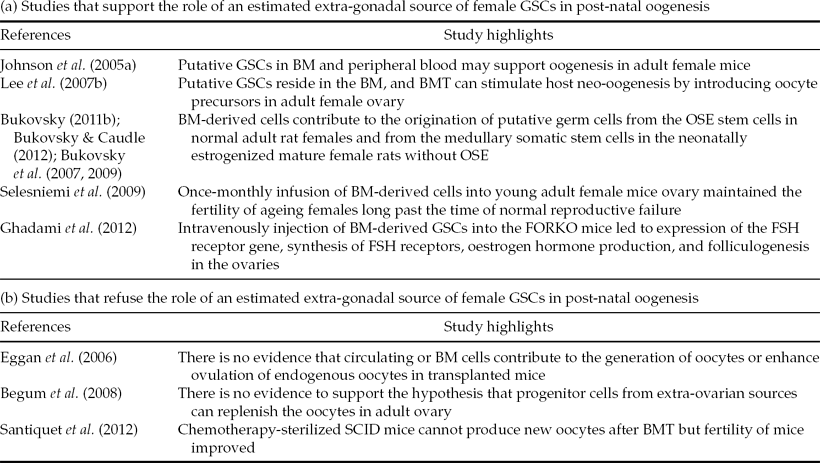
Johnson and his collaborators hypothesized that bone marrow transplantation (BMT) may restore the generation of oocytes in wild-type mice sterilized by chemotherapy and mice with a genetic disorder that rendered them incapable of oocyte production (Johnson et al., Reference Johnson, Bagley, Skaznik-Wikiel, Lee, Adams, Niikura, Tschudy, Tilly, Cortes, Forkert, Spitzer, Iacomini, Scadden and Tilly2005a). Based on gene expression analyses and BMT studies using chemotherapy-sterilized mice, these authors suggested that a putative GSC supply in BM supported oogenesis in adult female mice. They also claimed that peripheral blood included an additional source of GSCs in female mice. After transfusion of peripheral blood collected from transgenic females with germline-restricted GFP expression, GFP-positive oocytes were observed in the ovaries of chemotherapy-sterilized recipient females. These results led to the hypothesis that putative germ cells in BM release progenitor cells into the peripheral circulation that then may migrate to the ovaries (Johnson et al., Reference Johnson, Skaznik-Wikiel, Lee, Niikura, Tilly and Tilly2005b). However, to investigate the potential of naturally circulating peripheral blood cells to engraft in the ovary and contribute to oogenesis, Eggan and colleagues analysed ovulated oocytes from adult female mice that were surgically joined by parabiosis (Eggan et al., Reference Eggan, Jurga, Gosden, Min and Wagers2006). Parabiotic mice develop a common circulatory system and reveal a continuous, rapid exchange of cells and other circulating factors through the bloodstream (Wright et al., Reference Wright, Cheshier, Wagers, Randall, Christensen and Weissman2001a,Reference Wright, Wagers, Gulati, Johnson and Weissmanb; Bunster & Mayer, Reference Bunster and Mayer2005). Although circulating cells had the capacity to enter the ovary and associate with ovulating oocytes, they sustained all haematopoietic characteristics in this environment and did not contribute to the production of ovulated oocytes (Eggan et al., Reference Eggan, Jurga, Gosden, Min and Wagers2006). Moreover, in another study, 819 oocytes were examined in 30 ovarian grafts: GFP-negative ovaries were transplanted into GFP-positive transgenic hosts to test whether circulating germ cell progenitors could colonize the ovaries and organize new follicles. There was no evidence to support the hypothesis that progenitor cells from extra-ovarian sources could replenish the oocytes in adult ovaries (Begum et al., Reference Begum, Papaioannou and Gosden2008). However, in contrast with this result, Lee and collaborators observed that BMT into adult female mice treated with cytotoxic chemotherapy resulted in a restoration of follicle production, compared with continued sterility in chemotherapy-treated mice without receiving BMT. They suggested that a supply of GSCs resides in the BM, and that BMT triggers host neo-oogenesis by introducing oocyte precursors (Lee et al., Reference Lee, Selesniemi, Niikura, Niikura, Klein, Dombkowski and Tilly2007b). By using double-colour immunohistochemistry, Bukovsky and his group have claimed that BM-derived cells (monocyte-derived cells and T cells) contribute to the origin of putative germ cells from the OSE stem cells in normal adult rat females and from the medullary somatic stem cells in neonatally estrogenized mature female rats without OSE. They have argued that an alternative origin of putative germ cells from the medullary region may describe why ovaries with destructed OSE are still capable of forming new primordial follicles (Bukovsky et al., Reference Bukovsky, Ayala, Dominguez, Svetlikova and Selleck-White2007, Reference Bukovsky, Caudle, Virant-Klun, Gupta, Dominguez, Svetlikova and Xu2009; Bukovsky, Reference Bukovsky2011a; Bukovsky & Caudle, Reference Bukovsky and Caudle2012). Furthermore, vascular pericytes and BM-derived monocytes have been observed in association with the initiation of follicular development, selection and pre-ovulatory maturation of autologous oocytes (Bukovsky et al., Reference Bukovsky, Keenan, Caudle, Wimalasena, Upadhyaya and Vanmeter1995; Bukovsky, Reference Bukovsky2006, Reference Bukovsky2011b). It has also been demonstrated that a once-monthly infusion of BM-derived cells into young adult female mouse ovaries maintained the fertility of ageing females long past the time of normal reproductive failure (Selesniemi et al., Reference Selesniemi, Lee, Niikura and Tilly2009). This effect was attributed to the development of mature oocytes from host germline cells, sustained by a beneficial effect of BM-derived cell infusions on the ovarian environment (Niikura et al., Reference Niikura, Niikura and Tilly2009; Selesniemi et al., Reference Selesniemi, Lee, Niikura and Tilly2009). Hence, age-related reproductive failure may be related to deterioration of somatic microenvironments (niche) that support stem cell capacity. Interestingly, some regenerative signals in young and aged male blood can rejuvenate follicular dynamics in an aged ovary. The blood of male mice contains STRA8, which can induce ovarian expression of the germ cell-specific meiosis genes (Anderson et al., Reference Anderson, Baltus, Roepers-Gajadien, Hassold, de Rooij, van Pelt and Page2008) and leads to a significant increase in the ovarian follicle reserve through enhanced oogenesis (Niikura et al., Reference Niikura, Niikura, Wang, Satirapod and Tilly2010). In continuation of a study on putative BM-derived GSCs after birth, BM stem cells were injected intravenously into follitropin receptor knockout (FORKO) mice and penetrated into ovaries. These cells triggered the expression of the FSH receptor gene, synthesis of FSH receptors, oestrogen hormone production, and folliculogenesis in ovaries of FORKO mice (Ghadami et al., Reference Ghadami, El-Demerdash, Zhang, Salama, Binhazim, Archibong, Chen, Ballard, Sairam and Al-Hendy2012). However, Santiquet et al. (Reference Santiquet, Vallières, Pothier, Sirard, Robert and Richard2012) reported that there was no evidence that BMT or bovine embryonic ovarian tissue grafts led to the production of new oocytes in PU.1 and SCDI mice following treatment by chemotherapeutic agents. Nevertheless, the influence of BM cells improved the fertility of SCID mice that had been previously exposed to chemotherapeutic agents (Santiquet et al., Reference Santiquet, Vallières, Pothier, Sirard, Robert and Richard2012). Thus, Santiquet et al. (Reference Santiquet, Vallières, Pothier, Sirard, Robert and Richard2012) have suggested that the positive effects of transplanted bone marrow (BM) cells on the fertility of female mice could be due to renewal of self-tolerance of ovarian antigens; thereby, follicles are not demolished by chemotherapeutic agent treatment as a result of autoimmune damage. Additionally, Notarianni (Reference Notarianni2011) hypothesized that chemotherapeutic treatments led to ovarian failure, cellular apoptosis and reduction of ovarian antigen-specific regulatory T cells, and eventually to an autoimmune response in the ovary (Notarianni, Reference Notarianni2011). In conclusion, it is proposed that BMT decreases autoimmune responses induced by chemotherapy, and this change may occur by production of regulatory T cells in the ovary to improve restoration of self-tolerance. Some studies that report the role of an estimated extra-gonadal source of female GSCs in post-natal oogenesis are summarized in Table 2.
Some experiments that observe the role of an estimated extra-gonadal source of female GSCs in post-natal oogenesis
Conclusions
Remarkable studies on stem cell biology have revealed that most stem cells from different resources possess the same features such as multipotency (or sometimes pluripotency), self-renewal and regenerative potential in adulthood. The field of mammalian OSC biology has arguably been continuing, as the controversy of putative neo-oogenesis and follicular renewing in post-natal ovaries has intensified in the last 10 years. The basic doctrine that post-natal oogenesis occurs in lower vertebrates but not in mammals still prevails. However, the results of several studies have indicated that post-natal mammalian ovaries contain GSC precursors that are capable of renewing the oocyte pool and follicles.
The current authors believe that epigenetic mechanisms, such as histone modifications, DNA methylation, chromatin remodelling, and non-coding transcripts, play a determinative role in oogenesis and putative neo-oogenesis in post-natal ovaries. In studies that consider the epigenetic mechanisms in oogenesis, histone acetylation has been demonstrated to be involved in transcriptional regulation of germ cell development, including meiotic entry (Wang & Tilly, Reference Wang and Tilly2010) and meiotic continuation (Kim et al., Reference Kim, Liu, Tazaki, Nagata and Aoki2003). The activation of the STRA8 promoter in pre-meiotic germ cells was repressed by epigenetic factors that involved histone deacetylation (Wang & Tilly, Reference Wang and Tilly2010), and deacetylating histones of oocyte cytoplasm induced reprogramming of gene expression and resulted in the resumption of meiosis (Kim et al., Reference Kim, Liu, Tazaki, Nagata and Aoki2003). Wang & Tilly (Reference Wang and Tilly2010) also revealed that the class I/II histone deacetylase (HDAC) inhibitor, trichostatin-A (TSA), is associated with STRA8 activation, and that STRA8 expression is detectable and regulated physiologically in adult mouse ovaries. Cdk5 and the Abl enzyme substrate 1 (CABLES1) gene, which encodes a protein involved in the regulation of the cell cycle through interactions with several cyclin-dependent kinases, is a gene crucial for constraining the rate of oocyte renewal in adult mouse ovaries (Lee et al., Reference Lee, Sakamoto, Luo, Skaznik-Wikiel, Friel, Niikura, Tilly, Niikura, Klein, Styer, Zukerberg, Tilly and Rueda2007a). LIN28A also is a critical gene that affects PGC proliferation during embryogenesis and the size of the germ cell pool (Shinoda et al., Reference Shinoda, Soysa, Seligson, Yabuuchi, Fujiwara, Huang, Hagan, Gregory, Moss and Daley2013); FOXO3 (Forkhead box O3) has been described as a determinative gene in the development of the follicle pool size (Pelosi et al., Reference Pelosi, Omari, Michel, Ding, Amano, Forabosco, Schlessinger and Ottolenghi2013). Over-expression of FOXO3 can lead to augmentation of ovarian reproductive capacity in adulthood. In addition to these arguments, further studies are needed to clarify the effects of epigenetic mechanisms on putative neo-oogenesis in adulthood.
The controversy over the existence of OSCs and neo-oogenesis in adult mammals continues, and much more work is required to fully approve the concept that mammalian ovaries include cells with OSC-like characteristics that can be stimulated to enter a differentiation process and generate new oocytes. Nevertheless, there are some epigenetic and genetic concerns related to the in vitro differentiation of GSCs into oocytes, culture of OSE to produce autologous oocytes and growth of primordial follicles in vitro. In particular, stem cell dysfunction may result in some disorders such as ovarian cancer, polycystic ovary syndrome and fetal chromosomal abnormalities. In spite of these concerns, new outcomes in putative post-natal neo-oogenesis studies may lead to efficient therapy in female infertility and autologous regenerative medicine. Genetic disorders (such as POF), cancer treatment by chemotherapeutic agents and exposure to radiation can lead to infertility and inability to conceive. The differentiation of autologous GSCs into mature oocytes would enable in vitro fertilization and provide a new and novel expectancy for these sterile patients to produce offspring and delay menopause. It has also been postulated that putative stem cells in OSE can be involved in tumorigenesis and may be a therapeutic target in patients to offer more efficient therapy in the future.
Acknowledgements
I would like to express my great appreciation to the Scientific and Technological Research Council of Turkey (TÜBİTAK) for their valuable supports (Program 2215).



