INTRODUCTION
Executive functions (EF) have been conceptualised as a set of high-level control processes that enable an individual to adapt to diverse situations; inhibit inappropriate responses; formulate, initiate, and persevere with plans; and mediate the organisation of goal-directed thoughts and actions (Jurado & Rosselli, Reference Jurado and Rosselli2007; Miyake & Friedman, Reference Miyake and Friedman2012). While no single neuropsychological measure that can provide a holistic quantitative account of the complex composition of EF currently exists, the Wisconsin Card Sorting Test (WCST) is one of the most commonly administered tasks employed to investigate EF in neuropsychologically impaired populations, particularly in the schizophrenia spectrum. The card-based attentional set-shifting paradigm provides metrics of a respondent’s ability to develop, maintain, and update a response strategy, while inhibiting irrelevant or inappropriate responses. This makes it a versatile and popular measure of EF.
Individuals with schizophrenia spectrum disorder (SSD) are commonly reported not to successfully complete the WCST, attributed to an impaired ability to form concepts and engage in flexible thinking (Li, Reference Li2004; Polgár et al., Reference Polgár, Réthelyi, Bálint, Komlósi, Czobor and Bitter2010; Van der Does & Van den Bosch, Reference Van der Does and Van den Bosch1992; Waford & Lewine, Reference Waford and Lewine2010). Previous studies have documented that participants with SSDs require a high number of trials to complete the first category, register a high proportion of perseverative and non-perseverative errors, and frequently break set, resulting in their failure to meet the six categories achieved discontinuation rule before the maximum numbers of trials are administered. Executive dysfunction, as quantified through impaired WCST performance, has been associated with a broad range of constructs in schizophrenia spectrum research, including symptom dimensions (Donohoe & Robertson, Reference Donohoe and Robertson2003; Nieuwenstein et al., Reference Nieuwenstein, Aleman and De Haan2001; Polgár et al., Reference Polgár, Réthelyi, Bálint, Komlósi, Czobor and Bitter2010), functional outcome and learning proficiency (Green et al., Reference Green, Kern, Braff and Mintz2000; Lysaker et al., Reference Lysaker, Bell and Beam-Goulet1995; Rempfer et al., Reference Rempfer, Hamera, Brown and Bothwell2006; Rempfer et al., Reference Rempfer, McDowd and Brown2017), insight and theory of mind (Croca et al., Reference Croca, Lagodka, Gadel, Bourdel, Bendjemaa, Gaillard, Olie, Champagne-Lavau, Krebs and Amado2018; Rossell et al., Reference Rossell, Coakes, Shapleske, Woodruff and David2003), genetic variability (Rybakowski et al., Reference Rybakowski, Borkowska, Czerski, Dmitrzak-Weglarz, Skibinska, Kapelski and Hauser2006; Scarr et al., Reference Scarr, Sundram, Deljo, Cowie, Gibbons, Juzva, Mackinnon, Wood, Testa, Pantelis and Dean2012), and cortical activation and structure (Sasabayashi et al., Reference Sasabayashi, Takayanagi, Nishiyama, Takahashi, Furuichi, Kido, Nishikawa, Nakamura, Noguchi and Suzuki2017; Wilmsmeier et al., Reference Wilmsmeier, Ohrmann, Suslow, Siegmund, Koelkebeck, Rothermundt, Kugel, Arolt, Vauer and Pedersen2010).
Investigations using the WCST to study EF in SSDs typically employ the traditional group-averaged comparison approach, whereby inferences are made from the results of contrasting patient performance against those of healthy controls (HC) or another clinical group of interest (Kim et al., Reference Kim, An, Kwon and Shin2014; Li, Reference Li2004; Rady et al., Reference Rady, Elsheshai, el Wafa and Elkholy2011; Rossell & David, Reference Rossell and David1997). However, such group-averaged comparisons fail to account for the considerable within-group cognitive heterogeneity that exists within the schizophrenia spectrum and other psychotic disorders (Bora, Reference Bora2016; Joyce & Roiser, Reference Joyce and Roiser2007; Seaton et al., Reference Seaton, Goldstein and Allen2001). Several studies utilising neuropsychological batteries have attempted to characterise this within-group variability using a data-driven, cluster-analytic approach (Lewandowski et al., Reference Lewandowski, Baker, McCarthy, Norris and Öngür2018; Lewandowski et al., Reference Lewandowski, Sperry, Cohen and Öngür2014; Van Rheenen et al., Reference Van Rheenen, Lewandowski, Tan, Ospina, Ongur, Neill, Gurvich, Pantelis, Malhotra, Rossell and Burdick2017). Through identifying distinct clusters of participants who share a homogenous cognitive profile, several subgroups that characterise the within-group cognitive variability prevalent among people with psychosis have been consistently identified. Broadly, two anchoring cognitive profiles repeatedly emerge, a severely impaired subgroup and a cognitively intact subgroup, with a varying number of intermediate profiles of mixed/specific cognitive deficits emerging in-between (Burdick et al., Reference Burdick, Russo, Frangou, Mahon, Braga, Shanahan and Malhotra2014; Lewandowski et al., Reference Lewandowski, Baker, McCarthy, Norris and Öngür2018; Van Rheenen et al., Reference Van Rheenen, Lewandowski, Tan, Ospina, Ongur, Neill, Gurvich, Pantelis, Malhotra, Rossell and Burdick2017; Weickert et al., Reference Weickert, Goldberg, Gold, Bigelow, Egan and Weinberger2000; Wells et al., Reference Wells, Swaminathan, Sundram, Weinberg, Bruggemann, Jacomb, Cropley, Lenroot, Pereira and Zalesky2015). These subgroups can be identified at first episode (Reser et al., Reference Reser, Allott, Killackey, Farhall and Cotton2015; Uren et al., Reference Uren, Cotton, Killackey, Saling and Allott2017), transcend the familial and psychosis spectrum (Burdick et al., Reference Burdick, Russo, Frangou, Mahon, Braga, Shanahan and Malhotra2014; Hoti et al., Reference Hoti, Tuulio-Henriksson, Haukka, Partonen, Holmström and Lönnqvist2004; Lewandowski et al., Reference Lewandowski, Sperry, Cohen and Öngür2014; Van Rheenen et al., Reference Van Rheenen, Lewandowski, Tan, Ospina, Ongur, Neill, Gurvich, Pantelis, Malhotra, Rossell and Burdick2017), exhibit distinctive brain structure (Czepielewski et al., Reference Czepielewski, Wang, Gama and Barch2017; Van Rheenen et al., Reference Van Rheenen, Cropley, Zalesky, Bousman, Wells, Bruggemann, Sundram, Weinberg, Lenroot, Pereira, Weickert, Weickert and Pantelis2018; Woodward & Heckers, Reference Woodward and Heckers2015), and display altered response to treatment and functional outcomes (Gilbert et al., Reference Gilbert, Mérette, Jomphe, Émond, Rouleau, Bouchard, Roy, Paccalet and Maziade2014; Uren et al., Reference Uren, Cotton, Killackey, Saling and Allott2017). Together, this research indicates that while most individuals with SSD experience mild-to-severe cognitive dysfunction, a subset performs at similar-to-HC levels.
To date, investigations using cluster analytical techniques to characterise the cognitive heterogeneity within the schizophrenia spectrum have typically employed multidimensional batteries of cognition, with some studies entering indices of EF into the subgrouping analysis among other non-executive measures (Cobia et al., Reference Cobia, Csernansky and Wang2011; Dawes et al., Reference Dawes, Jeste and Palmer2011; Hill et al., Reference Hill, Ragland, Gur and Gur2002; Liu et al., Reference Liu, Fann, Chen, Liu, Oyang, Yang, Chang, Wen, Chen, Hwang, Hsieh, Liu, Faraone, Tsuang and Hwu2011; Sauvé et al., Reference Sauvé, Malla, Joober, Brodeur and Lepage2018; Van Rheenen et al., Reference Van Rheenen, Lewandowski, Tan, Ospina, Ongur, Neill, Gurvich, Pantelis, Malhotra, Rossell and Burdick2017). When emergent subgroups are compared on select EF indices, meaningful differences are reported for some (Cobia et al., Reference Cobia, Csernansky and Wang2011; Gilbert et al., Reference Gilbert, Mérette, Jomphe, Émond, Rouleau, Bouchard, Roy, Paccalet and Maziade2014; Liu et al., Reference Liu, Fann, Chen, Liu, Oyang, Yang, Chang, Wen, Chen, Hwang, Hsieh, Liu, Faraone, Tsuang and Hwu2011; Van Rheenen et al., Reference Van Rheenen, Lewandowski, Tan, Ospina, Ongur, Neill, Gurvich, Pantelis, Malhotra, Rossell and Burdick2017), however not all subgroup comparisons (McDermid Vaz & Heinrichs, Reference McDermid Vaz and Heinrichs2006; Potter & Nestor, Reference Potter and Nestor2010).
While it is becoming increasingly evident that considerable cognitive heterogeneity exists among individuals with SSD, further characterisation is required. To date, investigations have typically focused on broad neuropsychological batteries of predominately non-executive cognition. However, it is likely that meaningful variability in EF also exists among individuals with the disorder. In addition to the multidimensional composition of EF, current measures are complex and require multiple interdependent cognitive processes for successful completion. It is therefore likely that considerable executive variability exists among the people with SSD, in terms of both overall composition and task-specific performance. Consequently, an exploratory cluster analytic approach was employed here to first highlight the influential effects of EF heterogeneity on the schizophrenia spectrum, through characterising the within-group variability of outpatient performance on the WCST. The aim of the present study was to identify performance subgroups on the WCST using cluster analysis to further characterise the considerable cognitive heterogeneity evident within the population. It was hypothesised that two anchoring homogenous clusters of intact and severely impaired ability would emerge. An exploratory aim was to identify and characterise any additional clusters that emerge.
METHOD
Participants
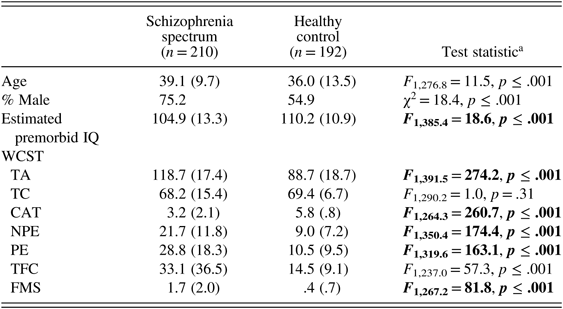
Data from 172 schizophrenia and 38 schizoaffective disorder patients and 192 HCs were obtained from the Cognitive and Genetic Explanations of Mental Illnesses (CAGEMIS) and Cooperative Research Centre (CRC) for Mental Health bio-databanks (Table 1). All participants had given prior informed consent for the analysis of their stored data and were recruited from metropolitan-based outpatient and community clinics. Participants’ previous exposure to the WCST was not recorded. Psychiatric diagnosis and HC eligibility were confirmed using the MINI-International Neuropsychiatric Interview (Hergueta et al., Reference Hergueta, Baker and Dunbar1998). Patient symptomology was assessed at the time of testing with either the Brief Psychiatric Rating Scale (BPRS; Overall & Gorham, Reference Overall and Gorham1962) or the Positive and Negative Syndrome Scale (PANSS; Kay et al., Reference Kay, Fiszbein and Opler1987). As the use of the BPRS and PANSS was mixed during data collection, a consistent metric of symptomology across all participants was created using the PANSS items that are encompassed within the BPRS for those participants without BPRS scores (see Supplementary Material). These scales have been shown to have similar scoring formats, display good correspondence in terms of treatment response (Leucht et al., Reference Leucht, Kane, Etschel, Kissling, Hamann and Engel2006; Leucht et al., Reference Leucht, Rothe, Davis and Engel2013), and have previously been combined in similar research studies (Van Rheenen et al., Reference Van Rheenen, Lewandowski, Tan, Ospina, Ongur, Neill, Gurvich, Pantelis, Malhotra, Rossell and Burdick2017). Items were combined and averaged to reflect the following three BPRS symptom subscales: affect, positive and negative (Shafer, Reference Shafer2005). All participants were fluent in English, were between the ages of 18 and 65 years old, and had an estimated premorbid intelligence quotient (IQ) >70 as scored by either the Wechsler Test of Adult Reading (Wechsler, Reference Wechsler2001) or the National Adult Reading Test (Blair & Spreen, Reference Blair and Spreen1989). Participants with significant visual or verbal impairments, a known neurological disorder, and current substance/alcohol abuse or dependence were excluded. At the time of testing, participants were not actively partaking in any form of cognitive remediation programmes or clinical trials. At the time of testing, all patients were on stable doses of anti-psychotic medication; most schizophrenia spectrum participants (90%) received atypical antipsychotic medications, usually clozapine, quetiapine, or aripiprazole. The remaining 10% of participants received typical antipsychotic medications such as haloperidol or zuclopenthixol or received a combination of typical and atypical antipsychotic medications. All procedures contributing to this work comply with the ethical standards of the relevant national and institutional committees on human experimentation and with the Helsinki Declaration of 1975, as revised in 2008.
Demographic summary

Data were reported as mean (SD) unless otherwise stated.
Bold font denotes large effect size. Estimated Premorbid IQ data unavailable for 10 participants.
a Brown–Forsythe F-ratio reported.
WCST, Wisconsin Card Sorting Test; TA, trials administered; TC, total correct; CAT, categories achieved; NPE, non-perseverative errors; PE, perseverative errors; TFC, trials to first category; FMS, failure to maintain set.
The WCST
Each participant completed the 128-card version of the WCST, which was administered and scored in standard fashion (Heaton, Reference Heaton1993). Variables selected for cluster analysis included trials administered (TA), categories achieved (CAT), perseverative errors (PE), non-perseverative errors (NPE), and trials to first category (TFC). Total correct (TC) was not entered into the cluster analysis as this is dependent on the number of TA. Failure to maintain set (FMS) was omitted from the cluster analysis as a proportion of participants (15%) failed to reach a level of success on the task that would permit this variable to be a valid indicator of performance. TC and FMS were used to characterise the subgroups emerging from the cluster analysis. This combination of variables was selected to provide a holistic summary of WCST task performance. TA, CAT, and TFC provide an indication of overall task success and efficiency. PE reflect the extent of perseveration, with higher scores indicative of greater cognitive inflexibility. Higher NPE indicates impaired task performance not attributable to cognitive inflexibility.
Statistical Analysis
Several hierarchical cluster analyses were conducted using TA, CAT, NPE, PE, and TFC Z-scores (based on the HC mean and SD) to identify and validate homogenous performance subgroups within our sample. Similarity between schizophrenia spectrum cases was computed using hierarchical agglomerative clustering, with Ward’s minimum variance method and Squared Euclidean distance. Collaborative inspection of the agglomeration schedule and dendrogram was used to establish the appropriate number of clusters to be retained and confirmed by discriminant function analysis. A k-means iterative partitioning technique was then employed to optimise the retained clusters, with initial partitions in the k-means solution defined using the cluster means obtained from the initial clustering procedure. The stability of the final cluster solution was evaluated through split-sample and alternate method replication via Cohen’s κ analysis, with high agreement over multiple design iterations required to validate the final clustering solution obtained (κ > .80; Landis & Koch, Reference Landis and Koch1977).
Emergent clusters were compared on premorbid IQ, demographic and clinical variables, and WCST variables using analysis of variance (ANOVA) or Chi-square (χ 2) analyses as appropriate. Brown–Forsythe F-ratio was used when appropriate. Post-hoc p-values were Games–Howell corrected for unequal sample sizes/unequal variances. Eta-Squared (η 2) was calculated for omnibus tests (large effect, η 2 > .26), Cohen’s d for post-hoc pairwise comparisons (large effect, d > .8), and Cramer’s V for χ 2 analyses (large effect, χ 2 > .3), as measures of effect size. For significant χ 2 results, adjusted standardised residuals and their calculated significance were reported.
RESULTS
As presented in Table 1, the schizophrenia spectrum participants performed significantly worse on all WCST variables except for TC compared to HCs. The non-significant difference in TC is attributed to the schizophrenia group having significantly more TA, therefore having more opportunity to correctly sort trials as opposed to performing equally as well as the HC group.
Cluster Analysis
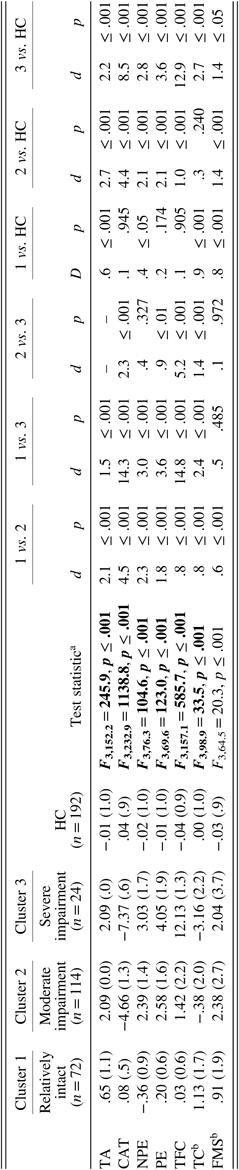
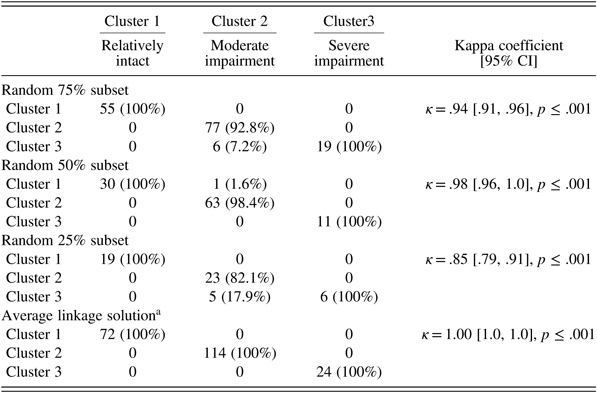
Three clusters representing three distinct WCST performance profiles emerged (see Table 2; Supplementary Figures S1 and S2). Table 3 displays the membership agreement and κ scores between the final clustering solution and four alternate design iterations. An almost-perfect level of agreement (Landis & Koch, Reference Landis and Koch1977) was detected between the final clustering solution and the solutions emerging from a random 75%, 50%, and 25% subset of the original patient sample using the same method, as well as the solution that emerged using the average linkage method on the whole patient sample.
Comparison of WCST z-scores across emergent cluster subgroups

Data were reported as mean (SD) unless otherwise stated.
Bold font denotes large effect size for omnibus tests.
HC, healthy control; WCST, Wisconsin Card Sorting Test; TA, trials administered; CAT, categories achieved; NPE, non-perseverative errors; PE, perseverative errors; TFC, trials to first category; TC, total correct; FMS, failure to maintain set.
a Brown–Forsythe F-ratio reported.
b Not included in cluster analysis.
Agreement and Kappa coefficient scores between final clustering solution and alternate replications

a All remaining analysis steps are as per main analysis described in the Method section.
CI, confidence interval.
Cluster One outperformed the remaining clusters on all WCST variables except for FMS (see below). Compared to the HC group, Cluster One exhibited a slightly less efficient, albeit successful performance on the WCST, scoring more TC, NPE, and FMS and therefore requiring additional TA to reach the same number of categories completed as the HC group. Cluster One was therefore labelled as the relatively intact subgroup. Cluster Two was deemed to represent a moderate level of impairment, distinguished by control equivalent performance on TC, in the absence of successfully achieving a high number of categories. This patient subgroup appeared to grasp the conceptual aspects of the task to permit the successful completion of some categories, however failed to maintain enough sets to enable the successful completion of the WCST. Despite requiring a relatively small number of trials to reach the first category, the performance of Cluster Two was impaired by a moderate number of both NPE and PE. Taken together, the moderate impairment subgroup displayed a profile of inefficient, unsuccessful, yet relatively flexible performance on the WCST. The third and final cluster, labelled as the severe impairment subgroup, was distinguished by a high TFC, PE, combined with an impaired profile of high TA, NPE, and low TC, CAT. The severe impairment subgroup was significantly impaired on all variables compared to both patient subgroups and HCs except for FMS. The non-differentiated performance on FMS was interpreted to reflect an inability to acquire a correct response set and therefore maintain it, as opposed to the inability to maintain an acquired set.
Non-WCST Results
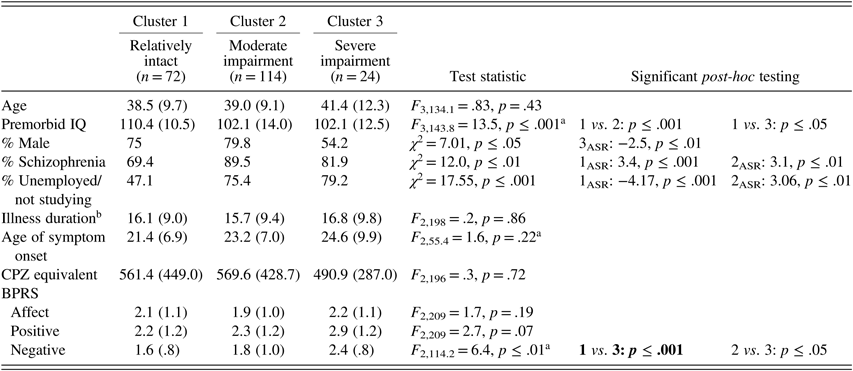
Table 4 summarises the demographic characteristics of the three emergent schizophrenia spectrum participant subgroups. Subgroups were not significantly different in illness duration, age of symptom onset, CPZ equivalent, BPRS affect, and BPRS positive. The severe impairment subgroup was detected to have significantly higher BPRS negative scores compared to the remaining patient subgroups, with the relatively intact subgroup detected to have significantly higher estimated premorbid IQ compared to the moderate and severe impairment subgroups. HC participants were detected to have significantly higher estimated premorbid IQ compared to the moderately (μ diff = 8.12; p ≤ .001; d = .67) and severely (μ diff = 8.15; p ≤ .05; d = .74) impaired subgroups, with no significant difference from the relatively intact subgroup detected (μ diff = −.24; p = .99; d = −.02). A significant difference in the distribution of sex across all groups was detected, with a significant difference in the distribution of schizophrenia spectrum diagnosis also detected across the three patient subgroups. Several significant main effects of sex and schizophrenia spectrum diagnosis were detected. On average, female participants and participants diagnosed with schizoaffective disorder required less trials, achieved more categories, and maintained more sets than their respective male counterparts and those diagnosed with schizophrenia. However, no significant sex-by-group or diagnosis-by-group interactions were detected (see Supplementary Tables 2 and 3). A significant difference in the distribution of employment/enrolment status was detected, with the relatively intact cluster having significantly less-than-expected participants either unemployed or not currently studying. The moderately impaired cluster had a significantly higher-than-expected proportion of participants either unemployed or not currently in school. Eighty-seven percent of the relatively intact subgroup, 89% of the moderate impairment subgroup, and 95% of the severely impaired subgroup were receiving atypical antipsychotic medications. No cognitive differences on the basis of medication status were detected among the subgroups.
Demographic characteristics of emergent cluster subgroups

Data were reported as mean (SD) unless otherwise stated.
Bold indicates large effect sizes. Illness duration data unavailable for 11 participants. Age of symptom onset data unavailable for 18 participants. CPZ data unavailable for 13 participants.
a Brown–Forsythe F-ratio reported.
b Years of total duration of active and residual periods.
BRPS, Brief Psychotic Rating Scale; ASR, adjusted standardised residuals.
DISCUSSION
The present study sought to characterise cognitive heterogeneity within the schizophrenia spectrum by examining the performance variability of a group of outpatients on a complex and popular measure of EF, the WCST. Using a data-driven cluster analysis optimised with k-means iterative partitioning, we were able to detect three homogenous subgroups of schizophrenia spectrum patients who exhibited distinct performance profiles. Of the three emergent clusters, a patient subgroup exhibiting a relatively intact level of performance on the WCST was identified, in addition to two subgroups of impairment: a moderate impairment subgroup and a severe impairment subgroup.
Impaired performance on the WCST is frequently reported in the schizophrenia spectrum literature and is most commonly attributed to cognitive inflexibility (Li, Reference Li2004). Contrary to this, we were able to identify a subgroup of participants who exhibited a control-equivalent level of overall performance. The relatively intact patient subgroup demonstrated cognitive flexibility and the ability to form and maintain concepts, enabling the majority of the subgroup to successfully complete the WCST, albeit less efficiently than the HC group. All relatively intact subgroup participants achieved five or more categories (one category = 10 successive correct sorts), with 83% (n = 60) reaching the six CAT task discontinuation criterion to successfully complete the WCST. This contrasts with the compromised performances of the moderate and severe impairment subgroups, in which no participant achieved more than four or two categories, respectively (see Supplementary Material).
The severe impairment subgroup represented an amplified version of what is typically reported within the available literature, a profile of poor concept formation paired with cognitive inflexibility. Distinguished by a high number of trials to reach the first category and a high number of perseverative errors, 11% of our patient sample failed to grasp the requirements of the task. Members of the severe impairment subgroup displayed an inability to form and maintain the concepts required to successfully complete multiple, if any, categories despite ongoing negative feedback. In contrast, the profile of the moderate impairment subgroup is viewed to reflect an unsuccessful attempt at adapting to the demands of the task. The moderate impairment subgroup exhibited a degree of cognitive flexibility and relative success, requiring only a modest number of trials to reach the first category and correctly sorting more trials and achieving more categories than the severely impaired subgroup. However, when compared against the performances of the relatively intact patient subgroup and HC group, the moderately impaired participants were less effective when it came to concept formation and demonstrated a compromised ability to maintain set.
To our knowledge, this is the first time that cluster analysis has been applied to a solitary complex measure of EF to identify homogenous subgroups in a conventional research sample of schizophrenia spectrum participants. The emergence of three distinct subgroups on the WCST coincides with previous cluster analytic studies that have documented multiple cognitive phenotypes within the psychosis spectrum (Lewandowski et al., Reference Lewandowski, Baker, McCarthy, Norris and Öngür2018; Lewandowski et al., Reference Lewandowski, Sperry, Cohen and Öngür2014; Reser et al., Reference Reser, Allott, Killackey, Farhall and Cotton2015; Van Rheenen et al., Reference Van Rheenen, Lewandowski, Tan, Ospina, Ongur, Neill, Gurvich, Pantelis, Malhotra, Rossell and Burdick2017). Such studies have consistently identified two anchoring cognitive subgroups: one characterised by severe cognitive impairments and the other a near-normal level of functioning, with a varying number of profiles of mixed impairments typically emerging in-between. The present results extend this literature, identifying two subgroups that differ in severity of executive dysfunction and a third subgroup exhibiting a relatively intact level of functioning as quantified through the WCST. Historically, schizophrenia spectrum disorder participants have been consistently documented as a single group to exhibit moderately impaired performance on the WCST relative to the HC population (Li, Reference Li2004; Van der Does & Van den Bosch, Reference Van der Does and Van den Bosch1992). By applying exploratory cluster analysis, a small proportion of the schizophrenia spectrum participants were identified as having severe impairments on the WCST. This is in line with previous data-driven research that consistently identified a small proportion of schizophrenia spectrum disorder participants who were characterised by severe cognitive dysfunction (e.g. Geisler et al., Reference Geisler, Walton, Naylor, Roessner, Lim, Schulz, Gollub, Calhoun, Sponheim and Ehrlich2015; Hill et al., Reference Hill, Ragland, Gur and Gur2002; Weinberg et al., Reference Weinberg, Lenroot, Jacomb, Allen, Bruggemann, Wells, Balzan, Liu, Galletly, Catts, Weickert and Weickert2016). Relatively intact subgroups of schizophrenia spectrum participants have previously been characterised (e.g. Van Rheenen et al., Reference Van Rheenen, Lewandowski, Tan, Ospina, Ongur, Neill, Gurvich, Pantelis, Malhotra, Rossell and Burdick2017), which exhibit an overarching profile of intact cognitive functioning, especially in comparison with the remaining patient subgroups that emerge, but exhibit one or two slight cognitive impairments relative to HCs. Considering that the WCST requires multiple interdependent cognitive processes to complete, it is not surprising that a group of schizophrenia spectrum participants identified as demonstrating an intact level of overall performance on the complex measure of EF were found to do so with a degree of inefficiency compared to HCs.
The relatively intact and two impaired subgroups were found to differ in estimations of premorbid IQ; such a distinction was not detected between relatively intact patient and HC participants. This suggests that the subtle differences between the HC and relatively intact groups and the differences in severity of impairment between the two remaining patient subgroups are not attributable to differences in premorbid functioning. Furthermore, subgroups did not significantly differ in terms of illness duration or age of illness onset, suggesting that the subgroups identified are specific to cognitive processes rather than these illness-related factors. Medication appears not to be a contributing factor as well, with no significant difference in chlorpromazine equivalence or medication status-by-group interactions detected. While mixed reports have been published regarding the clinical significance of cognitive subgroups (Dawes et al., Reference Dawes, Jeste and Palmer2011; Geisler et al., Reference Geisler, Walton, Naylor, Roessner, Lim, Schulz, Gollub, Calhoun, Sponheim and Ehrlich2015), the severely impaired subgroup in this instance was detected to exhibit greater negative symptomology compared to the moderate impairment and relatively intact subgroups. This is in line with several studies which suggest that individuals with SSD classified as having compromised cognitive capacity also experience more severe negative symptomology (Cobia et al., Reference Cobia, Csernansky and Wang2011; Potter & Nestor, Reference Potter and Nestor2010; Van Rheenen et al., Reference Van Rheenen, Cropley, Zalesky, Bousman, Wells, Bruggemann, Sundram, Weinberg, Lenroot, Pereira, Weickert, Weickert and Pantelis2018; Weinberg et al., Reference Weinberg, Lenroot, Jacomb, Allen, Bruggemann, Wells, Balzan, Liu, Galletly, Catts, Weickert and Weickert2016). However, as with previous research subgroups did not significantly differ in positive or affective symptom severity, suggesting that the cognitive subgroups identified in the current study do not reflect distinct clinical profiles, rather distinct executive phenotypes.
A significant difference in the distribution of employment/enrolment status between the three subgroups briefly highlights the functional importance of considering executive heterogeneity among the schizophrenia spectrum population. Participants classified as having relatively intact performance on the WCST were more likely to be either employed or currently studying, with the two impaired subgroups exhibiting similar levels of functional impairment. The identification of three distinct profiles of cognitive flexibility also encourages the consideration of EF heterogeneity when developing, implementing, and evaluating psychosocial and cognitive interventions (Bryce et al., Reference Bryce, Rossell, Lee, Lawrence, Tan, Carruthers and Ponsford2018; Cella et al., Reference Cella, Bishara, Medin, Swan, Reeder and Wykes2014; Wykes et al., Reference Wykes, Reeder, Landau, Everitt, Knapp, Patel and Romeo2007). Several studies report the functional benefits of interventions targeting cognitive flexibility (Farreny et al., Reference Farreny, Aguado, Ochoa, Huerta-Ramos, Marsà, López-Carrilero, Carral, Haro and Usall2012; Penadés et al., Reference Penadés, Catalán, Puig, Masana, Pujol, Navarro, Guarch and Gastó2010), which could likely be influenced by the within-group variability identified here. For example, patients exhibiting flexible, yet ineffective, adaptions to the environment may benefit from interventions based in the real world, such as Cognitive Adaptation Training, which utilises environmental supports and compensatory strategies to improve environmental adjustment and vocational recovery (Allott et al., Reference Allott, Killackey, Sun, Brewer and Velligan2017; Fredrick et al., Reference Fredrick, Mintz, Roberts, Maples, Sarkar, Li and Velligan2015). Highly perseverative patients may benefit from an intervention combining both cognitive remediation and functional adaptation training (Bowie et al., Reference Bowie, McGurk, Mausbach, Patterson and Harvey2012). Alternatively, the effectiveness of interventions improving cognitive and functional outcomes in impaired patients may be negatively influenced by the inclusion of cognitively intact individuals. Such patients would likely show minimal improvements after standard interventions designed to improve impaired cognitive capacities, negatively impacting the outcome indices used to assess the effectiveness of the intervention. Limited in its cognitive scope in contrast to a multidimensional cognitive battery, the WCST, in combination with cluster analysis, could be a useful and brief way to identify schizophrenia spectrum patients better suited to a particular intervention therapy.
The present study is not without its limitations. The evidence pertaining to the effects of practice on the WCST among the schizophrenia spectrum population is mixed. While some studies have reported non-significant practice effects over short and long intervals (Choi & Kurtz, Reference Choi and Kurtz2009; Light et al., Reference Light, Swerdlow, Rissling, Radant, Sugar, Sprock, Pela, Geyer and Braff2012), others have found significant improvements following repeated test administration (Bellack et al., Reference Bellack, Blanchard, Murphy and Podell1996; Bryson et al., Reference Bryson, Greig, Lysaker and Bell2002). Moderate-to-large performance improvements have also been reported among samples of schizophrenia spectrum participants following targeted interactive interventions that can persist for up to 6 weeks after training (see Kurtz et al., Reference Kurtz, Moberg, Gur and Gur2001). While participants were not currently partaking in any active cognitive intervention at the time of testing, participants’ prior experiences with the WCST were not recorded, something that future researchers administering the WCST should consider. While speculations were offered concerning the ecological and functional benefits of pairing cluster analysis with the WCST within the context of SSDs, no empirically based elaboration was possible. An index of employment/enrolment status was compared across subgroups; however, a more detailed assessment of functional outcomes is necessary. Considering the functional consequences associated with cognitive inflexibility (Green et al., Reference Green, Kern and Heaton2004; Velligan et al., Reference Velligan, Bow-Thomas, Mahurin, Miller and Halgunseth2000), more elaborate and targeted examination of the association between EF heterogeneity and outcomes is needed to permit further insight into the real-world applicability of the present findings. Due to the present study’s particular investigative focus, the indices of EF examined here are specific to achievement on the WCST. The field will therefore benefit from a broader examination of the executive heterogeneity within the schizophrenia spectrum population. A latent variable approach could be taken, investigating performance variability using the fundamental EFs of updating, shifting, and inhibition (Miyake & Friedman, Reference Miyake and Friedman2012; Miyake et al., Reference Miyake, Friedman, Emerson, Witzki, Howerter and Wager2000). Alternatively, a Boston Process Approach could be applied, identifying meaningful subgroups based on the deductive means through which participants complete higher-order executive tasks, rather than examining the task-specific performance indicators as per the current study. The study would have also benefitted from a comparison with the subgroups attained using a broader non-executive cognitive battery. This would have permitted comparisons between emergent subgroup solutions to determine if the performance subgroups characterised here are domain-specific or rather just reflective of a generalised partitioning of the patient sample. Furthermore, the present study only had access to verbal learning-based estimates of premorbid functioning, and while no unexpected differences across subgroups were found, the use of a premorbid functioning estimate measure based on visuospatial ability would have been more appropriate given the WCST reliance on visuospatial reasoning. While there has been a renewed interested in the use of data-driven cluster analytic approaches to characterise homogenous performance profiles in psychosis, limitations inherently lie in the statistical method that impact the validity and generalisability of the results of the present study. Emergent clusters are determined by the characteristics of the sample examined and by the measures employed. Therefore, despite establishing a high level of agreement between the final clustering solution and multiple design iterations, external replication is necessary to establish the validity and utility of the subgroups identified here (Lewandowski et al., Reference Lewandowski, Baker, McCarthy, Norris and Öngür2018).
In conclusion, cluster analysis was employed to investigate the within-group performance variability on a popular measure of EF, the WCST in a sizeable sample of schizophrenia spectrum disorder participants. Three clusters emerged, reflecting relatively intact, moderately, and severely impaired profiles of performance. The identification of three distinct subgroups highlights the importance of considering sample heterogeneity when administering complex measures of EF to participants with SSD. While cognitive subgroups appear to transcend both the schizophrenia and broader psychosis spectrums (e.g. Lewandowski et al., Reference Lewandowski, Baker, McCarthy, Norris and Öngür2018; Van Rheenen, 2017) future research should consider examining EF performance variability within each diagnostic group independently. Interventions targeting EF and functional outcomes should consider the strengths and weaknesses of heterogeneous subgroups within their sample before commencing. Due to the distinct performance profiles identified here, the results promote the reappraisal of findings from previous group-based association studies using the WCST to investigate EF in SSD.
ACKNOWLEDGEMENTS
This work was supported by Australian Postgraduate Awards (S.P.C, P.J.S) and by the Australian National Health and Medical Research Council (NHMRC; fellowships to C.G (ID: 5467262), T.V.R (1088785), E.J.T (1142424) and C.P (628386 and 1105825); and a project grant to S.L.R (ID: 1060664)). The authors acknowledge the support of the Monash Alfred Psychiatry Research Centre and the financial support of the Cooperative Research Centre (CRC) for Mental Health. The CRC programme is an Australian government Initiative. The authors wish to acknowledge the CRC Scientific Advisory Committee, in addition to the contributions of study participants, clinicians at recruitment services, staff at the Murdoch Children’s Research Institute, staff at the Australian Imaging, Biomarkers and Lifestyle Flagship Study of Aging, and research staff at the Melbourne Neuropsychiatry Centre, including coordinators Phassouliotis, C., Merritt, A., and research assistants, Burnside, A., Cross, H., Gale, S., and Tahtalian, S. None of the funding sources played any role in the study design; collection, analysis or interpretation of data; in the writing of the report; or in the decision to submit the paper for publication. Participants for this study were sourced, in part, through the Australian Schizophrenia Research Bank (ASRB), which is supported by the National Health and Medical Research Council of Australia (Enabling Grant ID: 386500), the Pratt Foundation, Ramsay Health Care, the Viertel Charitable Foundation, and the Schizophrenia Research Institute. We thank the Chief Investigators and ASRB Manager: Carr, V., Schall, U., Scott, R., Jablensky, A., Mowry, B., Michie, P., Catts, S., Henskens, F., Pantelis, C., Loughland, C. We acknowledge the help of Jason Bridge for ASRB database queries.
CONFLICTS OF INTEREST
The authors have nothing to disclose.
SUPPLEMENTARY MATERIALS
To view supplementary material for this article, please visit https://doi.org/10.1017/S1355617719000420