Introduction
What is a “hybrid” librarian? I do not remember seeing that on the curriculum at library school – although it is some time since I did my post-graduate qualification and it may well be an integral part of the course now. “Hybrid” conjures up images of the agricultural revolution for me, where a hybrid plant is bred to improve the plant's characteristics: improved production, disease resistance, and better performance.
So is that what we should all be striving to achieve in our work? (Not better breeding, but better performance!) Is this really something different or new?
This may depend upon the particular role or sector. I began my career with eight years in public libraries and local government and I can understand that, in such large organisations, there can be a need to segment roles and delineate responsibilities for effective working. However, I have found that success in a smaller commercial environment can mean taking on new skills, handling areas that are not traditionally “library”, particularly in the knowledge management area. I have heard the view expressed that to take on such new areas could dilute our profession and value, but I believe that, to the contrary, to take on a new area augments and demonstrates our value and not doing so may be risky and potentially a reduction in our value. Change can be both a huge opportunity and a benefit.
What is a “hybrid manager”?
“Hybrid manager” has been a concept since the late 1980s, when it was recognised that there was a need to combine knowledge of IT with business acumen in order to gain best value from IT investments.Footnote 1
All libraries have been affected by the development of digital resources, firstly with online, then the internet, now web 2.0, RSS, social media etc. Most information professionals have taken this in their stride, embracing the new technology, and providing the gateway and facilitation that our users need to access information and benefit from these changes.
Hybrids can include librarians just exploiting their own interests and aptitudes in areas such as Web 2.0, intranets, library catalogues. This expertise should be recognised and developed.
As technology develops and changes, the information professional is often the expert in specialist systems possibly moving between IT and information. How many librarians have worked for software providers who sell library management systems? To understand the business need for the system the business experts (librarians) need to be involved. Developing “hybrid” skills is really about effective working.
True hybrid
A possible definition of a true hybrid could be someone with qualifications outside the information profession. Within law firms, this has traditionally comprised the qualified lawyer who has taken on an information role.
Additionally, there are professional support lawyers (PSLs), who fulfil a role between that of the information professionals and the lawyers. This works well when PSLs use the information gathered by the library e.g. bulletins, current awareness, and results of enquiry work, and add value by explaining how the change may affect the practice, clients etc. PSLs can perform their expert role for all areas of law, including newly developing areas such as data protection law. Increasingly the PSL is useful to the business development, marketing and communications teams within a law firm.
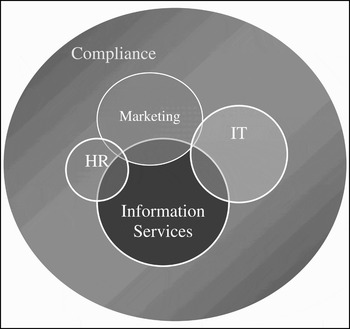
The diagram above illustrates the basic flow of information.

KIS (Knowledge and Information Services) still retains direct contact with the practice areas and are not restricted to information flows going via the PSL for everything – PSLs are seen as a useful adjunct to our service.
People with both a law degree and an information qualification have held roles within the knowledge and information services in law firms since the early 1970s – true hybrid professionals.
The increase in dual-qualified team members could be perceived as a threat to those who have a library qualification, but no legal qualification, potentially hindering their subsequent progression to managerial positions within law firms. This has not necessarily been the case. In the past some information job descriptions stipulated a legal qualification, but this requirement is not so frequent latterly. We see non-dual qualified librarians in managerial positions able to prove their value across law firms, leveraging their business acumen and using their facilitation skills, proving that a legal qualification is not a necessity.
In some organisations the requirement for a legally qualified person to develop know-how services has resulted in a divide between the knowledge management and library/information function. While this may exploit legal expertise, it can be difficult to decide exactly what the division of responsibilities should be and can result in administrative duplication. This structure can work when it is well-managed and co-ordinated and can potentially suit larger law firms.
This is not the situation at CMS Cameron McKenna, where KIS are responsible for library services, knowledge systems, document automation and a host of other areas, and we do not have a separate KM team. This allows us to exploit our hybrid skills and can provide immense job satisfaction, with minimum team size and very cost effective budgets.
In other sectors, hybrid roles first became apparent with the cross-over of IT professionals and, within the law firm, the main cross-functional or “hybrid” roles, came from IT and marketing, and human resources skills applied to training and development.
Main areas of synergy that require hybrid skill sets within the law firm environment

Role of the librarian
The librarian is a gateway to a wealth of knowledge and, within a law firm, the library strategy needs to be aligned to that of the firm, providing all the information that is needed for the business, whether that be commercial data, external information, enterprise data or shared experience. Our Knowledge and Information Services Department only exists to support the business in all its aspects.
This can be undertaken either by hybrid professionals, or information professionals following a more specialist path. From job advertisements it appears that only larger organisations and the academic or public sectors, where there are distinct and specific areas of responsibility, such as purely cataloguing or technical services work, do not use hybrid professionals. This could potentially be seen as restrictive, or as an illustration of a truly professional role. I have done both but feel that, at this stage in my career, I find the hybrid role more satisfying and interesting.
Information resources are not as structured as they were in the paper-only environment, and in the electronic environment we provide a vast range of databases on our lawyers' desktops, and a large part of our role is helping them to exploit them to their fullest. This can include training on databases and the “slicing and dicing” of data to provide commercial resources alongside internal know how.
Increasingly people are joining this interesting and challenging information environment via routes other than that of librarianship, but they can still add distinct areas of value to an information unit.
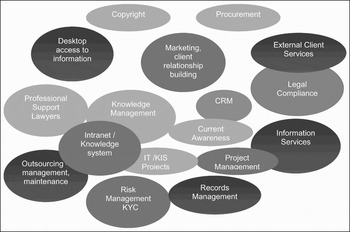
The diagram demonstrates some of the diverse areas Knowledge and Information Services is involved in

Information services at CMS Cameron McKenna
To be able to service these requirements, we have a number of non-librarian staff within our Knowledge and Information team, meaning that we have a good mix of skill-sets. Our team comprises:
• Seven librarians, including myself, four of whom are chartered and one is part-time. They all have specific responsibilities, as well as undertaking enquiry and current awareness roles. They all provide training to members of the firm.
• One web designer/CRM manager/knowledge system expert.
• One document automation developer, originally a banking lawyer.
• One international professional support lawyer. (I also liaise with all of our UK PSL's).
• One company searcher.
• One administrative assistant.
The department works with the practice and other business services departments on projects to support the requirements of the firm, utilising the typical skills of a librarian: logic, process, organisation, innovation, facilitation, a diagnostic mind, a holistic view, the ability to create systems, strategic thinking and a cross-functional approach. For example, when we developed a portal to replace our intranet and our existing knowledge system; to integrate our data from finance systems, HR systems, and marketing data; to develop a global taxonomy and to provide contextual access to knowledge as and when it is needed, this project was led and managed by KIS, not IT. The latter were, of course, crucial, but no system can function well without good content, behavioural change and insight into the business requirement.
KIS led the way in facilitating collaboration across the firm and across related networks, exploring and utilising social media.
Conclusion
The changing environment does mean that new demands are made of our profession every day, and in many different contexts, but the facilitation, design and community building carried out with Web 2.0 enables us to act as gatekeepers to different ways of working, collaborating across jurisdictions and within teams, finding relevant information, capturing and sharing expertise. This can be viewed as having hybrid skills, but it is really all about effective working. I do feel that there is a lot to be learnt from other disciplines, but this does not negate the value of a good librarian, who can cross such disciplines, provided they have an open mind and are willing to undertake the challenge.