Developmental dyslexia is widely believed to be caused either mainly (Ramus, Reference Ramus2003; Snowling, Reference Snowling2000) or partly (Stein & Walsh, Reference Stein and Walsh1997; Wolf et al., Reference Wolf, O'Rourke, Gidney, Lovett, Cirino and Morris2002) by a phonological deficit. In contexts where individuals with dyslexia are required to demonstrate a mastery of phonological units such as phonemes and syllables, their performance is consistently found to be weaker than that of controls matched for chronological age and/or reading age. This includes performance on phoneme deletion (Fawcett & Nicolson, Reference Fawcett and Nicolson1995; Wilson & Lesaux, Reference Wilson and Lesaux2001), phoneme counting (Bruck, Reference Bruck1992), and syllable counting or deletion tasks (Pratt & Brady, Reference Pratt and Brady1988). Other tasks with a phonological component, such as rapid naming and nonword repetition, also elicit weaker performance from dyslexic than nondyslexic individuals (Brady, Reference Brady, Brady and Shankweiler1991; Denckla & Rudel, Reference Denckla and Rudel1976).
A broad consensus has arisen in the field that this phonological deficit can be traced back to an impairment of phonological representations or phonological coding, defined as “the ability to use speech codes to represent information in the forms of words and word parts” (Vellutino, Fletcher, Snowling, & Scanlon, 2004, p. 12). Phonological representations have been implicated as causally linked to all the various manifestations of the phonological deficit, from paired associate learning and nonword repetition, to phonological awareness and reading (Brady, Reference Brady, Brady and Shankweiler1991; Ramus, Reference Ramus2003; Ramus, Pidgeon, & Frith, Reference Ramus, Pidgeon and Frith2003; Snowling, Reference Snowling2000; Stanovich, Reference Stanovich1988; Thomson, Richardson, & Goswami, Reference Thomson, Richardson and Goswami2005).
However, two issues relating to phonological representations in dyslexia require further attention. One is the relationship between phonemes (as phonological segments) and the segments of conventional orthography (letters or graphemes). The other is the relationship between phonological awareness and phonological representations. Let us now consider each of these issues in turn.
PHONOLOGICAL AND ORTHOGRAPHIC SEGMENTS
One controversial issue in dyslexia research is the nature of the relationship between phonological knowledge and familiarity with a writing system. Although spoken language and written language differ from each other in many significant ways, the two modalities nevertheless have a great deal in common. Current influential accounts of dyslexia seek to relate the deficit in written language to a deficit in aspects of spoken language (Ramus, Reference Ramus2003; Snowling, Reference Snowling2000), but the challenge that confronts this approach is the issue of how to handle what Harris (Reference Harris2000) calls the “symbiotic relationship” between these two modalities.
Learning to read and write in any orthographic system means that learners have to reshape their analyses of the sounds of words so as to match the analysis conveyed or implied in a word's conventional spelling (Treiman, Reference Treiman and Blachman1997), and familiarity with spelling conventions is known to affect people's concept of the properties of spoken words (Ehri, Reference Ehri, Gough, Ehri and Treiman1992; Shankweiler & Fowler, Reference Shankweiler and Fowler2004; Treiman & Cassar, Reference Treiman and Cassar1997; Treiman & Danis, Reference Treiman and Danis1988; Ziegler & Ferrand, Reference Ziegler and Ferrand1998). It is increasingly being recognized, more specifically, that segmentation at the phoneme level is unlikely to arise spontaneously for most people, but only when alphabetic literacy provides an impetus to do so (and a convenient, culturally shared example of how to do it) (Derwing, Reference Derwing, Downing, Lima and Noonan1992; Olson, Reference Olson, Amsel and Byrnes2002; Port, Reference Port, Bohn and Munro2007; Silverman, Reference Silverman2006; Treiman, Reference Treiman and Blachman1997).
If the phonemic segmentation of spoken words is supported by familiarity with alphabetic conventions, then there is a conceptual problem when we find that individuals with dyslexia are impaired in phonemic segmentation skills: such a finding may be nothing more than a circular restatement of what is already known of dyslexia; that is, that it involves difficulty with the conventions of written language.
This issue forms the background to the first main aim of this study: the need to test phonological knowledge that is independent of orthographic knowledge. For the purposes of the present study, it is assumed that any task that involves phonemic segments is liable to be approached with the individual's knowledge about the conventions of alphabetic orthography. We will therefore examine nonsegmental aspects of English phonology that do not overlap with orthography.
PHONOLOGICAL REPRESENTATIONS AND PHONOLOGICAL AWARENESS
The second controversial issue in dyslexia research is the extent to which tasks that tap into different kinds of metalinguistic skills can be informative about mental representations of spoken language. Although it has usually been assumed that a phonological awareness deficit constitutes evidence of a phonological representations deficit, this assumption is not necessarily warranted.
As noted above, the phonological deficit in dyslexia is most commonly identified in tasks that require participants to identify segments within words and perform some mental operation on these segments (such as deleting or substituting them). The most prominent feature of these tasks, however, is that they are metalinguistic in nature, rather than specifically targeting phonological representations.
There is of course a wide range of views on the nature of phonological representation. Here, we take what we believe is the most pretheoretical approach to linguistic knowledge that is available, and suggest that phonological representations are what are assumed to underlie speakers’ understanding about meaningful differences in the phonological patterns of linguistic structures. For instance, the contrast between /p/ and /b/ in English distinguishes the lexical items pin and bin, and the position of stress distinguishes the meaning of Énglish teacher from that of English teácher. Regardless of exactly how this knowledge is or is not mentally represented, it remains the case that although this type of knowledge is essential for successful communication, not all of it is necessarily available to analytical introspection by the speakers of a language.
Metalinguistic analysis, by contrast, requires that rather than simply making use of such phonological information as a means to a communicative end, the speaker must instead be able to access it as an object of investigation in its own right. Metalinguistic analysis of some kind is widely agreed to be necessary in the process of learning to read (although opinions differ as to whether this metalinguistic analysis is a prerequisite to approaching written text, Tunmer & Bowey, Reference Tunmer, Bowey, Tunmer, Pratt and Herriman1984, or a consequence of engagement with it, Scholes & Willis, Reference Scholes, Willis, Olson and Torrance1991). Nevertheless, despite its importance for literacy, the knowledge gained through conscious, metalinguistic introspection is rather different in its nature from implicit phonological knowledge (Pierrehumbert, Beckman, & Ladd, Reference Pierrehumbert, Beckman, Ladd, Burton-Roberts, Carr and Docherty2000). This can be expressed informally as the difference between “just using” language and “thinking about” language: metalinguistic analysis demands the adoption of a reflective viewpoint on language that is not necessary for efficient and fluent verbal communication (Tunmer & Herriman, Reference Tunmer, Herriman, Tunmer, Pratt and Herriman1984).
Although all parties agree that in the nature of things, it will always be difficult to test experimentally the nature of implicit linguistic representations, two sets of studies suggest that the issue of whether or not phonological representations are indeed impaired in dyslexia cannot yet be treated as resolved. The first set includes results reported by Boada and Pennington (Reference Boada and Pennington2006), which suggest that implicit representations may be impaired in dyslexia. They report that children with dyslexia showed more syllable-level confusions than phoneme-level confusions in a syllable similarity task, indicating that their representations are not yet mature enough to be organized on the basis of phonemes rather than syllables; they also reported that children with dyslexia require more acoustic information than age-matched peers in order to identify the correct word in a lexical gating task; and third, in a priming study they showed that although priming benefited word identification in all their participants, the participants with dyslexia were unable to benefit as much as controls from short primes. These findings are presented as converging evidence in favor of a deficit in implicit representations in dyslexia. The same conclusion is drawn by Elbro, Borstrøm, and Petersen (Reference Elbro, Borstrøm and Petersen1998) and Elbro and Pallesen (Reference Elbro, Pallesen, Verhoeven, Elbro and Reitsma2002), who elicited “clear” productions from children by asking them to correct the pronunciation of “indistinct” pronunciations made by a toy parrot. On the basis that children at risk for dyslexia show “less distinct” pronunciations than controls, these authors conclude that their implicit phonological representations are also indistinct. However, it is not clear how exactly to view the relationship between production data and implicit phonological representations: in this particular study, the “corrected” pronunciation of a word may involve an overarticulated form that does not accurately reflect participants’ typical productions, and more generally, it has been argued that truncation errors similar to those shown in these children's productions are not in fact reflective of representational deficits but are rather due to a developing phonology that constrains the child's output in well-formed although nonadultlike ways (Demuth, Reference Demuth, Morgan and Demuth1996).
In contrast, results from a series of studies reviewed by Ramus and Szenkovits (Reference Ramus and Szenkovits2008) point in a different direction. These studies investigated the probabilistic and typically language-specific processes that they call “phonological grammar,” something that should be expected to be impaired if phonological representations are indeed impaired in dyslexia. However, dyslexic and nondyslexic participants were equally sensitive to the legality of voicing assimilations, equally liable to experience perceptual illusions induced by language-specific phonotactic constraints, and equally susceptible to subliminal repetition priming.
Ramus and Szenkovits (Reference Ramus and Szenkovits2008) have therefore argued that, far from being degraded, in dyslexia, “phonological representations are intact, that grammatical processes that operate on them are intact too, and that the deficit lies somewhere else” (Ramus & Szenkovits, Reference Ramus and Szenkovits2008, p. 135). It is possible that some of the findings reported by Boada and Pennington (Reference Boada and Pennington2006) can be accounted for by considering that the tasks assume the phoneme as a linguistic unit, a position, which, as noted in the previous section, is unlikely to do justice to the phonological representations of individuals with dyslexia due to the alphabeticism confound. This problem is avoided by Ramus and Szenkovits (Reference Ramus and Szenkovits2008), who have looked at nonsegmental (subphonemic) phenomena, where literacy skills are likely to play less of a role.
This issue therefore provides the motivation for the second main aim of this study: in addition to controlling for segmentality, we will also test phonological skills in individuals with dyslexia in a way which controls the degree of metalinguistic analysis required.
AIMS
The two aims of this study can therefore be framed as the following research questions. Question 1: How do individuals with dyslexia perform on tasks that do and do not allow participants the option of drawing on orthographic knowledge in order to perform the putatively phonological aspects of the task? Question 2: How do individuals with dyslexia perform on tasks that vary in the implicit versus metalinguistic demands they make?
In order to address these aims, four tasks were devised, each with two different versions. Aim 1 was addressed by ensuring that each task consisted of both a segmental version (corresponding to areas of phonology that have orthographic counterparts) and a suprasegmental version (corresponding to areas of phonology that have no orthographic counterpart, and where recourse to orthographic knowledge was excluded). Aim 2 was addressed by using tasks which separately tested aspects of phonological competence with increasing degrees of metalinguistic analysis: (a) the ability to identify the referents of words that differ by phonological contrasts (the “picture-matching” task), (b) the ability to identify units of phonological representation in linguistic structures (the “unit-monitoring” task), (c) the ability to manipulate a phonological unit within a word (the “Pig Latin” task), and (d) the ability to manipulate two phonological units with additional working memory demands (the “spoonerism” task). These tasks will be described more fully in the Method Section.
A few words are in order about areas of English phonology that do and do not overlap with English orthography. In this study, segmental and suprasegmental (i.e., stress) contrasts are being used as indexes of orthography-overlapping and nonorthography-overlapping phonology, respectively. The advantages of using stress contrasts are twofold. Fundamentally, they cannot be distinguished on the basis of English orthography (compare fore-stressed steel warehouse “warehouse containing steel” and end-stressed steel warehouse “warehouse made out of steel”; the pair require to be produced with the appropriate stress pattern in order to be correctly interpreted). In addition, and more usefully, this is one of the few phenomena in English phonology that can be exploited to provide a near-equivalent to phonemic contrasts that do not involve segmental phonemes. Although stress can be conceptualized as attaching to units that are orthographically represented, in each of the suprasegmental tasks, the focus is on stress itself, not the segmental units it is associated with.
Predictions for the outcomes of these tasks vary according to the theoretical position adopted. Here we offer predictions from the perspective of the conventional phonological deficit hypothesis (Snowling, Reference Snowling2000; Vellutino et al., Reference Vellutino, Fletcher, Snowling and Scanlon2004). With respect to Question 1, this hypothesis assumes that the underlying cause of dyslexia is not an impairment of phonology that is specific to orthography, but rather one that is related to the general ability to use speech codes in representing words. By default, we assume that such a deficit is meant to apply to any type of phonological representation (e.g., phonemes, stress), although it is frequently illustrated using units no larger than phonemes (e.g., Snowling, Reference Snowling2000; Vellutino et al., Reference Vellutino, Fletcher, Snowling and Scanlon2004). This hypothesis would therefore predict that the performance of the dyslexic group will be weaker than that of controls in both the segmental (orthography-linked) and the suprasegmental (nonorthography-linked) versions of each task.
A problem with the use of speech codes in representations should affect phonological performance regardless of the degree to which metalinguistic processes are involved. Thus, for Question 2, the phonological deficit hypothesis would predict that the dyslexic group will be impaired in the tasks with lesser metalinguistic demands as well as the tasks with greater metalinguistic demands.
METHOD
Participants
The dyslexic group consisted of 21 students at universities in Scotland, who had been given a formal diagnosis of dyslexia (7 males, 14 females). The mean age was 24 years, 2 months (24;2; range = 17;5–41;4). None reported a history of speech/articulation or hearing difficulties. Potential participants with additional diagnoses such as dyspraxia and attention-deficit/hyperactivity disorder were excluded. Fifteen provided information about the time of their diagnosis of dyslexia; 6 were diagnosed in primary school, 5 in secondary school, and 4 after leaving school. The group of individuals with dyslexia was matched with a group of controls for age and gender. The control group consisted of 21 students who had no history of speech/language/literacy impairment and had never been diagnosed as having dyslexia (7 males, 14 females). The mean age of the control group was 24;1 (range = 17;6–42;5). All participants spoke English as their native language. Ethical approval was granted for this study.
Three background tasks were administered to both groups of participants.Footnote 1 For the reading subtest of the Wide Range Achievement Test (WRAT-3; Wilkinson Reference Wilkinson1993), the dyslexic group's mean standard score of 98 (range = 77–116, SD = 9.9) was significantly lower than the control group's mean standard score of 108 (range = 92–118, SD = 7.1), t = 3.5, df = 18, two-tailed p = .002. For the WRAT-3 spelling subtask, the dyslexic group's mean standard score of 101 (range = 73–114, SD = 9.6) on the spelling task was significantly lower than the controls’ mean standard score of 110 (range = 103–119, SD = 5.3), t = 3.9, df = 18, two-tailed p = .001. For the British Dyslexia Association Checklist, the dyslexic group's mean number of 11.9 “yes” responses (range = 7–19, SD = 3.7) was significantly higher than the controls’ mean of 4.7 (range = 2–10, SD = 2.1), t = 8.8, df = 20, two-tailed p < .001. The WRAT scores for the two groups are comparable to those that have been reported in other studies of students with dyslexia at university or about to enter university (e.g., Gallagher, Laxon, Armstrong, & Frith, Reference Gallagher, Laxon, Armstrong and Frith1996; Hatcher, Snowling, & Griffiths, Reference Hatcher, Snowling and Griffiths2002; Ramus, Rosen, et al., Reference Ramus, Rosen, Dakin, Day, Castellote and White2003). These results were taken to confirm the self-reports of dyslexia provided by the participants.
Materials
Four tasks were designed, varying in the extent to which they made demands on participants’ metalinguistic analysis. In addition, the use of both a segmental and a suprasegmental version for each task allowed experimental control over whether or not each task could be performed by making recourse to orthographic knowledge. The four tasks are listed below in order of increasing demands of metalinguistic knowledge.
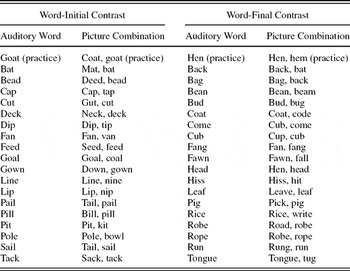
Picture-matching task. The stimuli for the segmental version of this task consisted of audio recordings of 36 monosyllabic consonant–vowel–consonant words, each of which belonged to a minimal pair that contrasted either word-initially (e.g., bat, mat) or word-finally (e.g., back, bag; see Table 1 for a full list of items). Each word was matched with two pictures, corresponding to the two members of that minimal pair (e.g., the soundfile “bat” was matched with pictures of a bat and a mat). These materials were based on the “minimal pair discrimination with pictures” subtask of the Psycholinguistic Assessments of Language Processing in Aphasia (Kay, Lesser, & Coltheart, 1992), used by permission.
Segmental picture matching task

Note: Modification of items used by Kay et al. (Reference Kay, Lesser and Coltheart1992).
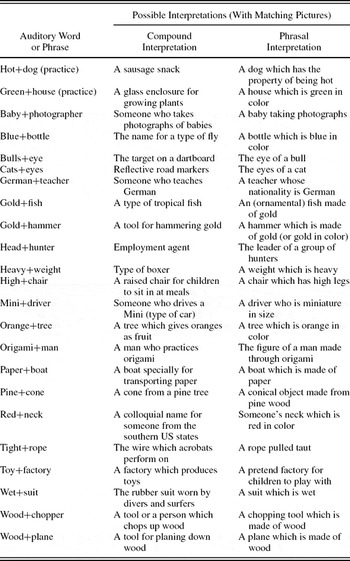
The stimuli for the suprasegmental version of the picture-matching task consisted of audio recordings of 21 stress-based minimal pairs such as toy factory versus toy factory (pairs that rely on stress in order to distinguish a compound from a phrase), and hotdog versus hot dog (pairs that rely on stress to distinguish an idiomatic lexical item from a phrase; see Table 2 for a full list of the experimental items). Both types of pairs take either a compound interpretation or a phrasal interpretation depending on what stress pattern they are realized with (i.e., fore-stress or end-stress, respectively). Each item was located in the syntactically neutral carrier frame, “This is what a ______ looks like.” As with the segmental minimal pairs, each auditory item was matched with two pictures. For example, “This is what a toy factory looks like” was matched with a picture of a factory producing toys, and a picture of a miniature model factory for children to play with. There was also an equal number of filler items, which were not included in the analysis. The fillers consisted of equal numbers of compound nouns (such as milkman, matched with pictures of a milkman and a frogman) and phrases (such as empty box, matched with pictures of an empty box and an empty glass).
Suprasegmental picture matching task

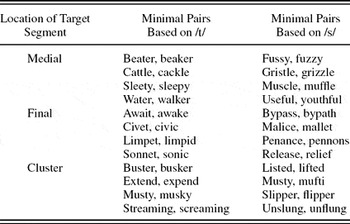
Unit-monitoring task. The stimuli for the segmental version of this task consisted of audio recordings of 24 phoneme-based minimal pairs, half of which were pairs involving /s/ (e.g., fussy-fuzzy; release-relief) and half involving /t/ (e.g., sonnet-sonic; beater-beaker; see Table 3 for a full list of items). The /s/ and /t/ phonemes were arbitrarily chosen from the classes of fricatives and voiceless stops. All the items were bisyllabic and none of the contrasts were located word-initially. Note that in Scottish English, /t/ in these contexts can be realized either as a voiceless stop or a glottal stop (but not an alveolar flap, as in American English); in the realizations of all the words used in this task, /t/ was a voiceless stop.
Segmental unit monitoring task

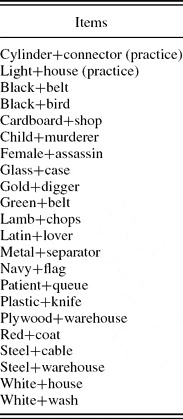
The stimuli for the suprasegmental version consisted of audio recordings of 20 stress-based minimal pairs, none of which was the same as those used in the picture-matching task (e.g., steel warehouse vs. steel warehouse; blackbird vs. black bird). See Table 4 for a full list of the experimental items. An equal number of near-minimal pairs were also presented as fillers, and were not included in the analysis (e.g., briefcase vs. brief chase; toothpaste vs. blue paste).
Suprasegmental unit monitoring task

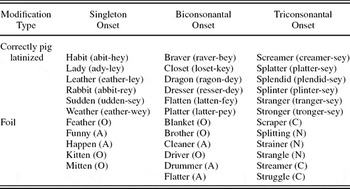
Pig Latin judgment task. The stimuli for the segmental version consisted of audio recordings of 35 bisyllabic items drawn from Pennington, van Orden, Smith, Green, and Haith (1990; see Table 5 for a full list of items). Twelve items began with biconsonantal clusters (e.g., blanket), 12 with triconsonantal clusters (e.g., splatter), and 11 with a singleton (e.g., habit). Half of the items (n = 18) were paired with the correct Pig Latin form, and half (n = 17) were paired with foils. The Pig Latin form of an item was created following the method used by Pennington et al. (Reference Pennington, van Orden, Smith, Green and Haith1990). The initial consonant was moved to the end of the word and made the onset of an extra syllable suffix whose nucleus was always /e/ (e.g., blanket /blaᵑkət/ becomes /laᵑkət-be/). Foil types were constructed following the four types used by Pennington et al. (Reference Pennington, van Orden, Smith, Green and Haith1990), with six “omission” foils (e.g., blanket becomes lanket-ey), six “addition” foils (e.g., blanket-bey), three “cluster” foils (e.g., anket-bley), and three “nonsegmentation” foils (e.g., blanket-ey).
Segmental Pig Latin task

Note: Subset of items used by Pennington et al. (Reference Pennington, van Orden, Smith, Green and Haith1990). Foil types are based on Pennington et al. (1990). O, omission foils, such as lanket-ey; C, cluster foils, such as anket-bley. A, addition foils, such as blanket-bey; N, nonsegmentation foils, such as blanket-ey.
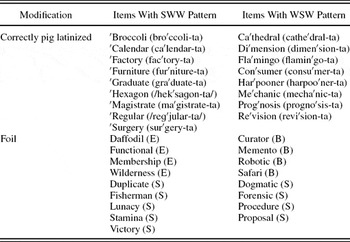
The stimuli for the suprasegmental version consisted of audio recordings of 34 trisyllabic words, half with a strong–weak–weak (SWW) stress pattern (e.g., ca.len.dar) and half with a weak–strong–weak (WSW) pattern (e.g., dog.ma.tic; see Table 6 for a full list of items). Half the items were paired with the correct Pig Latin form, and half were paired with foils. The Pig Latin forms were created by moving the main stress of the item one syllable toward the end of the word, and adding an extra syllable /ta/ at the end (e.g., ca.len.dar becomes ca.len.dar-ta; dog.ma.tic becomes dog.ma. tic-ta). Note that only the location of the word's main stress was shifted, not the order of the syllables or segments. Two foil types were constructed for each stress pattern, with equal numbers of foils where stress remains in the same place (instead of being moved toward the end), and equal numbers of foils where stress was moved to the wrong place (to the last syllable for SWW items, e.g., ca.len.dar-ta, ca.len.dar-ta, and to the first syllable for WSW items, e.g., dogma.tic, dog.ma.tic-ta).
Suprasegmental Pig Latin task

Note: SWW, strong–weak–weak; WSW, weak–strong–weak; E, for SWW items, stress moves two places toward the end rather than one place, for example, ca.len.′dar-ta; B, for WSW items, stress moves backward rather than forward in the word, for example, ′dog.ma.tic-ta; S, stress remains in the same place, for example, ′ca.len.dar-ta.
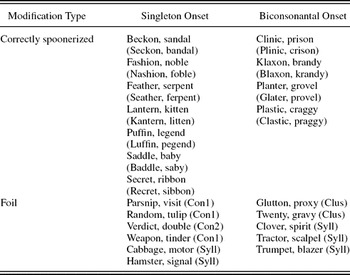
Spoonerism judgment task. The stimuli for the segmental version consisted of audio recordings of 22 pairs of bisyllabic words (see Table 7 for a full list of items). Half of the pairs consisted of words beginning with singleton consonants, and half with biconsonantal clusters. Half of the items were correctly spoonerized and half were matched with a foil. To create a spoonerism, the initial consonant of both words was exchanged (e.g., the pair plastic and craggy becomes clastic and praggy). Note that only the first consonant in the onset is affected in the spoonerism, not the whole onset. There were three types of foil, one where only one consonant was exchanged (e.g., plastic, praggy), one where the whole cluster was swapped (e.g., crastic, plaggy), and one where the whole syllable was swapped (e.g., hamster and signal becomes hamnal and sigster).
Segmental spoonerism task

Note: Con1 and Con2, for the items with singleton onsets, only the initial consonant of the respective first or second word was replaced, for example, plastic, craggy becomes plastic, praggy; Clus, for the items with biconsonantal onsets, the whole cluster of each word was exchanged, for example, crastic, plaggy; Syll, the whole syllable was exchanged, for example, ham.ster, sig.nal becomes ham.nal, sig.ster.
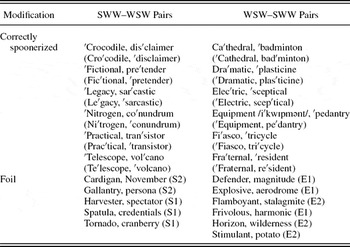
The stimuli for the suprasegmental version consisted of audio recordings of 23 pairs of trisyllabic words (see Table 8 for a full list of items). Each pair consisted of one word with a SWW stress pattern and one with a WSW pattern. Half the items were correctly spoonerized and half were given a foil. To create a spoonerism, the location of the main stress in the words was exchanged (e.g., the pair ca.the.dral and bad.min.ton becomes ca.the.dral and bad.min.ton). There were two types of foil: in both types, one of the items in the pair had its stress shifted appropriately, but in addition, in one foil type the stress remained in the same place on the other item (e.g., ca.the.dral, bad.min.ton), and in the other foil type, the stress moved to the end of the item (e.g., ca.the.dral, bad.min.ton).
Suprasegmental spoonerism task

Note: SWW, strong–weak–weak; WSW, weak–strong–weak; S1 and S2, stress remained in the same place on the first or second of the items, respectively, for example, ca′the.dral, ′bad.min.ton becomes ′ca.the.dral, ′bad.min.ton; E1 and E2, stress moved to the end of the first or the second of the items, respectively, for example, ca.the.′dral, bad.′min.ton.
Procedure
Participants were tested individually. They were seated in a sound-deadened booth facing a computer monitor with a keyboard. The auditory stimuli were presented through headphones and participants made their response using two specified keys on the keyboard. The same two keys were used in all tasks. One key corresponded to the correct answer in half of the trials in each task.
Tasks were presented in order of increasing metalinguistic demands. The segmental picture-matching task was always presented first, followed by the unit-monitoring task (the order of segmental and suprasegmental versions of these two tasks were counterbalanced). Following both versions of these two tasks, the two manipulation tasks were presented, counterbalancing both the order of the task (Pig Latin and Spoonerism) and the version (segmental and suprasegmental). It was intended that by staging the tasks in order of increasing metalinguistic demands, the amount of metalinguistic analysis which a participant might undertake in the picture-matching task would be kept to a minimum.
Verbal instructions were provided by the experimenter to each individual participant, and the same instructions were also provided on-screen before the task began. Sample words were however avoided in the on-screen instructions as they would necessarily have been written.
Each task was presented using E-Prime (Psychology Software Tools, Pittsburgh, PA). Items were automatically randomized by E-Prime in each task. In each task, there was a pause of 1 s after the participant made the response before the next item was played. The four tasks together took approximately 45 min to complete.
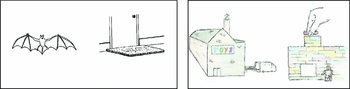
Picture-matching task. Participants were instructed to select the picture that matched the word or sentence that they heard. Pictures and sounds were presented simultaneously. Participants made their choice of picture based on two pictures presented side by side on the screen (see Figure 1).
Sample visual materials for (left) segmental and (right) suprasegmental versions of the picture-matching task. Minimal pairs shown are “bat” and “mat” (segmental) and “toy factory” and “toy factory” (suprasegmental). The materials for the segmental version of the picture-matching task were adapted from PALPA: Psycholinguistic Assessments of Language Processing in Aphasia, by J. Kay, R. Lesser, and M. Coltheart, 1992. Copyright 1992 by the authors. Adapted with permission. [A color version of this figure can be viewed online at http://journals.cambridge.org/aps]

Unit-monitoring task. Participants were given prerecorded auditory instructions as to what particular sound they were to listen for. In the segmental version, to monitor for /s/, the auditory instructions were: “Think about the first sound in the word sing. It's the same as the first sound in the word soft. Now listen for this sound in the words which follow.” The instructions to monitor for /t/ used the examples ten and time. In the suprasegmental version, it was explicitly pointed out to participants that the difference between hotdog and hot dog was in the way that they were stressed—either the hotdog pattern, or the DA-da pattern, and the hot dog, or da-DA, pattern. The target was then identified to the participant both by label (e.g., “the da-DA pattern”) and a sample sound (e.g., black bird). On each trial participants heard two items—one containing the target sound (phoneme or stress pattern) and the other consisting of its minimally different counterpart. There was an interval of 500 ms between the two members of each pair. Participants were required to state whether the target sound occurred in the first presented item or the second (e.g., whether /s/ occurred in fussy or fuzzy, or whether end-stress occurred in hotdog or hot dog).
Pig Latin judgment task. For the Pig Latin task, participants heard the original word followed by a manipulation of the word (either the correct Pig Latin form of the word or a foil), with an interval of 500 ms between the word and its manipulation. Prior to hearing the test items, the method of “pig latinizing” the words was illustrated to participants and they were given two practice items (or three if requested) in order to familiarize themselves with the task. In the task itself, participants were instructed to state whether the manipulation they heard was correct or not, in terms of the manipulation procedure which they had practiced. After the stimulus item was played, participants were shown a screen containing the word “yes” presented on the left hand side of the screen and “no” on the right-hand side.Footnote 2
Spoonerism judgment task. For both versions of the spoonerism task, participants heard the pair of original words followed by a manipulation of those words (either the correct spoonerism forms or a foil). There was an interval of 500 ms between the items in each pair and before the manipulation was played. Prior to being presented with the test items, the method of “spoonerizing” the words was illustrated to participants and they were given two practice items (or three if requested) in order to familiarize themselves with the task. As in the Pig Latin task, participants were instructed to state whether the manipulation they heard was correct or not, in terms of the description they had practiced.
RESULTS AND DISCUSSION
Accuracy and response time data was collected for each task. Because the picture matching and unit monitoring are binary forced-choice tasks, and the Pig Latin and spoonerism tasks are “yes–no” tasks, signal detection analysis was used to measure accuracy. Accuracy results are therefore reported in terms of d′ (Macmillan & Creelman, Reference Macmillan and Creelman2005). Response times were measured from the stimulus offset for all tasks. Response times for incorrect responses were not included in the analysis.
We first address the question of the role of orthography. The performance of the two groups is compared on both the segmental versions of the tasks (where the units of interest overlap with units of orthography) and the suprasegmental versions of the tasks (which do not rely on orthography). We then address the question of the effect of metalinguistic demands. The performance of the two groups is compared in the four tasks, ranging from low to high metalinguistic demands.
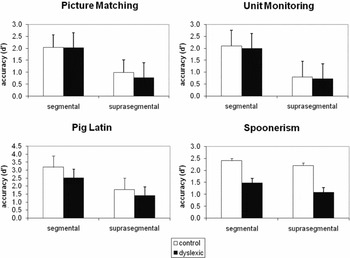
To start with we compared both groups of participants on the two versions of all four tasks. A 4 × 2 × 2 mixed analysis of variance (ANOVA) was conducted, with accuracy as the dependent variable, task and domain (segmental vs. suprasegmental) as within-subjects independent variables, and group as a between-subjects independent variable. There were main effects of group, F (1, 36) = 9.93, p < .01, task, F (3, 108) = 9.69, p < .001, and domain, F (1, 36) = 74.13, p < .001. There was an interaction between task and group, F (2.24, 80.61) = 7.47, p < .01, and an interaction between task and domain, F (2.77, 99.60) = 17.42, p < .001. There was no interaction between group and domain, F (1, 36) = 0.22, p = .64, and no interaction between group, task, and domain, F (2.77, 99.60) = 0.66, p = .58. Figure 2 shows accuracy in the two versions of each of the four tasks.
Mean accuracy (d′) for segmental and suprasegmental versions of the four tasks (error bars indicate standard errors).

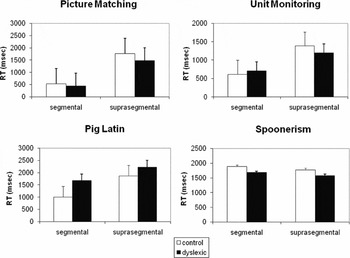
When response time was the dependent variable, there were main effects of task, F (3, 105) = 54.44, p < .001, and domain, F (1, 35) = 112.27, p < .001. The effect of group was nonsignificant, F (1, 35) = 0.07, p > .79. There was an interaction between task and domain, F (3, 105) = 16.59, p < .001. Figure 3 shows response time in the two versions of each of the four tasks.
Mean response time (ms) for segmental and suprasegmental versions of the four tasks (error bars indicate standard errors).

The results of these analyses show that the extent to which the groups differed depends on the task, and the extent to which there was a domain effect also depends on the task. We therefore compare the results for each of the four tasks in turn, examining performance in both the segmental (orthography-overlapping) version and the suprasegmental (nonorthography-overlapping) version.
Picture-matching task. A 2 × 2 mixed ANOVA was carried out with accuracy as the dependent variable, phonological domain (segmental vs. suprasegmental) as a within-subjects independent variable, and group as a between-subjects independent variable. There was no effect for group, F (1, 38) = 1.49, p = .230. There was a significant main effect for domain, F (1, 38) = 150.49, p < .001, with lower accuracy in the stress version than the phoneme version. There was no interaction, F (1, 38) = 2.19, p = .147.
When response time was the dependent variable, there was no effect of group, F (1, 34) = 0.94, p = .340. There was a significant main effect for domain, with longer response times in the stress version than the segmental version, F (1, 34) = 49.47, p < .001. There was no interaction between group and domain, F (1, 34) = 0.462, p = .502.
Unit-monitoring task. A 2 × 2 mixed ANOVA was carried out with accuracy as the dependent variable, phonological domain as the within-subjects factor, and group as the between-subjects factor. There was no effect for group, F (1, 38) = 0.43, p = .517. There was a significant main effect for domain, with lower accuracy in the stress version than the phoneme version, F (1, 39) = 103.34, p < .001. There was no interaction, F (1, 39) = .001, p = .970.
When response time was the dependent variable, there was no effect for group, F (1, 39) = 0.22, p = .640. There was a significant main effect for domain, with longer reaction times in the suprasegmental version than the segmental version, F (1, 39) = 27.71, p < .001. There was no interaction between group and domain, F (1, 39) = 1.13, p = .294.
Pig Latin task. A 2 × 2 mixed ANOVA was run, with accuracy as the dependent variable, phonological domain as the within-subjects factor, and group as the between-subjects factor. There was a significant main effect of group, with the control group showing higher accuracy than the dyslexic group, F (1, 39) = 6.94, p = .012. There was a significant main effect of domain, with lower accuracy in the suprasegmental version than the segmental version, F (1, 39) = 61.27, p < .001. There was no interaction, F (1, 39) = .82, p = .372.
When response time was the dependent variable, there was no effect of group, F (1, 39) = 2.68, p = .110. There was a significant main effect of domain, with longer response times for the suprasegmental version, F (1, 39) = 18.72, p < .001. There was no interaction between group and domain, F (1, 39) = 0.91, p = .345.
Spoonerism task. A 2 × 2 mixed ANOVA was carried out, with accuracy as the dependent variable, phonological domain as the within-subjects factor, and group as the between-subjects factor. There was a significant main effect of group, with higher accuracy in the control group, F (1, 39) = 15.63, p < .001. There was no effect for domain, F (1, 39) = 2.83, p = .100. There was no interaction, F (1, 39) = 0.17, p = .682.
When response time was the dependent variable, there was no effect for group, F (1, 39) = 0.52, p = .474, or for domain, F (1, 39) = 0.18, p = .675. There was no interaction between group and domain, F (1, 39) < 0.001, p = .993.
This consideration of the individual tasks allows us to address Question 1: How do the groups compare in tasks that do and do not exclude orthographic knowledge? In the picture-matching and unit-monitoring tasks, the suprasegmental versions were more difficult than the corresponding segmental versions, but no difference was found between the two groups. For these two tasks, therefore, there was no evidence for an impairment in areas of phonology that are not represented orthographically. In contrast, in the Pig Latin and spoonerism tasks, a difference was found between the groups, although it was only in the Pig Latin task that the suprasegmental version was more difficult than the segmental version (there was no effect of phonological domain in the spoonerism task). In these two tasks, therefore, the dyslexic group was impaired relative to the control group both on the versions which do and do not allow recourse to orthographic knowledge.
These results also provide an answer to Question 2: How do the groups compare in tasks which vary in the metalinguistic demands they make? For both segmental and suprasegmental versions of the tasks, group differences were found only in the two tasks that had the highest metalinguistic demands (Pig Latin and spoonerism tasks). In the two tasks with lower metalinguistic demands (the picture-matching and unit-monitoring tasks), the dyslexic group's performance was found to be no different from the control groups’ performance.
GENERAL DISCUSSION
This study aimed to investigate implicit phonological representations as distinct from metalinguistic skills, while being sensitive to the need to distinguish phonological knowledge from familiarity with orthographic conventions.
Question 1
The results did not support the view that dyslexia involves a deficit in phonological representations that is independent of orthographic knowledge. If dyslexia involves a deficit independent of orthographic knowledge, it would be predicted that the dyslexic group would show weaker performance than the control group in both the segmental/orthographic and suprasegmental/nonorthographic versions of the tasks. However, no group differences were found in the picture-matching or unit-monitoring tasks, which required participants to use their knowledge of the spoken forms of words to identify the correct pictorial referent, and to identify contrastive units within spoken words, respectively.
The lack of evidence for a deficit in the segmental domains in the picture-matching and unit-monitoring tasks is perhaps surprising, because in addition to the well-established metalinguistic phoneme awareness deficits, there are reports of speech perception deficits in at least some individuals with dyslexia (e.g., Manis et al., Reference Manis, McBride-Chang, Seidenberg, Keating, Doi and Munson1997). Had a deficit in the segmental versions of these tasks been found, it would of course still leave us with the puzzle over what exactly a deficit in segmental representations might mean, because given the closeness of the association between orthographic experience and the shaping of segmental phonological representations, there remains a pressing problem of how to distinguish between what is an orthographic problem and what is a segmental phonological problem.
In contrast, we found no evidence of a deficit in suprasegmental phonology, suggesting that areas of phonology that have no orthographic counterpart may be intact in dyslexia. This is, however, at odds with a study of dyslexic children by Cheung et al. (Reference Cheung, Chung, Wong, McBride-Chang, Penney and Ho2009), who specifically investigated the perception of Cantonese tone and aspiration contrasts, neither of which are represented orthographically. They showed that 10-year-old Cantonese-speaking children with dyslexia had categorical perception deficits for both these contrasts, and they conclude that phonological processes are impaired in dyslexia regardless of whether or not the phonological units have orthographic counterparts. Because neither our tasks nor our participants are directly comparable with Cheung et al.'s (2009), we would be keen to see how performance on our picture-matching task would relate to performance on a categorical perception task involving the compound/phrasal stress distinction, especially in younger children with dyslexia.
Question 2
The prediction offered for the role of metalinguistic demands was that a deficit in phonological representations would manifest itself in a group difference in all four tasks. This was not borne out by the results. In the tasks that made heavy metalinguistic demands, requiring both metaphonological awareness and the ability to manipulate phonological elements, deficits were seen in the dyslexic group in the manipulation of both segmental and suprasegmental components of the presented words (Pig Latin and spoonerism tasks). The standard interpretation of such phonological manipulation deficits is to say that they are due to impaired phonological representations, but our results do not support this. No deficit was found in the dyslexic group when the requirement of the task was simply to focus on the phonological form of a word and identify its phonological components (the unit-monitoring task). Even more crucially for the question of implicit phonological representations, no deficit was found in the dyslexic group in the task that tested the implicit knowledge of suprasegmental contrasts (the suprasegmental version of the picture-matching task). Because the suprasegmental picture-matching task was specifically designed with a view to teasing apart the role played by orthographic knowledge from the role of knowledge specific to spoken language, we now have a basis for speaking to the question of phonological representations that are not confounded by contributions from orthographic knowledge, and it does not appear that the dyslexic group is impaired in this area of phonology.
Implications
These findings have particular implications for theories of dyslexia that place special emphasis on the role of phonological representations in this impairment. The results of the Pig Latin and spoonerism tasks corroborate what has already been reported in the literature about the robustness and persistence of a deficit in dyslexia in the ability to manipulate phonological units even in adulthood (Birch & Chase, Reference Birch and Chase2004; Bruck, Reference Bruck1992; Downey, Snyder, & Hill, Reference Downey, Snyder and Hill2000; Gottardo, Siegel, & Stanovich, Reference Gottardo, Siegel and Stanovich1997; Judge, Caravolas, & Knox, Reference Judge, Caravolas and Knox2006; Pennington et al., Reference Pennington, van Orden, Smith, Green and Haith1990, Snowling, Nation, Moxham, Gallagher, & Frith, Reference Snowling, Nation, Moxham, Gallagher and Frith1997). The current results also extend these studies by showing a deficit in the manipulation of suprasegmental as well as segmental components of words. This provides more evidence for the well-established view that there is a phonology-related deficit in dyslexia, specifically in metalinguistic phonological manipulation. However, the current study does not allow this deficit in phonological manipulation to be traced back straightforwardly to a deficit in phonological representations: no difference was found between the dyslexic and the nondyslexic group in the task that eliminated metaphonological and manipulation demands and drew only on putative phonological representations (the picture-matching task). It would appear therefore that the deficits that are so widely found in dyslexia in tasks involving metaphonological manipulation must have an explanation somewhere other than in phonological representations. This is consistent with the conclusion reached by Ramus and Szenkovits (Reference Ramus and Szenkovits2008) that phonological representations in dyslexia may be intact, and also with the recent argument presented by Hazan, Messaoud-Galusi, Rosen, Nouwens, and Shakespeare (Reference Hazan, Messaoud-Galusi, Rosen, Nouwens and Shakespeare2009) that there is little evidence to suggest that dyslexia is truly characterized by difficulties in speech perception, as the lack of robust evidence in favor of a speech perception deficit in dyslexia has always undermined the plausibility of the phonological deficit.
If phonological representations are indeed intact in dyslexia, one possibility for how to reconceptualize the role of phonology in dyslexia would be to look more closely at metaphonological skills, considered in their own right. It did not appear from the results of the unit-monitoring task in the current study that the group of dyslexic participants had any impairment in low-demand metalinguistic skills. However, this outcome can be regarded as unexpected given phonological awareness deficits that are widely reported even in adulthood, based on phoneme and syllable counting tasks (Bruck, Reference Bruck1992; Pratt & Brady, Reference Pratt and Brady1988) and rhyme and alliteration judgments (Fawcett & Nicolson, Reference Fawcett and Nicolson1995). In contrast to implicit phonological knowledge, phonological awareness has been specifically tested in the vast majority of studies that report a phonological deficit in dyslexia (see also the review by Vellutino et al., Reference Vellutino, Fletcher, Snowling and Scanlon2004), which warrants treating the lack of a group difference in this task with caution unless further corroboration can be found.
Metaphonological skills, understood as distinct from implicit phonological representations, have been both associated with reading achievement and also predictive of future reading achievement (Goswami & Bryant, Reference Goswami and Bryant1990; Snowling, Reference Snowling2000; Vellutino et al., Reference Vellutino, Fletcher, Snowling and Scanlon2004; although for alternative perspectives, see Castles & Coltheart, Reference Castles and Coltheart2004; Scholes, Reference Scholes1998), and it has been shown that the relationship between speech perception and reading is best modeled as being mediated through phoneme awareness (McBride-Chang, Reference McBride-Chang1996). For theories of developmental dyslexia that assign a crucial role to the phonological deficit, the smallest possible change that it seems advisable to make would be to explicitly implicate metalinguistic skills rather than phonological representations as impaired in dyslexia. Indeed, it may well be the case that it is not “basic” metalinguistic skills alone that are impaired. Certainly, the manipulation tasks (such as Pig Latin and spoonerism tasks), which reliably elicit deficits in dyslexia in this and other studies, demand facility in segmenting, maneuvring, and blending arbitrarily specified units within words, and also rely fairly significantly on working memory, which has itself been observed to be impaired in dyslexia even in adults (see, e.g., Fawcett & Nicolson, Reference Fawcett and Nicolson1995; Pennington, van Orden, Kirson, & Haith, Reference Pennington, van Orden, Kirson, Haith, Brady and Shankweiler1991; Rack, Reference Rack1997; Ramus, Rosen, et al., Reference Ramus, Rosen, Dakin, Day, Castellote and White2003).
There are aspects of the current study that require further investigation. As mentioned, one aspect would be the demand which metalinguistic manipulation tasks make on working memory: this should be addressed in future research. Another aspect concerns the population of individuals with dyslexia. There was some overlap between the dyslexia group and the control group in their scores on the WRAT subtasks, which suggests the individuals with dyslexia had a relatively mild impairment and perhaps sufficiently good compensatory strategies to enable them to pursue university courses (as suggested by Ramus, Rosen, et al., Reference Ramus, Rosen, Dakin, Day, Castellote and White2003). Future work must also ascertain whether or not younger age groups, perhaps with more severe forms of dyslexia, will show the same behavior as the university students tested here. Finally, it will be important to find cross-linguistic verification of the suprasegmental results. The suprasegmental phenomenon that we exploited in the picture-matching and unit-monitoring tasks is not strictly contrastive in English (although it can be regarded as quasi-phonemic, to use the terminology of Scobbie & Stuart-Smith, Reference Scobbie and Stuart-Smith2006), because the fore-stressed and end-stressed patterns are correlated with syntactic or semantic information, namely, compoundhood and phrasality, respectively. Because contrastiveness and orthography are confounded in English (i.e., English stress patterns are never truly contrastive, whereas phonemic contrasts are almost always encoded in orthography), it will be valuable to look at other languages to tease apart the orthography and contrastiveness more directly.
The present study has shown a deficit in manipulation skills in dyslexia in both segmental and suprasegmental aspects of words, while simultaneously showing no evidence of a deficit in implicit phonological representations or the ability to recognize phonological components within words. Subject to replication, this appears to provide support for the view that although there is substantial evidence for a phonology-related deficit in dyslexia, implicit nonorthographic phonological representations are not the best candidate for explaining this deficit.
ACKNOWLEDGMENTS
This study was carried out as part of the first author's doctoral research, supported by ESRC Grant PTA-030-2003-00443. We thank Satsuki Nakai for helpful comments on an early draft.