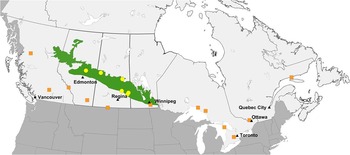
Quinoa, Chenopodium quinoa Willdenow (Amaranthaceae), is an ancient pseudocereal cultivated in the Andean region of South America for more than 5000 years (Bruno and Whitehead Reference Bruno and Whitehead2003; Dillehay et al. Reference Dillehay, Rossen, Andres and Williams2007). Quinoa is widely consumed for its high protein and mineral content and antioxidant properties (reviewed in Vega-Gálvez et al. Reference Vega-Gálvez, Miranda, Vergara, Uribe, Puente and Martínez2010). Its high nutritional qualities have led to increased market demand and expanded quinoa cultivation from its historical range in South America to Europe and North America (Jacobsen et al. Reference Jacobsen, Mujica and Ortiz2003). Production in North America continues to increase, with the Canadian Prairie Provinces now the largest producer of North American quinoa (~6100 ha in 2016, ~12 200 ha expected in 2017) (Fig. 1) (C.D., unpublished data).
Recommended growing region for quinoa in the Canadian Prairie Provinces (green; Dutcheshen Reference Dutcheshen2016) with known collection locations of Scrobipalpa atriplicella (Barcode of Life Data (BOLD) System) (orange squares) and quinoa commercial fields where damage was observed from S. atriplicella (yellow circles). Figure generated with Surfer 13.3.493 (Golden Software, Golden, Colorado, United States of America).

In South America there are at least 55 herbivorous insect species that feed on quinoa. Of these 55 species, only the noctuid moth complex (Agrotis ipsilon Hufnagel, Copitarsia decolora (Guenée), Copitarsia incommoda (Walker), Helicoverpa quinoa Pogue and Harp, and Helicoverpa titicacae Hardwick (Lepidoptera: Noctuidae)) and quinoa moth complex (Eurysacca melanocampta (Meyrick), Eurysacca media Povolný, and Eurysacca quinoae Povolný (Lepidoptera: Gelechiidae)) are major pests. Larvae from both complexes cause significant damage when they feed on the seed during the milk or dough stage leading to significant economic yield losses (reviewed in Gandarillas et al. Reference Gandarillas, Saravia, Plata, Quispe and Ortixz-Romero2015). With the introduction of a crop into a novel range comes the potential for insect pest issues; however, there is little overlap among species attacking quinoa in South America with those attacking quinoa in Europe and North America. Limited research has been conducted on insect pests of quinoa outside of South America, but most species found feeding on quinoa in Europe and North America are polyphagous and feed on species closely related to quinoa, including sugar beet (Beta vulgaris Linnaeus (Amaranthaceae)) and lambsquarters (Chenopodium album (Linnaeus) (Amaranthaceae)) (Cranshaw et al. Reference Cranshaw, Kondratieff and Qian1990; Sigsgaard et al. Reference Sigsgaard, Jacobsen and Christiansen2008). In Europe, the suite of insects attacking quinoa includes aphids, Aphis fabae Scopoli (Hemiptera: Aphidae), leafhoppers (Hemiptera: Cicadellidae), larvae of Cnephasia Curtis species (Lepidoptera: Tortricidae) and Scrobipalpa atriplicella (von Röslerstamm) (Lepidoptera: Gelechiidae), and the leaf beetles, Epitrix subcrinita (LeConte) and Cassida nebulosa Linnaeus (Coleoptera: Chrysomelidae) (Rasmussen et al. Reference Rasmussen, Lagnaoui and Esberg2003; Sigsgaard et al. Reference Sigsgaard, Jacobsen and Christiansen2008). To date, in North America the only major study of the insect complex was conducted in Colorado, United States of America where a broad suite of insects were found to attack quinoa with the main damage caused by the defoliator, Spodoptera exigua (Hübner) (Lepidoptera: Noctuidae), the aphids, Hayhurstia atriplicis (Linnaeus) and Macrosiphum euphorbiae (Thomas) (Hemiptera: Aphididae), and seed feeding mirids (primarily Lygus Hahn species (Hemiptera: Miridae)) (Cranshaw et al. Reference Cranshaw, Kondratieff and Qian1990). Insect pests feeding on quinoa in the Canadian Prairies have been a minor issue until recently when an unidentified stem-boring larvae was found causing severe damage to several quinoa stands throughout Saskatchewan, Canada. Here, we identify this stem-boring insect, document its known distribution in Canada and discuss its damage symptoms.
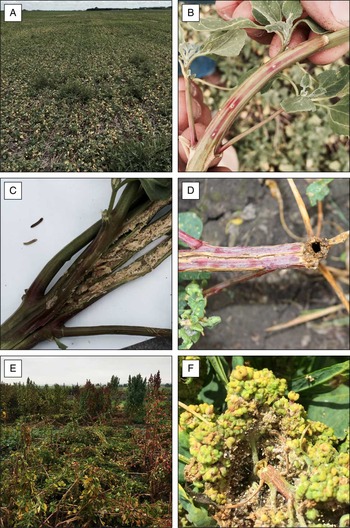
On 6 July 2016, extremely stunted and yellowing plants were noticed in a commercial quinoa production field near Wroxton, Saskatchewan (51.292°N, 101.973°W) (Fig. 2A). Upon closer examination small “pin” holes were observed in the stems of the plants (Fig. 2B), and when dissected several larvae were obtained (Fig. 2C). Infested quinoa plant material was collected from the field and placed on a layer of clean, field collected soil (insects and plant material removed by sieving) in a 37.85-L plastic bin fit with a mesh lid. The bin was transported to the laboratory at the Agriculture and Agri-Food Canada Saskatoon Research and Development Centre (Saskatoon, Saskatchewan). In the laboratory, the bin was placed on a bench (21±2 °C) adjacent to a window for natural light and misted daily with deionised water. Insect emergence was monitored daily. Insects were removed and frozen before identification. Similar damage symptoms to the Wroxton field were also observed in a quinoa field near Meadow Lake, Saskatchewan (54.071°N, 109.065°W) on 8 August 2016. Small “pin” holes were observed on quinoa stems and when split, Lepidoptera larvae were found. The larvae were preserved in 70% ethanol. In addition, 10 plant stems from infested (with “pin” holes) and seemingly uninfested (without “pin” holes) plants were collected and brought back to the Agriculture and Agri-Food Canada Saskatoon Research and Development Centre laboratory. In the laboratory, infested and seemingly uninfested plant stems were placed into separate insect cages (60×60×60 cm, BugDorm; Megaview Science, Taichung, Taiwan) with the basal end of the stems placed in Erlenmeyer flasks containing tap water. The cages were placed in a walk-in growth chamber (21±1 °C, 16:8 light:dark hours). Cages were monitored daily for emergence of insects. All insects were removed and frozen before identification.
(A) Commercial quinoa field damaged by Scrobipalpa atriplicella larval feeding near Wroxton, Saskatchewan (July 2016); (B) pin holes created by S. atriplicella when they enter or exit the stem (July 2016); (C) damaged stem with larvae (stem split open to obtain larvae) (July 2016); (D) lodged stem with pin holes (September 2016); (E) lodging damage to quinoa varieties compounded by stem borer feeding (September 2016); (F) damage caused by S. atriplicella larval feeding (larvae removed) on the seeds within the panicle of a quinoa plant (stem broken artificially to obtain larvae) (September 2016).

Over the course of the growing season several other commercial quinoa fields were monitored for the stem borer across Saskatchewan and Alberta, Canada (Fig. 1). In addition, in early September 2016 quinoa plants in an experimental variety trial (plot size 1.5×3 m, 16 varieties) near Saskatoon, Saskatchewan (52.183°N, 106.524°W) were examined and appeared to have been heavily damaged by a stem-boring insect. A total of 25 plant stems were cut and brought back to the laboratory. In the laboratory stems were dissected for larvae and boring damage was evident but no larvae were found within stems. Instead, Lepidoptera larvae were found in the panicles; these larvae were preserved in 95% ethanol.
Small, nondescript, brown–grey moths in the family Gelechiidae emerged in the laboratory from infested plant material from both Wroxton and Meadow Lake. No moths emerged from the uninfested material from Meadow Lake. Adult moths were identified at the Canadian National Collection of Insects, Arachnids, and Nematodes (Ottawa, Ontario, Canada) (by V. Nazari, National Identification Service Determination form 2016-201). Upon confirmation, additional specimens were identified by Agriculture and Agri-Food Canada Saskatoon Research and Development Centre staff and placed in the institutional entomological collection. In addition, a 658 base-pair region of the mitochondrial CO1 gene (the barcoding region) was sequenced to confirm the identity of the moths from Wroxton and Meadow Lake and larvae from stems of quinoa at Meadow Lake and from the panicle of quinoa from Saskatoon following the procedures of Hebert et al. (Reference Hebert, Cywinska and Ball2003). Sequences obtained for the specimens have been deposited in Genbank (accession number KY569023–KY569030).
Both morphological identification and genetic sequencing confirm the moths and larvae, both in the stem (early season) and in the panicle (later season) to be the goosefoot groundling moth, Scrobipalpa atriplicella (described in Huemer and Karsholt Reference Huemer and Karsholt2010). This is the first time S. atriplicella has been identified infesting quinoa in North America.
Scrobipalpa atriplicella is native to the Palaearctic where it has previously been found infesting quinoa in experimental fields in Denmark (Elsner et al. Reference Elsner, Huemer and Tokar1999; Sigsgaard et al. Reference Sigsgaard, Jacobsen and Christiansen2008). It is an invasive alien species that has become widespread throughout North America being found as far north and west as Alaska, United States of America, east as Nova Scotia, Canada, and south to Mexico (Povolný Reference Povolný1967; Bautista-Martínez et al. Reference Bautista-Martínez, Prado-Beltrán, Carrillo-Sánchez and Vejar-Cota1995; Metzler and Zebold Reference Metzler and Zebold1995; Ferris et al. Reference Ferris, Kruse, Lafontaine, Philip, Schimdt and Sikes2012; Pohl et al. Reference Pohl, Schmidt, Lafontaine, Landry, Anweiler and Bird2014).
Adult S. atriplicella are small (11–17 mm wingspan) with the head, throrax, and forewing covered in white-based dark scales mottled with orange–brown. The hindwing is grey and the underside of the abdomen cream coloured. The antennae are black. The cream-coloured abdomen is useful to separate S. atriplicella from S. acuminatella (Sircom) (Lepidoptera: Gelechiidae) found throughout Eurasia (Huemer and Karsholt Reference Huemer and Karsholt2010).
Scrobipalpa atriplicella larvae are known to feed on Atriplex patula Linnaeus, Atriplex prostrata Bocher ex Candolle, Atriplex tatarica Linnaeus, Chenopodium album Linnaeus, Chenopodium ficifolium Smith, Chenopodium hybridum Linnaeus, Chenopodium nuttalliae Safford, Chenopodium quinoa, and multiple varieties of Beta vulgaris (Amaranthaceae) (Elsner et al. Reference Elsner, Huemer and Tokar1999; Jansen Reference Jansen1999; Sigsgaard et al. Reference Sigsgaard, Jacobsen and Christiansen2008). Life history appears to vary with locality; in Mexico, Bautista-Martínez et al. (Reference Bautista-Martínez, Prado-Beltrán, Carrillo-Sánchez and Vejar-Cota1995) observed S. atriplicella deposit eggs in clusters on thin stems or the underside of leaves on C. nuttalliae. If flowers are present, single eggs are laid among the florets. In general, larvae have four instars and tunnel into the stem to feed on vascular tissue. The entrance hole in the stem closes rapidly which makes infestations difficult to detect (Bautista-Martínez et al. Reference Bautista-Martínez, Prado-Beltrán, Carrillo-Sánchez and Vejar-Cota1995).
In Europe, the first generation of S. atriplicella adults emerge from overwintering pupae and fly in May and June and a second generation of adults fly from July into August (Jansen Reference Jansen1999). Larvae of the first generation initially mine leaves, whereas later instars feed within leaves that have been spun together with silk. Second generation larvae are found in late August feeding among young quinoa flowers, leaves, and seeds that are spun together with silk (Sigsgaard et al. Reference Sigsgaard, Jacobsen and Christiansen2008; Huemer and Karsholt Reference Huemer and Karsholt2010). Stem-boring larvae have not been noted in the European literature.
In Saskatchewan, evidence suggests that S. atriplicella has two generations as it does in Europe. From our observations, the first generation bores into the stem and feeds on the pith and vascular tissue while the second generation larvae feed on the panicles. Small “pin” holes were visible on the stem in July and in September (Fig. 2B, 2D), this phenomenon should be further studied to determine if the “pin” holes are made by S. atriplicella larvae as they enter or exit the stem. Upon dissection the stem contained distinct larval galleries and the pith and vascular tissue was dried out and had a chalky appearance and feel (Fig. 2C). No pupal exuviae were found within the stems when dissected in July or in September indicating the larvae leave the stem to pupate. At the heavily infested Wroxton and Meadow Lake sites, plants were extremely stunted and aborted stem elongation and foliage production in an attempt to produce seed, which resulted in 100% yield loss. Quinoa plants that are not stunted by stem-boring larvae early in the season remain in danger of yield loss throughout the growing season. Stem boring weakens the quinoa stem and taller stemmed varieties in particular may be more susceptible to lodging from wind or heavy rain as was evident at a quinoa variety trial near Saskatoon (Fig. 2D, 2E). Stem punctures from larval entry or exit may also increase the risk of pathogen exposure, which could also affect yield in fields with low S. atriplicella infestations. However, damage severity appears to vary with plant growth stage and/or S. atriplicella population density as stem-boring larvae were observed in more established stands, but had limited impact on yield. The quinoa growth stages, which are more susceptible to stem-boring larval damage, have yet to be determined. Interestingly, we observed second generation larvae feeding within the panicles on the seed (Fig. 2F). The yield loss attributed to larvae feeding directly on the grain is not known for quinoa in Canada, but in South America grain feeding larvae can cause an 80% loss (Gandarillas et al. Reference Gandarillas, Saravia, Plata, Quispe and Ortixz-Romero2015).
There have been reports from Ontario of an unidentified stem borer in quinoa (Government of Ontario, Ontario Ministry of Food and Rural Affairs 2012); given that S. atriplicella is established across most of North America, it seems likely that S. atriplicella may be the causative agent. The potential for high yield losses makes further investigation into the population dynamics, phenology and control options for S. atriplicella a priority in order to maintain and expand sustainable quinoa production in Canada.
Acknowledgements
The authors thank Dr. Vazrick Nazari (Canadian National Collection of Insects, Arachnids, and Nematodes, Ottawa, Ontario, Canada) for morphological identification of adult S. atripicella and Alecia Lukash and Jennifer Holowachuk for their technical expertise. The authors would also like to thank two anonymous reviewers for their helpful comments.