Introduction
The genus Viburnum (Adoxaceae) consists of about 200 species with the greatest diversity occurring in eastern Asia. However, eastern North America and the mountains of Mexico and Central and South America also have this genus. In addition, some species occur in the mountains of Malesia and in Europe (Donoghue, Reference Donoghue1983). In Taiwan, the 15 taxa of Viburnum are shrubs or small trees and are distributed from 300 to 3300 m a.s.l.
Information about the level of morphophysiological dormancy (MPD) in seeds of species in the various clades of Viburnum potentially could increase our understanding of the evolutionary relationships between the nine levels of MPD. Of the 15 clades of Viburnum [according to Clement et al. (Reference Clement, Arakaki, Sweeney, Edwards and Donoghue2014)], information is available on the level of MPD in seeds of 17 species in 9 clades (Nikolaeva et al., Reference Nikolaeva, Rasumova and Gladkova1985; Baskin and Baskin, Reference Baskin and Baskin2014; Santiago et al., Reference Santiago, Ferrandis and Herranz2015). Information is not available on the level of MPD for seeds of species in six clades: Punctata, Pseudotinus, Lutescentia, Urceolata, Coriacea and Sambucina.
It is well known that seeds of Viburnum have MPD (Barton, Reference Barton1958; Baskin et al., Reference Baskin, Chen, Chien and Baskin2009; Chien et al., Reference Chien, Chen, Tsai, Baskin, Baskin and Kuo-Huang2011; Baskin and Baskin, Reference Baskin and Baskin2014), and many species have deep simple epicotyl MPD, in which warm stratification (≥15°C) is required for embryo growth and root emergence. After the root has emerged, cold stratification (approximately 0–10°C) is required for shoot (epicotyl) emergence (Hidayati et al., Reference Hidayati, Baskin and Baskin2005; Walck et al., Reference Walck, Karlsson, Milberg, Hidayati and Kondo2012; Phartyal et al., Reference Phartyal, Kondo, Fuji, Hidayati and Walck2014). Some species have non-deep simple epicotyl MPD, and warm stratification is the only requirement for embryo, root and shoot growth (Baskin et al., Reference Baskin, Chien, Chen and Baskin2008, Reference Baskin, Chen, Chien and Baskin2009). However, seeds of V. lantana have non-deep simple MPD, in which cold followed by warm stratification promoted the highest germination percentage. Embryo growth only occurred during warm stratification, and there was no delay between root and shoot emergence (Santiago et al., Reference Santiago, Ferrandis and Herranz2015).
The broad objective of our research was to determine the dormancy-breaking and germination requirements of seeds of V. plicatum var. formosanum, which is a member of the Lutescentia clade (Clement et al., Reference Clement, Arakaki, Sweeney, Edwards and Donoghue2014). V. plicatum occurs naturally in China, Japan, Korea, and variety formosanum is restricted to Taiwan, where it grows in cold-temperate coniferous and broad-leaved mixed forests at elevations of 1800–3000 m a.s.l. (Yang and Chiu, Reference Yang and Chiu1998). Since V. plicatum var. formosanum grows at high elevations, we hypothesized that exposure to cold stratification (approximately 0–10°C) is required for seed dormancy break.
We assumed that seeds of V. plicatum var. formosanum, like other taxa of Viburnum studied, have MPD. To determine the level of MPD in the seeds, we investigated the effects of cold stratification, warm stratification (≥15°C) and gibberellins on embryo growth and radicle emergence. The results of these studies would not only allow for the determination of the level of MPD, but they would help explain the regeneration niche of this taxon in its high elevation subtropical habitat. Furthermore, to increase our knowledge of the evolutionary relationships between the levels of MPD in Viburnum, we plotted the different levels of MPD in this genus on the phylogenetic diagram of Clement et al. (Reference Clement, Arakaki, Sweeney, Edwards and Donoghue2014) (not shown).
Materials and methods
Fruit harvest and seed handling
Ripe, red fruits were collected from three to four trees of V. plicatum var. formosanum in October 2014 in Tsuifeng (24°06′N, 121°11′E), Nanto County, Taiwan, at an elevation of 2300 m a.s.l. in a broad-leaved forest, and in late September 2016 in Suyuan (24°25′N, 121°20′E), Yilan County, Taiwan, at an elevation of 2000 m a.s.l. in a natural broad-leaved forest. Mean monthly temperatures (2002–2005) from a weather station in Suyuan, where the seeds were collected in 2016 are: December and January, 5.3 and 4.6°C, respectively; February, March, April, October and November, 6.7–12.9°C; May to September, 14.7–16.7°C (Data from Central Weather Bureau of Taiwan).
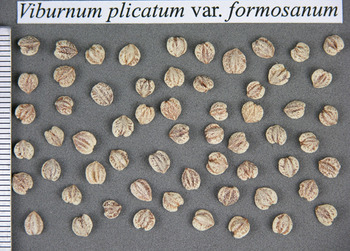
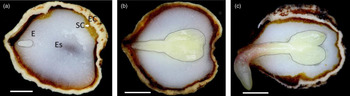
Seeds were extracted from fruits by macerating the pulp (exocarp + mesocarp) in water, and the clean seeds (with endocarp) were air-dried on paper for 2–3 d at ambient laboratory temperature (approximately 25°C), after which they were stored temporarily in sealed polyethylene bag at 5°C for 2–3 d before experiments were initiated. The germination unit (hereafter seed) consists of a seed covered by the hard endocarp. The seed has a small spatulate-shaped embryo surrounded by a large amount of endosperm (Figs 1 and 2a). There were about 37,800 and 40,900 seeds per litre from Tsuifeng and Suyuan, respectively.
Intact seeds (i.e. endocarp with seed inside) of Viburnum plicatum var. formosanum after removal of the mesocarp and exocarp. The scale is in mm.

Embryo growth in seeds of Viburnum plicatum var. formosanum. Longitudinal sections (a) fresh seeds with a small spatulate embryo, (b) a fully grown embryo and (c) radicle-emerged seed. The scale is 1 mm. Seeds from Tsuifeng were moist cold-stratified at 5°C and photographed each month. Abbreviations: E, embryo; EC, endocarp; Es, endosperm; SC, seed coat.

Effect of temperature on root emergence
To determine the temperature requirements for root emergence, fresh seeds from both Tsuifeng in 2014 and Suyuan in 2016 were mixed with moist sphagnum moss (cut into small pieces; water content of the sphagnum was about 400% of its dry mass) and sealed inside transparent polyethylene bags (0.04 mm in thickness). Moist sphagnum provides a good germination medium and contains the fungi Trichoderma and actinomycetes that are antagonistic to the growth of microorganisms (Wang et al., Reference Wang, Lin and Chang1998). Seeds from Tsuifeng and Suyuan were incubated in light (12 h day/12 h night) at alternating temperatures of 30/20, 25/15, 20/10 and 15/5°C and at a constant temperature of 25°C for 76 and 50 weeks, respectively. The light source in incubators (Saint Tien Co., Ltd, Taiwan) was cool white fluorescent tubes, and photon irradiance was about 60–80 μmol m−2 s−1. Due to the coarse nature of the sphagnum, most seeds received some light, but at any given point in time, a few may have been in darkness. However, at weekly intervals, the contents of each bag were poured out on a table to facilitate the examination of seeds for germination. After germination was monitored, seeds and sphagnum were returned to the bag, resulting in a re-shuffling of seeds with regard to their position in the sphagnum and thus exposure to light.
Each treatment consisted of three replications of 50 seeds each. Germination (root emergence) was recorded weekly, and seeds with a root ≥2 mm long were considered to be germinated. Results are expressed as mean (±1SE) germination percentage.
Effect of moist cold stratification on root emergence
To determine the response of seeds to moist cold stratification, fresh seeds from Tsuifeng in 2014 were mixed with moist sphagnum moss and sealed inside polyethylene bags, and incubated at 5°C in a dark cold room, where they were exposed to short periods of dim light when the door of the cold room was open. After 0, 4, 8, 12, 16 and 20 weeks at 5°C, seeds were incubated in light at 25/15°C for 50 weeks. Results are expressed as mean (±1SE) root emergence percentage (three replications with 50 seeds each) after roots grew to ≥2 mm long (based on the number of incubated seeds).
Effect of cold to warm and of warm to cold temperature sequences on root and shoot emergence
A move-along experiment (i.e. a double germination phenology study in which some seeds start at a winter temperature and others start at a summer temperature) was conducted using temperature regimes that simulate those occurring at Tsuifeng and Suyuan during the year: 5°C, December and January (winter); 15/5°C, February (early spring); 20/10°C, March and April (spring); 25/15°C, May, June and July (summer). Fresh seeds from Tsuifeng mixed with moist sphagnum moss were subjected to a sequence of temperatures beginning with a cold temperature, 5°C for 8 weeks → 15/5°C for 4 weeks → 20/10°C for 8 weeks → 25/15°C for 12 weeks, then continuing the sequence (i.e. 20/10 → 15/5 → 5°C) if all seeds had not germinated. Fresh seeds from Suyuan mixed with moist sphagnum moss were subjected to a sequence of temperatures beginning with a warm temperature, 25/15°C for 12 weeks → 20/10°C for 8 weeks → 15/5°C for 4 weeks → 5°C for 8 weeks → 15/5°C for 4 weeks → 20/10°C for 8 weeks → 25/15°C for 12 weeks. At the alternating temperature regimes, seeds received 12 h of light (photon irradiance of about 60–80 μmol m−2 s−1) each day, but at 5°C, they were in a dark cold room. In each temperature sequence, there were three replications of 50 seeds each. The controls were seeds incubated at each alternating temperature regime for 76 weeks. All seeds were monitored weekly for root emergence. The seeds with emerged roots were transferred to new bags containing moist sphagnum moss, returned to the appropriate temperature regime and monitored for shoot emergence at weekly intervals. However, some root-emerged seeds gradually rotted during the period of incubation. Results are expressed as percentage of root (based on the number of incubated seeds) or shoot emergence (based on the number of root-emerged seeds, three replications).
Embryo growth
Embryo growth was monitored in seeds from both Tsuifeng (in 2014) and Suyuan (in 2016). Fresh seeds from Tsuifeng were moist cold-stratified at 5°C in a dark cold room for 20 weeks, and seed and embryo lengths were determined for 10 seeds every 4 weeks. For seeds from Suyuan, embryo growth was monitored in seeds that were exposed to a temperature sequence that began with a warm temperature, 25/15°C for 12 weeks → 20/10°C for 8 weeks → 15/5°C for 4 weeks → 5°C for 8 weeks → 15/5°C for 4 weeks → 20/10°C for 8 weeks. At the alternating temperature regimes, seeds received 12 h of light (photon irradiance of about 60–80 μmol m−2 s−1) each day, but at 5°C, they were in a dark cold room. Every 2 weeks, seed and embryo lengths were determined for 10 seeds. Seeds from Tsuifeng and Suyuan were cut open longitudinally using a razor blade, and seed and embryo lengths were measured under a dissecting microscope equipped with a calibrated micrometer. Embryos were not measured for seeds with an emerged radicle. Each time 10 embryos and seeds were measured, mean embryo length and seed length (±SE) were calculated. Representative sections were photographed, and embryo (E) length:seed (S) length ratio (E:S ratio) was calculated.
Effect of GA3 and GA4 on germination (root emergence)
Fresh seeds harvested from Tsuifeng (in 2014) were soaked in double-distilled water (ddH2O) or in solutions of 25, 250, 2500 mM GA3 (potassium salt, 95% purity, Sigma, St Louis, Missouri, USA) or GA4 (90% purity, from Professor Lewis N. Mander, Australian National University) for 24 h at room temperature (about 25°C) prior to incubation. The treated seeds were mixed with moist sphagnum moss and incubated at 25/15°C for 77 weeks, and root emergence was monitored weekly. Each treatment consisted of three replications of 50 seeds each. Results are expressed as percentage of root emergence.
Statistical analysis
Root emergence data and shoot emergence data were converted to percentages, and means (three replications) and standard errors were calculated by Microsoft Office Excel 2010. Statistical analyses of root emergence, shoot emergence, embryo length, seed length and embryo length:seed length ratio data were carried out using the GLM procedure of SAS, and means were compared by Least Significant Difference (LSD) (SAS Enterprise Guide 7.1). Percentage data were arcsine square-root transformed before analysis, but only non-transformed data are shown in Figs 3 and 4.
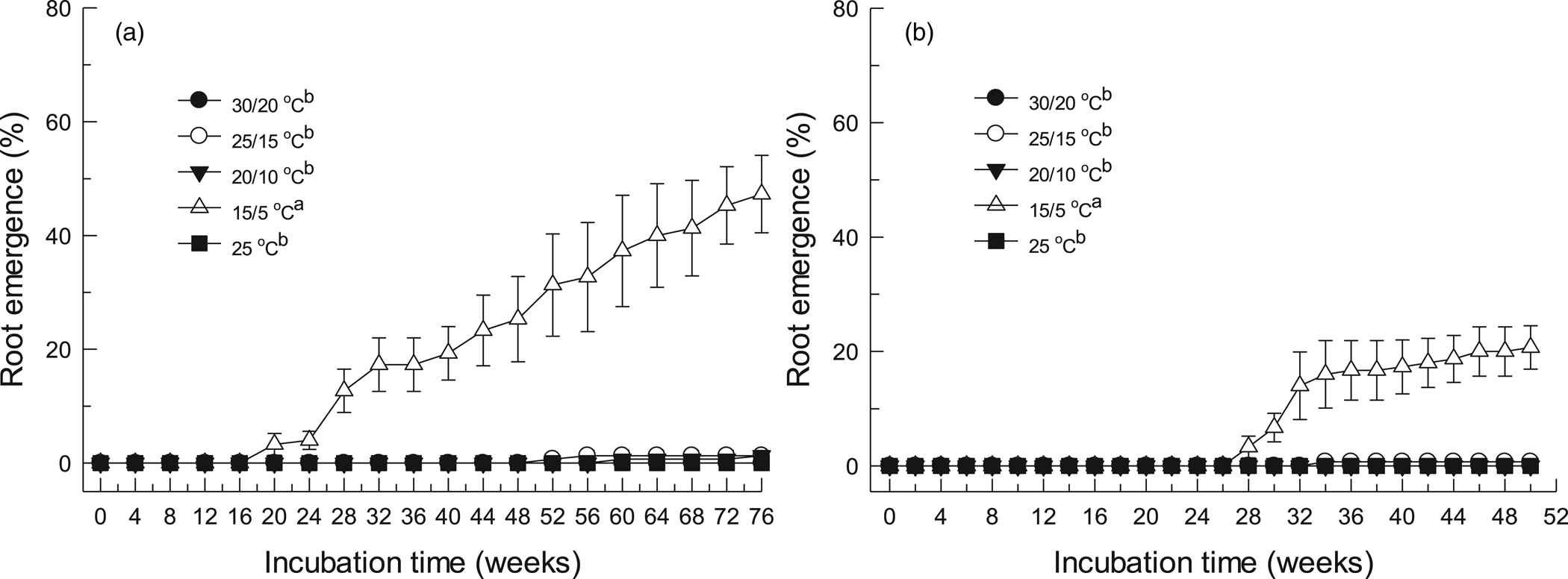
Cumulative germination (root emergence) percentages of fresh seeds of Viburnum plicatum var. formosanum at various temperatures. Seeds were harvested in Tsuifeng in 2014 (a) and Suyuan in 2016 (b). Final root emergence percentages among the incubation temperatures followed by different letters differ significantly (LSD, α = 0.05).

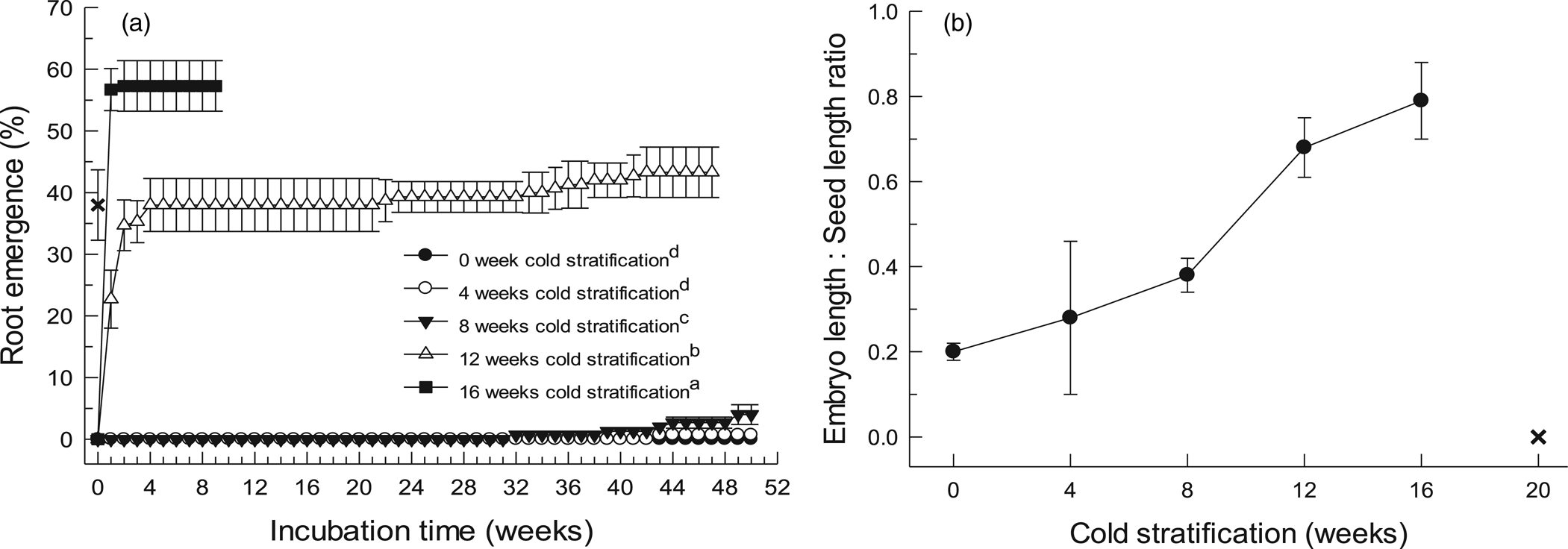
Effect of moist cold stratification at 5°C on root emergence (a) and embryo growth (b) of Viburnum plicatum var. formosanum seeds. Seeds from Tsuifeng in 2014 were cold-stratified for various periods of time and then incubated in light at 25/15°C. Final root emergence percentages among time treatments of moist cold stratification followed by different letters differ significantly (LSD, α = 0.05). Symbol ‘X’ indicates (a) 38.7 ± 6.2% root emergence at cold stratification for 20 weeks before taking out for incubation, (b) cold-stratified seeds for 20 weeks had emerged at 5°C cold room in dark.

Results
Effect of temperature on root emergence
Root emergence only occurred at 15/5°C, and 25 and 21% of the seeds collected in 2014 and 2016, respectively, had an emerged root at week 50. Extending the incubation time to 76 weeks for the 2014 seeds resulted in 47% root emergence (Fig. 3). Less than 2% of seeds incubated at 20/10, 25/15, 30/20 and 25°C had an emerged root at 76 weeks, and percentages of root emergence at these temperatures were significantly less (P < 0.001) than that at 15/5°C after 76 weeks. After 48 weeks of incubation at 15/5°C, 25.3 ± 7.5 and 20.0 ± 4.3% of seeds collected in Tsuifeng in 2014 and Suyuan in 2016 had an emerged root, respectively (Fig. 3), and there was no statistical difference between them (P > 0.05). Root emergence for seeds collected in Suyuan in 2016 was not extended to 76 weeks.
Effect of moist cold stratification on root emergence
Moist cold stratification at 5°C for 12 or 16 weeks significantly increased seed germination (root emergence), but none of the seeds cold-stratified for 8 weeks or less germinated. Seeds cold-stratified for 12 weeks germinated to 23 and 38% after 1 and 4 weeks incubation at 25/15°C, respectively, while those cold-stratified for 16 weeks germinated to 57% after 1 week at 25/15°C; no additional seeds had germinated after 40 weeks (Fig. 4). Final germination percentages of seeds cold-stratified at 5°C for 4, 8, 12 and 16 weeks were statistically different after incubation at 25/15°C. During moist cold stratification at 5°C for 20 weeks, 38.7% of the seeds germinated, and after 1 week of incubation at 25/15°C an additional 3% germinated, after which no more seeds germinated (data not shown).
Effect of cold to warm and of warm to cold temperature sequences on root and shoot emergence
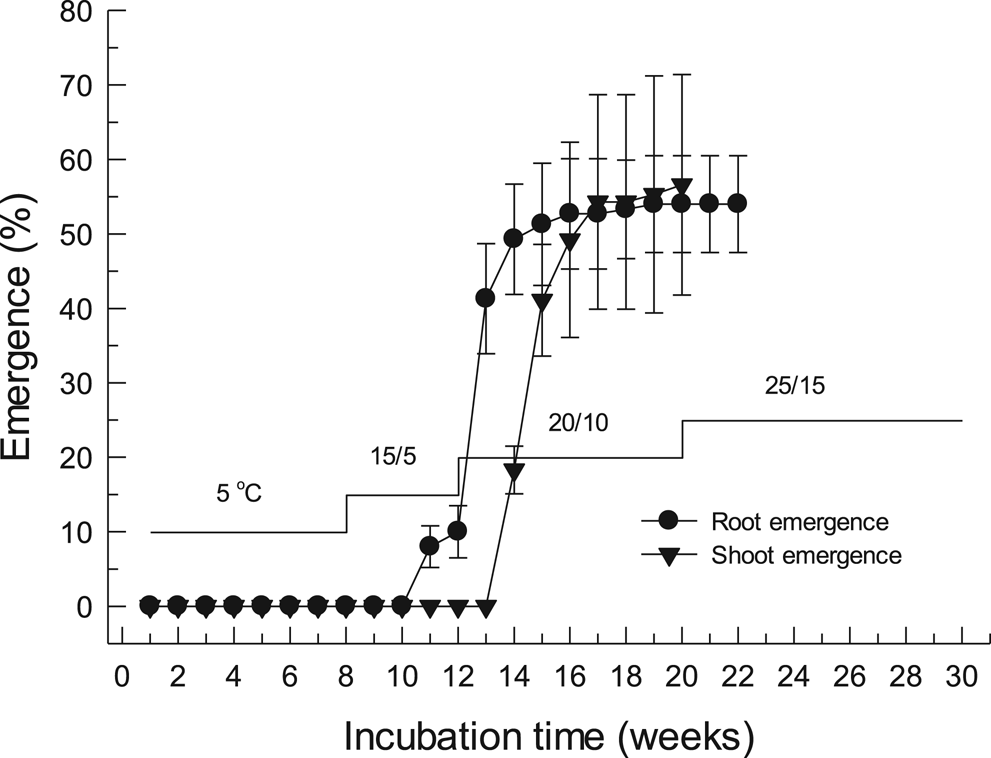
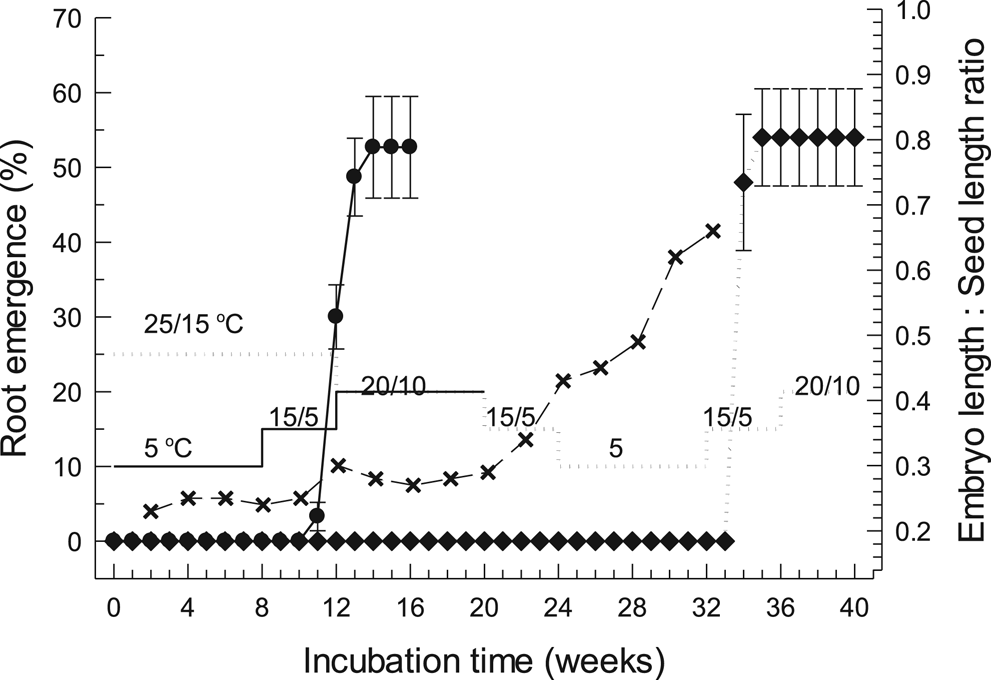
For seeds in the temperature sequence beginning at 5°C, root emergence began at 15/5°C and increased to 53% at 20/10°C (Fig. 5). However, no additional seeds germinated when subsequently moved to 25/15, then to 20/10, 15/6 and 5°C (data not shown). After root emergence, shoot emergence was delayed about 3 weeks (Fig. 5). In the temperature sequence that began at 25/15°C, no seeds germinated until after seeds had been cold-stratified at 5°C for 8 weeks. Germination of these seeds began when they were moved to 15/5°C, and it rapidly increased to 54% while seeds were at this temperature (Fig. 6).
Cumulative root emergence and shoot emergence in seeds of Viburnum plicatum var. formosanum incubated under a temperature sequence beginning at 5°C. Seeds of V. plicatum var. formosanum were collected in Tsuifeng in 2014.

Cumulative root emergence in seeds of Viburnum plicatum var. formosanum incubated under a temperature sequence beginning at 5°C or at 25/15°C. Seeds of V. plicatum var. formosanum were collected in Suyuan in 2016. -●-, 5°C → 25/15°C temperature sequence; ⋅⋅♦⋅⋅, 25/15°C → 5°C temperature sequence; ‘–x–’, E:S ratio following the 25/15°C → 5°C temperature sequence.

Embryo growth
Mean (±SE) length of embryos in fresh seeds from Tsuifeng in 2014 was 0.76 ± 0.06 mm, and the E:S ratio was 0.20 ± 0.02 (Figs 2a and 4b). After 0, 4, 8, 12 and 16 weeks of moist cold-stratified at 5°C, the E:S ratio was 0.28 ± 0.18, 0.38 ± 0.04, 0.68 ± 0.07 and 0.79 ± 0.09, respectively (Figs 2b and 4b). After 20 weeks of cold stratification at 5°C, the seeds had germinated and embryo measurements were not made.
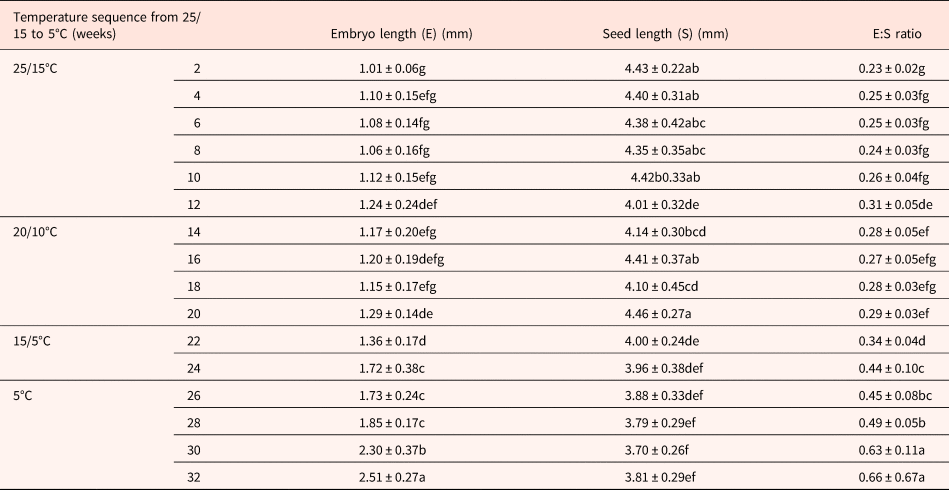
Mean (±SE) length of embryos in fresh seeds harvested from Suyuan in 2016 was 0.83 ± 0.07 mm, and the E:S ratio was 0.19 ± 0.02 (Fig. 6). In the temperature sequence beginning at 25/15°C, the E:S ratio did not change until seeds were moved from 20/10 to 15/5°C, where the E:S ratio began to increase (Table 1). The E:S ratio reached its maximum of 0.66 ± 0.27 during incubation at 5°C, at which time embryo length reached 2.51 ± 0.27 mm (Fig. 6). In other words, the small embryo increased in length by 300% while seeds were incubated at cold-stratifying temperatures. The colour of some cotyledons changed from white to light yellow-green during the temperature sequence.
Changes in embryo length, seed length, embryo length:seed length ratio at 2-week intervals as seeds of V. plicatum var. formosanum collected in Suyuan in 2016 were moved through a sequence of temperature regimes from 25/15 to 5°C. Means (n = 10) ± SE within a column followed by different letters differ significantly (LSD, α = 0.05)

Effect of GA3 and GA4 on germination (root emergence)
Seeds pre-treated with 25, 250 or 2500 mM GA3 or GA4 did not germinate during 29 weeks incubation at 25/15°C. When the incubation time was extended to 77 weeks, seeds treated with 2500 mM GA4 germinated to 12.7%, but to only to 0–5.3% when treated with the other concentrations of GA3 and GA4 (data not shown).
Discussion
None of the fresh seeds of V. plicatum var. formosanum incubated at 30/20, 25/15, 20/10, 15/5 and 25°C had germinated after 16 weeks, indicating that they were dormant. Since the underdeveloped (small) spatulate embryo in seeds of V. plicatum var. formosanum increased in length by 300% or more before root emergence occurred, seeds have MPD. There are nine recognized levels of MPD: non-deep simple, intermediate simple, deep simple, deep simple epicotyl, non-deep simple epicotyl, deep simple double, non-deep complex, intermediate complex and deep complex (Baskin and Baskin, Reference Baskin and Baskin2014). The question is which level of MPD do the seeds of V. plicatum var. formosanum have?
In the simple subclass of MPD, embryos grow at warm (≥15°C) stratification temperatures, while in the complex subclass embryos grow at cold (approximately 0–10°C) stratification temperatures (Nikolaeva, Reference Nikolaeva and Khan1977). Since embryos in seeds of V. plicatum var. formosanum grew at low temperature, that is 5°C, seeds have a complex level of MPD. Thus, our hypothesis that exposure to cold stratification is required for seed dormancy break is well supported.
The three levels of complex MPD (non-deep, intermediate and deep) are distinguished by temperature requirements for dormancy break and response to gibberellic acid. In non-deep complex MPD, seeds require warm stratification followed by cold stratification with embryos growing during cold stratification, while those with intermediate and deep complex MPD only require cold stratification. Seeds with non-deep and intermediate complex MPD will respond to treatment with gibberellic acid, but those with deep complex MPD do not respond. For seeds of V. plicatum var. formosanum, cold stratification at 5°C induced embryo growth and promoted root emergence, but GA3 and GA4 had no effect on root emergence. Thus, we conclude that seeds have deep complex MPD, which is a first report for Viburnum.
At present, four levels of MPD are known to occur in Viburnum: deep simple epicotyl, requiring warm followed by cold stratification for germination (Giersbach, Reference Giersbach1937; Hidayati et al., Reference Hidayati, Baskin and Baskin2005; Walck et al., Reference Walck, Karlsson, Milberg, Hidayati and Kondo2012; Phartyal et al., Reference Phartyal, Kondo, Fuji, Hidayati and Walck2014); non-deep simple epicotyl, requiring only warm stratification (Karlsson et al., Reference Karlsson, Hidayati, Walck and Milberg2005; Baskin et al., Reference Baskin, Chien, Chen and Baskin2008, Reference Baskin, Chen, Chien and Baskin2009); non-deep simple, requiring cold followed by warm stratification (Santiago et al., Reference Santiago, Ferrandis and Herranz2015); and deep complex, requiring only cold stratification (this study). Deep simple epicotyl MPD occurs in the clades Lentago, Lobata, Mollodontoinus, Opulus, Oreinodontotinus and Succodontinus, and non-deep simple epicotyl MPD is found in Solenotinus, Succodontinus and Tinus. Non-deep simple MPD is found in Lantana and deep complex in Lutescentia. Thus, we miss information for species in five of the remaining clades of the genus Viburnum, especially Urceolata, which is a sister of Lutescentia. Seeds of a member of Solenotinus, that is V. odoratissimum, which is closely associated with Lutescentia, have non-deep simple epicotyl MPD (Baskin et al., Reference Baskin, Chien, Chen and Baskin2008). Does this mean that non-deep simple epicotyl MPD and deep complex MPD are related, at least in Viburnum? Clearly, much additional research is needed on seed dormancy-breaking requirements of species of Viburnum from a phylogenetic perspective.
Studies on geographical movements and shifts in biomes during the diversification of Viburnum have revealed that the genus originated in warm-temperate climates and then diverged into cool-temperate and warm-tropical climates (Landis et al., Reference Landis, Eaton, Clement, Park, Spriggs, Sweeney, Edwards and Donoghue2021). These authors note that V. plicatum (within the Lutescentia clade) is one of many examples of a shift from a warm-temperature to a cool-temperate climate. Thus, it seems reasonable that during the shift of V. plicatum from a warm-temperature to a cool temperature climate, for example the high elevation habitats of V. plicatum var. formosanum, the cool climate selected for a low temperature required for seed dormancy break. The low-temperature requirement for seed dormancy release of V. plicatum var. formosanum ensures that seeds undergo dormancy break during winter and are non-dormant and thus ready to germinate at the beginning of the growing season in spring. This germination strategy would promote seedling establishment and growth during spring and summer, thereby allowing plants to reach a size that enhances perennation during the autumn drought and winter cold of the high elevation habitat of this taxon.
Acknowledgements
The authors thank Yen-Wei Chang, Chia-Yi Chen, Chang-Yen Chen, Yu-Cheng Hsieh, Shu-Niu Liau and Yu-Han Tsai, Taiwan Forestry Research Institute, for technical assistance.
Financial support
This research was supported by a grant (MOST 104-2313-B-054-002-MY3 to S.-Y.C.) from the Ministry of Science and Technology, Taiwan, ROC.
Conflicts of interest
The authors declare no conflicts of interest.