Introduction
In recent years, oxytocin (OT), a nine-amino-acid neuropeptide, has become a major focus of research in biological psychology (Taylor, Reference Taylor2006; Heinrichs & Domes, Reference Heinrichs and Domes2008; Heinrichs et al. Reference Heinrichs, von Dawans and Domes2009; Meyer-Lindenberg et al. Reference Meyer-Lindenberg, Domes, Kirsch and Heinrichs2011; Kumsta & Heinrichs, Reference Kumsta and Heinrichs2012). Several studies have shown that OT has beneficial effects on social interactions and associated cognitive processes including the recognition of facial emotions. For example, OT is reported to improve recognition of mental states using cues from the eye region (Domes et al. Reference Domes, Heinrichs, Michel, Berger and Herpertz2007b) and from full facial expressions (Fischer-Shofty et al. Reference Fischer-Shofty, Shamay-Tsoory, Harari and Levkovitz2010; Lischke et al. Reference Lischke, Berger, Prehn, Heinrichs, Herpertz and Domes2012a). On the neural level, OT seems to dampen activity in the amygdala (Kirsch et al. Reference Kirsch, Esslinger, Chen, Mier, Lis, Siddhanti, Gruppe, Mattay, Gallhofer and Meyer-Lindenberg2005; Domes et al. Reference Domes, Heinrichs, Glascher, Buchel, Braus and Herpertz2007a; Baumgartner et al. Reference Baumgartner, Heinrichs, Vonlanthen, Fischbacher and Fehr2008), a structure involved in both emotion processing and social attention (Davis & Whalen, Reference Davis and Whalen2001).
As attention has been considered a crucial factor in emotion processing itself (Vuilleumier, Reference Vuilleumier2005), the effects of OT on facial emotion processing might be mediated by modulation of attention. For instance, previous studies on OT and face processing have reported an increased number of saccades towards the eye region (Guastella et al. Reference Guastella, Mitchell and Dadds2008; Gamer et al. Reference Gamer, Zurowski and Buchel2010), suggesting that OT modulates overt visual attention during the processing of social cues. However, whereas Guastella et al. (Reference Guastella, Mitchell and Dadds2008) used neutral faces only, the OT-induced increase in post-stimulus saccades to the eye region reported by Gamer et al. (Reference Gamer, Zurowski and Buchel2010) was not affected by emotional expression. A recent study using very brief presentations of facial stimuli in a backward-masking paradigm provided the first evidence that the effects of OT on emotion recognition are not completely due to conscious evaluation of the presented stimulus (Schulze et al. Reference Schulze, Lischke, Greif, Herpertz, Heinrichs and Domes2011). This points to the possibility that OT-induced modulations of covert attention affect facial emotion processing with limited awareness.
Altered attention towards social information is associated with several clinical conditions such as anxiety, autism spectrum disorders (ASD) and Williams syndrome. Whereas people with ASD usually show reduced interest in social interactions, those with Williams syndrome display a ‘hypersociability’ (Jones et al. Reference Jones, Bellugi, Lai, Chiles, Reilly, Lincoln and Adolphs2000) characterized by increased approach behavior towards strangers (Jarvinen-Pasley et al. Reference Jarvinen-Pasley, Vines, Hill, Yam, Grichanik, Mills, Reiss, Korenberg and Bellugi2010). These differences in social phenotype seem to be reflected in gaze behavior: autistic individuals display reduced attentional capture by facial stimuli and avoidance of eye gaze (Riby & Hancock, Reference Riby and Hancock2009; Kliemann et al. Reference Kliemann, Dziobek, Hatri, Steimke and Heekeren2010) whereas individuals with Williams syndrome show enhanced gazing towards facial picture components, the eye regions of faces and happy facial expressions (Riby & Hancock, Reference Riby and Hancock2009; Dodd & Porter, Reference Dodd and Porter2010; Porter et al. Reference Porter, Shaw and Marsh2010; Moore et al. Reference Moore, Heavey and Reidy2012). Notably, both syndromes have recently been linked to alterations in the OT system (Campbell et al. Reference Campbell, Datta, Jones, Batey Lee, Sutcliffe, Hammock and Levitt2011; Dai et al. Reference Dai, Carter, Ying, Bellugi, Pournajafi-Nazarloo and Korenberg2012; Pobbe et al. Reference Pobbe, Pearson, Defensor, Bolivar, Young, Lee, Blanchard and Blanchard2012).
In anxiety, the main body of evidence suggests a bias towards threat despite some variability in results across studies and differential influences of timing and threat intensity (Mogg & Bradley, Reference Mogg and Bradley2002; Bar-Haim et al. Reference Bar-Haim, Lamy, Pergamin, Bakermans-Kranenburg and van IJzendoorn2007; for a recent review see Shechner et al. Reference Shechner, Britton, Perez-Edgar, Bar-Haim, Ernst, Fox, Leibenluft and Pine2012). However, results from a recent study suggest the existence of subgroups in social anxiety disorder, with patients displaying either a heightened vigilance or avoidance of social threat (Calamaras et al. Reference Calamaras, Tone and Anderson2012). Using the dot-probe paradigm, Cooper & Langton (Reference Cooper and Langton2006) investigated attentional capture by angry and happy facial stimuli in a healthy sample and showed biased attention towards angry faces exclusively for short presentation times, suggesting the involvement of initial covert attentional shifts.
In the present study we used a facial dot-probe task to investigate whether a single dose of OT modulates the allocation of attentional resources to negative and positive social cues (i.e. angry and happy faces). We varied the degree of overt attentional processes using two different presentation times (100 and 500 ms). We also controlled for eye movements indicating overt attention shifts using a remote eye tracker. We expected that OT would enhance the salience of positive rather than negative social stimuli (Unkelbach et al. Reference Unkelbach, Guastella and Forgas2008; Di Simplicio et al. Reference Di Simplicio, Massey-Chase, Cowen and Harmer2009; Marsh et al. Reference Marsh, Yu, Pine and Blair2010), as reflected by attentional preference for happy compared to angry faces after OT treatment.
Method
Participants
Sixty-nine male participants (mean±s.d. age: 24.0 ± 3.1 years) were randomly assigned to receive a single intranasal dose of OT (n = 35) or placebo (n = 34). An exclusively male sample was investigated because of empirical evidence suggesting sex differences in responding to intranasal OT (Domes et al. Reference Domes, Lischke, Berger, Grossmann, Hauenstein, Heinrichs and Herpertz2010; Lischke et al. Reference Lischke, Gamer, Berger, Grossmann, Hauenstein, Heinrichs, Herpertz and Domes2012b). Participants had no physical or mental illness according to self-report and also according to results from a standardized screening protocol. All participants had normal or corrected-to-normal vision, were non-smokers and free of any medication. There were no significant differences between the groups regarding age (OT: 24.5 ± 3.5 years; placebo: 23.6 ± 2.7 years; t 67 = 1.27, p = 0.21), general intellectual abilities (IQ; OT: 105.7 ± 6.2; placebo: 105.7 ± 4.2; t 67 = −0.02, p = 0.98) and self-reported psychopathology [Symptom Checklist (Franke, Reference Franke1995); OT: 0.34 ± 0.27; placebo: 0.34 ± 0.26; t 67 = −0.06, p = 0.95]. All participants gave written informed consent and were paid for participation. The study was part of a larger project (cf. Schulze et al. Reference Schulze, Lischke, Greif, Herpertz, Heinrichs and Domes2011) and was approved by the ethical committee of the Medical Faculty of the University of Rostock.
Administration of OT
OT was administered intranasally (Born et al. Reference Born, Lange, Kern, McGregor, Bickel and Fehm2002) following a standardized protocol used in previous studies (Domes et al. Reference Domes, Heinrichs, Glascher, Buchel, Braus and Herpertz2007a, Reference Domes, Heinrichs, Michel, Berger and Herpertzb, Reference Domes, Lischke, Berger, Grossmann, Hauenstein, Heinrichs and Herpertz2010). In brief, 45 min prior to the start of the dot-probe task, participants self-administered six puffs of Syntocinon® nasal spray (Novartis, Switzerland; three puffs per nostril, containing 4 IU OT each) or a placebo under the supervision of the researcher.
Dot-probe task
The dot-probe task (MacLeod et al. Reference MacLeod, Mathews and Tata1986) is a well-established paradigm for investigating the attentional preference to one of two stimuli presented for a short period of time. In brief, two stimuli are presented simultaneously, one of which is a target stimulus of higher salience, for example an emotional compared to a neutral face. Reaction to a subsequently appearing probe is generally faster if the probe location is congruent with that of the target stimulus compared to the control stimulus.
For the present study, angry, happy and neutral facial expressions of 40 participants (20 male/20 female) were selected from the Karolinska Directed Emotional Faces (KDEF; Lundqvist et al. Reference Lundqvist, Flykt and Ohman1998). Each trial started with a fixation cross with a randomized duration of 750 to 1500 ms. A pair of angry/neutral, happy/neutral or neutral/neutral expressions of the same person was then presented for 100 ms versus 500 ms (short versus long presentation condition). The two faces (295 × 400 pixels, 12.2 × 16.5° visual angle) were presented with an offset of ±200 pixels (8.3° visual angle) from the screen center. Immediately following picture presentation, the dot probe (10 × 10 pixels, 0.4° visual angle) was presented at the location of one of the facial expressions. In emotional trials (one facial expression being angry or happy), the probe appeared at the location of the emotional face (congruent) and at the location of the neutral face (incongruent) in the other half of the trials. Participants were asked to indicate the location of the probe as quickly as possible by pressing one of two buttons. Correct answers and reaction times (RTs) to the dot probes were recorded.
In total, 240 trials were presented, resulting in a total duration of approximately 20 min. The experiment was run on a Windows PC with a 20-inch TFT display (40.8 × 30.6 cm, 1024 × 768 pixels) using Presentation version 12.1 (Neurobehavioral Systems, USA).
Eye tracking
To disentangle the role of overt and covert shifts of attention, saccades on primes and probes were assessed using a remote infrared eye tracker (ViewPoint PC-60 Quick Clamp, Arrington Research, USA). The viewing distance was kept constant at 55 cm using a head rest. Gaze data were collected with 60-Hz temporal resolution and a typical gaze position accuracy of 0.25–1.0° visual angle. Eye tracking data were analyzed with an in-house script written in MATLAB version 7.1 (Mathworks, USA). Raw data were corrected for blinks using a moving average calculation to interpolate missing data. A saccade towards a specific prime or probe was defined as a horizontal translation exceeding a threshold of ±5° visual angle from the central position during presentation of the particular stimulus. The cumulative number of saccades on primes and probes was then calculated for the different experimental conditions.
Statistical analysis
RT data from erroneous responses and RTs <300 ms and >1500 ms were excluded from the statistical analysis. Errors and outliers accounted for 4.2% of the data and did not differ between groups (p > 0.10). The remaining RTs were averaged for each condition.
Enhanced capture of attention by emotional compared to neutral facial expressions in both groups was tested within a two-way ANOVA with group as the between-subject factor and probe location (congruent versus incongruent) as the within-subject factor. Attentional preferences for specific emotional facial expressions were then calculated by subtracting RTs within congruent trials from RTs within incongruent trials. These bias scores were subject to a three-way ANOVA with group as the between-subject factor and presentation duration (100 ms versus 500 ms) and prime valence (angry versus happy) as within-subject factors.
Saccades during primes were analyzed for the long presentation condition only, as stimulus-associated saccades usually have a latency of about 200 ms and thus were not likely to be detectable during the 100-ms presentation of primes. Saccades during primes were subject to a three-way ANOVA with the between-subject factor group and direction (to or away from the emotional prime) and prime valence (happy versus angry) as within-subject factors. Saccades during probes were analyzed with a corresponding five-way ANOVA adding prime duration (100 ms versus 500 ms) and target location (congruent versus incongruent) as within-subject factors.
Results
Attentional preference
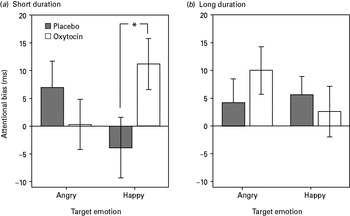
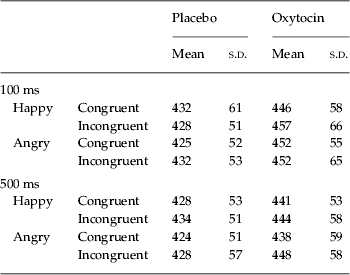
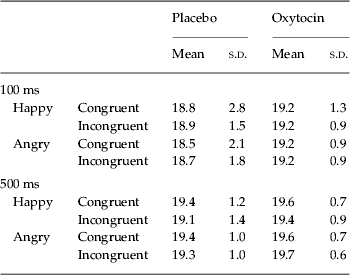
For raw RTs, a significant main effect of probe location was present (Table 1). RTs to probes at incongruent locations were significantly longer (F 1,67 = 7.15, p = 0.009). The group × location interaction did not reach significance (F 1,67 = 0.66, n.s.), indicating that subjects in both groups showed an attentional bias towards emotional cues. The subsequent ANOVA on attentional bias scores revealed a significant three-way interaction of group, duration and emotional valence (F 1,67 = 6.66, p = 0.012). Follow-up two-way ANOVAs were calculated for each presentation duration and showed a specific effect of OT for the short presentation condition (Fig. 1); the group × emotion interaction was significant (F 1,67 = 4.81, p < 0.05), with the OT group showing enhanced attention to happy facial expressions (t 67 = 2.11, p < 0.05). An additional ANOVA for the number of correct responses revealed no significant effects on detection rates for probes associated with OT administration (all p > 0.10). However, detection rates were high on average, as expected, and even higher for trials with long presentation of primes, as indicated by a significant main effect of prime duration (F 1,67 = 17.30, p < 0.001; Table 2).
Effects of intranasal oxytocin on attentional bias for facial expressions presented with either (a) short duration (100 ms) or (b) long duration (500 ms). Error bars represent the standard error of the mean. * t 67 = 2.11, p < 0.05.

Average reaction times (in ms) for the different conditions in the facial dot-probe paradigm
s.d., Standard deviation.
Average number of correct responses for the different conditions in the dot-probe paradigm
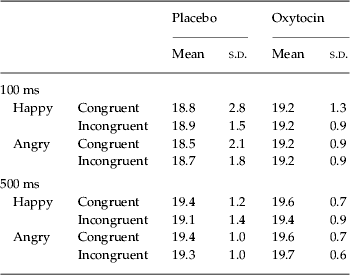
s.d., Standard deviation.
Eye tracking
Eye tracking data from three participants of the OT group and two of the placebo group were removed because of poor calibration or hardware malfunction. For the remaining participants, the ANOVA revealed a single main effect for saccades during presentation of primes: in general, there were more saccades on emotional primes compared to neutral primes (F 1,62 = 19.26, p < 0.001). All other effects were not significant. During the presentation of probes, saccades were much more likely on probes than off probes (F 1,62 = 74.78, p < 0.001), and occurred more frequently after primes presented with a short duration compared to primes presented with a long duration (F 1,62 = 10.33, p < 0.005). In addition, following long primes, there were more saccades on probes at the incongruent location (F 1,62 = 9.41, p < 0.004). All other effects were not significant (all p > 0.10).
Discussion
In the present study, the administration of OT resulted in an attentional preference towards happy faces when stimuli were presented with a short duration of 100 ms. This suggests that intranasal OT promotes the attentional preference for briefly presented positive social cues. The specificity of OT effects for facial cues of positive social interaction is in line with previous research in humans (Unkelbach et al. Reference Unkelbach, Guastella and Forgas2008; Di Simplicio et al. Reference Di Simplicio, Massey-Chase, Cowen and Harmer2009; Marsh et al. Reference Marsh, Yu, Pine and Blair2010), and also with a large body of animal research emphasizing the crucial role of OT in prosocial behavior (e.g. Young, Reference Young2009; Keebaugh & Young, Reference Keebaugh and Young2011). Of note, a recent study using a comparable paradigm with sad and angry facial stimuli showed increased disengagement from briefly presented angry faces (Ellenbogen et al. Reference Ellenbogen, Linnen, Grumet, Cardoso and Joober2012). Although in the present study, the effect for angry facial expressions was not significant, the two studies are in accordance with the hypothesis that OT might shift attention towards positive rather than negative social stimuli.
To our knowledge this is the first study to show that OT selectively enhances covert attention for positive emotional cues and thereby might promote prosocial behavior. Our results provide an explanation for previously reported OT effects on behavioral and neural responses to facial emotional expressions in the absence of changes in overt attentional processing (Domes et al. Reference Domes, Lischke, Berger, Grossmann, Hauenstein, Heinrichs and Herpertz2010; Alvares et al. Reference Alvares, Chen, Balleine, Hickie and Guastella2012; Lischke et al. Reference Lischke, Berger, Prehn, Heinrichs, Herpertz and Domes2012a). For example, Lischke et al. (Reference Lischke, Berger, Prehn, Heinrichs, Herpertz and Domes2012a) studied OT effects on gazes to the eye region of dynamically presented faces of varying emotional expression. Although OT generally improved recognition of the specific emotion, it did not affect gazing behavior as measured by eye tracking. The authors concluded that the beneficial effects of OT on emotion recognition are not mediated by changes in overt visual attention. The results from a recent study by Leknes et al. (Reference Leknes, Wessberg, Ellingsen, Chelnokova, Olausson and Laeng2012) found an OT-induced enhancement of emotional attention that was associated with an overall increase in pupil dilation irrespective of the type of expression.
However, in most of these studies visual attention was guided explicitly towards facial emotional expressions and often included cognitive evaluation of the particular expression. The dot-probe paradigm used in our study allowed for investigation of covert attention as the emotional stimuli are not task-relevant per se and not located in the center of visual attention. Furthermore, for the short presentation condition, stimuli were presented too briefly to allow for overt gaze shifts towards them. Notably, OT-induced modulation of covert attention concurs with the recently reported lower detection threshold for very briefly presented emotional facial expressions in a backward-masking paradigm (Schulze et al. Reference Schulze, Lischke, Greif, Herpertz, Heinrichs and Domes2011).
The present study has some limitations, such as the exclusively male sample, the between-subject design and the use of faces as the only stimuli, which could be subject to improvement in replication studies investigating sex differences (Domes et al. Reference Domes, Lischke, Berger, Grossmann, Hauenstein, Heinrichs and Herpertz2010; Lischke et al. Reference Lischke, Gamer, Berger, Grossmann, Hauenstein, Heinrichs, Herpertz and Domes2012b) and the specificity of our findings. In addition, it should be noted that the size of the OT-induced effects on attentional biases as revealed by RTs were, although significant, relatively small. However, together with previous studies reporting effects of OT on neural activity using functional magnetic resonance imaging (for an overview, see Meyer-Lindenberg et al. Reference Meyer-Lindenberg, Domes, Kirsch and Heinrichs2011), the present results point to the possibility that OT modulates the neural circuitry underlying the early attentional orienting and processing of emotional stimuli (Tamietto & de Gelder, Reference Tamietto and de Gelder2010). This assumption could be investigated in future studies using experimental paradigms that focus on different aspects of attention, such as overt versus covert or temporal attention, to better understand the role of OT in the context of human emotion processing.
The results of the present study also have clinical implications. Several studies have provided initial evidence that OT might be a promising option in the treatment of mental disorders with social impairments (Guastella et al. Reference Guastella, Howard, Dadds, Mitchell and Carson2009, Reference Guastella, Einfeld, Gray, Rinehart, Tonge, Lambert and Hickie2010; Pedersen et al. Reference Pedersen, Gibson, Rau, Salimi, Smedley, Casey, Leserman, Jarskog and Penn2011). Given the role of biased social attention in different clinical syndromes such as anxiety or autism (Riby & Hancock, Reference Riby and Hancock2009; Kliemann et al. Reference Kliemann, Dziobek, Hatri, Steimke and Heekeren2010; Shechner et al. Reference Shechner, Britton, Perez-Edgar, Bar-Haim, Ernst, Fox, Leibenluft and Pine2012), a better understanding on how OT shapes attention for social signals seems highly relevant. Future studies could investigate valence-related effects of OT on social attention in clinical populations combining an exogenous administration of OT with analyses of genetic factors and brain-imaging data. For example, in a recent study Sauer et al. (Reference Sauer, Montag, Worner, Kirsch and Reuter2012) showed that variations in the CD38 gene important for OT secretion are associated with differences in neural responses to social stimuli, with these differences being increased following OT administration.
Furthermore, evidence from both animal and human studies suggests strong interactions of the OT and the dopaminergic system in the context of social behavior (Baskerville & Douglas, Reference Baskerville and Douglas2010; Strathearn, Reference Strathearn2011). OT was shown to increase dopamine signaling in reward-related brain structures in rats, with the latter being associated with increased maternal behavior (Shahrokh et al. Reference Shahrokh, Zhang, Diorio, Gratton and Meaney2010). In our study, the automatic attentional shift towards positive social cues might reflect increased reward sensitivity after OT administration, possibly mediated by OT effects on dopaminergic mid-brain regions (Krebs et al. Reference Krebs, Boehler, Roberts, Song and Woldorff2012).
To summarize, OT seems to shape early attentional processes in a way that might facilitate prosocial behavior. Because of the complexity of the OT system and its inter-relatedness with other neurophysiological systems, future studies should address the role of OT in social attention in health and clinical conditions following a multi-modal approach.
Acknowledgments
We thank J. Greif for assistance with the data collection. This work was supported by the German Research Foundation (DFG Do1312/2-1; He5310/1-1).
Declaration of Interest
None.