Introduction
Life as we know it on the Earth, and as we are currently able to conceive it somewhere else in the Solar System or in the universe, is based on complex organic compounds interacting in liquid water. Elaborated structures such as proteins, DNA or RNA, cannot appear by themselves at once on a planet. They result from a complex chemical evolution far from being entirely understood, in which the building up of carbonaceous molecules starts in the core of giant red stars where the nucleosynthesis of C atoms occurs, and gets through different astrophysical environments such as diffuse interstellar medium, molecular dark clouds, accretion discs, and eventually in the atmosphere or at the surface of a planet or in a small body (comet or asteroid) (Ehrenfreund et al. Reference Ehrenfreund, Charnley, Wooden, Festou, Keller and Weaver2004). At some point, at some yet to define stage of complexity and organization of matter, an important step is made and chemistry turns into biology. Astrochemistry may have a leading role in this scenario, and photochemistry is certainly a process of prime importance.
The radiation of stars plays a key role in the evolution of organic molecules in astrophysical environments and in planetary atmospheres. In the Solar System, the energetic input of the Sun is major: at 1 astronomical unit (au), i.e. in the Earth vicinity, the total Solar irradiance (TSI) is equal to 1.361 kW m−2 (measured during the 2008 Solar minimum period). This energetic electromagnetic radiation is made of approximately 46% of infrared (IR) radiation, 46% of visible light and 8% of UV light (calculated from Thuillier et al. (Reference Thuillier, Floyd, Woods, Cebula, Hilsenrath, Hersé and Labs2004b)). Those 8% of UV are however crucial for organic chemistry since the UV domain is the one driving most of the chemical evolution, either for the building of new compounds with an increase in the molecular complexity, or on the other hand to destroy organic structures. Thus Solar UV initiate an exceptionally complex chemistry in Titan's atmosphere (Waite et al. Reference Waite, Young, Cravens, Coates, Crary, Magee and Westlake2007) that turns the lightest gaseous organic compounds such as methane, into heavy and solid organic aerosols. It can also erase the organic traces of past life at the surface of planets, such as Mars (Oro & Holzer Reference Oro and Holzer1979; Stalport et al. Reference Stalport, Guan, Coll, Szopa, Macari, Raulin, Chaput and Cottin2010a), destroy organic molecules present on meteorites (Barbier et al. Reference Barbier, Chabin, Chaput and Brack1998; Bertrand et al. Reference Bertrand, Chabin, Brack, Cottin, Chaput and Westall2012), or contribute to the selection of key compounds such as RNA structures for the origin of life when the surface of our planet was not protected by a stratospheric ozone layer (Vergne et al. This issue).
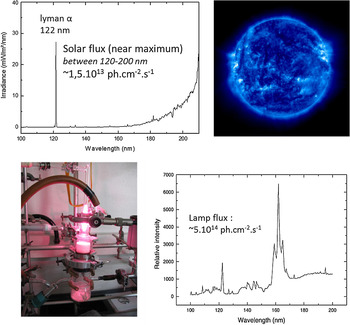
For this reason, laboratory studies of the photolysis of organic compounds related to astrophysical environments are common with various kinds of UV sources specifically in the vacuum ultraviolet (VUV) domain (100 < λ < 200 nm). Either monochromatic (e.g. H2/He lamps (122 nm), Xe (147 nm) and CH4/He (193 nm) (Cottin et al. Reference Cottin, Gazeau, Doussin and Raulin2000)), or providing a wider range of UV (e.g. H2 lamps (122 and 160 nm) (Cottin et al. Reference Cottin, Moore and Bénilan2003), deuterium discharge lamp (190–400 nm) (Ten Kate et al. Reference Ten Kate, Garry, Peeters, Quinn, Foing and Ehrenfreund2005), high-pressure xenon lamps (190–400 nm) (Poch et al. Reference Poch, Noblet, Stalport, Correia, Grand, Szopa and Coll2013)), or actually attempting to simulate the Solar radiation with a combination of several sources (Cook et al. Reference Cook, Mattioda, Quinn, Ricco, Ehrenfreund, Bramall, Minelli, Quigley, Walker and Walker2014), no synthetic source reproduces faithfully the solar radiation below 200 nm (Fig. 1). Therefore results obtained in the laboratory are extremely difficult to extrapolate to extraterrestrial environments. A comparison between photolysis kinetics measured in the laboratory and in low-Earth orbit has shown that extrapolation of data acquired in the laboratory to space environment may result in significant errors (a factor of 10 or >100 between measurements in space and extrapolations of laboratory results to space conditions) (Guan et al. Reference Guan, Fray, Coll, Macari, Raulin, Chaput and Cottin2010).
Comparison of the Solar spectrum between 100 and 200 nm (Thuillier et al. Reference Thuillier, Floyd, Woods, Cebula, Hisenrath, Herse, Labs, Pap and Fox2004a) (up) with a typical laboratory UV lamps (H2) (Cottin et al. Reference Cottin, Moore and Bénilan2003) (bottom). To date, no laboratory lamp is able to accurately simulate the Solar spectrum in the VUV.

On the other hand, kinetics for photolysis could be estimated from laboratory measurements if the absorption cross-section spectra in the VUV of each molecule of interest were measured (Saiagh et al. Reference Saiagh, Cloix, Fray and Cottin2014), as well as the quantum yields of their destruction at each wavelength. This last measurement is especially difficult and requires monochromatic sources with well-constrained fluxes (such as synchrotron sources), and simplistic assumptions have often to be made due to the lack of data (yields being either set as equal to 1 or 0 while it has been shown, when data are available, that it is not true (see for instance Gans et al. (Reference Gans, Peng, Carrasco, Gauyacq, Lebonnois and Pernot2013) for a discussion about methane)). Subsequently both results (VUV spectra and quantum yields) have to be convoluted and scaled to the Solar spectrum. UV light reaching low-Earth orbit (at the altitude of the Interstellar Space Station) is unfiltered. Therefore, with experiments conducted in space, many samples (hundreds) can be exposed simultaneously, measurement is direct across the real Solar UV spectrum, and the kinetics can be easily extrapolated to various astrophysical environments and are extremely accurate for the Solar System.
Moreover, the simulation of cosmic particles in addition to UV photons requires additional tools (ion and electron guns, particles accelerators) and increases the complexity of ground experiments. Therefore, space is a unique laboratory allowing the exposure of many samples simultaneously to all space parameters as well as the irradiation of the samples under identical conditions. Although the International Space Station (ISS) altitude, well beyond the radiation belts, is not optimized for Solar and cosmic particles, this is a first step towards higher altitude exposure facilities we hope to use in the future.
AMINO is an astrochemistry/astrobiology experiment, which was part of the EXPOSE-R facility (Rabbow et al. This issue). Samples were prepared at participating laboratories in July 2008, and were exposed outside the ISS from March 2009 until January 2011. With the ORGANIC experiment (PI: P. Ehrenfreund (Bryson et al. This issue)), AMINO is one of the two experiments related to chemistry and evolution of carbonaceous matter in astrophysical environment. Although ORGANIC is related to polycyclic aromatic hydrocarbons (PAHs) and fullerene-type molecules in the context of the study of the chemistry in the interstellar medium, the AMINO experiment is addressing other science themes and other environments: small bodies (carbonaceous asteroids & comets), the atmosphere of Titan, and RNA world hypothesis on the primitive Earth. The goal of this paper is to give a general overview of the AMINO experiment: hardware development and improvements compared with previous similar experiments in low-Earth orbit, sample preparation and configuration. Since AMINO is divided in three main science subjects, detailed results and their discussion are reported in the specific papers: Bertrand et al. (This issue) for results related to the stability of amino acids in meteorites and small bodies of the Solar System, Carrasco et al. (This issue) for gas-phase photochemistry of CH4 related to the atmosphere of Titan, and Vergne et al. (This issue) for the stability of RNA molecules at the surface of the primitive Earth or other planets not protected from energetic UV (by an ozone layer for instance). The AMINO experiment is part of a series of similar projects that have taken place in recent years in low-Earth orbit. Those projects are presented in the next section of this paper. Then the hardware (emphasizing the new closed and tight closed cells for gas-phase studies), experimental configuration, sample preparation and analysis are discussed. Environmental conditions during the exposure are then described before details on the selected sample are given.
Previous exposure program in space (completed, in operation)
Completed
AMINO is a new step of a series of experiments already implemented in space. The first ones were mainly devoted to the exposure of amino acids to space conditions.
-
• DUST experiment on BIOPAN-1 in 1994: (Barbier et al. Reference Barbier, Chabin, Chaput and Brack1998), DUST experiment on BIOPAN-2 in 1997: (Barbier et al. Reference Barbier, Henin, Boillot, Chabin, Chaput and Brack2002) and PERSEUS-EXOBIOLOGIE experiment on MIR in 1999: (Boillot et al. Reference Boillot, Chabin, Buré, Venet, Belsky, Bertrand-Urbaniak, Delmas, Brack and Barbier2002).
These experiments have shown that amino acids are readily destroyed in space unless they are protected in a mineral matrix.
More recently, three experiments have flown and were safely returned to the Earth:
-
• The ORGANICS experiment (PI: P. Ehrenfreund) on BIOPAN-5 in 2005 (Ehrenfreund et al. Reference Ehrenfreund, Ruiterkamp, Peeters, Foing, Salama and Martins2007) has confirmed that PAH molecules are very stable compounds in space. However, the fluence that was collected during the Foton capsule flight (15 days) was not sufficient to measure any photodestruction and derive any quantitative kinetics data.
-
• The UVolution experiment (PI: H. Cottin) on BIOPAN-6 in 2007 (14 days in orbit and about 30 h of direct sun exposure) successfully tested the exposure of gas mixtures in space in closed cells for short durations and compared the kinetics of photolysis in space and in the laboratory for the solid-state samples related to comets and Mars. The results have shown that the current extrapolation procedures of laboratory simulations to space conditions (typically by taking into account only the influence of the Lyman α line at 122 nm) are extremely hazardous and can lead to errors of a factor 100 on the kinetics for some molecules (Guan et al. Reference Guan, Fray, Coll, Macari, Raulin, Chaput and Cottin2010). The case of Martian simulations is more favourable, showing that the lamps simulating the UV flux reaching the surface of Mars (λ > 190 nm) are more acceptable than in the case of unfiltered flux. However, there still remains a factor of 2–13 between space and laboratory results depending on the molecule (Stalport et al. Reference Stalport, Guan, Coll, Szopa, Macari, Raulin, Chaput and Cottin2010a). Interestingly, UVolution results have shown that the photolysis of organic molecules is activated by the presence of a mineral analogue of Martian soil. Stability of carbonates has also been studied, but the duration of the exposure was too low to be significant (Stalport et al. Reference Stalport, Guan, Noblet, Coll, Szopa, Macari, Person, Raulin, Chaput and Cottin2010b).
-
• PROCESS (PI: H. Cottin) was part of the payload of EXPOSE-E on the EUTEF facility from February 2008 until September 2009 (1.5 year in space and ~1500 h of direct Sun exposure). Samples exposed in PROCESS were in the solid or in the gaseous phase. Open and closed cells were used. A total of 40 samples were exposed to space in PROCESS. Measurements regarding the photostability of amino and carboxylic acids were conducted, and lifetimes calculated (Bertrand et al. Reference Bertrand, Chabin, Brack, Cottin, Chaput and Westall2012; Noblet et al. Reference Noblet2012). The exposure cells designed for gaseous samples, suitable for short-duration exposure missions such as UVolution, were not tight enough to ensure that the mixtures did not significantly leak into space (Cottin et al. Reference Cottin2012). This aspect was significantly improved for the AMINO experiment.
In operation
One experiment is currently ready for launch and shipment to the ISS at the time of the writing of this paper.
-
• PSS (Photochemistry on the Space Station) (PI: H. Cottin) is a part of the EXPOSE-R2 facility. This is a new use of the EXPOSE-R facility, with new exposure trays. Hardware has been optimized in order to accommodate more samples (25 samples per sample carriers compared with 20 for PROCESS and AMINO) and the new kind of samples. The team has become international and the science subjects have broadened: meteorites, comets, Mars, Titan, interstellar medium and also the stability of biochips sensors is tested versus space environmental parameters (launch, temperature, radiations other than UV) (Vigier et al. Reference Vigier, Le Postollec, Coussot, Chaput, Cottin, Berger, Incerti, Triqueneaux, Dobrijevic and Vandenabeele-Trambouze2013).
Experimental
EXPOSE, open and closed cells
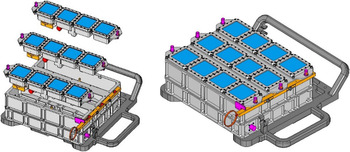
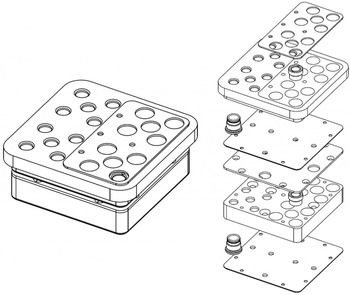
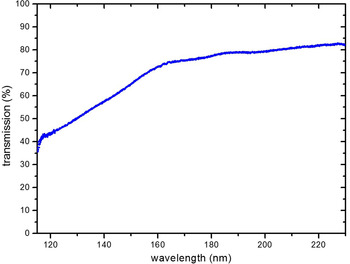
The EXPOSE-R facility is shown in Fig. 2. Three experiment trays are equipped with four squared sample carriers (see Rabbow et al. (This issue) for more details). Sample carriers for experiments related to astrochemistry can contain 20 sample cells (Fig. 3) with MgF2 windows allowing the transmission of UV photons down to 115 nm (Fig. 4). MgF2 is a material with a good transmission of photons up to 10 μm in the IR, which enables analysis of the sample by transmission by IR technics. AMINO samples were distributed on two sample carriers (half of carrier 1 (C1) and the whole carrier 2 (C2)) on the tray number 1 of EXPOSE-R.
The EXPOSE-R facility (480 × 520 × 327.5 mm3) is made of three experiment trays into which four square sample carriers (77 × 77 × 26 mm) are fitted (Figure 3). Pictures courtesy of RUAG/Kayser-Threde GmbH.

Sample carrier for AMINO (77 × 77 × 26 mm3) was designed to receive 20 exposure cells. They can accommodate open cells (from bottom of the exposure plates) or closed cells (from top of the exposure plates). Two layers of samples are flown at the same time: one layer exposed to space, and one layer right below acting as a flight control layer. The second AMINO sample carrier (not shown) was accommodating only open cells Pictures courtesy of RUAG/Kayser-Threde GmbH.

Transmission of MgF2 windows used for AMINO cells. The mean of spectra for four windows measured between 110 and 230 nm with a Horiba-Jobin Yvon VUV spectrometer is shown (more details on this instrument in Saiagh et al. (Reference Saiagh, Cloix, Fray and Cottin2014)). It must be noted that MgF2 is transparent up to 10 μm (1000 cm−1) in the IR (not shown).

Amino samples were accommodated in two kinds of exposure cells. In open cells only samples in the solid phase can be accommodated and gaseous photoproducts (if any) are passively pumped out towards the outer space through venting lines. In closed cells, gaseous mixtures can be exposed, or solid with the intent to keep any gaseous photoproduct for analysis after return to Earth.
Open cells
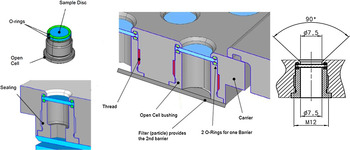
Open cells used in the PSS experiment on EXPOSE-R2 are shown in Fig. 5. Both configurations can be used for P.S.S. Samples are deposited on the inner side of the MgF2window. Such cells are used for pure kinetics studies of solid organic compounds. Gaseous photoproducts cannot be analysed because they are passively vented to space. This effect is beneficial for accurate kinetics measurements because the residual gases cannot interact with the sample as it would be the case in a closed cell.
When open cells are used, samples are deposited on an MgF2 disc, which is accommodated in a sample carrier and held by a bushing screwed from below the sample carrier. The organic sample is deposited onto the inside face of the window. Picture courtesy of RUAG/Kayser-Threde GmbH.

Closed cells
Closed cells can be used either to study the photolysis of a gaseous mixture (simulation of an atmosphere) or to collect the photodissociation products of a solid molecule, in addition to results derived from exposition in open cells.
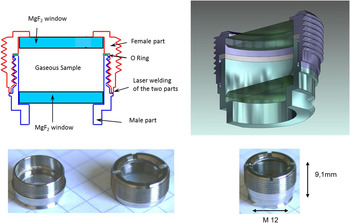
Closed cells were used in UVolution and PROCESS experiments, and will also soon be used in PSS (Fig. 6). Although the concept is the same since 2007, the manufacturing process has drastically changed since their first use in UVolution and PROCESS. The first generation of closed cells was made of two aluminium cylinders which were screwed one into the other. A MgF2 window was glued at each end of the cell. Tightness was ensured by a Viton O-ring between the two parts (Cottin et al. Reference Cottin2008). It has been shown that, although the level of vacuum-tightness is sufficient for short-duration experiments such as UVolution (14 days in space, and roughly 1 month between the preparation of the samples, and their analysis after return), it is not enough for long-duration experiments such as the ones conducted outside of the space station. Some of the PROCESS closed cells were empty when they returned to Earth (Cottin et al. Reference Cottin2012).
AMINO closed cells. Two stainless steel cylinders are screwed into each other in a controlled atmosphere with the composition intended to be the actual gaseous sample. Two MgF2 are brazed at both ends to allow photolysis in the VUV–UV and the analysis of molecules inside the cell by spectroscopy. Sealing (relative to laboratory atmosphere or vacuum in space) is ensured by a Viton O-ring and laser welding.

A new generation of closed cells has been manufactured for AMINO, under the supervision Air Liquide (DTA Grenoble, France). This time the body of the cell is made of stainless steel, the windows are brazed and the vacuum-tightness between the two parts of the cells is ensured by laser soldering. In each cell, a small amount of He (~10%) is added to the sample, in order to check the sealing with a He leak detector. Before soldering, the leak level is about 10−7 mb L s−1. After soldering, the leak level is below 10−9 mb L s−1, compatible with long-duration experiments in orbit (loss <10% for 2 years in space).
Sample preparation
Solid samples can be prepared in a vacuum sublimation system, similar to the one described in Ten Kate et al. (Reference Ten Kate, Garry, Peeters, Quinn, Foing and Ehrenfreund2005) and Guan et al. (Reference Guan, Fray, Coll, Macari, Raulin, Chaput and Cottin2010). The thickness of the deposit can be monitored by interferometry (Guan et al. Reference Guan, Fray, Coll, Macari, Raulin, Chaput and Cottin2010). For AMINO, it is usually set between 100 and 250 nm. When AMINO samples were prepared in 2008, due to the lack of transmission data in the VUV domain for the samples selected, it was thought that those samples would be thin enough to enable homogeneous photolysis over their entire thickness. First-order kinetics parameterization would then be sufficient to derive kinetics constants. However, after acquisition in 2009 of new instrumentation at LISA enabling quantitative transmission measurement in the VUV range, it has been shown that such thicknesses are not compatible with a first-order kinetics approximation and that further radiative transfer modelling has to be taken into account to measure the photolysis rate (Saiagh et al. Reference Saiagh, Cloix, Fray and Cottin2014; Saiagh et al. Submitted).
Solid samples that cannot be sublimated prior to being thermodegraded are deposited using an evaporative method. This involves firstly either dissolving the sample or dispersing the molecule as a powder throughout a solvent to prepare a suspension by mechanical agitation and then depositing this solution in the cell. Finally, the sample is obtained after the total evaporation (vacuum evaporation) of the solvent. This method is described in Boillot et al. (Reference Boillot, Chabin, Buré, Venet, Belsky, Bertrand-Urbaniak, Delmas, Brack and Barbier2002) and Bertrand et al. (Reference Bertrand, Chabin, Brack, Cottin, Chaput and Westall2012).
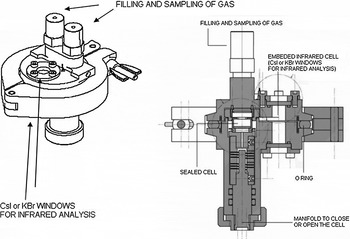
Gaseous samples are prepared in an ‘analytical cell’ such as the one shown in Fig. 7. Although called ‘analytical’, it is used for both filling and sampling the sealed cells with gas, and for IR analysis of the gaseous content of the sealed cells. It consists of two main stainless steel parts on the inside of which both parts of a CNES closed cell are separately fitted. The two analytical cell parts are adjusted one opposite the other. The gaseous sample for the experiment can then be introduced inside the analytical cell before screwing the two parts of the closed cell one into the other, using a screw connecting one part of the cell to the outside of the analytical cell, thus enclosing the gases inside the closed cell. The closed cell can then be removed from the analytical cell, subsequently soldered by laser, and placed onto a sample holder for the experiment in space.
Design of the analytical cell. It allows the filling or sampling of gases inside a sealed cell which can be fitted inside the holder. An embedded IR cell can be used for the analysis of gases in the IR range. Picture courtesy of COMAT aerospace.

Sample exposure principle
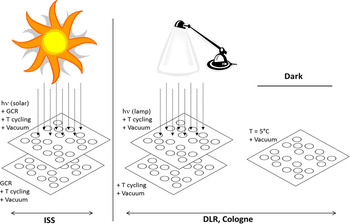
For each kind of sample (molecule, mixture, etc.), the following pattern is applied: two cells are completely exposed (first layer on the left side of Fig. 8, exposed to the influence of UV, cosmic rays, temperature, vacuum), two cells act as flight dark controls (second layer on the left side of Fig. 8, exposed to the influence of transmitted cosmic rays, temperature, vacuum). On the ground at DLR Cologne (Germany) a similar set with two layers of sample cells is stored in a vacuum facility on the ground, the upper layer being photolysed by a ground solar simulator (λ > 190 nm) and the lower layer being kept in the dark. This experimental set has been submitted to a temperature history similar to the samples in space (transmitted via telemetry for study of the influence of temperature and vacuum). An additional layer of samples was stored in a vacuum facility on the ground at 5 °C (to study the influence of vacuum only).
Scheme showing the experimental breakdown of samples on the ISS and at DLR Cologne. The environmental conditions to which they are exposed are shown. A total of 30 samples have been exposed to the Sun directly in LEO, with 30 dark controls directly below them (left). The same disposition has been reproduced in an irradiation chamber at DLR Cologne, with an additional series of samples that has been kept in vacuum, in the dark, at 5 °C.

Sample analysis
Samples can be analysed by IR spectroscopy before launch and after retrieval. From the difference between spectra measured before and after flight, the photochemical reactivity of the samples can be characterized. Additionally, gas chromatography–mass spectroscopy (GC–MS) analysis can also be conducted for the closed cells to identify photoproducts and fragments that cannot be unambiguously determined via optical spectroscopy. Further measurements have been conducted on the specific samples: high-resolution mass spectrometry for amino acids (Bertrand et al. This issue) and electrophoresis for RNA (Vergne et al. This issue). Additional laboratory experiments can include ground control sample exposure to a UV H2-discharge lamp illumination to provide short-wavelength, high-energy UV radiation that simulates interplanetary and interstellar conditions.
After processing of the measurements, it is possible to calculate the photochemical lifetime of the molecule at 1 AU, which can subsequently be extrapolated at other heliocentric distances and other astrophysical environments (diffuse interstellar medium, dark clouds) (see for instance Guan et al. (Reference Guan, Fray, Coll, Macari, Raulin, Chaput and Cottin2010)).
Experiment environmental parameters
Photons
AMINO samples have been exposed to the space environment from the extra vehicular activity (EVA) 21a on March 10th 2009, to EVA 27 January 28th 2011, i.e. during 682 days (1 year and 10 months) (more detail in Rabbow et al. (This issue)). They were not always facing the Sun because the ISS is orbiting around the Earth, and is adopting various orientations relative to the Sun. In addition, multiple shadows can be casted by the Solar panels, radiators and the local environment in the vicinity of EXPOSE-R on the Russian Zvezda module. The geometry of the ISS and location of EXPOSE-R have been reconstructed and the insulation on the EXPOSE-R have been modelled with a three-dimensional (3D) model taking into account the orbital parameters of the ISS and the position of its fixed and mobile elements (including Solar panels orientation and logs of the docking of spaceships). Results from those simulations, adjusted with measurements from sensors embedded in the EXPOSE-R facility, indicate that the samples on carriers 1 and 2 of tray 1, with the AMINO samples, have been exposed to 2946 and 2934 h respectively of equivalent perpendicular Solar irradiation at 1 AU Solar distance (Beuselinck & Bavinchove Reference Beuselinck and Bavinchove2011). The EXPOSE-R platform has been much more homogeneously irradiated than EXPOSE-E (variation of about 0.5% of total irradiation between all the AMINO samples on EXPOSE-R, and about 50% between all the PROCESS samples on EXPOSE-E), and 60% more efficiently oriented towards the Sun (~80 h month−1 of equivalent perpendicular Solar irradiation for PROCESS on EXPOSE-E versus 130 h/month for AMINO on EXPOSE-R). This exposure duration is equivalent to a total dose (100–1 mm) of 13.5 × 10⁹ and 13.2 × 10⁹ J m−2 received at the top surface of sample carriers 1 and 2, respectively, including a UV dose (100–400 nm) of 1.04 × 10³ and 1.02 × 10³ MJ m−2 estimated at the sample site of carriers 1 and 2, respectively (exposure time and doses estimated with ±2.2%) (Beuselinck & Bavinchove Reference Beuselinck and Bavinchove2011). About 77% of the dose reached to the samples below the MgF2 windows.
Particles
The energetic particle environment was measured by the R3D-R experiment, which was part of the EXPOSE-R payload (Dachev et al. This issue). The average dose of particles was calculated to 81.4 μGy day−1 for Galactic Cosmic Rays (GCR), 506 μGy day−1 for South Atlantic Anomaly (SAA) protons, and 89 μGy day−1 for Outer Radiation Belt (ORB) electrons, which results in a total of 676.4 μGy day−1. The R3D-R was only measuring particles that reached the top surface of EXPOSE-R, behind a shielding of 0.4 g cm−2, which comes very close to the shielding of the flight exposed samples of AMINO (0.31 g cm−2). This resulted in a total dose deposited onto our exposed samples that was estimated to have been 68 mGy from GCR (833 days of exposure from lift-off to landing, since GCR are sufficiently energetic to pass through the structure of the Progress capsule, the ISS and Space Shuttle), 345 mGy from SAA protons (682 days of external exposure, from 10 March 2009 till 21 January 2011) and 61 mGy from ORB electrons (also 682 days of exposure), which resulted in a total of 474 mGy (=equal to approximately half a Gray = half of a Joule per kg). For the dark flight controls, the shielding was between 1.11 and 1.21 g cm−2. No measurements were made by the R3D-R at that shielding depth. It can then only be assumed that the dark flight samples were shielded against the ORB electrons, not at all against GCR, and partly against the SAA protons. Therefore because the largest contribution to the dose was made by the SAA protons, we cannot calculate a value for the dose received by the dark flight samples, not even an estimated number. However, the comparison of results measured on the different layers of samples does not reveal any distinguishable contribution of energetic particles to the evolution of our samples.
Temperature
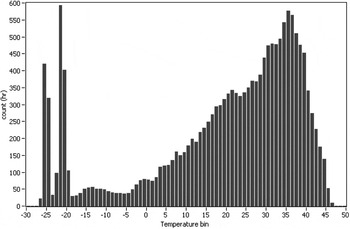
Temperature of the EXPOSE-R structure was both measured by sensors on the facility, and modelled. Thermal modelling of the structure concluded that temperature of the exposed and control flight samples are not significantly different. Owing to some hardware failure, a significant part of the thermal history of EXPOSE-R in space is only known by the modelling (Rabbow et al. This issue). However, those numbers are extremely consistent when both sets of data are available, which make us think that the modelling is quite reliable. The average temperature of the EXPOSE-R trays close to the samples is of 19 °C, with extreme temperatures equal to −27 and 46 °C (Beuselinck & Bavinchove Reference Beuselinck and Bavinchove2011) (Fig. 9). Although temperatures were higher than 0 °C for most of the EXPOSE-R mission, 285 freeze–thaw cycles were identified, including 11 freeze periods with a duration longer than the 90 min orbital period. Those modelling numbers have been used for the ground simulation.
Temperature of the EXPOSE-R trays histogram during the exposure. (Figure from REDSHIFT company, (Beuselinck & Bavinchove Reference Beuselinck and Bavinchove2011)).

Contamination
After the space exposure of EXPOSE-R samples, it has been observed that a change of colour (brownish compared with transparent clear before flight) occurred on most of the optical parts of the facility. Post-flight investigations revealed that the coloration is due to a film of organic material at the inside of the exposure windows. It is highly probable that volatile compounds originating from the interior of the EXPOSE-R facility have been photolysed by Solar irradiation and fixed at the rear side of the windows. The origin of the volatiles is not fully identified; most probably there is a significant number of sources involved, including the biological test samples, adhesives, plastics and other constitutive materials from the facility. Only a minor alteration was observed on the outer surface of the windows (pointing into space). AMINO, as well as the other EXPOSE-R experiments, are disturbed by this contamination issue. Only open cells however are affected, since the closed cells are in compartments that are not linked to the inside of the facility and then cannot be reached by contamination. A detailed analysis and discussion about this issue is given in Demets et al. (This issue). For the AMINO open cell samples, the contamination material is added at the bottom of the organic samples deposited on the inner surface of the MgF2 windows and is interfering with the photochemical processes and the interpretation of the samples. It is not known if the contamination has been released continuously throughout the exposure, or during a limited number of events (for instance, outgassing only at the beginning of the experiment). Therefore, the science return for some of the samples in open cells might then have been affected by this issue, and mitigation procedures, like outgassing of the facility with samples in space during a few weeks, before the actual exposure period (removal of a cover above EXPOSE-R2) have been adopted for next use of the facility (mid-2014–2015: EXPOSE-R2).
Samples
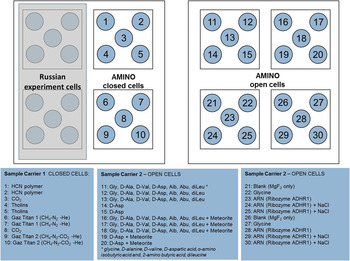
Samples (Fig. 10) have been selected in order to cover the various science subjects of the proposing AMINO science team. For the science related to the small bodies of the Solar System (carbonaceous asteroids, and related carbonaceous chondritic meteorites, comets and related micrometeorites), a selection of amino acids and a dipeptide (glycine, D-alanine, D-valine, D-aspartic acid, α-amino isobutyric acid and 2-amino butyric acid and di-leucine) were exposed as a mixture, or in the pure form in the case of glycine and D-aspartic acid. Some samples with those amino acids have been exposed embedded in meteoritic powder. They were chosen to study the photostability sensitivity of the molecules to the alkyl chain length (glycine, alanine, 2-amino butyric acid), the substitution on the α-carbon (alanine, 2-aminoisobutyric acid) or β-carbon (valine), the stability of the functional group (aspartic acid) or the amide bond (for the dipeptide). Results and discussion for this set of samples are reported in Bertrand et al. (This issue). Samples related to the study of the photochemistry of Titan were also selected for the study of both the solid and the gaseous phase. For the solid phase, tholins and HCN polymers have been selected as proxies for the organic aerosol haze in Titan's atmosphere. Owing to the limited amount of exposed samples, the results related to those samples will be discussed and compared as full set of samples including EXPOSE-E, EXPOSE-R and the forthcoming EXPOSE-R2 samples, and therefore are not included in this set of papers related to AMINO. Titan's gaseous samples in closed cells are made of a mixture of N2–CH4–He and N2–CH4–CO2–He. The hardware have proven to be tight enough to recover most of the sample after the 22 months in space, and almost 3 years after the actual preparation of the samples at LISA and the recovery in the laboratory for the analysis. A discussion of the results is given in Carrasco et al. (This issue). The formation of a thin film of tholins on the window of the cell, from the photochemistry of methane, is reported. RNA samples have also been exposed to study their stability towards UV photons at the surface of a planet not protected from energetic photons by its atmosphere. The stability of those samples is presented in Vergne et al. (This issue). Two closed cells with CO2 were also exposed to be used as chemical actinometers (measurements of the UV flux from a known photochemical modelling of the chemistry of CO2) (Kuhn et al. Reference Kuhn, Braslavsky and Schmidt1989). For these samples, again, due to the limited amount of cells with CO2, discussion of results will be combined for comparison with samples from the forthcoming PSS experiment in which another actinometer is used: N2O.
List and locations of the samples selected for the AMINO experiment. 1.5 sample carriers have been allocated to AMINO samples, i.e. 30 samples on the exposed layer in space (+flight and ground controls).

It must be noted that samples of AMINO have been selected and prepared in July 2008, before the samples of the EXPOSE-E PROCESS experiment were returned to Earth and distributed for analysis in participating laboratories (October 2009). Therefore no lesson-learned between the two experiments for sample selection has been possible.
Conclusion
Recent hardware improvements have broadened the possibilities for astrochemistry and astrobiology studies in the Earth Orbit. Since the 1990s and the pioneering experiments lead by A. Brack and B. Barbier at Centre de Biophysique Moléculaire (CNRS, Orléans, France) (Barbier et al. Reference Barbier, Chabin, Chaput and Brack1998), the possibilities to expose a large variety of organic samples, with the intent to measure quantitative kinetics data about the photostability of organic molecules have been enhanced. With the AMINO experiment, a significant step has been made demonstrating the capabilities to conduct long-duration quantitative experiments on samples in the gaseous phase. A new experiment called PSS has been selected and prepared since AMINO returned to Earth. New upgrades on the hardware have been implemented compared to AMINO (more samples exposed per sample carrier, new configurations for closed cells with the enclosure of filters to simulate the transmission of UV through the atmosphere of Mars). The PSS experiment should be launched in July 2014 for the ISS, and returned to Earth late 2015/early 2016.
Space exposure experiments however still suffer limitations that are restraining their science return. Passive exposure platform such as EXPOSE do not allow direct in situ measurements of the evolution of the samples. This is a severe limitation for accurate kinetics studies. New generation platforms such as the O/OREOS NASA nanosat (Mattioda et al. Reference Mattioda2012; Ehrenfreund et al. Reference Ehrenfreund2014) and the forthcoming Oreocube platform outside the ISS (Elsaesser et al. Reference Elsaesser2014) allow in situ measurement in the UV–vis domain. New capabilities for exposure platform are currently under studies with the possibilities of in situ IR diagnostics. This would be the next step to achieve a significant improvement in exposure facilities. Enabling the exposure of samples as ice mixtures would also be a major feature to be implemented in space. Indeed, organic chemistry in the outer Solar System (surface of the icy satellites, comets), and dense molecular clouds occurs in the condensed phase at low temperature (<100 K). Moreover, experiments conducted in the low-Earth orbit are protected from most of the galactic cosmic rays and Solar wind radiations because of the Earth radiation belt. More realistic studies of the chemical evolution in extraterrestrial environment would then require other orbits, either with higher inclination regarding the Earth plane (polar orbit) or higher altitude (geocentric transfert orbit). Astrochemistry and astrobiology orbit exposure facilities are making step-by-step improvements towards more sophisticated systems enabling the most accurate measurements on the evolution of organic matter in space, but great challenges are still ahead of us to get the most suitable exposure platforms.
Acknowledgements
This study was supported by the Centre National d'Etudes Spatiales (CNES). It is based on observations with the AMINO experiment embarked on the EXPOSE-R ESA facility. The authors would like to acknowledge the support of Michel Viso from CNES for the human, financial, and technical support; ESA, DLR Cologne (Elke Rabbow and Corinna Panitz); Air Liquide DTA Grenoble (Sébastien Triqueneaux), RUAG, Kayser-Threde and RedShift companies. IPSL is also acknowledged for funding. Special thanks to Léna Le Roy and Audrey Noblet for their help during the last rush for sample preparation in 2008.