Bell pepper and tomato are important vegetable crops in the United States, with an annual market value of $806 and $1,243 million, respectively (USDA 2016). Tomato (fresh market) and bell pepper (fresh market plus processing) are grown on over 39,400 and 18,130 ha, respectively, in the United States (USDA 2016). North Carolina farmers produce approximately 4% of the US production of fresh market tomato and bell pepper (USDA 2016). Fresh market tomato and bell peppers may be cultivated in a plasticulture production systems. Plasticulture production involves the placement of polyethylene mulch over raised beds and the use of drip irrigation (Lament Reference Lament1993). The use of plastic mulch has numerous advantages over bare-ground cultivation, including reduced weed emergence, increased yield, earlier harvest, conservation of moisture, and increased early season soil temperature (Dodds et al. Reference Dodds, Madramootoo, Janik, Fava and Stewart2003; Lament Reference Lament1993). The beneficial growing environment created by polyethylene mulch also provides a suitable environment for weed seed germination. The main weed species present in tomato and bell pepper include grasses of the genera Digitaria and Eleusine, and broadleaved weeds of the genera Amaranthus and Portulaca (Webster Reference Webster2010). These weeds usually grow in row middles and through planting holes in plastic mulch. In contrast, weed species such as yellow nutsedge and purple nutsedge (Cyperus rotundus L.) are capable of penetrating polyethylene mulch once a suitable habitat is provided for growth (Gilreath and Santos Reference Gilreath and Santos2004; Santos et al. Reference Santos, Gilreath, Esmel and Siham2007).
Common purslane is ranked the sixth and fourth most troublesome weed in bell pepper and tomato production, respectively (Webster Reference Webster2010). Common purslane is difficult to control because a single plant can produce over 240,000 seeds over the course of the season under favorable growing conditions (Haar and Fennimore Reference Haar and Fennimore2003). Seed germination can be immediate, allowing for multiple generations over the course of a season. Furthermore, purslane has the ability to propagate from cuttings and pieces remaining after plant removal, which makes it more difficult to manage (Proctor et al. Reference Proctor, Gaussoin and Reicher2011). Yield loss in vegetable crops from season-long interference by common purslane is significant (Santos et al. Reference Santos, Dusky, Stall, Bewick and Shilling2004; Vengris and Stacewicz-Sapuncakis Reference Vengris and Stacewicz-Sapuncakis1971). Season-long interference from common purslane reduced table beet (Beta vulgaris L.) and snap bean (Phaseolus vulgaris L.) yield by 85% and 21%, respectively (Vengris and Stacewicz-Sapuncakis Reference Vengris and Stacewicz-Sapuncakis1971). Common purslane reduced sugarbeet yield 20% to 90% as common purslane density increased from 1 to 100 plants per meter of crop row (Norris Reference Norris1997).
Yellow nutsedge is reported to be the first and sixth most troublesome weed present in bell pepper and tomato production, respectively, in North Carolina (Webster Reference Webster2010). Yellow nutsedge can penetrate polyethylene mulch and can propagate through tubers (Webster Reference Webster2005). Morales-Payan et al. (Reference Morales-Payan, Stall, Shilling, Dusky, Bewick and Charudattan2003b) reported that season-long yellow nutsedge interference at densities of 100 plants m−2 reduced marketable tomato yield up to 65%. In bell pepper, yellow nutsedge inference at a density of 1.5 and 40 plants m−2 reduced yield 57% and 70%, respectively (Motis et al. Reference Motis, Locascio and Gilreath2004; Santos et al. Reference Santos, Gilreath, Esmel and Siham2007). Morales-Payan et al. (2003a) concluded that yellow nutsedge interference above and below the ground cause equal reduction in tomato shoot dry weight. Thus, for effective control of yellow nutsedge, a management plan must address nutsedge shoot growth and subterranean (tuber) growth.
Methyl bromide (MeBr) was the industry standard for control of soil-borne fungi, nematodes, insects, and weeds in tomato and pepper. However, MeBr has been linked to ozone depletion, and its use in agriculture has been banned, as mandated by the US Clean Air Act and the Montreal Protocol on Ozone Depleting Substances (USEPA 2005). Numerous attempts have been made to find an effective alternative to MeBr. However, thus far an alternative treatment with comparable efficacy as a broad spectrum soil fumigant has not been found (Bangarwa et al. Reference Bangarwa, Norsworthy and Gbur2009a, Reference Bangarwa, Norsworthy and Gbur2009b; Norsworthy et al. Reference Norsworthy, Malik, Jha and Oliveira2006). Numerous studies have looked at comprehensive pest and weed control strategies using alternative soil fumigants, PRE and POST herbicide applications, and the allelopathic properties of the Brassicaceae plant family (Bangarwa et al. Reference Bangarwa, Norsworthy and Gbur2009b; Gilreath et al. Reference Gilreath, Noling and Santos2004; Locascio et al. Reference Locascio, Gilreath, Dickson, Kucharek, Jones and Noling1997).
Metam-sodium is a broad-range soil fumigant that can be applied through drip irrigation preplant for control of weeds, insects, and plant-parasitic nematodes and fungi (Ou et al. 2006). The application of pesticides through a drip irrigation system has numerous advantages compared to conventional fumigation and herbicide application strategies. Drip-application decreases applicator exposure in comparison with backpack or tractor-mounted application. By taking advantage of the irrigation system, growers can avoid a tractor or backpack trip across the field for herbicide application (Santos et al. Reference Santos, Gilreath, Lugo and Rivera2008). While metam-sodium itself is not biocidal, it is converted to toxic methyl isothiocyanate (MITC) when placed in moist soil (Ou et al. 2005). The conversion of metam-sodium to MITC is rapid; between 78% and 98% of metam-sodium converts to MITC within 2 to 8 hr after application. MITC has a high affinity for the liquid phase, and its movement through the soil profile is dependent on soil texture, soil moisture, and water flow (Candole et al. Reference Candole, Csinos and Wang2007). MITC coverage and residence time in the soil profile greatly impact the extent of weed and pest control that it provides. Candole et al. (Reference Candole, Csinos and Wang2007) showed that metam-sodium at 150 kg ai ha−1 caused 58% to 100% mortality in yellow nutsedge tubers located within 20 cm of the drip tape emitters. However, in sandy soils yellow nutsedge mortality decreased as distance from the drip tape emitter increased (Candole et al. Reference Candole, Csinos and Wang2007). The varied emergence of yellow nutsedge and common purslane, and the short half-life of metam-sodium, may necessitate use of a residual herbicide to achieve the level of control provided by MeBr.
S-metolachlor is a seedling root inhibitor with residual activity and a proven ability to control yellow nutsedge. S-metolachlor is efficacious when applied through drip irrigation system (Santos et al. Reference Santos, Gilreath, Lugo and Rivera2008). Drip application of S-metolachlor provided similar control of yellow nutsedge, produced comparable tomato yields, and failed to show any negative growth responses when compared to commercial standard application (Monday et al. Reference Monday, Foshee, Blythe, Wehtje and Gilliam2015). The effectiveness of S-metolachlor for yellow and purple nutsedge was observed in tomato and bell pepper in previous studies (Bangarwa et al. Reference Bangarwa, Norsworthy and Gbur2009a, Reference Bangarwa, Norsworthy and Gbur2009b). An herbicide program utilizing drip-applied metam-sodium followed by (fb) drip-applied S-metolachlor has not been evaluated for weed control in bell pepper and tomato. Therefore, the objective of this study was to determine the effect of drip-applied metam-sodium, alone or followed by drip-applied S-metolachlor, on yellow nutsedge and common purslane in tomato and bell pepper.
Materials and Methods
Field studies were conducted in the summers of 2011 and 2012 at the Mountain Horticultural Crops Research and Extension Center in Mills River, North Carolina (35.43°N, 82.56°W; elevation 631 m). The soil was a Bradson gravelly loam (sandy clay loam, oxidic, mesic Typic Hapludults) with pH 6.5, CEC 5.2 meq per 100 g, and organic matter 3.7%. Raised beds 15 cm high by 76 cm wide at the top were formed on 1.5-m centers at least 4 wk before transplanting. A single drip irrigation tape was laid off center (tomato) or in the center (bell pepper) of each bed, approximately 5 cm below the soil surface. The drip tapes had emitters spaced 30.5 cm apart and delivered 374 L ha−1. To ensure a dense weed population, yellow nutsedge tubers (Azlin Seed Services, 112 Lilac Drive, Leland, MS) were spread on the planting beds at a density of >80 tubers m−2, and a hand rake was used to lightly cover them with soil before the polyethylene mulch was laid. A natural population of common purslane (at least three plants per crop hole) was used in the study. One day before transplanting, planting holes were mechanically punched in the middle of beds, and drip irrigation was started to provide sufficient moisture to support tomato and bell pepper establishment. ‘Amelia’ (2011) and ‘Redline’ (2012) tomato and ‘Aristotle’ bell pepper transplants were hand-transplanted on June 29, 2011 and June 19, 2012. Tomato plots were single rows with six plants spaced 0.6 m apart on a raised bed. Bell pepper plots were double rows with 30 plants and 30-cm in-row and between-row spacing on a raised bed.
The studies were conducted in a randomized complete block design with four replications. Herbicide treatments consisted of weed-free, weedy, S-metolachlor alone at 0.85 kg ha−1, methyl bromide, metam-sodium (43, 86, 176, and 358 kg ai ha−1) alone, and metam-sodium (43, 86, 176, and 358 kg ai ha−1) fb S-metolachlor at 0.85 kg ha−1. Metam-sodium rates were chosen based on previous MeBr-alternative studies and the recommended maximum application rate of 358 kg ai ha−1 (Anonymous 2010; Devkota et al. Reference Devkota, Norwsorthy and Rainey2013; Devkota and Norsworthy Reference Devkota and Norsworthy2014; Gilreath et al. Reference Gilreath, Santos, Motis, Noling and Mirusso2005). Metam-sodium and S-metolachlor were applied preplant 2 wk before and 2 wk after transplanting (WAT), respectively, through drip irrigation. MeBr (50:50 v/v ratio of chloropicrin to MeBr) treatment was applied 4 wk before transplanting. Application timing was based on label recommendation (Anonymous 2010). The drip-applied herbicide treatments were carried out using the method described by Dittmar et al. (Reference Dittmar, Monks and Jennings2012). Metam-sodium and S-metolachlor were applied through the drip irrigation systems to each plot individually using a fertilizer injector tank (EZ-FLO hose and drip system 2.8 L tank, EZ-FLO Fertilizing Systems, 3640 Cincinnati Ave., Buildings C&D, Rocklin, CA) pressurized to 82 kPa. Main line tape was placed across the front of each replication to supply water to each plot. A backflow valve was connected to the main line tape to prevent the herbicide solution from entering the water source. The tank was attached to the main line tape and the drip tape at the front of each plot. In each injector tank, water was mixed with the herbicide solution and 1 to 2 mL spray dye (Highlight spray indicator, Becker Underwood, Inc., Ames, IA) per tank. Herbicide rate calculations were determined for a plot length of 6 m and a bed width of 0.76 m. The transparent output tube attached to injector tank was dark blue in color from the spray dye, and as water from the main line tube displaced the herbicide solution the treatment solution became clear (approximately 45 to 55 min). The tank was then disconnected and moved to the next plot. Weed-free treatment plots were maintained with hand-weeding as needed. Standard cultural practices, including fertigation and insect and disease management, were followed as recommended by the North Carolina Cooperative Extension Service (Kemble 2011).
Plant injury (on a scale with 0% meaning no injury and 100% meaning crop death), weed density, and harvest data were collected each year. Common purslane and yellow nutsedge densities were determined 4, 6, and 15 WAT. In both years, bell pepper was harvested twice and then hand-graded according to the US Department of Agriculture (USDA) grade and standard guidelines (USDA 2005). Bell pepper fruits were graded for US fancy, US No. 1, and US No. 2 categories, and fruit number and weight were recorded for each grade. In both years, tomato was harvested weekly for 4 wk when fruit was red to breaking stage. A mechanical grader was used to separate tomato fruits according to the following USDA diameter grade standards: jumbo (≥8.8 cm), extra large (7.3 to 8.8 cm), large (6.4 to 7.3 cm), medium (5.7 to 6.4 cm), small (5.0 to 5.7 cm), and cull (<5 cm or containing damage or defects). Marketable tomato fruit included medium, large, extra large, and jumbo fruit grades.
PROC MIXED of SAS version 9.2 (SAS Institute, Cary, NC) was used to analyze data, and means were separated using Tukey’s honest significant difference (HSD) test (P≤0.05). All data were checked for homogeneity of variance before statistical analysis by plotting residuals. Data for yellow nutsedge density from bell pepper at 4 and 15 WAT were subjected to square-root transformation. However, to facilitate the interpretation of results, back-transformed means are presented. The weed-free check was not included in the weed density analysis because of the lack of variability in data (0 m–2). Nonlinear regression analysis was applied to the least squares means using SigmaPlot 12.0 (Systat Software, Inc., Chicago, IL) to produce regression graphs. Yellow nutsedge density, common purslane density, marketable yield, and marketable fruit number were regressed against metam-sodium rate in SigmaPlot 12.0 using the quadratic equation:
 $$y\,{\equals}\,a{\plus}{ bx}{\plus}{cx}^{2} $$
Where a, b, and c are constants, x is the metam-sodium rate, and y is the yellow nutsedge density, common purslane density, marketable yield, or marketable fruit number.
Results and Discussion
No injury was observed on either tomato or bell pepper during both years. This was in agreement with previous studies that reported no injury to bell pepper and tomato from metam-sodium applied at 360 kg ha−1 (Devkota et al. Reference Devkota, Norwsorthy and Rainey2013; Devkota and Norsworthy Reference Devkota and Norsworthy2014). The year by treatment interaction was not significant for weed density, fruit number, or yield in either tomato or bell pepper; therefore, data were combined over 2011 and 2012. Yellow nutsedge and common purslane density, fruit number, and yield for all grades were not influenced by the main effect of herbicide program (metam-sodium or metam-sodium fb S-metolachlor at 0.85 kg ha−1) or the interaction of herbicide program and rate (P>0.05) in either bell pepper or tomato, except yellow nutsedge density 15 WAT in bell pepper. Therefore, data were combined over herbicide program for further analysis. After pooling the data over herbicide program, treatments included weedy, weed-free, MeBr, S-metolachlor at 0.85 kg ha−1, and four rates of metam-sodium (43, 86, 176, and 358 kg ai ha−1).
Bell Pepper Weed Control
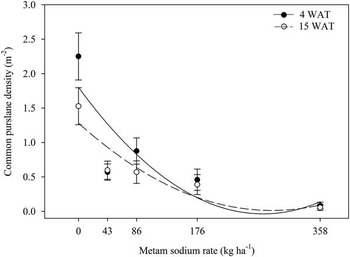
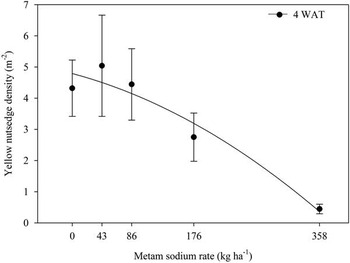
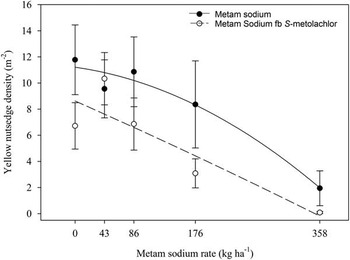
Weeds did not emerge in plots treated with MeBr in either year. The weed density data were combined over herbicide programs, except for yellow nutsedge density at 15 WAT, for which the main effect of herbicide program was significant. The main effect of rate was significant (P<0.0001) for yellow nutsedge and purslane density at 4 and 15 WAT. Purslane density at 4 and 15 WAT displayed a quadratic decrease as metam-sodium rate increased (Figure 1). Similarly, yellow nutsedge density also exhibited a quadratic decrease with increasing metam-sodium rate at 4 and 15 WAT (Figures 2 and 3). At 4 WAT, the addition of S-metolachlor application to the metam-sodium treatments did not impact yellow nutsedge density, which decreased from 4.3 to 0.5 m−2 with metam-sodium rates of 0 to 358 kg ha−1 (Figure 2). However, at 15 WAT, the impact of S-metolachlor application was evident on yellow nutsedge density (Figure 3). A greater decrease in yellow nutsedge density was observed when S-metolachlor was included in the program compared to when metam-sodium was used alone (Figure 3). Yellow nutsedge density decreased from 11.8 to 1.9 and 6.8 to 0.1 plants m−2 as rates increased from 0 to 358 kg ha−1 with metam-sodium alone and metam-sodium fb S-metolachlor, respectively (Figure 3). Metam-sodium at 358 kg ha−1 fb or not fb S-metolachlor, and metam-sodium at 176 kg ha−1 fb S-metolachlor, provided the best season-long yellow nutsedge control. However, in the case of common purslane, the addition of S-metolachlor application after metam-sodium did not improve control. Devkota et al. (Reference Devkota, Norwsorthy and Rainey2013) reported greater than or equal to 87%, 84%, and 83% control of Palmer amaranth (Amaranthus palmeri S. Wats.), large crabgrass [Digitaria sanguinalis (L.) Scop.], and yellow nutsedge, respectively, using metam-sodium at 360 kg ha−1, results comparable to those achieved with MeBr plus chloropicrin at 390 kg ha−1. In same study, the authors observed a lower level of yellow nutsedge control from metam-sodium at ≤270 kg ha−1 than from metam-sodium at 360 kg ha−1. Gilreath et al. (Reference Gilreath, Santos, Motis, Noling and Mirusso2005) also observed that drip-applied metam-sodium at 362 kg ha−1 was comparable to MeBr plus chloropicrin at 400 kg ha−1 for Cyperus spp. control in one of three bell pepper growing seasons. In another study (Gilreath et al. Reference Gilreath, Noling and Santos2004), authors reported ≥85% control of purple nutsedge in bell pepper with the high rate of 483 kg ha−1 metam-sodium.
The influence of metam-sodium rate on common purslane density in bell pepper, combined over metam sodium and metam-sodium followed by S-metolachlor treatments and the years 2011 and 2012 at Mills River, North Carolina. Points are means ±SE. Regression equations are as follows: 4 WATcommon purslane density = 1.8 – 0.013X + 0.00006X 2, R2 = 0.72; 15 WATcommon purslane density = 1.2 – 0.009X – 0.000004X2; R2=0.82; X represents metam-sodium rate. Abbreviation: WAT, weeks after transplanting.

The influence of metam-sodium rate on yellow nutsedge density in bell pepper, combined over metam-sodium and metam-sodium followed by S-metolachlor treatments and the years 2011 and 2012 at Mills River, North Carolina. Points are means ±SE. Regression equation is as follows: 4 WATyellow nutsedge density=4.7 – 0.006X – 0.00004X 2; R2=0.94; X represents metam-sodium rate. Abbreviation: WAT, weeks after transplanting.

The influence of metam-sodium rate on yellow nutsedge density in bell pepper at 15 weeks after transplanting, combined over the years 2011 and 2012 at Mills River, North Carolina. Points are means ±SE. Regression equations are as follows: Yellow nutsedge densitymetam-sodium=11.2 – 0.007X – 0.00001X 2, R2=0.96; Yellow nutsedge densitymetam-sodium fb S-metolachlor=8.6 – 0.023X – 0.000001X 2, R2=0.79; X represents metam-sodium rate. Abbreviation: fb, followed by.

Bell Pepper Fruit Number and Yield
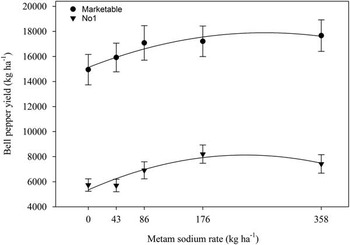
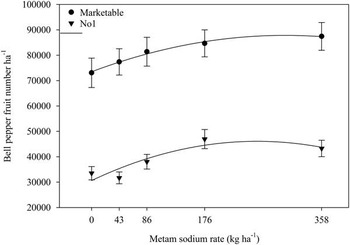
The main effect of rate was significant for No. 1 and marketable fruit number and yield. No. 1 and marketable bell pepper yield and number showed a quadratic increase with increasing metam-sodium rates from 0 to 358 kg ha−1 (Figures 4 and 5). The effect of metam-sodium rate on fancy bell pepper fruit yield and number could not be fit to a regression model (data not shown).
The influence of metam-sodium rate on bell pepper yield, combined over metam-sodium and metam-sodium followed by S-metolachlor treatments and the years 2011 and 2012 at Mills River, North Carolina. Points are means ±SE. Regression equations are as follows: Marketable yield=15123 + 20.4X – 0.037X 2, R2=0.92; No. 1 yield=5345 + 23.1X – 0.047X 2, R2=0.88; X represents metam-sodium rate.

The influence of metam-sodium rate on bell pepper fruit number, combined over metam-sodium and metam-sodium followed by S-metolachlor treatments and the years 2011 and 2012 at Mills River, North Carolina. Points are means ±SE. Regression equations are as follows: Marketable number=73488 + 95.1X – 0.158X 2, R2=0.98; No. 1 number=30613 +120X – 0.233X 2, R2=0.82; X represents metam-sodium rate.

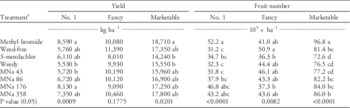
Multiple comparisons among metam sodium rate, S-metolachlor alone, MeBr, weedy, and weed-free treatments revealed significant differences for bell pepper yield (No. 1 and marketable) and number (No. 1, fancy, and marketable) (Table 1). Bell pepper in plots treated with S-metolachlor at 0.85 kg ha−1 and in weedy plots produced lower marketable pepper yield than did bell pepper in plots treated with MeBr (Table 1). Marketable yield from plots that received metam-sodium at 43 to 358 kg ha−1 was not different than that from plots treated with MeBr (Table 1). No. 1 bell pepper yield in plots treated with metam-sodium at 86, 176, and 358 kg ha−1 was similar to that of plots treated with MeBr (Table 1). However, No. 1 yield from bell pepper treated with metam-sodium at 43 kg ha−1 was lower than the No. 1 yield from MeBr-treated bell pepper.
Bell pepper yield and number response to drip application treatments at Mills River, North Carolina. Data for 2011 and 2012 are pooled.Footnote a, Footnote b

a Abbreviations: WAT, weeks after transplanting; MNa, metam-sodium.
b Means within columns followed by different letters are significantly different at P≤0.05 using Tukey’s honest significant difference test.
c Data pooled over metam-sodium and metam-sodium fb S-metolachlor treatments for each metam-sodium rate: 43, 86, 176, and 358 kg ha−1.
Bell pepper treated with MeBr had a higher number of marketable fruit than did pepper receiving any other treatment (Table 1). Bell pepper treated with metam-sodium at 176 and 358 kg ha−1 yielded 46,840 and 43,190 No. 1 peppers ha−1, respectively, which was similar to the yield of plots treated with MeBr (Table 1). The number of fancy fruit from plots treated with metam-sodium rates from 43 to 358 kg ha−1 was not different from that of plots that received the MeBr treatment (Table 1).
These studies indicate that adding S-metolachlor application after metam-sodium had no apparent effect on bell pepper fruit number or yield. Marketable yield and fruit number were higher in the plots that received metam-sodium at 176 and 358 kg ha−1 because of effective weed control. Although marketable and No. 1 bell pepper yields from bell pepper treated with metam-sodium at 86 kg ha−1 were similar to those of bell pepper treated with MeBr, this treatment did not provide weed control comparable to that provided by MeBr. Bell pepper treated with metam-sodium at 43 kg ha−1 had a lower yield than did bell pepper in MeBr-treated plots because of the lower level of weed control. Gilreath et al. (Reference Gilreath, Noling and Santos2004) reported higher bell pepper yield in the first year and equivalent bell pepper yield in the second year with metam-sodium at 483 kg ha−1 compared to that with MeBr at 400 kg ha−1. In another study, Gilreath et al. (Reference Gilreath, Santos, Motis, Noling and Mirusso2005) reported that marketable bell pepper yield with metam-sodium at 362 kg ha−1 was comparable to that with MeBr plus chloropicrin at 400 kg ha−1 in two of three bell pepper growing seasons. Total marketable yield of bell pepper with metam-sodium at 360 kg ha−1 was comparable to that seen with MeBr plus chloropicrin at 390 kg ha−1 (Devkota et al. Reference Devkota, Norwsorthy and Rainey2013).
Tomato Weed Control
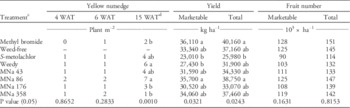
Common purslane density was less than 1 plant m−2 during both years at 4 and 15 WAT, and no differences were observed in treatments (data not presented). Yellow nutsedge density at 4 and 6 WAT was ≤2 plants m−2 and was not influenced by treatments (Table 2). However, later in the season, at 15 WAT, the number of yellow nutsedge plants increased. At the same time, a lower density of yellow nutsedge plants was observed in plots treated with MeBr (2 plants m−2) and metam-sodium at 176 and 358 kg ha−1 (3 and 1 plants m−2, respectively) compared to weedy check (Table 2). Metam-sodium at 360 kg ha−1 has been documented to provide similar Palmer amaranth (≥85%), crabgrass (≥85%), and yellow nutsedge (≥86%) control as does MeBr plus chloropicrin at 390 kg ha−1 (Devkota and Norsworthy Reference Devkota and Norsworthy2014). Gilreath and Santos (Reference Gilreath and Santos2004) reported that metam-sodium applied at 485 kg ha−1 was comparable to MeBr plus chloripicrin at 400 kg ha−1 in controlling purple nutsedge throughout tomato and bell pepper growing season.
Yellow nutsedge density and tomato yield and number response to drip application treatments at Mills River, North Carolina. Data for 2011 and 2012 are pooled.Footnote a, Footnote b

a Abbreviations: WAT, weeks after transplanting; MNa, metam-sodium.
b Means within columns followed by different letters are significantly different at P≤0.05 using Tukey’s honest significant difference test.
c Data pooled over metam-sodium and metam-sodium fb S-metolachlor treatments for each metam-sodium rate: 43, 86, 176, and 358 kg ha−1.
d Yellow nutsedge density was recorded only in year 2012.
Tomato Fruit Number and Yield
S-metolachlor alone at 0.85 kg ha−1 was the only treatment that reduced marketable and total fruit yield compared to that with MeBr. Marketable and total tomato yield were not influenced by metam-sodium rate (Table 2). No differences in marketable or total fruit number were observed among treatments (Table 2). Similar yield response has been observed in previous studies. Devkota and Norsworthy (Reference Devkota and Norsworthy2014) reported that marketable tomato yield in plots treated with metam-sodium at 270 or 360 kg ha−1 was similar to that of plots treated with MeBr plus chloropicrin at 390 kg ha−1. Likewise, marketable tomato yield with metam-sodium at 360 kg ha−1 was equivalent to that with MeBr plus chloropicrin at 400 kg ha−1 (Gilreath and Santos Reference Gilreath and Santos2004).
The differences in weed control and yield loss between bell pepper and tomato are likely due to differences in their growth habits. Bell pepper has a short stature, an open canopy, and a slow growth habit, so yield loss because of weed interference is more pronounced in bell pepper than in other robust vegetable crops like tomato (Norsworthy et al. Reference Norsworthy, Oliveira, Jha, Malik, Buckelew, Jennings and Monks2008). Morales-Payen et al. (1998) observed higher yield loss (73%) in bell pepper than in tomato (42%) due to purple nutsedge interference.
The primary goal of this research was to examine the efficacy of drip-applied metam-sodium fb drip-applied S-metolachlor, and to determine if this regimen can be a suitable replacement for MeBr treatment. In general, the additional application of S-metolachlor did not improve measureable outcomes; however, yellow nutsedge density at 15 WAT in bell pepper was lower when S-metolachlor was applied after metam-sodium compared to when metam-sodium was applied alone. Tomato and bell pepper plots treated with metam-sodium at 176 and 385 kg ha−1 had weed control and marketable yield comparable to that of plots treated with MeBr. Metam-sodium at 176 kg ha−1 provided a similar level of weed control as did metam-sodium at 385 kg ha−1, which is in contrast to previously reported studies (Devkota et al. Reference Devkota, Norwsorthy and Rainey2013; Devkota and Norsworthy Reference Devkota and Norsworthy2014). This result may be due to lower weed pressure in our studies compared to other studies, or the difference in application method (drip application versus broadcast spray using a CO2-pressurized backpack sprayer) of metam-sodium. Results from these studies indicate that drip-applied metam-sodium (176 and 385 kg ha−1) is a potential alternative to MeBr to provide weed control and maintain yield in plasticulture bell pepper and tomato production. The additional application of S-metolachlor would be beneficial under high weed pressure. In this study, additional application of S-metolachlor improved season-long yellow nutsedge control in bell pepper. Another benefit of applying S-metolachlor after metam-sodium is that it would reduce the weed seedbank and thus limit weed outbreaks and the need for intensive weed management in subsequent years. Further research evaluating drip application of metam-sodium fb other herbicides registered in tomato and bell pepper will be helpful in determining the crop safety and spectrum of weed control.
Acknowledgments
The authors express appreciation to the following for their assistance with conducting this research: Dr. Stephen Meyers, Nicholas Basinger, and the staff at the Mountain Horticultural Crops Research and Extension Center, Mills River. Furthermore, the authors thank Dr. Cavell Brownie for her assistance with data analyses.