Introduction
Mites of the family Trochometridiidae (Acari: Trombidiformes: Heterostigmatina) are associated with three orders of the insects (Coleoptera, Dermaptera, and Hymenoptera) and most species are found with apoid bees of the families Halictidae and Andrenidae (Cross and Bohart Reference Cross and Bohart1979; Lindquist Reference Lindquist1985; Hajiqanbar et al. Reference Hajiqanbar, Khaustov, Kamali, Saboori and Kamali2009; Mortazavi et al. Reference Mortazavi, Hajiqanbar and Saboori2011). A study on the life cycle of one of the species, Trochometridium tribulatum Cross, showed that this species has a triple-symbiotic relationship of mite, fungus, and bee host. The mites carry the fungal spores (via pairs of pouch-like structures (sporothecae) between base of the legs III and IV) to the nest of the host, which cause the death of the bee eggs and young larvae. The mites contribute to the growth of the fungus and the offspring of the mites feed on the fungal mycelia that grow on the corpses of the host eggs and young larvae (Cross and Bohart Reference Cross and Bohart1979; Lindquist Reference Lindquist1985; Kaliszewski et al. Reference Kaliszewski, Athias-Binche and Lindquist1995).
The family Trochometridiidae has two genera; Neotrochometridium Hajiqanbar and Khaustov with one species and Trochometridium with five species: T. tribulatum Cross from North America and Africa; T. chinensis (Mahunka) from China, the Netherlands, New Guinea, and Iran; T. kazachstanicum Khaustov and Eidelberg from Kazakhstan and Iran; and T. iranicum Hajiqanbar and Khaustov and T. kermanicum Mortazavi and Hajiqanbar both from Iran (Cross Reference Cross1965; Mahunka Reference Mahunka1966; Cross and Bohart Reference Cross and Bohart1979; Khaustov and Eidelberg Reference Khaustov and Eidelberg2002; OConnor and Klimov Reference OConnor and Klimov2004; Hajiqanbar et al. Reference Hajiqanbar, Khaustov, Kamali, Saboori and Kamali2009; Mortazavi et al. Reference Mortazavi, Hajiqanbar and Saboori2011).
In this paper, we describe the sixth representative of the genus Trochometridium associated with two different genera of the wasp family Mutillidae (Hymenoptera). In addition, some new insect host records are reported and an illustrated key to world species of the family Trochometridiidae is presented.
Materials and methods
Mites were collected from two different wasp genera of the family Mutillidae captured in a light trap. The mites were phoretic, grasping sternite setae of the lateral and ventral grooves of thorax. Specimens were cleared in lactophenol and mounted in Hoyer’s medium. The morphology of the mites was studied using an Olympus BX51 light microscope (Tokyo, Japan) under phase contrast. All measurements in the description are given in micrometers for the holotype and two paratypes (in parentheses). The terminology mostly follows that of Lindquist (Reference Lindquist1986) and partly (chaetotaxy of tarsus I) of Hajiqanbar et al. (Reference Hajiqanbar, Khaustov, Kamali, Saboori and Kamali2009). Details of the geographical coordinates of the sampling areas were recorded using a GPS mobile device. Host wasps were identified to the genus level with the help of Drs Arkadiy S. Lelej (Institute of Biology and Soil Science, Russian Academy of Sciences, Far Eastern Branch, Russia) and James Pitts (Department of Biology, Utah State University, United States of America). The holotype is deposited in the Acarological Collection, Department of Entomology, Faculty of Agriculture, Tarbiat Modares University, Tehran, Iran. One paratype is deposited in United States National Museum of Natural History, Washington, DC, United States of America. Other material including host insects are retained with the holotype.
Systematics
Family Trochometridiidae Mahunka, 1970
Genus Trochometridium Cross, Reference Cross1965
Type species Trochometridium tribulatum Cross, Reference Cross1965
Trochometridium mutilliphillum Loghmani and Hajiqanbar, new species
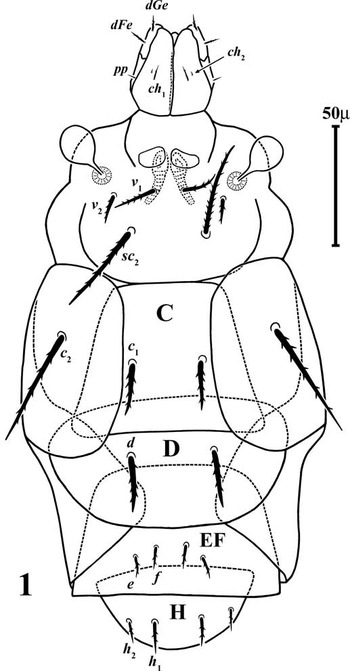
Trochometridium mutilliphillum Loghmani and Hajiqanbar, new species (female). Dorsum of the body. Scale bar 50 μm.

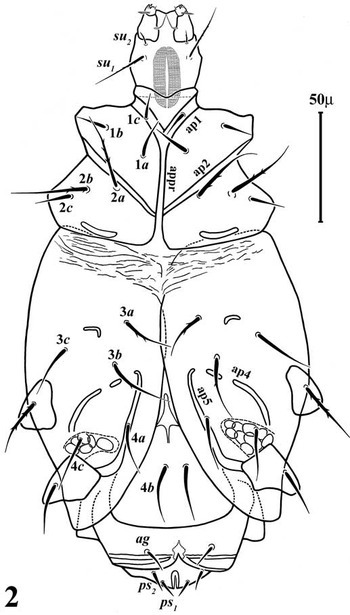
Trochometridium mutilliphillum Loghmani and Hajiqanbar, new species (female). Venter of the body. Scale bar 50 μm.

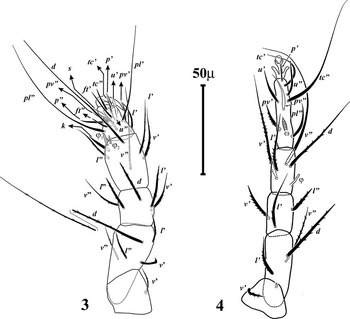
Trochometridium mutilliphillum Loghmani and Hajiqanbar, new species (female). 3. Leg I in dorsal view. 4. Leg II in dorsal view. Scale bar 50 μm.

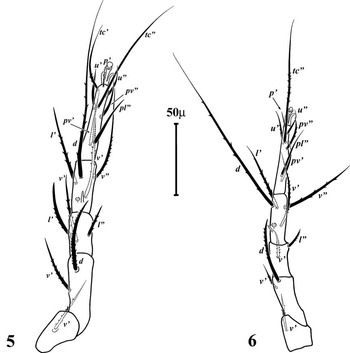
Trochometridium mutilliphillum Loghmani and Hajiqanbar, new species (female). 5. Leg III in dorsal view. 6. Leg IV in dorsal view. Scale bar 50 μm.

Type material. Female holotype (AL-20130607-1) phoretic on Tricholabiodes species and two paratypes phoretic on Dentilla species (Hymenoptera: Mutillidae). The hosts captured by a light trap, in northeastern Iran, Razavi Khorasan province, (near Pistachio orchards, 60 km southwestern Bajestan town, in a desert region), 34.40°N, 57.74°E, altitude 1270 m., 16.vii.2011, leg. A. Loghmani.
Diagnosis. Idiosomal setae e, f, h 1, and h 2 subequal; seta sc 2 not reaching to the base of gnathosoma; seta c 1 not extending to the posterior border of tergite C; setae c 2 two times longer than c 1; setae c 1 and d subequal; setae 2a, 2b, 3a, and 3b barbed, other ventral setae smooth; setae 2a and 2b subequal; setae d on femora II–IV relatively short and never extending to base of related tarsi.
Female. Gnathosoma (Figs 1, 2). Gnathosomal length 45 (45–45), width 36 (37–40); gnathosoma in dorsal view nearly hexagonal; cheliceral stylet thick, curved 9 (10–11); gnathosoma dorsally with two pairs of cheliceral setae: ch 1 7 (9–10), ch 2 2 (2–2), ch 1 weakly barbed, at least four times longer than ch 2; gnathosoma laterally with obvious palpcoxal setae pp 2 (2–2); subcuapitulum with setae su 1 29 (30–33), su 2 6 (8–8), both pointed weakly barbed; palpi obvious, with two palpomeres, extended to apex of gnathosomal capsule; femurogenua with two pairs of pointed, weakly barbed setae dGe 7 (8–9), dFe 7 (8–9); tibiotarsus with one large solenidion 5 (5–6), one eupathidion, both rod-shaped.
Idiosoma. Idiosomal length 227 (240–245), width 131 (148–156).
Idiosomal dorsum (Fig. 1). Stigmata reniform; trichobothria capitate; all dorsal plates smooth; all dorsal setae barbed, setae e, f, h 2 pointed, subequal, h 1 almost pointed, somewhat longer than setae e, f, h 2; other dorsal setae blunt-ended; cupuli invisible; length of dorsal setae: v 1 18 (16–19), v 2 13 (15–16), sc 2 43 (41–47), c 1 25 (29–32), c 2 52 (64–68), d 25 (25–29), e 11 (11–12), f 10 (10–13), h 1 13 (13–15), h 2 11 (11–13); distances between dorsal setae: v 1–v 1 14 (10–11), v 2–v 2 49 (50–51), sc 2–sc 2 33 (35–37), c 1–c 1 31 (28–31), d–d 36 (36–37), e–e 30 (31–32), f–f 13 (13–15), h 1–h 1 21 (20–22), h 2–h 2 45 (45–45).
Idiosomal venter (Fig. 2). Apodemes 1, 2, 5, and presternal apodemes (appr) well developed, apodemes 3 and poststernal apodemes (appo) reduced, apodeme 4 developed but reduced medially; coxisternal plates I–IV each with three pairs of setae (1a–1c; 2a–2c; 3a–3c; 4a–4c), 4b on a triangular midsternal plate; setae 2a, 2b, 3a, 3b barbed, other ventral setae smooth; all ventral setae pointed; sporotheca (containing some fungal spores) at bases of legs IV; length of ventral setae: 1a 21 (25–26), 1b 15 (20–21), 1c 15 (20–21), 2a 34 (33–38), 2b 32 (39–39), 2c 18 (19–24), 3a 28 (29–32), 3b 33 (35–38), 3c 30 (37–38), 4a 29 (32–36), 4b 29 (36–37), 4c 26 (31–35), ag 12 (11–16), ps 1 8 (8–9), ps 2 10 (9–11).
Legs (Figs 3–6). Five-segmented, legs II, III, IV with pair of claws and empodium, leg I with large claw, without empodium.
Leg I (Fig. 3). Thicker than other legs. Tarsus: with a large sickle-like claw, all tarsal setae almost smooth, setae u’, u” rod-shaped, subequal, opposed to claw, setae pl’, pl” long, whip-like, subequal; seta tc” located on pinaculum, solenidion ω 9 (9–10), finger shaped with tiny apical thorn. Tibia: eupathidial seta k stiff, seta d longer than other leg setae except femoral d, solenidion φ1 8 (8–9), longer than φ2 5 (5–5) both finger-shaped and thinner than ω, setae l”, l’, v’ barbed. Genu: setae l’, l”, d blunt-ended, all setae barbed. Femur: seta d attenuated, longest on leg I; seta v’ hook-like, all setae barbed. Trochanter: seta v’ barbed.
Leg II (Fig. 4). Tarsus: only seta pv’ barbed, solenidion ω 7 (7–8) finger shaped with tiny apical thorn, seta tc” longest on segment. Tibia: only seta v” smooth, seta v” whip-like, long, solenidion φ 8 (8–9) uniformly thin. Genu: all setae barbed, seta l’ longer than setae d, l”, seta l” blunt-ended. Femur: all setae barbed, setae d blunt-ended not reaching base of tarsus. Trochanter: seta v’ barbed.
Leg III (Fig. 5). Tarsus: setae tc’, p’ barbed, setae tc’, tc” whip-like, seta tc” clearly longer than tc’. Tibia: all setae barbed, v’, v”, l’ subequal, seta d approximately two times longer than other setae, longest on leg, solenidion φ 7 (7–7) uniformly thin. Genu: all setae barbed, seta l’ clearly blunt-ended, seta v’ longer than l’ and two times longer than l”. Femur: all setae barbed, setae d not reaching base of tarsus. Trochanter: seta v’ barbed, pointed.
Leg IV (Fig. 6). Tarsus: setae u’, p’, pv”, tc” barbed, seta tc” whip-like, clearly longer than other setae of segment. Tibia: all setae barbed, seta d almost two times longer than other setae, longest on the leg; setae l’ shortest on tibia, solenidion φ 8 (8–9) uniformly thin. Genu: all setae barbed, seta l” shorter than v’. Femur: all setae barbed, seta d longer than v’ but not reaching base of tarsus. Trochanter: seta v’ barbed, pointed.
Male and larva unknown.
Etymology. The name of the new species refers to hosts of the family Mutillidae.
Differential diagnosis. Due to the subequal idiosomal setae e, f, h 1, and h 2, the new species is similar to T. kazachstanicum. The new species is distinguished from T. kazachstanicum by the following characters: seta sc 2 not reaching to the base of gnathosoma, seta c 1 not extending to the posterior border of tergite C, and setae d on femora II–IV clearly short and never extending to base of related tarsi (in T. kazachstanicum seta sc 2 reaching to the base of gnathosoma, seta c 1 extending to the posterior border of tergite C, and setae d on femora of legs II–IV extending to base of related tarsi).
New host records for the family Trochometridiidae from Iran
Trochometridium kermanicum Mortazavi and Hajiqanbar, Reference Mortazavi, Hajiqanbar and Saboori2011.
Material examined: one female (near Pistachio orchards, 60 km southwestern Bajestan town, Razavi Khorasan province, Iran, 34.43°N, 57.74°E, 1270 m), phoretic on Komarowia tartara (Saussure) (Hymenoptera: Tiphiidae) captured in a light trap, found in a vial containing two host specimens, 16.vii.2011, leg. A. Loghmani.
Remarks: this species was previously recorded from southern Iran (Kerman province) phoretic on Paulusiella species (Coleoptera: Elateridae) (Mortazavi et al. Reference Mortazavi, Hajiqanbar and Saboori2011), but in this study it was collected from K. tartara, which is a new host record.
Trochometridium iranicum Hajiqanbar and Khaustov, Reference Hajiqanbar, Khaustov, Kamali, Saboori and Kamali2009.
Material examined: Two collections: three females (near Pistachio orchards, 60 km southwestern Bajestan town, Razavi Khorasan province, northeastern Iran, 34.43°N, 57.74°E, 1270 m), phoretic on K. tartara captured in a light trap, found associated with two individual hosts, on the lateral grooves of thorax, 3.vi.2012, leg. A. Loghmani; four females (pastures near Shandiz town, Razavi Khorasan province, northeastern Iran, 36.40°N, 59.33°E, 1390 m), associated with an undetermined fly of the family Calliphoridae (Diptera), phoretic on ventral body surfaces, grasping setae of the abdomen, near legs, captured directly by a forceps when the fly exited from nest hole of a halictid bee (Nomia Latreille species; Hymenoptera: Halictidae), 14.vii.2012, leg. A. Loghmani.
Remarks: This species was previously found during two different studies: from northeastern Iran (Razawi Khorassan province) phoretic on Pseudapis nilotica (Smith) (Hymenoptera: Halictidae) (Hajiqanbar et al. Reference Hajiqanbar, Khaustov, Kamali, Saboori and Kamali2009) and from the central regions of Iran (Isfahan province), phoretic on Philanthus triangulum (Fabricius) (Hymenoptera: Crabronidae), captured by netting (Tajodin et al. Reference Tajodin, Hajiqanbar and Talebi2012). In this study the mites were found on K. tartara and an undetermined fly of the family Calliphoridae (new host records). Because of recently emerged conditions of the fly, genus and species could not be determined.
Discussion
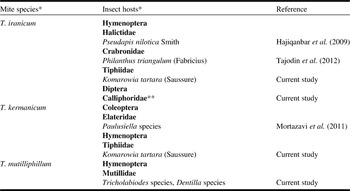
The insect host range of the Trochometridiidae was reviewed by Mortazavi et al. (Reference Mortazavi, Hajiqanbar and Saboori2011). In the current study, our findings extended host range for three representatives of the trochometridiids, summarised in Table 1. The Tiphiidae is new host family for this group of mites, as the only previous record on the Tiphiidae was Myrmosa unicolor Say (Cross and Bohart Reference Cross and Bohart1979), which was later transferred to the Mutillidae (Brothers Reference Brothers1999). The discovery of trochometridiid mites on a fly is the first record of the order Diptera as a host. However, as it is just one collection from a fly visiting the nest-hole of a halictid bee, we must consider it a possible accidental association. Various arthropods, including predators, parasites, and also scavengers (e.g., calliphorid flies mentioned above) visiting the nests of bees could potentially carry this group of mites, as stated by Lindquist (Reference Lindquist1985). Alternatively, the association implies the use of other nest visitors as phoretic carriers. In any case, further collections and life history investigations are needed to clarify nature of these interesting multiple relationships.
The host range of three Trochometridiidae species.

Notes: *All mites and insect hosts collected from Iran.
**Impossible to identify because fly had recently emerged.
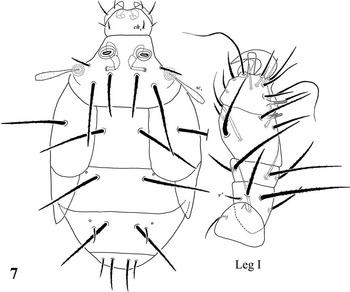
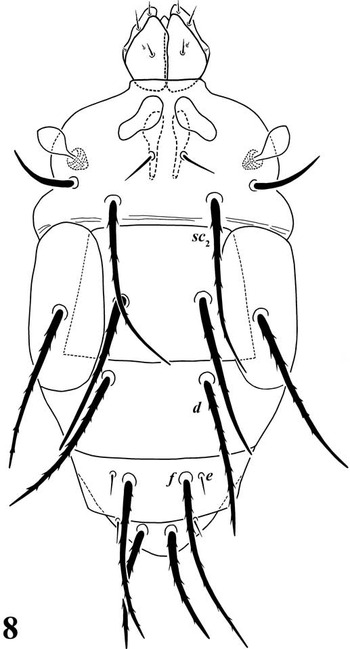
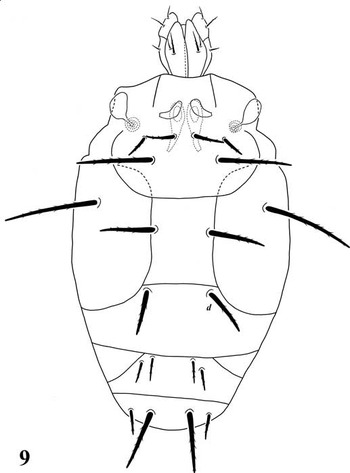
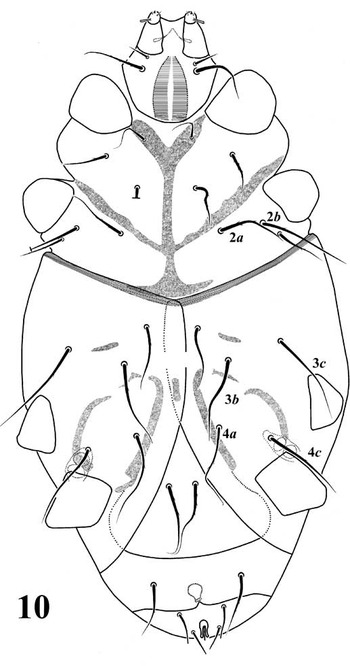
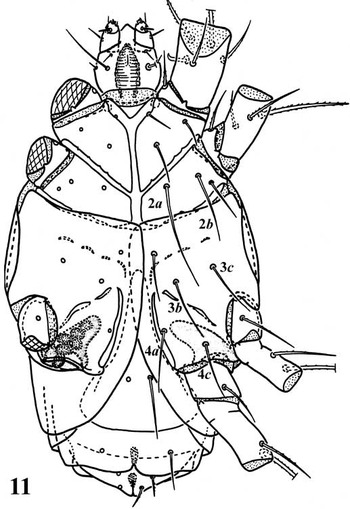
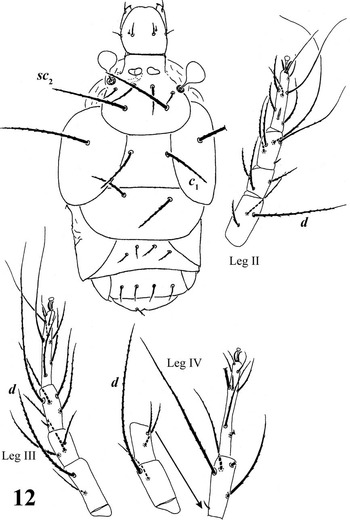
Currently, the family Trochometridiidae consists of two genera and seven species that are distinguished using the following illustrated key.

Neotrochometridium sensillum Hajiqanbar and Khaustov. Dorsum of the body and leg I.

Trochometridium chinensis (Mahunka). Dorsum of the body.

Trochometridium iranicum Hajiqanbar and Khaustov. Dorsum of the body.

Trochometridium kermanicum Mortazavi and Hajiqanbar. Venter of the body.

Trochometridium tribulatum Cross. Venter of the body (adapted from Lindquist Reference Lindquist1985).

Trochometridium kazachstanicum Khaustov and Eidelberg. Dorsum of the body and legs II-IV (adapted from Khaustov and Eidelberg Reference Khaustov and Eidelberg2002).

Acknowledgements
The authors are grateful to Drs Arkadiy S. Lelej (Institute of Biology and Soil Science, Russian Academy of Sciences, Far Eastern Branch, Russia) and James Pitts (Department of Biology, Utah State University, Utah, United States of America) for identification of the mutillid wasps, Prof. Knut Rognes (Department of Early Childhood Education, Faculty of Arts and Education, University of Stavanger, Norway) for some notes on the calliphorid host fly, and Mr. Mohsen Bakhshi for guidance and help in the sampling process. This research was partly funded by a grant (No. 88001046) from the “Iran National Science Foundation” and partly from the Office of Vice President for Research Affairs, Tarbiat Modares University, Tehran, Iran, which is greatly appreciated.