





Introduction
Nonprofit employees’ work engagement, which involves bringing “selves to their work roles” and expressing “themselves physically, cognitively, and emotionally during role performances” (Kahn, Reference Kahn1990: 694), is crucial for nonprofits to achieve organizational missions and goals (Akingbola & Van Den Berg, Reference Akingbola and Van Den Berg2019). In nonprofit organizations, employees usually receive lower salaries than those in the private sector and have less job security than government employees (Lee, Reference Lee2016; Leete, Reference Leete2000). Existing studies have applied the Job Demands-Resources (JD-R) model to examine the effects of various job resources (e.g., transformational leadership), personal resources (e.g., public service motivation), and job demands (e.g., time pressure) on work engagement (Huynh et al., Reference Huynh, Metzer and Winefield2012; Park et al., Reference Park, Kim, Park and Lim2018). Research has also extended the model in nonprofits by incorporating ideological (e.g., value congruence) and philanthropic resources (e.g., compassion) (Mer et al., Reference Mer, Kumar, Verma, De and Mathew2024; Selander, Reference Selander2015). However, despite the ethical challenges faced by nonprofits (Bhandari, Reference Bhandari2010), the role of ethical leadership as a job resource in the JD-R model and its impact on nonprofit employees is underexamined (Mer et al., Reference Mer, Virdi and Sengupta2023).
Unlike for-profit firms, nonprofits primarily rely on public trust and moral legitimacy to secure resources and achieve their missions (Moore, Reference Moore2000; Yasmin & Ghafran, Reference Yasmin and Ghafran2021). Recent nonprofit scandals have drawn the attention of both researchers and practitioners to the concept of ethical leadership (Chapman et al., Reference Chapman, Hornsey, Gillespie and Lockey2023). For instance, the case of Oxfam staff sexually exploiting survivors of the 2010 Haiti earthquake (Scurlock et al., Reference Scurlock, Dolsak and Prakash2020), as well as the scandal involving a project leader from the China Charities Aid Foundation for Children who defrauded tens of millions in “life-saving” donations (Zhang, Reference Zhang2024), calls attention to the urgent need for ethical leadership in nonprofit organizations. Existing research has offered evidence that ethical leadership shapes the ethical climate of nonprofit organizations and also enhances affective organizational commitment and satisfaction among volunteers (Benevene et al., Reference Benevene, Dal Corso, De Carlo, Falco, Carluccio and Vecina2018). However, little research has paid attention to its impact on work engagement, especially among nonprofit employees.
This study addresses these gaps by using the motivational pathway of the JD-R model to explore the role of ethical leadership as a key job resource in shaping nonprofit employees’ work engagement. In particular, the study considers two ideological resources, mission valence and work meaningfulness, as mediators and one external job resource, stakeholder participation, as a moderating factor. Using empirical data collected from 345 nonprofit employees in China, the study aims to answer three research questions. First, does ethical leadership enhance nonprofit employees’ work engagement? Second, how does ethical leadership influence nonprofit employees’ work engagement through mission valence and work meaningfulness? Third, how does stakeholder participation moderate these indirect effects? By answering these questions, this research adds to the literature on ethical leadership, especially in the context of the third sector, where organizations seek to make meaningful social impact. It also contributes to JD-R scholarship by exploring how ethical leadership as an internal job resource, mission valence and work meaningfulness as ideological resources, and stakeholder participation as an external job resource work together to influence nonprofit employees’ engagement.
Literature review and research hypotheses
This section first introduces the JD-R model and explains how the motivational pathway of this model can be applied in this research. Then, based on the literature review, the following five subsections introduce the key variables, develop their relationships, and also propose our research hypotheses.
The job demands-resources (JD-R) model and the motivational pathway
The JD-R model, introduced by Demerouti et al. (Reference Demerouti, Bakker, Nachreiner and Schaufeli2001), has been widely used to explain employees’ work engagement (Kwon & Kim, Reference Kwon and Kim2020). This model divides job characteristics into job demands and job resources. Job demands, such as workload and time pressure, often require employees’ sustained physical and psychological efforts (Bakker & Demerouti, Reference Bakker and Demerouti2007). In contrast, job resources, such as job autonomy and social support, help employees to reduce job demands and achieve work goals (Bakker & Demerouti, Reference Bakker and Demerouti2007). Based on this distinction, the JD-R model shows two processes: an impairment process where excessive job demands lead to disengagement, and a motivational process, where job resources enhance motivation and engagement (Crawford et al., Reference Crawford, LePine and Rich2010; Schaufeli & Bakker, Reference Schaufeli and Bakker2004).
This study focuses on the motivational pathway of the JD-R model. This is because nonprofit employees often work with limited resources but high demands, and their work engagement relies heavily on job resources (Lee, Reference Lee2016; Leete, Reference Leete2000). Existing literature has discussed the influence of various job resources, such as leadership styles (e.g., transformational and servant leadership), job autonomy, and participatory HR practices, on employees’ engagement in nonprofit organizations (Akingbola & Van den Berg, Reference Akingbola and Van Den Berg2019; Park et al., Reference Park, Kim, Park and Lim2018; Selander, Reference Selander2015). Considering the unique mission-driven environment, research has also explored ideological resources (e.g., value congruence and public service motivation) as antecedents of work engagement in nonprofits (Mer et al., Reference Mer, Virdi and Sengupta2023; Selander, Reference Selander2015). Based on the motivational pathway of the JD-R model, this study considers ethical leadership as a job resource and explores how it activates nonprofit employees’ ideological resources, which in turn increases work engagement.
Ethical leadership and work engagement
Work engagement refers to the degree to which employees are involved in and enthusiastic about their work, both physically and mentally (Kahn, Reference Kahn1990; Schaufeli & Bakker, Reference Schaufeli and Bakker2004). It is a positive work state characterized by employees’ high energy and strong commitment, and can predict positive job outcomes (Borst et al., Reference Borst, Kruyen, Lako and de Vries2020). In nonprofit organizations, employees’ work engagement is even more critical due to limited monetary incentives and heavy reliance on their intrinsic motivation to deliver social value (Park & Word, Reference Park and Word2012). They tend to commit to meaningful work and expect that what they do aligns with their personal values (Word & Park, Reference Word and Park2015).
Among those organizational factors that might influence employees’ work engagement, leadership plays a central role, especially leadership styles that emphasize ethical and moral dimensions, which are important in mission-driven settings. Ethical leadership, in particular, has received increasing scholarly attention (Constandt & Willem, Reference Constandt and Willem2019).
The concept of ethical leadership was introduced by Treviño et al. (Reference Treviño, Hartman and Brown2000) with the background of growing academic concern with addressing unethical conduct in the business sector. They suggested that ethical leaders are moral persons and at the same time act as moral managers committed to fostering an ethical work environment. Brown et al. (Reference Brown, Treviño and Harrison2005, p. 120) defined ethical leadership as “the demonstration of normatively appropriate conduct through personal actions and interpersonal relationships, and the promotion of such conduct to followers through two-way communication, reinforcement, and decision-making.” Unlike other ethically oriented leadership styles, such as servant leadership, focusing on the growth and well-being of followers (Liden et al., Reference Liden, Wayne, Zhao and Henderson2008), and authentic leadership reflecting leaders’ self-awareness (Walumbwa et al., Reference Walumbwa, Avolio, Gardner, Wernsing and Peterson2008), ethical leadership emphasizes leaders’ role modeling and active moral management (Brown et al., Reference Brown, Treviño and Harrison2005).
While many studies discuss the role of ethical leadership in business organizations, promoting ethical leadership practices is uniquely salient for nonprofit organizations. The nonprofit work contexts present a different situation for leaders to make ethical decisions and lead by role modeling (Heres & Lasthuizen, Reference Heres and Lasthuizen2012). Unlike for-profit firms that focus more on financial metrics, nonprofits operate primarily on moral legitimacy (Moore, Reference Moore2000; Yasmin & Ghafran, Reference Yasmin and Ghafran2021). More importantly, nonprofit leaders are expected to uphold public trust, particularly among donors and beneficiaries, as a matter of organizational survival (Constandt & Willem, Reference Constandt and Willem2019).
Previous studies examine the role of ethical leadership in shaping followers’ work behaviors, drawing primarily on social learning theory, arguing that leaders are role models, and social exchange theory, focusing on the norm of reciprocity (Constandt & Willem, Reference Constandt and Willem2019). In addition, the JD-R model offers a useful lens to conceptualize ethical leadership as a critical job resource that enhances employees’ work engagement (Mer et al., Reference Mer, Kumar, Verma, De and Mathew2024).
In nonprofit work contexts, ethical leadership could serve as a job resource to improve employee work engagement in several ways. Ethical leaders are role models in adhering to appropriate behaviors, including high levels of engagement (Den Hartog & Belschak, Reference Den Hartog and Belschak2012). According to the social learning theory, followers observe and imitate their leaders’ behaviors (Brown et al., Reference Brown, Treviño and Harrison2005; Junaidi, Reference Junaidi2024), thereby increasing their work engagement. Besides, ethical leaders lead with integrity and respect, and prioritize followers’ interests (Mayer et al., Reference Mayer, Aquino, Greenbaum and Kuenzi2012). Following social exchange theory, when followers perceive a fair and supportive working environment created by ethical leaders, they would feel a sense of obligation to reciprocate by increasing their job involvement and adhering to other positive work behaviors (Brown & Treviño, Reference Brown and Treviño2006; Kacmar et al., Reference Kacmar, Andrews, Harris and Tepper2013). Therefore, we propose:
Hypothesis 1: Ethical leadership positively influences nonprofit employees’ work engagement.
The mediating role of mission valence
The extended JD-R model proposed by Selander (Reference Selander2015) suggests that employees’ ideological attitudes toward work also predict their work engagement. Existing literature has identified public service motivation, value congruence, and spirituality as ideological resources exerting influence on work engagement (Mer et al., Reference Mer, Virdi and Sengupta2023; Park et al., Reference Park, Kim, Park and Lim2018; Selander, Reference Selander2015). This study takes another ideological resource into account: mission valence.
The concept of mission valence was developed based on the expectancy theory of motivation, suggesting that individuals would assess the value of outcomes before making decisions (Vroom, Reference Vroom1964). Rainey and Steinbauer (Reference Rainey and Steinbauer1999), studying public sector employees, expanded the concept and proposed mission valence, which refers to the importance employees place upon the organization’s mission. Employees are more motivated to perform better if they find that the mission of the organization they work for is attractive and valuable (Rainey & Steinbauer, Reference Rainey and Steinbauer1999). Although existing literature on mission valence has focused primarily on public sector employees (Caillier, Reference Caillier2016; Wright et al., Reference Wright, Moynihan and Pandey2012), employees’ emotional attachment to the organizational mission is equally important in nonprofit organizations. In particular, previous nonprofit studies have paid more attention to the concept of mission alignment, which either focuses on the organizational level to explore the consistency between a nonprofit’s projects and its mission (Ma et al., Reference Ma, Jing and Han2018), examines goal congruence within inter-organizational settings (Chapman & Varda, Reference Chapman and Varda2017), or, at the individual level, explores the alignment of employees’ or volunteers’ personal values with organizational missions (AbouAssi et al., Reference AbouAssi, Upoma and Walls2026; Wang, Reference Wang2022). Mission valence, however, goes beyond mere alignment and reflects individuals’ perception of how attractive or exciting the organization’s mission is (Rainey & Steinbauer, Reference Rainey and Steinbauer1999).
Previous research has shown that transformational leaders who are committed to articulating a clear and appealing mission to followers can strengthen their mission valence (Caillier, Reference Caillier2016; Wright et al., Reference Wright, Moynihan and Pandey2012). In the nonprofit setting, this study argues that ethical leaders also shape followers’ attitudes toward the organization’s mission by modeling behaviors consistent with the organization’s mission and values (De Hoogh & Den Hartog, Reference De Hoogh and Den Hartog2008). Moreover, ethical leaders clearly communicate the organization’s core values to followers (Brown et al., Reference Brown, Treviño and Harrison2005). This makes the organization’s mission visible and clear to employees, thereby increasing their understanding and recognition of the organization’s mission (Ahmad et al., Reference Ahmad, Donia, Khan and Waris2019; Brown et al., Reference Brown, Treviño and Harrison2005).
In addition, given its emphasis on promoting an ethical climate within the organization, ethical leadership can reduce ethical issues and lead the organization to achieve its mission and goals in an ethical and appropriate way (Grojean et al., Reference Grojean, Resick, Dickson and Smith2004). This integrity minimizes ethical controversies, making the organization’s mission appear more legitimate and attractive to employees. When nonprofit employees feel confident and proud of their organization’s mission, which is seen as attractive and worthwhile to society (Rainey & Steinbauer, Reference Rainey and Steinbauer1999), they are likely to be more engaged with their work. Therefore, we propose:
Hypothesis 2: Mission valence mediates the relationship between ethical leadership and work engagement.
The mediating role of work meaningfulness
In addition to mission valence, this research considers work meaningfulness as another mediator bridging ethical leadership and nonprofit employees’ work engagement. Work meaningfulness is defined as “the degree to which the individual experiences the job as one which is generally meaningful, valuable, and worthwhile” (Hackman & Oldham, Reference Hackman and Oldham1976: 256), which is another positive psychological state of employees (Nelson & Simmons, Reference Nelson, Simmons, Quick and Tetrick2003). This research argues that work meaningfulness also serves as an ideological resource within the JD-R model (Mer et al., Reference Mer, Kumar, Verma, De and Mathew2024; Selander, Reference Selander2015). This resource is particularly essential within the nonprofit sector where employees often seek intrinsic rewards and a sense of purpose.
Previous studies have explored antecedents of work meaningfulness. In particular, Wang and Xu (Reference Wang and Xu2019) suggested that it is an ethical responsibility of organizational management to help employees find meaning in their work. But they noted that meaningfulness is rooted in employees’ subjective interpretations of work experiences and individuals’ agency (Lips-Wiersma & Morris, Reference Lips-Wiersma and Morris2009; Wang & Xu, Reference Wang and Xu2019). Thus, ethical leaders act as crucial facilitators for employees’ own sense of purpose rather than a top-down manipulation perceived as inauthentic (Bailey & Madden, Reference Bailey and Madden2016). First, ethical leaders foster meaningfulness through role modeling. In nonprofits, ethical leaders demonstrate how they lead and act with integrity, honesty, and responsibility, and then these ethical behaviors can be observed and imitated by followers (Mayer et al., Reference Mayer, Aquino, Greenbaum and Kuenzi2012). When employees engage in ethical behaviors, and especially when they perceive the positive impact of their ethical behaviors on the organization and society, they are more likely to sense a good purpose in their work (Sharif & Scandura, Reference Sharif and Scandura2014).
Second, ethical leaders are committed to communicating with employees about the meaning of what they are trying to achieve, especially their contribution and responsibility to society (Piccolo et al., Reference Piccolo, Greenbaum, Hartog and Folger2010). Such value-based communication can enhance employees’ sense of purpose in their work. Third, ethical leaders actively construct an ethical climate within organizations, where employees perceive that the organization is achieving its goals and missions in ethical ways, therefore feeling their work is meaningful (Michaelson et al., Reference Michaelson, Pratt, Grant and Dunn2014).
There is also evidence showing that work meaningfulness influences various outcomes, including work engagement (Mostafa & Abed El-Motalib, Reference Mostafa and Abed El-Motalib2020; Park et al., Reference Park, Kim, Park and Lim2018). Piccolo et al. (Reference Piccolo, Greenbaum, Hartog and Folger2010) suggested that ethical leadership helps employees perceive the meaningfulness of their work, which in turn translates into increased effort and productivity. Based on the above discussion, this research proposes:
Hypothesis 3: Work meaningfulness mediates the relationship between ethical leadership and work engagement in nonprofit organizations.
The serial mediating effect of mission valence and work meaningfulness
It is noted in previous research that “an organization’s mission can be a powerful and positive force” (Wright & Pandey, Reference Wright and Pandey2011: 22). Thus, this study tries to examine the influence of mission valence on nonprofit employees’ perceptions of work meaningfulness and its subsequent effect on work engagement. Mission valence represents the importance of an organizations’ missions to its employees (Caillier, Reference Caillier2014). If employees perceive that their organizations’ missions are attractive and worthwhile, they would internalize the missions or values into their own belief systems and then find greater meaning in their work (Weiss & Piderit, Reference Weiss and Piderit1999). This positive mind condition, in turn, motivates them to increase their work engagement (Mostafa & Abed El-Motalib, Reference Mostafa and Abed El-Motalib2020). Therefore, building on the arguments above, this study develops the following hypothesis:
Hypothesis 4: Mission valence and work meaningfulness sequentially mediate the relationship between ethical leadership and work engagement.
Stakeholder participation as a moderator
Based on the proposed serial mediating mechanisms of mission valence and work meaningfulness, this study further explores the moderating effect of stakeholder participation. In nonprofit governance, stakeholder participation is essential for enhancing transparency, trust, and effectiveness (Balser & McClusky, Reference Balser and McClusky2005; Fu et al., Reference Fu, Cooper, Woo and Kwestel2024; López‐Arceiz & Bellostas, Reference López‐Arceiz and Bellostas2020). Within the JD-R model, stakeholder participation can serve as an external job resource that, along with ethical leadership, influences employees’ attitudes, behaviors, and work outcomes (Demerouti & Bakker, Reference Demerouti and Bakker2023).
For nonprofit organizations, there are two important stakeholders: donors, who provide financial resources, and beneficiaries, whose needs and outcomes are related to an organization’s mission. Existing literature has argued that donors and beneficiaries are not mere external entities, but value co-creators contributing to nonprofit governance (Benjamin, Reference Benjamin2021; Wellens & Jegers, Reference Wellens and Jegers2014). Their active involvement can enhance nonprofits’ accountability and service quality (Wellens & Jegers, Reference Wellens and Jegers2014). High-quality contact with beneficiaries can positively influence nonprofit workers’ psychological experiences and job satisfaction (Borzaga & Tortia, Reference Borzaga and Tortia2006; see also Wellens & Jegers, Reference Wellens and Jegers2014). We argue that stakeholder participation can help nonprofit employees see and understand the value of their organizations.
However, this study does not focus on the direct influence of stakeholder participation on nonprofit employees’ attitudes or behaviors. Instead, it suggests an interactive effect of ethical leadership and stakeholder participation on nonprofit employees’ mission valence, and in turn, the indirect impact on work engagement. As discussed above, ethical leaders create an open and ethical communication environment, where followers are encouraged to discuss the organization’s missions and visions. If stakeholders can effectively participate in nonprofit governance and provide their feedback, employees are more likely to understand how their work solves social issues or creates positive social impact (Wang, Reference Wang2022). Therefore, the study suggests that the combination of the two resources, ethical leadership as internal and stakeholder participation as external, enhances the perceived attractiveness of the organizational mission, ultimately improving employees’ work engagement. This study proposes:
Hypothesis 5: Stakeholder participation moderates the relationship between ethical leadership and nonprofit employees’ mission valence, such that higher levels of stakeholder participation strengthen the positive impact of ethical leadership on mission valence.
Hypothesis 6: Stakeholder participation moderates the indirect relationship between ethical leadership and nonprofit employees’ work engagement through mission valence and work meaningfulness, such that higher levels of stakeholder participation amplify the indirect positive impact of ethical leadership on work engagement via mission valence and work meaningfulness.
Research methods
Data collection
Data for this study were collected using a snowball-sampling method due to the difficulty in defining the overall research population. This method has been widely used to help researchers access target participants (Dusek et al., Reference Dusek, Yurova and Ruppel2015). To begin with, we contacted 24 nonprofit employees through professional and personal networks as the initial seed sample. These participants were drawn from 24 formally registered nonprofit organizations across four provinces in China–Jiangsu (East), Guangdong (South), Sichuan (West), and Shaanxi (Northwest). All these nonprofit organizations have established a hierarchical governance structure, which provides us with the necessary leader-follower dynamic to examine the effects of ethical leadership. Also, these nonprofit organizations represented various service fields, including aged care, education, environmental protection, and community development. These strategies helped us collect data from different entry points, which can reduce selection bias.
After being informed of the study’s purpose and providing consent, participants were invited to complete the survey and also asked to recommend their colleagues and friends who met the study criteria. Our sample selection criteria are full-time employees of nonprofit organizations in China, including general staff, mid-level managers, and senior managers, but excluding top organizational leaders such as CEOs, board chairs, and executive directors. Newly referred participants were also asked to recommend additional participants following the same criteria after completing the survey. We repeated this referral process and gradually expanded the sample size. Technically, we distributed the survey via a QR code and a web link through emails and WeChat. This allowed participants to access and complete the survey on the Wenjuanxing platform using their preferred method. All participants were assured of the anonymity of their responses.
From December 2023 to February 2024, we received a total of 386 responses. Those participants were from 32 nonprofit organizations. To ensure data quality, we conducted a data cleansing process before data analysis. We removed respondents whose survey completion times were excessively short or long, and also those who provided identical answers to all items, including reverse-coded questions. After this process, the final valid sample for this study consisted of 345 responses.
As the statistical data show, most respondents (62.3%) were female, which reflects the gender composition of the nonprofit workforce (Mastracci & Herring, Reference Mastracci and Herring2010). According to the data from the China Development Brief (CDB) survey of 1849 nonprofit employees in China, approximately 70.74% were women (Liu, Reference Liu2018). Thus, the gender composition of our sample is broadly consistent with national trends. In terms of age, our sample suggests a relatively young workforce, with 61.1% of respondents under the age of 35, closely aligning with the CDB data showing that 68.2% of nonprofit employees were within the 22–35 age range (Liu, Reference Liu2018). Most respondents (66.6%) in our sample held a bachelor’s degree or above, but the educational level was lower than figures reported by other studies. The CDB survey found that 88.26% of nonprofit employees held a bachelor’s degree or above (Liu, Reference Liu2018), and the China Foundation Center (2022) reported that 77% of full-time foundation staff in China had a bachelor’s degree or higher. One possible explanation is that the snowball-sampling approach recruited more frontline nonprofit workers. When looking at job positions, 58% of respondents were general staff members, and middle-level and senior managers respectively comprised 22.9% and 19.1% of the sample. The sample also included a mix of new and experienced employees. Specifically, 55.9% of respondents had less than 3 years’ experience, while 44.1% had served over 3 years.
Measurements
This research adopted well-established scales to measure the five key variables. However, since the participants were Chinese and Chinese is their first language, we translated all English scales into Chinese. The translation process followed Brislin’s (Reference Brislin1970) back-translation techniques. One of our researchers first translated the original scales into Chinese, and another researcher independently back-translated the Chinese version into English. Then, we compared the two English versions and discussed the differences. Finally, we made some minor revisions to the Chinese version to ensure the accuracy of each item. All items were measured using 5-point Likert-type scales, with responses ranging from 1 = “strongly disagree” to 5 = “strongly agree.”
Ethical leadership was measured using the 10-item scale developed by Tian et al. (Reference Tian, Liu and Fan2015) in their study on CSR in China. This scale includes eight items derived from the classic ethical leadership scale by Brown et al. (Reference Brown, Treviño and Harrison2005) and two items from the ethical dimension of paternalistic leadership scale developed by Cheng et al. (Reference Cheng, Chou, Wu, Huang and Farh2004). A sample item is: “My supervisor sets an example of how to do things the right way in terms of ethics.” The Cronbach’s alpha for this scale was 0.96.
Mission valence was measured using the 4-item scale adapted from Wright and Pandey (Reference Wright and Pandey2011). A sample item is: “For me, the mission of this organization is exciting.” The Cronbach’s alpha for this scale was 0.78.
Work meaningfulness was measured with a scale adapted from Spreitzer’s (Reference Spreitzer1995) Psychological Empowerment Scale. We used the dimension of meaning, including three items. A sample item is: “The work I do is meaningful to me.” The Cronbach’s alpha for this scale was 0.89.
Stakeholder participation was measured with a scale adapted from the Stakeholder Integration Scale developed by Plaza-Úbeda et al. (Reference Plaza-Úbeda, de Burgos-Jiménez and Carmona-Moreno2010). We used the dimension of stakeholder interactions, including six items. A sample item is: “The organization frequently has meetings with the stakeholders.” The Cronbach’s alpha for this scale was 0.90.
Work engagement was measured using the short version of the Utrecht Work Engagement Scale, including nine items, developed by Schaufeli et al. (Reference Schaufeli, Bakker and Salanova2006). A sample item is: “At my work, I feel bursting with energy.” The Cronbach’s alpha for this scale was 0.92.
Lastly, we controlled for nonprofit employees’ age, position, tenure, and education level, consistent with previous literature (e.g., Mostafa & Abed El-Motalib, Reference Mostafa and Abed El-Motalib2020; Wang & Xu, Reference Wang and Xu2019).
Analysis procedures
Our data analyses were guided by a moderated serial mediation framework that links ethical leadership to work engagement through mission valence and work meaningfulness, and is moderated by stakeholder participation. We conducted the data analyses in several steps. We first used Mplus to conduct a common method bias test and confirmatory factor analysis (CFA). Then, we used SPSS to conduct descriptive and correlation analyses. To test the hypotheses, we employed structural path analysis to examine the mediation and moderated mediation effects. Finally, we constructed bias-corrected 95% confidence intervals using a bootstrap procedure with 10,000 resamples to estimate the indirect and conditional indirect effects, following the approach suggested by Preacher et al. (Reference Preacher, Rucker and Hayes2007).
Results
Validity and reliability of measurements
Since all the variables in this study were rated by the respondents at the same time, we assessed the discriminant validity by conducting a CFA to compare measurement models and test the construct distinctiveness of the five variables (ethical leadership, mission valence, work meaningfulness, stakeholder participation, and work engagement). The results shown in Table 1 indicate that the hypothesized five-factor model (M0) provided a good fit to the data (χ2 = 933.991, df = 454, RMSEA = 0.055, SRMR = 0.057, CFI = 0.941, TLI = 0.936). Then, we compared the hypothesized 5-factor model (M0) to a series of nested 4-factor models (M1–M8) and a 1-factor model (M9). Results of the fit index and the Chi-square difference test indicated that the 5-factor model fit the data best, and the 1-factor model provided the worst fit.
Confirmatory factor analysis

Table 1. Long description
The table consists of 10 columns: Model, Factor, chi-squared, d f, delta chi-squared, chi-squared over d f, R M S E A, S R M R, C F I, and T L I.
* M 0: Hypothesized 5-factor model (E L, W E, W M, M V, S P) shows the best fit with chi-squared 933.991, d f 454, R M S E A .055, S R M R .057, C F I .941, and T L I .936.
* M 1 to M 8: Various 4-factor models where two factors are combined (indicated by a plus sign). These models show a significant increase in chi-squared (delta chi-squared ranging from 187.633 to 1246.238, all p < .001) and generally poorer fit indices compared to M 0.
* M 9: 1-factor model (all factors combined) shows the poorest fit with chi-squared 3337.689, d f 464, R M S E A .134, S R M R .106, C F I .648, and T L I .623.
Abbreviations: E L is ethical leadership, W E is work engagement, W M is work meaningfulness, M V is mission valence, and S P is stakeholder participation. N equals 345.
Note: EL ethical leadership, WE work engagement, WM work meaningfulness, MV mission valence, SP stakeholder participation; N = 345; *** p < .001.
Then, we calculated the average variance extracted (AVE) values and the composite reliability (CR) values of the five variables, which were above 0.5 and 0.7, respectively (see in Table 2), confirming the convergent validity based on the criteria proposed by Hair et al. (Reference Hair, Hult, Ringle, Sarstedt, Danks and Ray2021).
Descriptive statistics, AVE and CR values, and correlations

Table 2. Long description
The table presents data for 10 variables. Columns include Mean, S D, A V E, C R, and a correlation matrix numbered 1 through 10.
1. Gender: Mean 1.620, S D 0.485.
2. Age: Mean 2.270, S D 1.024, correlation with Gender -0.074.
3. Education: Mean 3.690, S D 1.217, correlation with Age -0.280.
4. Position: Mean 1.610, S D 0.789, correlation with Age 0.276, Education -0.150.
5. Tenure: Mean 2.350, S D 1.081, correlation with Gender -0.132, Age 0.324, Education -0.145, Position 0.316.
6. Ethical leadership: Mean 3.486, S D 1.029, A V E 0.681, C R 0.955, correlation with Gender 0.148, Education 0.231, Position -0.138.
7. Mission valence: Mean 3.585, S D 0.908, A V E 0.526, C R 0.806, correlation with Education 0.221, Tenure 0.112, Ethical leadership 0.578.
8. Work meaningfulness: Mean 3.497, S D 1.107, A V E 0.727, C R 0.889, correlation with Gender 0.106, Education 0.215, Position -0.117, Ethical leadership 0.577, Mission valence 0.629.
9. Stakeholder participation: Mean 3.336, S D 0.936, A V E 0.599, C R 0.899, correlation with Education 0.134, Position -0.139, Ethical leadership 0.522, Mission valence 0.490, Work meaningfulness 0.494.
10. Work engagement: Mean 3.319, S D 0.892, A V E 0.575, C R 0.923, correlation with Education 0.114, Tenure 0.136, Ethical leadership 0.527, Mission valence 0.571, Work meaningfulness 0.615, Stakeholder participation 0.481.
Note: N equals 345. Asterisks indicate p-values less than .05 or .01.
Note: N = 345; * p < .05; ** p < .01; *** p < .001.
Descriptive statistics and correlation analysis
The means, standard deviations, and correlations among all variables are presented in Table 2. Ethical leadership is positively related to mission valence (r = 0.578, p < 0.01), work meaningfulness (r = 0.577, p < 0.01), and work engagement (r = 0.527, p < 0.01). Work engagement is positively correlated with mission valence (r = 0.571, p < 0.01) and work meaningfulness (r = 0.615, p < 0.01).
Hypotheses test
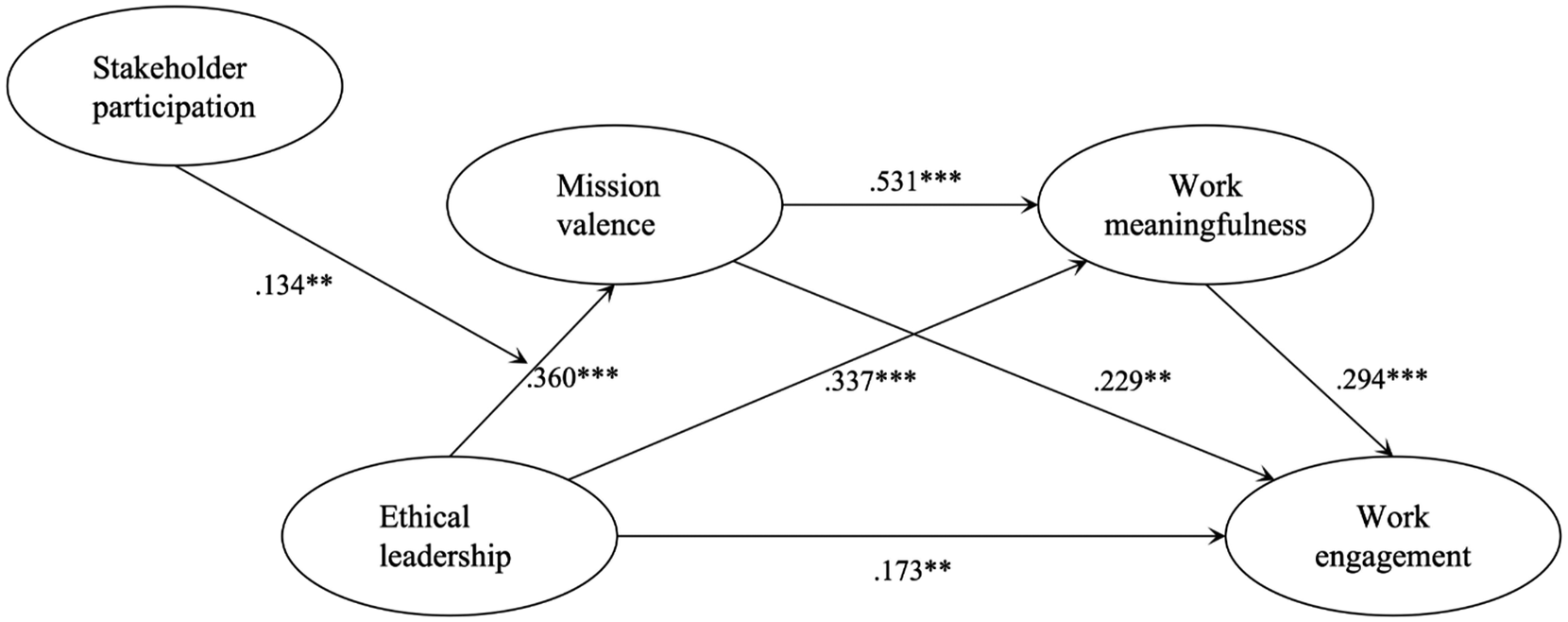
To test the proposed model, we conducted a series of path analyses. Figure 1 presents the integrated structural model demonstrating path coefficients and significance levels.
The structural model with path coefficients and significance levels. Note: N = 345; ** p < .01; *** p < .001; control variables were included in the estimation but omitted from the figure for clarity.

Fig. 1 Long description
A path diagram consisting of five oval nodes connected by directional arrows with numerical path coefficients.
* On the far left, Stakeholder participation has a single arrow pointing to the relationship between Ethical leadership and Mission valence with a coefficient of .134 star star.
* At the bottom left, Ethical leadership has three outgoing arrows:
- To Mission valence with a coefficient of .360 star star star.
- To Work meaningfulness with a coefficient of .337 star star star.
- To Work engagement with a coefficient of .173 star star.
* In the center top, Mission valence has two outgoing arrows:
- To Work meaningfulness with a coefficient of .531 star star star.
- To Work engagement with a coefficient of .229 star star.
* In the center right, Work meaningfulness has one outgoing arrow:
- To Work engagement with a coefficient of .294 star star star.
* On the far right, Work engagement serves as the final dependent variable receiving three paths.
First, we tested the main effect of ethical leadership on nonprofit employees’ work engagement. As shown in Model 1 of Table 3, the results indicate that ethical leadership has a positive and significant influence on work engagement (b = 0.455, SE = 0.041, p < 0.001). Therefore, H1 is supported.
Unstandardized estimates (standard error) of path analyses

Table 3. Long description
The table presents unstandardized estimates B and standard errors S E for five models.
Header Row:
Model 1: Work engagement.
Model 2: Mission valence.
Model 3: Work meaningfulness.
Model 4: Work engagement.
Model 5: Mission valence.
Control Variables:
Gender: Values range from negative .026 to .154.
Age: Values range from negative .032 to .075.
Education: Values range from negative .034 to .076.
Tenure: Significant positive effects in Model 1 (.114, p < .01), Model 2 (.134, p < .01), and Model 5 (.115, p < .01).
Position: Values range from negative .071 to .044.
Independent Variable:
Ethical leadership: Highly significant positive effects across all models: Model 1 (.455, p < .001), Model 2 (.474, p < .001), Model 3 (.337, p < .001), Model 4 (.173, p < .01), and Model 5 (.360, p < .001).
Mediating Variables:
Mission valence: Significant in Model 3 (.531, p < .001) and Model 4 (.229, p < .01).
Work meaningfulness: Significant in Model 4 (.294, p < .001).
Moderating Variable:
Stakeholder participation: Significant in Model 5 (.267, p < .001).
Interaction:
Ethical leadership * Stakeholder participation: Significant in Model 5 (.134, p < .01).
Model Fit:
R super 2 values are .298 for Model 1, .368 for Model 2, .471 for Model 3, .466 for Model 4, and .435 for Model 5.
Note: N = 345, * p < .05; ** p < .01; *** p < .001.
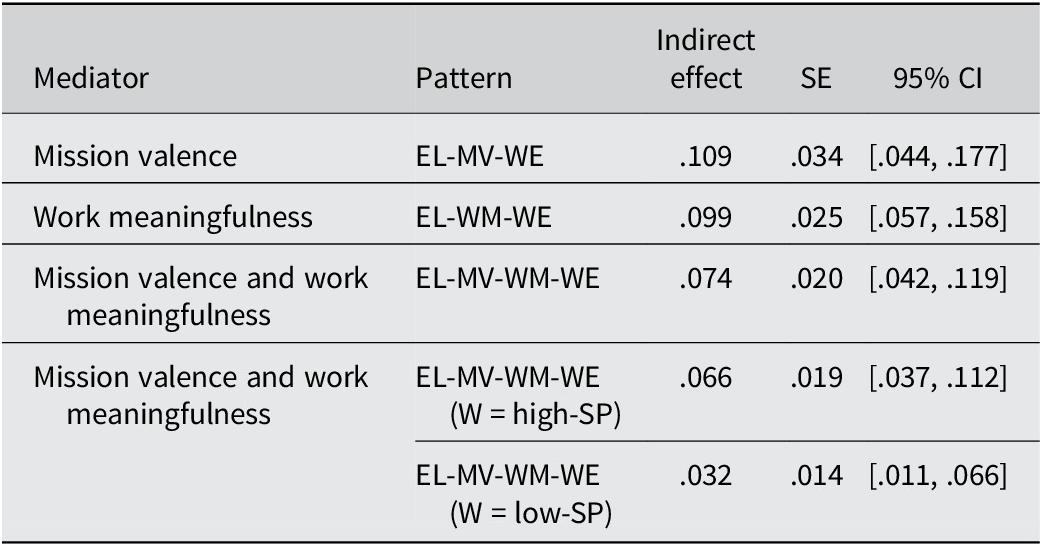
Next, we tested the mediating effect of mission valence in the relationship between ethical leadership and work engagement. As shown in Model 2 and Model 4 of Table 3, ethical leadership is positively related to mission valence (b = 0.474, SE = 0.045, p < 0.001), and mission valence is positively related to work engagement (b = 0.229, SE = 0.069, p < 0.01). The results of the indirect effect, presented in Table 4, suggest that mission valence mediates the relationship between ethical leadership and work engagement (indirect effect = 0.109, SE = 0.034, 95% CI [0.044, 0.177]). Thus, H2 is supported. Specifically, ethical leadership explains 36.8% of the variance in mission valence (R2 = 0.368).
Comparison of mediating effect and moderated indirect effect

Table 4. Long description
The table consists of five columns: Mediator, Pattern, Indirect effect, S E, and 95% C I.
* Row 1: Mediator is Mission Valence. Pattern is E L-M V-W E. Indirect effect is .109. S E is .034. 95% C I is [.044 TO .177].
* Row 2: Mediator is Work Meaningfulness. Pattern is E L-W M-W E. Indirect effect is .099. S E is .025. 95% C I is [.057 TO .158].
* Row 3: Mediator is Mission valence and work meaningfulness. Pattern is E L-M V-W M-W E. Indirect effect is .074. S E is .020. 95% C I is [.042 TO .119].
* Row 4: Mediator is Mission valence and work meaningfulness. Pattern is E L-M V-W M-W E (W = high-S P). Indirect effect is .066. S E is .019. 95% C I is [.037 TO .112].
* Row 5: Pattern is E L-M V-W M-W E (W = low-S P). Indirect effect is .032. S E is .014. 95% C I is [.011 TO .066].
Model 3 and Model 4 in Table 3 indicate that ethical leadership is positively related to work meaningfulness (b = 0.337, SE = 0.067, p < 0.001), and work meaningfulness is positively related to work engagement (b = 0.294, SE = 0.053, p < 0.001). The results of the indirect effect, shown in Table 4, suggest the mediating role of work meaningfulness between ethical leadership and work engagement (indirect effect = 0.099, SE = 0.025, 95% CI [0.057, 0.158]), which supports H3. Ethical leadership explains 47.1% of the variance in work meaningfulness (R2 = 0.471).
We then tested the serial mediating effect of mission valence and work meaningfulness in the relationship between ethical leadership and nonprofit employees’ work engagement. As indicated in Model 3 of Table 3, mission valence positively influences work meaningfulness (b = 0.531, SE = 0.072, p < 0.001). Furthermore, the results in Table 4 confirm a significant serial mediating effect through mission valence and work meaningfulness (indirect effect = 0.074, SE = 0.020, 95% CI [0.042, 0.119]). These findings support H4. The combined model explains 46.6% of the variance in work engagement (R2 = 0.466), indicating a strong explanatory effect of the serial mediation pathway.
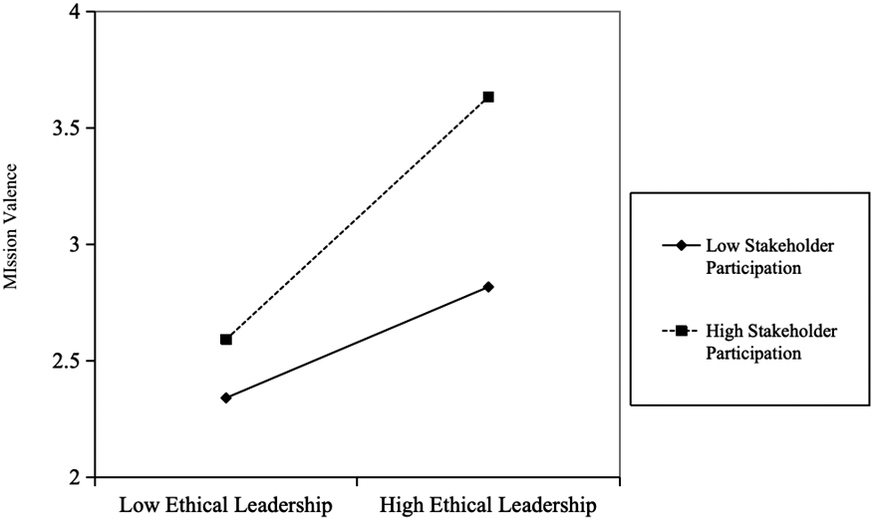
As presented in Table 3, we incorporated stakeholder participation into Model 5 as a moderator and introduced an interaction effect between ethical leadership and stakeholder participation. The results demonstrate a positive interaction effect between ethical leadership and stakeholder participation in predicting mission valence (b = 0.134, SE = 0.045, p < 0.01). A simple slope test was then conducted, and the plot in Figure 2 illustrates that ethical leadership is positively associated with mission valence when stakeholder participation is high (b = 0.485, SE = 0.061, 95% CI [0.368, 0.605]). This association remains significant even when stakeholder participation is low (b = 0.234, SE = 0.071, 95% CI [0.089, 0.368]). These findings support H5.
The interaction of ethical leadership and stakeholder participation.

Lastly, according to the bootstrapping results shown in Table 4, the indirect impact of ethical leadership on nonprofit employees’ work engagement through the serial mediating roles of mission valence and work meaningfulness becomes stronger when the level of stakeholder participation is high (indirect effect = 0.066, SE = 0.019, 95% CI [0.037, 0.112]), than when stakeholder participation is low (indirect effect = 0.032, SE = 0.014, 95% CI [0.011, 0.066]). Therefore, H6 is supported.
Discussion
Making employees more engaged in their work is essential to nonprofit organizations. This study first confirms a positive relationship between ethical leadership and nonprofit employees’ work engagement. Drawing on the motivational pathway of the JD-R model, we conceptualize ethical leadership as an internal job resource that stimulates employees’ motivation and fosters engagement. While prior nonprofit research has focused on the role of transformational, transactional, and servant leadership in nonprofit contexts (e.g., Gözükara & Şimşek, Reference Gözükara and Şimşek2015; Román-Calderón et al., Reference Román-Calderón, Battistelli and Odoardi2013; Sarti, Reference Sarti2014), this study shows that ethical leadership plays a uniquely important role in mission-driven settings. Ethical leadership is distinguished by demonstrating a dedicated work ethic and showing a sense of responsibility (Brown et al., Reference Brown, Treviño and Harrison2005), which supports employees’ high work engagement. Although existing studies have linked ethical leadership to work engagement in private and public sectors (Mostafa & Abed El-Motalib, Reference Mostafa and Abed El-Motalib2020; Treviño et al., Reference Treviño, Hartman and Brown2000), this study extends this relationship to nonprofit organizations. This addresses a gap in the ethical leadership literature, and also, following Selander’s (Reference Selander2015) work, applies the JD-R model to nonprofit contexts.
In addition to ethical leadership as a key job resource, the study identifies two other ideological resources that enhance employees’ work engagement: mission valence and work meaningfulness. This adds to earlier research on nonprofit employees that incorporated ideological resources into the JD-R model (Park et al., Reference Park, Kim, Park and Lim2018; Selander, Reference Selander2015). More importantly, when Selander (Reference Selander2015: 1408) suggested that ideological orientation “should be encouraged by mentoring,” this study finds that ethical leaders, through day-to-day ethical communication (Brown et al., Reference Brown, Treviño and Harrison2005), can effectively activate followers’ mission valence and work meaningfulness. This reveals an internal motivational mechanism within the JD-R model, through which job resources activate ideological resources, and then lead to a higher level of work engagement.
Among the existing literature exploring various job resources that enhance nonprofit employees’ work engagement by using the JD-R model (Park et al., Reference Park, Kim, Park and Lim2018), resources from outside the organization have been ignored. Based on existing nonprofit studies examining stakeholder participation from governance and resource-dependence perspectives (Wang, Reference Wang2022; Wellens & Jegers, Reference Wellens and Jegers2014), this study conceptualizes it as an external job resource. When stakeholders, such as donors and beneficiaries, participate effectively, they enhance employees’ understanding of organizational goals (Fu et al., Reference Fu, Cooper, Woo and Kwestel2024) and amplify the value-laden signals sent by ethical leaders.
In brief, ethical leadership and stakeholder participation function as complementary job resources, one internal and one external, and interact to shape employees’ motivation. Ethical leadership influences daily work through role modeling and communication (Brown et al., Reference Brown, Treviño and Harrison2005), while stakeholder participation offers legitimacy from the external environment (Leardini et al., Reference Leardini, Moggi and Rossi2019). Our findings suggest that their combination activates employees’ ideological resources, effectively strengthening their internal motivation. These mechanisms are theoretically supported by the JD-R model, suggesting that different forms of job resources can enhance work engagement (Bakker & Demerouti, Reference Bakker and Demerouti2007; Schaufeli & Bakker, Reference Schaufeli and Bakker2004). At the same time, these findings add a novel dimension to the model by revealing the synergistic effects of internal and external job resources and ideological resources.
The findings of this study offer several implications for nonprofit management, particularly regarding leadership development and stakeholder engagement. Leadership development is essential for nonprofits. Existing leadership development initiatives, however, focus more on management skills and capacities, such as innovation, crisis management, and digital transformation (Austin et al., Reference Austin, Regan, Samples, Schwartz and Carnochan2011; Gilstrap et al., Reference Gilstrap, Gilstrap, Holderby and Valera2016; Shier & Handy, Reference Shier and Handy2020; Young, Reference Young2018). Our findings suggest that ethics-related training should be included in leadership development programs, emphasizing ethical decision-making and ethical communication. In addition, when recruiting or nurturing future leaders, nonprofits should assess their moral competence (Kim & Kim, Reference Kim and Kim2013). This study also found that stakeholder participation can amplify the positive effects of ethical leadership. Therefore, nonprofit organizations should explore effective stakeholder participation strategies, such as targeted feedback seeking and social media engagement (Carboni & Maxwell, Reference Carboni and Maxwell2015; Woo et al., Reference Woo, Actis and Fu2023), and allow various stakeholders to participate in governance and relevant decision-making processes (Rossi et al., Reference Rossi, Leardini, Moggi and Campedelli2015). These approaches can improve employees’ connection to the organizations’ mission and perception of work meaningfulness, which in turn promotes stronger work engagement.
Nevertheless, this study has some limitations. First, this study’s sample consisted of 345 respondents from 24 formally registered nonprofit organizations with hierarchical governance structures in China, which may limit the generalizability of our findings to other national and cultural contexts, as well as to non-hierarchical organizations. In addition, due to a lack of a full sampling frame, we used a snowball-sampling method relying on personal and referral networks, which may lead to selection bias (Parker et al., Reference Parker, Scott and Geddes2019). Future studies could examine whether these results hold across different institutional, cultural, or structural environments and could also work with nonprofit umbrella associations to recruit more diverse participants. The second limitation is about the analytical level. This study focused exclusively on individual-level outcomes, especially employees’ attitudes and behaviors, but overlooked potential group- or organizational-level impacts of ethical leadership, such as the development of an ethical climate and broader organizational performance (e.g., donation income). Future research could adopt multilevel designs to explore these dynamics. Third, while our findings, as well as much of the existing literature, highlight the positive impacts of ethical leadership, its potential negative effects have been overlooked. The ethical demands created by ethical leadership might lead to employees’ emotional exhaustion (Zheng et al., Reference Zheng, Witt, Waite, David, van Driel, McDonald and Crepeau2015). This should be carefully considered in future research. Lastly, when examining the moderating effect of stakeholder participation as an external job resource, this study viewed it as a general construct. However, external stakeholders are diverse, such as donors, beneficiaries, government agencies, for-profit companies, or community partners (Woo et al., Reference Woo, Actis and Fu2023). Different stakeholders may exert distinct influences. Future studies could unpack the differential effects of specific stakeholder groups or even consider different forms of participation.
Conclusion
Drawing on the JD-R model, this study explored a motivational mechanism through which ethical leadership as a key job resource activates nonprofit employees’ ideological resources (mission valence and work meaningfulness), and then enhances their work engagement. Additionally, stakeholder participation should be valued in nonprofit management, not only as a means of resource acquisition but also as a tool for enhancing employee motivation. These findings contributed to nonprofit leadership literature and also expanded the use of the JD-R model in nonprofit studies. Practically, the study offered implications for nonprofit human resource management.
Data availability statement
The data are not publicly available due to ethical, legal, or privacy concerns.
Funding statement
This work was supported by Macau University of Science and Technology Faculty Research Grants (No. FRG-26-023-MSB).
Competing interests
The author(s) declared no potential conflicts of interest with respect to the research, authorship, and/or publication of this article.




 Open access

