

Introduction
Domestication of chicken
Chicken are believed to be the most popular poultry species worldwide and are believed to have descended from the four species of the jungle fowl: the red jungle fowl (Gallus gallus), the grey jungle fowl (Gallus sonnerati), the Ceylon jungle fowl (Gallus lafayettei) and the green jungle fowl (Gallus varius) (Dana, Van der Waaij and Van Arendok, Reference Dana, Van der Waaij and Van Arendok2011). It is still an open question whether the modern chicken were domesticated from one or all of these species. Cumulative data from the geographic range of the species (Crawford, Reference Crawford and Crawford1990), archaeological discoveries (West and Zhou, Reference West and Zhou1988), protein polymorphisms and morphological characteristics (Moiseyeva et al., Reference Moiseyeva, Romanov, Nikiforov, Sevastyanova and Semyenova2003), suggested that domestic chickens were derived from the red jungle fowl. The studies that utilized four species of genus Gallus (G. gallus, G. varius, G. lafayettei and G. sonnerati), three subspecies of G. gallus (G. g. gallus, G. g. spadiceus and G. g. bankiva), nine domestic breeds of chicken from South Asia, South East Asia, Japan and Europe, (Akishinonomiya et al., Reference Akishinonomiya, Miyake, Sumi, Takada, Ohno and Kondo1994, Reference Akishinonomiya, Miyake, Takada, Shingu, Endo, Gojobori, Kondo and Ohno1996) on their 400 base pairs of mt DNA D-loop region, presented results which suggested that domestic chickens are derived from a single continental population of G. g. gallus. However, other subspecies of the red jungle fowl are believed to be modern ancestor of current chicken (Liu et al., Reference Liu, Wu, Yao, Miao, Luikart, Baig, Beja-Pereira, Ding, Palanichamy and Zhang2006). Genetic integration of species in the genus Gallus has been demonstrated as well. This suggests that several species might have contributed to origin of modern chicken (Nishibori et al., Reference Nishibori, Shimogiri, Hayashi and Yasua2005). Eriksson et al. (Reference Eriksson, Larsen, Gunnarsson, Bed‟hom, Tixier-Boichard, Stromstedt, Wright, Jungerius, Vereijken, Randi, Jensen and Andersson2008) by examining the origins of skin colour variations in domestic chickens, revealed that although the white skin allele in modern chickens is derived from the red jungle fowl, the most likely origin of the yellow skin gene is the grey jungle fowl (G. sonnerati). Contrary to Crawford (Reference Crawford and Crawford1990), Liu et al. (Reference Liu, Wu, Yao, Miao, Luikart, Baig, Beja-Pereira, Ding, Palanichamy and Zhang2006) using maternal DNA found evidence suggesting that origin of indigenous chicken was centred around South and South East Asia. This was in agreement with previous studies by Akishinonomiya et al. (Reference Akishinonomiya, Miyake, Sumi, Takada, Ohno and Kondo1994, Reference Akishinonomiya, Miyake, Takada, Shingu, Endo, Gojobori, Kondo and Ohno1996).
Introduction of chicken to Africa and Kenya
The route and dates by which chicken entered the African continent remain poorly understood. It is suggested that chickens were first introduced into Africa via Egypt from South-western Asia via the middle-east (Magothe et al., Reference Magothe, Okeno, Muhuyi and Kahi2012). According to Blench and MacDonald (Reference Blench, Macdonald, Kiple and Ornelas2000), archaeological evidence and other representations indicate occasional presence of chickens in Egypt in the period between 1425 and1123 BC (Dana, Van der Waaij and Van Arendok, Reference Dana, Van der Waaij and Van Arendok2011). During that time, the chickens were thought to have been kept for cockfighting sports. Around 650 BC and beyond there was change of chicken utility from recreational to cultural and spiritual usage; it is thought that chickens were used to tell the time of day and for sacrifices before planting or harvesting (Maina, Reference Maina2000) and subsequently introduced as source of food. At around 500 BC, human migration to the South led to the spread of chickens to Central Africa (Magothe et al., Reference Magothe, Okeno, Muhuyi and Kahi2012). Chicken are believed to have entered Kenya through different routes. Migration of the Bantu people from Central Africa eventually led to the arrival of chickens in Western Kenya at around 100 BC. Migration of the Paranilotics from the North at around 50 AD and the Nilotics along the Nile valley later on is also thought to have brought more chickens (Maina, Reference Maina2000). The early Greco-Roman east-coast trade is hypothesized to have brought the Asiatic and game chickens along the Kenyan coast at around 100 AD (Blench and MacDonald, Reference Blench, Macdonald, Kiple and Ornelas2000) and eventually reaching Eastern Kenya probably at around 200 AD (Maina, Reference Maina2000).The long span of period is thought to have caused the change of relative importance of chicken.
The modern world breeds of chickens can be grouped into four evolutionary lineages: (a) egg-type chickens of Mediterranean origin; (b) game chickens of Asiatic origin; (c) meat-type chickens of Asiatic origin and (d) true Bantams of various descents (Moiseyeva et al., Reference Moiseyeva, Romanov, Nikiforov, Sevastyanova and Semyenova2003).Trade with several empires may have introduced the Asiantic types into present Kenya, while migration from the north may possibly have brought more of the Mediterranean and the Bantams types. Selection, mutations and random drifts over time may have resulted in the modifications and subsequent development of the various chicken eco- and genotypes presently available in various climatic regions in Kenya.
The primary reasons for domesticating animals in Africa were their cultural, ritual and social values. Their role as source of food came much later with the expansion of human population (Clutton-Brock, Reference Clutton-Brock, Shaw, Sinclair, Andah and Okpoko1993). The conflict between archaeological findings to date on one hand and the apparently deep embedding of chicken in many African cultures, as well as the linguistic and ethnographic evidences on the other hand, suggest presence of chicken in Africa at much earlier dates (Williamson, Reference Williamson, Blench and MacDonald2000). Hence, it is possible that chicken were present in Africa well before the earliest date yet attested by archaeological findings.
Kenyan indigenous chicken genetic resources and population
Population, distribution and classification of indigenous chicken
The Kenyan chicken population is estimated to be 32 million, with approximately 80 percent being classified indigenous and 20 percent as commercial layers and broilers (KNBS, 2010). Other poultry types such as turkey, duck, pigeon, ostrich, guinea fowl and quail are becoming increasingly important.
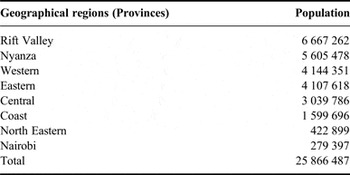
The indigenous chickens of Kenya consist of various unimproved, non-selected sub-populations of heterogeneous features such as plumage colour, comb and wattle types, earlobes and body sizes. They are evenly distributed across the country as presented in Table 1, with exception of Nairobi (which is small and mainly urban) and North Eastern (which is majorly an arid area with nomadic lifestyle) provinces. This distribution is attributed to rural human population, environmental conditions and availability of feed resources. Most of farmers in these regions practice crop production which is the major feed source for the indigenous chicken. Okeno, Kahi and Peters (Reference Okeno, Kahi and Peters2012) observed that the number of indigenous chicken per household were high in crop production regions, but declined gradually from high agricultural potential regions to semi-arid and further in arid regions.
Population and distribution of indigenous chicken in Kenya.

Source: Kenya National Beaurea of Statistics, 2010.
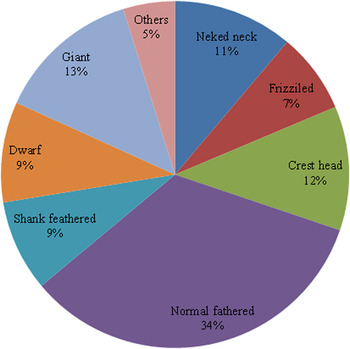
The Kenyan indigenous chicken as in most other developing countries in the tropics have not yet been classified to breeds, but commonly named according to regions of placements or ecotypes or phenotypic expression of major genes. For instance different ecotypes such as Bondo, Bomet and Narok, Kakamega, West Pokot, Lamu and Taita-Taveta have been studied and named based on the regions where they are found in Kenya (Okeno, Kahi and Peters, Reference Okeno, Kahi and Peters2012). On the other hand the Kenyan indigenous chicken have been grouped as naked-neck, frizzled-feathered, shanked feathered, normal-feathered, dwarf, giant, rumples and crested head (Magothe, Muhuyi and Kahi, Reference Magothe, Muhuyi and Kahi2010; Okeno, Kahi and Peters, Reference Okeno, Kahi and Peters2012) based on their phenotypic expression of major genes. The relationship between phenotypes and genotypes in chicken is well known as these phenotypes are a result of genes with major effects (Falconer, Reference Falconer1989). Although the exact population of both genotypes and ecotypes for the Kenyan indigenous chicken are not well documented, the study by Okeno, Kahi and Peters (Reference Okeno, Kahi and Peters2011) could give an insight on the population structure for different genotypes and ecotypes. In that study, the populations of different indigenous chicken genotypes were sampled from six counties (Kakamega, Bondo, Bomet, Turkana, Narok and West Pokot) in different climatic conditions. In the pooled data, they demonstrated the population structure for different genotypes within the farmers’ households as presented in Figure 1.They also demonstrated that although the population is dominated by normal-feathered birds, the other genotypes are well represented in all the counties.
Population structure and distribution of different Kenyan indigenous chicken genotypes. Source: Okeno et al., Reference Okeno, Kahi and Peters2011.

The genetic diversity of the Kenyan indigenous chicken could have been as a result of their dispersal from putative centres of domestication to different regions with diverse environmental conditions and people of different cultural orientations (Mwacharo et al., Reference Mwacharo, Nomura, Hanada, Han, Amano and Hanotte2013). Other factors that may have played a role in the genetic differentiation include founder effects, natural and human selection, mutation and genetic drift (Dana, Reference Dana2011). Although, both genetic, nutritional and disease resistance studies have been carried out on different genotypes (Magothe, Muhuyi and Kahi, Reference Magothe, Muhuyi and Kahi2010) and ecotypes (Kaingu et al., Reference Kaingu, Kibor, Shivairo, Kutima, Okeno, Waihenya and Kahi2010; Kingori, Wachira and Tuitoek, Reference Kingori, Wachira and Tuitoek2010; Ngeno et al., Reference Ngeno, Vander Waaij and Kahi2013) of indigenous chicken and further studies are still ongoing under Indigenous Chicken Improvement Program (InCIP – http://incip.org/) under Kenyan conditions, their classification have not been published in the Domestic Animal Diversity Information System (DAD_IS) website (http://dad.fao.org/) except Naked-neck and frizzled-feathered.
Adaptation characteristics of different ecotype and genotypes of indigenous chicken
The indigenous chicken have a number of adaptive traits and genes such as naked-necks and frizzle feathers, black bones and meat, which have special utility in the hot and humid tropics (Horst, Reference Horst1989). In Kenya for instance, the naked-neck, frizzle, dwarf and rump-less genotypes are mostly found in Western and Coastal regions which are characterized by warm and humid climatic conditions and Eastern and Northern parts which are hot and dry (Olwande et al., Reference Olwande, Ogara, Okuthe, Muchemi, Okoth, Odindo and Adhiambo2010; Okeno, Kahi and Peters, Reference Okeno, Kahi and Peters2012). This could be explained by the fact that these genotypes are known to be tolerant to high ambient temperatures and other environmental stresses associated with such areas (Horst, 1988). In high altitude areas such as Mount Kenya and the highlands East and West of Rift Valley, which are characterized by cool and wet climatic conditions, normal-feathered, crested head, feathered shank and bearded genotypes are predominant (Njega, Reference Njega2005). This could be explained by the fact that these genotypes have well-covered bodies with feathers which insulate and protect them against body heat loss. There is, however, ample evidence that some of these genotypes in most of these regions are endangered and on the verge of becoming extinct (Maina, Reference Maina2000).
The expression of the genotypes in specific zones shows that there are a number of genes with major effects on the phenotype that seem to be of special interest for chicken keeping in smallholder systems (FAO, Reference Sørensen2010). These adaptive genes can be split into three categories; feather-reducing genes, genes that reduce body size and genes that control plumage colour (FAO, Reference Sørensen2010).The feathered chickens/genotypes are predominant in cold climates, their body is well covered with feathers and this helps in insulation and protection against losing body heat. On the contrary, warm and hot climate is dominated by naked-necks or frizzle feathers a feature that allows better heat dissipation from the skin. The naked-neck genotype is characterized by featherless skin on the neck, on the breast and on ventral part of the thigh. This expression is caused by an incomplete dominant gene termed Na (Mérat, Reference Mérat1986). The homozygous dominant Na/Na chickens have no feathers on 30–40 percent of the body surface and the heterozygote Na/na chickens have no feather cover on 20–30 percent of the body surface. Moreover, the heterozygotes have a tuft of several dozen feathers on the front of the neck (Crawford, Reference Crawford1976). The frizzled genotype is caused by a single incomplete dominant gene F. In homozygotes, the shafts of all feathers are extremely recurved (i.e. fletched arrow feathers) and the barbs are curled. In the heterozygote, only the contour feathers are recurved. These birds are not able to fly, and the feathers are easily broken off by crowding. The homozygotes, in particular, may look bare. There are modifying genes that make the extent of curling less extreme (Hutt, Reference Hutt1949).
Genotypes possessing the naked-neck and frizzle genes, either singly or in combination are associated with increased growth rates, superior body weights, better feed conversion, higher egg production and disease tolerance in tropical environments (Islam and Nishibori, Reference Islam and Nishibori2009; Magothe, Muhuyi and Kahi, Reference Magothe, Muhuyi and Kahi2010). These genotypes and Kuchi genotype (found in the coastal region of Kenya and Tanzania (Msoffe et al., Reference Msoffe, Mtambo, Minga, Gwakisa, Mdegela and Olsen2002) would be ideal for meat production in warm and humid areas. The Kuchi genotype has game chicken characteristics and would thus be better able to evade or fight off predators (Magothe et al., Reference Magothe, Okeno, Muhuyi and Kahi2012). The dwarf genotype has better feed efficiency and mass egg production. They have a lower feed intake due to reduced body size and produce more eggs and could thus be utilized for cross-breeding purposes thus employing mating as a breeding tool.
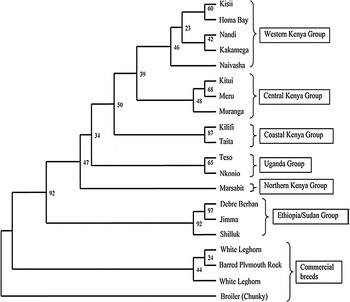
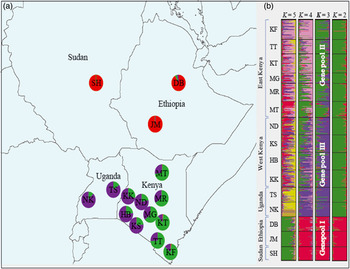
Maina (Reference Maina2000) characterized indigenous chicken based on morphology and feather colours, and reported wide variations in these features. They reported the crested genotype to be more distinct than others while the naked-neck and feathered shank were more genetically close to one another. There exists many morphological clades of indigenous chicken (Okeno, Kahi and Peters, Reference Okeno, Kahi and Peters2012) and evidenced adaptive, biological, reproductive and production traits variations (Kingori, Wachira and Tuitoek, Reference Kingori, Wachira and Tuitoek2010). Despite these observed variations, molecular characterization using 30 microsatellite markers, concluded that the Kenyan indigenous chicken can be grouped into four genetic clades; Coastal, Central, Western and Northern Kenya groups (Figure 2) (Mwacharo et al., Reference Mwacharo, Nomura, Hanada, Jianlin, Hanotte and Amano2007). Recent studies by the same authors using 30 autosomal microsatellite markers on genomic DNA revealed two major gene pools/groups. They included Eastern (Kilifi, Taita-Taveta, Muranga, Kitui, Meru, Marsabit) and Western (Kisii, Nandi, HomaBay, Kakamega) Kenya (Mwacharo et al., Reference Mwacharo, Nomura, Hanada, Han, Amano and Hanotte2013).This study also revealed population admixture between the two gene pools (Figure 3) with east to west genetic cline of gene pool two. In tandem to that study, Ngeno et al. (in press), while studying genetic diversity and MHC region variability in indigenous chicken in Kenya, reported that the indigenous chicken host 46 polymorphic MHC marker LEI0258 alleles. The Cluster analysis in that study indicated a clear ecotype subdivision into two to three genetically distinct groups. Two main population clusters indicated by ΔK and PCoA are Lamu (one cluster) and populations from Kakamega, West Pokot, Turkana, Bomet, Narok and Siaya as a second cluster. An extra group (third cluster) was from Taita-Taveta. It is worth noting that although the two studies reported equal gene pool numbers, the sampling sites were different. Ngeno et al. (in press) sampled from localities that were never reached by the cockerels exchange programme (Wainaina Reference Wainaina1994). Besides, Mwacharo et al. (Reference Mwacharo, Nomura, Hanada, Han, Amano and Hanotte2013) did not sample from Lamu a distinct cluster realized in Ngeno's study.
Dendrogram showing phylogenetic relationships within and between Kenyan and other indigenous chicken sampled from Ethiopia, Uganda and Sudan. The numbers at each interior node is the bootstrap value from 1000 re-samplings of loci with replacement (Mwacharo et al., Reference Mwacharo, Nomura, Hanada, Jianlin, Hanotte and Amano2007).

(a) Geographic distribution of village chickens. The shaded area in each pie is proportional to the number of individuals in each population observed for each gene pool. (Population abbreviations: East of Kenya: KF, Kilifi; TT, Taita; KT, Kitui; MG, Muranga; MR, Meru; MT, Marsabit; West of Kenya: KS, Kisii; ND, Nandi; HB, Homa Bay; KK, Kakamega; Ethiopia: DB, DebreBerhan; JM, Jimma; Sudan: SH, Shilluk; Uganda: TS, Teso; NK, Nkonjo). Colour codes: Red, Gene pool I; Green, Gene pool II: Purple, Gene pool III. (b) Bayesian analysis of population structure of East African village chickens. Individuals (represented by single vertical lines) are assigned to three distinct gene pools based on clustering result at K = 3. Color codes: Red, Gene pool I; Green, Gene pool II; Purple, Gene pool III. (Mwacharo et al., Reference Mwacharo, Nomura, Hanada, Han, Amano and Hanotte2013).

Contributions of indigenous chicken to rural households
Village chickens make substantial contributions to household food security throughout the developing world. Indigenous chicken serves as an investment and source of security for households in addition to their use as sources of meat and eggs for consumption and of income (Muchadeyi et al., Reference Muchadeyi, Eding, Wollny, Groeneveld, Makuza, Shamseldin, Simianer and Weigend2007a, Reference Muchadeyi, Wollny, Eding, Weigend, Makuza and Simianer2007b). Indigenous chicken are alternative source of animal protein due to the fact that they can be slaughtered and consumed as a single meal hence do not require storage facilities. Their demand is ever increasing and thus marketing is easy thus providing source of income to resource-poor rural families (Bett et al., Reference Bett, Musyoka, Peters and Bokelmann2012a, Reference Bett, Bett, Peters, Kahi and Bokelmann2012b). They are also a means of investment in low-input farming systems in the tropics (Dana, Van der Waaij and Van Arendok, Reference Dana, Van der Waaij and Van Arendok2011; Okeno, Kahi and Peters, Reference Okeno, Kahi and Peters2012). Besides rural households, these low-input, low-output poultry-husbandry systems are an integral component of the livelihoods of most of peri-urban, and some urban households in most parts of the developing world (Magothe et al., Reference Magothe, Okeno, Muhuyi and Kahi2012). A review by Guèye (2000) indicated that an average family flock of five adult chickens (two males and three females) enabled women in Central Tanzania to generate an additional income equivalent to 10 percent of the average annual income. In the Niger Delta, family poultry husbandry contributes 35 percent of the income of household women, which represents about 25 percent of Nigerian minimum wage and 50 percent of the per capita income. Experiences in many other developing countries have shown that village poultry can be used as an effective means of empowering women and as a tool for poverty alleviation (Kitalyi, Reference Kitalyi1998). Besides economic considerations, the chickens are useful in a number of social, cultural and spiritual activities such as entertainments, gifts, funeral rights and spiritual cleansing (Njega, Reference Njega2005). In some parts of the country, cock fighting is an exciting and popular entertainment for rural folk (Maina, Reference Maina2000; Okeno, Kahi and Peters, Reference Okeno, Kahi and Peters2011).Other uses include disposal of kitchen leftovers, manure production, being biological clocks for telling time of day especially in rural areas and a means of controlling insect.
Conservation and utilization of indigenous chicken in Kenya
Having recognized the enormous roles played by indigenous chicken to the resource-poor rural households, the Kenya Government through National Poultry Development Programme (NPDP);initiated InCIP in 1974 (Wainaina, Reference Wainaina1994; Magothe et al., Reference Magothe, Okeno, Muhuyi and Kahi2012). The aim of the project was to increase the smallholder farmers’ income and protein intake through commercialization of indigenous chicken production. The program was implemented by importation of exotic breeds such as Rhode Island Red, White Leghorn, Black Australop and Light Sussex which were to be crossed with indigenous chicken. The idea was that famers were to be supplied with exotic pullets and cockerels in exchange for indigenous chicken cocks. The program was also supported by management practices such as massive vaccination of indigenous chicken for Newcastle disease and training of farmers and field officers on management of the improved stock. Although, the resultant genotypes had improved productivity, the program was terminated in 1993 as the subsequent crosses were not adapted to the harsh environmental conditions among other reasons (Magothe et al., Reference Magothe, Okeno, Muhuyi and Kahi2012). This unplanned and poorly organized cross-breeding strategy was also a danger to indigenous chicken genetic diversity and conservation.
Having learnt from mistakes done under NPDP (Magothe et al., Reference Magothe, Okeno, Muhuyi and Kahi2012), the Kenya Government and World Bank initiated a second improvement program in 2006.This was introduced under the umbrella InCIP (http://incip.org/) which was a collaborative project between the Ministry of Livestock Development, Egerton University, and Kenya Agricultural Research Institute. The main objective of this program was to undertake comprehensive analysis of indigenous chicken actors for the purpose of understanding the sub-sector and build human capacity in different fields in sub-sector. Such undertaking was found to be critical as it would provide insight in to the existing situations in terms of strengths, weaknesses, dynamics and complexities, which are important in formulating solutions. Currently the indigenous chicken actors in Kenya has been analysed (Bett et al., Reference Bett, Musyoka, Peters and Bokelmann2012a, Reference Bett, Bett, Peters, Kahi and Bokelmann2012b), the indigenous chicken sub-sector characterized, breeding objectives and management strategies defined and within indigenous chicken genotype and ecotype selection programme initiated (Ngeno, Reference Ngeno2011; Magothe et al., Reference Magothe, Okeno, Muhuyi and Kahi2012; Okeno, Kahi and Peters, Reference Okeno, Kahi and Peters2013).The InCIP programme activities are presently, mainly funded by European Union through African Union and have expanded its activities to other African countries such as Malawi in collaboration with Lilongwe University of Agriculture and Natural Resources. In Malawi the main aim of InCIP is to establishing local breeding programme for improvement and conservation of Malawian indigenous chicken which are also under threat due to indiscriminate cross-breeding with Black Australorp breed (Safalaoh, Reference Safalaoh2001). Previously, the Malawi Government introduced the Smallholder Poultry Improvement Programme (SPIP) in the 1950s with the objective to increase egg and meat production of indigenous chicken through cross-breeding with the Black Australorp (Safalaoh, Reference Safalaoh2001). Although the project has been running for more than 50 years, very few studies have been conducted to evaluate cross-breeding as a strategy to improve productivity of the indigenous chickens. The same scenario was realized in Kenyan case with no performance record taken to assess the magnitude, benefit and extend of genetic dilution of the indigenous chicken.
In 2012, the Kenyan Government and stakeholders in the poultry sector formulated Poultry Development Bill 2012 (http://www.parliament.go.ke/plone/archive/archive-10thParliament/bills). This bill has a lot of input emanating from InCIP activities and findings. Some of the key issues the bill addresses include characterization, conservation and development of indigenous poultry breeds, feed resources and disease control, marketing and capacity building. When passed to law the bill will regulate indiscriminate cross-breeding and replacement of indigenous chicken with exotic which is not only a threat to genetic diversity, but could also lead to extinction of some of the uniquely adapted indigenous chicken genotypes and ecotypes.
Utilization of cross-breeding programme has been practiced and benefit noted (Safalaoh, Reference Safalaoh2001). However for its ultimate success a clear strategy has to be adhered to. Amongst them, is training of farmers on proper guidelines on how to conduct the cross-breeding. For instance because the exotic hens do not sit on their eggs, the farmers should be encouraged to buy exotic cocks which can then be crossed with local hens (Okeno, Kahi and Peters, Reference Okeno, Kahi and Peters2013). Where local cocks are crossed with exotic hens, the fertilized eggs from the exotic hens should be placed under local brooding hens for natural incubation. Alternatively, the eggs can be placed, in artificial incubators if the facility is presented. Rather than leaving the task of cross-breeding to the farmers, InCIP could be encouraged to carry out the cross-breeding themselves so that the farmers are actually sold the cross-breeds as a terminal product. This would require identification and selection of the local breeds with the best performance in terms of desired traits (Okeno, Kahi and Peters, Reference Okeno, Kahi and Peters2013). The cross-breeds could combine the characteristics of improved productivity from the exotic breeds and adaptability and stress tolerance to the local harsh conditions from the local chicken and should be able to survive in the prevailing harsh village conditions better than the exotic breeds.
Past attempts to genetically improve indigenous chickens of Kenya
The demand and popularity of indigenous chicken genetic resources has been increasing since time immemorial (Okeno, Kahi and Peters, Reference Okeno, Kahi and Peters2012).Market trends in Kenya, see consumers shifting interest from the dominant hybrid layer eggs and broiler meat towards what is conceived as a healthier diet of free-range or indigenous eggs/chicken. According to Magothe et al. (Reference Magothe, Okeno, Muhuyi and Kahi2012), from 1984 to 2004, indigenous chicken population increased by more than 75 percent and their egg and meat products increased by more than 34 and 79 percent, respectively. The observed increase was attributed to an increase in the human population and hence a corresponding demand for indigenous chicken products. In recent study to assess the demand and price dynamics of indigenous chicken products in Kenya (Bett, Peters and Bokelman, Reference Bett, Peters and Bokelman2011), there is evidence of escalating indigenous chicken products prices and the consumers’ willingness to pay more as compared with other poultry products . The observed increase in demand of indigenous chicken products by consumers has caused farmers, Research Institute, Universities, Government and Non-governmental organizations, to engage in attempts to improve their productivity. For instance, since 2006 in the forefront is the Smallholder InCIP at Egerton University that has established breeding and multiplication centre and initiated a number of activities to improve the indigenous performance (www.incip.org).
Previously, poor quality and inadequate feed resources, health care, marketing, housing and lack of breeding stock have been identified as constraints towards improved performance of indigenous chicken in developing countries (Gondwe and Wollony, Reference Gondwe and Wollony2007; Kingori, Wachira and Tuitoek, Reference Kingori, Wachira and Tuitoek2010; Okeno, Kahi and Peters, Reference Okeno, Kahi and Peters2011). To address nutritional constraints in Kenya, attempts have focused on models to supplement feeding at different times and stages of growth and production, determining protein and energy requirement levels (Chemjor, Reference Chemjor1998; Kingori, Wachira and Tuitoek, Reference Kingori, Wachira and Tuitoek2010). Although, these interventions increased productivity under on-station (Kingori, Wachira and Tuitoek, Reference Kingori, Wachira and Tuitoek2010), their adoption and sustainability under on-farm conditions was low due to high unavailability of feed resources, high cost of formulated feeds and low genetic potential of indigenous chicken for growth and egg production.
The past genetic improvement programmes for increasing chicken productivity in developing countries mainly focused on use of imported temperate breeds (Dana, Van der Waaij and Van Arendok, Reference Dana, Van der Waaij and Van Arendok2011). Many exotic breeds of chicken (White and brown Leghorns, Rhode Island Red, New Hampshire, Cornish, Australorp, Light Sussex etc.) were introduced over the years. The other approach to improve productivity of the village poultry production was based on use of cross-bred animals. This involved crossing of unselected local chicken to different levels of exotic blood. In Ethiopia for instance, evaluations of cross-bred chicken at the DebreZeit Agricultural Research Centre indicated that 62.5 percent white leghorn crosses showed superior performance to the locals as well as pure white leghorns in terms of egg production (DZARC, 1991, 2007). In a cross-breeding programme at Assela, Brannang and Persson (Reference Brannang and Persson1990) also compared different York × local crosses. Their results indicated that egg production declined with increasing level of exotic inheritance (above 50 percent). Increasing the level of exotic blood also resulted in loss of broody behaviour, a trait of considerable economic value under village systems. Although the cross-breeding programmes produced successful results under experiment stations almost all of them were discontinued decades ago for various reasons (Dana, Reference Dana2011).
In the 1970s and 1980s the Ministry of Agriculture in Kenya and Ethiopia, respectively, initiated a cockerel distribution scheme. This involved importation and distribution of cockerels to be used as breeding males in villages. In Ethiopia, the scheme failed because farmers were unwilling to remove their local cocks and the exotic cocks failed to adapt in the village environments (Dana, Van der Waaij and Van Arendok, Reference Dana, Van der Waaij and Van Arendok2011).
In Kenya, the genetic improvement was started through a cross-breeding scheme by the National Poultry Development Programme (NPDP); unlike Ethiopia, the programme utilized crossing between cockerels and pullets of exotic breeds with the local indigenous chicken. The initiative termed cockerel exchange programme started in 1976 initially in 12 districts and by 1980 another additional 9 districts were included. Later more districts were recruited into the programme and by 1993, 26 out of 54 districts were involved in the programme (FAO, 2007a, 2007b). A hybrid cock was exchanged for the local cock and then all the local cocks were killed. For the pullet exchange, a farmer was required to keep 10–15 pullets. Farmers’ training on poultry management and vaccination for disease control was also undertaken as components. The programme witnessed improved performance in the crossbreds but declined with subsequent generations (Okeno, Kahi and Peters, Reference Okeno, Kahi and Peters2012). Failure of the programme to meet stakeholders’ expectation led to its termination in 1994 (FAO, 2007a, 2007b). The factors attributed to its failure included poor planning and understanding of the indigenous chicken sub-sector with respect to production environment, needs of actors (i.e. farmers, marketers and consumers), lack of clear breeding objectives and lack of sustainable breeding programme to supply constant pure-line breeding stock (Ndegwa et al., Reference Ndegwa, Mead, Norrish, Shephered, Kimani and Wachira2012).
Current genetic improvement of Indigenous chicken in Kenya
Since 2006 another collaborative programme called the Smallholder InCIP was initiated with the view of holistic and comprehensive approach to analysing the entire indigenous chicken production actors and avert the causes of previous failures. The InCIP mandate is to characterize the indigenous chicken production system, develop clear breeding objectives accounting for all players in the sectors, design appropriate selection and mating schemes for modern dissemination of superior genetic resources. It is therefore true that InCIP has in mind the fundamental questions common to a breeder namely; “which are the best indigenous chicken among and between the populations and how can they be genetically improved?”
In addressing these questions, InCIP initiated basic but prudent methodologies. First, eggs and live birds were collected from various Agro-ecological regions or ecotypes namely; Kakamega, Bondo, Narok, West Pokot, Bomet, Taita-Taveta, Lamu, Egerton and Mwingi. These ecotypes are currently on-station at Egerton University Poultry Research and Breeding (PRB) facility for multiplication, performance recording and selection. It is upon the performance records that selection and mating are based. In line with the project objectives several studies have been conducted and findings disseminated. Ngeno (Reference Ngeno2011) reported variations on body weights among the ecotypes, and further estimated heritabilities and genetic correlations. A similar study by Magothe, Muhuyi and Kahi (Reference Magothe, Muhuyi and Kahi2010) showed that the naked-neck, frizzle and crested-head genotypes do influence body weights and growth patterns. Magothe, Muhuyi and Kahi (Reference Magothe, Muhuyi and Kahi2010) noted that the crested-head genotype had a slower growth rate and were lighter compared with the normal-feather genotype when subjected to the same level of management. Growth rate and egg production being inversely correlated, the authors speculated that the crested-head genotype could be a superior egg producer. This hypothesis is currently being tested on-station at Egerton University. Several studies done outside Kenya on general or morphological characterization, production and reproduction performances of available indigenous chicken genotypes did not vary from Kenyan situation (Okeno, Kahi and Peters, Reference Okeno, Kahi and Peters2010).
In determining where to go, a study by Okeno, Kahi and Peters (Reference Okeno, Kahi and Peters2011) determined the selection criteria by farmers and traits of economic importance preferred by the farmers. In that study, the authors reported that farmers prefer selection based on growth rate, large body size, high egg production, hatchability and good mothering ability. They also indicated that normal feathered, crest-head, necked-neck and giant (i.e. big body size) genotypes were the most predominant genotypes (Figure 1). To define breeding objectives among farmers, marketers and consumers, the study identified egg number, growth rate, body size, fertility, disease resistance, meat quality, egg size, egg shell colour, broodiness and mothering ability to be traits of economic importance (Okeno, Kahi and Peters, Reference Okeno, Kahi and Peters2012). However, all these traits cannot be included in the breeding objectives and some are negatively correlated, this therefore calls for critical decisions to be made on which trait to account for in the breeding objective. In a simulation study Okeno, Kahi and Peters (Reference Okeno, Kahi and Peters2013) demonstrated that improving IC for growth and therefore meat production would result to better genetic gains and economic returns. Based on this finding the selection for indigenous chicken at the PRB has been focused on growth.
Future genetic improvement strategies
The future genetic improvement practices will be done at PRB, Egerton University and are based on the previous findings of Okeno, Kahi and Peters (Reference Okeno, Kahi and Peters2013) and principles of genetic improvement of livestock. The InCIP noble course is anchored on Millennium Development Goals (UNDP, 2013) through Kenya Vision 2030 (www.vision2030.go.ke) for eradication of extreme poverty and hunger and improved food security in Kenya respectively. In plan are a plethora of integrated quantitative and molecular research projects to be formulated and implemented. To improve disease resistance, InCIP intends to first determine genetic variation among the indigenous chicken ecotypes and genotypes using both innate (natural antibodies, compliment) and adaptive immunity (interleukins, specific antibodies after vaccine challenge).If variation exists, the birds will be divergently selected for low and high immune response for subsequent generations. Individual performance will be recorded and pedigree data established. This will assist in estimating genetic parameters. Breeding for enhanced immunity is sustainable (Parmentier et al., Reference Parmentier, Baelmans, Savelkoul, Dorny, Demey and Berkvens2004; Okeno, Kahi and Peters, Reference Okeno, Kahi and Peters2010), will save the farmer their money for antimicrobial drugs and eradicate the consumers’ food safety concerns. Such study will give insight in the biological mechanism of immunity for genetic control of a plethora of ever increasing pathogens of birds and compliment vaccination strategy as a disease prevention measure (Parmentier et al., Reference Parmentier, Baelmans, Savelkoul, Dorny, Demey and Berkvens2004; Khobondo, Reference Khobondo2012). Following Okeno, Kahi and Peters (Reference Okeno, Kahi and Peters2012), recommendation based on traits preferred by farmers, there is already on-station selection for improved production and reproduction traits for subsequent estimation of genetic parameters and variance components for the economically important traits. Such selection programmes will cause change in input requirements, e.g. feed intake for maintenance and production requirements of the birds. Since feed costs account for over 70 percent of the cost of production (Kingori, Wachira and Tuitoek, Reference Kingori, Wachira and Tuitoek2010), InCIP considers avenues to reduce costs of production besides increasing revenues. This makes feed efficiency (a measure of how much saleable product is produced for each unit of feed consumed and can be expressed as either gross feed efficiency or net feed efficiency) a trait of economic importance that should be included in breeding objective alongside production traits due to its direct influence on production costs. The aim of incorporating feed efficiency study is to carry out an analysis of net feed efficiency within the indigenous chicken flock in Kenya. In the proposed study, variance components, genetic and phenotypic parameters for net feed efficiency traits and growth characteristics will be estimated and the genetic and phenotypic parameters obtained. The results from this study will provide information required for breeding programmes aimed at improving efficiency in the production of indigenous chicken.
To achieve these goals InCIP team will employ basic breeding tools of mating and selection on-station. Pure-line ecotypes will be selected generation after generation based on economic traits (Okeno, Kahi and Peters, Reference Okeno, Kahi and Peters2012) at nucleus tier, multiplied at the second tier for ultimate cross-breeding/mating at the commercial tier. The resulting hybrid will then be sold to farmers. It is with no doubt there are morphological and production variations amongst the different ecotypes and genotypes (Magothe, Muhuyi and Kahi, Reference Magothe, Muhuyi and Kahi2010; Ngeno, Reference Ngeno2011), this calls for molecular characterization using microsatellite and single nucleotide polymorphism (SNPs) to decipher the witnessed differences.
InCIP will employ the safest conservation method by continuous breeding involving sufficient numbers of birds to avoid inbreeding and genetic drift (FAO, 2007a, 2007b). InCIP propose to train farmers to optimally utilize the indigenous chicken that match with their environment and production system. For instance, in hot and cold ecozones/regions, InCIP will advocate for rearing of adaptive genotypes that best suits the environment. Where management is enhanced, with high input availability, high producing meat and egg pure lines will be encouraged. This may be complimented with cross-breeding with exotic breeds. In addition, InCIP plans to use cryoconservation method. Cryoconservation of avian sperms, ova and embryo has been successful in France (Blesbois, Reference Blesbois2007; Blesbois et al., Reference Blesbois, Grasseau, Seigneurin, Mignon-Grasteau, Saint Jalme and Mialon-Richard2008). For traits with low heritability, InCIP will employ genome wide association studies to build a consensus prediction formula for genomic breeding value estimation in the nucleus scheme. This will lower generational interval and could be economical in long run.
Conclusions
There have been several attempts to improve indigenous chicken production and address constraints in their production in Kenya. These attempts had minimal success due to, among others, lack of a holistic approach in solving the constraints and dissemination of inappropriate technologies given the production circumstances and market dynamics. This review has highlighted the various past attempts, discussed current improvement strategies and suggested possible future directions to improve the indigenous chicken productivity which could improve the livelihood of the rural households in line with Kenya vision 2030. Current studies have suggested potential for improvement of indigenous chicken production in Kenya given the available genetic and physical resources and have recommended a holistic approach/strategy that increases productivity. Future research entails modern studies that will improve traits of economic importance using quantitative genetics and genomics. Besides, the current improvement programme entails conservation strategies and cross-breeding principles.
Acknowledgement
We acknowledge the Indigenous Chicken Improvement Programme for the provision of facilities. The programme is funded by the European Union through the African Union.
Statement of interest
No conflict of interest.