Introduction
Pine shoot beetles of genus Tomicus (Coleoptera: Curculionidae: Scolytinae) are destructive to forests worldwide (Bakke, Reference Bakke1968; Postner, Reference Postner and Schwenke1974; Långström, Reference Långström1983; Långström & Hellqvist, Reference Långström and Hellqvist1990, Reference Långström and Hellqvist1993). In Southwestern China, Tomicus minor, Tomicus yunnanensis, and Tomicus brevipilosus are the most destructive pests of Pinus yunnanensis Franch (Ye, Reference Ye1992; Ye & Lieutier, Reference Ye and Lieutier1997; Långström et al., Reference Långström, Lisha, Hongpin, Peng, Haoran, Hellqvist and Lieutier2002). They attack the fresh shoots of living trees, which can weaken the host and curtail growth (Stark, Reference Stark1952; Chararas, Reference Chararas1962; Byers, Reference Byers1992), sometimes harming 100% of the shoots and causing death directly (Ye & Li, Reference Ye and Li1994; Ye & Lieutier, Reference Ye and Lieutier1997; Ye & Ding, Reference Ye and Ding1999; Långström et al., Reference Långström, Lisha, Hongpin, Peng, Haoran, Hellqvist and Lieutier2002; Lieutier et al., Reference Lieutier, Ye and Yart2003). In Yunnan province, Tomicus has caused extensive mortality of Yunnan pines (P. yunnanensis), affecting over 200,000 ha of pine plantations (Lieutier et al., Reference Lieutier, Ye and Yart2003), and 93,000 ha of Yunnan pines have withered because of damage (Ji et al., Reference Ji, Xie-qiong, Hong-ping, Li-shai, Hong, Xiao-peng, Haoran and Sang-zi2007).
In Southwestern China, three bark beetle species coexist together with different compositions in different locations. T. minor mostly occurs together with T. yunnanensis and sometimes with T. brevipilosus or both of them. In the southwest part of Yunnan, the main species is T. brevipilosus. We also observed that T. minor and T. yunnanensis, but not T. brevipilosus, coexisted in the same shoot when dissecting damaged shoots in the laboratory. However, the tunnels of the three species were not interconnected in the shoots. Lu et al. (Reference Lu, Zhao and Ye2014) found that the entrance hole of T. minor was the closest to the apical bud, and that of T. yunnanensis was furthest away from the apical bud.
The pioneer bark beetle identifies susceptible trees by kairomonal, visual, and/or gustatory cues (Lindgren & Borden, Reference Lindgren and Borden1989) or volatiles derived from the host trees (Byers et al., Reference Byers, Lanne, Löfqvist, Schlyter and Bergström1985; Lanne et al., Reference Lanne, Schlyter, Byers, Löfqvist, Leufvén, Bergström, van der Pers, Unelius, Baeckström and Norin1987; Byers, Reference Byers1989; Ye & Li, Reference Ye and Li1994; Ye & Lieutier, Reference Ye and Lieutier1997; Lieutier et al., Reference Lieutier, Ye and Yart2003; Poland et al., Reference Poland, de Groot, Burke, Wakarchuk, Haack and Scarr2003). Tomicus piniperda is not considered an aggressive species in Europe (Långström & Hellqvist, Reference Långström and Hellqvist1993) and there is no evidence of an aggregation pheromone (Byers et al., Reference Byers, Lanne, Löfqvist, Schlyter and Bergström1985; Löyttyniemi et al., Reference Löyttyniemi, Heliövaara and Repo1988); rather, host-tree monoterpenes (kairomones) were attractive (Byers et al., Reference Byers, Lanne, Löfqvist, Schlyter and Bergström1985; Byers, Reference Byers1995). However, T. piniperda was attracted to myrtenol and trans-verbenol (Volz, Reference Volz1988), which had been isolated and identified from the hindgut extracts of boring females of T. piniperda (Lanne et al., Reference Lanne, Schlyter, Byers, Löfqvist, Leufvén, Bergström, van der Pers, Unelius, Baeckström and Norin1987). Song et al. (Reference Song, Ren, Sun, Zhang, Zhang and Gao2005) trapped T. piniperda using semiochemical lures in Changchun City in Northeastern China, and observed that α-pinene was the most attractive terpene and that α-pinene was significantly more attractive to T. piniperda when it was mixed with trans-verbenol.
T. destruens was attracted slightly to the host volatile α-pinene, but a strong synergistic effect was found in the attraction towards monoterpenes when ethanol was added to the bait (Gallego et al., Reference Gallego, Galián, Diez and Pajares2008). There is still limited information on the chemical stimuli that govern host selection by T. destruens adults, although they are known to be attracted by Mediterranean pine shoots and their extracts (Faccoli et al., Reference Faccoli, Anfora and Tasin2008).
Lanne et al. (Reference Lanne, Schlyter, Byers, Löfqvist, Leufvén, Bergström, van der Pers, Unelius, Baeckström and Norin1987) identified trans-verbenol from hindgut extracts of both sexes of T. minor collected on Scots pine (Pinus sylvestris L.) and suggested that the female may produce aggregation pheromones. However, T. minor was observed to damage Scots pine in the upper part of trees in Southern Sweden (Långström, Reference Långström1983; Lanne et al., Reference Lanne, Schlyter, Byers, Löfqvist, Leufvén, Bergström, van der Pers, Unelius, Baeckström and Norin1987), and it was observed to damage P. yunnanensis in the lower part of trees in Southwestern China (Lu et al., Reference Lu, Wang, Zhang, Byers, Jin, Wen and Shi2012).
T. yunnanensis attacks P. yunnanensis by aggregating on shoots and boring into them during shoot feeding to predispose pines to subsequent trunk attacks in Yunnan province (Ye, Reference Ye1993, Reference Ye, Gregoire, Liebhold, Day and Salom1997; Ye & Li, Reference Ye and Li1994; Ye & Lieutier, Reference Ye and Lieutier1997; Långström et al., Reference Långström, Lisha, Hongpin, Peng, Haoran, Hellqvist and Lieutier2002; Lieutier et al., Reference Lieutier, Ye and Yart2003). Laboratory tests also showed that T. yunnanensis had a positive response to extracts of shoots of P. yunnanensis during shoot feeding (Yan et al., Reference Yan, Ma and Ze2011). Host-seeking behaviour and pheromones of T. brevipilosus have not been reported. However, T. yunnanensis and T. brevipilosus were identified incorrectly as T. piniperda in Southwestern China until 2008 (Kirkendall et al., Reference Kirkendall, Faccoli and Ye2008); therefore, the prevailing understanding of the behaviour of these three beetle species must be reexamined.
Thus far, Tomicus beetles are mainly controlled by removing damaged wood, using chemical control (Lu et al., Reference Lu, Zhang, Li and Liu2000; Gitau et al., Reference Gitau, Bashford, Carnegie and Gurr2013), and using trap trees (Braquehais, Reference Braquehais1973). Investigation of many possible management tactics using semiochemical strategies (kairomones) has led to operational management programmes, such as the utilisation of semiochemical-baited traps to suppress bark beetle populations and the use of inhibitors to protect vulnerable host trees from attack (Gitau et al., Reference Gitau, Bashford, Carnegie and Gurr2013). For example, traps can reduce population densities to levels below the critical threshold (El-Sayed et al., Reference El-Sayed, Suckling, Wearing and Byers2006; Hansen et al., Reference Hansen, Bentz, Munson, Vandygriff and Turner2006; Schiebe et al., Reference Schiebe, Blaženec, Jakuš, Unelius and Schlyter2011).
Control of Tomicus is difficult because they have two different dispersion phases: towards the canopy of healthy trees and towards the trunk of dying trees. Their small size, elusiveness, and largely cryptic feeding habit have also made their control difficult. Researches have mainly focused on the trunk-breeding stage. To control damage to trees in Southwestern China, it is imperative to focus on the maturation feeding stage and not only on the breeding stage (Lieutier et al., Reference Lieutier, Ye and Yart2003). The concentration of shoot attacks is the main reason for the extensive tree damage observed in China (Lieutier et al., Reference Lieutier, Ye and Yart2003). Successful shoot feeding weakens the host tree, generating conditions conducive for subsequent trunk breeding. In addition, some T. minor individuals may mate in the shoots during the shoot-feeding stage (Ye et al., Reference Ye, Lv and Francois2004). Shoot feeding lasts for 7–9 months, thereby severely injuring pine trees. Volatiles released by bark beetles or those released from the host in response to bark beetle infestation may collect more beetles to damage shoots. Therefore, it is important to study the shoot-feeding stage.
The main purposes of this study were to determine: (1) the intraspecific attraction of the three beetle species; (2) the interspecific relationships of the three beetle species; and (3) the existence of semiochemicals that can affect the attraction of the three species during shoot feeding. This study provides an in-depth understanding of the relationship between beetles and pines and among beetle species, in addition to evidence for further identification of the semiochemicals during the shoot-feeding period.
Materials and methods
Collection of beetles
The three species of beetles were obtained from naturally infested shoots that were cut from pine trees. The damaged shoots were 30–40 cm long, had many yellow needles, and they were collected in two plantations of pure pine trees in Yunnan province, Southwestern China. The first site was located on a small mountain near Jianshui County (N23°42′37.8″, E102°45′55.0″, 1620 m elevation), where T. minor and T. yunnanensis were collected on P. yunnanensis. The second site was located near Puer City (N22°54′09.20″, E101°15′27.87″, 1400 m elevation), where T. brevipilosus was collected on Pinus kesiya. Samples were collected from May to September 2013. The trees were 10–30 years old and ranged from 3 to 15 m in height, with a diameter at breast height of approximately 8–20 cm. The shoots were brought back to the laboratory and stored at 4°C. Beetles were dissected from the shoots and separated by species and sex. They were distinguished under a stereoscope by the presence of erect hairs, granules, and punctures on the elytral declivity, as described by Kirkendall et al. (Reference Kirkendall, Faccoli and Ye2008). Adults were then maintained at 4°C in the dark on moistened absorbent cotton in Petri dishes, at 80% relative humidity, until their use in experiments.
Odour source
Three substances were used as the odour source in an experimental trial. Shoots were separated according to beetle species and sex. First, we used a beetle-damaged shoot as the odour source. The shoot was placed in a glass container with an inner diameter of 12 cm and a length of 50 cm. The container was connected to a constant supply of clean air, produced by a generator, by a Teflon tube that had a 3-mm inner diameter. In the second round of tests, shoot extracts were used. Shoots damaged by different beetle species and sexes were sheared into pieces measuring 2 mm × 2 mm, and 5-g fragments were weighed and soaked in a sample vial containing 10 ml of n-hexane for 12 h. The extracts were preserved in 4°C. The third round of tests used the dynamic headspace sampling method. Ten damaged shoots for which the damaging species and sexes were known were placed in sealed odourless PE fresh-keeping film (Toppits, Canada) to collect the volatiles. The volatiles were trapped in a glass tube (15 × 0.3 cm, Chrompack) containing Porapak Q (adsorbent, 150 mg, Amberlite XAD-2). The glass tube was connected with a Teflon tube, one end of which was connected to the air inlet of the air generator, and the other end of which was connected to the PE fresh-keeping film. The ends of the other Teflon tube were connected to the air outlet of the air generator and the PE fresh-keeping film, respectively. (In other words, both tubes were covered by the odourless PE fresh-keeping film at one end, while the other ends were connected to the air inlet and air outlet of the air generator, respectively.) The airflow rate was 0.5 l min−1. The collecting process was operated in a closed circulation system and lasted for 8 h. Volatiles trapped in Porapak Q were rinsed with 4 ml of n-hexane before being concentrated to 2 ml. The eluate was preserved at 4°C.
Laboratory bioassay of walking beetles
The responses of beetles to the three odour sources were tested using a modified open-arena olfactometer. The open-arena bioassay was performed as described by Byers & Wood (Reference Byers and Wood1981), Lanne et al. (Reference Lanne, Schlyter, Byers, Löfqvist, Leufvén, Bergström, van der Pers, Unelius, Baeckström and Norin1987), and Byers (Reference Byers2012). The test of taxis was conducted in a flat glass plate in which four circles were drawn, one with a radius of 19 cm and three with a radius of 2 cm. Small circles were drawn in the odour region, and one of them was tangent to the larger circle. The other two small circles were drawn 10 cm away on either side of the small circle that was tangent to the larger circle. The device consisted of an air generator that drew air out of the room through two Teflon tubes (3-mm inner diameter) placed at the ‘downwind’ side. At the ‘upwind’ end of the olfactometer system, the air containing the odour was forced through an air generator by a Teflon tube. The other two tubes were placed 10 cm apart, horizontally, on either side of the middle one. The air generator maintained an approximately laminar airflow with a speed of 0.5–0.6 m s−1 at the semiochemical source, 15 cm from the centre of the bigger circle. The beetles were released in the centre of the larger circles. The air containing volatiles from three tubes was treated with powdered activated carbon and then blown towards the other end of the larger circle (fig. 1).
Laboratory bioassay of walking beetles (black squares represent filter paper; arrows represent airflow direction).

A 10-μl volume of shoot extracts or dynamic headspace volatiles was placed on a piece of filter paper (1.2 cm × 1.2 cm) in the odour region. A volume of 10 μl of n-hexane was dropped on the same filter papers placed on either side of the odour region. The n-hexane was replaced by filtered air when the attracting substance was replaced by damaged shoots. In the control group, the odour source was replaced by n-hexane, and the damaged shoots were replaced by undamaged shoots.
One beetle of each sex was released at the centre of the larger circle for each trial. The number of times that the beetle entered the odour region within 5 min after release was recorded. Each beetle was used only once but the assay was repeated eight times for each beetle. Five beetles were used in each treatment.
Data analysis
The number of times that the beetles entered the odour region was used to evaluate the level of attraction for each substance. Data were subjected to non-parametric tests in SPSS 19.0. Independent samples were evaluated using the Kruskal–Wallis test, which was followed by all possible pairwise multiple comparisons at α = 0.05 in all analyses. Figures were drawn in Excel 2010. Values and standard errors in the figures refer to the mean number of times the beetles entered the odour region area for each tested volatile.
Results
Attraction to damaged shoots
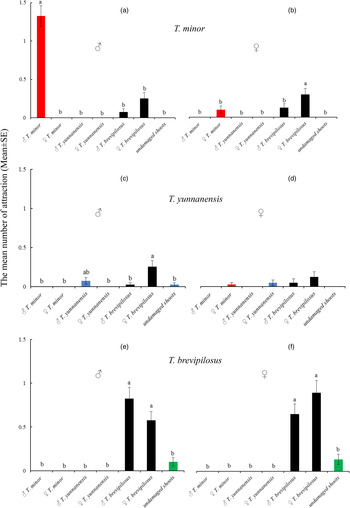
The test using damaged shoots indicated that overall, beetles were more attracted to shoots damaged by T. brevipilosus (fig. 2). However, male T. minor (fig. 2a) showed the strongest attraction to shoots that had been damaged by male T. minor. T. minor showed no attraction to undamaged shoots or to shoots damaged by either sex of T. yunnanensis; similarly, T. yunnanensis was not attracted to shoots damaged by T. minor.
Attraction of male (a) and female (b) T. minor, male (c) and female (d) T. yunnanensis, and male (e) and female (f) T. brevipilosus to shoots that had been damaged by beetles of different species and sexes. Bars with the same letters are not significantly different. Lowercase letters show significant difference, P < 0.05. Kruskal–Wallis test; n = 40.

T. yunnanensis (fig. 2c, d) individuals did not show attraction to shoots that had been damaged by their own species and sex, but males were attracted to shoots damaged by female T. brevipilosus.
Male and female T. brevipilosus (fig. 2e, f) showed stronger attraction to shoots that had been damaged by their own species than to shoots damaged by others.
Attraction to shoot extracts
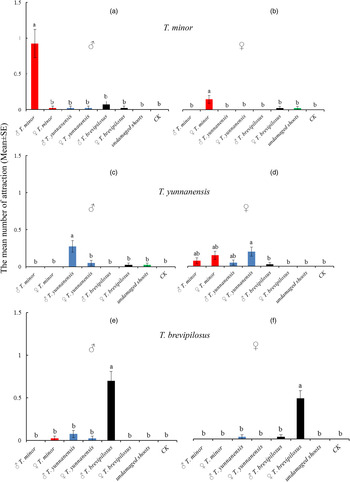
Beetles were attracted only to extracts from shoots that had been damaged by beetles of their own species and sex (fig. 3).
Attraction of male (a) and female (b) T. minor, male (c) and female (d) T. yunnanensis, and male (e) and female (f) T. brevipilosus to extracts from shoots that had been damaged by beetles of different species and sexes. Bars with the same letters are not significantly different. Lowercase letters show significant difference, P < 0.05. Kruskal–Wallis test; n = 40.

Attraction to dynamic headspace volatiles
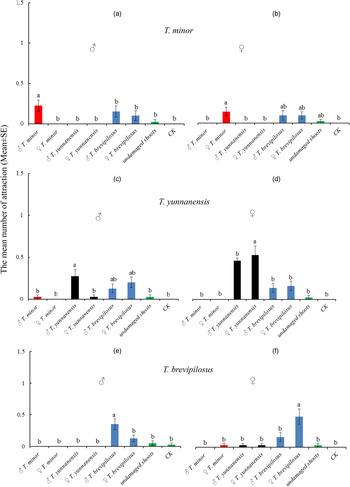
Beetles were strongly attracted to dynamic headspace volatiles that had been extracted from shoots damaged by their own species and sex; the only exception was female T. yunnanensis (fig. 4), which was attracted to dynamic headspace volatiles extracted from shoots damaged by both sexes of its own species.
Attraction of male (a) and female (b) T. minor, male (c) and female (d) T. yunnanensis, and male (e) and female (f) T. brevipilosus to dynamic headspace volatiles extracted from shoots that had been damaged by beetles of different species and sexes. Bars with the same letters are not significantly different. Lowercase letters show significant differences, P < 0.05. Kruskal–Wallis test; n = 40.

Discussion
The different behaviours of the three bark beetle species may result from variation in the semiochemicals released from different damaged shoots, as the blend of volatiles released by plants in response to insect attack is specific for each insect–plant system (Engelberth et al., Reference Engelberth, Alborn, Schmelz and Tumlinson2004; Arimura et al., Reference Arimura, Matsui and Takabayashi2009). Attraction of the three bark beetles to damaged shoots and dynamic headspace volatiles showed similar trends, which suggests that the volatiles released from shoots damaged by the three bark beetle species affected the behaviour of the beetles. Further studies should investigate the identity of the volatiles and their specific effects.
There was almost no attraction between T. minor and T. yunnanensis individuals, except that T. yunnanensis showed attraction to extracts from shoots damaged by T. minor. The lack of attraction may be the result of different phenology and different host preferences and may explain why these two species share little overlap in the wild. It is possible that interspecific communication aids individuals in avoiding interspecific competition (Byers et al., 2013). Similar to the phenomena we observed, in the wild, the same beetle species are mainly discovered on a single shoot or in the same tree.
T. brevipilosus only showed strong attraction to shoots that had been damaged by the same beetle species. Furthermore, the three odour sources from shoots that had been damaged by T. brevipilosus were attractive to T. minor and T. yunnanensis, but not vice versa. It thus appears that dynamic headspace volatiles from shoots damaged by T. brevipilosus contain semiochemicals that attract T. minor and T. yunnanensis. This phenomenon may be mediated by herbivore-induced plant volatiles that effect the interactions between plants and arthropods (Arimura et al., Reference Arimura, Matsui and Takabayashi2009; Karban, Reference Karban2011), as beetle species may use the volatiles to control population quantity and maintain the ecological balance.
The shoots damaged by male and female T. minor attracted the same sex of T. minor. The same situation was observed for T. yunnanensis. However, the shoots damaged by T. brevipilosus attracted both sexes of T. brevipilosus. Liu et al. (Reference Liu, Zhang, Ye, Wang, Clarke and Lu2010) introduced 10 males or females, or 10 pairs of T. yunnanensis, into P. yunnanensis bolts, and the infested bolts captured both sexes of T. yunnanensis. We used the same method to trap T. minor in 2011; regardless of whether the bolts were inoculated with males, females or both sexes of the two beetle species, both sexes of the two beetle species were collected from each bolt (unpublished data). Therefore, conditions are different between the shoot-feeding and trunk-breeding periods.
The damage caused by the three Tomicus species in Southwestern China may be related to their aggregation on particular trees during the shoot-feeding period (Ye & Li, Reference Ye and Li1994; Ye & Lieutier, Reference Ye and Lieutier1997; Långström et al., Reference Långström, Lisha, Hongpin, Peng, Haoran, Hellqvist and Lieutier2002; Lieutier et al., Reference Lieutier, Ye and Yart2003). In wild lure experiments, we were not able to trap the three bark beetle species by only using host volatiles (terpinenes), whereas the beetles were lured by terpinenes mixed with terpinene alcohol (volatiles collected from the hindguts of bark beetles) (unpublished data). We speculate that the specific behaviour of three bark beetles in response to different odour sources during the shoot-feeding phase may not only be associated with the host volatiles. In addition, the three odour sources were mainly attractive to the same species and sex of bark beetles, which suggests the existence of special behaviour of the three bark beetle species during the shoot-feeding period.
The shoot extracts were extracted using n-hexane, which may include a number of non-volatiles or impurities because an optimal quantity of volatiles compounds is normally released by the plants into the atmosphere, whereas a different blend of volatiles is produced in response to herbivory (Arimura et al., Reference Arimura, Matsui and Takabayashi2009). Therefore, the extraction method may affect the chemical composition of dynamic headspace volatiles of damaged shoots. The dynamic headspace sampling method should be used over the shoot extract method to collect the different volatiles of different shoots in further studies.
In China, the tested Tomicus species are oligophagous on pine trees, such as P. yunnanensis and P. kesiya (Kirkendall et al., Reference Kirkendall, Faccoli and Ye2008). P. yunnanensis occupies the middle and northern areas of Yunnan where the three beetle species were observed, and P. kesiya is distributed in Southwestern Yunnan (Zhang et al., Reference Zhang, Yu, Li, Li, Li and Bao2014), where T. brevipilosus specimens were collected. We did not collect the three beetle species from the same sites or the same host trees for this experiment. The behavioural responses of T. brevipilosus to damaged shoots of P. yunnanensis and P. kesiya should be compared, and the chemical components of volatiles released by shoots damaged by T. brevipilosus from P. yunnanensis and P. kesiya should be identified in future work.
The semiochemicals released by the three beetles during this stage have not been elucidated. Further studies should include an analysis of the chemical component of dynamic headspace volatiles from damaged pines and hindguts of the three beetle species during different stages. These volatiles could be used to trap bark beetles in the wild. The relationships of the three beetle species with regard to semiochemical effects and the chemical mechanism of the relationships should be studied. Three possible attraction hypotheses should be tested: (1) pheromones exist that affect the behaviour of the beetles; (2) the behaviour is affected by the induced volatiles of host tree kariomones; and (3) both the pheromone and kariomone have interactive effects during the shoot-feeding stage. Such studies will promote the development of new semiochemical-based management methods to ensure the health of forestry.
Acknowledgements
The authors would like to thank Liu Yue, Li Xingwen, and Li Yongyong for their assistance during fieldwork, in addition to the Forest Pest Control Stations of Puer City and Jianshui County, Yunnan Province, China. This work was supported by National Natural Science Foundation of China (grant no. 31370655) and the National Science & Technology Pillar Program during the Twelfth Five-year Plan Period (2012BAD19B07).