Introduction
Cesar Majul, a distinguished scholar of Muslim Filipino studies, relates the following about the colonisation of Mindanao, which started in the early twentieth century in the Cotabato region under the American colonial system:
When the Americans came to Muslim lands after their arrival in the Philippines, they initially labeled the inhabitant[s] savages who needed to be pacified … . The Americans then assumed responsibility for westernising the Muslims so they would be as capable of governing themselves as the Christian Filipinos, at least at certain administrative levels. They sent Christian Filipino civil officials to Muslim area[s] to introduce new ways of government to the Muslims and to encourage both communities to cooperate in civic projects, in hopes of reducing deep-rooted Christian–Muslim animosity. Possibly, as part of this program, they encouraged Christian Filipinos to settle in Mindanao. Before World War I, they were even responsible for establishing at least seven agricultural colonies in traditional Muslim areas. Unlike the Spaniards, the Americans did not encourage Christian–Muslim animosity. By sending thousands of Christian settlers to Muslim lands, however, they sowed seeds of tensions and conflict between the two communities.Footnote 1
Interestingly, all instances of ‘they’ appearing in the above quotation connote ‘Americans’. Majul, equating the Christian Filipinos with the Muslims as ‘the colonised’, explained that ‘the Americans’ had promoted the Christian Filipino migration to Muslim areas. In the passage above, Majul obviously plays down and masks the role played by the Christian Filipino elite (the ilustrado) in Philippine colonial state-building. This description oversimplifies the relationship between the Americans and the Christian Filipinos, the coloniser and the colonised. Similar arguments can be found in other scholarly works that emphasise the strong desire of the Americans to develop and exploit Mindanao's abundant natural resources.Footnote 2
Mindanao was viewed as a land of promise by the US military and American capitalists and merchants who saw the island as having great potential for economic investment.Footnote 3 Governor Leonard Wood of Moro Province, for example, attempted various plans to develop the island. These included the extension of the Public Land Act to Moro Province, the acceptance of labourers to mitigate the labour shortage, the construction of customs posts and an invitation to commercial shipping from Hong Kong to dock at Zamboanga. Wood also enthusiastically supported railway construction in Mindanao.Footnote 4 Meanwhile, Christian Filipinos also viewed Mindanao as a land of promise, although in a different sense. Though initially not forming a majority of the island's population, they had migrated in great numbers to Surigao and Misamis in northern Mindanao at the start of the twentieth century. Since their encounters with Mindanao began during Spanish rule, it is worth examining how Christian Filipinos viewed Mindanao and how they contributed to Mindanao's colonisation during this formative period of Philippine colonial state-building.
In order to trace the role of the Christian elite, both resident in Mindanao and elsewhere in the Philippines, this paper will focus on the workings of the Philippine Assembly during the early American administration, through which bills related to Mindanao's colonisation took shape from 1907 to 1913. This study will explore in particular the debate between the Philippine Assembly (hereafter the Assembly) and the Philippine Commission (hereafter the Commission) over the bills, and will illustrate to what extent the Assembly, as a Lower House, was involved in policy-making concerning Mindanao's colonisation. It will also examine the motives and intentions of these bills' authors against the background of a vociferous public debate over proposals to separate Mindanao from the rest of the country. In short, this paper offers a critical analysis of the colonisation of Mindanao from the perspective of the Christian Filipino elite, rather than that of the Americans.
Of primary importance was an agricultural colony project popularly known as the ‘rice colonies’, implemented from 1913 to 1917 in Mindanao.Footnote 5 Over a five-year period, a total of six such colonies were created in Cotabato and one in Lanao. The sites within Cotabato were Pikit, Silit, Peidu-Pulangi, Pagalungan, Glan and Talitay. In Lanao, the Momungan colony was established for American ex-servicemen with Filipina wives. The ‘rice colony’ project aimed to alleviate the worsening land tenancy problem and serious food shortages caused by population increases in the more densely inhabited provinces. To cope with these issues, the project focused on two different groups of subjects: Christian Filipinos living outside Mindanao and Muslim Filipinos originally living in, or close to, potential agricultural colony sites. Two acts were devised to implement the project in 1913: the Philippine Commission Act (hereafter Commission Act) 2254 and the Commission Act 2280.Footnote 6 The former appropriated 400,000 pesos to establish the Rice Colonisation and Plantation Fund, while the latter, which came into force on 23 August 1913, appropriated 50,000 pesos to establish the Moro Colonisation and Plantation Fund.Footnote 7 These Acts are the basis of the perception that it was the Americans who initiated the agricultural project.
Careful examination of the legislative record reveals, however, that the agricultural colony project was originally introduced to the Philippine Legislature as the Philippine Assembly Bill 399 in 1913 by three Christian Filipino assemblymen: Leon Borromeo (Misamis), Lucio Gonzales (Nueva Ecija) and Vicente Lozada (Cebu). In addition, the exemplar of establishing the agricultural colony could already be found in an earlier bill: Assembly Bill 148 of 1910. Does this mean that the principal designers and executors of the agricultural colony project were Christian Filipinos and not Americans?
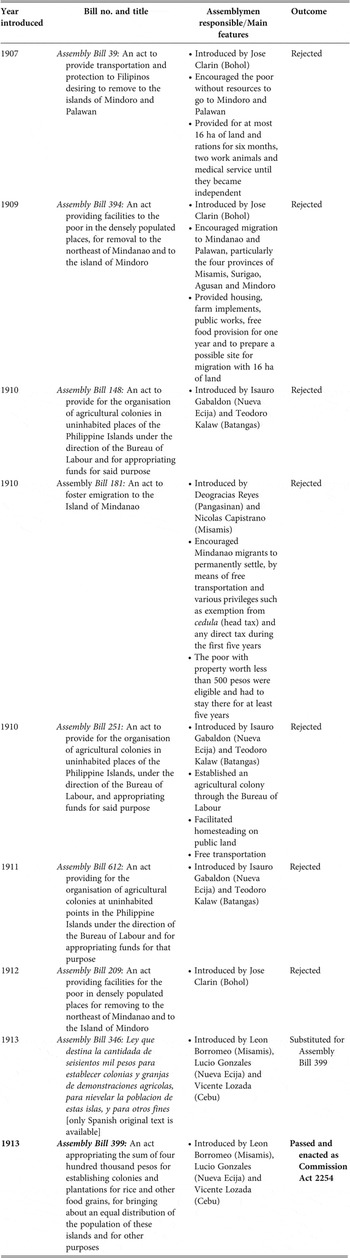
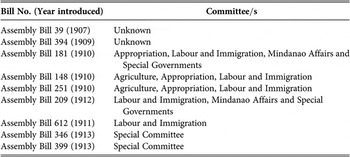
The relationship between the Commission and the Assembly in the early American era has been characterised as being, in general, so hostile and antagonistic that any bills proposed by either House resulted in disapproval or rejection by the other House.Footnote 8 As outlined in Table 3, although eight bills directly or indirectly related to Mindanao's colonisation had been proposed, only the similar ninth Assembly Bill 399 was approved by the Commission on 11 February 1913. This demonstrates that the introduction of Assembly bills and their ensuing debate must have met fierce opposition from the Commission. Given such an uncooperative atmosphere, how was Assembly Bill 399 passed by the Commission?
This paper will first examine the formation of the Assembly and its legislative jurisdiction over Mindanao and describe how its limited power over Mindanao became the fundamental cause for further political tensions between the Assembly and the Commission. The following sections will illustrate the legislative debate over the nine Assembly bills related to Mindanao's colonisation from 1907 until 1913 and describes how Assembly Bill 399 was finally approved. The final section discusses what made the Christian Filipino elite view Mindanao as ‘their’ territory.
This paper will use primary source materials and the records of both Houses, including the Diario de Sessiones de la Asamblea Filipina (Daily record of the Philippine Assembly) and the Actas de la Asamblea Filipinas (Journal of the Assembly), as well as the Journal of the Philippine Commission.
The Assembly and its limited power over Mindanao
On 1 September 1900, the second Commission — popularly known as the Taft Commission (named after its chairperson, William Howard Taft) — was formally established as the unicameral legislative body of the colonial Philippine state. Aside from Taft, the four other appointed members were all Americans.Footnote 9 The First Commission (the Schurman Commission) was led by Jacob Gould Schurman, president of Cornell University. The primary missions of the Schurman Commission were to investigate the conditions of the Philippines and to propose an adequate form of government. Schurman's final report concluded that: the United States could not withdraw from the Philippines; the Filipinos were wholly unprepared for independence; and there was no unified Philippine nation, rather, ‘only a collection of different peoples’.Footnote 10 The racial bias of this report stemmed from the belief of the Commission members that the Filipinos were not given to expressing public opinions and, as such, there was a danger in giving them self-government. The Commission recommended that the President put into operation a civilian government in the parts of the archipelago that were at peace.Footnote 11 This report provided the justification for the United States' colonial mission in the Philippines: political education under American tutelage.
In response, the Taft Commission immediately undertook to establish a civilian government in the provinces pacified by the American military.Footnote 12 The Municipal Code and the Provincial Government Act were both adopted in 1901, the latter making Pampanga in Central Luzon the first centre of local government.Footnote 13 These Acts allowed Christian Filipinos to have full control of their local governments, aside from American inspection and intervention in finance, public works, public health and education.Footnote 14 The Commission also formulated the Philippine Organic Act of 1902 (hereafter the Organic Act), which served as a de facto constitution.Footnote 15 One noteworthy feature of this Act was the establishment of the Assembly as the Lower House with the aim of overcoming the Filipinos' lack of practical knowledge and experience on how a popular government ought to be run.Footnote 16 This limited transfer of power for Filipino self-rule, allowing the Christian Filipino elite to participate in national politics, was highly anticipated in terms of the quest for Philippine independence. On 16 October 1907, the first Assembly was set up, composed of eighty assemblymen, who were elected for two-year terms and who also represented their own provinces.Footnote 17
Expanding Filipinos' capacity for self-rule, however, did not mean granting them unlimited autonomy to exercise these new freedoms. There were clear limits to the Assembly's legislative power over the southern Philippines, including Mindanao and the Sulu archipelago. The American government relegated the Filipinos to a status of tribes, with each tribe representing a particular period in the evolutionary stage of human progress. The dichotomy of civilised–wild had been used by the previous coloniser, the Spaniards: Filipinos whom they referred to as indio and civilised were those they had baptised as Catholics. The unbaptised were called ladrones, to describe how ‘wild’ and ‘untamed’ they were. The Philippines Islands were broadly divided into two parts roughly corresponding to these racially charged categories: general provinces and special provinces.Footnote 18 The former referred to the areas where Christian residents were dominant, while the latter referred to areas heavily populated by non-Christians such as northern Luzon, Mindanao (exclusive of Misamis and Surigao) and the Sulu archipelago. Under this ‘divide-and-rule’ policy, the legislative power of the Assembly was solely restricted to the former type of territories, while the Commission was vested with exclusive legislative power over the special provinces.
Under this bifurcated political structure, the Christianised regions of Misamis and Surigao in northern Mindanao already had full autonomy, while the rest of Mindanao was given restricted autonomy. On 1 June 1903 the Muslim-dominated Moro Province was carved out of Mindanao and Sulu. The creation of this province exemplifies the intention to transfer political power to a civilian government, as in the case of general provinces. Moro Province, however, continued to be ruled by American military officials. General Leonard Wood, the first Governor, considered Mindanao as another colonial frontier. The Christian Filipino elite viewed the American military-led Moro Province as being separate from Manila and as belonging to the Americans.Footnote 19 What was perceived by Christian Filipinos as their exclusion from their rightful role in Mindanao affairs was to stir up further hostility between the Assembly and the Commission.
Accordingly, Filipino assemblymen aggressively attempted to reverse this decision, resorting to a legal battle as the first Assembly convened. On February 1908, soon after the creation of the Assembly in Manila, three assemblymen — Maximino Mina (Ilocos Sur), Andres Asprer (La Union) and Jose Clarin (Bohol) — immediately expressed their concerns about the unfairness of their limited powers in the southern Philippines. Their resolution was introduced to the Assembly as Assembly Joint Resolution No. 18.Footnote 20 In this resolution, they maintained that the Christian Filipinos were best suited to draft the laws to govern the people of Mindanao because they were ‘the genuine and legitimate representatives’.Footnote 21 To this end, Resolution No. 18 requested both Houses to instruct the Resident Commissioners — Benito Legarda and Pablo Ocampo — to secure from the US Congress either amendments to, or a repeal of, Section 7 of the Organic Act of 1902:
After said Assembly shall have convened and organised, all the legislative power heretofore conferred on the Philippine Commission in all that part of said Islands not inhabited by Moros or other non-Christian tribes shall be vested in a Legislature consisting of two Houses — the Philippine Commission and the Philippine Assembly.Footnote 22
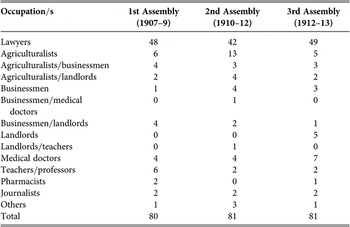
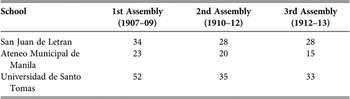
The three co-authors emphasised two principal reasons for the resolution: the territorial integrity of the Philippine nation and genuine representation for Filipinos. Behind these motives were the fact that the Christian Filipino elite, with their similar socio-economic, cultural and educational backgrounds in Manila (see Tables 1 and 2), had come to act as mediators between local (their home province) and national concerns.. Born in various provinces under Spanish rule, most of the assemblymen had followed the same path — schooling at San Juan de Letran or the Ateneo Municipal de Manila and then the Universidad de Santo Tomas to study law. As Benedict Anderson observed:
[The Christian Filipino elite] got to know one another well in a civilised ‘ring’ sternly refereed by the Americans. They might dislike one another, but they went to the same receptions, attended the same churches, lived in the same residential areas, shopped in the same fashionable streets, had affairs with each other's wives, and arranged marriage between each other's children.Footnote 23
Philippine assemblymen: Major occupations

Note: The number of assemblymen increased to 81 in 1909.
Sources: Gregorio Nieva, Philippine Assembly official directory, first Philippine Legislature (Manila: Bureau of Printing, 1908), pp. 16–19; Ramon Diokno, Asamblea Filipina directorio official, segunda legislatura Filipina (Manila: Bureau of Printing, 1912), pp. 6–9; Teodoro Kalaw, Directorio oficial de la Asamblea Filipina, Tercera legislatura Filipina, Primer periodo sessiones (Manila: Bureau of Printing, 1913), pp. 6–9.
Philippine assemblymen: Educational backgrounds

Sources: Diokno, Asamblea Filipina directorio official; Kalaw, Directorio oficial de la Asamblea Filipina; Nieva, Philippine Assembly official directory.
Their homogeneity in many aspects was so marked that they had great potential to act as a political interest group, particularly to defend their taken-for-granted prerogatives and to put their wishes into practice.Footnote 24
As Julian Go puts it, despite the diverse geographical and spatial differences of the Philippines, colonial state-building served to provide the elite with a forum for discursive exchange such as in the Assembly.Footnote 25 For example, in handling bills, the Assembly in general favoured public works, education and agriculture because the Assembly expected some material benefits for the welfare of the Christian provinces they represented. In contrast, the Assembly was always suspicious of the civil service, constabulary, and insular police largely because they disfavoured intervention by the American-dominated Commission, thereby attempting to cripple its workings during sessions. Given the ever-present unequal power relations vis-à-vis American officials, Filipino assemblymen — not only from Mindanao, but also from all over the country — started to see themselves as the defenders of Mindanao for all Filipinos.
Undoubtedly, the Christian Filipino assembly members' resistance made the Commission quite wary and defensive.Footnote 26 One of the Commissioners noted that
while the assembly is doubtless genuinely representative of the Christian inhabitants of the several provinces which have elected its members, it is not, and could [not] be, in any sense representative of the non-Christian inhabitants of these provinces nor the Provinces of Benguet, Nueva Vizcaya, Lepanto-Bontoc, Agusan and the Moro Province […] The Christian and non-Christian peoples of the Philippines have up to the present time had little [if] anything in common; indeed the relations between them have too often been those of active warfare.Footnote 27
Consequently, the Committee of Non-Christian Tribes, headed by Worcester along with two Filipino commissioners — T.H. Pardo de Tavera and Jose R. de Luzuriaga — made an investigative report on its legitimacy and unsurprisingly proposed ‘the indefinite postponement’ of Assembly Joint Resolution No. 18 on 26 March 1908.Footnote 28 Undertaking state-building in collaboration with the elite, American officials such as Worcester had been forced to grant the latter powers while limiting their ability to execute them. This subtle control was vital for the Commission to simultaneously induce the cooperation and consent of the Filipino elite while demonstrating American legitimacy over the Philippines. Given that more than half of the assemblymen were lawyers, their weapon for undermining American hegemony was open and public attack in the media and through law-making.
The legislative debate over Mindanao's colonisation
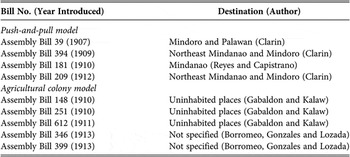
Bills related to the colonisation of Mindanao accordingly began to be introduced in the Legislature as soon the Assembly was created in 1907. From 1907 to 1913, before the passing of Commission Act 2254, there were nine Assembly bills explicitly or implicitly concerning the colonisation of Mindanao (See Tables 3 and 4). The bills had mainly two kinds of purposes: the first category of bills focused on the migration of the landless or the poor. The rest focused on the creation of agricultural colonies. The former can be called a push-and-pull model, whose purpose was to alleviate overpopulation by means of migration to promote the resettlement of poor farmers in less densely populated areas of the Philippines such as Mindanao, Palawan and Mindoro. The latter was regarded as a model to dramatically improve the food supply through introducing modern agricultural technology to put an end to the chronic food shortages, thereby developing so-called independent Filipino farmers.
Nine Assembly bills related to Mindanao's colonisation, 1907–13

Sources: Philippine Assembly, Actas (Manila, 1911),VI, pp. 20, 151, 167, 219–21; Philippine Assembly, Actas (Manila, 1913), VIII, pp. 4, 128, 134–6, 143, 155, 212, 223, 227; Philippine Assembly, Diario (Manila, 1912 ), VII, pp. 142–4; War Department, List of bills introduced in the Philippine Assembly during the inaugural, first and second sessions of the first Philippine Legislature, p. 4, BIA, 26854/13; War Department, Rejected bills first Legislature, pp. 176–85, BIA 364/150; War Department, Rejected bills second Legislature, pp. 192–9, BIA 364/151.
Classification of nine assembly bills by objective and migrant destination

Sources: Philippine Assembly, Actas (Manila, 1911), VI, pp. 20, 151, 167, 219–21; Philippine Assembly, Actas (Manila, 1913), VIII, p. 4, 128, 134–6, 143, 155, 212, 223, 227; Philippine Assembly, Diario (Manila, 1912), VII, pp. 142–4; War Department, List of bills introduced in the Philippine Assembly during the inaugural, first and second sessions of the first Philippine Legislature, p. 4, BIA, 26854/13; War Department, Rejected bills first Legislature, pp. 176–85, BIA 364/150; War Department, Rejected bills second Legislature, pp. 192–9, BIA 364/154.
The areas under consideration were grouped into two main zones: areas targeted by the push-and-pull model were explicitly concerned with Mindanao, Mindoro and Palawan. These islands had the lowest population density and the largest percentage of uncultivated land in the Philippines. On the other hand, the later bills involving the agricultural colony model did not specify areas where such settlements would be established and rather ambiguously referred to ‘uninhabited places’ of the Philippine archipelago. As shown in Table 4, however, ‘uninhabited places’ logically included not only Mindoro and Palawan, but also Mindanao, all islands known for their abundant land and unexploited natural resources.Footnote 29 Hence, the masking of Mindanao as a possible destination for population redistribution can be seen as a rhetorical legislative strategy to get the bills passed.
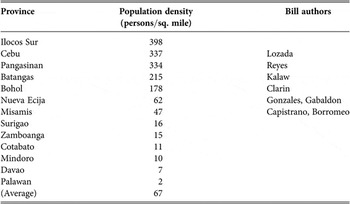
Nevertheless, it should be noted that the most of the authors of the nine bills were from provinces with high population densities (Cebu, Pangasinan, Batangas, Nueva Ecija); the exception were the two from Misamis in Mindanao (see Table 5). This suggests that demographic conditions — specifically, an ever-increasing population — in their provinces had something to do with the drafting of bills related to Mindanao's colonisation. Legislators from the more densely populated provinces would have felt the need to cope with the rising problems of chronic land shortages and unbalanced land distribution.
Population densities of provinces whose representatives authored 9 bills

Sources: Bureau of Census, Census of the Philippine Islands (Washington. D.C.: Government Printing Office, 1903), II, p. 28; Diokno, Asamblea Filipina directorio oficial, pp. 6–9; Kalaw, Directorio oficial de la Asamblea Filipina, pp. 6–9; Nieva, Philippine Assembly official directory, pp. 5–8.
Let us examine the legislative process through which the bills — both the push-and-pull model and the agricultural colony model — were, respectively, discussed and debated in both Houses (for a summary, see Table 3). The four bills under the push-and-pull model were more or less alike in purpose. Three bills were introduced by Jose Clarin, a representative from Bohol, a ‘regular’ Christian-dominated province, who later became senator and authored another bill to develop a town named after his family in Misamis, Mindanao, where he and many Visayan Christians had migrated independently. His assumed territorial map of the Philippines was soon to cause issue with the Commission over the Assembly's jurisdiction.
Assembly Bill 39, which was initially introduced by Clarin on 12 November 1907, aimed to move poor Filipinos to Mindoro and Palawan to take up land.Footnote 30 This Bill did not talk about Mindanao at all. Applicants, who had to be economically hard up and at least sixteen years of age, were expected to receive various kinds of support such as food, medical services and sanitation. The budget proposed was 100,000 pesos. It was struck down by the Commission, however.Footnote 31 Clarin's Bill was motivated by his disapproval of the increasing number of Filipinos emigrating to Hawaìi as labourers; he wanted to divert such labour to less densely populated areas in the Philippines, where there was great possibility for economic progress and agricultural development.Footnote 32 He felt that encouraging migration would serve sparsely populated areas in need of labour while giving families in Luzon and the Visayas the chance to take advantage of the riches of the ‘promised land’.
A year-and-a-half later, Clarin introduced Assembly Bill 394 of 1909, which appears to be almost identical to Assembly Bill 39.Footnote 33 This too was rejected by the Commission for the following reasons: Palawan should have been included in the project; all provinces did not necessarily favour out-migration; the four provinces in favour of out-migration were distant from one another, making the management of the Bill difficult in practical terms; there seemed to be little chance for individuals to repay their debt; and the obligations and responsibilities of the assigned place were indefinite in nature. The Commission also commented on its technical inadequacies: ‘this bill was received by late on the last day of the session of the Legislature as it contained numerous good features, and with necessary amendments might well be passed … further consideration [should] be given to this very important subject at the next session’.Footnote 34
Clarin then authored Assembly Bill 209 on 26 November 1912, the title of which is also identical to that of Bill 394 (see Table 3).Footnote 35 Once again, although the Bill was passed at the Assembly, it was rejected by the Commission. The following recommendation was reported from the Committee on Matters Pertaining to the Department of Public Instruction:
This bill provided for a degree of paternalism inconsistent with a people as progressive and well developed as the people of the Philippine Islands, and your committee does not believe that the Legislature is justified in assuming the degree of incompetence on the part of the people that the passage of this bill would indicate. Besides, even if this were true, it calls for an appropriation of 750,000, which, in the present condition of the Treasury, does not seem advisable. Moreover, the bill is of such complex character and contains so many provisions that it would require such comprehensive study as your committee is not able to give in these closing days of the special session.Footnote 36
None of the three bills drafted by Clarin were passed. An underlying motive for his repeated attempts to pass these bills was that the Bohol assemblyman had forged an interdependence with Mindanao through an inter-island network mediated by ongoing migration between Bohol and Misamis. Clarins strongly feared the detrimental effects to Christian Filipinos of a possible loss of Philippine sovereignty over Mindanao to the Americans, who wanted to dominate the island's rich natural resources.
Direct challenges to the authority of the Commission over the issue of Mindanao continued unabated. Assembly Bill 181, seeking migration to the island, was co-authored by two assemblymen in 1910: Deogracias Reyes and Nicolas Capistrano.Footnote 37 Capistrano, like Leon Borromeo, represented Misamis, a regular ‘Christian’ province north of Mindanao. The Bill focused on the poor with property worth less than 500 pesos and was accordingly expected to serve to improve their well-being. The destination for migration specified Mindanao alone. The Committee on Affairs pertaining to the Moro Province within the Commission spontaneously rejected the Bill, because ‘it [contained] certain provisions affecting the whole of Mindanao, and therefore the Moro Province, over which the Assembly [had] no jurisdiction.’Footnote 38 Undoubtedly, it would obviously violate the Organic Act, as the Bill straightforwardly and explicitly focused on Mindanao. Nevertheless, Capistrano, who was a native of Misamis in Mindanao and who was also the chair of the Committee of Mindanao Affairs and Special Provinces, would not give up the cause of defending the interests of Mindanao against American rule — it was almost of equal benefit to his own people, as the ruling elite of Misamis, and of all Filipinos. Indeed, he dared to challenge the Organic Act.
Meanwhile, the idea of constructing an agricultural colony was, for the first time, presented in Assembly Bill 148 on 24 October 1910 by Isauro Gabaldon (Nueva Ecija) and Teodoro Kalaw (Batangas). The regions that they represented were known as heavily populated regions of Luzon. During the same session, however, it was substituted by a modified version — Assembly Bill 251 — on 10 November 1910.Footnote 39 Both were identical in title and substance. Bill 251 included the following aspects: the creation of an agricultural colony; the encouragement of homesteading on public land; the assignment of a supervisor to oversee the work of an agricultural colony; and a free transportation service to the destination by the Bureau of Labor. The explanatory statement of Assembly Bill 251, prepared by Gabaldon and Kalaw, deserves special attention.Footnote 40 It explained how, despite the availability and fertility of vast areas of land within the Philippines where American sovereignty was established, many ‘unsettled regions’ of the Philippines failed to achieve agricultural development. They attributed such an anomaly to ‘the lack of labour, though American and foreign enterprises had made a success’. Yet, it was insufficient and unsatisfactory. Accordingly, Bill 251 suggested that more development measures should be encouraged through the immigration of Filipino labourers, particularly of those who had remained landless in highly populated areas. Interestingly, this statement implicitly indicates the Bill's hidden aims, given that the proposed migrant destination to ‘unsettled regions’ in areas ‘free from typhoons’ undoubtedly refers to Mindanao, which is outside the typhoon belt, unlike Luzon and the Visayas. In this sense, introducing the Bill may be understood as the authors' claim for their legitimate share in the economic exploitation of Mindanao. The Bill was rejected by the Commission, which found the plan extremely ‘paternal’; in addition, the plan was said to have no positive prospects; further, there had been too little time for careful examination during the session. In the subsequent session, Assembly Bill 612, identical to Assembly Bill 251 of 1910, was proposed on 16 November 1911.Footnote 41 This bill was rejected too, this time on financial grounds: ‘Your committee favors the passage of this or a similar bill as soon as the finances of the Government will justify the expenditure of the money — a condition which does not exist at present.’Footnote 42
The eighth bill, Assembly Bill 346, was introduced on 12 January 1913 by three assemblymen — Leon Borromeo (Misamis), Lucio Gonzales (Nueva Ecija) and Vicente Lozada (Cebu) — and contained the following: creation of a colony for agricultural experiments; equal distribution of the population; and appropriation of 600,000 pesos for funding.Footnote 43 This Bill was immediately substituted by Assembly Bill 399 on 31 January 1913 to reduce the amount for funding to 400,000 pesos. Its modification was suggested by the Special Committee to eliminate any grounds for refusal. The Bill was finally passed in the Assembly on 1 February 1913 and forwarded to the Commission on 3 February 1913. It was consequently adopted as Commission Act 2254 after minor changes.Footnote 44
The debate in the Commission, after the two modifications had been made, guaranteed its passage by majority vote. There were six ‘yes’ votes (five votes were cast by the Filipino commissioners, along with the American governor-general) and two ‘no’ votes. The two ‘no’ votes were cast by two American commissioners — Newton Gilbert and Dean Worcester — who both disliked the ‘paternalism’ which they saw in the Assembly bills. Gilbert stated that, for him, the Bill was quite ‘paternal’ and ‘socialistic’ in nature, and was thus far removed from being an experiment in agricultural development. He noted that this kind of Bill may be a bad example for the majority of Filipinos hoping for early and immediate establishment of self-government. Consequently, he believed it would have an unfavourable outcome fairly quickly.Footnote 45 Worcester added that there was no reason for this Bill to provide for farm cattle and implements through public funds to migrant settlers who would be sent to such a fertile and large place such as Mindanao. For this reason, he felt that material assistance would be more of a hindrance to further agricultural development.Footnote 46 To these commissioners Bill 399 seemed to aim at offering a generous ‘give-away’, which was contrary to the vision of the agricultural experiment model. that is, the development of independent farmers.
The legislative debate accompanying the bills reveals that there were two kinds of reasons why the Commission rejected the Assembly bills: technical and political. First, the Assembly was said to have handled the bills ineptly during the sessions and some were sent to the Commission on the last day of their session. Due to the Assembly's inexperience in the new legislative process — a model based on the US House of Representatives — this tardiness made obtaining the Commission's approval even more impossible.Footnote 47 It would be incorrect to say, however, that the Assembly failed to deliberate on each bill properly. As Table 6 indicates, seven bills, except for two bills introduced by Clarin, had been referred to various committees during the Assembly's sessions for further revisions and modifications at least before being sent to the Commission.Footnote 48 The second kind of reason given for rejection was political: bills were rejected due to a lack of appropriation funding or thrown out because they contained provisions relating to Mindanao, which was regarded as being beyond the Assembly's jurisdiction. All the ‘push-and-pull’ bills were rejected. The bills involving the agricultural colony model seemed to be more flexible, in that no destination was specified, but the result for the first few was the same. The American commissioners always suspected that the Assembly bills contained more or less ‘paternalistic’ features, a hindrance to their notion of self-rule, and further evidence of Filipinos' unpreparedness and inability to govern themselves.
Bills and committees of the Philippine Assembly referred to

Sources: Diokno, Asamblea Filipina directorio oficial, pp. 6–9; Kalaw, Directorio oficial de la Asamblea Filipina, pp. 6–9; Nieva, Philippine Assembly official directory, pp. 5–8; Philippine Assembly, Actas (Manila, 1911), VI, pp. 20, 151, 167, 219–21; Philippine Assembly, Actas (Manila, 1913), VIII, pp. 4, 128, 134–6, 143, 155, 212, 223, 227; Philippine Assembly, Diario (Manila, 1912), VII, pp. 142–4; War Department, List of bills introduced in the Philippine Assembly during the inaugural, first and second sessions of the first Philippine Legislature, p. 4, BIA, 26854/13; War Department, Rejected bills first Legislature, pp. 176–85, BIA 364/150; War Department, Rejected bills second Legislature, pp. 192–9, BIA 364/151.
Despite the opposition of two commissioners, how and why was Assembly Bill 399 approved in 1913? In order to answer this question, we need to consider at least two factors — external and internal — affecting the evolution of this legislation. One external reason was related to food shortages in the Philippines. Since the United States' takeover of the Philippines, two serious rice shortages had already taken place, in 1903 and 1911,Footnote 49 attributed to poor harvests triggered by drought, cattle disease and transmittable diseases such as cholera. In order to cope, the colonial state, upon solving the immediate food crises, needed to establish a sustainable food farming system as soon as possible. As a countermeasure, two plans were carried out: the introduction of scientific agricultural methods to increase crop yields and promoting rice as a staple food. Gilbert, who was acting governor-general and one of the leaders most concerned about economic conditions in the Philippines, referred to Mindanao as a promising site for rice plantations.Footnote 50 His plan was to convert a broad valley of Cotabato province into a vast rice granary. To transform such enthusiasm into reality, at the opening of a session of the Third Legislature on 16 October 1912, a message from Governor-General Cameron Forbes, who expected the Legislature to draft the bills concerning the food shortage, was read:
I desire to recommend to the thoughtful consideration of the Legislature a plan which attempts the development of some of these areas upon as large a scale as many seem wise, for the two-fold purpose of increasing the food supply of the Islands and of encouraging immigration of people from the more populous and sterile districts into those parts of the Archipelago where nature has been most bounteous in her gifts. Such tracts of land may be found in various parts of the Archipelago, some of the best of them being in the Islands of Mindanao; and I would like to suggest what seems to be sometimes forgotten, that the Philippine Archipelago consists not of Luzon and the Visayas alone, but of Luzon, the Visayas and the Moro province.Footnote 51
Hence, the introduction and approval of Assembly Bill 399 can be understood as a realistic option, or as a political compromise on the part of both Houses in the face of deteriorating economic conditions in the Philippines. Without a food crisis, Assembly Bill 399 would not have been passed. The other reason was the change in membership within the Commission owing to the rising tide of ‘democratisation’ in US politics which contributed to a smoother session in the interests of the Filipinos. When the Commission came into being in 1900, its members were originally all Americans. In 1912, however, ‘Filipinisation’ had already pervaded the Commission due largely to the rise of Democratic President Woodrow Wilson (after decades of Republican rule in Washington) and the consequent appointment of Francis Burton Harrison as Governor-General of the Philippine Islands, to the extent that more than half of the commissioners' seats were occupied by Filipinos. This explains the number of ‘no’ votes cast by the two American members of the Commission and the six ‘yes’ votes from the five Filipino commissioners (Frank Branagan, Jose de Luzuriaga, Rafael Palma, T.H. Pardo de Tavera and Juan Sumulong) and the American Governor-General. This meant that all except Gilbert and Worcester favoured Assembly Bill 399. In a politically fluid situation, the Christian Filipino assemblymen had succeeded in winning over the Filipino Commissioners to get the Bill passed.
The other debate over Mindanao separation
To look at the wider political context, we also need to consider the growing tensions over Mindanao affairs during these years between American capitalists and Moro provincial officials (mostly Americans and their Moro supporters) in Zamboanga and the Christian Filipino elite over the idea of making Mindanao a US territory. Attempts to separate Mindanao from the Philippines reached a climax twice, in 1905–6 and 1909–13. The nationalistic claim of Philippine sovereignty over Mindanao was reflected in this debate, and involved not only the authors of the nine bills, but also local government officials and the Philippine media. For the bills' authors, Mindanao constituted an indispensable part of the Philippine territory. The Christian Filipino elite explicitly represented themselves as defenders of the Philippine nation against the threatened loss of Mindanao.
The debate over Mindanao can be described as one of the biggest political struggles involving the centre (Manila) and the local (Zamboanga) versus the imperial centre and metropole of Washington, specifically the Department of War and the White House. The first attempt at political separation began with the resolution titled ‘Mindanao for the Americans’, unanimously passed and approved by the Zamboanga Chamber of Commerce (hereafter the Chamber) on 8 August 1905.Footnote 52 This document contended that Mindanao, being separate from the Philippine body politic, should be given the status of a US territory. This resolution was made in time for the visit of Taft, then the US Secretary of War, who arrived in Zamboanga ten days later.Footnote 53 For the Americans, a territory referred to an administrative area which did not yet qualify for the full status of being a state. The incorporation of Mindanao as a US territory would indicate that its land, sooner or later, would be integrated into the United States.Footnote 54 The Chamber pointed out the following reasons to justify the legitimacy of its claim: the availability of vast amounts of fertile land in Mindanao; that there was no hindrance to America's civilising projects due to the limited number of natives; that American settlers had a need to propagate their Western civilisation in the colony; and Christian Filipinos did not possess any system for self-governance and, therefore, they were not capable of ruling Moro Province. At that time, Zamboanga published a weekly newspaper called the Mindanao Herald under the auspices of its foreign business community. Its editor, Samuel DeRackin, who was also President of the Bank of Zamboanga, waged a series of political campaigns supporting Mindanao separation. From July to September of 1905, the Herald featured articles and editorials related to the Chamber's resolution, such as: ‘We demand separation’, ‘Colonisation of Mindanao’, and ‘Mindanao's ambition’.Footnote 55
The other debate was initially proposed by Moro Province. In its annual report in 1909, Colonel Ralph Hoyt, Acting Governor of the Moro Province, recommended the plan titled, ‘the Mindanao Plantations’, which was about the permanent separation of Mindanao, the Sulu archipelago, and Palawan, inclusive of neighbouring islands from the rest of the Philippine archipelago.Footnote 56 In this plan, Hoyt strongly emphasised that despite Moro Province's potential for great change and material improvement, it had failed to attain this end: fragile and unstable surroundings were the biggest obstacles in inducing capital investment and an influx of more able settlers from abroad.Footnote 57 Hoyt's recommendations included: making Mindanao the coal station and naval base within the Philippines; continuing the current military rule; maximising the use of natural resources for large-scale plantations; and allocating reservation sites for the native population. Following its first resolution in 1905, the Chamber decided to adopt the resolution again on 30 January 1910, adding that ‘we pledge ourselves to use every effort to have Mindanao and the adjacent Islands become a territory of the United States.’Footnote 58
Both debates, which took place just before and after the creation of the Assembly in 1907, had similar aims regarding Mindanao's development and both also wanted Mindanao separated from the Philippine body politic. Some officials of Moro Province and the Chamber already thought of Mindanao as a US territory. Following the creation of the Assembly of 1907, both Moro Province and the Chamber feared that political and economic conditions would only become less favourable. On 8 April 1905, twelve days after the the Governor-General Luke Wright publicly announced an election for delegates to the newly established Assembly, an editorial in the Herald entitled ‘A white man's country’ argued strongly that ‘The Moro Province is a white man's country and will remain so. The native population is infinitesimal, and conditions are so entirely different here than in the northern provinces.’Footnote 59
The Chamber also believed that Christian Filipinos could not be trusted to govern the region. The editorial was immediately followed by two articles outlining the Chamber's political campaign for separation. DeRackin, in particular, insisted that current policies in Moro Province were inadequate and counter-productive which he attributed to Christian Filipinos' inability to govern the region.Footnote 60 Clearly the debates indicated Zamboanga's foreign businessmen's fears about being placed under the political control of Christian Filipinos. Nevertheless, those who were pressing to separate Mindanao from the Philippines failed to get the support of Manila and Washington, or even Zamboanga,Footnote 61 with the exception of a tiny group of Manila-based American journalists.Footnote 62 Washington put an end to the chaos by announcing that ‘the administration has no intention at this time of dismembering Mindanao from “the Philippine group”’.Footnote 63 But matters did not end there.
Christian Filipinos' fierce opposition and Muslim Filipinos' response
A furious and nation-wide opposition and agitation by the Christian Filipino elite erupted, particularly in the pro-Filipino media. Soon after the publication of ‘A white man's country’, heated arguments broke out between those for and against Mindanao separation. The Filipino newspaper La Vida Filipinas opposed the plan in an article entitled ‘Three stars of the Philippine banner’.Footnote 64 Another Filipino newspaper, El Renacimiento, published the whole text of the Chamber's resolution on the same day — 17 August 1905 — that the US Secretary of War, William Taft, was scheduled to visit Zamboanga, through which the move for separation taking place far from Manila soon came to be known to the public.Footnote 65 Furthermore, La Vanguardia, a pro-nationalist newspaper, suspected that the real purpose of Secretary Jacob Dickinson's removing his visits to Misamis and Surigao from his itinerary was to warrant Mindanao separation.Footnote 66 In addition, a petition signed by the provincial governor of Misamis and eighty-nine other local officials was also forwarded to Washington through the governor-general.Footnote 67 Opposition to the separation of Mindanao surfaced and continued for almost a year until the end of 1906.Footnote 68 The opposition's campaign seemed more influential and profound than that of those agitating for separation. Matters reached a climax when a number of memoranda signed by those against the plan were brought to the attention of President Theodore Roosevelt.Footnote 69 The Manila government, which handled all memoranda forwarded to Washington, tried to remain neutral on this particular matter. Acting Governor-General Cameron Forbes had only this to say: ‘I recommend that no action be taken on it as there were a number of Moros.’Footnote 70 The situation became tense and volatile, especially after the creation of the Philippine Assembly.
Three years later, in 1910, a second debate was staged. Misamis' delegate to the Assembly, Capistrano, sent a petition to the visiting Secretary of War of the United States demanding that Mindanao be placed under the direct rule of Christian Filipinos:
The petition which the inhabitants of the island of Mindanao respectfully present to the Congress of the United States through the worthy means of Your Honor, referring to the extension of the jurisdiction of the Philippine Assembly to the parts of said Island inhabited by Moros and other non-Christian tribes, so that there may be only legislative power in the islands, the Philippine Legislature, instead of the three that now exist: the Commission, the Legislative Council of Zamboanga, and the Philippine Assembly …. [the]Assembly, which now satisfactory cooperate to colegislate for the Christian peoples, will be more competent to colegislate for the small remainder of the country inhabited by Moros and non-Christian, who from their ignorance require simpler laws and a simpler government, even though a firmer one, if desired.Footnote 71
The second debate deserves special attention because it involves other provinces of Mindanao, particularly Zamboanga, Misamis, Surigao, and other local governments as far as Negros in the Visayas, Mindoro, and Bulacan in Luzon.Footnote 72 The threat of Mindanao being separated from the Philippines had awakened Filipino nationalism over the issue: who owns Mindanao? Behind this resistance was the Christian Filipino nationalists' intention to take full control over Mindanao, sincerely believing that the second largest island belonged to Las Islas Filipinas. Such an objective could only be fulfilled if the region would be able to parry the separatist aspirations of American officials, big planters, and their Moro protégés.
As described earlier the seeds of this political turmoil were sown when the colonised Philippines was segregated into ‘civilised’ and ‘wild’Footnote 73 and Section 7 of the Organic Act of 1902 prescribed that ‘all the legislative power, heretofore conferred on the Commission in all that part of said islands not inhabited by Moros or other non-Christian tribes shall be vested in a Legislature consisting of two Houses — The Commission and the Philippine Assembly.’Footnote 74 The Christian elite were highly dissatisfied with their exclusion from Mindanao affairs.
Some sectors of Philippine society clearly saw the move as America's ploy to destroy their sense of national integrity.Footnote 75 Given that the setting up of Moro Province itself was viewed with suspicion, the plan to separate Mindanao from the Philippines was bound to spark political contestation. Opposition was strong from the Christian Filipinos in Misamis and Surigao where, prior to the creation of Moro Province, autonomy had already been provided. The Christian elite had been granted substantial legislative power, and hence could mobilise a large-scale and persistent resistance within public and official realms. Capistrano, for instance, challenged the authority of military rule in Moro Province in introducing with Pangasinan assemblyman Deogracias Reyes Assembly Bill 181 in October 1910 to make Mindanao a ‘Filipino’ and not a ‘white man's’ country. The political power vested in the Christian elite had expanded dramatically to become stronger and more influential than ever. Their influence was felt throughout the colonial system, even if they were colonial subjects themselves, and they came to constitute a vital counterpart to the colonial government based in Manila.
Meanwhile, unlike Christian Filipinos who responded aggressively to the debate over Mindanao separation, the Muslims were demonstrably ambivalent. During the first debate in 1905, Moro Province was still run by Governor Wood, who was still restoring peace, quelling uprisings and chasing ‘outlaws’. The primary purpose of American direct rule over Mindanao was to weaken the political influence of the datus (traditional elite), and then turn Muslim society into a tribal ward system, where traditional leaders would be expected to serve as headmen representing each ward.Footnote 76 Some leaders disliked and opposed American military rule,Footnote 77 however, they quickly realised that they were powerless and their strategies were feeble. Consequently, the majority of Muslims, while resorting to sporadic resistance, became rapidly submissive to the American military for their own purposes. Their leaders were mainly appointed as intermediaries between the Americans and the ordinary Muslims, or between the American military and the so-called outlaws. As a result Muslim voices were hardly heard during the first debate over Mindanao in Zamboanga.Footnote 78
When the debate resurfaced in 1909, two years after the creation of the Philippine Assembly, however, the responses of Muslims, particularly the elite datus, became more public and articulate. The datus requested lasting protection from the Americans against the Christian Filipinos, as well as over Mindanao. They collectively rejected the Christian Filipinos' claims over Moro Province and Mindanao. Datu Mandi, the most powerful and influential Muslim leader of Zamboanga, as well as an American military aide, is a good example: he strongly favoured the rule of the American military as colonisers of Moro Province:
As I look about, I see far more Moros than the Filipinos contingent, and if that is so, that is the reason it is called the Moro Province … If the American government does not want the Moro Province any more they should give it back to us. It is a Moro province. It belongs to us.Footnote 79
Another prominent datu, Hadji Nuno proclaimed:
We are a different race; we have a different religion; we are Mohammedans. And if we should be given over to the [Christian] Filipinos, how much more would they treat us badly, when they treated even the Spanish badly who were their own mothers and their own fathers in generation? How did they treat them? Think about it! Think twice! We far prefer to be in the hands of the Americans, who are father and mother to us now, than to be turned over to another people.Footnote 80
These highly politicised speeches made by the datus to welcome the visiting US Secretary of War, Jacob Dickinson, to Zamboanga on 23 August 1910, did not clearly suggest whether they favoured Mindanao separation. Considering the nature of the occasion, a gathering of almost 200 Christian Filipinos and 2,000 Muslims, their expressed desires favouring lasting American rule of Mindanao can hardly be accepted at face value.Footnote 81 For the Muslim elite, the occasion was a political ritual to publicly demonstrate their allegiance and loyalty to the American military. In other words, the Muslim leaders tried to convince the Americans to free Mindanao from the agitation of Christian Filipinos. Secretary Dickinson was helpless, but announced his reluctance to entrust Mindanao affairs to Christian Filipinos right after four datus publicly swore their allegiance to America.Footnote 82
Dickinson's address at Zamboanga discouraged Christian Filipinos because he emphasised the importance of listening to the voices of the majority in Mindanao:
When you go before Congress to urge that the time has come for Philippine independence, your main argument is bound to be that government should rest upon the consent of the governed. Now if that be true, are you occupying a consistent position when you ask the American government to withdraw from the present administration and turn over 335,000 Moros to be governed by 66,000 Christians?Footnote 83
The speeches were sensationalised in a Manila-based daily newspaper: ‘Moros offer allegiance to US and say they will fight’ and ‘Filipinos can't have Moros to govern says Secretary Dickinson’.Footnote 84
Throughout America's rule in Mindanao, the Muslims were considered as the ‘silent majority’. The discourses of the datus presented here can hardly be considered to represent the whole of Muslim society; they reflected instead the merits of the datus themselves, whose status had been redefined by colonialism. It is safe to say that the Muslims, except for certain datus, neither favoured nor opposed the debate over Mindanao separation. But the Muslim elite were sensitive to the subtle changes of governance in Mindanao and Moro Province and felt insecure as Christian Filipinos began agitating against Mindanao separation. The continuing struggle of the Christian Filipinos to attempt to establish migrant colonies in Mindanao, through legislation and media attacks, stirred up the issue of who owned Mindanao.
Despite their predicament, the Muslims failed to mobilise their power to prevent Christian Filipino agitation, largely because they were never organised as a monolithic group. Instead, they were differentiated into numerous regional and linguistic subgroups and hence, unlike the Christian Filipinos, they failed to consolidate and organise their struggle. The Muslims could only resort to seeking protection from the US military — in short, the retention of Moro Province and Mindanao under American rule. Put differently, the bond between the American military and the Muslim elite was cohesive as long as they had a common foe: Christian Filipinos. The Christian Filipino elite viewed the debates and the attendant responses from the Muslims as a great threat to the territorial foundation of Filipino nationhood.
Conclusion
This paper has examined why the Filipino Christian elite regarded Mindanao as a territorial asset in the early years of the American administration, pursuing this goal in a series of bills to enact migration and resettlement in Mindanao from the more populated Christian majority areas. The motives of the bills' drafters were not entirely consistent, and, in fact, were rather more situational. All of them, however, developed a common vision and interest with regard to Mindanao as an integral part of the Philippine nation. The assemblymen, with their similar cultural, educational and occupational backgrounds, considered themselves to be ‘genuine representatives of the Philippines’ as a whole, and were dedicated to defending its national interests, including protecting the nation's sovereignty over Mindanao.
The national territorial map of the Christian Filipino elite was increasingly engendered through their translocal communication and experiences under the Americans, as many of them resettled or established economic and labour migration networks in the less developed islands, in particular, in northern Mindanao. The Assembly was vital as the legislative body for the Filipino elite in terms of practical political education, but also as a public sphere under colonialism.Footnote 85 This new public sphere was where assemblymen in Manila formed and accumulated social capital beyond their regional differences, and where they shared their common concerns and interests,Footnote 86 institutionalising translocal networks of knowledge, information and sentiment. The introduction of bills on Mindanao's colonisation affirmed what the Christian elite regarded as self-evident, that the island was part of the Philippines. This territorial concept was a byproduct of both Spanish colonialism and Filipino nationhood-in-the making.
Majul, who apparently underestimated the role of the Filipinos in crafting the colony project in Cotabato, had assumed that this project was the sole handiwork of the Americans. As this paper pointed out, in fact, two Americans in the Commission were vehemently opposed to it but were outvoted at the very end. The colony project, was approved and then implemented under the aegis of the Moro Province with General John Pershing as governor (1909–13). Still American capitalists and sympathetic American officials (the likes of Captain Hoyt) desiring the separation of Mindanao from the Philippine territory for Americans, fuelled the already ingrained hostility between the Moros and Christian Filipinos, who were supposed to become friendly neighbours in the colony project. This plan was not only expressed in the petitions during 1905–6 and 1909–13, but was pursued for years, notably in the failed Bacon Bill submitted in 1926 to the US Congress, which aimed to make all of Mindanao a permanent territory of the United States.Footnote 87
Also, Majul's underestimation of the nature of the colony project was perhaps reinforced by the succeeding administration of the Moros by an American civilian government under Frank Carpenter (1913–17), who tried to uphold the same civilising mission. The project, however, had a distinctly ‘Filipinised’ face that would change the tone of the presumed enmity between Moros and Filipinos while these two communities were being prepared for Philippine independence. Under these circumstances, it would be misleading to think that Christian Filipino interest in Mindanao was novel or something discovered only after Philippine colonial state-building had begun to take place under the Americans. Rather, the nationalistic view of the geo-political map, emphasising the territorial integrity of the Philippines comprising Luzon, the Visayas, and Mindanao, must have taken shape over the long period of Spanish colonialism of more than 300 years. During this period, the Christian elite must have absorbed and formed into their mindset such a ‘self-evident’ territorial concept of Mindanao. The Moro datus did not seem to have, or display, similar nationalistic sentiments, perhaps on account of their own diverse origins in multiple independent sultanates; also they were oriented toward a non-Western world where nationhood or modern state formation had yet to be encoded in their discourse. Perhaps more intriguing is how the inherited notion of Philippine territory came to be re-contextualised as ‘natural’ in an entangled colonial space, consequently acquiring a new nationalistic meaning. Thus assemblymen representing other regions of the Philippines proclaimed themselves responsible for Mindanao.
For them, the notion that Mindanao was an inseparable part of Philippine territory was not to be questioned, a fervent belief which they demonstrated through legislative debate and the media, despite the fact that the majority of the inhabitants in that region were not Christians. Mindanao was part of the Christian Filipino elite's territorial map and was not for the Americans to own or administer on behalf of the Moros that they had conquered. In this way, the assemblymen were upholding the idea of Filipino nationhood; and Mindanao now shines as one of the stars in the Philippine flag.