Found in languages as diverse as Flemish, English, Spanish, Greek, and Korean, negative concord is an intriguing and cross-linguistically common feature of negative clauses. In the literature, “negative concord” comprises two different kinds of phenomena: “negative doubling” and “negative spread” (Giannakidou, Reference Giannakidou2000; Watanabe, Reference Watanabe2004). Negative doubling references the co-occurrence of a sentential negator with a negative concord itemFootnote 1 as in (1) from Italian.
(1) Non ho visto nessuno.
In (1), the negator non licenses the negative concord item nessuno. In contrast, negative spread involves the co-occurrence of two or more negative concord items in a single sentence even in the absence of the canonical sentential negator as in (2) from Spanish.
(2) Nadie dijo nunca nada.
Nobody said never nothing
‘Nobody ever said anything.’
In (2), three negative concord items are copresent in the sentence, one in the subject Nadie ‘nobody’ and two in the predicate: nunca ‘never’ and nada ‘nothing’. Negative concord in Santa María Chiquimula K'ichee’ (MAR) is a variable but very particular instantiation of negative doubling in which the negator itself, rather than a negative concord item, is repeated after every syntactic component to the right of its canonical position as in (3).Footnote 2
(3) Le tixoɓal, ʃqax ta ʧi nuwaʧ tax.
Le tijoɓal ʃ-0-qax ta ʧi nu-waʧ tax
D school I-3sA-fall Neg2 loc 1sE-face Neg2
‘School, I don't like it at all.’ (ManuelFootnote 3 25 years old, Santa María ChiquimulaFootnote 4)
In (3), the negator ta(x) Footnote 5 appears in canonical position following the verbal predicate head ʃqax ‘fall’, and an additional copy follows the prepositional complement headed by the locative ʧi. In contrast to (1) in which the Italian negator no licenses a negative concord item such as nessuno, in MAR, an additional copy of the negator is inserted. The reader should note that, unlike in Italian, the presence of a second copy of the negator in sentences such as (3) is optional in MAR. In contrast, in every non-MAR K'ichee’ dialect, only one Neg2 is allowed.
Syntacticians and sociolinguists have given much attention to negative concord. On the one hand, the presence of two or more negative words in what semantically is only one negation raises fundamental questions about the principle of compositionality and the manner in which meaning and syntax interface (De Swart & Sag, Reference De Swart and Sag2002; Giannakidou, Reference Giannakidou2000; Herburger, Reference Herburger2002; Wallage, Reference Wallage2012; Watanabe, Reference Watanabe2004). On the other, negative concord is a choice site to study the interactions among grammar, standardization, and speaker identity. Many studies have examined the sociolinguistic distribution of double and triple negatives in various dialects of English and French, for example (Bayley & Maynor, Reference Bailey and Maynor1987; Cheshire, Reference Cheshire1982:51–71, Reference Cheshire, Tieken-Boon van Ostade, Tottie and Van der Wurff1999; DePrez, Reference DePrez and DeGraff2001; Feagin, Reference Feagin1979:215–236; Howe, Reference Howe1997; Howe & Walker, Reference Howe, Walker and Poplack2000; Labov, Reference Labov1972; Rickford, Reference Rickford1997; Sankoff & Vincent, Reference Sankoff and Vincent1981; Smith, Reference Smith2001; Trudgill, Reference Trudgill1974:55–63; Wolfram, Reference Wolfram1969:152–165).
Despite considerable interest in the topic, however, few studies have examined the emergence of negative concord from a variationist perspective. This paper contributes to this literature with a quantitative study of a language typologically and genetically different from the ones previously examined by scholars. Focusing on K'ichee’, a Mayan language spoken in the western highlands of Guatemala, I examine the appearance and diffusion of negative doubling in the variety spoken in the township of Santa María Chiquimula (MAR). Using both apparent-time and real-time data, I show that double and triple negation in MAR—currently a syntactic change in progress—emerged in the early 20th century as the last episode in a series of changes that negative clauses have undergone in K'ichee’. To the best of my knowledge, MAR is the only case of negative concord in the Mayan stock.Footnote 6
I start with a brief description of the syntax of negative clauses in Modern K'ichee’. Next, I discuss the structural features of double and triple negatives in MAR and their diachronic evolution based on the quantitative analysis of 20 monolingual sociolinguistic interviews recorded in 2005.
NEGATIVE CLAUSES IN MODERN K'ICHEE’
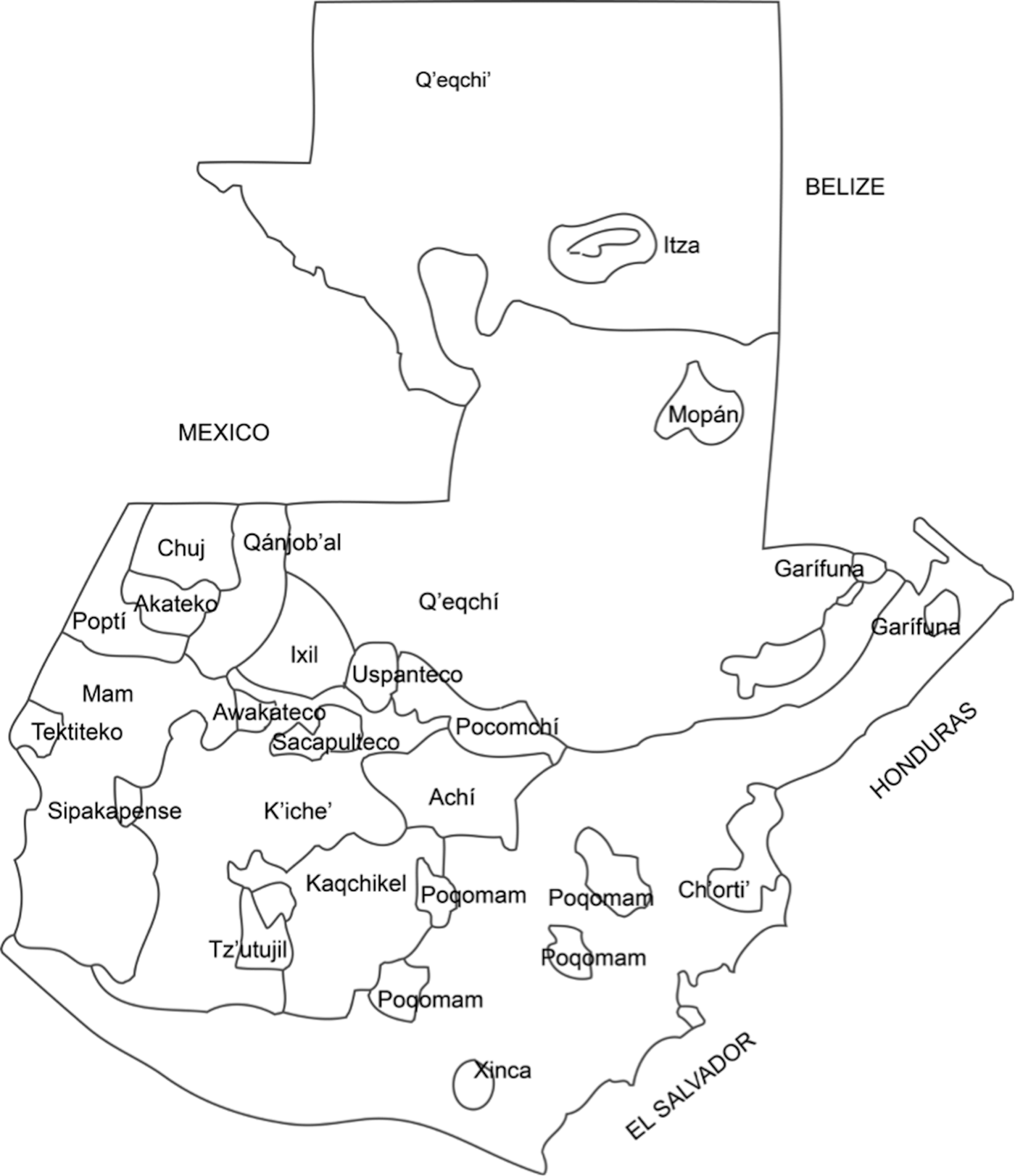
K'ichee’ is a Mayan language spoken in the western highlands of the Republic of Guatemala in Central America by at least 920,000 speakers (See Figure 1) (Richards, Reference Richards2003:62–63).
Geography of Mayan languages spoken in Guatemala.

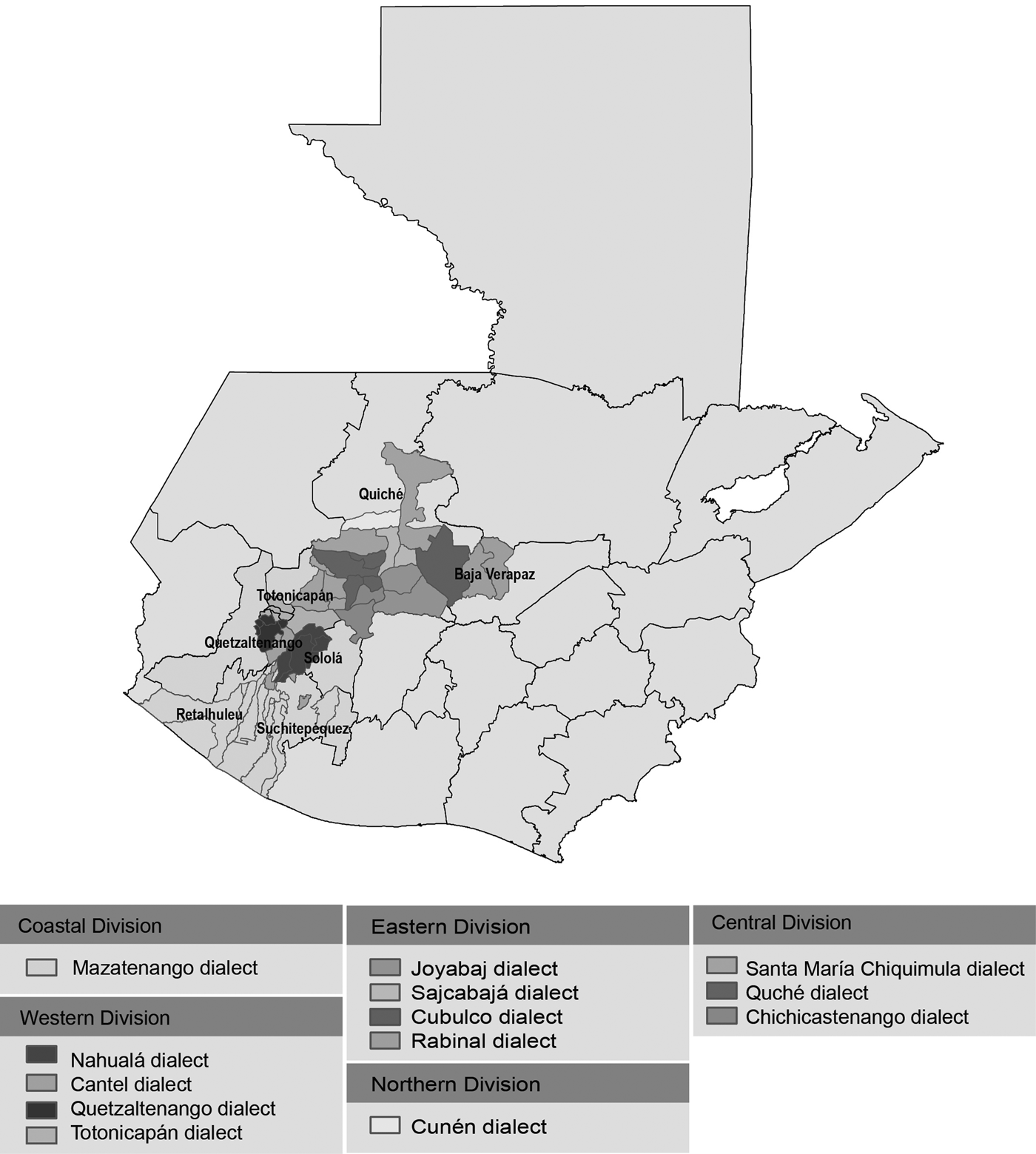
K'ichee’ has close genetic relations with sister languages of the K'iche'an group of Eastern Mayan—Kaqchikel, Tz'utujil, Sipakapense, Uspanteko, Sakapulteko, Poqom, and Q'eqchi’—though it is not mutually intelligible with them (Campbell, Reference Campbell1997:156–169; Kaufman, n.d.). It shows a substantial degree of regional variation in lexicon and phonology (see Figure 2).
The dialects of Modern K'ichee’ and their geographic distribution.
Syntactically, the default word order in K'ichee’ is Verb-Object-Subject. As with other sister K'iche'an languages, it is an ergative language: the objects of transitive verbs are marked on the verb with the same morphemes as the agents of intransitive verbs, known as “the absolutive set,” while the agents of transitive verbs and nominal possessors are marked with the “ergative set” (López Ixcoy, Reference López Ixcoy1997:76–78). The following examples are invented for purposes of illustration.
(4) ʃatulik!
ʃ-at-ul-ik
C-2sA-arrive-PF
‘You have arrived!’
(5) ʃatwaʧiʔlax iwi:r.
ʃ-at-w-aʧiʔlax iwi:r
C-2sA-1sE-accompany yesterday
‘I accompanied you yesterday.’
(6) ʃutix le ule:x le a Luʔ.
ʃ-0-u-tix le u-le:xle a Luʔ.
C-3sA-3sE-eat D 3sE-tortilla D m Peter
‘Peter ate his tortilla.’
The second-person singular absolutive marker /-at-/ in (4) marks the agent of the intransitive verb /-ul/ “arrive” and the object of the transitive verb /-aʧiʔlax/ ‘accompany’ in (5). In (6), the third-person singular ergative marker /-u-/ marks the agent of the verb /-tix/ ‘eat’, as well as possession concord in ule:x ‘his tortilla’.
In Dahl's (Reference Dahl1979:88–89) typology, standard negationFootnote 7 in K'ichee’ is syntactic and bipartite, involving two uninflected particles: the first preceding the predicate head (Neg1) and the second (Neg2) immediately following it. The canonical structure is outlined in (7).
(7) (Neg1) – Predicate Head – Neg2 – Complement – (Subject)Footnote 8
First, predicate heads–verbal and nonverbal–are optionally preceded by the particle man (Neg1), or its equivalent na in some dialects,Footnote 9 and, second, the negator ta(x) (Neg2) obligatorily follows the head as in (8) and (9).
(8) (Na) ke:ʧ'aw ta pa qaʧ'aɓa:l.
Na k-e:-ʧ'aw ta pa qa-ʧ'aɓal
Neg1 I-3pA-speak Neg2 loc 1pE-language
‘They do not speak K'ichee.’
(9) (Na) k'o ta ʧi(k) nuraxi:l.
Na k'o ta ʧi(k) nu-raxi:l.
Neg1 EX Neg2 already 1sE-money
‘I do not have any more money.’
In (8), the verbal head ke:ʧ'aw ‘they speak’ is preceded by the optional particle na (Neg1) and followed by the negator ta(x) (Neg2) in canonical position. In (9), the predicate head k'o is an “existential,” a syntactic category characteristic of Mayan languages that subsumes the roles of English presentational “there” and possession constructions headed by “have.” The nonverbal head in (9) is preceded by na but obligatorily followed by the canonical negator ta(x). Note that na is syntactically optional in both examples: if we delete it, the sentences Ke:ʧ'aw ta pa qaʧaɓa:l and K'o ta ʧi:(k) nuraxi:l would be preserve the same semantics.
The outline in (7) recapitulates Stage 3 of Jespersen's Cycle in which a formerly emphatic particle following the predicate head — ta(x) in K'ichee’ — acts as default negator in standard negation while the old negator is transformed into an optional negative polarity item. In Jesperson's Cycle, named after the famous Danish linguist Otto Jespersen, first, an optional lexeme acting as a modifier of the negative force of the clause is grammaticalized as canonical negator; second, the original negator is reanalyzed, becoming an optional stylistic particle licensed by the new negator, with the exception of a limited number of syntactic contexts in which it preserves the original negative semantics (Breitbarth, Reference Breibarth2009; Giannakidou, Reference Giannakidou, Everaert, Van Riemsdijk, Goedemans and Hollebrandse2006; Jespersen, Reference Jespersen1917; Lucas, Reference Lucas2007, Romero, Reference Romero2012; Van Gelderen, Reference Van Gelderen2008; Watanabe Reference Watanabe2004). In Colonial K'ichee’,Footnote 10ma(n) used to be a simplex negator and ta(x) was exclusively an irrealis marker, a function that the latter continues to have in Modern K'ichee’ (Romero, Reference Romero2012:87–91).
NEGATIVE CONCORD IN SANTA MARÍA CHIQUIMULA: THE VARIABLE CONTEXT
In MAR, innovations in the syntax of negative clauses did not stop with Jespersen's Cycle. In this township and its satellites, Patzité and Santa Lucía La Reforma, a form of negative concord emerged in which one or more copies of the negator ta(x) variably appear on the right periphery of all complement phrases after the predicate head, and sometimes even after the subject, whose canonical position follows the predicate object. In contrast with other languages with negative doubling such as Italian in which a negative concord item is inserted (see (1)), in MAR, additional copies of the negator itself are introduced. Pragmatically, the number of copies may act as a sort of cumulative index iconically marking emphatic negation.
(10) K'o ta ʃinɓan pasar tax.
K'otaʃ-0-in-ɓanpasartax
EXNeg2C-3sA-1sE-dohappenNeg2
‘Nothing happened to me.’
(Catarina, 38 years old, Santa María Chiquimula)
Example (10) carries only one semantic negation with scope over the subordinate clause introduced by k'o. The extra copy of ta(x) immediately following the complement ʃinɓan pasar is not semantically motivated. It is an insertion occurring after the syntactic derivation marking negative emphasis. If we removed the second ta(x) from (10), the sentence could still be used in MAR and in every other K'ichee’ variety. Negative concord in MAR is variable, not a categorical rule as in Spanish, in which a negative concord item such as nada is a categorical necessity in similar sentences.
(11) Oseake mo kuxunamata(x) ta ru:k' ri waral tax.
Oseakemanka-0-xunam-a-ta(x)taru:k'riwaral tax
soNeg1I-3sA-same-e-PSNeg2 withD here Neg2
‘And so it cannot be compared with anything here.’ (Catarina, 38 years old, Santa María Chiquimula)
In (11), a copy of ta(x) follows the complement clause introduced by the prepositional noun ru:k’. The particle man and the negator ta(x) appear in their canonical position preceding and following the predicate head, respectively.
(12) Le tixoɓal, ʃqax ta ʧi nuwaʧ tax.
Le tijoɓal ʃ-0-qax ta ʧi nu-waʧ tax
D school I-3sA-fall Neg2 loc 1sE-face Neg2
‘School, I don't like it.’ (Manuel, 25 years old, Santa María Chiquimula)
Additional copies of ta(x) variably appear on the right periphery of complement phrases after the sentential negator as in the previous three examples. It follows a deverbal nominalizationFootnote 11 in (10) and prepositional phrases in (11) and (12). In (11), the phrase is headed by the prepositional noun ru:k’ ‘with’, as explained earlier, and in (12) by the locative ʧi.
(13) Uʧa:nim biyen k'astal uwa:ʧ. Na xunam ta ru:k’ le we: in ta oxe:r tax.
Uʧa:nim biyen k'astal uwa:ʧ na xunam ta ru:k’
nowwell awake 1sE-face Neg1 same Neg2 with
le we: in ta oxe:r tax
D mine 1sA Neg2 yore Neg2
‘Now, he is very intelligent. Unlike me, back in the day …’ (Isabel, 25 years old, Santa María Chiquimula)
In (13), the canonical negator follows the predicate head xunam. The first copy appears after the complement phrase introduced by the preposition ru:k’, and the second follows the deictic oxe:r ‘yore’ at the end of the sentence.
SOCIOLINGUISTIC VARIATION IN NEGATIVE CONCORD IN SANTA MARÍA CHIQUIMULA K'ICHEE’
What triggered the emergence of negative concord in MAR? We do not have real-time data from Santa María Chiquimula before 2005. Nevertheless, it is possible to approach the question from an apparent-time perspective. Furthermore, observations in areas settled in the late 19th century by Chiquimulan migrants provide a complementary real-time perspective to ascertain the manner in which negative concord emerged and expanded.
In 2005, I lived for 11 months in Santa María Chiquimula doing ethnographic fieldwork and collecting a corpus of monolingual interviews in K'ichee’,Footnote 12 recorded at the homes of interviewees. The topics discussed included current news events as well as the life, occupations, and interests of the interviewees and their families. The interviews lasted between 50 minutes and 3 hours (Romero, Reference Romero2006). In order to ascertain in apparent time whether negative concord was a change in progress at the time, I analyzed 20 interviews in five age groups (10 men, 10 women) focusing on the first 50 negative clauses after the second minute of each audio recording.
Age groups diachronically correlate with the onset of recent changes in the Chiquimulan economy and in access to a Spanish-language education or mark important milestones in the Chiquimulan life cycle. First, the large majority of Chiquimulans marry by the age of 25. Marriage is a rite of passage that marks the onset of adult responsibilities for young men and women. Second, the 26 to 35 generation was socialized during the civil war, which ended in 1996 with the signing of the Peace Accords between guerrilla and state representatives (Nelson, Reference Nelson1999:3–10). This period involved a heightened presence of the Guatemalan state in the lives of young Chiquimulans and an expansion of primary and secondary school education. Third, a sizable portion of the population works today as travelling merchants selling different wares in both bulk and retail in markets throughout highland Guatemala (Falla, Reference Falla2008). Only 30 years ago, when the oldest age group was socialized, wheat and corn agriculture was the main occupation of the township. Since the collapse of Chiquimula agriculture in the early 1980s, Chiquimulans increased their reliance on trade, wage labor, and migration as sources of household income. Linguistically, this required an enhanced use of Spanish as a contact language in non-K'ichee’ areas as well as more frequent contact with non-MAR K'ichee’ dialects. Language skills—both in Spanish and K'ichee’—became crucial professional assets for many Chiquimulans. Access to a Spanish school education and Spanish literacy has substantially increased in the township since the 1980s with the opening of new primary and secondary schools in urban and rural areas. The two youngest age groups (25 and younger and 26–35 years) show high levels of bilingualism, and K'ichee’ monolinguals are rare (Romero, Reference Romero2006).
The expansion of retail commerce for domestic economies also shifted gender roles and opened public spaces for women outside the household, the village, and the township. Some of the women I interviewed reported that they acquired fluency in Spanish travelling and working as merchants with their parents and husbands. Often, they ended up in charge of the family business, especially when menfolk migrated to the United States (Falla, Reference Falla2008). As we will see later, gender was not a statistically significant factor group, but clearly women have been as affected as men by the changes discussed. The latter may have played a leveling effect, except in ethnolinguistic stereotypes, which continue to show statistically significant differences between genders (Romero, Reference Romero and Stanford2009).
The total number of analyzed clauses was 1018, in which the overall rate of double or triple negatives in the clause was 23% (232 of 1018). Independent variables were age, gender, and phrase type. Phrase (predicate) types were either existential, which are headed by the particle k'o (see (9)) or nonexistential.
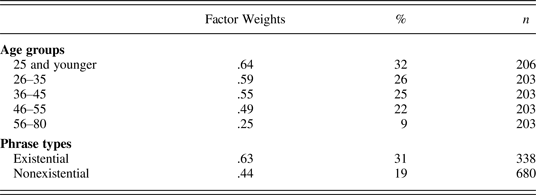
The results of a binomial regression with the Goldvarb (Sankoff, Tagliamonte, & Smith, Reference Sankoff, Tagliamonte and Smith2012) program are presented in Table 1.Footnote 13 Age and phrase type were found to be statistically significant. With respect to phrase type, favoring negative concord are existential as opposed to nonexistential predicates (with factor weights of 0.63 and 0.44, respectively). Higher frequency of negative concord in existential clauses may be related to a higher frequency of quantitatives in existential than in nonexistential clauses (Romero, Reference Romero2006). This does not seem to be unique to K'ichee’. Barrett (Reference Barrett1999) reported that in Sipakapense Mayan the existential k'ot, where -t is a cliticized form of irrealis taq, optionally co-occurs with mees, which also plays the role of quantifier, in an apparent negative concord pattern.
Factors contributing to negative concord in Santa María Chiquimula
Input = .209
n = 1018
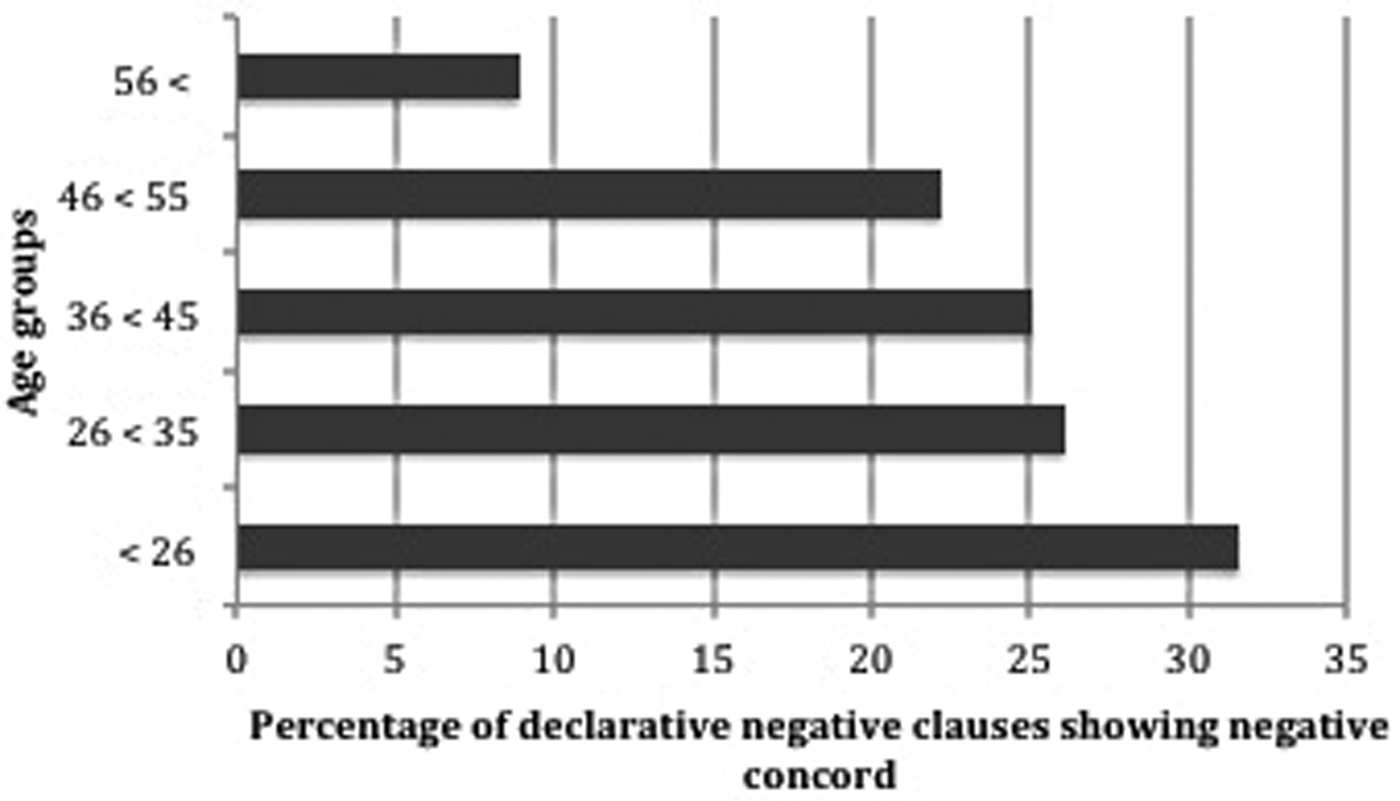
As concerns age, factor weights are >.5 for the three younger age groups and <.5 for the two oldest, showing a significant inverse correlation between age and frequency of negative concord. The contrast between speakers older than 56 and those younger than 26 is stark: the respective factor weights are .25 and.64. Figure 4 shows the relevant age group frequencies.Footnote 14
The frequency gap between speakers older than 56 and those younger than 26 is larger than 20 percentage points, as can be seen in Figure 3. Differences between consecutive groups are smaller but consistent in direction, indicating that the younger a speaker is, the more likely he or she is to use negative concord. Given that the sociolinguistic interviews were conducted under similar conditions, it is reasonable to suppose that age was the crucial factor to explain differences between speakers.
Frequencies of negative concord by age group in the Santa María Chiquimula K'ichee’ corpus.
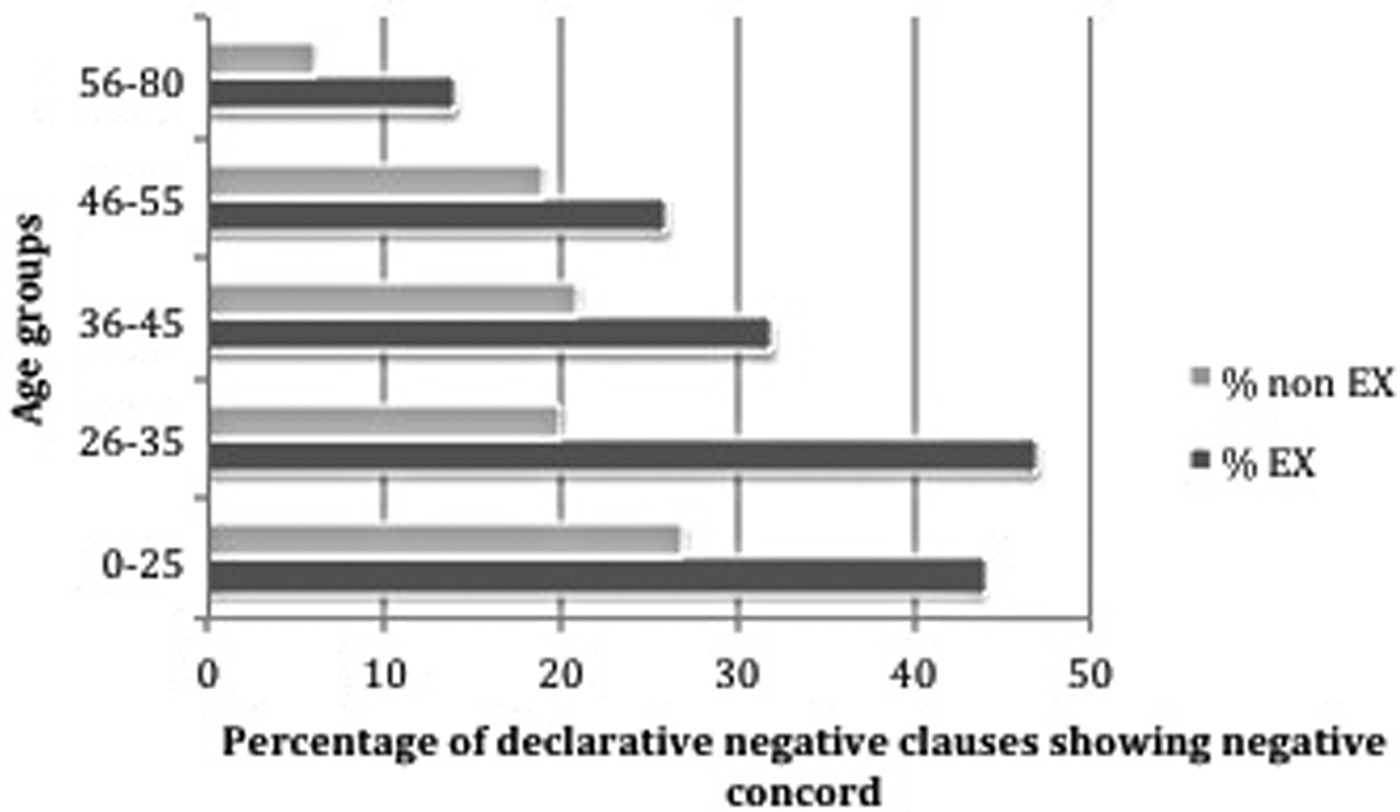
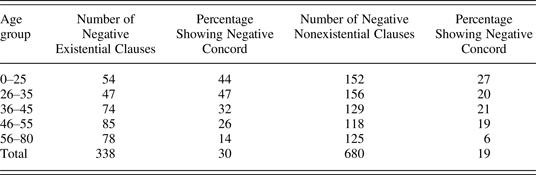
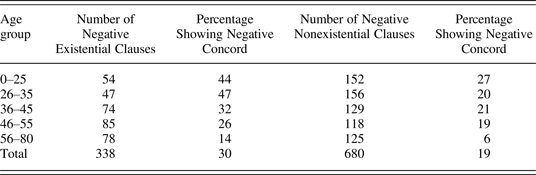
Table 2 presents a cross-tabulation of negative concord by age group and phrase type. For all age groups, the rates of negative concord are higher in existential clauses, as can be seen in Figure 4. The figure shows also a consistent inverse correlation between age and frequency of negative concord for both existential and nonexistential clauses, except for the 26 to 35 age group. The smaller percentages of negative concord in existentials in the 26 to 35 age group than in the 36 to 45 group are probably the result of the small number of tokens for the former (see Table 2).
Frequencies of negative concord by phrase type (existential vs. nonexistential) in the Santa María Chiquimula K'ichee’ corpus.
Negative concord and phrase type by age group in Santa María Chiquimula
Apparent time data indeed suggest that negative concord may be a change in progress. In order to exclude the possibility of age grading, however, real-time data was required. Unfortunately, I could not find any recorded MAR data prior to my fieldwork in 2005. To the best of my knowledge, none of the fieldworkers who collected text corpora in the early 20th century recorded speakers from Santa María Chiquimula. Nevertheless, an examination of the K'ichee’ varieties spoken by the descendants of Chiquimulan migrants settled in other highland townships allows us a reasonable approximation to Chiquimulan speech at the turn of the 20th century.
A TENTATIVE CHRONOLOGY FOR NEGATIVE CONCORD IN SANTA MARÍA CHIQUIMULA K'ICHEE’
Demographic growth and the exhaustion of agricultural land in the township forced many Chiquimula families to search for subsistence land elsewhere in the last three decades of the 19th century (McCreery, Reference McCreery1994:236–264). Hundreds purchased small individual plots in the townships of Sacapulas, Cunén, and Cotzal in the department of El Quiché, north of Santa María Chiquimula, and settled in family clusters forming villages where nearly everyone spoke K'ichee’, preserving their language and distinct ethnic identity over generations. These Chiquimula migrants and their descendants have coexisted for many decades with speakers of Sakapulteko, Cuneteco,Footnote 15 and Ixil, respectively, sometimes becoming bilingual but practicing linguistic endogamy, which requires K'ichee’ to be the home language. They continue to identify as K'ichee’ even if most have never visited Santa María Chiquimula and no longer have any family connections there. Their speech is archaic from a Chiquimula perspective, lacking any superficial evidence of recent Chiquimula innovations, such as negative concord and the intervocalic assibilation of /l/ (Romero, Reference Romero and Stanford2009).
In visits to Cunén and Cotzal in the summer of 2013, I was able to converse in K'ichee’ with many settlers of Chiquimula descent but did not notice negative concord in their speech. In fact, when I described it, they were amused and said they had not heard it before. If we make the reasonable assumption that K'ichee’ enclaves in the department of El Quiché preserve the syntax of negative clauses of their Chiquimula ancestors at the time of their departure from Santa María Chiquimula, we can date the emergence of the latter to no earlier than the turn of the century. The apparent time data we have for Chiquimula is therefore evidence not of age grading but of a change in progress, which, seemingly, is not present in Chiquimula enclaves elsewhere.
Negative concord is not an ethnolinguistic stereotype in Santa María Chiquimula. MAR speakers do not discuss it and it is not construed in neighboring towns as emblematic of the Chiquimula “accent.” When I brought up the subject with Chiquimulas, they seemed bewildered to realize that indeed there was more than one sentential negator in many MAR utterances. Negative concord in MAR is not subject to any prescriptive norm. Unlike in Spanish, for example, it is also not a categorical structural rule. There is some evidence of incipient stylistic variation, however. In the publications of the Catholic parish, the only institution in Santa María Chiquimula publishing materials in K'ichee’, negative concord can be seen in books for children, especially in direct speech.
(14) Su kaɓana waral? Qe:ʧ waʔ ri ox waral.
su k-0-aɓan-a waral q-e:ʧ waʔ ri ox waral
what I-3sA-2sE-do-DI here ours D D 1Ap here
‘What are you doing here? This place is ours!’
Man awe:ʧ ta ri at tax. Xat pa ri axuyuɓ!
man aw-e:ʧ ta ri at tax x-at pa ri axuyuɓ
Neg1 2sE-yours Neg2 D 2sA Neg2 go-2sA loc D hill
‘It is not yours! Go to your own hill/hamlet!’
(Ixcoteyac Reference Ixcoteyac2004:18)
In (14), a direct quote from Lu’, one of the characters in a children's story, a copy of ta(x) follows the subject ri at ‘you’ while the sentential negator is in canonical position after the predicate head awe:ʧ. In contrast, in the pamphlets, catechisms, and self-help books for adults published between 2000 and 2005, I did not find any instance of negative concord. Stylistically, negative concord seems to be appropriate for children's stories but not for adult materials. It is an example of what Labov calls a “new and vigorous change,” an innovation rapidly expanding through the speech community that is beginning to develop stylistic associations even if they are not openly discussed (Labov, Reference Labov2001:256).
NEGATIVE CONCORD IN K'ICHEE’ AND CONTACT WITH SPANISH
Negative concord seems to be absent in every Mayan and non-Mayan language with which K'ichee’ speakers have been in contact in the last thousand years, except Spanish. There is no evidence of it in Xinka, Nahuatl, or in any Mike-Sokean languages of Mexico, for example. It is tempting to turn to Spanish as the source, or rather, the trigger for this innovation in MAR. Spanish is the only language with negative concord in the immediate vicinity of Santa María Chiquimula, and many Chiquimulas are bilingual K'ichee’-Spanish speakers. Both Spanish and MAR allow negative doubling in which the negator licenses the presence of one or even two negative concord items (see (2) and (13)). The collusion of widespread bilingualism and apparent structural convergence might suggest contact as the source. As we saw earlier, the younger age groups have substantially more fluency in Spanish and more contact with Spanish speakers than the older groups do.
Nevertheless, the differences between K'ichee’ and Spanish negative concord are substantial. First, K'ichee’ does not allow negative doubling when a negator is not present in canonical position after the predicate head. In contrast, sentences such as (2) in which the sentential negator no is absent occur in Spanish. Second, negative doubling is categorical in Spanish but variable in K'ichee’.
(15) No sé nada. No sé algo.
Neg I-know nothing Neg I-know something
‘I do not know anything.’ ‘I do not know something.’ ‘I do not know anything (*).’
(16) K'o ta wetaʔam. K'o ta wetaʔam tax
k'o ta w-etaʔam. k'o ta w-etaʔam tax
Ex Neg2 1sE-know Ex Neg2 1sE-know Neg2
‘I do not know anything.’ ‘I do not know anything (at all).’
In (15), the negative concord item nada is required for the relevant reading. In MAR, in contrast, as can be seen in (16), negative concord is not categorical but is an optional variant. It is conceivable, however, that contact with Spanish may have triggered a sort of pragmatic generalization of negative concord in MAR similar to King's (Reference King2000) account of English influence on Prince Edward Island French.
Be that as it may, MAR is not the only K'ichee’ dialect in contact with Spanish, but it is the only one having negative concord today. If indeed contact with Spanish was the trigger—the actuation factor—then contact outcomes are neither predetermined by the structure of the languages involved nor contingent upon density of contact. Other K'ichee’ varieties have been in closer contact with Spanish for much longer than MAR, such as Quetzaltenango and Totonicapán, yet in none do we find evidence of negative concord.
CONCLUSION
This paper described the emergence of negative concord in MAR as a change in progress. Using apparent-time data and evidence from K'ichee’-speaking enclaves in Ixil-speaking areas, I showed that it is a recent innovation that started no earlier than the turn of the 20th century. The fact that only MAR has developed negative concord in K'ichee’ confirms the contingent and unpredictable nature of language change and reminds us of the intrinsic challenges in its study that the founders of the discipline of modern sociolinguistics pointed out (Weinreich, Labov, & Herzog, Reference Weinreich, Labov, Herzog, Lehmann and Malkiel1968, Labov Reference Labov1994).