Introduction
Taenia pisiformis (Cestoda: Taeniidae) is globally distributed (Saeed et al., Reference Saeed, Maddox-Hyttel, Monrad and Kapel2006; Martínez-Moreno et al., Reference Martínez-Moreno, Hernández, López-Cobos, Becerra, Acosta and Martínez-Moreno2007; Lahmar et al., Reference Lahmar, Sarciron, Rouiss and Mensi2008; Bagrade et al., Reference Bagrade, Kirjusina, Vismanis and Ozoliņs2009), and has a significant impact on the health and economics of dog and rabbit breeding, which is especially important in China, the world's largest producer of rabbits. Taenia pisiformis is one of the most common parasites of rabbits and causes autologous poisoning, emaciation, can weaken the host's resistance against other diseases and may eventually cause death (Zhou et al., Reference Zhou, Du, Zhang, Wu, Tong and Wu2008). During the life history of T. pisiformis, cysticerci, the larval stage of T. pisiformis, usually parasitize the liver capsule, the gastric omentum majus and the mesentery of rabbits, while adult T. pisiformis establish and mature in the small intestine of dogs and foxes (Saeed et al., Reference Saeed, Maddox-Hyttel, Monrad and Kapel2006; Bagrade et al., Reference Bagrade, Kirjusina, Vismanis and Ozoliņs2009). Infections may occur when canines ingest the internal organs of rabbits infected with cysticerci, and when lagomorphs consume food polluted with embryonated eggs of T. pisiformis from infected canines (Yang et al., Reference Yang, Fu, Wu, Xie, Nie, Chen, Nong, Gu, Wang, Peng, Yan, Zhang, Zheng and Yang2012).
A previous study used the wild rabbit (Oryctolagus cuniculus) and T. pisiformis as an example to study the phylogeography of easily available organisms (Barbosa et al., Reference Barbosa, Thode, Real, Feliu and Vargas2012) based on the cox1 gene (encoding cytochrome c oxidase 1). As a result of its higher mutation rate and smaller effective population size than nuclear DNA, mitochondrial DNA is one of the most powerful and reliable molecular markers for detecting population structure and inferring population history (Zink & Barrowclough, Reference Zink and Barrowclough2008). The mitochondrial genes cox1 and nad1 (encoding NADH dehydrogenase 1) have been used successfully to study the genetics of taeniid cestodes, including their genetic origin, genetic boundaries and the genotyping of intra- and inter-specific variation (Jeon et al., Reference Jeon, Kim and Eom2007; Nakao et al., Reference Nakao, Xiao, Okamoto and Yanagida2009; Tsubota et al., Reference Tsubota, Nakatsuji, Matsumoto, Fujihira, Yoshizawa, Okazaki, Murakami, Anagawa, Oku and Oishi2009). In the present study, the mitochondrial genes cox1 and nad1 were used to assess the genetic diversity of T. pisiformis from Sichuan province, China.
Materials and methods
Collection of isolates
Sixty-one larvae of the tapeworm T. pisiformis were obtained from rabbits in slaughterhouses from eight geographical localities in Sichuan province, China, including Ya'an (eight isolates, YA1–YA8), Chengdu (eight isolates, CD1–CD8), Panzhihua (seven isolates, PZ1–PZ7), Leshan (seven isolates, LS1–LS7), Guangyuan (eight isolates, GY1–GY8), Luzhou (eight isolates, LZ1–LZ8), Guang'an (eight isolates, GA1–GA8) and Aba (seven isolates, AB1–AB7). The T. pisiformis isolates were washed with sterile phosphate-buffered saline, and stored at 4°C until DNA extraction.
Molecular analysis
Genomic DNA was extracted using phenol and chloroform as previously described by Sambrook et al. (Reference Sambrook, Fristsch and Maniatis2001). DNA was eluted in 50 μl Tris–EDTA buffer (TE) and stored at − 20°C until use. Sequences of cox1 and nad1 were polymerase chain reaction (PCR)-amplified according to the following protocol: 50 μl reaction mixture containing 25 μl of PCR mixture (Tiangen, China), 2 μl of each primer (10 pmol/μl, forward and reverse), 1 μl of template DNA (approximately 100 ng) and 20 μl sterile water. The PCR primers were designed by the software Primer 5.0 (Premier Biosoft International, Palo Alto, California, USA) using the mitochondrial genome sequence of T. pisiformis (GenBank ID: NC_013844).
Conserved primers Tp1 (forward) 5′-TTAGGGTTATGGTCTGGT-3′ and Tp2 (reverse) 5′-ATACATAAGTGCAATCATCAAC-3′ were used to amplify a fragment of cox1 under the following PCR conditions: 94°C for 5 min, followed by 35 cycles consisting of denaturation at 94°C for 1 min, annealing at 52°C for 1 min, elongation at 72°C for 1 min, and a final extension at 72°C for 10 min. Conserved primers Tp3 (forward) 5′-CTTATGTTTGGTTTTGTGTCAGG-3′ and Tp4 (reverse) 5′-AATAGACATAAACAAACATCTCAAA-3′ were used to amplify a fragment of nad1 under the following conditions: 94°C for 5 min, followed by 30 cycles consisting of denaturation at 94°C for 55 s, annealing at 54°C for 55 s, elongation at 72°C for 50 s, and a final extension at 72°C for 7 min. PCR products (50 μl) were separated by electrophoresis in a 1.0% agarose gel and stained with ethidium bromide. Fragments of predicted size were extracted and purified using a TIANgel Mini Purification kit (Tiangen, China). The amplicons were cloned into a pMD19-T vector (TaKaRa, China) according to the manufacturer's recommendations, and positive clones were sequenced three times using our in-house ABI PRISMTM 377XL DNA Sequencer (Applied Biosystems, Foster City, California, USA). The GenBank BLAST program was used for DNA sequence comparisons with the mitochondrial genome sequence of T. pisiformis.
The edited cox1 and nad1 sequences were aligned using Clustal X1.83 (Thompson et al., Reference Thompson, Gibson, Plewniak, Jeanmougin and Higgins1997), and transformed into FASTA and MEGA files, respectively. Sequences of cox1 and nad1 were concatenated for analysis (Hüttner et al., Reference Hüttner, Nakao, Wassermann, Siefert, Boomker, Dinkel, Sako, Mackenstedt, Romig and Ito2008). The sequence divergence was analysed by the MegAlign procedure in the DNASTAR software package (Burland, Reference Burland2000). Conserved and variable sites, information on the number of haplotypes, haplotype diversity (Hd), gene flow (Nm), Tajima's D, Fu and Li's test, and nucleotide diversity (π) were obtained using DnaSP 4.10.9 (Rozas et al., Reference Rozas, Sánchez-DelBarrio, Messeguer and Rozas2003). Analysis of molecular variance (AMOVA), and global fixation index of genetic differentiation (F ST) were carried out by Arlequin v3.11 (Excoffier et al., Reference Excoffier, Laval and Schneider2007). Network 4.0 (Bandelt et al., Reference Bandelt, Forster and Röhl1999) analysed the median-joining (MJ) network of haplotypes. MEGA 4.0 (Tamura et al., Reference Tamura, Dudley, Nei and Kumar2007) and Bayesian inference (BI) using MrBayes 3.1 (Huelsenbeck & Ronquist, Reference Huelsenbeck and Ronquist2001) were used to estimate an original phylogeny of the haplotypes. Parameters for the neighbour-joining (NJ) tree reconstruction included the Kimura-2-parameter index and 1000 bootstraps resampling.
Twenty-one cox1 sequences of T. pisiformis (accession numbers KC020690–KC020710) were obtained from a BLAST search in GenBank, including sequences from the north-eastern Iberian Peninsula (B1, B8, G1, L3, L4, T1, B10, B7, B6, B2, L2, B3,T2) and the south-western Iberian Peninsula (H4, H5, H2, H3) in Spain, and from the Azores (A1, A2, A3, A4) in Portugal. A total of 82 cox1 sequences (700 bp, including 61 cox1 sequences from this study) of T. pisiformis were used to analyse sequence divergence, phylogenies (NJ and BI trees) and MJ-network of haplotypes using the methods described above.
Results and discussion
Taenia pisiformis is one of the most harmful parasites in rabbit farming. Comprehensive knowledge of its biology, distribution and genetic characteristics is essential for effective control of T. pisiformis. Sequences of cox1 (1427 bp) and nad1 (738 bp) obtained in our study have been deposited in GenBank (accession numbers, cox1: JN870101–JN870126 and JX677941–JX677975; nad1: JN870127–JN870152 and JX677967–JX678010). Nucleotide variations of cox1 consisted of nine parsimony informative sites (nine transitions: four G–A, five C–T). The genetic variation in nad1 consisted of four parsimony informative sites (two transitions: one G–T, one C–T and two A–T). In total, there were 13 polymorphic sites in sequences of concatenated nad1–cox1, and pairwise comparison showed that the percentage of divergence among all concatenated sequences ranged from 0 to 0.6%. This demonstrated that the sequence variation of cox1 was higher than that of nad1, and that the AT-richness of the two genes exceeded 70%, which was similar to earlier observations (Jia et al., Reference Jia, Yan, Guo, Zhu, Wang, Shi, Chen, Zhan, Zhang, Fu, Littlewood and Cai2010; Liu et al., Reference Liu, Lin, Li, Liu, Liu, Yuan, Song, Zhao, Zhang and Zhu2011).
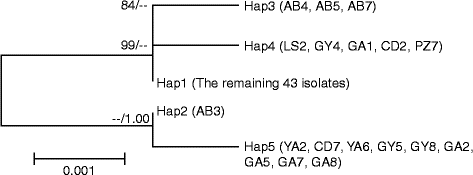
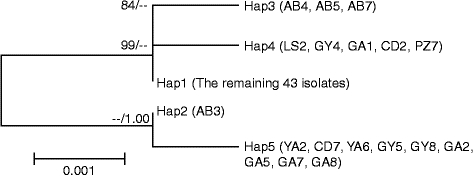
Five haplotypes were found in 61 concatenated sequences. The sample AB3 of the Aba district was identified as Hap2, and the isolates of AB4, AB5 and AB7 shared Hap3 (fig. 1). Hap4 included the isolates of LS2, GY4, GA1, CD2 and PZ7. The isolates of CD7, YA2, YA6, GY5, GY8, GA2, GA5, GA7 and GA8 were identified as Hap5. The remaining 43 isolates were included in Hap1, including isolates from all regions. Sixty-one concatenated sequences had an Hd of 0.48 and a π value of 0.00 137. A π greater than 0.01 is considered to indicate a comparatively large variation (Neigel & Abise, Reference Neigel and Abise1993). The π values of the 61 T. pisiformis isolates thus indicated that all samples from all eight regions had limited genetic diversity.
Neighbour-joining (NJ) and Bayesian inference (BI) trees for five haplotypes of 61 Taenia pisiformis isolates; Ya'an, YA; Chengdu, CD; Panzhihua, PZ; Leshan, LS; Guangyuan, GY; Luzhou, LZ; Guang'an, GA; and Aba, AB. The remaining 43 isolates included YA1, YA3–YA5, YA7, YA8, CD1, CD3–CD6, CD8, PZ1–PZ6, LS1, LS3–LS7, GY1–GY3, GY6, GY7, LZ1–LZ8, GA3, GA4, GA6, AB1, AB2 and AB6. Numbers along the branches indicate bootstrap values from different analyses in the order NJ/BI.
The results of AMOVA showed that the intra-region molecular genetic variation was 89.04%, and there was 10.96% variation among regions. The global Nm and F ST values were 1 and 0.10 957, respectively. The inter-regional Nm and F ST values could be used to analyse the degree of variation (Hamrick et al., Reference Hamrick, Godt, Sherman-Broyles, Hoch and Stephnon1995). Gene flow is one of the most important factors governing the evolution of species (Morjan & Rieseberg, Reference Morjan and Rieseberg2004; Baird et al., Reference Baird, Miller and Stark2012). Subsequently, 0.05 < F ST< 0.15 shows a moderate population genetic differentiation (Rogers & Harpending, Reference Rogers and Harpending1992). The global F ST value showed that the limited genetic differentiation was represented in eight regions. An Nm>1 is considered sufficient to resist the effect of genetic drift and to prevent the occurrence of genetic differentiation (Hamrick et al., Reference Hamrick, Godt, Sherman-Broyles, Hoch and Stephnon1995). Thus, both the global Nm and F ST values support our conclusion. This was consistent with the AMOVA results that molecular mutation was mainly derived from intra-regional differences.
The NJ and BI trees based on concatenated sequences of nad1–cox1 led to very similar trees with shallow branches, and showed that the eight districts did not form geographical clustering (fig. 1). The MJ-network of haplotype showed that Hap1 was prominent (including 67.21% of T. pisiformis isolates). Seven mutational sites occurred between Hap1 and Hap2, and two mutational sites in other adjacent haplotypes. In neutrality tests, Tajima's D < 0 (mean value: − 0.29 537, P>0.1) and Fu's FS>0 (mean value: 2.48 325, P>0.1) were not significantly different, which showed that the evolution of T. pisiformis followed a neutral mode.
The percentage of sequence divergence among 82 cox1 sequences of T. pisiformis (including 17 sequences from Spain, four sequences from Portugal and 61 sequences from our study) ranged from 0.01 to 1.7%. Thirteen different haplotypes were identified (data not shown), and one of them contained 58 isolates (seven isolates from Spain and 51 isolates from China). Four isolates from Portugal and one isolate from Spain shared one haplotype. Phylogeny trees and MJ-network showed that three sub-populations of T. pisiformis from Spain, Portugal and China did not form geographical clustering. Results of the identified haplotypes, the phylogeny trees and MJ-network unequivocally suggested that the genetic characteristics of T. pisiformis sub-populations from Spain, Portugal and China might not be correlated with their geographical distribution. Barbosa et al. (Reference Barbosa, Thode, Real, Feliu and Vargas2012) argued that comparative phylogeography of a parasite and its intermediate prey host could provide evidence for population movements of a definitive predator host, independently of genetic analysis of the latter. The correlation between genetic characteristics of T. pisiformis isolates and rabbits thus requires further analysis.
In conclusion, this has significant implications for studying the population genetics and control strategies of T. pisiformis. Further research will focus on the relationship between genetic haplotypes and infectivity, pathogenicity and virulence of T. pisiformis.
Financial support
This study was supported by a grant from the Program for Changjiang Scholars and Innovative Research Team in University (PCSIRT) (No. IRT0848).
Conflict of interest
None.
Ethical standards
The authors assert that all procedures contributing to this work comply with the ethical standards of the relevant national guides on the care and use of rabbits and have been approved by the institutional committee of Sichuan Agricultural University of China.