

Introduction
Acute tonsillitis represents a significant proportion of admissions to ENT in our Trust and nationally, with total numbers of tonsillitis increasing year on year.Reference Millington and Phillips1 In our institution, each year approximately 120 patients are referred to ENT with acute tonsillitis, with the majority of these being admitted overnight. These patients are predominantly young with few co-morbidities, and they generally respond quickly to treatment.
Given the current pressures faced by the National Health Service, it is of vital importance to look for safe alternatives to admission where possible. Previous studies have shown that patients with tonsillitis can often be safely managed in an out-patient setting, therefore avoiding unnecessary admissions.Reference Bird, Biggs, Schulz, Lower, Faris and Repanos2, Reference Mohammed, Jin, Masterson and Wickstead3 We demonstrate the use of a management pathway for patients with acute tonsillitis in a district general hospital that utilises an ambulatory medical unit to assess and treat patients, with regular re-assessment to minimise unnecessary admissions.
This project aimed to design and implement a management guideline for tonsillitis, with the intent of reducing the number of unnecessary overnight admissions. We assessed its safety and efficacy by auditing the number of admissions and re-admissions of patients with tonsillitis. This study adds to previous work undertaken by including the use of an ambulatory medical unit, meaning patients can be managed without the time constraints of the emergency department and without being formally admitted to a ward. This avoids using a ward bed, freeing up this space for another patient. It also helps to alleviate pressure on emergency department nurse practitioners, who would otherwise be required to administer several intravenous medications for each of these patients.
Materials and methods
A retrospective review of over four months of admission notes and discharge summaries of 48 patients referred to ENT with a diagnosis of acute tonsillitis was carried out. Exclusion criteria included a diagnosis of peritonsillar abscess, positive glandular fever screen findings and age under 16 years.
A management guideline was developed and implemented, with the aim of treating patients in a safe out-patient setting, and involved reassessing the need for admission following initial treatment. This guideline was based on current evidence and was agreed locally by the ENT department.
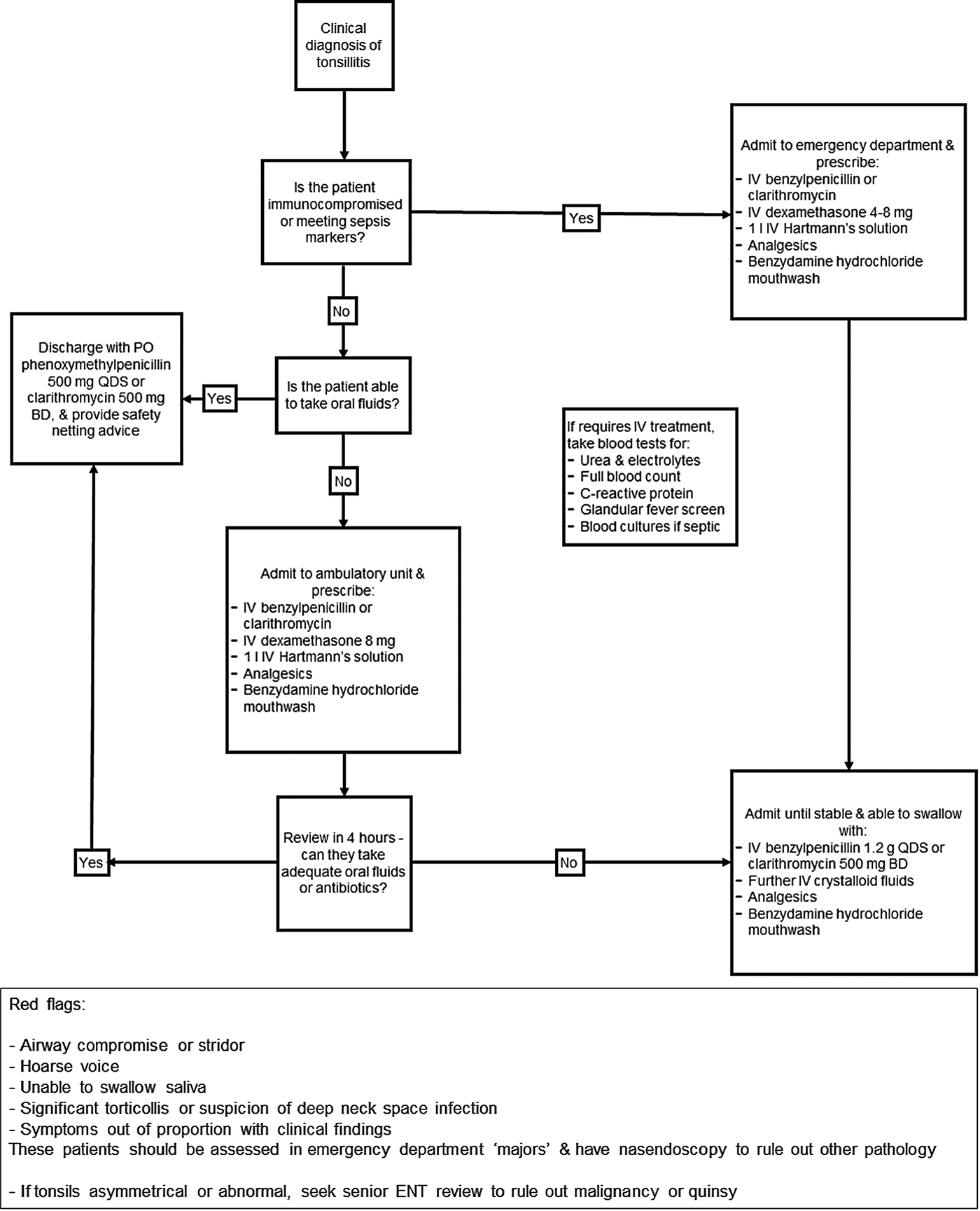
A clinical diagnosis of acute tonsillitis, based on current National Institute for Health and Care Excellence guidelines, is required to initiate the guideline.4 If the patient is unable to manage oral fluids or antibiotics, they are commenced on the treatment algorithm. At least one dose of intravenous antibiotics is given as per local antimicrobial guidelines. Intravenous fluids, unless contraindicated, and analgesics including benzydamine hydrochloride spray, are administered. A dose of 8 mg intravenous dexamethasone is given based on evidence from a systematic review and meta-analysis, which concluded that systemic corticosteroids provide symptomatic relief of sore throat when used in combination with antibiotics.Reference Hayward, Thompson, Heneghan, Perera, Del Mar and Glasziou5
This treatment algorithm takes place in the ambulatory medical unit, thus bypassing the emergency department. This enables avoidance of potential patient breaches and saves valuable emergency department bed space, as well as ensuring the rapid review of expected patients.
Out-patient treatment algorithms have been trialled successfully elsewhere, with no increase in re-admissions.Reference Bird, Biggs, Schulz, Lower, Faris and Repanos2–4 A ‘red flags’ alert box was added to the guideline to minimise the risk of patients with more serious diagnoses being missed and discharged. These red flags include: airway compromise or stridor; hoarse voice; complete aphagia; torticollis or suspicion of deep neck space infection; symptoms out of proportion to clinical findings; or abnormal appearance of tonsils. Any of these features should prompt senior ENT review with flexible nasolaryngoscopy.
A prospective re-audit of 41 patients was carried out. The primary parameters assessed were: length of stay, and percentages of overnight admissions and re-admissions.
Results
During the initial cycle of the audit, 48 patients were referred to ENT with a clinical diagnosis of tonsillitis. Thirty-six patients were admitted overnight (rate of overnight admission = 0.75) (Figure 1). Of the remaining 12 patients, 8 could eat and drink and were discharged from the emergency department on oral antibiotics, and 4 were admitted to a ward but discharged the same day.
Graph demonstrating the change in overnight admissions and unplanned re-admissions before and following implementation of the tonsillitis guideline.

After implementation of the tonsillitis guideline, a re-audit was carried out. Forty-one patients were referred during this cycle. Twelve patients were admitted overnight (rate of overnight admission = 0.29) (Figure 1). Of the remaining 29 patients, 2 were able to eat and drink and were discharged on oral antibiotics, and 27 received intravenous treatment according to the guideline but were able to be discharged on the same day.
The relative rate of overnight admission following the introduction of the guideline was 0.39 (95 per cent confidence interval (CI) = 0.25–0.60, p < 0.001), with an absolute rate reduction of 0.46 (95 per cent CI = 0.25–0.67, p < 0.001).
The mean length of stay following the introduction of the guideline was 9.5 hours, compared with 19.2 hours during the initial cycle of the audit (difference between mean length of stay was 9.7 hours (95 per cent CI = 4.7–14.7, p < 0.001).
There was a reduction in the number of re-presentations following the implementation of the guidance (five in the original cycle and three in the second); however, this difference in rate was not significant (0.10 and 0.07, relative risk = 0.70, 95 per cent CI = 0.18–2.75, p = 0.72) (Figure 1).
There were two re-admissions in both cycles of the audit; given the difference in denominator for the two cycles, this meant a non-significant increase in the relative rate of re-admissions following the introduction of the guideline (0.04 and 0.05, relative risk = 1.17, 95 per cent CI = 0.17–8.02, p = 1.00) (Figure 1).
The mean age of patients referred was similar in the first and second cycle of the audit (26 years in the first cycle and 27 years following the introduction of the guideline; mean difference of 1 year, p = 0.66).
Discussion
The total numbers of acute tonsillitis cases presenting each year to ENT departments nationally is continuing to rise. In the year 2013–2014, 46 987 patients were admitted to hospital with either bacterial or Epstein–Barr tonsillitis or peritonsillar abscess.Reference Ashman and Harris6 There are multiple hypotheses for this trend, including the difficulty in accessing primary care appointments and the increased pressure on primary care to rationalise antibiotic prescribing for sore throats.Reference Moore, Stuart, Hobbs, Butler, Hay and Campbell7 There is also a downward trend in the number of tonsillectomies being performed in the UK because of stricter guidelines, which could be causing the epiphenomenon of an increase in cases of severe tonsillitis and its complications.Reference Millington and Phillips1, Reference Banigo, Moinie, Bleach, Chand, Chalker and Lamagni8
• Acute tonsillitis cases referred to ENT are rising, with a high volume being admitted overnight
• This study supports evidence that patients can often be managed without overnight admission and introduces the concept of using an ambulatory medical unit
• The ambulatory medical unit is a novel concept that may help in the management of rising acute tonsillitis cases
• This is a safe and cost-efficient method of managing acute tonsillitis in secondary care
Since the rationing of tonsillectomy surgery for recurrent tonsillitis, occurring over the past 20 years, the UK has seen an increased number of admissions for acute tonsillitis, peritonsillar abscess and, most concerningly, deep neck space infections.Reference Lau, Upile, Wilkie, Leong and Swift9 Although the rationing of such surgery was intended to increase cost-efficiency in the national management of sore throat, the number of bed days used for the management of tonsillectomy and sore throat combined increased by 14 per cent from 2001 to 2011 in England,Reference Lau, Upile, Wilkie, Leong and Swift9 well beyond that of the percentage increase in population.
The recent NHS England publication ‘Evidence-Based Interventions: Consultation Document’10 stated that the Scottish Intercollegiate Guidelines Network criteria should be employed for all potential tonsillectomies for tonsillitis. Hence, it aimed to further restrict the number of procedures conducted, which may further increase the burden of acute tonsillitis and its complications. Therefore, National Health Service trusts must look for alternative ways to manage the increasing number of acute tonsillitis cases. We feel that the use of an ambulatory medical unit in tonsillitis management, which thus aims to manage the majority of patients in a completely out-patient setting, is a potential remedy to this problem.
With the average cost of a bed space alone being £222 per day,11 there are financial implications for this increase in admissions. As our cohort demonstrates, patients presenting with tonsillitis are usually young and therefore less likely to have medical co-morbidities, making out-patient management a viable and safe option. We have demonstrated that the majority of these patients can be managed safely in an ambulatory medical unit, with a very low rate of re-presentations and re-admissions.
The ambulatory medical unit is an area within the acute hospital, staffed by registered nurses, where intravenous medications and analgesics can be administered. As it is not bound by the same constraints as the emergency department, prompt treatment and regular re-assessment are possible, without the need to formally admit the patient.
There is currently little good quality evidence on acute tonsillitis management in secondary care, and most is based on expert opinion and primary care evidence.Reference Bird, Biggs and King12 Our management guideline follows generic sepsis protocols and current best practice in severe sore throat management. Should a patient with tonsillitis present with haemodynamic instability, they are managed in the emergency department under guidelines for sepsis.13 This pathway is also followed by patients with an increased risk of deterioration, such as diabetes or immunocompromise. The majority of patients do not fall into this category and are thus managed in an ambulatory medical unit.
Patients who are unable to eat and drink are prescribed intravenous crystalloid fluids to manage dehydration, and a dose of intravenous antibiotics. Benzylpenicillin is given as a first-line treatment, as it is effective against the most common organism implicated in acute bacterial tonsillitis in adults, group A haemolytic streptococci.Reference Banigo, Moinie, Bleach, Chand, Chalker and Lamagni8, Reference Abhilash14 It also avoids the potential risk of side effects when amoxicillin is given to patients with infectious mononucleosis. A systematic review and meta-analysis of the use of corticosteroids in sore throat concludes that a single dose of corticosteroids in acute tonsillitis improves pain and hastens the resolution of symptoms, without significant risk of adverse effects.Reference Hayward, Thompson, Heneghan, Perera, Del Mar and Glasziou5 We therefore use a single dose of intravenous dexamethasone as part of the initial treatment for our patients. If a patient is unable to tolerate oral medication and fluids despite the above treatment, they are admitted for further intravenous antibiotics and fluids, until stable and able to eat and drink.
The guideline algorithm is demonstrated in Figure 2. The algorithm should be treated as a guideline rather than a protocol, and clinical judgement should be used.
Algorithm demonstrating the guideline for acute tonsillitis. IV = intravenous; PO = per os (by mouth); QDS = four times per day; BD = twice per day
Conclusion
The tonsillitis guideline has significantly reduced the number of overnight admissions and the overall length of stay for patients with tonsillitis. The limitation of this study is the relatively small number of patients, and future work could include a further audit loop with increased numbers. However, this study does demonstrate the potential significant impact of a specific tonsillitis guideline on both cost and patient flow, which are particularly important when considering the current pressures on the National Health Service. The percentage of re-admissions remains low and total re-presentations has decreased, proving that this is a safe and cost-effective intervention.
This study adds to previous work on tonsillitis management, demonstrating that patients with acute tonsillitis can be managed safely in an out-patient setting. It also introduces the concept of using an ambulatory medical unit to avoid pressures on the emergency department and in ward settings.
Competing interests
None declared



