Disasters can be defined as events typically caused by natural or manmade hazards. Among the natural disasters are climatological incidents that produce hazardous weather events, which are triggered by severe winter conditions, waves of cold temperatures, and strong winds.Reference Guha- Sapir, Vos, Below and Ponserre 1 Many atmospheric disasters are due to extreme temperatures (both hot and cold) and precipitation (both floods and drought). These events can produce strong winds and result in extremely cold winter conditions.Reference Ross 2 During and after extreme weather events, the most vulnerable groups who may be adversely affected are people with health problems, those in low-income populations with few resources,Reference Reininger, Raja and Carrasco 3 and public service workers who are constantly exposed to external elements.
Strong winds and high temperature differences that result in hazardous weather events are common in Turkey, where warm weather advances north from the Mediterranean region and cold weather moves south through the Black Sea and the Balkans. Hazardous weather conditions mostly occur in the northern Aegean, western and central Mediterranean, and Marmara regions of the country, where the city of Çanakkale, in Marmara, Turkey, is located. The city is affected by weather patterns produced by the Dardanelles, the narrow strait in northwestern Turkey that connects the Aegean Sea to the Sea of Marmara, which links the Mediterranean and Black seas. As temperatures fall from the low-lying coastal regions and move inland to higher elevations, constantly high winds are produced in the Dardanelles. 4
Emergency medical service (EMS) personnel are among the most important groups providing medical care for the treatment and transport of injured persons during emergencies and, especially, disasters. Because the EMS typically work outdoors, they are constantly at risk of exposure to cold and extreme weather conditions. If EMS personnel lack personal protection against cold weather, it affects the efficiency of emergency health care response and can lead to a public health problem. Therefore, this study aims to evaluate how well ambulance personnel in Çanakkale prepare themselves, their homes, and their vehicles in anticipation of cold winter conditions.
Methods
This descriptive study was conducted in Çanakkale, Turkey, in the command and control center of 112 emergency aid and recovery service stations and in 17 EMS stations. The data were entered by the participants (n = 167, 69.58%) with use of a sealed envelope method. A survey of 49 questions, developed by us, elicited sociodemographic characteristics (10 questions) and methods the participants took to prepare for serious winter conditions (39 questions). The participants were surveyed about what they should do to prepare themselves, their homes, and their cars for extreme winter conditions, which were based on recommendations from the Centers for Disease Control and Prevention. 5
The 18 questions which refer to individual and domestic preparations in the survey were scored as follows: yes answers were rated 1, and no, I don't know, and I don't have any idea were rated 0. Thus, the minimum score was 0, and the maximum score was 18. Because not all participants had a vehicle, the answers related to cars were excluded from the scoring. The average score of the participants was calculated, and those whose scores were below average (what measurement?) were considered unprepared, and those with above-average scores (what measurement?) were defined as prepared.
Results
The study population consisted of 167 persons, ranging in age from 19 to 59 years (mean age, 29.8 ± 7.9 years). Of these, 34.4% (n = 58) were between the ages of 26 and 30 years; 52.7% (n = 88) were women; 54.5% (n = 91) were high school graduates; 54.75% (n = 91) were emergency medical technician; 53.3% (n = 89) were married, and 68.9% (n = 115) worked in the rural areas of Çanakkale. In addition, 9% of the participants (n = 15) suffered from a chronic illness that required medication; 20% of these participants (n = 3) were diabetic. Also, 24.6% (n = 41) participated in sports during winter.
For personal protection in cold weather, 80.2% of the participants (n = 134) used waterproof boots; 76.6% (n = 128) had water-resistant coats; 70.7% (n = 118) had gloves; 58.7% had a scarf that covered the neck, chin, and face; 55.7% (n = 93) had a hat covering the ears; and 36.5% (n = 61) dressed in multiple layers of thin clothing.
Regarding the heat source in their homes, 63.5% (n = 106) used natural gas and 31.7% (n = 53) had wood- or coal-burning stoves; 24% of the participants (n = 40) stored their fuel before winter, while 57.5% (n = 96) monitored news reports when the weather was cold. During cold weather, 58.7% of the participants (n = 98) had an alternative source of heat in their homes; 54.5% (n = 91) kept a food supply of 3 days that required no cooking; 50.3% (n = 84) had a wall thermometer; 39.5% (n = 66) had a first-aid kit, 17.4% (n = 29) had an emergency kit; 11.4% (n = 19) had a fire extinguisher; 7.2% (n = 12) had an active smoke detector; 6.6% (n = 11) had a carbon monoxide detector; and 4.8% (n = 8) kept a bag of rock salt or sand. In addition, 38.9% of the participants (n = 65) checked for insulation around doors and windows every year; 43.7% (n = 73) checked that chimneys were clean; and 41.3% checked for insulation against frost on outer pipes.
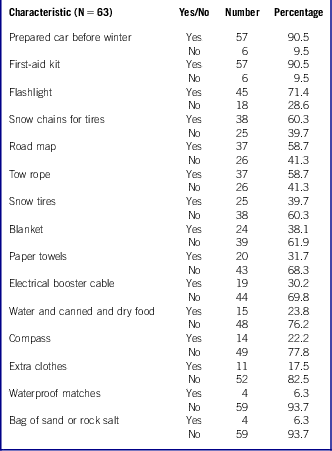
Of the 37.7% (n = 63) of the participants who had cars, 90.5% of them (n = 57) had their cars serviced before winter, and 90.5% (n = 57) had a first-aid kit in the car. Also, 71.4% of them (n = 45) had a flashlight; 60.3% (n = 38) had snow chains; 58.7% (n = 37) had a road map; 58.7% (n = 37) had a tow rope; 39.7% (n = 25) had snow tires; 38.1% (n = 24) had a blanket; 31.7% (n = 20) had paper towels; 30.2% (n = 19) had an electrical booster cable; 23.8% (n = 15) had water and canned and dry food; 22.2% (n = 14) had a compass; 17.5% (n = 11) had extra clothing; 6.3% (n = 4) had waterproof matches to melt snow; and 6.3% (n = 4) had a bag of sand or rock salt (Table).
Distribution of Participants’ Preparations of Their Cars for Winter in Çanakkale, Turkey, 2012

Participants also reported that during the winter, 8.4% (n = 14) had a car accident, 17.4% (n = 29) were injured, 9% (n = 15) had hypothermia, and 8.4% (n = 14) experienced frostbite. Moreover, 18.2% (n = 30) stated that they could not go to work resulting from problems that they experienced due to their unpreparedness against cold weather conditions.
The participants in the study achieved scores from 1 to 17 points (average, 7.52 ± 3.21). The scores for personal winter preparation complied with a normal distribution: 13.8% of the participants (n = 23) scored 9 points; 3% (n = 5) had 1 point; and 0.6% (n = 1) had 17 points. It was determined that the scores relating to household and individual preparation for severe winter conditions increased by participants’ age (P < .003), being married (P < .000) and working in the city center (P < .021).
Statistical significance for winter preparation was also increased in male participants who had a tow rope in their car and participated in winter sports (P < .5), those who worked in rural areas of the province and had snow tires for their vehicles (P < .001), and those who worked in the city center and were unable to work because they were unprepared for severe winter conditions (P < .05). No statistical significance was found between those who were prepared for winter with regard to going to work.
Discussion
Cold weather aggravates serious infectious diseases such as the common cold, which should not be underestimated, and other diseases (eg, chronic lung disease, pneumonia, and cerebrovascular and cardiac diseases) that may cause death.Reference Kilbourne 6 For the 9% of the participants (n = 15) who were found to have a chronic disease that required medication, insufficient preparation for extended cold weather can put them at risk of death.
Study participants who reported the use of natural gas, wood- or coal- burning stoves, and electric heaters to heat their homes also are at risk of death caused by fire due to faulty systems. 7 Working smoke alarms and carbon monoxide detectors should be mandatory in all houses to preclude hazards from fire and dangerous gas emissions. Among our participants, only 10.4% who used natural gas (n = 11) reported having smoke and carbon monoxide detectors, and 1.9% of those who used wood- or coal-burning stoves (n = 1) had a smoke detector. Smoke detectors are important to warn people of fires, especially at night. 7 , Reference Ahrens, Hall, Comoletti, Gamache and LeBeau 8
People who work outdoors or who travel during dangerous weather conditions are at a higher risk of exposure and frostbite due to decreased temperatures and increased wind speeds. Furthermore, drivers are at higher risk of having an accident on roads affected by snow, ice, and fog. According to a Canadian study, 19% of 125 cases of frostbite occurred because of car accidents.Reference Valnicek, Chasmar and Clapson 9 In our study, 8.4% of the participants (n = 14) reported having a car accident during dangerous weather conditions, placing them at risk of frostbite.
The participants in our study are supposed to be prepared for disaster and emergencies owing to the nature of their work. However, the findings from our study showed that some of the participants were unprepared or only partially prepared for severe winter conditions. For example, only 17.4% reported having an emergency kit in the house. In another study in Turkey of patients and their relatives, only 5.6% had an emergency kit.Reference Koçak 10 In comparison, the emergency workers surveyed in our study were more aware of preparedness issues than the general public, but the percentage was quite low.
Limitations
Due to the descriptive nature of the study, the results of our study should be reviewed accordingly. Because the data were collected by station leaders who were trained by researchers in the province, errors may have been introduced. Also, an analysis of the relevant literature pointed to additional areas of inquiry that could have been included in the study, such as questions about whether participants want to receive training in protective measures for severe winter conditions; whether participants consumed alcohol; where they lived; if they were injured, and if so, where and when it happened, and if they were injured while working. Information with regard to these areas of inquiry would be helpful and should be considered for further studies.
Conclusions
The findings in our study have disclosed the deficiencies our participants had in protecting themselves, their homes, and their vehicles in the advent of potentially hazardous winter conditions. All health care workers should undergo educational training to increase their levels of protection in regions known for severe winter conditions. Moreover, it has been suggested that a scale should be developed to evaluate the level of preparedness of active personnel for severe winter conditions.
Disclaimer
Paper presented at: 18th World Congress on Disaster and Emergency Medicine; May 30, 2013; Manchester, United Kingdom.