In seabirds, diet and feeding methods are related to the species morphology (Croxall, Evans, & Schreiber, Reference Croxall, Evans and Schreiber1984). Species that feed on living, mobile resources rely on a fully operational beak to efficiently seize, kill and swallow their prey. This is particularly important to diving species, such as penguins, that are highly time constrained when searching for prey at depth—as air-breathing predators, penguins must maximise their feeding efficiency during their deep foraging dives (Wilson & Wilson, Reference Wilson, Wilson, Davis and Darby1990). This is why the observation of free-ranging penguins with physical abnormalities in good body condition is so rare. Here we report a highly unusual observation of a premoult adult king penguin (Aptenodytes patagonicus Miller) in good body condition with a highly anomalous beak.
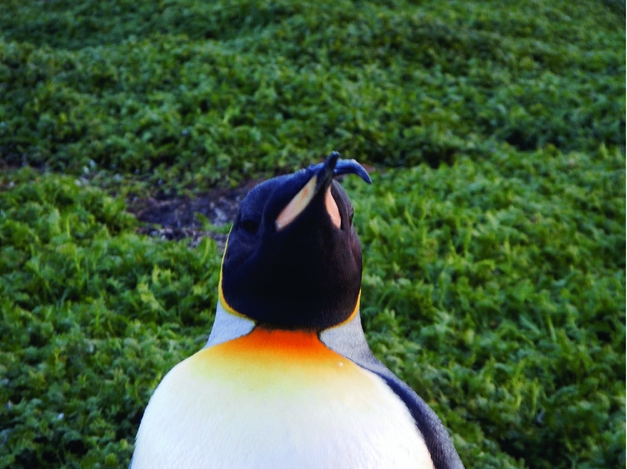
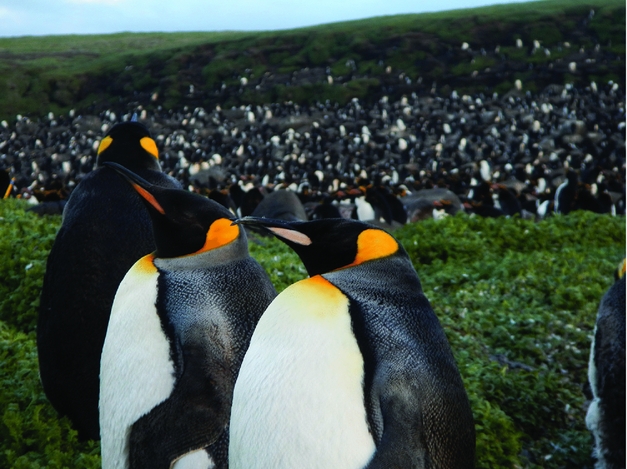
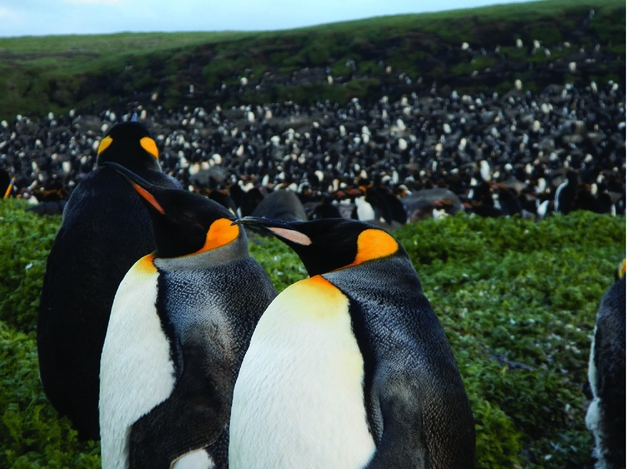
This observation was made at the Kerguelen Islands (49°03′24.27″S, 70°18′35.11″E), south Indian Ocean. During a survey performed on the 28 December 2013 at Cap Cotter, about ten king penguins were observed settling between the breeding colonies of macaroni penguins to complete their moult. Among these premoult adult king penguins, we observed a bird with a major beak anomaly (Fig. 1). The upper mandible was twisted to the left from the base of the beak to its extremity. The origin of the deformation could not be determined; however, we are certain that it was not a recent accident as there were no traces of fresh injuries. If this defect had resulted from an accident, the injuries were completely healed. Surprisingly, this penguin seemed to have very good body condition, having just started to moult with a body mass similar to that of its congeners (Fig. 2).
Head of free-ranging king penguin with a highly pronounced beak anomaly (photography by A. Corbeau).

Moulting king penguin with twisted beak mandibles (third from left) with conspecifics at Cap Cotter (photography by A. Corbeau).
This observation of an anomalous king penguin with a twisted beak is especially intriguing for two reasons: (1) the bird was healthy, fat and had just started to moult, and (2) the colours of its plumage indicated that it was an adult. In king penguins, the adult plumage is reached at the end of the second year, after the moult (Bost et al., Reference Bost, Delord, Barbraud, Cotté, Peron, Weimerskirch, Borboroglu and Boersma2013). Thus, this penguin must have been foraging successfully for at least three years. Among penguins, there are only a limited number of reports of deformations. Two of these concern creched Aptenodytes penguin chicks (king penguins: Stonehouse, Reference Stonehouse1960; and emperor penguins [Aptenodytes forsteri Gray]: Pütz & Plötz, Reference Pütz and Plötz1991). To our knowledge, no similar information has been published concerning adult penguins. King penguins are specialised foragers, feeding on small prey characterised by patchy distribution—mesopelagic myctophid fish represent more than 89% of their diet by biomass (Cherel & Ridoux, Reference Cherel and Ridoux1992). Most of the fish usually caught by Kerguelen king penguins are very small (mass range: 1–9 g; Bost, Zorn, Le Maho, & Duhamel, Reference Bost, Zorn, Le Maho and Duhamel2002). The long mandibles of king penguins, curved towards the front of the beak, are well suited to quickly grasp and ingest such small fish. Thus, a markedly twisted beak is potentially a major disadvantage when catching myctophids.
Among terrestrial birds, beak anomalies are sometimes observed. Recent studies on terrestrial birds show very high rates of beak deformities in a limited number of sites. For example, beak anomalies caused by keratin deficiency have been reported in 30 bird species in Alaska, mainly in black-capped chickadees (Poecile atricapillus L.) (Handel et al., Reference Handel, Pajot, Matsuoka, van Hemert, Terenzi, Talbot and Trust2010). Other incidences of beak anomalies have been recorded in willow flycatchers (Empidonax traillii (Audubon)) (Sogge & Paxton, Reference Sogge and Paxton2000), northwestern crows (Corvus caurinus Baird) (Van Hemert & Handel, Reference Van Hemert and Handel2010) and in terrestrial birds of North Patagonia (Gorosito, Gonda, & Cueto, Reference Gorosito, Gonda and Cueto2016). All these recorded anomalies resulted from an avian keratin disorder of unknown cause—the main proposed causes being pollution or bacterial infection (Gartrella, Alleya, & Kellyb, Reference Gartrella, Alleya and Kelly2003; Van Hemert & Handel, Reference Van Hemert and Handel2010; Van Hemert, Handel, & O'Brien, Reference Van Hemert, Handel and O'Brien2012). More recently, a newly discovered picornavirus, called ‘poecivirus’, has been linked to avian keratin disorder and proposed as a candidate causative agent (Zylberberg et al., Reference Zylberberg, van Hemert, Dumbacher, Handel, Tihan and DeRisi2016). Concerning the anomalous king penguin, we believe that it is unlikely that the twisted mandible resulted from a keratin disorder since no signs of any outgrowths were observed in other keratin-containing tissues, as are often observed in Alaskan birds with beak deformities (Handel et al., Reference Handel, Pajot, Matsuoka, van Hemert, Terenzi, Talbot and Trust2010).
Van Hemert et al. (Reference Van Hemert, Handel and O'Brien2012) showed that birds with beak deformities in Alaska are able to change their diet. This adaptability is associated with human contact and the birds feed more on ‘artificial’ food that is more easily accessible, while displaying a reduced function of the beak. The main question raised by this unusual king penguin is how the bird has been able to feed efficiently over a long period with such a heavily deformed beak. One possible explanation is that the penguin forages on a more diverse diet, probably including larger squid (squid are assumed in this case to be easier to catch with a beak deformity, relative to small myctophids). King penguins are known to rely more on squid as a food source during winter than during summer (Cherel, Verdon, & Ridoux, Reference Cherel, Verdon and Ridoux1993). Therefore, a shift from a specialised diet of small myctophids to a more diversified diet during the summer might explain the long-term survival of this bird. Unfortunately, it was not possible to determine the breeding status of this bird as both non-breeding and breeding king penguins can be found moulting at the time of our observation in December (Weimerskirch, Stahlt, & Jouventin, Reference Weimerskirch, Stahlt and Jouventin1992).
To conclude, here we report an observation of a very specialised top marine predator surviving with a severe beak anomaly. The successful foraging activities of this anomalous bird are striking and suggest compensatory feeding behaviour.
Acknowledgements
The present work was supported financially and logistically by the Institut Polaire Français Paul-Emile Victor (IPEV, programme Oiseaux Plongeurs, resp. C.-A. Bost) and was realised (Prog. 394) in agreement with the ethics committee of IPEV and with the authorisation of Prefect of the French Southern and Antarctic Lands (Terres Australes et Antarctiques Françaises–TAAF). We are especially indebted to Annette Scheffer for her help with the English.