On the importance of the environment
Beyond the original concept of environment, which has centered predominantly on its physical and natural specification as ‘ecological system’, social sciences in general, and human ecology in particular, have stressed the anthropological and socio-cultural components inextricably integrated into any concept dealing with it. The environment is a total phenomenon. It is both a natural realm as well as a built up realm, hence both interdisciplinary and trans-disciplinary approaches are required.
In this connection, we note some theoretical frameworks, such as those of the neo-ecological school, which contribute to differentiation between the ‘ecological-human realm’ and the ‘sociological-urban realm’. It is in this connection that Hawley (Reference Hawley1950) considers that the community is a collective response to the habitat involved, an adaptation, so to speak, of the human organism to the milieu in which it lives. It is Hawley's contention that culture is an ecosystem considered from an analytic outlook while an ecosystem is culture considered from a synthetic outlook. Thereafter, Duncan (Reference Duncan, Hauser and Duncan1959) stressed that both the material culture (technology), and the non-material culture (organisation) have emerged from the population-environment relationship. Every ecosystem is analysed from its unity onwards, with its constituent components such as population, milieu, social organisation, and technology.
A self criticism of the ecological-human thinking, mainly through Erpicun (Reference Erpicun, Bourgoignie, Cardyn, Dandenault, Erpicun, Lessard, Marsan, Racine and Valke1976) is valuable especially because of the introduction of the ego consciousness, so that the environment can be seen as an interiorised milieu. This allows links to be established with an existential sociology (Acebo Ibáñez and Brie Reference Acebo Ibáñez and Brie2006) as a fresh sociological reading of the existentialist thinking of Heidegger, Sartre, Jaspers, etc. Precisely, the human being, as a homo conditor, (a founder of communities and cities), not only develops strategies for survival in the world but also the human being founds space or territories that could be called realms for meaning. So, the human being inhabits within the existentialist meaning Heidegger (Reference Heidegger1954) gives to this concept.
Arising from the influence of Simmel's sociology (Reference Simmel1908), the theoretical-empirical production of the school of Chicago (Park and others Reference Park, Burgess and Mckenzie1974) mainly between 1915 and 1925, laid the foundation stone for what could be called environmental sociology, even though this branch of sociology arose amidst an ecological crisis the magnitude of which is vast: reduction of the ozone layer, atmosphere heating process, industrial pollution, etc., a crisis which requires urgent solutions for the environmental problems more than a calm discussion on frames of reference and theoretical postulates. Obviously, however, such an ecological crisis is not free from ethical and existential connotations with reference to either its causes or its consequences and means for the solution and prevention thereof. At the same time, this environmental crisis has lead to immediate, conflict like approaches in terms of setting out opposing elements: for example first and third world, north-south, developed countries and not fully industrialised countries etc.
The fact of inhabiting is a proprium, that is a characteristic which defines the human being as such, as Heidegger (Reference Heidegger1954) put it aptly in his essay Bauen, whonen, denken, humans build and construct because they inhabit previously, and not the other way around. Hence, the importance of to dwell, representing not only a human need but also a necessary consequence of being-in-the-world. Heidegger understands that inhabiting means dwelling, residing but, also, implies contentment, feeling that you are at peace and free. Precisely, the basic trait of the fact of inhabiting is the care for the land of the mortals. Hence, we realise that any predation, any action likely to contribute to the ecological-environmental crisis demonstrates that humans have relinquished their very existential vocation. It is quite clear that to inhabit should mean to save the land.
A theoretical approach to ‘rootedness’ has been developed (Acebo Ibáñez Reference Acebo Ibáñez1996, Reference Acebo Ibáñez2000, Reference Acebo Ibáñez2007; Acebo Ibáñez and Costa Reference Acebo Ibáñez and Costa2006), in which it emerges as a total phenomenon, multidimensional and interdependent, namely: a) ‘rootedness’-space level (territorial bonding); b) social ‘rootedness’ (sense of pertaining to groups, especially primary groups, as well as real and potential participation in community affairs); and c) cultural ‘rootedness’ (low level of anomie). The community attachment that represents ‘rootedness’ is a phenomenon dialectically connected with the ways of living, attitudes, behaviours and representations of reality, in sum, as Weber (Reference Weber1922) indicated with the subjective meanings the social actors are attaching to their social actions.
Research and methodology
On the basis of the above considerations, a study was conducted on the representations young people (age 15–25), from the cities of Buenos Aires and Bariloche, have with regard to Antarctica and its environmental problems. The former, Buenos Aires, is the capital with almost 3 million inhabitants in its federal district and almost 14 million in the whole metropolitan area, and the much smaller Patagonian city of San Carlos de Bariloche, with almost 120,000 inhabitants. Buenos Aires is situated on the River Plate estuary while Bariloche is much further south and is situated in a mountainous region.
A sample of 500 persons was selected for each city on the bases of age, gender, and socioeconomic level (SEL) quotas. A questionnaire with both open and closed questions was administered.
Attitudes and behaviours in relation to Antarctica, its environmental problems and possible solutions, were recorded bearing in mind the hypothesis that ‘rootedness’, anomie, participation, and consumerism can be explanatory variables. Respective indexes were constructed.
Sociodemographical aspects
The city of Buenos Aires
Buenos Aires has a registered total of 2,775,138 inhabitants according to the 2001 census. A population fall is observed since the 1991 census (2,965,403 inhabitants): a 6.4% negative inter-census drop (INDEC 2001) while a projection onto the year 2007 had forecasted a 3,034,161 inhabitant population (DGEC 2008).
The city covers 202.9 km2, so, according to the 2001 census, the population density was 13,679 inhabitants km2. As regards Buenos Aires population pyramid, a demographical transition process can be observed: while both the birth rate and death rate are decreasing, at the same time life expectancy is growing.
The Buenos Aires population fluctuations have been positive and negative during the last quinquennium. Fluctuations have been due to negative migration growth rates, and vegetative growth positive rates.
With regard to education, almost 40% of the 15 year old, and older, Buenos Aires population completed senior high school, without, however, continuing to university. 35% completed elementary school without continuing to junior/senior high school. A fifth of population passed university studies.
In 2007, 8.7% of the active population of Buenos Aires was unemployed, and 7.7% of the active population was underemployed. Among employed people, a third part was working in trade activities; a fifth part worked in tourist services (hotels, restaurants and the like, and shops) and a similar percentage was working in activities related to finance, insurance, and real estate. The remainder of employed people, in similar percentages, worked in the following sectors: industry, public transport, household service, and the building trade.
With regard to poverty indexes, it has been observed that 7.8% of Buenos Aires inhabitants had sustained unsatisfied basic needs during 2001 (INDEC 2001). More updated data show that 9% of population was living under the poverty level, and 3% of the population was living under the indigence level in 2007 (DGEC 2008).
In the city itself, the main environmental issues are floods (caused by a poor territorial management), the lack of treatment for industrial gases, and the non-application of existing rules as regards cars (Di Pace Reference Di Pace2007).
The city of San Carlos de Bariloche
San Carlos de Bariloche is situated in the province of Río Negro. According to the 1991 census, there were 94,640 inhabitants, and, according to the 2001 census, there were 109,826 inhabitants, that is a 16% inter census relative growth (INDEC 2001). There are no more recent census related data, however some 2005 estimates considered that there were already125,000 inhabitants (Monasterio Reference Monasterio2005).
The Buenos Aires population has been stable in comparison with the strong growth of the Bariloche population (the 2005 population was nine times higher than the 1947 population).
Bariloche covers 5,415 km2. So, while the population density was of 17.5 inhabitants km2, in 2001 population reached a density of 20.3 inhabitants km2. An estimate for year 2005 suggested a population density of 23 inhabitants km2. The Bariloche age groups are only starting a demographic transition process.
Even though Bariloche received many immigrants during the 1970s and 1980s, during recent years, growth has been caused by an increasing birth rate. With regard to education, 40.5% of the population has not completed elementary school; 39.4% completed elementary school only, while 16% completed their senior high school level without, however, continuing to university. Only 4% passed university studies (Iwanow Reference Iwanow2005).
As regards work, 9% of the economically active population is unemployed, and 23% is underemployed. Among the employed population, a fifth works in trade, 10% work in hotels and restaurants, 9% are employed in public utilities, and only 1% works in the production sector (Iwanow Reference Iwanow2005).
With regard to the poverty index, it has been observed that 20.3% of the Bariloche inhabitants had sustained unsatisfied basic needs during 2001 (INDEC 2001). Other research, however, indicates higher poverty, pursuant to which 61% of the population would be living under the poverty level, and 32% were indigent (Iwanow Reference Iwanow2005).
In Bariloche, the main environmental issues are landslides, floods, floodings and forest fires. Many deficiencies have also been observed in urban services such as sewage and rain effluent, the electric network, drinking water supply, mains, and the treatment of residues (Secretaría de Planeamiento y Medio Ambiente 2009). Finally, heterogeneity is observed among the city inhabitants’ cultural guidelines, a product, so to speak, of the different migration flows that have generated a somewhat chaotic urban growth thus hampering the setting up of a clear, local identity (Iwanow and Méndez Reference Iwanow and Méndez2001).
Antarctica
Antarctica as a metaphor and a reality
Antarctica as an empty space is a representation of the confluence of national statements on sovereignty and the globalisation processes, a latent integration process and the perspective of conflicts, due to the overlapping of territories that are claimed by different countries.
In can be seen as a paradigm of a natural realm that human beings have to protect, a realm which is a patrimony for humankind, a confluence of esthetic and ethics, reality and poetry, immaculate purity facing potential exploiters. As Codling (Reference Codling2001: 337) reminds us, ‘. . . in article 3 of the 1991 Protocol on Environmental Protection to the Antarctic Treaty, the Antarctic Treaty Consultative Parties (ATCPs) committed themselves to “the protection of the Antarctic environment [. . .] and the intrinsic value of Antarctica, including its wilderness and aesthetic values.”’
Following this, the different perceptions people have as regards Antarctica as an emotional connection with the environment have been pointed out (Roura and Acebo Ibáñez Reference Roura, del Acebo Ibáñez and Acebo Ibáñez2000). These are Antarctica as an experience (that is ‘living its virginity and purity as an experience’); Antarctica as a belonging (that is ‘we are both a part and a product of the environment’, ‘in the white continent the natural environment-individuals relationship is only affected in a most minimal way’), and Antarctica as a symbol (that is ‘being a virgin or wild territory’, ‘as a symbol for peace and cooperation’, ‘as an expression of creation’).
Individual representations about Antarctica
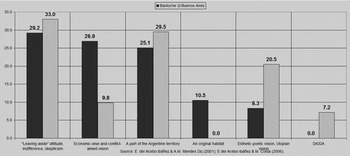
In this research, subjects were asked what does Antarctica represent for them. Answers were distributed among the following categories (Fig. 1).
a) Some 33% of the young inhabitants of both cities demonstrate a ‘leaving aside’ attitude, indifference and scepticism (that is ‘that does not mean anything’, ‘I don't feel it is near me’, ‘it's only a piece of ice’, ‘that's where penguins live’, ‘it's something far away and forgotten’, ‘that's the world's icebox’, ‘that's a no man's land’, ‘it's the other point of the world’, ‘it's a place nobody can live in’, ‘this is a desolate place).
b) For almost 30% of the subjects from Buenos Aires, and 25.1% of the subjects from Bariloche, Antarctica represents a part of Argentine territory (that is ‘a part of Argentina that a great deal of people have forgotten’, ‘it lies to the south of Argentina’, ‘it is a part which belongs to Argentina’, ‘it is a part of the national patrimony’). It is sociologically relevant that many young inhabitants see Antarctica as a part of the national territory instead of a continent.
c) 20% of the interviewees in Buenos Aires (but only 8.3% in Bariloche) evidence a poetic or utopian vision of Antarctica: that is ‘beautiful landscapes’, ‘beauty’, ‘a dream’, ‘something unknown which should be explored’, ‘the infinite beauty only the Lord is able to create’, ‘mystery’, ‘the last shelter’, ‘humankind's patrimony’, ‘a virgin place’, ‘a pure place’, ‘an oasis’.
d) Almost 10% of interviewees from Buenos Aires (but 26.9% from Bariloche) demonstrate an economic, conflict aimed vision of Antarctica (that is ‘this is a land many people dispute over on account of its resources’, ‘a many-resourced place’, ‘an immense water reservoir’, ‘a strategic place’, ‘cause of international conflicts’). These percentages increase significantly in both cities when it comes to individuals with the highest SEL.
e) It should be noted that only 7% of the Buenos Aires sample did not answer to this question. There are significant percentage differences as far as young people within the 15–19 age range are concerned (11.3% versus 4.9% among the 20–25 age range), and also among subjects with the lesser SEL (20%).
As we can see the poetic and utopian attitudes are more present in Buenos Aires than in Bariloche, whose inhabitants are more focused on the economic wise and conflict aimed vision.
Individual representations on Antarctica (young inhabitants of Bariloche and Buenos Aires) (%).

Environmental problems as subjects perceive them
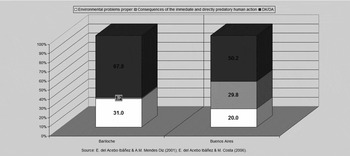
50% of the young Buenos Aires inhabitants, and more than 66% of the Bariloche sample either did not know anything with regard to the environmental problems likely to be caused in Antarctica or they did not know what to say. This percentage increased significantly as the SEL of subjects decreased.
From the subjects that did answer the question, their answers can be grouped as follows (Fig. 2).
a) 20% of the Buenos Aires subjects (and 31% of the Bariloche sample) perceived that there exist environmental problems proper (that is ‘ozone layer’, ‘defrosting’, ‘overheating’). The percentage increases in both cities together with the SEL.
b) 29.8% of the Buenos Aires sample (but only the 1.2% of the Bariloche sample) perceived that environmental problems in Antarctica are a consequence of immediate, and directly predatory human action (that is ‘refuse and waste from the boats causing water pollution’, ‘oil spillages’, ‘contamination caused by the military bases’, ‘trash’, ‘slaughter of the marine fauna’, ‘non discriminating fishing’). There is a greater percentage with this kind of answer whenever SEL increases. This is also the percentage among subjects within the 20–25 age range. They also tend to be subjects with a higher ‘rootedness’ level, and a lower individual anomie level.
Identifying Antarctic environmental problems (young inhabitants of Bariloche and Buenos Aires) (%).

What are the possible solutions to those environmental problems?
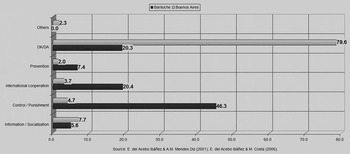
It should be noted that when they were asked about possible solutions as regards Antarctica environmental problems, and how could it be possible to face them, almost 80% of Buenos Aires subjects (79.6%), admit they have no idea about it, or simply avoided the question directly. All subjects that did not answer were suffering from individual anomie. In the case of the Bariloche sample only the 20.3% answered in this way.
The replies gathered among the remaining subjects can be grouped as follows (Fig. 3).
a) Information/socialisation (that is ‘make people aware’, ‘educate tourists’) is mentioned by 7.7% of the Buenos Aires sample, and 5.6% of the Bariloche subjects. These are subjects with either a high ‘rootedness’ level and/or a high SEL.
b) Control/punishment (that is ‘navigation must be forbidden’, ‘norms and regulations must be set up’, ‘control is a must’). Almost half of the Bariloche sample (46.3%) answered in this way, but only 4.7% of the Buenos Aires sample. This tendency among Bariloche young inhabitants shows that they have a clearer perception about predatory behaviours.
c) International cooperation (that is ‘the world powers should reach an agreement’): 20.4% among the Bariloche inhabitants (but just 3.7% of the Buenos Aires sample).
d) Prevention (that is ‘to protect fauna’, ‘to protect nature’, ‘take away people that are there so that they do not go on polluting the environment’): 7.4% of the Bariloche sample and 2.0% of the Buenos Aires subjects.
Possible solutions for solving Antarctic environmental problems (young inhabitants of Bariloche and Buenos Aires) (%).

Some conclusions
Many young subjects from Buenos Aires and San Carlos de Bariloche lack any knowledge about the environmental problems that Antarctica is facing. The percentages climbed to higher figures when subjects were asked about the possible problem solving process. This is likely to mean that the environmental problems are a topic that reference is made to in general instead of being a problem the magnitude and consequences of which people are keenly aware.
The study has confirmed that individuals with a high ‘rootedness’ level, and a low anomie level tend to identify environmental problems with problems dealing with immediate human action in terms of depredation and/or direct pollution. This can be envisaged as explicit acknowledgment of individual responsibility as far as the aetiology of the contemporary environmental problems is concerned. At the same time, this type of social actor (‘rooted’ and not anomic) tends to give priority as a solution to the socialisation and information processes.
In this case, too, subjects are resorting to the capacity and responsibility of individuals, in the sense that individuals are likely to modify their behaviours through an adequate information and formation process. This also implies a certain hope with respect to the possibility of modifying human behaviour, hence, solving environmental problems.
Perhaps a clear visualisation, coupled to clear experience, of the normative-axiological web of a given society could anchor individuals so that they might be in a better position to identify environmental problems, their possible causes and solutions. In that case, the authors have been dealing also with young people with a higher grade of inner life, a fact leading the great majority of them to demonstrate an aesthetic, poetic, and utopian vision of Antarctica. Besides, their high total ‘rootedness’ level causes them to consider that, basically, Antarctica is a part of Argentine territory. Conversely, a low grade of inner life causes subjects to put environmental problems ‘away from one's responsibility’ and mainly ‘due to natural disasters’, or ‘to floods’.
A high grade of anomie causes subjects to envisage the future in a most pessimistic way. Individuals enjoying higher SELs tend to perceive Antarctica from an economic, conflict-aimed approach.
Control and punishment as a way of formulating a remedy to environmental problems tend to be emphasised by subjects within the 20–25 age range and within a higher percentage of female subjects. The same solution is also suggested by individuals suffering from a low actual as well as potential participation level.
Antarctica tends to be seen as the Terra Incognita, as was mentioned above. A high percentage of subjects that do not answer or do not know the issue can be summed up as demonstrating the predominant ‘couldn't-care-less’, indifference and scepticism attitude shown by many young people with respect to the continent.
The imaginary Antarctica, as fruit of an aesthetic, poetic, and utopian vision is predominantly present among young people with a lesser grade of consumerism-aimed life, a low anomie level and a high grade of potential participation, that is, individuals endowed with sufficient energy to view Antarctica as a metaphor of beauty, mystery and the last shelter. Conversely, a more pragmatic and conflict-aimed vision of Antarctica is to be found in a higher ratio among young people with the highest SEL.
This study attempts to show how the different ways of being-in-the-world, the different modes of the urban fact of dwelling resonate among the different forms and types of behaviour and representations of reality in relation to the present and future environmental problems proper and their probable and desirable solutions, in relation to Antarctica.
Indeed, this is an ecological crisis. In order for it to receive both adequate diagnosis and prognosis, beyond easy, shallow statements and clichés à la mode, the following factors must be taken into account, the preexisting social and anthropological crisis, the ways humans have had to dwell on the face of the planet, and human ways of being and ways of dwelling here and now.
So, the emerging planet wide crisis will be demanding not only national and international policies in terms of prevention and preservation, but also more and more quotas of existential authenticity and strength from individuals, heavy factors making the light and fast attitude more difficult to be overcome, since this attitude has been fostered by consumerism as well as by utilitarian culture.
We do need existential authenticity and ‘rootedness’, that is dwelling modes that are indispensable to maintain an adequate course. If the planet Earth is to become a dwelling, this implies the highest degree of existential commitment between Earth and the humans.