Introduction
Corporate governance is a crucial driver of firm performance, value, innovation, and dividends paid (Acharya et al., Reference Acharya, Myers and Rajan2011; Ammann et al., Reference Ammann, Oesch and Schmid2011; Bhagat and Bolton, Reference Bhagat and Bolton2008; Wu, Reference Wu2008). There exist influential indices to measure it (see, e.g., Bebchuk and Cohen, Reference Bebchuk and Cohen2005; Brown and Caylor, Reference Brown and Caylor2006; Gompers et al., Reference Gompers, Ishii and Metrick2003). Even though well-established in management and finance literature, the impact of corporate governance plays only a minor role in industrial economics, particularly in studies on cartels and collusion.
Collusive agreements are concerted practices that increase profits but harm consumer welfare. Involved firms agree on sales quotas below the competitive equilibrium or prices above it. Another practice is assigning monopoly markets by geographical distinction: one cartel member is the sole distributor within a specific region, state, or country. While reliable statistics on cartels substantially suffer from the structural challenge that they are mostly illegal and hard to track, statistics exist on their disclosure. Between 2019 and 2023, the European Commission imposed fines amounting to 3.8 billion EUR.Footnote 1 The US Department of Justice imposed fines worth 1.3 billion USD in this period.Footnote 2 A remarkable case in the European Union has been the commercial truck cartel. For at least 14 years, DAF/Paccar, Daimler, Iveco, MAN, Scania and Volvo/Renault colluded on pricing and introducing new low-emission technologies. The cartel had a joint market share of 90% in Europe's medium and heavy truck market. As a consequence, the fines for this cartel alone make up for 3.8 billion EUR, imposed in 2016 and 2017.Footnote 3
Even though complex governance structures within and between firms are predominant, in industrial economic research a common simplification of firms to abstract entities prevails. They often interact based on the maximization of an infinite stream of expected profits (Schmal, Reference Schmal2022). Such an approach may neglect how entangled communication and coordination between firms in a corporate cartel can become.Footnote 4 Put differently, focusing on firm profits addresses financial but not governance aspects of collusion. As cartels are illegal in most countries, the governance schemes of a cartel need to incorporate that collusive agreements cannot be legally enforced. Corporate governance within a firm is already an established subject of study. The same holds for market characteristics that foster or harm the formation and duration of cartels. This paper examines the layer between the two: governance among firms within a cartel. It aims to study how polycentric governance of cartels can serve as an additional explanation of their stability. It attempts to widen the perspective of how to study collusion, its emergence, and its collapse. Doing so aims to complement and expand the existing research programme on cartels.
The present paper introduces the concept of polycentricity to the mesolevel of firm interaction within a cartel.Footnote 5 Using a comprehensive OECD dataset, I present correlational evidence pointing at the presence of polycentric structures, particularly among large cartels. I provide evidence that more cartel members do not co-occur with lower cartel duration. Furthermore, a concave relationship exists between the number of cartel members and the aggregate financial sentence for a disclosed cartel. Lastly, third parties involved, such as business associations, hardly increase cartel stability in the present dataset.
A few papers already address some governance-related topics within cartels: Dick (Reference Dick1996) and Hyytinen et al. (Reference Hyytinen, Steen and Toivanen2019) study cartel contract design. However, both investigate legal cartels, which has implications for the organizational structure. Furthermore, both focus on the mechanics of the cartel – to which extent firms collude on prices or quantities and how they compensate each other. It leaves open questions regarding the overall governance structures. Haucap and Heldman (Reference Haucap and Heldman2023) descriptively investigate characteristics of the inner workings of German cartels. Haucap et al. (Reference Haucap, Heldman and Rau2024) experimentally demonstrate that gender can affect the willingness to collude. However, an institutional analysis of the governance dimension in a more general way (and following Aligica, Reference Aligica2015) is hitherto missing.
The concept of polycentricity in governance structures has lately been applied to various collectively organized structures aside from public administration. Aligica et al. (Reference Aligica, Boettke and Tarko2019) propose a ‘polycentric stakeholder analysis’ to better understand corporate governance and social responsibility. Shortland (Reference Shortland2018) applied the concept to extra-legal governance structures such as kidnapping, Shortland and Shortland (Reference Shortland and Shortland2020) to the not always law-abiding market for precious art. Lewis and Aligica (Reference Lewis and Aligica2024) outline how strongly Ostromian governance theory ties in with self-governance, which is present in illegal endeavours such as cartels. Enriching the interdisciplinary field of antitrust with methods of the (broader) public choice literature has been proposed lately by Shughart (Reference Shughart2022). Doing so also tackles the decreasing heterogeneity in research on collusion (Schmal, Reference Schmal2023b). I study collective action issues within cartels – an up-to-now rather neglected topic.
The concept of polycentricity applied to cartels
The origins of the concept of polycentricity date back to botanical studies. They used mono- and polycentricity to distinguish the reproduction of plants. In the 1960s, it was adapted to study administrative structures (Stephan et al., Reference Stephan, Marshall, McGinnis, Thiel, Blomquist and Garrick2019). Ostrom et al. (Reference Ostrom, Tiebout and Warren1961) observed for US metropolitan areas many different governmental units that are not hierarchically organized but independent and partially overlapping. They defined polycentric structures as having more than one officially independent decision-making centre that may act independently or be interrelated with others.
Ostrom (Reference Ostrom2005, p. 283) subsumed the concept as such that ‘Each unit exercises considerable independence to make and enforce rules within a circumscribed domain of authority for a specified geographical area… some units are general-purpose governments while others may be highly specialized… . These are nested in several levels of general-purpose governments’. This definition was suited to understanding governance structures in public administration. It requires adjustment for its use in industrial economics. Considering the case of different hierarchy levels joint with general and special purpose management roles, it is easily conceivable that this universal definition is also applicable to corporate cartels.
In their review, Aligica and Tarko (Reference Aligica and Tarko2012) suggest that polycentricity encompasses three building blocks: multiple decision centres, an institutional framework with over-lapping rules, and spontaneous order in terms of market entry and exit as well as information availability. McPhail and Tarko (Reference McPhail, Tarko and Altman2017) label these blocks as the ‘structure’, ‘process’ and ‘outcome’ of a polycentric governance system and add an evaluation loop as an iterative element.
Subsequently, I go through these three blocks and discuss how corporate cartels can be related to this concept. At that point, I define a sample cartel as a collusive agreement between two or more firms that want to optimize joint profits by illegally colluding on prices and quantities sold. They have several managerial levels, such as a board, top management and middle management, e.g., regional or product managers. For simplicity, I set aside more details on market characteristics and structure.
Multiplicity of decision centres
As Aligica and Tarko (Reference Aligica and Tarko2012) state, this criterion requires the ‘active exercise of diverse opinions’ as well as ‘autonomous decision-making layers’. Last, there must be either common or individual goals. Sticking to the sketched situation, it is the case that colluding firms communicate their needs and opinions on how to behave given the joint maximization of profits. Plenty of evidence exists that people in cartels communicate (Haucap and Heldman, Reference Haucap and Heldman2023). Harrington and Skrzypacz (Reference Harrington and Skrzypacz2011) theoretically demonstrate that communicating its sales figures to fellow cartel members can be an equilibrium behaviour. Furthermore, sales and target profits are, to some extent, private knowledge, which requires communication if it is meant to be shared.
The last point relates to the autonomous decision-making layers. Various case studies of cartels in leading economics journals often describe in detail the mechanisms applied but not how these mechanisms have been concluded. An exception is the work of Igami and Sugaya (Reference Igami and Sugaya2022) on the global vitamin cartels in the 1990s. They mention that the agreements were developed on the firms’ top-level boards but reviewed on lower levels by different agents at different meetings. It highlights that several vertically related decision centres may exist and have some autonomy over how to reach defined targets. However, a hierarchy continues to exist as it is hardly imaginable that middle managers possess the same authority to decide crucial issues as the top management. There may still be autonomy in the sense that the firms themselves constitute decision centres. Even if there exists some central entity organizing meetings or information exchange, every firm is independent as it autonomously decides whether to stick to the collusive agreement or to deviate. Plenty of research has shown that a firm's valuation of future profits is crucial to the stability of a cartel, and every cartel is only as stable as its ‘weakest’ member, i.e., the firm with the lowest future discount factor. It even assigns small firms much power over the stability of a cartel. Hence, the power distribution in cartels can be understood as ‘primus inter pares’ (‘first among equals’) in the sense that larger firms may be leaders but among equals since every member can break up the cartel. Put differently, autonomy concerning cartels can be understood as ‘mutually assured destruction’. Thus, polycentric power stems from the absence of legally binding contracts, given the illegality of such undertakings.
Institutional/cultural framework (overarching system of rules)
Regarding the institutional framework, Aligica and Tarko (Reference Aligica and Tarko2012) highlight the overlapping systems of rules present in a polycentric structure. It clearly applies to cartels. They name incentive compatibility, which is a cornerstone of cartels. Furthermore, often multiple jurisdictions exist – formal ones in the countries where the firms are doing business as well as informal, moral jurisdictions, as cartels are, in general, illegal. The involved agents may feel the urge to justify their behaviour before themselves or bystanders who know about the illegal activities.
Third, the agents are directly involved in the rule design as they define the mechanisms of what to do in case some corporate targets are not met or when someone deviates from an agreement. The collective choice is highly involved as it depends on the specific cartel and whether there is a majority or consensus rule. Due to the ‘primus inter pares’ situation the firms find themselves in, majority rules are risky in light of the option for everyone to deviate from the agreement or even to apply for lenience and disclose the whole cartel.
Spontaneous order
The third block of the polycentricity concept is spontaneous order and evolutionary competition. It comprises three aspects: entry, exit and information. All of them are crucial issues for corporate cartels. ‘Entry’ has two dimensions: the initial entry when forming the cartel. It is already an essential evolutionary and under-studied topic as it is unclear how firms contact each other to form a cartel, whether during association meetings or bilaterally, e.g., during fairs or privately. Once a cartel establishes itself, it is an open question how the cartel members deal with either left-out market participants or new market entrants. The global vitamin cartels highlight the endogeneity of the issue as the artificially high prices for vitamins triggered the emergence of new competitors (Igami and Sugaya, Reference Igami and Sugaya2022).Footnote 6
The opposite is true for any exit from a cartel. Two options exist. Either a cartel member deviates or contacts competition authorities (or both). Theoretically, a firm could also leave a collusive agreement without further action. Since the activities within a cartel remain illegal even after leaving it, approaching competition authorities and applying for full leniency appears to be a better protection against prosecution. However, it does not protect the firm from private damage claims. This additional threat can strengthen cartel stability and make ‘silent exits’ more attractive (Bodnar et al., Reference Bodnar, Fremerey, Normann and Schad2023). Last, there must be some information involved, either publicly or privately. It is certainly the case given the data on sales, production capacities, and, of course, the level of future orientation the cartel members have.
Polycentricity collapse
The three building blocks of polycentricity can also break down if they are no longer satisfied. For the multiplicity of decision centres, Aligica and Tarko (Reference Aligica and Tarko2012) point out three potential breakages for polycentric structures. Besides the trivial ‘risk’ that a cartel becomes meaningless because its purpose disappears, e.g., by a rapidly growing market, two issues are central: the exchange of opinions does not work anymore, or the structure becomes hierarchic. The latter case may occur especially if some members disrespect the primus inter pares principle and try to exert decision power on the other cartel members.
Related to the institutional framework/system of rules, the major risks for polycentricity in cartels emerge if the cartel members either dismiss the cartel's rules as beneficial for them or the members can no longer alter or enforce the self-imposed rules. In cartels, especially new board members or shareholders that want to change the conduct of their firm could be a cause for that.
Regarding a breakdown related to spontaneous order, the aspect of ‘no entry’ seems crucial as cartels generate super-normal profits that may attract other firms to enter the market. It can be vital for the cartel to incorporate the newcomers into their collusive agreement. The case of the vitamin cartels exemplifies how the inability to incorporate new members into an existing collusive agreement may lead to a collapse of this polycentric order. The other two points raised by Aligica and Tarko (Reference Aligica and Tarko2012) are also applicable: missing information to maintain the cartel is an issue that may occur and be particularly crucial in case cartel members withhold information because they mistrust each other. Last, there is the risk that the ‘constituency of the system is unclear’. It means ambiguity over who is part of the cartel. It also could apply to cartels in which the member firms are dispersed worldwide or in which only one or a few members communicate with other members. The risk is more relevant for decentral communication.
Mapping drivers of cartel failure and success
Plenty of research investigates disclosed cartels. Levenstein and Suslow have published important reviews of drivers of cartel success (2006) and their failure (2011). They define three crucial challenges for cartels: coordination, cheating and entry (Levenstein and Suslow, Reference Levenstein and Suslow2006, p. 85). In particular, they name coordination in response to an altered economic environment as well as the entry of new competitors as the two primary breakpoints of cartels.
Regarding coordination, Levenstein and Suslow (Reference Levenstein and Suslow2011) find that cartels with compensation schemes are much more stable than those that punish their members for deviations from the collusive agreement.Footnote 7 Related to the economic conditions, they find variations in firm-specific time discounting to be much more influential than exogenous variation in interest rates, which constitutes some generic future discounting. It does not only emphasize the role of individual discount factors (as outlined, e.g., by Schmal, Reference Schmal2022), but it also offers various relations to polycentricity analysis. The fragile balance created by the intra-cartel compensation and maintenance systems to explore the common pool resource of excess profits generated by joint profit maximization suits the definition of overlapping decision centres, at least for large companies, quite well. While the cartel as such is the overall body, it consists of the firms as entities that cooperate and compete simultaneously. Nested within these firms are the different managerial layers with their own ties and organizational rivalries, which are common, especially in multinational firms (see, e.g., Becker-Ritterspach and Dörrenbächer, Reference Becker-Ritterspach and Dörrenbächer2011; Birkinshaw and Lingblad, Reference Birkinshaw and Lingblad2005; Bouquet and Birkinshaw, Reference Bouquet and Birkinshaw2008).
Relating to the vitamin cartels, one can see that firms took different roles within the organization of the collusive agreement: according to process files of the European Commission (2003), Roche representatives contacted the Japanese firm Eisai in 1989. Later on, Roche was the critical intermediary between Europe and Asia as only Roche held contact with Eisai and represented all three European firms (see paras 234–239, ibid). Hence, the outcome of a successful set-up of the cartel in Europe led Roche to extend the number of actors by involving Eisai as a non-European member. An apparent parallel existed in the Vitamin C cartel that consisted of the European members Roche, BASF and Merck. Again, it was Roche that contacted a Japanese firm, Takeda, and held a similar role as an intermediary between the European cartel members and Takeda, whose officials mostly met and communicated bilaterally with Roche officials: ‘Takeda refused to attend multilateral cartel meetings with BASF and Merck but held “one-to-one” meetings with Roche’ (European Commission, 2003, para 415). It hints at the presence of multiple decision centres.
As Aligica and Tarko (Reference Aligica and Tarko2012) note, polycentric orders collapse once they get hierarchical, and the multiplicity of decision centres disappears. This might be a reason why cartels using sophisticated compensation schemes are more resilient (Levenstein and Suslow, Reference Levenstein and Suslow2006). Even though such methods leave more traces and underline criminal intentions, such compensation schemes require maintenance and, by that, the involvement of more agents and decision centres. In contrast, very plain cartels that can be arranged solely by one decision layer or are managed by one leading firm are rather monocentric. The same holds for incorporating a third party into the cartel governance, such as a business or trade association. These institutions may serve as essential clearing centres of information, such as actual prices and sales of the participants. However, they also centralize communication and decision-making, which may lead to monocentric governance structures within a cartel. This, in turn, would destabilize a cartel in the long run, according to polycentricity theory.
One should not ignore that such schemes may also raise stability and deter cheating as compensation schemes usually adjust for asymmetries between the cartel members in terms of future orientation, market shares or cost structures (Levenstein and Suslow, Reference Levenstein and Suslow2011). Furthermore, internal compensation schemes can foster trust among the participants, a core ingredient of cartels (Leslie, Reference Leslie2003) and collective action more generally (Ostrom, Reference Ostrom1998).
Aside from coordination and cheating, the third sensitive topic for cartel stability is the entry of new competitors (Levenstein and Suslow, Reference Levenstein and Suslow2011). This threat always exists in markets but is particularly relevant for those with solid cartels operating in them. Overly high prices are an endogenous accelerator of market entry. Ostrom (Reference Ostrom and McGinnis1999, p. 59) stated that the ‘viability of the market as a polycentric ordering will depend upon whether individuals have incentives to organize firms that will be effective participants in such a market … and whether such firms are free to enter the market and engage in trade’. While it is conceivable that new market participants are interested in participating in the incumbent cartel, the opposite may not hold. Cartels, as well as oligopoly markets, often engage in driving new entrants out of their market (see, e.g., Asker and Bar-Isaac, Reference Asker and Bar-Isaac2014; Lerner, Reference Lerner1995; Scott Morton, Reference Scott Morton1997).
On the other hand, cartels also try to approach existing or new competitors in their market to join them. Thus, entry is possible. Exit from a cartel is also conceivable but difficult: if a firm leaves a cartel, its former cartel partners may still possess compromising evidence of the period in which the leaving firm was active in the cartel (and so does the leaving firm). Also, a firm leaving a cartel may scare the other participating firms and managers, of whom one or more could use the often-offered leniency schemes to disclose the cartel to the authorities under the condition of impunity. Thus, an exit of a member is a moment of peak instability but generally imaginable.
Exploratory empirical evidence
By construction, analyses of corporate cartels and collusive agreements are troublesome as they usually operate illegally. Sample selection exists as only detected cartels can be studied.Footnote 8 Switching to legal cartels, as, for example, Forsbacka et al. (Reference Forsbacka, Le Coq and Marvão2023) do, is not an alternative as such cartel agreements can rely on legal structures and enforcement mechanisms. It severely alters the setting in which the involved agents find themselves. Therefore, I rely on the scarce data on illegal but disclosed collusion cases.
I use the OECD cartel database that includes 191 unique cartels discovered between 2012 and 2018.Footnote 9 It bears the advantage of including recent cartels and a comparatively large number of cases. But overall, there is still a relatively small number of observations, and I can only discuss correlational evidence.Footnote 10 Given this endeavour's novel and exploratory character, it may still be informative. Figure 1 depicts the number of corporate cartels per industry using the established ‘North American Industry Classification System’ (NAICS) to structure industries.
Number of cartels per industry sector.

Figure 2 presents cartel duration and imposed sanctions separated by NAICS, and Table 1 presents further descriptive statistics.
Duration and sanctions of cartels per industry sector.

Descriptive statistics of the variables in the dataset

Cartel members and duration
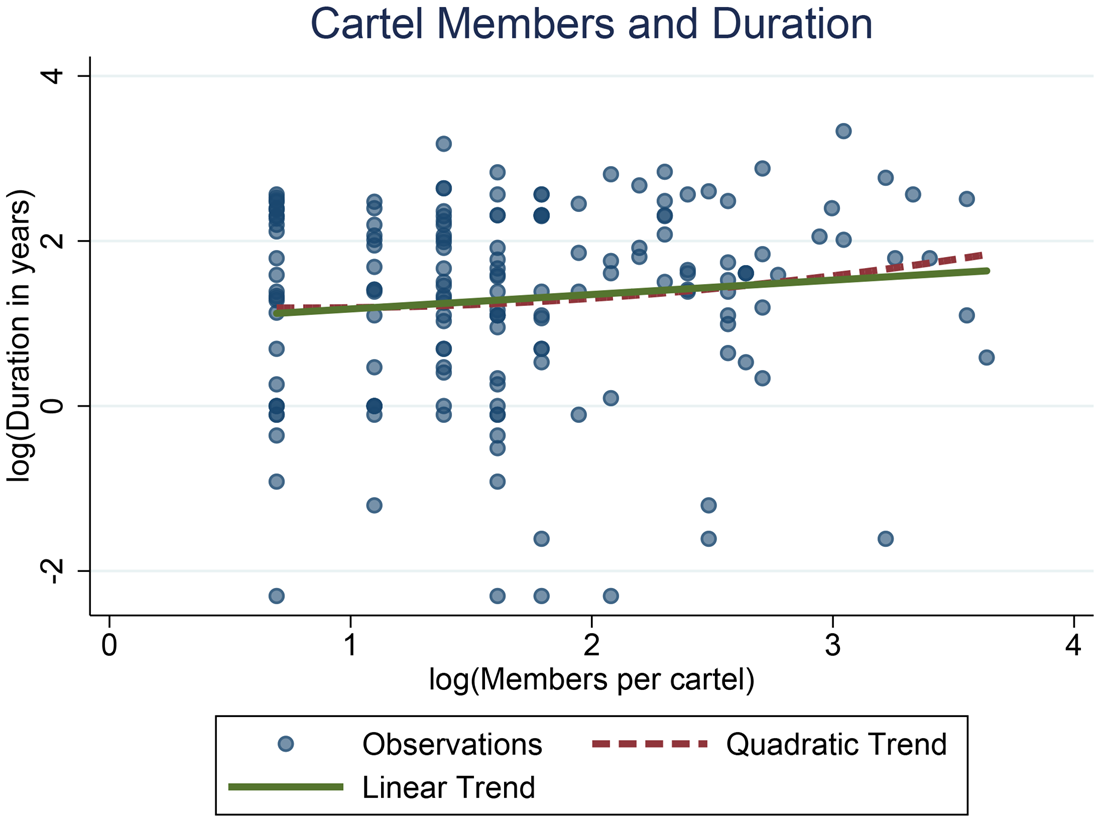
In the first step, I analyse the relationship between the number of members of a cartel and its duration.Footnote 11 Figure 3 provides a scatter plot and both a linear and quadratic fitted trend for the relationship between logarithmic cartel duration and members. One observes a very light upward trend but a large dispersion of observations. Table 2 shows the OLS coefficients for a linear and Table 3 for a quadratic specification. I use logarithmic values for all variables. Each table consists of five columns that implement different sets of time and industry fixed effects; column #1 does not include any.

Linear relationship between the number of cartel members and cartel duration

Estimation method: OLS. Dependent variable: logarithmic cartel sanctions in million USD. Heteroscedasticity-robust standard errors in brackets below. Significance levels: *P < 0.10, **P < 0.05, ***P < 0.01. Table B1 in the online appendix presents the results for the corresponding jackknife standard error computations.
Quadratic relationship between the number of cartel members and cartel duration

Estimation method: OLS. Dependent variable: logarithmic cartel sanctions in million USD. Heteroscedasticity-robust standard errors in brackets below. Significance levels: *P < 0.10, **P < 0.05, ***P < 0.01. Table B2 in the online appendix presents the results for the corresponding jackknife standard error computations.
The regression without fixed effects (col. #1) in Table 2 indicates an insignificant linear coefficient of +0.175 for the duration, which would imply for a 1% increase in cartel members an increase in duration by 0.175%. It is fully tentative as the coefficient does not differ statistically from zero. The same holds for the specifications with industry, time, industry and time, and, lastly, industry × year fixed effects. Including the fixed effects implies looking at estimates within an industry and/or year. In the quadratic specification, both coefficients for the number of cartel members are statistically insignificant for any combination of fixed effects as well. This means that neither studying cartel cases across time or industry nor within them leads to a statistically significant relationship between cartel duration and the number of cartel members.
I intentionally chose the two fixed effects for time (year of discovery) and industry. Due to unobserved industry characteristics, cartel stability may substantially vary across industries. While general time trends in cartel detection and sanctioning may exist, which would already justify the inclusion of ‘year’ fixed effects, Marvão and Spagnolo (Reference Marṽao and Spagnolo2023) detect what they call ‘leniency inflation’. The term shall capture that in the European Union, an increasing number of former cartel members applied for some form of leniency in recent years.Footnote 12
Especially industry heterogeneity can also be drawn from Figures 1 and 2. They emphasize stark differences between industries in the overall occurrence of (detected) cartels as well as their duration and sanctions. Including industry fixed effects is crucial to not simply pick up differences across industries. Of course, one has to remember that all results are still correlational and do not allow for causal interpretation. Furthermore, the regressions might fall prey to some omitted variable bias. Nevertheless, including time and industry fixed effects can already capture much statistical variation, as the increase in the measure R 2 highlights.
The absence of a statistically significant downward trend in cartel members is a surprising departure from the basic game theoretic modelling of cartels. The conventional wisdom suggests that more firms would ‘destabilize’ the cartel as the deviation profit increases in the number of cartel members relative to each participant's collusive profit. With more participants, one's own share decreases while the deviation profit remains approximately the same. Therefore, a significantly negative coefficient would be the expected result. The fact that this is not the case is a noteworthy finding that warrants further investigation.
In light of the polycentricity theory, the null effect makes sense. An increase in members could stabilize a cartel as more members allow for a more dispersed assignment of responsibilities as well as more mutual interdependencies. This positive effect could offset the undoubtedly increasing incentive to cheat on the other cartel members.
One data-driven objection to this finding is the potential risk that cartel duration is easy to measure at the end but not at the starting point. Here, the data rely on legal investigations and court decisions. However, investigators are not always able to prove the existence of a cartel years ago judicially, mainly if no clear records exist (see also Zhou, Reference Zhou2016). Thus, cartel duration could be, in reality, longer than in the data. As long as this left-truncation is idiosyncratic, it is acceptable. However, it may bias the dataset if the lack of evidence occurs more often among smaller cartels as they could be able to better hide and delete evidence than larger cartels.
A last objection to the analysis concerns the evolution of the size of a cartel. It could be the case that only very few firms initiated a cartel, but others joined over time. When detected, only one value for the number of cartel members is registered, and it is likely the number recorded at detection. Empirically assuming that the value at the end equals the one at the beginning might distort the analysis. Even though I cannot resolve this issue with the given data, it is unlikely that many firms joined an existing cartel. It is more likely that only a few successfully joined over time (if at all) due to the complicated procedures of integrating a new member into grown governance and trust structures.
Cartel members and sanctions
Sanctions for detected cartels are a crucial tool for policymakers to fight collusion. After investigating the relationship between cartel members and duration, I will look at the correlation between sanctions and cartel members, as it can tell us a lot about how liable individual firms can be depending on cartel size and governance. In theory, more members may increase the fines imposed when a cartel is detected because bigger cartels are likely to cover a higher market share, which might cause higher welfare losses.
Besides this first-order effect, it is unclear in which direction any second-order effect points. A linear relation would be conceivable given that more participants also require a higher fine because every member needs to be punished. As the welfare losses caused by a cartel with a higher number of members should be greater than those of a cartel in the same market with fewer participants, even an increase in sanctions, which is larger than proportional, could be theoretically backed. In contrast, there is the regressive nature of the leniency regulation: as Connor (Reference Connor2012) notes, nearly all recent major cartel cases ended with full or partial leniency for at least one former cartel member. So, fines could also grow slower with a higher number of members if more of them file for leniency.
Tables 4 and 5 depict the actual relation found in the OECD database. Again, I provide both linear and quadratic specifications. The sanctions imposed on the cartel members increase in the number of participants. The positive linear coefficient in both specifications is evidence for that. However, the significant coefficient for the squared number of members emphasizes that it is not a linear increase alone but a concave relationship in which a negative quadratic effect offsets the positive linear effect. Again, this effect is stable regardless of the inclusion of fixed effects, as the columns (2)–(5) of Table 5 demonstrate.
Linear relationship between the number of cartel members and the amount of sanctions

Estimation method: OLS. Dependent variable: logarithmic cartel sanctions in million USD. Heteroscedasticity-robust standard errors in brackets below. Significance levels: *P < 0.10, **P < 0.05, ***P < 0.01. Table B3 in the online appendix presents the results for the jackknife standard error computations.
Quadratic relationship between the number of cartel members and the amount of sanctions

Estimation method: OLS. Dependent variable: logarithmic cartel sanctions in million USD. Heteroscedasticity-robust standard errors in brackets. Significance levels: *P < 0.10, **P < 0.05, ***P < 0.01. Table B4 in the online appendix presents the results for the jackknife standard error computations.
Figure 4 illustrates the concave relationship between the number of cartel members and the total amount of sanctions. Given the distribution of the cartel member variable, it becomes clear that most cartels are in the area with a positive slope. However, several cartels with many participants received comparatively low sanctions.
Relationship between cartel members and sanctions: quadratic specification. Red vertical line: median of the logarithmic number of cartel members: 1.609 ≈ 5 cartel members. Corresponding regression coefficients presented in Table 5, column (1).

The decrease per firm is also directly captured by the coefficient for ‘log(#cartelists)’ in the linear specification in Table 4. In the logarithmic setting, a 1% increase in the number of members corresponds only to an increase of 0.673% increase in the amount of sanctions. Put differently, sanctions are relatively inelastic to more participants in a collusive agreement. Again, this result also holds within industries, years, and industries and years combined. Thus, the concavity is not a statistical artefact driven by differences across industries or years of disclosure.
Again, polycentricity is a potential driver of this statistical artefact. The more participants a cartel has, the more dispersed its decision centres and layers can be.
Suppose a sufficient amount of spontaneous order coordination and overlapping decision centres exists. In that case, it may be more challenging for competition authorities to prove who was responsible for specific illegal activities or otherwise had ‘the last word’. While, for example, Martin and Schmal (Reference Martin and Schmal2021) explain sophisticated cartel organization with its arguably beneficial impact on raising the future orientation of participating firms, it might also be reasoned by the sociological phenomenon of ‘shifting the blame’. As argued by Fiorina (Reference Fiorina1982, Reference Fiorina1986) and Vaubel (Reference Vaubel1986), politicians have an interest in delegating unpleasant tasks and the responsibility for bad decisions to other agencies in the public body. A polycentric order of a collusive structure could reflect this behaviour in the context of firms.
A system of different decision layers might serve not only as a top-down delegation system but also as a sharing of responsibilities so granular that every participant considers themselves only as a small part of a larger system, which reduces the potential burden of doing something illegal as well as the actual ability of legal authorities to assign particular actions to specific entities. Polycentricity can serve as a protection against legal action since dispersed decision-making processes make it more difficult to assign accountability in a legally binding way.
The impact of third party involvement
In the last step, I examine the role of third parties in collusive structures. Frequent examples are industry associations that facilitate unobtrusive coordination. They also often allow their members to track other members’ sales by collecting and aggregating information. By doing so, third parties are often considered a stabilizing element in cartels (see, e.g., Levenstein and Suslow, Reference Levenstein and Suslow2006). Such associations come with the advantage that membership is legal. Cartels also often hire retired officials, law or consulting firms to coordinate and/or monitor the activities of cartel members (Awaya and Krishna, Reference Awaya and Krishna2020; Jaspers, Reference Jaspers2017).
From a polycentric governance perspective, the involvement of a third party does not necessarily need to stabilize a cartel. Centralizing communication and coordination by employing a third party may constitute a monocentric element within a cartel that actually destabilizes it. Of course, it depends on the specific governance structure of a cartel. It matters to which extent such a third party is involved in decision-making or whether its role is just information aggregation and provision. For the latter, the challenge of monocentricity is likely to be smaller. Empirical evidence using the OECD database hints at a null relation and only slightly towards a positive effect. However, only 14 cartels included a third party. The analysis, admittedly, suffers from low statistical power.
First, I look at the relationship between the number of cartel members and the presence of a third party. Unsurprisingly, the likelihood of a third party being present increases in the number of cartel participants, as Table 6 shows. Large cartels are more likely to require a third party to organize and coordinate information streams. Crucially, I cannot detect an effect of a third party on cartel duration. Figure 5 presents two boxplots for cartel duration for those cartels with and without an involved third party. Cartels with a third party (RHS) had a higher average cartel duration. However, both group averages are influenced by one stark outlier. It affects the much smaller group of cartels with a third party more severely than the group without.
Relationship between cartel members and the presence of a third party

Estimation method: Probit. Dependent variable: binary indicator for the presence of a third party. Heteroscedasticity-robust standard errors in brackets. Significance levels: *P < 0.10, ** P < 0.05, ***P < 0.01. Table B5 in the online appendix presents the results for the corresponding jackknife estimation, Table A1 the results for the quadratic specification.
Boxplot for the duration of a cartel and the presence of a third parts. The boxes (0) present the duration of cartels without (0) and with (1) an involved third party. The horizontal red line depicts the overall average cartel duration.

To not only rely on visual inspection, Table 7 presents the results from a two-sample t-test and the P-value for the non-parametric Mann–Whitney U-test (MWU-test). While there exists a difference between the group averages, it is not statistically significant, as the p-values of 0.118 (t-test) and 0.145 (MWU-test) indicate. Levenstein and Suslow (Reference Levenstein and Suslow2011) detect in their analysis that third parties increase the risk of being caught but also stabilize a cartel. These two effects could offset each other. An up-to-now overlooked issue is that the implementation is a monocentric element in a cartel. It (consciously) centralizes communication and coordination. By that, it collides with the core principles of polycentricity, as presented in section ‘The concept of polycentricity applied to cartels’. The ‘multiplicity of decision centres’ vanishes when everything is centred around, e.g., meetings of a business association. It may differ in cases where a third party, such as a law firm, only serves as an information exchange. The risk of monocentricity would decrease.
Cartel duration and the presence of a third party: t-test/MWU-test

Two sample t-test with unequal variances to account for the variation in variance between cartels without and with an involved third party (see also Ruxton, Reference Ruxton2006, on the ‘unequal variance’ t-test). Excluding two outliers with cartel duration of >20 years. The full sample test is presented in Table A2 in the online appendix. An alternative to the t-test is the nonparametric Mann–Whitney U test (Reference Mann and Whitney1947). It requires less functional form assumptions than the t-test and leads to a test statistic of z = −1.463, which corresponds to a p-value of p = 0.1435 for the sample without outliers.
In any case, third-party involvement undermines spontaneous order. A central organization collects large amounts of data that may serve as evidence for competition authorities if detected. Exiting a cartel that includes a business association raises doubts about whether the leaving member is still welcome there. Even if a firm leaves a cartel, it remains part of the industry and, probably, of a business or trade association, as such organizations tend to be monopolies in their respective branches. This monocentric organization implies that exit is only possible when the cartel as a whole breaks down. In turn, it incentivizes the firm willing to leave to file for leniency. Such a scheme, however, will destroy the cartel as a whole – a consequence that could be avoided if a participating firm could exit without facing such problems.
Common theory primarily discusses a third party as a monitoring device, which increases stability via increased transparency but decreases it via a greater risk of detection (see, e.g., Levenstein and Suslow, Reference Levenstein and Suslow2011). While the stabilizing factor addresses internal communication, the destabilizing factor is higher external detectability. A polycentric perspective adds the monocentric information-gathering issue as an additional governance element that may internally destabilize the whole endeavour.
I argue that monocentricity destabilizes cartels relying on a third party organizing communication and coordination. In general, polycentric governance may be a novel explanation for the question of why there exist so many cartels with a large number of participants, even though economic theory would suggest more instability for them.Footnote 13Previous research in this domain has focused on external factors, such as market characteristics, that may have led to relative stability despite the large size of cartels. The present paper contributes the governance dimension as an additional explanation. Nevertheless, cartel governance, especially the role of third parties, requires further research. It should avoid reducing the presence of a third party to a binary indicator as in the present OECD dataset.
Conclusion
Business scholar Deborah Spar inadvertently explained the necessity of the research question discussed here in the preface of her book ‘The Cooperative Edge: The Internal Politics of International Cartels’: ‘Thus while the economics of cartels underlie this study, … it is still not a book about the economics of cartels. Rather, this is a book about cooperation and about the internal forces that shape, constrain, and define the cooperative process’ (Spar, Reference Spar1994, p. X). In the past, industrial economic research often ignored the governance dimension and focused on different aspects of collusion. The present paper shall serve as a first step to change this. It theoretically introduces the concept of polycentricity to cartels and provides suggestive empirical evidence for its existence and role. Given the intertwined illegal situation firms and their managers find themselves in, it is reasonable to assume that corporate cartels have complex governance systems.
The concept of polycentric governance offers novel ways to understand coordination within a cartel. Applying it to an extensive OECD dataset of detected cartels, polycentricity sheds new light on several empirical phenomena. There seems to be no negative relationship between the number of cartel members and its duration. In addition, sanctions imposed on cartel participants follow a concave pattern. Fines increase less than proportionally with the rise in members. Lastly, although large cartels often involve third parties in their activities, such entities do not appear to substantially stabilize a cartel in terms of duration.
Polycentric governance can offer an explanation for all three empirical findings. By that, the paper shows how institutional theory can fruitfully enrich the understanding of industrial economic phenomena. I consider it the first step towards deeper integration of institutional, political, and public choice theory into industrial economics to better understand firm behaviour. More rigorous empirical evidence beyond my preliminary and correlational findings is needed to explain the governance dimension within cartels. This paper shall serve as a starting point and a proposal for a broader research agenda.
Supplementary material
The supplementary material for this article can be found at https://doi.org/10.1017/S1744137424000274.
Data and appendix availability
The appendix, as well as data and code replication files, is openly available on Zenodo: Schmal, W. B. (2024). Online Appendix and Replication package for the paper ‘Polycentric Governance in Collusive Agreements’. Zenodo: https://doi.org/10.5281/zenodo.13312411
Acknowledgements
I am grateful for the helpful support of the editors Geoffrey Hodgson and Esther-Mirjam Sent, and valuable feedback from three anonymous referees, whose remarks substantially improved the paper. Paul Aligica, Bernhard Ganglmair, Ilya Kukaev, Johannes Paha, and Anja Shortland provided valuable feedback, as well as participants at the 19th Annual ASCOLA Conference 2024 at Julius Maximilians University Wuerzburg, the 28th Annual SIOE Conference 2024 at the University of Chicago, the 51st Meeting of the EPCS 2024 at WU Vienna University, the 2nd Markets & Society Conference 2023 in Falls Church (VA), the 60th Hohenheim Colloquium 2024 at Philipps University Marburg, and the NOUS Spotlight session in March 2024. This work received financial support from the Institute for Humane Studies (grant No. IHS016790), which is gratefully appreciated. The idea for this project originated from my participation in the Oskar Morgenstern Fellowship at the Mercatus Center at George Mason University, for which I acknowledge funding and hospitality. All errors, views, and opinions are solely my own.