The use of extracorporeal membrane oxygenation in infants and children with cardiac disease who develop refractory cardiogenic shock, cyanosis, or cardiac arrest is increasing.Reference Haines, Rycus, Zwischenberger, Bartlett and Undar1 Surviving patients are at risk for long-term dysfunction of multiple organ systems related to their underlying cardiac disease, non-cardiac comorbidities, treatment-related complications, and exposure to extracorporeal membrane oxygenation. Among the most important acute complications related to support with extracorporeal membrane oxygenation is injury to the central nervous system, which may contribute to adverse neurodevelopmental outcomes. All of these factors, in turn, influence quality of life.
In this review, we have summarised existing knowledge regarding intermediate-term outcomes and quality of life following support with extracorporeal membrane oxygenation for cardiac disease in children. Particular emphasis is given to neurodevelopmental disabilities and their influence on quality of life.
Intermediate-term survival
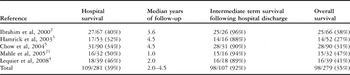
Data from the 2008 report of the Extracorporeal Life Support Organization Registry indicate that overall survival to discharge from the hospital in children with underlying cardiac disease who require extracorporeal membrane oxygenation is 43%, with better outcomes in older children (58% survival) when compared with neonates and infants (38% and 47% survival, respectively).Reference Haines, Rycus, Zwischenberger, Bartlett and Undar1 A number of centres have reported intermediate-term survival rates in this population of patients.Reference Ibrahim, Duncan, Blume and Jonas2–Reference Taylor, Cousins and Butt6 Studies in which both the in-hospital and subsequent out-of-hospital rates of mortality are reported and shown in Table 1. Taken together, these data indicate that mortality before discharge from the hospital is relatively high for cardiac patients supported with extracorporeal membrane oxygenation, with approximately four of every ten patients surviving to discharge from the hospital. However, for those patients who do survive to discharge from the hospital, subsequent mortality is uncommon, and approximately 90% of such children are alive at follow-up.
Intermediate-term rates of survival in infants and children with cardiac disease who received extracorporeal membrane oxygenation support.

Clinical and neurodevelopmental outcomes
Neonates, infants, and children with cardiac disease who are placed on extracorporeal membrane oxygenation and survive are at risk of imperfect outcomes for a variety of reasons. The severity of the underlying cardiac physiology is one important factor.Reference McCrindle, Williams and Mitchell7 In one report of survivors of cardiac extracorporeal membrane oxygenation, physicians indicated that 20 out of 21 (95%) patients were in New York Heart Association class I or II at follow-up, suggesting that many children who survive do so with no or only mild limitations to physical activity.Reference Ibrahim, Duncan, Blume and Jonas2 Non-cardiac issues also may have an important impact on outcomes. Patients who undergo femoral cannulation are at risk for injury to the femoral vasculature leading to compartment syndrome with resultant neuromuscular weakness or, rarely, limb amputation. Cannulation of the cervical vessels has been associated with injury to the recurrent laryngeal nerve resulting in paresis of the vocal cord. Chronic respiratory and renal insufficiency and other sequelae also may be problematic.
Acute neurological injuries contributing to adverse neurodevelopmental outcomes are likely the most widely described complication of extracorporeal membrane oxygenation. Such injuries may be due to hypoxic-ischaemic events, thromboembolism, or bleeding. Data from the Extracorporeal Life Support Organization registry indicate that seizures and infarcts of the central nervous system both occur in 3–10% of children on extracorporeal membrane oxygenation, with neonates and infants at higher risk when compared with older children.Reference Haines, Rycus, Zwischenberger, Bartlett and Undar1 In a study at a single centre, Chow et alReference Chow, Koirala and Armstrong5 found that patients with congenital cardiac defects and those requiring cardiopulmonary resuscitation before extracorporeal membrane oxygenation were at risk for acute neurological sequelae. The fact that patients who require extracorporeal membrane oxygenation to aid cardiopulmonary resuscitation are at greater risk of acute neurological injury is not surprising. Kane et alReference Kane, Thiagarajan and Wypij8 reported 172 patients who received extracorporeal membrane oxygenation to aid cardiopulmonary resuscitation at a single centre, of which 88 survived to discharge from the hospital. Acute injury to the central nervous system occurred in 31 out of 88 (35%) survivors, including seizures in 17 (19%) and radiologic evidence of injury in 24 (27%). Despite these injuries, 65 survivors (75%) were assigned Pediatric Overall Performance Category scores less than or equal to 2, and 69 (79%) had Pediatric Cerebral Performance Category scores less than or equal to 2 at discharge from the hospital or at short-term follow-up, indicating no-to-mild neurological impairment. Of note, no difference in these scores was found between patients with univentricular physiology compared with those with a biventricular circulation. In a larger analysis of data obtained from the Extracorporeal Life Support Organization registry, children with or without cardiac disease that underwent extracorporeal membrane oxygenation to aid cardiopulmonary resuscitation had a 22% incidence of neurological injury, including brain death in 11%.Reference Barrett, Bratton, Salvin, Laussen, Rycus and Thiagarajan9 In this study, independent risk factors for acute neurological injury were:
• non-cardiac disease,
• lower pH in the blood before extracorporeal membrane oxygenation,
• the need for dialysis,
• the need for cardiopulmonary resuscitation, and
• the development of pulmonary haemorrhage while on extracorporeal membrane oxygenation.Reference Barrett, Bratton, Salvin, Laussen, Rycus and Thiagarajan9
Another review from the National Registry of Cardiopulmonary Resuscitation found 199 children placed on extracorporeal membrane oxygenation during arrest with an overall survival of 44%. In 59 survivors who had a Pediatric Cerebral Performance Category assigned at the time of hospital discharge, 37 (63%) had normal neurodevelopmental function, 15 (25%) had mild disability, 4 (7%) had moderate disability, and 3 (5%) had severe disability.Reference Raymond, Cunnyngham, Thompson, Thomas, Dalton and Nadkarni10
A number of centres have reported intermediate-term neurodevelopmental outcomes for children with cardiac disease who previously required extracorporeal membrane oxygenation. Ibrahim et alReference Ibrahim, Duncan, Blume and Jonas2 used a combination of parental surveys over the telephone and written questionnaires of physicians to obtain intermediate-term outcomes for 25 paediatric survivors of cardiac extracorporeal membrane oxygenation. At follow-up, median height was at the 28th percentile, and median weight was at the 36th percentile, suggesting that growth following extracorporeal membrane oxygenation was reasonable. Neurodevelopmental outcomes were assessed using parental reports of achievement of developmental milestones for patients cannulated as infants and school performance for older children. Moderate neurological impairment was present in 9 out of 21 (43%) and severe neurological impairment in 4 out of 21 (19%). Included in these 13 moderately-to-severely impaired patients were three with haemiplegia, one with cerebral palsy, and three with severe anoxic encephalopathy. Overall, only 8 out of 67 (12%) patients survived with no or mild neurological disability. Younger weight at the time of extracorporeal membrane oxygenation and an earlier history of circulatory arrest during cardiac surgery were found to be risk factors for neurological impairment at follow-up, whereas in-hospital neurological complications, cardiopulmonary resuscitation, neck cannulation, and carotid artery reconstruction were not associated with adverse neurological outcome. Despite these neurological issues, parents reported that 20 out of 25 (80%) of these patients had overall health status that was either excellent or good.
Hamrick et alReference Hamrick, Gremmels and Keet3 described intermediate-term neurodevelopmental outcomes for infants supported with extracorporeal membrane oxygenation after cardiac surgery. Of 53 initial patients, only 14 (26%) were known to be alive at a median of follow-up of 55 months, and only 7 (13%) survived completely intact. Neuromotor outcome was defined as abnormal when cerebral palsy, diplegia, or haemiplegia was present, and suspect when lesser abnormalities existed. Of these 14 survivors, 10 (72%) had normal neuromotor outcomes, 3 (21%) were abnormal, and 1 (7%) was suspect. Cognitive outcome was abnormal when patients scored less than two standard deviations below the mean on age-appropriate developmental testing. Cognitive outcomes were normal in seven (50%), suspect in three (21%), and abnormal in four (29%). Ten of these 14 survivors had an examination of the brain with magnetic resonance imaging, of which five showed evidence of hypoxic-ischaemic injury to the brain.
Lequier et al reported outcomes for 39 children who were less than 5 years of age when supported with cardiac extracorporeal membrane oxygenation in Edmonton, Alberta (Canada) between 2000 and 2004. Sixteen patients (41%) were alive at 2 years follow-up, and only seven (18%) were completely intact. Eight out of 16 (50%) had cognitive delay as evidenced by scores less than two standard deviations below the mean on age-appropriate developmental tests.Reference Lequier, Joffe and Robertson4 Highest inotropic score on extracorporeal membrane oxygenation and duration of time to normalise lactate on extracorporeal membrane oxygenation explained 69% of the variance in cognitive outcome, but the need for cardiopulmonary resuscitation did not predict cognitive delay. Of these 16 patients, 63% had behavioural concerns, two (13%) had cerebral palsy, and one had epilepsy.Reference Lequier, Joffe and Robertson4
Chow et alReference Chow, Koirala and Armstrong5 reported intermediate-term outcomes for 90 children with cardiac disease who were supported with extracorporeal membrane oxygenation. Two patients were lost to follow-up and only 26 (29%) were known to be alive. Of these survivors, 11 had long-term neurological sequelae and only 15 out of 90 (17%) patients survived intact. A detailed analysis failed to identify predictors of abnormal neurological status at follow-up. Van Litsenburg et alReference Van Litsenburg, De Mos, Edgell, Gruenwald, Bohn and Parshuram11 described intermediate-term outcomes for 80 children who received extracorporeal membrane oxygenation between 1997 and 2002, of which 62 had underlying cardiac disease. Pediatric Overall Performance Category and Pediatric Cerebral Performance Category scores were assigned for 19 out of 28 survivors at one year after discharge from the hospital. Pediatric Overall Performance Category scores were normal in 10 patients, mildly dysfunctional in 6, and moderately dysfunctional in 3, whereas Pediatric Cerebral Performance Category scores were normal in 4 patients, mildly decreased in 12, and moderately decreased in 3.
Taylor et alReference Taylor, Cousins and Butt6 reported long-term outcomes for 224 children who received respiratory or cardiac extracorporeal life support at Children's Hospital in Melbourne, Australia between 1998 and 2000. Of these 224 patients, 169 were supported with extracorporeal membrane oxygenation with the remaining patients supported using a ventricular assist device. Follow-up was available for 211 children at a median of 7.2 years after admission for mechanical support. Of these 211 patients, 105 had underlying cardiac disease. Of these 211 patients, 69 (33%) were alive at the time of follow-up. Pediatric Overall Performance Category scores were reported for these 69 survivors: good overall performance was present in 42 children (61%), mild disability in 15 (22%), moderate disability in 9 (13%), and severe overall disability in 3 (4%). Of the 105 patients with cardiac disease, 81 patients had died before assessment. The Pediatric Overall Performance Category scores for the remaining 24 cardiac patients were good in 16, mild disability in 3, moderate disability in 4, and severe disability in one. Thus, of the initial 105 cardiac patients included in this study who were supported with extracorporeal membrane oxygenation, only 19 (18%) survived with good functional status or only mild disability.
Limited data exist regarding visual deficits and hearing loss after paediatric cardiac extracorporeal membrane oxygenation. Of 16 survivors of paediatric cardiac extracorporeal membrane oxygenation reported by Lequier et al,Reference Lequier, Joffe and Robertson4 two (13%) had hearing loss and two (13%) had strabismus. Of 22 survivors of paediatric extracorporeal membrane oxygenation – 13 of which had cardiac disease – reported by Wagner et alReference Wagner, Risnes and Berntsen12, visual problems were identified in the 11 (50%) but none had overt evidence of chronic hearing loss. Of 111 graduates of non-cardiac neonatal extracorporeal membrane oxygenation who underwent audiologic testing, 29 (26%) had sensorineural hearing loss.Reference Fligor, Neault, Mullen, Feldman and Jones13 Independent predictors of hearing loss in that study included an underlying diagnosis of congenital diaphragmatic hernia, longer duration of extracorporeal membrane oxygenation, and greater exposure to aminoglycoside antibiotics. These data suggest that early routine visual and audiologic evaluation is warranted for paediatric survivors of extracorporeal membrane oxygenation.
When considering those patients treated with extracorporeal membrane oxygenation who sustain severe neurological injury leading to withdrawal of support, as well as the occurrence of neurological morbidity in a subset of survivors, it is clear that efforts to protect the brain during the period of time surrounding and including support with extracorporeal membrane oxygenation are important. The timely implementation of extracorporeal membrane oxygenation before the onset of cardiac arrest and the conduct of good cardiopulmonary resuscitation during cannulation for extracorporeal membrane oxygenation for those patients who have arrested are two obvious areas for improvement.Reference Thiagarajan, Laussen, Rycus, Bartlett and Bratton14 Data regarding the use of hypothermia during in-hospital paediatric cardiac arrest are lacking, and its use is being investigated in an ongoing clinical trial.Reference Meert, Donaldson and Nadkarni15 A better understanding of ideal strategies for cannulation and anticoagulation in these patients is also needed to decrease the incidence of haemorrhage involving the central nervous system.
In many cases, defining the relative contribution of injury to the central nervous system and other events related to extracorporeal membrane oxygenation noted above to long-term outcomes is difficult, given that many other factors may be contributory. For example, in-utero abnormalities in cerebral development occur in foetuses with selected complex cardiac defects, likely related in part to abnormal patterns of cerebral flow of blood.Reference Limperopoulos, Tworetzky and McElhinney16, Reference Licht, Shera and Clancy17 Approximately 15% of children with cardiac disease are born with an underlying genetic syndrome or other major non-cardiac structural anomaly, both of which influence outcomes. Perioperative injury to the brain and length of stay in the intensive care unit may also influence neurodevelopmental outcomes.Reference Miller, McQuillen and Vigneron18, Reference Newburger, Wypij and Bellinger19
Quality of life
“Health-related quality of life” refers to a person's perceived physical and mental health over time. Studies have shown that quality of life is lower in children with complex cardiac disease when compared with that of patients with simple lesions and population-based controls.Reference McCrindle, Williams and Mitchell7, Reference Marino, Tomlinson and Wernovsky20 Limited data exist regarding quality of life in children who have previously been on extracorporeal membrane oxygenation for cardiac indications.
Taylor et alReference Taylor, Cousins and Butt6 reported quality of life for 69 intermediate-term paediatric survivors of extracorporeal life support, which included ventricular assist devices for cardiac patients as well as extracorporeal membrane oxygenation for a variety of cardiac and non-cardiac indications. Using the “Health State Utilities Index Mark 1”, quality of life was found to be good in 49 children (71%), moderate in 16 (23%), and poor in 4 (6%). Specific details were not provided on quality of life for the cardiac subset of patients in this study. Mahle et alReference Mahle, Forbess, Kirshbom, Cuadrado, Simsic and Kanter21 used the “Health Utilities Index Mark II survey” to assess quality of life in 15 paediatric survivors of cardiac extracorporeal membrane oxygenation. Scores range from death to full health (0–1.0). The mean score for survivors of extracorporeal membrane oxygenation, as reported by parents, was 0.75 ± 0.19 – ranging from 0.41 to 1.0. Two patients had severe impairment and disability – utility scores less than 0.5, whereas three reported full health – utility score of 1.0. The calculated cost-utility for extracorporeal membrane oxygenation in these patients was $24,386 (2003 dollars) per quality life year saved, which falls within the bounds of routinely accepted cost-utility.
Wagner et alReference Wagner, Risnes and Berntsen12 assessed quality of life in 22 children who survived extracorporeal membrane oxygenation, of which 13 had a cardiac indication for extracorporeal membrane oxygenation. Using the “Pediatric Quality of Life Inventory 4.0”, parents reported that 8 out of 22 (36%) children had decreased quality of life, but further details were not provided. Conlon et alReference Conlon, Breatnach, O'Hare, Mannion and Lyons22 used the “Pediatric Quality of Life Inventory 4.0 survey” in a study of 70 children who previously had a prolonged (greater than 28 days) stay in the paediatric intensive care unit. Of these patients, one-third had cardiac disease as a primary diagnosis. Parents reported that 57% had normal quality of life, whereas 43% had scores greater than one standard deviation below the mean of the control population, including 20% who had poor quality of life. The populations of patients described in the aforementioned studies by Wagner and Conlon are not directly comparable. However, the data suggest that the parents of survivors of cardiac extracorporeal membrane oxygenation feel that their children have similar quality of life as assessed by the Pediatric Quality of Life Inventory instrument to that reported by parents of children who previously had a prolonged stay in a paediatric intensive care unit.
Conclusions
Early mortality in children with cardiac disease who require extracorporeal membrane oxygenation remains an important issue, as only 40% of cannulated patients survive to discharge from the hospital. However, it is encouraging that 90% children who are discharged alive from the hospital after extracorporeal membrane oxygenation are still alive at intermediate-term follow-up. Many survivors remain medically complex related to their underlying cardiac disease, comorbidities, and sequelae of complications acquired over their lifetime. Neurological morbidity clearly plays an important role in approximately one-third of survivors, with significant deficits in approximately 10%. The limited data about quality of life that are available for survivors of cardiac extracorporeal membrane oxygenation suggest that approximately 15–30% of survivors have at least moderately decreased quality of life. Overall, published data support the ongoing use of support with extracorporeal membrane oxygenation in children with acute cardiac failure, most of whom would die without it. However, programmatic efforts to improve the selection of patients and the preservation of the function of end organs during extracorporeal membrane oxygenation are clearly needed in order to improve long-term outcomes.