

The 2019 New South Wales (NSW) Department of Education preschool census found that 2,889 children with disability were enrolled in a community preschool, representing 6.3% of the total enrolments. Nearly 10% of those children were reported as having multiple disabilities. Of all community preschools in NSW, 82% had at least one child with a disability enrolled in their service, meaning that a large proportion of community preschool educators work with a child or children with disability. This highlights the need to ensure that preschools are well equipped to include children with disability in their learning environments and educational programs.
Since the 1980s, Australian federal and state governments have strived to create systems and landscapes in which children with disability are fully included in educational settings (Carroll, Forlin, & Jobling, Reference Carroll, Forlin and Jobling2003). The Disability Standards for Education, which came into effect in 2005 (Australian Government, 2005), underline the obligations of education and training providers to ensure that students with disability are able to access and participate in education without experiencing discrimination (Department of Education, Skills and Employment, 2020). These and other educational reforms have meant that the majority of children with disability are now being educated in mainstream schools and early childhood education (ECE) services, rather than being segregated into ‘special’ schools, as was the historical practice (Forlin, Chambers, Loreman, Deppeler, & Sharma, Reference Forlin, Chambers, Loreman, Deppeler and Sharma2013).
The enrolment of children with disability in mainstream educational settings is a necessary starting point for inclusion. However, contemporary research highlights that full inclusion extends beyond the physical presence of children with disability in these mainstream settings and requires them to be included in a meaningful way in all activities and environments (Lalvani, Reference Lalvani2013; Rafferty & Griffin, Reference Rafferty and Griffin2005; Vakil, Welton, O’Connor, & Kline, Reference Vakil, Welton, O’Connor and Kline2009). The NSW Government’s inclusive education policies, and the programs designed to align with them, meet many of the key features of and factors for effective inclusive education identified in recent inclusion theory and research. These include valuing children with disability, equal access, meaningful participation, removing barriers, appropriate supports (personal, individualised, specialist) and accommodations, as well as adequate and appropriate funding. A commitment to quality and equitable education for children with disability is also embedded in the principles of the Australian Early Years Learning Framework (EYLF; Department of Education and Training, 2009). The framework offers a vision where ‘all children experience learning that is engaging and builds success for life’ (p. 7), which includes educators having a belief in the capability of all children to succeed in their learning, regardless of abilities. This requires recognising and responding to barriers preventing children from achieving educational success, challenging the practices that contribute to exclusion of these children, and making curriculum decisions that promote the participation of all children.
This article outlines the department’s funding models and sector capacity building (SCB) endeavours, which are supported by research and designed to educate and empower community preschools to facilitate the full inclusion of children with disability in their centres. Data collected by the Disability and Inclusion Program in 2019 are used to highlight the key strengths and barriers identified by the preschools when it comes to embodying full inclusion in their services, followed by a discussion of how the Disability and Inclusion Program is attempting to mitigate the challenges that services may face. This article provides a ‘snapshot in time’ of the early stages of the program, with the intention of using data from the program to inform its development and maintain its relevance and currency over time.
Key Elements of Inclusive Education
Inclusive education is a widely debated term that has been noted to lack a ‘tight conceptual focus’ (Forlin et al., Reference Forlin, Chambers, Loreman, Deppeler and Sharma2013, p. 5). Cologon (Reference Cologon2013) has posited that confusion about what defines inclusion makes it difficult to uphold the right to inclusive education. One definition of inclusion in ECE states that children with additional needs must be ‘given opportunities and support to access regular ECEC [early childhood education and care] services’, are ‘included in all activities and environments within the ECEC setting’, and are provided with support to enable them to ‘participate meaningfully in all ECEC programme activities’ (Moore, Symes, & Bull, Reference Moore, Symes and Bull2013, p. 10). In other words, inclusive education allows for children with disability and additional needs to participate on the same basis as their peers. It is this concept that drives the Disability and Inclusion Program.
Despite a lack of consensus on a singular definition of inclusion, some key principles have been identified in contemporary academic literature. These are (a) valuing children with disability, which involves understanding disability as something to be expected and valued, and recognising the benefits of human diversity within everyday environments and interaction (Corbett, Reference Corbett2001); (b) equal access, meaning that all children are welcomed as equal members of an educational community, and have access to the same environment, activities, and material, and social, cultural, and educational opportunities (Komesaroff & McLean, Reference Komesaroff and McLean2006); (c) meaningful participation, which involves every child having an equal right and opportunity to actively participate in and contribute to all areas of early learning (Early Childhood Australia, 2016); (d) removing barriers that prevent access and participation, such as stigma, inadequate training of educators, inaccessible settings, and lack of funding (Cologon, Reference Cologon2013); and (e) establishing an environment that adapts to the needs of the child rather than a child with disability needing to adapt to a setting (Loreman, Deppeler, & Harvey, Reference Loreman, Deppeler and Harvey2005). Inclusive education practices require individualised supports, program changes, curriculum adaptations, and responsive teaching and learning strategies (Thornton & Underwood, Reference Thornton and Underwood2013). These are practices that benefit all children, with or without disability (Rafferty & Griffin, Reference Rafferty and Griffin2005). For children with disability, inclusion has been shown to enhance wellbeing and help develop social, language, and cognitive skills. For children without disability, benefits may include increased empathy and learning to help others (Hsieh & Hsieh, Reference Hsieh and Hsieh2012).
Promotion of Successful Inclusion
One targeted approach to understanding the nebulous concept of inclusion is through reference to essential factors for effective inclusive practice in ECE settings. These factors include access (welcoming all children), participation (all children learn in a mainstream classroom with children their own age and follow a similar program), and supports (provision of adequate resources and training). Some studies highlight specific factors for successful inclusion, including attitudes, parent–provider relationships, therapeutic interventions, and adaptations (Cross, Traub, Hutter-Pishgahi, & Shelton, Reference Cross, Traub, Hutter-Pishgahi and Shelton2004). It must be noted that these factors are not wholly consistent across the literature and policy landscape and are often determined by the social and political contexts in which they take place.
The following key principles and elements are commonly identified as essential factors for quality inclusion. They form some of the building blocks for inclusive practice in educational settings and guide and inform the Disability and Inclusion Program.
Leadership
Leadership among ECE staff has been identified as central to establishing, building, and maintaining a culture of inclusion, as this process depends in large part on teacher skills and preparation (Forlin et al., Reference Forlin, Chambers, Loreman, Deppeler and Sharma2013; Sharma, Forlin, Deppeler, & Guang-xue, Reference Sharma, Forlin, Deppeler and Guang-xue2013). In ECE settings, leadership roles should include directors, administrators, educators, and other members of the service.
Adequate and appropriate funding
Essential to high-quality inclusive education is adequate funding and resourcing (Division for Early Childhood and the National Association for the Education of Young Children, 2009). Inadequate funding can have a direct impact on individual children and lead to exclusionary practices (Cologon, Reference Cologon2013). Resourcing issues can also prevent ECE services from modifying their physical setting to support children to access the environment or curriculum (Purdue, Reference Purdue2009).
Adaptations: Individualised and specialist support
For some children, full participation in play and learning is only possible with additional individualised accommodations and supports (Division for Early Childhood and the National Association for the Education of Young Children, 2009). Inclusion requires recognising every child’s right to be included in education and adapting environments and teaching approaches to ensure the meaningful participation of all children (United Nations, 2006). These adaptations can be physical or environmental, or be made to communications, instructions, or processes.
Quality programs and teaching
Fundamental to high-quality inclusive programs is children with disability having access to a wide range of learning opportunities and activities (Division for Early Childhood and the National Association for the Education of Young Children, 2009). Inclusive practices provide multiple and varied formats for instruction and learning, including technology, to ensure access to educational routines and a general curriculum, as well as to promote learning and development (Buysse, Skinner, & Grant, Reference Buysse, Skinner and Grant2001).
Quality teaching is a key component of effective programs and positive outcomes for children with disability. Quality teaching can be characterised by a focus on individual achievement, fostering cohesive learning communities, responsiveness to learning processes, creating learning opportunities, aligning goals and resources, joint engagement between teachers and students, and assessment and self-reflection (Alton-Lee, Reference Alton-Lee2003). The attitudes of educators and administrators can have a direct impact on whether education settings are welcoming of children with disability, whether there are adequate educational programs, and, for individual children, whether educational experiences are optimised and specific needs are met (Cross et al., Reference Cross, Traub, Hutter-Pishgahi and Shelton2004).
Capacity building and professional development
Developing staff capacity is integral to an inclusive ECE service (Barton & Smith, Reference Barton and Smith2015). Capacity building includes professional development and training, as well as policies and administrative supports to assist educators to learn best practice. Researchers have identified that without guidance and instruction, educators may only interpret inclusion in relation to ‘deficit models of disability’ (Rietveld, Reference Rietveld2010, p. 17) rather than employing a strengths-based approach.
Family-centred practice: Engagement between children, families, and educators
Cross et al. (Reference Cross, Traub, Hutter-Pishgahi and Shelton2004) found that inclusive practice addresses the needs of the individual child in the context of their families’ needs. This includes educators understanding and respecting family routines, relationships and goals, and promoting the child’s active and meaningful participation in the family. In family-centred inclusive practice, educators plan with the family and other professionals to ensure that any adaptations and modifications in instruction fully include the child in the classroom.
Encouraging peer relationships
Fostering social-emotional development and behaviours, independent classroom participation, and a sense of belonging is important for achieving high-quality inclusive practices in ECE (Barton & Smith, Reference Barton and Smith2015). Interactions between peers in preschools provide opportunities for children to develop their knowledge and skills, and having an emotional connection to specific classmates is a key facilitator of inclusivity, development, and learning (Diamond & Hong, Reference Diamond and Hong2010).
The NSW Disability and Inclusion Program for Community Preschools
The Disability and Inclusion Program assists children with disability and additional needs to participate in a quality ECE program on the same basis as their peers. The program provides funding to support access to and participation in preschool for children with disability and additional needs, builds the capacity of community preschools to be inclusive, and supports the skills development of early childhood educators. This multilevel approach is designed to support children with disability and additional needs to achieve equitable educational outcomes in community preschools.
The Disability and Inclusion Program is informed by departmental inclusion priorities and strategies (Department of Education, Skills and Employment, 2020; NSW Department of Education, 2019) and current research. Major national reforms and funding changes such as the National Disability Insurance Scheme (NDIS) have also prompted efforts to rethink and further embed inclusive policies and practices in ECE (Deloitte Social Impact Consulting, 2016). Governments and jurisdictions responded to these reforms by developing policies and strategies to improve the provision of inclusive education and ensure positive educational outcomes for children with disability.
The Disability and Inclusion Program comprises four components designed to achieve these goals: (a) high learning support needs funding, (b) minor capital works funding, (c) an SCB program, and (d) Early Childhood Early Intervention (ECEI) scholarships. It is supported by the provision of Start Strong equity funding for children with disability and additional needs.
Start Strong equity funding
The NSW Government’s funding model for universal access to ECE, Start Strong, provides community preschools with funding for all children to participate in 600 hours of quality preschool education in the 2 years before school, with a focus on ensuring the participation of children with disability and additional needs through provision of the highest rate of funding under the Start Strong model, known as equity funding.
These funding priorities are based on research that shows that children who participate in quality ECE in the 2 years before school are more likely to start school equipped with the social, cognitive, and emotional skills they need to engage in learning (Early Childhood Australia and Early Childhood Intervention Australia, 2014; Fox & Geddes, Reference Fox and Geddes2016). In 2018, Start Strong was extended to include non-equity 3-year-olds with disability and additional needs. This allows for an additional year of Start Strong funding for this population, and also provides funding at the highest base rate, thereby improving the affordability of ECE for families. As of December 2019, Start Strong equity funding provided $6,732 per year for each child with disability enrolled in a community preschool for 600 hours.
High learning support needs funding
Additional funding is available to support the development and delivery of individual learning plans for children with high learning support needs. High learning support needs funding is used by the service to support a child’s specific learning requirements and enable them to participate in educational programs on the same basis as their peers. Applications must be supported by a written diagnosis and/or developmental assessment from the relevant specialists, or by preschool observations documenting the developmental areas where the child displays difficulties.
Minor capital works funding
This funding is used to increase children’s access to the physical environment of ECE services. It covers minor environmental adjustments and specialised educational equipment or furniture.
Leadership, quality teaching, and family-centred practice
The three funding components outlined above speak to the essential factors of ‘adequate and appropriate funding’ and ‘adaptations and individualised support’ outlined in the previous section. However, the other essential factors of inclusive education require more than just the provision of government funding. Strong leadership, quality teaching and programs, capacity building, family-centred practice, and the ability to foster social-emotional development are just as crucial to building inclusive environments for children with disability.
These factors require access to relevant training, targeted support, and qualified staff, and are addressed by the program’s capacity-building elements. The ECEI scholarships program is currently under development, and will respond to feedback that there may not be enough focus on early childhood development and early childhood intervention in special education studies. The SCB program is a training and support program designed to develop the capacity of community preschools to include children with disability and additional needs in the educational program on the same basis as their peers. Under the SCB program, preschools are assigned an ECEI service or other qualified organisation to provide on-the-ground training, support, and resources, which respond to the individual preschool’s circumstances and needs. The providers offer site visits, provide phone and email support, and deliver a coaching and mentoring-style program delivered by university-trained early childhood special education teachers.
In order to inform the SCB program, baseline data were collected in relation to inclusive practice, including the barriers to inclusion that preschools are experiencing, their levels of confidence in inclusive practice, and their inclusion successes. The program aims to investigate the current needs of preschools and to identify the types of further support that would benefit them. These data are also to be used as a baseline by which to measure program outcomes.
Method
The data included for analyses were collected by the NSW Department of Education from March to July 2019 via a survey of NSW community preschools, and analysed by the department. The survey was developed by the department and administered by the SCB program providers on behalf of the department and in close consultation with the preschools. The data reported on in this article were collected as part of routine program management and monitoring to improve the delivery and outcomes of the SCB program, and provided voluntarily by services. No personal information about children or staff at the services was collected, so the study was deemed to be low risk and formal ethics approval by a human research ethics committee was not sought. Only aggregate service-level data was collected and reported on in this article, and it has been deidentified. As no personal or identifying information has been published, additional informed consent was not obtained by participants who took part in the study.
Participants
The survey was completed by SCB providers, who worked closely with directors of not-for-profit community preschools in NSW and, in some cases, other educators at the preschool. The SCB providers are ECEI services and other qualified organisations contracted by the department to deliver the SCB program. They are required to employ early childhood teachers with qualifications in special education to deliver the program. Of the 738 not-for-profit community preschools in NSW approached, 680 (92%) completed the survey.
Survey of Preschool Educators
The survey was conducted via SurveyMonkey. A link was sent to all SCB providers, and preschools were also sent information about the completion of the survey, along with a PDF copy. The data collection was a collaborative process involving interviews and observations within the preschool setting. The survey provides the department with a snapshot of how community preschools are tracking in their inclusive education practices and the additional support required for the educational development of children with disability, based on conversations with preschool staff, site visits, and observations.
The survey consisted of 21 questions across six sections: (a) SCB provider and preschool details, (b) EYLF, (c) NDIS, (d) physical environment, (e) identification of inclusion barriers and successes, and (f) focus on inclusion practices. A mix of closed and open-ended questions were included to provide an opportunity for SCB program providers to fully describe the issues, concerns, and successes raised by preschools. The open-ended questions provided a rich body of qualitative data, which was then coded and analysed quantitatively.
How SCB program providers chose to complete the survey differed. Approaches included completion of the survey (a) on site using a tablet or laptop; (b) using a printed copy of the PDF, then entered online by the provider at a later date; (c) using a PDF sent to the preschool prior to the visit in preparation, then discussed and completed cooperatively at a later date. The relevant survey documents were distributed to providers in March 2019. The first completed survey was submitted on 6 March 2019 and the final profile was submitted on 1 July 2019.
Data Analysis
The data from the Preschool Profile Survey were analysed in January 2020. Descriptive frequencies of the Likert-scale questions were produced. Responses to the open-ended questions were coded after thematic analysis was conducted by two of the authors, and descriptive frequencies were produced to document the key barriers to inclusion and successes as identified by the preschool staff.
Results and Discussion
The 2019 Preschool Profile Survey of NSW community preschools highlighted the key focus areas for inclusion in community preschools and the barriers that preschools face in implementing fully inclusive practices. It also revealed the best practice approaches adopted by preschools and the confidence levels of services in achieving the educational outcomes identified by the EYLF for children with disability. Their experiences are crucial to understanding what inclusion looks like on the ground and where the Disability and Inclusion Program can support preschools to be inclusive for all children. The 2019 data also provided the department with a baseline so that the impact of the Disability and Inclusion Program can continue to be tracked and monitored.
Barriers to Inclusion
Barriers that prevent children with disability and additional needs from participating in all the experiences offered at preschool were identified in the Preschool Profile Survey. Staff-related issues were the most commonly identified barrier to inclusion (n = 455), and issues related to physical environment, systems, understanding, and navigating NDIS processes and families were also reported to contribute to preventing children with disability from participating fully in preschool activities.
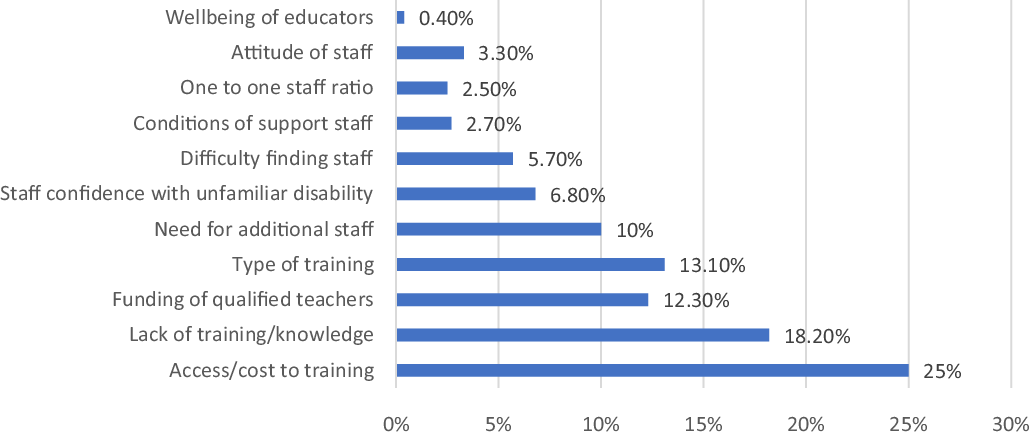
Further delineation of the data on staff-related barriers to inclusion are represented in Figure 1. These findings highlight that the special training required to work with children with disability was a significant barrier for services due to its costliness and lack of accessibility (25%). Other staff-related issues that were identified by service providers included a shortage of relevant knowledge within the service, as well as funding for qualified teachers, additional support staff, and participation in targeted training regarding inclusion, autism, trauma, and challenging behaviours. This indicates that although government funding may go some way to improving inclusive practices in preschools, there is a need for more on-the-ground support and training from qualified teachers and practitioners to supplement the existing knowledge in these services.
Inclusion Barriers Related to Staff Issues. Source: Early Childhood Education Directorate, Disability and Inclusion Program Survey, March–April 2019, Question 17.

Staff attitudes was one of the least concerning barriers at 3.3%. This indicates that preschool staff are overall welcoming and supportive of children with disability in their services, but need support to build their capacity to translate their attitudes into practice. The finding that early childhood teachers generally have a positive attitude towards inclusion concurs with earlier research findings (see, e.g., Hsieh & Hsieh, Reference Hsieh and Hsieh2012; Kilgallon & Maloney, Reference Kilgallon and Maloney2003; Mohay & Reid, Reference Mohay and Reid2006). Training and resources to support inclusion have also been identified in previous research (e.g., Frankel, Reference Frankel2004; Kilgallon & Maloney, Reference Kilgallon and Maloney2003).
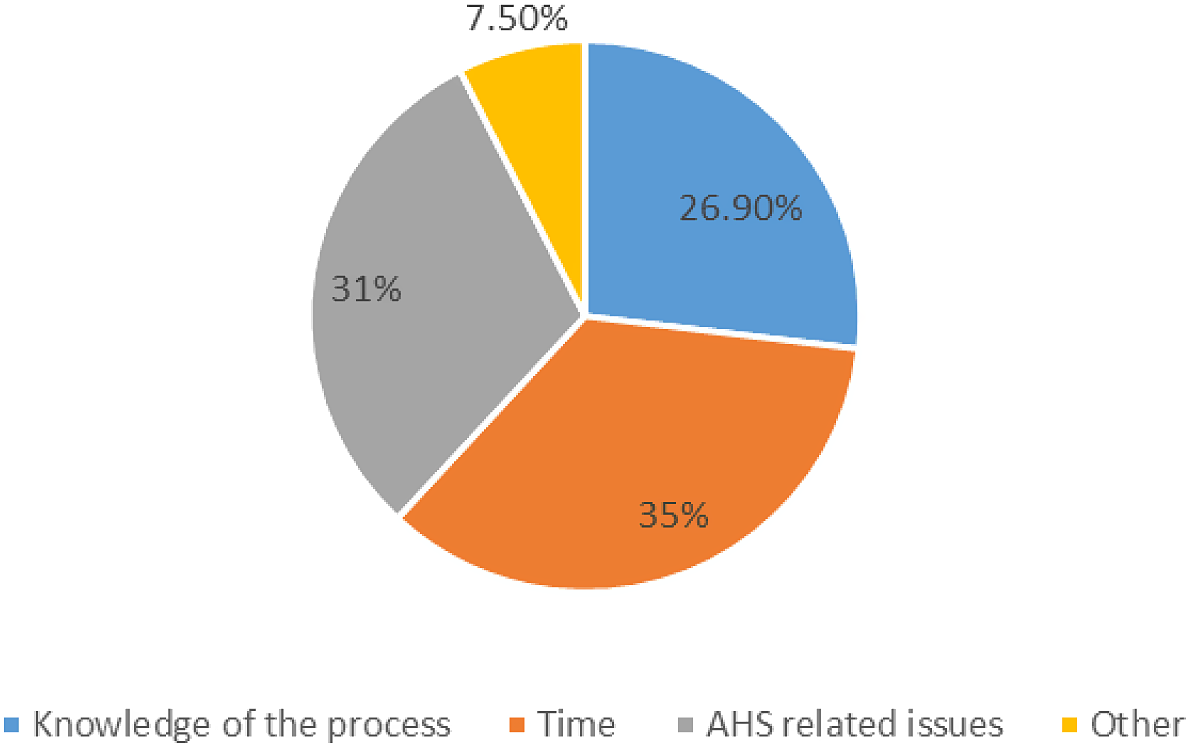
The need for additional support through professional development, training, and networking is further highlighted when examining the barriers preschool educators and directors identified as part of the NDIS process. Inclusion barriers related to the NDIS were mentioned 294 times in the Preschool Profile Survey in response to the open-ended question, ‘In consultation with the preschool, and conversations with preschool staff, site visits, and observations, please list any barriers you have observed or noted that have prevented children with disability and additional needs from participating in all the preschool experiences offered’. These barriers are presented in Figure 2. The lack of knowledge of the process represented 26.9% of these mentions in response to the same question. This is a significant issue given that approximately 30% of the 2,878 children with disability in community preschools in 2018 were children with an NDIS reference number.
Inclusion Barriers Related to the NDIS. Source: Early Childhood Education Directorate, Disability and Inclusion Program Survey, March–July 2019, Question 17.

Inclusion barriers relating to the NDIS process can be better understood through the preschools’ responses to Section 3 of the survey. This section examined the level of understanding of the NDIS as it relates to the ECEI approach. There were three questions relating to this topic. One asked preschools to rank the current level of understanding of the NDIS against a 5-point scale, ranging from no understanding to high understanding. As shown in Figure 3, 52.2% of preschools had staff with a limited understanding of the NDIS process, with only 11.9% indicating that they had a ‘good’ or ‘high’ understanding and 6.2% stating that they had no understanding (see Figure 3).
Level of Understanding of the NDIS. Source: Early Childhood Education Directorate, Disability and Inclusion Program Survey, March–July 2019.

Respondents were also invited to make comments about the NDIS process. Three key themes about the current understanding of preschool staff of the NDIS emerged after the qualitative data were analysed. They included (a) the difference in knowledge levels between directors and educators, (b) knowledge of different aspects of the NDIS process among all preschool staff, and (c) identified paths to improve knowledge. The level of knowledge of directors was found to be higher than that of educators, with 43.2% of directors indicating that they had moderate to high knowledge of the NDIS, compared to 25.4% of educators. Some of the systemic barriers to knowledge sharing among staff were identified in the qualitative data. For example, sharing of information and reflection occurred when staff have the opportunity to come together in staff meetings. In some preschools, this was difficult due to their operating environments. Statements from smaller preschools were more likely to indicate that there was not enough time allocated for all-staff meetings. Other respondents noted that they did not actively pursue acquiring information about the NDIS, as at the time they did not have any children with disability enrolled in the service. However, they knew where they could find the information to accommodate children if they enrolled. Educators were of the opinion that their directors were informed about the NDIS and would be able to assist them if required.
Preschool educators and directors primarily gained their knowledge of the NDIS through their SCB program provider (32.8%), followed by workshops (19%). Educators and directors also gained knowledge through brochures and resources, as well as their networks and providers. More than 20% of respondents (21.2%) stated that they had requested additional personal training and development in this area or expressed a wish to undertake training in the future.
Respondents were also asked what further guidance could be offered (Question 10) and what further support would be valued (Question 11). Both of these questions were open-ended. The most popular type of guidance requested was direct guidance within the preschool (41.8%), either through attendance at staff meetings or regular catch-ups. Partner forums were also sought after, with 22.3% of respondents looking to meet with ECEI and NDIS partners in their area. A further 20.3% were keen to have further information sessions and networking. Partner forums and networking were seen as important avenues to meet and discuss issues with others, gain best practice knowledge, and receive practical advice on the issues faced by preschools.
Many preschools saw the need for more resources to be available, not only for themselves but also for families. The information sought for families was in the form of brochures and information to be included in newsletters and directly through information sessions. Topics that were seen as areas for capacity building for preschools included ECEI, NDIS pathways, and the NDIS ECEI approach. Other topics that were also put forward for capacity building included the application process, referrals, and the role that preschools play in the process.
Best Practice
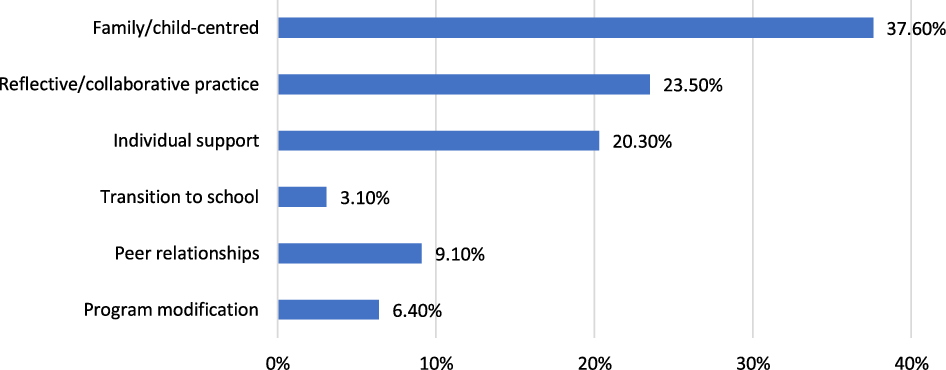
Preschools were also asked to share their inclusion success stories. Three major themes emerged as contributing to success: educational practice (n = 718), staff (n = 590), and access (n = 234). Educational practice refers to the approach taken by the service when working with children with disability and their families, and linking these with their programming by focusing on meeting the needs of the individual child. Analysis of the Preschool Profile Survey, as reported in Figure 4, identified that the three most common themes raised by the preschools in relation to educational practice were having a family- and child-centred service (37.6%), reflective and collaborative practice (23.5%), and individualised support for children with disability (20.3%).
Best Practice Themes Related to Preschool Practice. Source: Early Childhood Education Directorate, Disability and Inclusion Program Survey, March–July 2019.

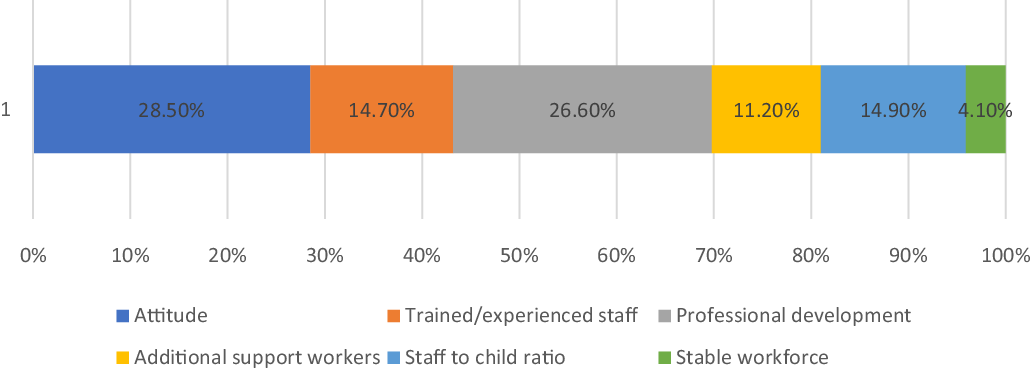
The ability to provide an inclusive practice is reliant on skilled and knowledgeable early childhood educators. The attitude of staff and their access to professional development were raised as the most important factors contributing to good inclusion practices, as can be seen in Figure 5. Of the total responses, 28.5% (n = 590) referred to the attitude of staff when describing key success factors, and 26.6% of total responses referred to professional development. It is interesting to note that reflective and collaborative practices among staff were also highly rated. The other staffing-related issues that respondents identified as barriers were access to trained and experienced staff, and additional support staff. It should be noted that to avoid micro forms of exclusion, the additional support staff referred to by respondents should not replace educators or become ‘velcroed’ to a child (Purdue, Reference Purdue2009).
Best Practice Related to Staffing. Source: Early Childhood Education Directorate, Disability and Inclusion Program Preschool Profile Survey, March–July 2019.

The findings for best practice approaches to including children with disability in preschools highlight the importance of building staff capacity and the value of appropriate professional development. It also demonstrates the need for preschool staff who have the knowledge and training to fully include children with disability rather than taking a deficit approach to disability.
Implications for Policy and Practice
The findings of the 2019 Disability and Inclusion Program Preschool Profile Survey have provided the department with baseline data that will enable it to track the impact of the Disability and Inclusion Program over the coming years. In addition, they highlight the need to provide preschool staff with easily accessible resources, training, and support. This focus on SCB is especially vital given that the survey found that staff-related issues are the main barrier to inclusion, and identified the lack of accessibility of staff training as the key staff-related issue.
Recent NSW Department of Education consultations with ECE sector stakeholders revealed that this issue needs to be addressed in the ECE sector, noting a lack of staff capabilities and quality education in inclusive practice, a lack of training-focused resources, and a lack of training in NDIS reforms. This was also apparent in the survey findings, which highlighted the need for greater training, particularly around NDIS processes. This issue has been widely recognised, with researchers noting that educators often report that they feel unprepared to work effectively with students with disability (Brodzeller, Ottley, Jung, & Coogle, Reference Brodzeller, Ottley, Jung and Coogle2018; Cramer, Coleman, Park, Bell, & Coles, Reference Cramer, Coleman, Park, Bell and Coles2015) and that improved teacher preparation is a necessity (Bannister-Tyrrell et al., Reference Bannister-Tyrrell, Mavropoulou, Jones, Bailey, O’Donnell-Ostini and Dorji2018). As noted in one study (Smith & Tyler, Reference Smith and Tyler2011), educators often face challenges in keeping up to date with inclusion research, theory, and a growing knowledge base around inclusive practice, highlighting the need to provide training, resources, and accessible support to ECE staff. The variability in the quality of training, which has a major impact on the quality of educational practice, has been identified (NSW Department of Education, 2018) as well as a need for more qualified educators, including those with specialised skills in working with children with disability and additional needs.
The information provided by respondents in the current study also helps providers know what to focus on in terms of training, support, and resources for preschools. Successful inclusion requires significant changes in the way education is provided to all children, which depends on how adequately teachers and related professionals are prepared to implement policies and reforms. When teachers are adequately trained, have access to appropriate resources and support, including professional development, and have a positive attitude towards including students with disability, effective practice becomes evident in classrooms (Boyle, Scriven, Durning, & Downes, Reference Boyle, Scriven, Durning and Downes2011).
The results of the preschool survey accord with the work of international researchers in the field who emphasise the need to think beyond ‘access’ when developing strategies for fully including children with disability in ECE (Cologon, Reference Cologon2013; Loreman, Sharma, & Forlin, Reference Loreman, Sharma and Forlin2013; Thornton & Underwood, Reference Thornton and Underwood2013). Forlin et al. (Reference Forlin, Chambers, Loreman, Deppeler and Sharma2013) have suggested that translating inclusive policies into inclusive practice relies heavily on the knowledge, skills, and attitudes of educators, who are responsible for turning principles into actions. The EYLF (Department of Education and Training, 2009) also identified the development of knowledge and skills as key to ensuring that equitable educational practices are realised and implemented.
The literature also highlights the need for strong and effective leadership for inclusive practice to be effective (e.g., Carter & Abawi, Reference Carter and Abawi2018; Division for Early Childhood, 2015; Forlin et al., Reference Forlin, Chambers, Loreman, Deppeler and Sharma2013; Sharma et al., Reference Sharma, Forlin, Deppeler and Guang-xue2013). In 2012, the Organisation for Economic Co-operation and Development focused on the need for capacity building, specifically around educational leadership, noting that ‘leadership preparation and training are central … to stimulate and spread innovation and to develop diverse curricula’ (Schleicher, Reference Schleicher2012, p. 29). The European Commission has similarly stressed the need to improve educator leadership and empower existing education leaders (including teachers) through investment in initial teacher training, peer learning, and career-long professional development (Council of the European Union and European Commission, 2015). The aims of this leadership development include enabling ‘learners to experience inclusion, equality, equity, non-discrimination and democratic citizenship in their learning environments’ (Council of the European Union and European Commission, 2015, p. 4). Although leadership from governments is important for developing inclusive policies, building leadership capital and capacity among educators is also key to implementing these policies and achieving inclusive education practices. This was also highlighted in the survey data in relation to knowledge of NDIS processes, where educators indicated that they relied on directors to have the requisite knowledge and skills to navigate the NDIS process.
Department Support Model
The NSW Department of Education’s Early Childhood Education Workforce Strategy focuses on a need to build a more inclusive workforce, as well as ensuring the workforce has a strong understanding of research into and theories on inclusion best practice. It links capacity building and professional development and training with inclusive practice, which are cited as underpinning principles of the strategy. This includes a focus on ‘build[ing] the skills and capability of the workforce by supporting educators and teachers to participate in professional development’ (NSW Department of Education, 2018, p. 5), as well as supporting the workforce to obtain the qualifications and experience necessary to prepare them for the workplace.
Under the SCB program, the early childhood intervention services and other qualified providers assigned to each preschool are responsible for providing support and capacity building, depending on the service’s circumstances and level of need. This includes supporting preschools to (a) identify any barriers preventing participation of children with disability in all preschool activities/experiences, (b) determine whether these barriers relate to the skills/experience of educators or features of the preschool itself, and (c) evaluate the nature of any additional support required by a service to meet each child’s developmental milestones. An Online Self-Assessment of Inclusive Practice tool is being developed for services to support this process of barrier identification. Assessment processes, as well as consultation with the child’s parents/carers, determine whether identified barriers may be removed or reduced only with additional funding. Aligning with government policies, principles, and priorities around transition to school, the Disability and Inclusion Program will also include an Early Learning Transitions pilot program, designed to support successful transitions into preschool for children with disability.
Conclusion
Quality education programs and teaching, and therefore professional development and capacity building for educators, are key factors for effective inclusive education. The research outlined in this paper has identified the need for greater staff training and capacity building around inclusive education. These findings support those identified in the research literature. The response of the department to these needs is being addressed through funding programs and SCB endeavours, which are designed to educate and empower preschools to facilitate the full inclusion of children with disability. Through the SCB program, the Disability and Inclusion Program is supporting preschools to review their staff development, educational practice, and physical environments with the aim of ensuring children with disability and additional needs are meaningfully included in the educational program. Although it is too early to comment on the impact of the program, the 2019 survey findings provide a baseline from which to measure program outcomes in the future.