INTRODUCTION
One essential part of learning a language is building a lexicon. Beginning in the second year of life, children rapidly add to their lexicons and eventually learn as many as ten words a day (Bloom & Markson, Reference Bloom and Markson1998). The task of learning a word requires a number of steps including segmenting the word from fluent speech, mapping the stream of phonemes to an appropriate referent, determining extensions of word meaning, and remembering the sounds of the word. In addition to these essential elements of word learning, children must also learn how to map acoustically variable productions of words onto stored lexical items (Houston & Jusczyk, Reference Houston and Jusczyk2000) – an ability known as ‘perceptual constancy’. Depending on a variety of talker characteristics – including differences in gender, age, regional dialect, and native language – the phonetic form of acquired lexical items will sound quite different from initially encountered instances. The ability to perceive these highly variable speech signals is a basic foundational skill that must develop for communication to successfully occur with the wide range of talkers encountered in daily life. Therefore, data on when and how children acquire the ability to perceptually compensate for phonetic variability is essential for a full understanding of the development of speech perception and word recognition. The current study explores how differences in talker native language influence four- to seven-year-old children's word recognition.
Production and perception of regional dialects and foreign accents
Across-talker differences in native language and region of origin can have substantial influence on the phonetic realizations of words. However, these two types of variability – foreign accents and regional dialects – can differ in their effects on both production and perception. Regional dialect variation tends to primarily influence vowel production (Adank, Evans, Stuart-Smith & Scott, Reference Adank, Evans, Stuart-Smith and Scott2009; Clopper, Pisoni & de Jong, Reference Clopper, Pisoni and de Jong2005; Nathan, Wells & Donlan, Reference Nathan, Wells and Donlan1998). For example, in London English, the words boot and naughty may be produced as [but] and [nɔːtʰi], whereas in Glaswegian English, they may be produced as [bʏt] and [nɔtʰe] (Nathan et al., Reference Nathan, Wells and Donlan1998). For adult listeners, the acoustic-phonetic differences across native varieties can result in lower intelligibility, particularly for unfamiliar or non-standard dialects (Clopper & Bradlow, Reference Clopper and Bradlow2008; Major, Fitzmaurice, Bunta & Balasubramanian, Reference Major, Fitzmaurice, Bunta and Balasubramanian2005). Further, unfamiliar native dialects are processed more slowly than familiar dialects (Adank et al., Reference Adank, Evans, Stuart-Smith and Scott2009; Floccia, Goslin, Girard & Konopczynski, Reference Floccia, Goslin, Girard and Konopczynski2006). However, these effects tend to be small to negligible in the quiet for adults (Adank et al., Reference Adank, Evans, Stuart-Smith and Scott2009; Floccia et al., Reference Floccia, Goslin, Girard and Konopczynski2006).
In contrast to regional dialect variation, which tends to be primarily confined to vowel differences, foreign-accented speech frequently deviates from native language norms on all levels of phonological structure, including vowels (e.g. producing carry as [kʌɹi]), consonants (e.g. producing mouth as [maʊt]), and suprasegmentals (e.g. producing window as [wɪnˈdoʊ]). Due to these deviations from native language norms, foreign-accented speech is typically less intelligible than native-accented speech for native adult listeners, particularly in adverse listening conditions, and takes longer to process (Bent & Bradlow, Reference Bent and Bradlow2003; Floccia, Butler, Goslin & Ellis, Reference Floccia, Butler, Goslin and Ellis2009b; Munro, Reference Munro1998; Munro & Derwing, Reference Munro and Derwing1995; Tajima, Port & Dalby, Reference Tajima, Port and Dalby1997; van Wijngaarden, Reference van Wijngaarden2001).
Few studies have directly compared the perception of regional dialect variation with the perception of foreign-accented speech. Thus, knowledge of how these types of linguistic variation may differentially influence perception is limited (Cristia et al., Reference Cristia, Seidl, Vaughn, Schmale, Bradlow and Floccia2012). However, two studies that have made this comparison have found that foreign-accented speech results in greater decrements to intelligibility and greater processing time costs than regional variability for native adult listeners (Adank et al., Reference Adank, Evans, Stuart-Smith and Scott2009; Pinet, Iverson & Huckvale, Reference Pinet, Iverson and Huckvale2011). Further, the processing of foreign-accented speech may require more top-down lexical processing than regional accents (Goslin, Duffy & Floccia, Reference Goslin, Duffy and Floccia2012).
Maintaining perceptual constancy is essential for efficient speech communication. Consequently, it is crucial to understand how speech variability – including variability stemming from regional dialects and foreign accents – influences word recognition in children once they embark on the task of word learning. Nathan et al. (Reference Nathan, Wells and Donlan1998) were the first to test how regional dialects influence word recognition in children. In their study, four- and seven-year-old children from London were tested on their perception of words produced in their home dialect compared to an unfamiliar regional dialect, Glaswegian English. The words were presented in quiet and the child's task was to repeat each word and then define it. Response accuracy as well as whether the child produced a phonetic response – a repetition of the phonetic structure of the word without accessing a lexical item – were evaluated. Both the four-year-old and seven-year-old children were less accurate at identifying words in the unfamiliar regional dialect compared to their home dialect. Further, the ability to accurately perceive words in the non-home dialect was significantly better for the seven-year-old children compared to the four-year-old children. Lastly, the seven-year-old children produced fewer phonetic responses for the Glaswegian stimuli than the four-year-old children.
Nathan and colleagues (Reference Nathan, Wells and Donlan1998) attributed their findings to two developmental factors: changes in phonetic sensitivity and precision of phonological representations. The younger children were presumed to have greater sensitivity to phonetic detail. Sensitivity to certain fine phonetic details may hinder a child's ability to understand that two word productions – whose pronunciations differ across dialects – represent the same lexical item. The younger children were also presumed by the researchers to have less precise phonological representations. The imprecision of phonological representations was proposed to relate to inexperience with accents and smaller vocabulary sizes. However, neither experience with language variation or vocabulary size was explicitly tested. Thus, an aim of the current study is to address one of these limitations by examining vocabulary size in relation to children's perception of a different, but related, type of speech variability, foreign-accented speech. Vocabulary size can serve as an indirect measure of children's exposure to language input. Children with greater and more diverse linguistic input tend to have larger lexicons and are more efficient at lexical processing (Hurtado, Marchman & Fernald, Reference Hurtado, Marchman and Fernald2008; Huttenlocher, Haight, Bryk, Seltzer & Lyons, Reference Huttenlocher, Haight, Bryk, Seltzer and Lyons1991). Greater quantity and quality of linguistic input may allow for more accurate and efficient word recognition for both canonical and non-canonical pronunciations.
Although precise and distinct phonological representations allow for more complete and accurate lexical representations that are more efficiently accessed (Elbro, Reference Elbro1996; McDowell, Lonigan & Goldstein, Reference McDowell, Lonigan and Goldstein2007), the precision of phonological representations may not be one of the developmental changes underlying children's increasing abilities to better perceive words produced in unfamiliar dialects in early childhood. More recent research has found that lexical representations are encoded in fine phonetic detail, starting in the second year of life (e.g. Mani & Plunkett, Reference Mani and Plunkett2007; Swingley & Aslin, Reference Swingley and Aslin2002; White & Morgan, Reference White and Morgan2008). Further, the ability to accurately perceive words that differ in their acoustic-phonetic characteristics due to dialect or accent differences may be more closely related to perceptual flexibility (Creel, Reference Creel2012) than phonological specificity. Both toddlers (e.g. White & Morgan, Reference White and Morgan2008) and preschoolers (Creel, Reference Creel2012) are able to identify words with mispronunciations, although they are slower, less accepting, and have greater uncertainty as the mispronunciations deviate further from the canonical pronunciation (Creel, Reference Creel2012; White & Morgan, Reference White and Morgan2008). It is possible that the improvements observed in children's ability to accurately perceive words produced in an unfamiliar dialect later in development (e.g. Nathan et al., Reference Nathan, Wells and Donlan1998) are a result of increases in perceptual flexibility or the ability to recognize words despite the presence of multiple deviations from native dialect norms rather than changes in phonological representation specificity.
During the same period in development that recognition of words in a non-home dialect substantially improves, children's metalinguistic awareness of regional dialects and foreign accents increases. Five-year-old children have been shown to be relatively insensitive to regional accent differences in sentence categorization tasks, whereas seven-year-old children can reliably categorize speakers by regional dialect (Floccia, Butler, Girard & Goslin, Reference Floccia, Butler, Girard and Goslin2009a; Girard, Floccia & Goslin, Reference Girard, Floccia and Goslin2008). Further, children between the ages of five and seven years more accurately categorize talkers with foreign accents compared to speakers with non-home regional dialects. The difference in metalinguistic awareness between foreign accents and regional dialects presumably occurs because the acoustic-phonetic properties of foreign-accented speech tend to be more perceptually salient (Floccia et al., Reference Floccia, Butler, Girard and Goslin2009a; Girard et al., Reference Girard, Floccia and Goslin2008). Because there are differences in children's metalinguistic awareness for these two types of speech variation, there may also be differences in how these two types of variation influence word recognition in children.
Current study
Metalinguistic awareness of foreign accents has been investigated for children in early and middle childhood (Floccia et al., Reference Floccia, Butler, Girard and Goslin2009a; Girard et al., Reference Girard, Floccia and Goslin2008). However, there is a gap in the literature on how children in this developmental period are able to map words with this form of variability onto their stored lexical representations. That is, how is children's word recognition influenced by the variability present in foreign-accented speech? As discussed above, the acoustic-phonetic features present in foreign-accented speech tend to differ from those in regional dialects (Clopper & Pisoni, Reference Clopper and Pisoni2004; Floccia et al., Reference Floccia, Butler, Girard and Goslin2009a). Thus, children's ability to perceptually compensate for this type of variability may be different than for other types of across-talker variability.
In contrast to adults, children have much less experience with speech variability. Adults are typically able to understand a variety of acoustically distinct productions of words. Even talkers whose words deviate substantially from native norms can be understood with sufficient practice (Bradlow & Bent, Reference Bradlow and Bent2008; Clarke & Garrett, Reference Clarke and Garrett2004; Sidaras, Alexander & Nygaard, Reference Sidaras, Alexander and Nygaard2009). However, children – who have developing linguistic systems and reduced cognitive capabilities relative to adults – may have difficulty accurately perceiving foreign-accented words. With increasing linguistic knowledge and experience, children may be better able to map foreign-accented words onto stored lexical representations. The current study investigates the perception of foreign-accented words in children between the ages of four and seven years. This age range was selected because previous studies have shown that children's ability to accurately perceive words from unfamiliar regional dialects improves during this developmental period (Nathan et al., Reference Nathan, Wells and Donlan1998), as do their metalinguistic abilities with language variation (Floccia et al., Reference Floccia, Butler, Girard and Goslin2009a; Girard et al., Reference Girard, Floccia and Goslin2008).
The current study will address two sets of questions regarding children's perception of foreign-accented speech:
1. How does children's perception of foreign-accented words compare to adults? And, how do these abilities develop in children between the ages of four and seven years?
2. Is vocabulary size related to the ability to perceive foreign-accented words?
METHODS
Participants
Participants were monolingual American-English speakers with normal speech and hearing. There were 33 child participants (22 female and 11 male) who ranged in age from 4;0 to 7;7, including four-year-olds (n = 11), five-year-olds (n = 7), six-year-olds (n = 11), and seven-year-olds (n = 4). Most of these children had lived exclusively in Indiana (n = 20). For the children who had lived elsewhere, several had lived in other states in the Midwest, including Michigan (n = 3), Illinois (n = 1), and Ohio (n = 1). The remaining children had lived in other states in the US, including California (n = 1), Kentucky (n = 1), Maryland, (n = 1), New York (n = 2), Vermont (n = 1), Virginia (n = 1), and Wyoming (n = 1). Most of these children had lived in Indiana longer than their other states of residence. They averaged three years of residence in Bloomington, Indiana (range = 0·75–5·5 years), whereas they had spent an average of 2 years 4 months in these other states (range = 4·5 months to 5 years). Thirteen additional children were tested but not included in final data analysis due to failure to attend both sessions (n = 2), computer error (n = 1), hearing screening failure (n = 2), articulation screening failure (n = 1), bilingual language background (n = 1), prior exposure to Korean-accented English (n = 4), or very high number of ‘don't know’ responses during the experiment (n = 2, described further below). There were 24 adult participants (10 female and 14 male) with an average age of 21 years (range = 19–26). Three additional adults were tested but not included in the final data analysis due to bilingual language background (n = 1) or hearing screening failure (n = 2). Normal hearing was evidenced by a pure-tone hearing screening of 20 dB HL at 500, 1000, 2000, 4000, and 8000 Hz and 25 dB HL at 250 Hz for all participants. Children's articulation was measured with the Sounds-in-Words section of the Goldman-Fristoe Test of Articulation, 2nd Edition (GFTA-2; Goldman & Fristoe, Reference Goldman and Fristoe2000). Children were considered to have typical articulation if their score was no more than one standard deviation below the mean relative to age- and gender-matched peers.
Each child's parent(s) completed a language background questionnaire that included questions about their child's language learning experiences and exposure to foreign languages, foreign accents, and regional dialects. Parents were asked to report the accents and dialects to which their child had been exposed, the frequency of exposure, the ages of exposure, as well as the role of the speakers providing the exposure (e.g. teachers, family members). Most parents reported that their child had not been exposed to any foreign-accented speech (n = 22). Of the remaining 11 children, their exposure to foreign-accented speech varied from frequent daily exposure to a few times a year. Because native speakers of Korean produced the non-native stimuli for the current experiment, none of the children included in the study had parents who reported any exposure to Korean-accented English. Most children (n = 23) had been exposed to various regional dialects of English including primarily other US dialects and some with exposure to speakers from other countries who spoke English natively (e.g. British English).
Stimuli
Stimuli were selected from the Hoosier Database of Native and Non-native Speech for Children (Atagi & Bent, Reference Atagi and Bent2013; Bent, Reference Bent2010). This database includes audio recordings of 28 speakers from 7 language backgrounds reading words, sentences, and paragraphs. In addition to the recordings, measures of objective intelligibility, perceived comprehensibility, and strength of foreign accent have been gathered from adult listeners. The word intelligibility scores for each talker were based on 10 native English adult listeners’ transcriptions of 550 words. The words were played to the listeners in quiet, and intelligibility scores were based on number of keywords correctly transcribed. The strength-of-foreign-accent score was based on ratings from native English adult listeners on a scale of 1–7, where 1 indicates ‘no foreign accent’ and 7 indicates a ‘strong foreign accent’.
From the database, four talkers from two language backgrounds were selected for use in the current experiment: two native speakers of American English (1 male and 1 female) and two native speakers of Korean (1 male and 1 female). The average word intelligibility scores in quiet for the native speakers were both 99% correct, and the Korean female and male talkers had average intelligibility scores of 84% and 83% correct, respectively. The foreign-accent strength scores for the native talkers were both 1·1. The foreign-accent strength scores for the Korean talkers were 5·5 for the female talker and 5·8 for the male talker. The Korean talkers were selected because their intelligibility scores were significantly lower and their foreign-accent scores were significantly higher than the native talkers, indicating the presence of a fairly strong foreign accent. However, the talkers’ intelligibility scores were not so low as to result in words that were too difficult for children to identify.
The Korean-accented talkers' pronunciations differed from native norms in both consonant and vowel production. These talkers produced frequent vowel substitutions, such as producing good as [ɡud], six as [siks], and gum as [ɡɑm], as well as frequent vowel distortions. They also produced words with consonant substitutions, such as in the words jelly [ʒ li], three [sɹi], and sun [θʌn], as well as consonant distortions, such as partial devoicing. Additions were rare, but occurred in words, such as corner [kɝənɚ] and china [ʧɹaɪnə]. Deletions were also rare, but occurred several times in words with /ld/ clusters, such as children [ʧɪdɹεn], as well as a few other instances such as brown [bɹaῦ]. Suprasegmental errors were not common, as the majority of the words were monosyllabic. However, there were a few stress errors in the multisyllabic words, such as window [wɪnˈdoʊ].
The words used in the current experiment were selected from the database described above and included words in the Lexical Neighborhood Test (LNT) and the Multisyllabic Lexical Neighborhood Test (MLNT) (Kirk, Pisoni & Osberger, Reference Kirk, Pisoni and Osberger1995). These word lists, which include all real English words, have been successfully used with children, including those with and without hearing loss (Kirk, Eisenberg, Martinez & Hay-McCutcheon, Reference Kirk, Eisenberg, Martinez and Hay-McCutcheon1999; Kirk, Hay-McCutcheon, Sehgal & Miyamoto, Reference Kirk, Hay-McCutcheon, Sehgal and Miyamoto2000; Kirk et al., Reference Kirk, Pisoni and Osberger1995; Schorr, Roth & Fox, Reference Schorr, Roth and Fox2008). Kirk and colleagues developed these lists based on their productive use by children in the three- to five-year old age range. All the words have been previously assessed for familiarity and were given overall high ratings of familiarity for children (Kirk, Sehgal & Hay-McCutcheon, Reference Kirk, Hay-McCutcheon, Sehgal and Miyamoto2000). The LNT includes two lists of 50 monosyllabic words each, and the MLNT includes two lists of 24 multisyllabic words. Half of the words on each list are lexically ‘easy’ words and half the words are lexically ‘hard’ words as defined by their frequency and neighborhood density (Luce & Pisoni, Reference Luce and Pisoni1998). Easy words are high-frequency words with few neighbors, whereas hard words are low-frequency words with many neighbors. Neighbors are words that differ from the target word by the addition, substitution, or deletion of one phoneme. The specific stimulus words included in the LNT and MLNT can be found in Kirk et al. (Reference Kirk, Eisenberg, Martinez and Hay-McCutcheon1999).
Procedure
Children were tested individually over two sessions lasting approximately 90 minutes each, separated by at least two days. Before the child began the experiment, the parent completed a consent form and a language background questionnaire (described above). During the two sessions, the child participants were given numerous breaks, including a longer break with a snack and games. After the completion of each session, the child was given a small toy and the parent was paid $10.
In the first session, children's hearing was screened and the articulation test (GFTA-2) was administered. Receptive vocabulary was assessed with the Peabody Picture Vocabulary Test, 4th Edition (PPVT-4; Dunn & Dunn, Reference Dunn and Dunn2007) and, if time allowed, expressive vocabulary was assessed with the Expressive Vocabulary Test, 2nd Edition (EVT-2; Williams, Reference Williams2007). In the second session, children completed the EVT, if they did not complete it in the first session, and the experimental word recognition test. The stimuli for the word recognition test were embedded in a speech-shaped noise at a +5 dB SNR. The noise was added to prevent word recognition scores at ceiling levels, particularly in the native conditions. The speech-shaped noise was created by concatenating all of the experimental words into a single wav file and then extracting the long-term average spectrum (LTAS). The LTAS was then used as a filter to shape a broad-band white noise using the Akustyk add-on (Plichta, Reference Plichta2012) in Praat (Boersma & Weenink, Reference Boersma and Weenink2010). During the experiment, a random segment of the noise was selected that was 1 second longer than the word so that there were 500 milliseconds of noise presented before the word and 500 milliseconds after. These two sound files were then mixed to create the desired SNR and played through a Yamaha (MSP7 Studio Powered) monitor at approximately 68 dB. The speaker was 36 inches from the participant.
The word recognition test was controlled by custom-designed software written in Python and was presented using a Mac Mini. The children were presented with four practice trials (one word from each talker in the experiment) before the start of the experimental trials to accustom them to the task. The practice words were selected from the Phonetically Balanced Kindergarten (PBK) lists (Haskins, Reference Haskins1949) and were words that were not included in the experimental trials. Children were next presented with the two LNT lists followed by the two MLNT lists. The native talkers produced one list of each type (half of the words by each talker) and the Korean talkers also produced one list of each type (again half of the words by each talker). The word list produced by the native talkers and the Korean talkers was counterbalanced across participants. The order of these lists was also counterbalanced across participants. Each list contains half lexically easy words and half lexically hard words, and therefore each talker produced approximately half of the easy words and half of the hard words. The pairing of words to specific native and non-native talkers was not counterbalanced. The presentation of the lexical items and two talkers’ productions within a list were randomized for each participant.
The participants were presented with one word at a time and had to repeat the word to the experimenter. After the child produced the word, the experimenter recorded the response by typing the word into a text box that appeared on a computer screen. If the child was unsure, she was encouraged to provide her best guess. If the experimenter was unsure of the child's response, she would ask the child to repeat the word. If the experimenter was still unsure, she would ask the child to define the word. If the child did not provide a guess, the response was indicated as ‘no response’. Further, following Nathan et al. (Reference Nathan, Wells and Donlan1998), incorrect responses were also coded as phonetic responses as needed. These responses were nonwords that were at least partially related to the stimulus production. Phonetic imitations included responses such as [paɪɡɚ] for tiger, [bε] for bed, and [ɡid] for give. The stimuli that invoked these phonetic responses were produced by a Korean-accented talker as [tʰaɪɡɚ], [bεd̚], and [ɡiv], respectively. If the child produced a response that appeared to be a complete or partial imitation of the word, the child was asked what the word meant or if her response was a real word. If the child said that it was not a real word, the experimenter recorded a phonetic spelling of the word and indicated that it was a phonetic response. There were only five instances in which a child produced a nonword and then defined it. For example, during a trial in which the target word was cook, the child produced the response [koʊp]. When the child was asked what this word meant, the child responded, ‘somebody that is your friend, maybe’. A second coder checked all phonetic responses. If there was a disagreement between the initial and second coders, a third coder was consulted to make a final determination. If a child was not attending during the presentation of a trial, the trial was marked as ‘non-attention’. Non-attention trials primarily occurred when a child began talking during the presentation of a stimulus. The children's oral responses were digitally audio recorded for accuracy rechecking, as needed. The children were given breaks after the presentation of approximately 25 words but could take additional breaks as needed.
The adults were tested in a one-hour session. Adults completed a consent form, language background questionnaire, hearing screening, and the word recognition experiment. The procedures for the word recognition experiment were the same as for the children except that adults did not receive as many breaks. Adults were paid $10 for their participation.
ANALYSIS
For the PPVT-4 and EVT-2, both raw scores and standardized scores were computed based on standardized scoring protocols. The average PPVT-4 raw score was 119 (range = 67–147) and the average PPVT-4 standard score was 121 (range = 88–140). The average EVT-2 raw score was 92 (range = 43–138) and the average EVT standard score was 120 (range = 91–139). Thus, all children showed average or above-average vocabulary skills as measured by these two standardized tests.
For the word recognition task, the participant's response to each word was compared to the intended target word and was scored as correct if it matched the target word exactly; words with added or deleted morphemes, don't know responses, non-attention trials, and phonetic imitations were counted as incorrect. Percent correct scores were then calculated for the easy and hard words for the native- and Korean-accented talkers. Due to the relatively small number of words included in the MLNT, the scores for the LNT and MLNT were collapsed so that each participant received four scores: native easy, native hard, non-native easy, and non-native hard. Scores were averaged across conditions and for talkers within a language background. Percent correct scores were converted to RAU (rationalized arcsine units) to facilitate meaningful statistics across the entire range of scores (Studebaker, Reference Studebaker1985). The RAU scale extends from −23 (corresponding to 0% correct) to 123 (corresponding to 100% correct).
RESULTS
Overall performance by adults and children
Nearly all children were able to complete the task. Trials in which children were not attending (i.e. scored as ‘non-attention’) were relatively rare, accounting for 0·43% of trials. Children were also able to provide a response on nearly all trials, as responses of ‘don't know’ accounted for only 0·84% of total trials. Further, no individual child included in the analysis had more than 3% of trials marked for non-attention trials or more than 5% of trials with ‘don't know’ responses. Two children responded ‘don't know’ on over 10% of trials (11·6% and 14·3%) and thus were excluded from the analysis (as mentioned above). Phonetic responses (i.e. nonword responses that were phonetically related to the target) will be analyzed further below, but for the initial analysis were included with the other incorrect responses.
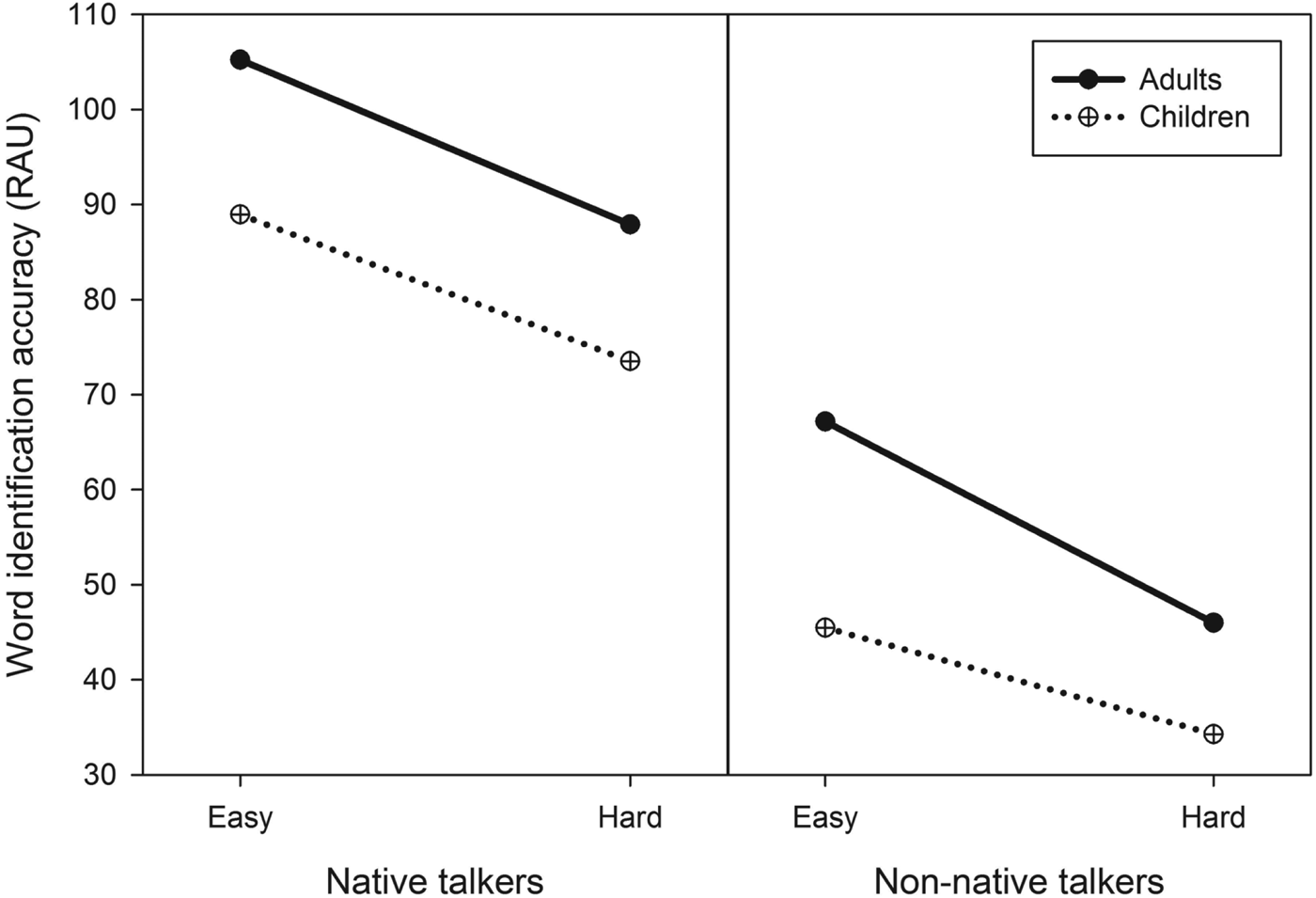
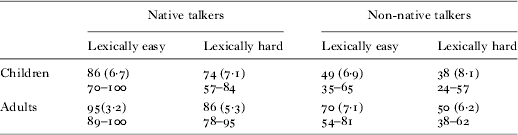
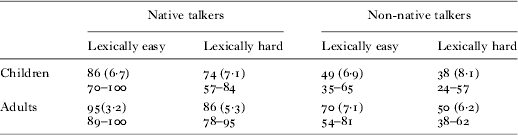
The word recognition data were analyzed using a repeated-measures ANOVA with age (children versus adults) as the between-subjects variable and lexical difficulty (easy versus hard) and nativeness (native versus non-native) as within-subject variables (Figure 1 and Table 1).Footnote 1 The ANOVA showed main effects of age (F(1,55) = 127·73, p < ·001, η 2 = 0·699), lexical difficulty (F(1,55) = 240·80, p < ·001, η 2 = 0·814), and nativeness (F(1,55) = 1105·33, p < ·001, η 2 = 0·953). The main effects were in the expected direction with adults performing better than children; lexically easy words were identified more accurately then lexically difficult words; and stimuli produced by native speakers were identified more accurately than those produced by non-native speakers. The interaction between lexical difficulty and age was significant (F(1,55) = 7·60, p = ·008, η 2 = 0·121). This interaction was due to adult listeners showing a larger difference between easy and hard words (difference of 18·6 RAU) than child listeners (13·0 RAU). No other two-way interactions were significant. The three-way interaction among age, lexical difficulty, and nativeness was also significant (F(1,55) = 5·99, p = ·018, η 2 = 0·098). To facilitate the interpretation of the three-way interaction, two additional repeated measures ANOVAs were conducted: one for the native stimuli and one for the non-native stimuli. In both of these, age was the between-subject factor and lexical difficulty was the within-subject factor. For the native stimuli, there were main effects of lexical difficulty (F(1,55) = 165·09, p < ·001, η 2 = 0·750) and age (F(1,55) = 52·82, p < ·001, η 2 = 0·490), but there was not a significant interaction between lexical difficulty and age. Similarly with the non-native stimuli, there were significant effects of lexical difficulty (F(1,55) = 142·35, p < ·001, η 2 = 0·721) and age (F(1,55) = 136·02, p < ·001, η 2 = 0·712). Additionally, there was a significant interaction between age and lexical difficulty (F(1,55) = 13·54, p = ·001, η 2 = 0·198). The results of these two ANOVAs suggest that the three-way interaction was a result of children and adults showing similar response patterns for the items produced by the native speakers, but different response patterns for the items produced by the non-native speakers. That is, adults and children showed similar difference scores between easy and hard words for the native stimuli; responses to easy words were 17·3 RAU higher than hard words for the adults and 15·5 RAU higher for the children. In contrast, for the non-native stimuli, adults showed a greater difference between easy and hard words (19.9 RAU) than the children (10.5 RAU).
Word recognition scores (RAU) for lexically easy and hard words by native and non-native talkers for adult and child listeners.

Word recognition scores (percent correct) for lexically easy and hard words by native and non-native talkers for adult and child listeners. Averages are listed followed by standard deviations in parentheses. Minimum and maximum scores are listed below the average scores
Accuracy scores for individual target items were compared between the child and adult listeners to determine whether adults and children showed similar identification accuracy patterns across items. This analysis was conducted by summing the number of correct responses for each item produced by the same talker for the adult listeners and the child listeners. Because the talker who produced a particular lexical item (i.e. one of the native-accented talkers vs. one of the Korean-accented talkers) was counterbalanced between listeners, this analysis was conducted separately for two counterbalanced conditions. The accuracy scores for the child and adult listeners across lexical items were strongly correlated in both conditions. These correlations were significant when both native and non-native items were entered into the analysis (Condition 1: r = 0·827, p < ·001; Condition 2: r = 0·838, p < ·001) and when only the non-native items were analyzed (Condition 1: r = 0·801, p < ·001; Conditions 2: r = 0·816, p < ·001). Therefore, the child and adult listeners demonstrated similar identification accuracy patterns across stimulus items.
Phonetic responses
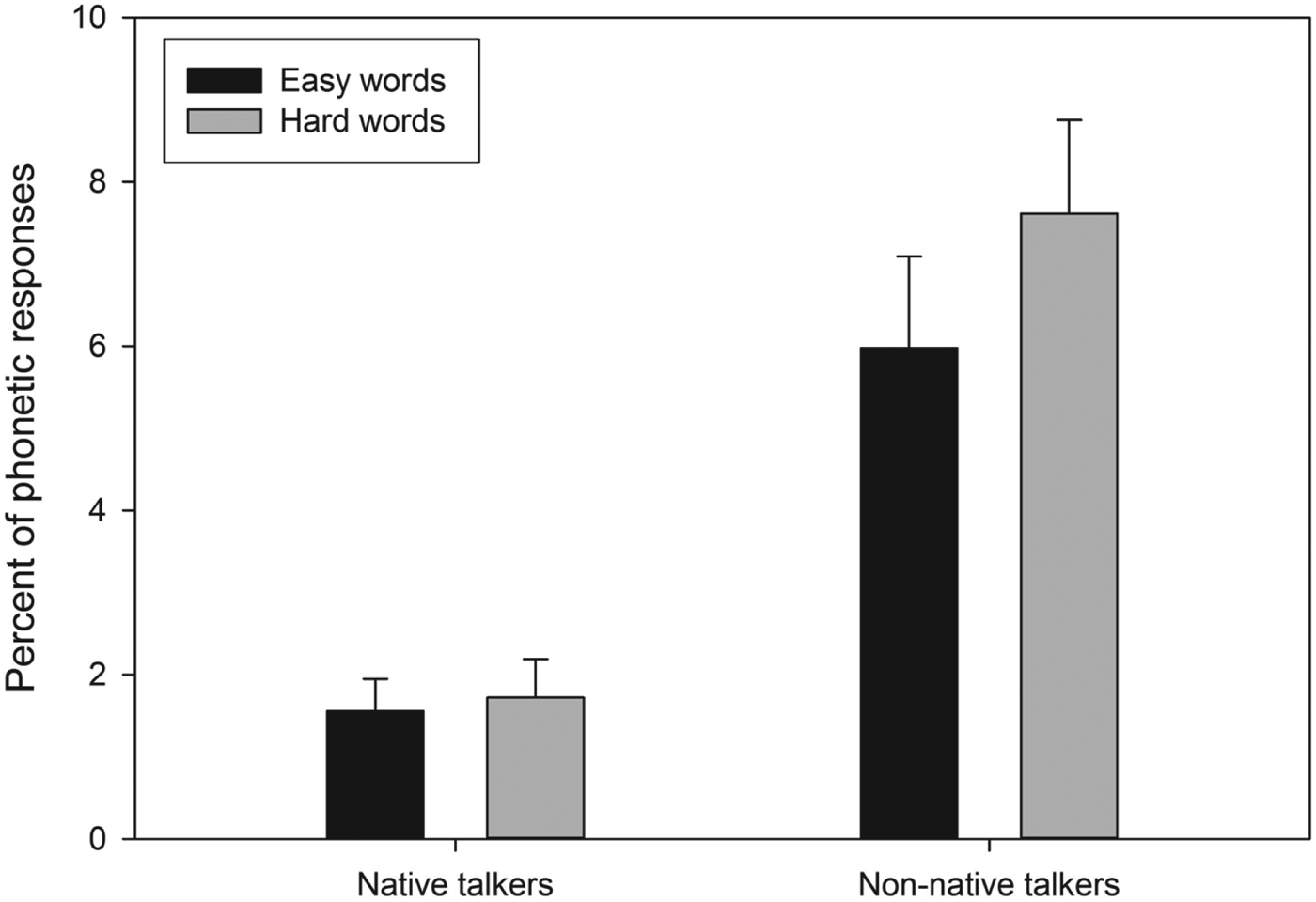
The phonetic response data (i.e. nonword responses that were phonetically related to the target) were analyzed using a repeated-measures ANOVA with lexical difficulty (easy versus hard) and nativeness (native versus non-native) as within-subject variables (Figure 2). Phonetic responses were only analyzed for the children because adults very rarely gave phonetic responses (less than 1% of trials overall), whereas most children provided at least one phonetic response during the course of the experiment. Adults’ errors consisted primarily of providing incorrect real word responses with occasional ‘don't know’ responses. The ANOVA showed a main effect of nativeness (F(1,32) = 57·98, p < ·001, η 2 = 0·644), but there was no effect of lexical difficulty or an interaction between the two variables. Children gave significantly more phonetic responses for words produced by non-native talkers (−2·6 RAU or 6·8% of trials) than for those produced by native talkers (−15·7 RAU or 1·6% of trials), although it should be noted that, even for the non-native talkers, there were relatively few phonetic responses. Correlations between scores for phonetic responses and age were not significant, indicating that phonetic responses did not decrease over this age range. The greater number of phonetic responses was partially due to the greater number of incorrect responses for the non-native tokens overall. For the incorrect responses only, phonetic responses accounted for 10% of the incorrect responses for the native-accented words compared with 12% for the non-native-accented words. Responses in which the child produced an incorrect real word constituted the vast majority of errors in all conditions (i.e. 89% of errors for native talkers’ productions and 86% of errors for non-native talkers’ productions were incorrect real words).
Percent of phonetic responses by children for lexically easy and hard words by native and non-native talkers. Error bars show the standard errors.
Relationships between word recognition scores and other variables for children
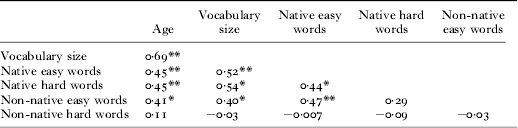
The relationships of the four word recognition scores (native easy, native hard, non-native easy, and non-native hard) to vocabulary size (average of the PPVT and EVT raw scores) and age were assessed through Pearson product-moment correlation coefficients (Table 2). Three of the speech perception measures (native easy, native hard, and non-native easy) were positively correlated with age (native easy: r = 0·453, p = ·008; native hard: r = 0·445, p = ·009; non-native easy: r = 0·406, p = ·019) and the vocabulary measure (native easy: r = 0·515, p = ·002; native hard: r = 0·538, p = ·001; non-native easy: r = 0·401, p = ·021). Therefore, word recognition increased on the native easy, native hard, and non-native easy conditions with increasing age and vocabulary size. However, the word recognition scores for the non-native hard words were not correlated with either age or vocabulary size.
Correlations among age, vocabulary size, and word recognition scores
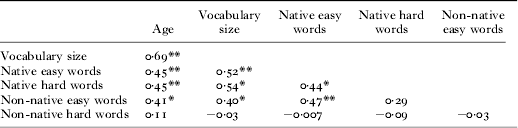
notes: ** = p < ·01; * = p < ·05.
Age and the vocabulary score were also significantly correlated with one another (r = 0·694, p < ·001). Therefore, to determine if there was an independent contribution of age or vocabulary size, partial correlations were conducted. When age was controlled for, the significant correlation between the vocabulary score and scores on the native hard condition remained (r = 0·354, p = ·047). Further, there was a trend for a significant positive relationship between the vocabulary score and word recognition score in the native easy condition when age was controlled for (r = 0·312, p = ·082). However, there was no correlation between the vocabulary score and the word recognition scores for the non-native conditions once age was controlled for (non-native easy: r = 0·182, p = ·320; non-native hard: r = −0·154, p = ·400). Once the vocabulary scores were controlled for, there was not a significant relationship between age and any of the word recognition scores (native easy: r = 0·155, p = ·396; native hard: r = ·119, p = ·156; non-native easy: r = 0·194, p = ·289; non-native hard: r = 0·188, p = ·302). Therefore, there appeared to be a relationship between vocabulary size and word recognition for native-accented words independent of age. However, for this sample, any independent contribution of age or vocabulary size to word recognition with non-native talkers could not be determined.
DISCUSSION
Children's speech perception abilities are developing throughout early and middle childhood and even into adolescence (Hazan & Barrett, Reference Hazan and Barrett2000). Recent work has substantially contributed to our understanding of infants’ and toddlers’ speech perception abilities. Specifically, a number of recent studies have investigated infants’ and toddlers’ maintenance of perceptual constancy in the presence of regional dialect and foreign accent variation (Best, Tyler, Gooding, Orlando & Quann, Reference Best, Tyler, Gooding, Orlando and Quann2009; Butler, Floccia, Goslin & Panneton, Reference Butler, Floccia, Goslin and Panneton2011; Floccia, Delle Luche, Durrant, Butler & Goslin, Reference Floccia, Delle Luche, Durrant, Butler and Goslin2012; Schmale, Cristia & Seidl, Reference Cristia, Seidl, Vaughn, Schmale, Bradlow and Floccia2012; Schmale, Cristia, Seidl & Johnson, Reference Schmale, Cristia, Seidl and Johnson2010; Schmale, Hollich & Seidl, Reference Schmale, Hollich and Seidl2011; Schmale & Seidl, Reference Schmale and Seidl2009; White & Aslin, Reference White and Aslin2011). The current study contributes to this literature by providing data on children's ability to perceptually compensate for the variability introduced by foreign accents later in development. The development of this ability was investigated in two ways. First, children's perception of foreign-accented words was compared with adults’. Second, developmental changes in word recognition were investigated for children between the ages of four and seven years.
In the comparison to adults, children performed more poorly on the recognition of both native- and foreign-accented words. The finding that children have more difficulty than adults perceiving speech in noise has been well documented (e.g. Eisenberg, Martinez, Holowecky & Pogorelsky, Reference Eisenberg, Martinez, Holowecky and Pogorelsky2002; Krull, Choi, Kirk, Prusick & French, Reference Krull, Choi, Kirk, Prusick and French2010; Wilson, Farmer, Gandhi, Shelburne & Weaver, Reference Wilson, Farmer, Gandhi, Shelburne and Weaver2010). However, children's ability to understand words that deviate from native language or dialect norms has not been compared to adults. The current results demonstrate that – relative to adult listeners – children did not show a greater global decrement on foreign-accented words compared to native-accented words. Further, although children's word identification accuracy was lower overall, adults and children showed similar accuracy patterns across word tokens. Thus, the acoustic-phonetic characteristics of certain words made them more readily mapped to another lexical item or difficult to identify. Because children and adults showed similar accuracy patterns across items, this finding appeared to be relatively independent of listener age, lexicon size, and experience with language variation.
Although there were similarities in performance across the child and adult listeners, comparison of the lexically easy and hard foreign-accented words showed a different pattern for the adult and child listeners. There was a larger accuracy difference between adult and child listeners for the lexically easy words (20% difference) than the lexically hard words (12% difference). The advantage demonstrated by the adults for the lexically easy words may be related to word frequency, which is higher for the lexically easy words than the lexically hard words. As word frequency increases, the likelihood of experiencing many acoustic-phonetic variants for a word also is likely to increase. If listeners store experienced exemplars of lexical items with all their phonetic detail, as has been proposed in usage-based accounts of the lexicon (Bybee, Reference Bybee2001), then adult listeners would be able to draw on their greater experience with dialect and accent variants – which they have stored in memory – to map the non-canonical pronunciations onto stored lexical items. Although adults have greater experience than children with both high- and low-frequency words, the difference in experience between the two populations may be greater with high-frequency words. However, the lexically easy and lexically hard words in the current study differed on two dimensions: frequency and neighborhood density. The assessment of word recognition accuracy with stimuli that disentangle these two dimensions would be necessary to determine whether differences in frequency or density are responsible for the current pattern of results.
In addition to children's less accurate word recognition scores compared to adults, children showed a greater number of phonetic responses, particularly for the foreign-accented words, although the primary incorrect response type was a real word. Adults very rarely provided phonetic responses during the course of the experiment. Phonetic responses indicate that the child did not map the acoustic signal onto any word in their lexicon. Instead, children may be more likely than adults to accept a phonetic response as a possible word because their vocabularies are still relatively small and they are continually encountering new lexical items. Therefore, they may bring a slightly different response strategy or bias to the word recognition task than adults. Adults may be biased towards mapping the acoustic input they hear onto a word in their lexicon as they are informed that the task is a word recognition task. Even if the input only partially matches a word in their lexicon, adults may be biased towards selecting this word. In contrast, when children hear a word that only partially matches a word in their lexicon, they may more frequently assume it is a new word they have not yet encountered. This bias also may be influenced by adults’ greater metalinguistic awareness of language variation. In cases in which a talker is a non-native speaker of the language, adults may be aware that the talkers’ pronunciations at times will not map directly onto their stored lexical entries. Under these circumstances, they may be more willing to accept these partial matches as words in their lexicon. However, children – whose metalinguistic abilities are still developing – may not be able to use this indexical information to change their response strategies as adeptly as adults. Consequently, children may more frequently assume that input only partially matching a word in their lexicon must be a new word.
The occurrence of phonetic responses did not change over the age range tested. This finding differs from the findings of Nathan et al. (Reference Nathan, Wells and Donlan1998), who showed the number of phonetic responses given for words from an unfamiliar regional dialect decreased in the same age range as tested in the current study. The discrepancy in findings between these two studies may result from processing differences between regional dialect variation and foreign accent variation (Adank et al., Reference Adank, Evans, Stuart-Smith and Scott2009; Floccia et al., Reference Floccia, Butler, Girard and Goslin2009a; Goslin et al., Reference Goslin, Duffy and Floccia2012). However, it should be noted that the number of phonetic responses given in the current study, even by the youngest children, was much lower than the four-year-olds in the study by Nathan and colleagues. The overall error rate for the current study was higher, but the children in the current study provided more incorrect real word responses rather than phonetic responses. Further, the experimental conditions differed between the two studies; in the current study, the words were mixed with noise, whereas in Nathan et al. (Reference Nathan, Wells and Donlan1998) the words were presented in quiet. In the current experiment, the environmental degradation (i.e. degradation stemming from the addition of noise) was combined with source degradation (i.e. degradation stemming from the talker) in the foreign-accented conditions. There are additional cognitive processes involved when listening in noisy environments – such as greater selective attention requirements – which may affect response strategy compared to quiet listening conditions (Mattys, Davis, Bradlow & Scott, Reference Mattys, Davis, Bradlow and Scott2012). It should be noted, however, that the addition of the mild level of noise in the current study reflects communication in real-world settings as spoken communication rarely occurs in perfect listening conditions. Further research should investigate the interaction between source and environmental degradation in children by testing different regional dialects and foreign accents in both quiet and noisy listening conditions.
Vocabulary size
Children's ability to perceive highly variable speech signals and speech that differs from their own native dialect representations improves during early and middle childhood (Nathan & Wells, Reference Nathan and Wells2001; Nathan et al., Reference Nathan, Wells and Donlan1998; Ryalls & Pisoni, Reference Ryalls and Pisoni1997), as do their metalinguistic abilities with speech variability (Floccia et al., Reference Floccia, Butler, Girard and Goslin2009a; Girard et al., Reference Girard, Floccia and Goslin2008). A number of studies have demonstrated increasing speech perception abilities with age for multiple-talker conditions (Ryalls & Pisoni, Reference Ryalls and Pisoni1997), unfamiliar regional dialects (Nathan et al., Reference Nathan, Wells and Donlan1998), and synthetically manipulated speech (Eisenberg, Shannon, Martinez, Wygonski & Boothroyd, Reference Eisenberg, Shannon, Martinez, Wygonski and Boothroyd2000). The current study demonstrated that the perception of foreign-accented words also improves during this developmental window. However, the skills that underlie these increases are unknown. In this developmental time period, there are large changes in all levels of linguistic processing (e.g. phonetic, semantic, syntactic, pragmatic, metalinguistic) and substantial cognitive gains.
In the current study, the contribution of lexicon size to the recognition of native- and foreign-accented words was investigated. The expansion of the lexicon may contribute to enhanced word recognition abilities. The ability to perceive lexically easy and hard native-accented words as well as lexically easy foreign-accented words was significantly correlated with vocabulary size. As children's lexicons expand, their phonological representations of lexical items become more highly specified (Walley, Metsala & Garlock, Reference Walley, Metsala and Garlock2003). These more fine-grained phonological representations may lead to more robust word recognition both in cases where the pronunciations are canonical and when mapping non-canonical forms onto stored lexical representations, at least for lexically easy words. However, other research suggests that lexical representations are already highly specified by the age range tested in the current study (e.g. Mani & Plunkett, Reference Mani and Plunkett2007; Swingley & Aslin, Reference Swingley and Aslin2002; White & Morgan, Reference White and Morgan2008). Therefore, an alternative explanation for the effect of vocabulary size may be that it is a proxy for the quantity of language exposure. Children with greater language input have been shown to have larger vocabulary sizes (Huttenlocher et al., Reference Huttenlocher, Haight, Bryk, Seltzer and Lyons1991). Therefore, children with larger vocabularies may have experienced a greater amount of linguistic input, including a wider variety of exemplars of lexical items. This greater language exposure would assist in the mapping of native- and foreign-accented words to stored lexical entries. In the current study, it was not possible to determine whether there was an independent contribution of vocabulary size distinct from other age effects for the foreign-accented words. When age effects were partialled out, there was no effect of vocabulary for the foreign-accented words. And likewise, there was no effect of age when vocabulary was partialled out. To decouple the effects of age and vocabulary, a larger group of children who are closer in age and have a wider range of vocabulary scores is needed. Further, it should be noted that the children in the current study on average demonstrated vocabulary scores well above the mean for the standardized tests. Including a sample of children with scores that skewed less highly may lead to different results.
CONCLUSION
Accurate and efficient word recognition requires children to learn both about abstract phoneme categories, which serve to differentiate words, and phonetic variability under which words are acoustically distinct yet still represent the same lexical item (Best et al., Reference Best, Tyler, Gooding, Orlando and Quann2009). The current study tested children's ability to accommodate phonetic variability and adds to the literature that has assessed infants’ and toddlers’ perceptual abilities in this domain. The results demonstrated that children's recognition of both native- and foreign-accented words in noise is less accurate than adults, but improves throughout the four- to seven-year-old age range. Future studies should continue to investigate how variables such as lexicon size as well as other linguistic, experiential, and cognitive factors contribute to children's ability to accommodate phonetic variability.