INTRODUCTION
The genesis of this article was a re-examination of the Roman pottery from the Sanctuary at Kommos in the Messara (Callaghan Reference Callaghan2014, passim).Footnote 1 There, epigraphic evidence demanded an early Neronian date for certain ceramic developments if they were to be germane to my argument. I sought to prove a usurpation of the Sanctuary at Kommos by a college of potters who may have used the dilapidated temple as a club-house. This phase of the temenos’ existence seems to have ended during the first half of the reign of Nero, when the governor issued edicts in the emperor's name returning state and sacred lands, which had been usurped by private individuals, to their rightful owners. Unfortunately there is a disconnect between north and south-central Crete if the traditional chronological emphasis for Knossos is retained. It is this discrepancy I am concerned to remedy here. Knossian parallels were found to be rather loosely dated to about the middle of the first century ad in the primary publications, and there has been a growing tendency to ascribe them to the reign of Claudius. This engenders a potential disconnect between north and south-central Crete if my thesis is to be regarded as cogent. At the risk of embarking on a circular argument, I have felt it necessary to attempt a closer definition of the relevant assemblages as well as those immediately before and after this potentially ambiguous date.
As new evidence is unearthed there is often scope for modifications in the accepted chronologies of Roman pottery on Crete. In particular, the somewhat muddied waters of the Claudian–Neronian chronological divide seem ripe for reappraisal. In his early studies, Hayes was careful to append an approximate date for the deposits examined there (Hayes Reference Hayes1971, 257 and 263), thus allowing some movement from late in the reign of Claudius to the first half of that of his successor, Nero. It is perhaps unfortunate that a rich floor deposit from above the Unexplored Mansion was given a Claudian code (Sackett Reference Sackett1992, C1 197–203) though Sackett's reason for so doing is understandable. He went to great lengths, and justifiably so, to separate this destruction level from that of a nearby house where numismatic evidence supported a Neronian date (Sackett Reference Sackett1992, 210–14), and where some shapes seem to have progressed somewhat from the ‘earlier’ deposit. Fortunately the thoroughness and clarity of his exposition facilitated any subsequent re-examination of the relevant material on my part, as did his retention of much of the unpublished material, now stored in the Stratigraphical Museum at Knossos.
At Kommos, on the main temple dump, whose upper levels were identified as waste from a nearby kiln (Callaghan Reference Callaghan2014, 324–5), the uppermost stroma contained a series of lamps identical to those from the ‘Claudian’ destruction at the Unexplored Mansion at Knossos. These have been dated to the middle of the first century ad (Hayes Reference Hayes, Shaw and Shaw2000, 320 and 322), introducing a tendency to restrict dating to the Claudian period. Other lamps were unearthed in Building B of the same type and similarly associated with amphorae identical to those of the Upper Dump levels (Callaghan Reference Callaghan2014, 322–4). The same lamp types were found by Banou among the detritus of a potter's workshop at Knossos (Banou Reference Banou, Di Vita, Livadoti and Simiakaki2004, 903–6), though this time alongside amphorae of a distinctly more developed type (Banou Reference Banou, Di Vita, Livadoti and Simiakaki2004, 886–9). Once again a Claudian date is advanced (Banou Reference Banou, Di Vita, Livadoti and Simiakaki2004, 907). However, a copy of an Italian thin-walled grey ware bowl (Banou Reference Banou, Di Vita, Livadoti and Simiakaki2004, 902 no. 28) should almost certainly be Neronian, since the type is never found in the UM excavations in a secure context before the reign of that emperor (Sackett Reference Sackett1992, 166). In this way there has been a ‘bracket creep’ backwards as succeeding authors reinforce a Claudian date for a complex of forms without the support of new evidence. The following exposition will offer a new interpretation of all relevant deposits and will seek to place them where I believe they belong, that is to say during the reign of Nero.
RELEVANT DEPOSITS
I. UM Deposit C1 (Sackett Reference Sackett1992, 197–203)
It is appropriate that we should begin our investigation with a re-examination of this floor deposit. It is not only the richest of the ‘Claudian’ assemblages found at Knossos, but also potentially the earliest typologically. Amenable to rigorous analysis, there is but one caveat: it is incomplete. Part of the floor in question was found to extend beyond the excavated area. In consequence, the pottery found on it is rather more fragmentary than could have been hoped for. Thus the usual procedure of giving added weight to whole pots or profiles is not altogether feasible.
The deposit lay above an Augustan floor with an intervening layer of slight build-up containing material dating to at least the reign of Tiberius and possibly nearer the middle of the first century ad (Sackett Reference Sackett1992, 197). Only one pot is mentioned as coming from this transitional stratum (Sackett Reference Sackett1992, 197, B2 no. 71). This is a chytra otherwise not amenable to close dating but, at all events, since it was complete and its rim was level with the new floor, there is a distinct possibility that it was sunk from the later deposit for use as a storage container. An examination of the residual material on the floor itself reinforces a probable date of c. ad 50 for the latter's installation. Hayes proposed a period covering the decade ad 50–60 for the pottery assemblage found on it (Sackett Reference Sackett1992, 197). Needless to say, this suggested chronology covers the first six years of the reign of Nero, but there has been a tendency, beginning in the primary volume itself, to assign this assemblage to the more restricted date bracket of the reign of Claudius (Catling and Catling Reference Catling, Catling and Sackett1992, L102–3, 111, 114, 141, 153, 171, 175, 281, 381, 685; Sackett Reference Sackett1992, 145; Banou Reference Banou, Di Vita, Livadoti and Simiakaki2004, 907). The discussion below seeks to remedy this situation and to examine the traits that distinguish Neronian pottery from that which precedes and follows it.
A. The residuals
These small fragments generally date to the second quarter of the first century ad. The means by which they reached their final destination are unclear. They may have erupted upwards as the earthen floor eroded with use, or they might have been present in the soil which was brought in when the floor was laid down. Less likely, perhaps, is that they actually date the first use of the floor, given the dates proposed for the pottery found in the layer beneath. The numbers involved are C1 nos 6a–c, 15–16, in Italian sigillata; 23–5 in ESB1; 30–1, 33, 35 in ESA; and 36–8 in black ware. The large size of some of the sherds might mean we are to regard them as ‘best china’, possibly retained intact for some considerable time after their manufacture. Such a survival is not unparalleled on Crete and pales into insignificance beside an example from Lyttos, where an Attic kantharos of the late fourth century bc was found intact in a Lyttian destruction deposit securely dated to 220 bc (Englezou Reference Englezou2005, pl. 10 no. 423).
B. The latest sherds
The upper date bracket is confirmed by the presence of deposits dated by coins to at least the time of Nero, one of which partly overlies our floor (Sackett Reference Sackett1992, 197–203). Here there is a distinct progression of types and, therefore, the certainty of a late but still Neronian date. As for our floor, potentially important dateable sherds include C1 nos 4 (ad 35–90), 11–12 (ad 50–60), 13 (ad 30–80/90), 34 (ad 10–50). Four pots seem to date after ad 50, viz. nos 17, 18, 20, 20a. Given the stratigraphical evidence outlined above, the likely time span for all these vases would be ad 50–60, and we might therefore date the closing of our deposit during the first half of the reign of Nero.
C. Contemporary pottery
It is indisputably difficult to date Roman sigillatas at all closely. The floruit of each type is usually at least 30 years long, and, in a few cases, it may be popular for over a century. Because of this, two scholars studying the same body of material can, and do, arrive at radically different conclusions. I would suggest, however, that a relatively precise date bracket is possible.
Sackett was at pains to isolate a Claudian horizon in the Unexplored Mansion excavations; I, conversely, am anxious to identify a Neronian assemblage. The emphases we place on the pottery in question are consequently in conflict. The reader should bear in mind this interpretive difficulty, but also acknowledge that the chronological gap is a mere ten years. However, the results of such a revision are immense: it allows the subsumption of an important corpus of epigraphic evidence in order to illuminate social and religious habits in the Messara (Callaghan Reference Callaghan2014, passim).
If there is difficulty in assigning close dates to the Early Imperial sigillatas, this pales into insignificance when compared with that facing us in regard to the Italian thin-walled pottery. There is a bewildering variety of types and forms, probably because there were multiple production centres. Sackett and Kenrick warn against attempting any binding classification in the present state of our knowledge (Sackett Reference Sackett1992, 165; Kenrick Reference Kenrick1985, 307). All we can do is present the stratigraphical results from Knossos and append what dating evidence is available at present (a not ambiguous result) to give a secure sequence of types which may even be of use to students working in the western Mediterranean, especially in Italy itself. At the UM no Italian thin-walled pottery predates the reign of Nero – a glaring absence in view of the richness of Deposit C1.
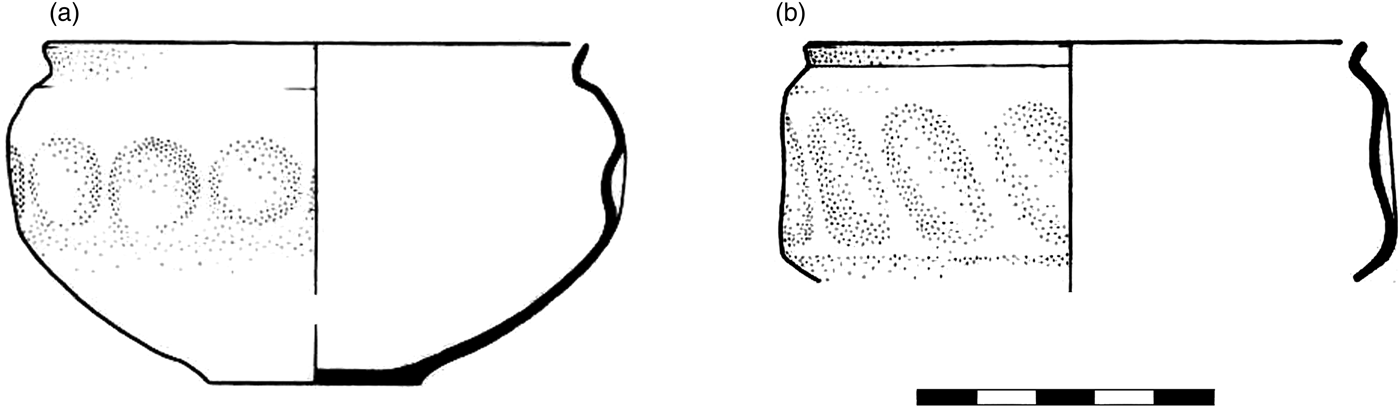
As for the Knidian thin-walled pottery, we might begin with the seemingly most intractable vases, two cups with thumb indentations: UM C1 nos 81–2 (Fig. 1a , b ). At Knidos, the probable manufacturing centre, mass production does not seem to have started before the reign of Claudius (Kögler Reference Kögler2010, 349), though Kögler claims an Augustan/Tiberian inception date for the type (Kögler Reference Kögler2010, 348). This seems too early, judging from the evidence presented above. It is certain that, at Knossos, the type is not found before whatever date we append to Deposit UM C1. Possibly, if early examples there are at Knidos, they were not exported to Crete. A published parallel is from Cosa (Marabini Moeus Reference Marabini Moeus1973, 238 no. 434). This vessel is dated to the Claudian era or even later. At Hofheim the type occurs only once in the Claudian level of the camp and is entirely absent during the Flavian occupation. One example from the UM excavations found in a Hadrianic deposit may possibly indicate an attenuated survival into a much later period, though this appears unlikely, since the deposit in which it was found was a levelling fill which by its very nature would include much earlier material. Thumb impressions on the body wall seem to belong to the second half of the first century ad on other shapes (EAA ii, pl. 83 nos 11–13), strengthening the probability that our cups belong in the Neronian period – a logical conclusion, perhaps, judging from their excellent state of preservation which would seem to negate any temptation to regard them as residuals.
Bowls from UM C1, nos 81–2.

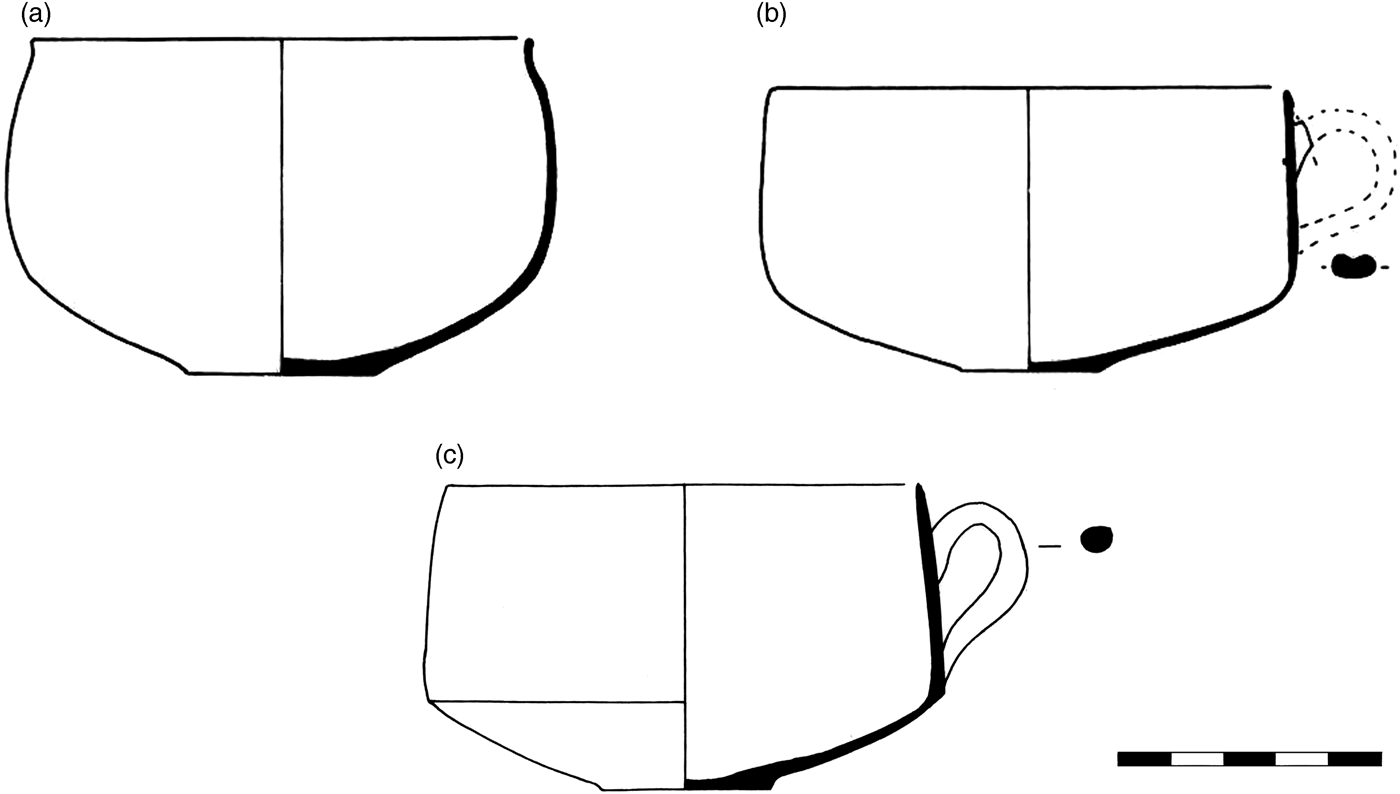
A series of Knidian one-handled cups is rough cast, that is to say, decorated by spreading a sprinkling of sandy grits over the entire surface except for the rim. Two types are represented in our deposit. The first (Fig. 2a ) is almost hemispherical, but with a vertical upper wall. Four similar examples were found (Sackett Reference Sackett1992, 201 nos 79–80): the second has a rounded carination (Fig. 2b ) and looks forward to an indisputably Neronian type (Sackett Reference Sackett1992, N1 no. 21, see pl. 157). On page 212 of Sackett Reference Sackett1992, no. 20 is said to be identical to this. Two other fragments of carinated cups were found in UM C1. It might very well be that the two types are contemporary and are merely the products of different workshops, but I would prefer to see this bifurcation as reflecting a period of transition from a hemispherical form to one with a sharp carination at Knossos. By the recognisably Neronian UM N1 deposit, the evolution is complete (Fig. 2c ). This period of flux is most easily dated to the period ad 50–65. The lack of obvious successors at Knossos after Nero could well indicate that this shape is a convenient horizon marker for that emperor's reign (cf. Section III, b). At Knidos, from whence our examples came, carinated forms are said to date as early as the reign of Augustus (Kögler Reference Kögler2010, 74–6, fig. 64). Once again, perhaps, a degree of caution is called for when considering this date bracket, since an overlying deposit dates to ad 75 (Kögler Reference Kögler2010, 74). No hemispherical examples have been noted at that city, implying that the evidence is incomplete. It seems that a high point of production began in the reign of Claudius and continued into that of his successor. At Ephesos, a similar early date is offered for carinated types (Meriç Reference Meriç2002, 150, K392–9). However, the deposit is in a well, a situation which allowed for the migration of these few sherds downwards.
Rough-cast cups from UM C1, nos 76, 78 and N1, no. 21.

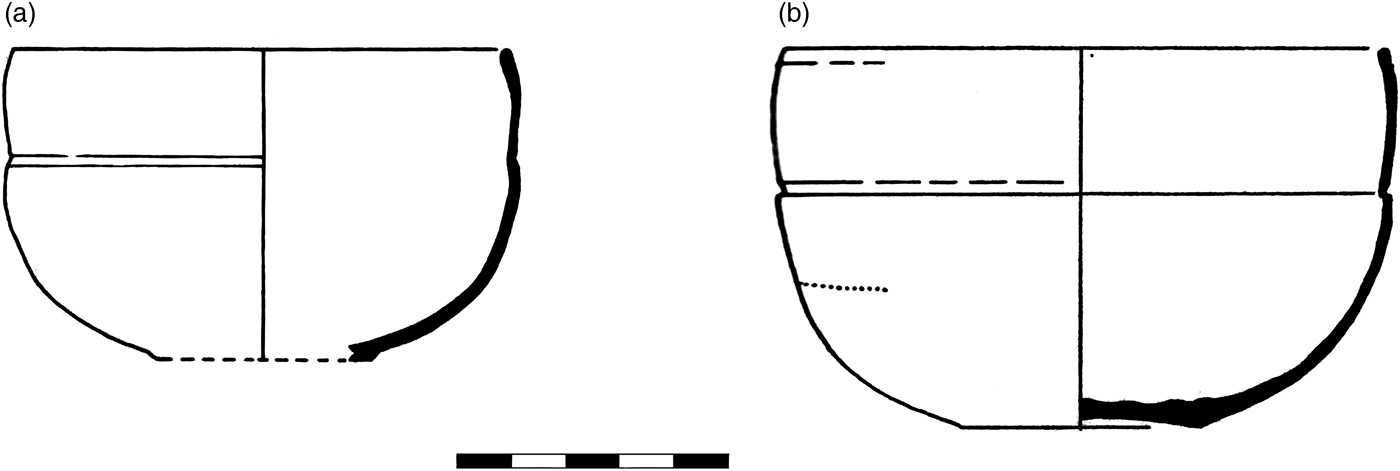
A slight step sideways is now in order. UM Deposit C2 has also been dated to the reign of Claudius (Sackett Reference Sackett1992, 203–10). Among the thin-walled vessels is no. 65, a bowl with a slight change of angle two-thirds up the wall (Fig. 3a ). A direct parallel can be found in the well KW/51/13 (Hayes Reference Hayes1971, 265, fig. 15 no. 22), here illustrated as Fig. 3b . As we shall see below, this latter should also date to Nero's reign; the sharply carinated no. 66 also belongs here (Sackett Reference Sackett1992, pl. 154). Both 66 and 67 are Italian thin-walled types with relief decoration. The pattern of discovery at Knossos implies a probable Neronian date for them (Sackett Reference Sackett1992, 166).
Cups from UM C2, no. 65 and KW/51/13, no. 22.

Little need be said of the lamps. The corpus of 10 from our floor is almost entirely made up of the Ivy-Leaf Group, with only two of the Italian discus type. In the Unexplored Mansion volume they are all said to belong to the Claudian epoch (L102–3, 111, 114, 141, 153, 171, 175, 281, 381, 685). Our re-examination of the associated pottery suggests rather that they are all Neronian. There the matter should rest, but they have been used to date lamps from Knossos (Banou Reference Banou, Di Vita, Livadoti and Simiakaki2004, 903–5) and Kommos (Hayes Reference Hayes, Shaw and Shaw2000, 320) to the middle of the first century ad. At Kommos such a date for the lamps from the main temple dump seems to be too early if my reconstruction of the Roman history of the site is correct (Callaghan Reference Callaghan2014, passim). Wardle (Reference Wardle1972, 274) dates the introduction of the Ivy-Leaf Group to c. ad 50. The evidence from the Unexplored Mansion suggests rather an Augustan date (Catling and Catling Reference Catling, Catling and Sackett1992, 307–8). But in the earlier Julio-Claudian assemblages, they are always accompanied by sub-Hellenistic wheel-made types (Catling and Catling Reference Catling, Catling and Sackett1992, 317). An early date for their introduction would suit the evidence better, since their descent from lamps of the Ephesos types is unquestioned. The latter die out in the first quarter of the first century ad at Athens (Wardle Reference Wardle1972, 274). At Kommos, Hayes notes the absence of the early stages of the Ivy-Leaf Group on the main temple dump (Hayes Reference Hayes, Shaw and Shaw2000, 321). Carington Smith, in an important article that appears to have been overlooked (Carington Smith Reference Carington Smith1982, 255–93), dates a similar group to ad 60–5 or later. Here, at last, the numismatic evidence is conclusive. Two worn coins were found, associated with earlier burials dating to ad 54–5 and thus definitely Neronian (Carington Smith Reference Carington Smith1982, 268). Since the tomb continued in use for perhaps a generation, and since the lamp corpus therein corresponds to the patterns at Knossos and Kommos, we may abandon the ambiguous date of ‘mid-first century ad’, and assign all of the above to the reign of Nero. Unfortunately, other ceramic evidence is absent from this context, so the lamp types must bear the burden of dating the richer deposits discussed above.
As for the amphorae, those that were not illustrated or catalogued are more important for this discussion that those that are. In the Stratigraphical Museum at Knossos (Box 3253) are preserved the handles of three pseudo-Rhodian demi-jars of Marangou Type AC4, whose accepted date for introduction in Crete is the mid-first century ad (Marangou-Lerat Reference Marangou-Lerat1995, 184–9), though forerunners with straightish handles may date as early as the reign of Augustus, even if no massive production is implied (Bezeczky Reference Bezeczky2013, 38–9; 76–7; Di Vita Reference Di Vita2001, 275; Sackett Reference Sackett1992, pl. 127, no. 31). The present pattern suggests a minuscule production and diffusion of a proto-AC4 sometime in the first half of the first century ad (for this pattern of development, see Bezeczky Reference Bezeczky2013, 35 Types a–d). At Ephesos a variant of the type with straightish handles is already present in Phase 4 of the Tetragonos Agora (Bezeczky Reference Bezeczky2013, 77), but bowed handles are only found in Bezeczky's Types c–d, which date later. Together with these are examples of four or five amphorae whose broad strap handles describe an acutely angled profile: I have elsewhere suggested that this is a Neronian innovation (Callaghan Reference Callaghan2014, 330).
One angled-handled amphora from Ephesos (Meriç Reference Meriç2002, pl. 42, K514) comes from a context pre-dating the reign of Claudius (fill B1): another migrant from above in the well-fill? By contrast, a deposit in Padua dated to around the mid-first century ad, contained 36.5% of AC3 amphorae. Unfortunately, I have not been able to ascertain whether or not they possessed sharply angled handles, but the fuzziness of the date renders this lack of little consequence here (Peña Reference Peña2011, 343).
A kiln site at Loutra has been dated to the Late Hellenistic period (Tsatsaki and Nodarou Reference Tsatsaki and Nodarou2014, 287–95). The characteristic amphora type possesses sharply angled handles, which would be quite out of place at such an early date. Certainly, the published associated pottery must be earlier than the jars. In addition all three illustrated examples have a characteristic internal thickening of the rim, a feature shared by Hayes Reference Hayes1971, pl. 39 no. 52, which I have redated to the reign of Nero (Callaghan Reference Callaghan2014, 330), and by a stamnos excavated behind the Stratigraphical Museum at Knossos by Warren. This last was found in a group together with lamps which we might date to the reign of that emperor (Warren, pers. comm.). I would suggest that the Loutra kiln was positioned among the ruins of a derelict Late Hellenistic farm complex, possibly to shelter the furnace from the worst of the strong winds that plague the vicinity. In a similar fashion a Minoan kiln at Kommos was sheltered by the ruined back wall of the South Stoa of Palatial Building T (Shaw Reference Shaw2001, 8). Anyone who has suffered the daily gales on the site would understand the desire of the potters to escape the stinging sand blasts which are a feature of this weather pattern. Indeed, such is the force of these wind-blown particles that vases exposed to them on the main temple dump possessed heavily eroded surfaces (Callaghan Reference Callaghan2014, 324). The Hellenistic pottery from Loutra would then only date the farmyard complex, the kiln itself being much later.
Finally, we should note that Banou's Knossian deposit, mentioned above, has many points of similarity to our UM C1 deposit, but with the important difference that it contains several forms that certainly date to the reign of Nero.
II. Well MW/58–59 (Hayes Reference Hayes1971, 257–63)
The fill of this well consists of two distinct groups. The lower seems to belong to the late first century bc; the upper is described as Claudian or slightly later. We need note here only three vases: the Dish no. 13 is ESB1 of a type found in UM, C1 no. 21. A pseudo-Rhodian amphora with strongly bowed handles (Hayes Reference Hayes1971, pl. 39a) is also present. Although this is not a demi-amphora of Marangou-Lerat's AC4 type, we might assume that the two types developed in tandem; thus a date pre-ad 50 is to be considered unlikely. The Italian thin-walled grey ware bowl (Hayes Reference Hayes1971, 259 no. 15) is of a type whose history goes back to the Augustan period, but vases of this ware do not appear at Knossos until the Neronian period (Sackett Reference Sackett1992, 166). The closest parallels for the amphora are to be found in the Neronian deposit N1 of the Unexplored Mansion (Sackett Reference Sackett1992, pl. 159 no. 47) and the Flavian deposit F2 (Sackett Reference Sackett1992, pl. 168 nos 39a and b). The Neronian group includes no. 48, which is far more conservative, possessing straight handles as the Augustan A2, no. 101 (Sackett Reference Sackett1992, pl. 135). We might surmise either that this is a survivor in reuse or, more likely, that the change to strongly bowed handles on Cretan copies of the Rhodian type took place around the time of Nero. In this regard note especially the Loutra example (Tsatsaki and Nodarou Reference Tsatsaki and Nodarou2014, 295, fig. 20), a straight-handled jar found in what I regard as a Neronian context. For the above reasons we must call into question Eiring's date for a handle of bowed type (second to first centuries bc – Eiring Reference Eiring, Coldstream, Eiring and Foster2001, 129, fig. 3.19d); his thesis finds no support in later Hellenistic deposits from Knossos. Mochlos also provides supporting evidence for a Late Hellenistic type with straight handles (Vogeikoff-Brogan Reference Vogeikoff-Brogan2014, fig. 24.III nos 72–3 and fig. 27.III no. 90). This would imply a tardy response to developments in the true Rhodian sequence, since slightly bowed handles there seem to go back to the early first century ad (Robinson Reference Robinson1959, pl. 3 no. F94; now Hayes Reference Hayes2008, 301, N19:1, first quarter of the first century ad). Both Finkielsztejn and Peña warn against too strong a reliance on amphorae for dating purposes (Peña Reference Peña2011, 61–193; Finkielsztejn Reference Finkielsztejn2004, 283–8), given the abundant evidence for systematic reuse in both the Hellenistic and Roman periods. If Lawall is correct in his assumption that the Pergamon amphora deposit was cleared at one time from demolished storage buildings on the acropolis of that city (Lawall Reference Lawall2002, 315), the wide range of dates for the stamp handles found there would add a further example of reuse on a significant scale. It is possible to posit a riposte, however. When the picture is one of consistent pattern, as above, we appear to be on safe enough ground to construct a relative chronology. The evidence noted above would seem to indicate a Neronian date for this deposit. This is in agreement with the date proffered by Hayes himself, though admittedly the process of selection of material has possibly been too rigorous.
III. Well KW/51/13 (Hayes Reference Hayes1971, 263–70)
Hayes distinguishes two fills for this well: an early phase of the first century bc and a later one of approximately Claudian date. The pottery, however, was not stored by levels and so the division is based on external criteria. For the purposes of this paper, I follow Hayes’ division and cavil only at the exact date for the later material.
There is no need to discuss every vase; I content myself only with a description of those pots which might support a Neronian date for the deposit.
-
(a) Bowl (Hayes Reference Hayes1971, 265, fig. 15 no. 22; Fig. 3a , b ). A deep hemispherical shape with a slight groove approximately halfway up the body wall. This is said to be related to Haltern type 40A, implying an Augustan date. Another was found in the Unexplored Mansion excavations; in Sackett Reference Sackett1992, 208 no. 65, it is correctly said to adhere to Marabini's type xxxvi. The author quotes Cosan examples dating to the reign of Augustus, though the type survives at Cosa into the Claudian period (Marabini Reference Marabini Moeus1973, pl. 30 nos 276–7). We might now add a vase from Camulodunum which has a secure Neronian context (EAA ii, 307, Marabini type xxxvi). The Knossian examples (Fig. 3a ) have a deep profile more in keeping with this later date. Their good state of preservation, despite the thinness of their walls, implies that they should belong with the latest of their associated vases. Of course it may be possible that all these examples may be residual and therefore irrelevant for a Neronian dating, though I would insist that its multiple occurrence in Claudian/Neronian contexts implies a survival of the type into the later Julio-Claudian period.
-
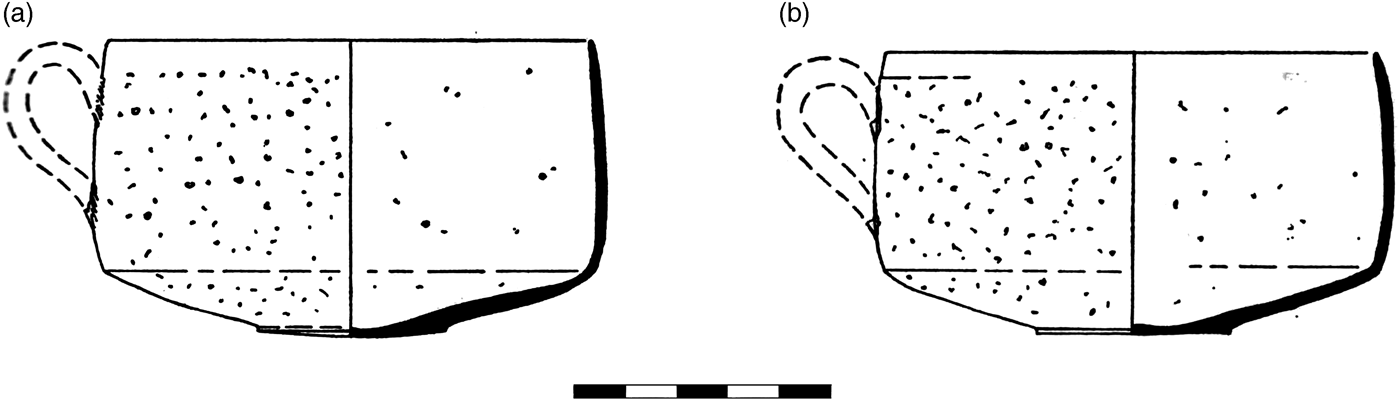
(b) Cup (Hayes Reference Hayes1971, 264, fig. 15 nos 20–21; here Fig. 4a – b ). These should post-date Marabini nos 475–6, also rough cast (Type xlii, pl. 51). This type has been dated to the Claudian/Neronian period, but our examples sport a distinct carination. A direct parallel may be found in Sackett Reference Sackett1992, pl. 157, 21 from a well-dated Neronian deposit. UM deposit C1 seems to mark this transition.
-
(c) Dish (Hayes Reference Hayes1971, 265 no. 19). This is a form in ESB1 that is largely pre-Claudian, and so it is perhaps significant that parallels exist in Well MW/58 (Hayes Reference Hayes1971, 259 no. 13) and the Unexplored Mansion (Sackett Reference Sackett1992, Deposit C1, pl. 143 no. 21). I have argued above that both should date to the first half of the reign of Nero. This conclusion is consistent with the chronology proposed by both authors in the primary publications, which imply a survival of the type into the late Julio-Claudian period.
-
(d) Cup (Hayes Reference Hayes1971, 264 no. 14). Dated to the Claudian epoch or slightly later. The simplified relief-spiral motif suggests this later date (see Consp. 23.2, where the type is dated to the second and third quarters of the first century ad).
-
(e) Transport Amphora (Hayes Reference Hayes1971, 269 no. 52, pl. 39b). When this deposit was published Hayes noted that this was an unknown version of the shape without published parallel. He assigned it to the earlier phase of the well-fill, and it subsequently entered the literature as an Augustan forerunner of Marangou's type AC3 (Marangou-Lerat Reference Marangou-Lerat1995, 83; Tsatsaki and Nodarou Reference Tsatsaki and Nodarou2014, 292), whose assumed chronological position was quite isolated from the main sequence for this class. The true AC3 sequence appears to begin with an example from Tomb 4 in the cemetery at Potamos (Marangou-Lerat Reference Marangou-Lerat1995, 83, fig. 68 no. A123) dating to the second half of the first century ad. This example possesses the characteristic sharply angled handles and a devolved and comparatively small button-base. The handles describe a pronounced bowing out, which is absent on our example. To the same period should belong Marangou-Lerat Reference Marangou-Lerat1995 fig. 68b–c from Pompeii: the latter possesses sharply angled handles whose lower part is severely vertical and unbowed, which matches ours. Since the two fills of well KW/51/13 were inextricably mixed in storage, it is probable that our amphora belongs to the secondary fill dating towards the middle of the first century ad or, as I would have it, the reign of Nero (Callaghan Reference Callaghan2014, 330). This would provide us with a continuous sequence spanning the second half of the first century ad and the whole of the second.
Rough-cast cups from KW/51/13, nos 20–1.

Before we conclude this discussion we should emphasise once again that our jar shares a peculiar internal thickening of the rim with a stamnos associated with lamps of the Claudian/Neronian period from the Stratigraphical Museum excavations (Warren, pers. comm.) and three published amphora necks from Loutra (Tsatsaki and Nodarou Reference Tsatsaki and Nodarou2014, 292–3, figs 9–13). This seems to be a short-lived feature already absent on the Pompeian examples and thus securely dated to the reigns of Nero and perhaps Vespasian.
IV. UM XIV, Pit 4 (Sackett Reference Sackett1992, 192–6)
This deposit was published as part of Deposit B2, a Tiberian layer stratified above A2 (Augustan) and below N2 (Neronian). I here isolate the Pit/Tip and redate it to a point late in the reign of Nero. The material is stored in Box 3247 in the Stratigraphical Museum at Knossos. Obviously it is a later intrusion into the Tiberian level, whose exact date is predicated, in part, by the Neronian stratum above. The Bowl B2 no. 21 is an ESB type 7b (EAA ii, pl. xv no. 11) and first produced in the middle first century ad. It becomes the dating sherd rather than a later intrusion as described in the primary publication (Sackett Reference Sackett1992, 194, B2 no. 21). While it remains true that the vast bulk of the sigillatas date to the Tiberian era, we may note that the Pit/Tip fill consisted basically of much later amphora fragments. Thus we might explain this pattern as indicative of the intrusion of a more advanced group of vases into a Tiberian stratum with a large proportion of fine wares.
-
(a) Stamnos (Sackett Reference Sackett1992, pl. 140, B2 no. 84; SMP 11412.2). This vase, of which only the profile of rim, neck, shoulder and handle are preserved, was inscribed before firing with a series of Xs and strokes which probably represent the vase's capacity (Slane Reference Slane1990, 115 no. C246). The handle is acutely angled and would be quite surprising in a true Tiberian context. It is, however, rather more slender than Warren's jar, found together with lamps whose date cannot be earlier than ad 50/60 (Wardle Reference Wardle1972, 274; Carington Smith Reference Carington Smith1982, 291). Ours, because of its attenuated profile, should be later, but cannot be pushed into the Flavian period as the Pit is overlain by deposit N2, whose sigillatas belong to the period ad 50–75. A date that is close to the end of the reign of Nero is called for.
-
(b) Amphora. The small, devolved, button-base finds its best parallel on the amphora from Tomb 4 at Potamos, which dates to the period ad 50–75 (Marangou-Lerat Reference Marangou-Lerat1995, pl. 18, fig. A123). A very similar base was discovered by Banou (Reference Banou, Di Vita, Livadoti and Simiakaki2004, 889, fig. 7) in what I regard as a Neronian context. By ad 79 the button-base had been replaced by a nippled one (Marangou-Lerat Reference Marangou-Lerat1995, pl. xviii, fig. 6). So a rather tight chronology is possible for these vases, namely ad 50–75.
-
(c) Amphora or stamnos. The surviving handle is acutely angled and the rim is echinoid as with (a) above. There is one other echinoid rim sherd in the deposit, perhaps giving us the characteristic form for this date bracket. All have lost the peculiar internal thickening of the rim, which we have noted on Warren's stamnos (Hayes Reference Hayes1971, pl. 39b no. 52; Tsatsaki and Nodarou Reference Tsatsaki and Nodarou2014, 292–3, figs 9–13). On the basis of the Warren stamnos we might date this latter feature earlier than our examples but still within the reign of Nero.
-
(d) Amphorae: two handles of Marangou's pseudo-Rhodian demi-amphora type AC4. Their introduction is dated to the second half of the first century ad (Marangou-Lerat Reference Marangou-Lerat1995, 87), though the inception of the type seems to be much earlier. One handle is rather more bowed than the other, but both differ radically from the straight, high-horned handles of the first century bc and Augustan periods (Vogeikoff-Brogan Reference Vogeikoff-Brogan2014, fig. 27.III, 90; Sackett Reference Sackett1992, pls 127.A1, 31, and 135.A2, 102; Grace Reference Grace1979, fig. 36). Straight handles also occur in Tsatsaki and Nodarou Reference Tsatsaki and Nodarou2014, 295, fig. 20 and as late as Nero (Sackett Reference Sackett1992, pl. 159 no. 48), where it may be residual given the presence of bowed handles in Robinson Reference Robinson1959, pl. 3, F94, now dated by Hayes (Reference Hayes2008, 32) to the first quarter of the first century ad. However, as noted above in Section II, a delayed response to morphological developments on the true Rhodian jars seems the most likely answer for the parochial pattern evident among Cretan copies of the type.
V. UM Deposit N1 (Sackett Reference Sackett1992, 210–14)
This deposit lies beyond the scope of this article since one could, perhaps, extend the date bracket into the early Flavian period. In particular, we might stress again the importance of a tomb group published by Carington Smith (Reference Carington Smith1982, 255–93) where the lamp corpus is identical to that of UM C1, but where a date bracket extending to cover the whole of the third quarter of the first century ad seems likely. Another tomb group (Wardle Reference Wardle1972, 271–6) is closer to the patterns among the lamps in our deposit: this has been dated, with some reason, to the last quarter of the first century ad (Wardle Reference Wardle1972, 274). In our deposit two coins suggest a date early in the reign of Nero (Sackett Reference Sackett1992, 211 nos 146–7); but evidence from elsewhere shows that coins of hoary antiquity were still in circulation when deposits were laid down. Sackett suggests (1992, 211) that the floor deposit in question was terminated by the known Knossian earthquake of ad 67 (Sackett Reference Sackett1992, 211). Carington Smith's tomb group, where closely datable glass vessels and the coins together suggest a date covering this period, should give us pause. UM N1 may be late in the reign of Nero. The earlier publications strongly argue that the change in fashion from Ivy-Leaf to Discus Lamp types really occurred very late in the reign of Nero, at the earliest.
Among the sigillatas from UM N1, there is practically no overlap with Deposit C1 (Section I above). The majority belong to vases whose main period of popularity lies in the third quarter of the first century ad (Sackett Reference Sackett1992, 211). All the ESB vessels are in transitional B1/2 ware, dated by Hayes to the period ad 40/45 to 70 (Hayes Reference Hayes2008, 32). Italian grey ware appears here for the first time in a secure context, making its absence from the earlier and richer C1 even more glaring. Parallels for the cooking pots are to be found at Pompeii, suggesting a date close to, but preceding, ad 79 for them all. Among the amphorae we find the first secure example of a pseudo-Rhodian type with strongly bowed handles from this excavation (Sackett Reference Sackett1992, pl. 139 no. 47). A more conservative neck (Sackett Reference Sackett1992, pl. 139 no. 48) may indicate that Knossian potters maintained an allegiance to earlier Rhodian prototypes. This possibility is also suggested by the discovery of a straight handle at Loutra in what I regard as a late first century ad context (Tsatsaki and Nodarou Reference Tsatsaki and Nodarou2014, 295, fig. 20). We might, perhaps, regard the pattern as observed above for deposit N1 as indicating a period of transition at Knossos. By the last quarter of the first century ad the bowed handle reigns supreme (Sackett Reference Sackett1992, pl. 168 nos 39a–b), as it does in another Neronian context (Banou Reference Banou, Di Vita, Livadoti and Simiakaki2004, 287, fig. 64 a–b), though this may be somewhat earlier to judge from the lamp fragments.
In summary, there is no difficulty in accepting Sackett's contention that this floor was demolished by the known earthquake of ad 67 (Sackett Reference Sackett1992, 211; Forsdyke Reference Forsdyke1956, 153). If, however, we regard the Wardle and Carington Smith tomb groups as closed deposits, and admit that the lamp patterns in the latter locale parallel those from UM C1, the possibility of a Neronian date for the last seems very seductive. Of the tombs the first was somewhat disturbed by roof fall and tree roots. The second was intact and its doorway was still sealed: it is here that the Neronian coins were found.
CONCLUSIONS
It may seem that a wholesale redating of ‘Claudian’ deposits leaves no room for a Claudian horizon at Knossos. On the contrary, I am not suggesting that there is no Claudian material in this corpus. It is certain that, at least as regards UM Deposit C1 (Section I above), it was installed during that reign. I suggest only that the date of closure should be placed later, during the time of his successor. If, as seems likely, there were two earthquakes (Sackett Reference Sackett1992, 198), we might note the likelihood is that both occurred during Nero's reign.
A Neronian date for the introduction of the sharply angled strap handle on Marangou's Type AC3 amphora would at last bring the archaeological evidence from north and south-central Crete into agreement. Remembering that at Kommos the curved handles seem to have survived into the early part of his reign, there the end of the amphora dump coincides with the resumption in the use of a sympotic range of shapes within the cella at about ad 60 (Hayes Reference Hayes, Shaw and Shaw2000, 313). It follows that jars with gracefully curved handles were continuing to be manufactured until about this date. I would propose that sharply angled strap handles were first introduced c.ad 60. The evidence from Loutra, if my dating of that assemblage is accepted, indicates that the progression outlined above is not a purely Knossian development but one which potentially covered the whole of Crete. This argues against any tendency to regard the Kommotian amphorae as products of a local Messariot tradition, both provincial and conservative. Indeed, one amphora from Kommos adheres to the later type (Shaw and Shaw Reference Shaw and Shaw2000, pl. 4.67 no. 46), proving that the form was known there. Unfortunately, it was discovered in sand near one of the altars, and so is virtually without context. We might note, however, that this area was kept clean of sand build-up for the whole of the amphora period at the site (Callaghan Reference Callaghan2014, 324), and thus the probability exists that this vessel belongs within the final period of use in the Sanctuary, that is to say post-ad 60/70.
At Knossos, our cluster of ‘Claudian’ deposits might be seen to be a result of the earthquake of ad 67. Proving earthquakes is always difficult, as is the assumption that various similar deposits are strictly contemporary. All we can say is that there does appear to have been dislocation at about this time in widespread areas of the city. I leave it to the reader to decide whether this disruption should be dated the reign of Nero.
Finally, the combined Knossian evidence suggests that a real revolution in both ceramic vessels and lamps occurred in the second half of Nero's reign, arguing against a tendency to make divisions strictly in accordance with a change of emperor.
ACKNOWLEDGEMENTS
I wish to thank Hugh Sackett for giving me permission to re-examine the Julio-Claudian deposits from the Unexplored Mansion excavations. The British School at Athens gave me leave to republish the drawings from previous excavations which appear in this article. The two anonymous referees examined the manuscript with a thoroughness that led me to make various changes which have strengthened my arguments. Any remaining errors are mine. Doniert Evely typed up the final text and guided it through the process of publication. Finally I must acknowledge the input of Conor Trainor, who provided references and swung the conversation at dinner away from Bronze Age archaeology to that of the Roman period.