Introduction
New and emerging diseases present new health challenges to humans, their animals and wildlife around the globe (Dazak et al., Reference Dazak, Cunningham and Hyatt2000; Woolhouse, Reference Woolhouse2002). Many of these infections are transmitted by arthropods. The emergence of West Nile virus (WNV) as a significant vectorial disease in North America illustrates how dramatically such diseases can spread between continents. Since 1999, when WNV was first identified in the USA in New York and Maryland, it has spread 7,923,215 km2 across the country resulting in over 16,616 infected people and more than 664 deaths (http://www.cdc.gov/ncidod/dvbid/westnile/qa/cases.htm).
The recent suggestion that WNV is present in migrant and non-migrant birds in two English counties (Buckley et al., Reference Buckley, Dawson, Moss, Hinsley, Bellamy and Gould2003), together with the lack of human deaths (Department of Health, 2004) from this disease, suggests that, if transmission occurs in the UK, it is presently solely from bird-to-bird. Nonetheless, since the ecology of the UK is changing rapidly, largely due to changes in land use as well as climate change (Doody, Reference Doody1990; DEFRA, 2001), there may be new opportunities for the virus to become transmitted to humans and other mammals. Such events could represent a threat to the health of people, their domesticated animals and wildlife, resulting in anxiety of communities living close to mosquito-breeding sites. There are also major cost implications for the control of any disease outbreak. In New York alone, $3 million was spent on disease control in the first year of the WNV outbreak.
Recent attempts to estimate the threat from vector-borne diseases in the UK (Lindsay & Thomas, Reference Lindsay and Thomas2001; Rogers et al., Reference Rogers, Randolph, Lindsay, Thomas and Maynard2001) has exposed serious gaps in our knowledge about the distribution, relative abundance and seasonality of mosquitoes in this country. This lack of information seriously reduces our ability to predict the risk of all major human and veterinary vector-borne diseases in the UK. At present, range maps of insect vectors largely reflect the distribution of entomologists, rather than where the vectors actually occur (Snow et al., Reference Snow, Rees and Bulbeck1998). Many of these are also out of date, with some nearly 90 years old (Lang, Reference Lang1918). Recently mathematical models have been used to capture the climate envelopes of vector-borne diseases or the vectors themselves and to create distribution maps (Lindsay & Thomas, Reference Lindsay and Thomas2001; Rogers et al., Reference Rogers, Randolph, Lindsay, Thomas and Maynard2001). However, none of these models have been validated by field surveys of biting insects, so we do not know whether they are accurate or not.
As the UK has many possible vectors of WNV and other arboviruses including the principal vector in Europe, Culex pipiens, a program of mosquito surveillance, supported by the Department of Health, was carried out during 2002. This pilot study was designed to catch as large a range of mosquitoes as possible to provide baseline data on mosquito diversity and activity in a range of different habitats in central and southern England. This allowed us to assess the catching efficiency of two traps used commonly to collect mosquitoes in the USA: the CDC (Centre for Disease Control, Atlanta) light trap (Miller et al., Reference Miller, Stryker, Wilkinson and Esah1969; Magnarelli, Reference Magnarelli1975; Emord & Morris, Reference Emord and Morris1982; Reiter et al., Reference Reiter, Jakob, Francy and Mullenix1986); and MosquitoMagnet® (American Biophysics, Rhode Island, USA). This is the first large-scale evaluation of their ability to trap mosquitoes in the UK.
Methods
Field sites
Mosquitoes were collected from sites in four different habitats: an urban site (Chadwell Heath, 51°35′00″ N, 00°12′00″E); deciduous woodland (Epping Forest, 51°39′00″N, 00°03′00″E); saltmarsh (Isle of Sheppey, 51°23′00″N, 00°48′00″E); and freshwater marshland (Wicken Fen, 52°18′00″N, 00°18′00″E) from June to September 2003 (fig. 1). Chadwell Heath is a densely populated area with many small gardens situated to the east of London. Epping Forest comprises 2400 ha of mature mixed deciduous and coniferous woodland close to London. The forest is visited by thousands of people during the summer and has many horse stables around its borders. Elmley reserve on the Isle of Sheppey is the largest (1240 ha) remaining grazing marsh in the southeast of England. Wicken Fen comprises over 350 ha of fresh water fenland. These sites were selected on the following criteria: (i) each habitat was likely to support a distinct and diverse range of mosquito species; (ii) they were located in central and southern England, the warmest parts of the UK and, therefore, the region most likely to be at risk from WNV; (iii) the wetland sites held high numbers of resident and migratory birds and, therefore, were considered to be sites likely to be at greatest risk from WNV; and (iv) they were all situated close to human habitation or had large numbers of people visiting the area, sites that had the potential for WNV to spill over to the human population.
Location of study sites.

Mosquito sampling
Two carbon dioxide (CO2) baited traps, CDC (Lines et al., Reference Lines, Curtis, Wilkes and Njunwa1991) light traps and MosquitoMagnet® Commercial Pro traps, were used for sampling mosquitoes at each site. The CDC trap was suspended with the fan 1.5 m from the ground and baited with CO2 from a gas cylinder (British Oxygen Company, BOC, discharged at 0.5 l min−1). Traps were placed at least 100 m apart. A small light attracted mosquitoes at close range that were then sucked into a collecting net by a rotating fan. Traps were powered by 6 v gel batteries (6V-10AMP Powercell gel battery, J Perkins Distribution Ltd). MosquitoMagnet® traps attract mosquitoes using CO2, water vapour and heat (Taverne, Reference Taverne2001). An additional bait sachet, 1-Octen-3-ol (Octenol), was placed in the output pipe with a release rate of 0.5 mg h−1. The MosquitoMagnet® is a counter flow trap where the air flow is bi-directional, blowing out baited heated air from a central pipe and sucking in air and flying insects from a surrounding larger pipe. Specimens are prevented from escaping by the constant air current passing through the net in the trap. Each trap is powered by a propane gas cylinder (BOC, 23 kg) and the trap converts the gas into warmed CO2, which is released at a rate of 350 ml min−1.
Gas cylinders were replaced weekly with CDC light traps and every eight weeks for MosquitoMagnet® traps. MosquitoMagnet® traps weigh 20.5 kg without the gas bottle and CDC light traps weigh approximately 2 kg. The dimensions of MosquitoMagnet® traps are 1 m (high)×550 mm×250 mm, CDC light traps are 500 mm×300 mm long. Costs per unit are currently £1100 for a MosquitoMagnet® trap and £100 for a CDC light trap.
Traps were run from dusk (approximately 19:00 h) to dawn (07:00 h) at all sites from Monday to Thursday and emptied daily each morning. Collections were made in all sites from June to September 2003, except at Chadwell Heath where traps were operated from August to October 2003. At each site, a field worker started and stopped the traps, charged the batteries and emptied the collection chambers of each trap. Samples were stored at 4°C, collected weekly and identified to species in the laboratory.
An additional study was carried out to determine whether the height above ground of a CDC light trap affected the number of mosquitoes caught. This was carried out in a wooded garden in Frinton-on-Sea (51°49′ 58″N, 01°14′ 43″E) between 29th June and 15th August in 2004. Three light traps were operated from a mature oak tree (Quercus robur) suspended with the top of the trap 1, 2.5 and 5 m above ground level.
Statistical analysis
Data were analysed using SPSS software. Mosquito counts were transformed using ln or log10 (n+1) to normalize the data. Independent t-tests were used to investigate any difference between overall catch between trap types. A full factorial model was used to assess important sources of variation in catches. Main effects and interactions between factors were used in the model. Regression analysis was used to explore the relationship between trap catches between the two types of trap. Differences between CDC light trap data at different heights were studied using non-parametric statistics (Kruskal-Wallis test) since these data were not normally distributed.
Results
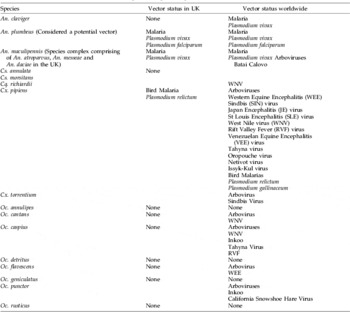
A total of 5414 mosquitoes were collected during the study, consisting of 16 species, almost half of the total species list for the UK (table 1). Coquillettidia richardii (23%) was the most abundant mosquito collected, followed by Anopheles claviger (22%). An. claviger, Culiseta annulata (19%), Cx. pipiens s.l. (7.3%), Cx. torrentium (4.5%) and An. maculipennis (1.9%) were found at all sites. The potential of each species to be a disease vector is summarized in table 2.
Collections from CDC light traps (CDC) and Mosquito Magnet® (MM) traps from June–September 2003 at sites in central and southern England.

* An. maculipennis s.l. comprises three species in UK: An. atroparvus, An. daciae and An. messeae (Linton et al. Reference Linton, Lee and Curtis2005).
Possible or actual vectorial status of mosquitoes caught in traps.

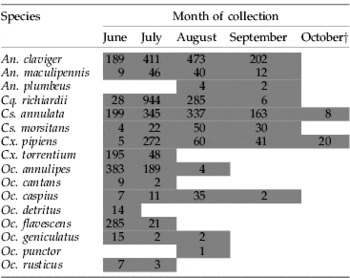
The number of mosquitoes collected varied according to site, day of collection and trap type (ANOVA, p<0.001). Wicken Fen had the greatest diversity of mosquitoes (13 species) and provided 66% (3576/5414) of specimens collected. The greatest numbers of mosquitoes collected were in July and August, whilst the largest numbers of different species were trapped in June (n=14, table 3). Our data show that, in general, mosquito numbers were low in June, but rose rapidly in July and August, before declining in September (table 3). Few mosquitoes were active at the end of October. However, there were three exceptions to this general trend, with Oc. annulipes, Oc. flavescens and Cx. torrentium occurring in greatest numbers in June whilst An. plumbeus and Oc. puntor were only collected at the end of the survey period.
Seasonality of mosquito collections.

† October results are for the urban site Chadwell Heath only. In June and July, no collections were made in the urban site. Grey boxes show months when species were present, as a guide to their seasonality.
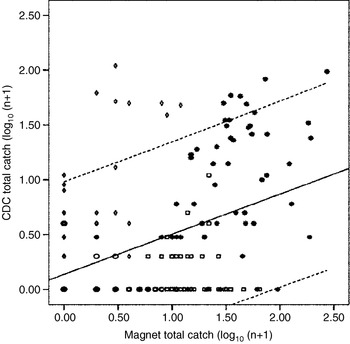
Light traps collected 11 species of mosquito, whilst MosquitoMagnet® traps caught an additional five species, including all those represented in the light traps. Species only collected using MosquitoMagnet® traps were Ochlerotatus punctor, Oc. cantans, Oc. rusticus, Oc. detritus and An. plumbeus. The MosquitoMagnet® trap collected considerably higher numbers of mosquitoes than the CDC light trap, catching 2.7 times the number caught by CDC light traps (F=42.7, df=1, P<0.001). Magnet traps seemed particularly good at trapping low numbers of individuals when CDC light traps caught none (fig. 2).
Regression of catches with CDC light traps against Mosquito Magnet traps for four locations. □, Epping Forest; ⋄, Isle of Sheppey; ●, Wicken Fen; ○, Chadwell Heath; dashed lines show 95% confidence intervals; log10 (n+1).

An analysis of the daily collections of Cx. pipiens s.l. showed that more mosquitoes were collected at 5 m than at either 1 or 2.5 m. There was a between-group difference for females trapped at different heights (χ2=6.1, df=2, P<0.05). Using the multiple comparison test LSD, a significant difference was seen between the number of females caught in the 5 m trap and those at either 1 or 2.5 m. There was no difference between the 1 and 2.5 m traps for females, or between any of the heights of trap for male catch (fig 3).
Trap catches of Culex pipiens using CDC light traps at three different heights over 27 nights, June–August. Error bars show 95% confidence intervals;  , female;
 , male.

Discussion
Many of the mosquitoes trapped during this survey are capable of transmitting WNV (Medlock et al., Reference Medlock, Snow and Leach2005), particularly Cx. pipiens s.l. and Cq. richiardii. These, and several of the other species trapped, can also vector several arboviruses. The evidence that WNV may be transmitted by mosquitoes between birds is controversial. The Health Protection Agency of the UK started a bird surveillance program, which tests dead birds for the presence of WNV, in April 2006. From April to June 2006 all 113 tested were negative for the presence of WNV virus (Veterinary Laboratories Agency, 2006). Since the initial report of WNV antibody-positive birds in Dorset and Cambridgeshire (Buckley et al., Reference Buckley, Dawson, Moss, Hinsley, Bellamy and Gould2003) there has been no confirmatory evidence that WNV is present in the UK. Antibodies against Sindbis virus, Usutu virus and Tahyna virus have also been detected in resident birds, suggesting that viruses are being transmitted between birds by ornithophilic mosquitoes in the UK (Gould et al., Reference Gould, Higgs, Buckley and Sergeevna Gritsun2006). Whilst An. claviger, An. messeae and An. atroparvus are able to transmit vivax malaria (Marshall, Reference Marshall1938) and An. plumbeus is capable of transmitting both vivax and falciparum malaria (Eling et al., Reference Eling, van Gemert, Akinpelu, Curtis and Curtis2003), the risk of malaria being transmitted to the public by English mosquitoes is considered to be extremely low (Rogers et al., Reference Rogers, Randolph, Lindsay, Thomas and Maynard2001). Both CDC light traps baited with CO2 and MosquitoMagnet® traps collected a large number and a wide variety of mosquito species during this survey. Whilst Wicken Fen was a particularly rich site for mosquitoes, people who visit the Fen rarely complain about being bitten during the day. The traps used here were run from dusk to dawn when most people have left the reserve, which would explain the high numbers of mosquitoes but low number of complaints.
MosquitoMagnet® traps collected a wider number of species (16 vs 11) and more specimens than did the CDC light traps (3938 vs 1476). MosquitoMagnet® traps were probably better at sampling mosquitoes than light traps because the MosquitoMagnet® trap produces warmed CO2, octenol and water vapour, whilst light traps only release CO2 (Takken et al., Reference Takken, Dekker and Wijnholds1997; Clements, Reference Clements1999). On the Isle of Sheppey, the only site where CDC light traps caught more than MosquitoMagnet®, both magnet traps were operated in open pasture, whilst the light traps were hung from trees in a small orchard. It may be that the low catches of mosquitoes from the MosquitoMagnet® trap was a consequence of the strong winds encountered on the marshland, compared with the more sheltered orchard.
Both trapping methods are likely to be a considerably more efficient way of sampling mosquitoes than either larval surveys or resting searches. For example, we spent more than three years collecting the aquatic stages and adult mosquitoes on the Isle of Sheppey using visual sampling methods. Whilst no Oc. flavescens were collected during those surveys, we caught several hundred using MosquitoMagnet® traps.
Both types of traps are best suited to different environments. Biophysics, the manufacturers of MosquitoMagnet® traps, state they are most effective in an open environment away from buildings and vegetation that would disrupt the odour plume. Whilst this may maximize the odour plume, placement of these traps too far from hedges, forest or shrubs reduces the catch in the UK. Magnet traps are approximately four times as large and over ten times as heavy as CDC light traps and, therefore, cannot be sited as easily as the lighter more portable CDC traps. All CDC light traps were hung from trees and, thus, would be more likely to attract mosquitoes such as Cx. pipiens pipiens, which feed predominantly on birds in the tree canopy (Marshall, Reference Marshall1938). This can be seen with the increased catches of female Cx. pipiens s.l. at traps placed 5 m off the ground compared with those placed at 2.5 and 1 m. These findings also suggest that females of the species are more abundant in the tree canopies than are males.
MosquitoMagnet® traps are robust in construction, being able to take rough handling and transportation. They also require no electrical power source, as all power is derived from the propane gas, and the collection bag is contained within a waterproof housing, preventing the catch from becoming wet and difficult to identify, which was often the case with the CDC light traps. MosquitoMagnet® traps can run continuously for eight weeks off one bottle of propane. However, the MosquitoMagnet® traps used in this survey cost £1100 per unit compared with £100 for a light trap with the necessary regulators, batteries and chargers. The other problem with MosquitoMagnet® traps is their long-term reliability. Over 50% of MosquitoMagnet® traps (9/18) stored over winter within an unheated, dry building failed to work the following season and had to be returned to a dealer for repair. The two most common problems with these traps were their failure to ignite, so no power could be generated, and the failure of the fan to operate, thus preventing any output of odour or suction. Another problem with these traps is transporting and exposing field sites to large containers of a highly flammable gas. Although no problems were encountered with gas during the surveillance, much reassurance was needed before the MosquitoMagnet® traps could be placed in the field, especially in the urban site where there were young children. More recently, American Biophysics has made improvements to their traps and the ignition system, which gave particular problems during this study, has been completely changed and is now an electronic system which should improve start up. Many other companies have also started to produce similar types of traps. These include the Mega-Trap™ Ultra (EnviroSafe Technologies, NZ), The Dragonfly (Agricultural Research Service and BioSensory Inc, USA), Mozzie Slayer Trap (Bantix Worldwide Pty Ltd, Australia) and the SkeeterVac (Uniflame, USA). Individual traps are likely to vary in their attractiveness to different species of mosquito. None of these new traps have been designed specifically for British mosquitoes and, without field trials, their relative merits and faults can only be guessed. Thus, until further research has been undertaken, we would recommend CDC light traps for routine surveillance work in the UK.
It should be noted that both traps in this study caught blood-seeking females, not blood-fed mosquitoes. Whilst this is sufficient for many surveys, it is not the best method for maximizing the chances of collecting a WNV-infected mosquito. Many female mosquitoes trapped will be searching for their first blood meal after eclosion. To detect active virus, females that have blood-fed and developed an egg batch provide a much greater probability of testing positive, due to the time the virus has had to replicate in the mosquito. Such females may be best sampled using gravid traps (Reiter et al., Reference Reiter, Jakob, Francy and Mullenix1986; Mans et al., Reference Mans, Yurgionas, Garvin, Gary, Bresky, Galaitsis and Ohajuruka2004). Future surveys should consider using a combination of CDC light traps and gravid traps to maximize the chance of detecting mosquitoes infected with arboviruses.
Acknowledgements
This work was funded by the Department of Health. We would like to thank two anonymous referees for their helpful comments and Adrian Colston (Wicken Fen), Steven Cox (Chadwell Heath), Jeremy Dagley (Epping Forest) and Alan Johnston (Elmley RSPB, Isle of Sheppey) for their help with running the traps.