The physiologically maintained high and constant body temperature over fluctuating environmental conditions, endothermic homeothermy, has evolved independently in mammals and birds and has been considered responsible for their ecological success (Brashears et al. Reference Brashears, Hoffman and DeNardo2017, Lovegrove Reference Lovegrove2017, McNab Reference McNab1978). The high core temperatures of endothermic homeotherms, typically 33–38°C for mammals and 38–42°C for birds, provide an optimal environment for coordinated biochemical reactions, development of complex neurological physiology, and protection against environmental pathogens (Nespolo et al. Reference Nespolo, Verdugo, Cortés and Bacigalupe2010, Nowack et al. Reference Nowack, Levesque, Reher and Dausmann2020, Preußner et al. Reference Preußner, Goldammer, Neumann, Haltenhof, Rautenstrauch, Müller-McNicoll and Heyd2017, Robert & Casadevall Reference Robert and Casadevall2009, Ruf & Geiser Reference Ruf and Geiser2015). Maintaining such high temperatures is energetically expensive (Hayes Reference Hayes2010; McNab Reference McNab2009), and in times of adverse environmental conditions, high predation pressure, and/or food and water shortages may be too expensive to maintain (Ruf & Geiser Reference Ruf and Geiser2015). Perhaps therefore, many mammals and some birds express temporal heterothermy, a physiological adaptation whereby animals down-regulate their metabolic rate and body temperature to reduce energetic costs (Nowack et al. Reference Nowack, Levesque, Reher and Dausmann2020, Ruf & Geiser Reference Ruf and Geiser2015). Daily heterothermy and reduction of body temperature during inactive phases of circadian activity cycles can be advantageous when high energy demands of endothermic homeothermy cannot be met (Refinetti Reference Refinetti2020). However, for many wild mammals it is currently unknown if, and to what extent, their body temperature fluctuates in their natural environments. Evidence shows that high fluctuations in ambient temperature and food resources induce expression of daily heterothermy (Boratyński et al. Reference Boratyński, Iwińska and Bogdanowicz2018, Bozinovic et al. Reference Bozinovic, RuÍz, Cortés and Rosenmann2005, Nespolo et al. Reference Nespolo, Verdugo, Cortés and Bacigalupe2010), including a laboratory study on the gerbil, Gerbillus pussilus, a resident of arid habitats (Buffenstein Reference Buffenstein1985). Due to foreseen complex interactions among environmental factors in determining physiology (Bastos et al. Reference Bastos, Pradhan, Tarroso, Brito and Boratyński2021, Boyles & Warne Reference Boyles and Warne2013), it is important to report cases of observed daily temperature changes in wild animals to understand mechanisms behind heterothermy (Geiser Reference Geiser2021a).
Here, we report night and day body temperatures in nine individuals belonging to three Gerbillus species of the Muridae rodents (Figure 1; Table 1). Animals were live captured by hand-held nets, in the Lower Drâa Valley in southern Morocco, between the 18th and 31st of October 2021 (Table S1). After capturing animals were transferred to individual cages (40×30×20 cm) containing local sand and cardboard pieces for nesting material and kept without food and water under natural photoperiod conditions. After 30 minutes of acclimation, air and body temperatures were measured (between 22:30 and 05:30, local time for the study period) with thermometer (0.1°C; Hanna Instruments) equipped with a thermistor (BIO-BRET-3, BiosebLab Instruments), inserted 1 cm in rodents’ rectum for 5 seconds. Air and body temperatures were measured for the second time 2–6 hours after sunrise (between 07:30 and 08:00), during resting phase of daily activity cycles of those nocturnal mammals (Geiser Reference Geiser2021d, Geiser & Baudinette Reference Geiser and Baudinette1985, Time and Date AS 2022). After temperature measurements animals’ weight and body dimensions were recorded. Species identification was performed based on morphology (body dimensions, pilosity of the hind feet soles, and fur colouration) in the field, later confirmed with cytochrome b gene phylogeny (Bouarakia et al. Reference Bouarakia, Denys, Nicolas, Tifarouine, Benazzou and Benhoussa2018, Bryja et al. Reference Bryja, Meheretu, Boratyński, Zeynu, Denys, Welegerima, Bryjová, Kasso, Kostin, Martynov and Lavrenchenko2022, Ndiaye et al. Reference Ndiaye, Chevret, Dobigny and Granjon2016).
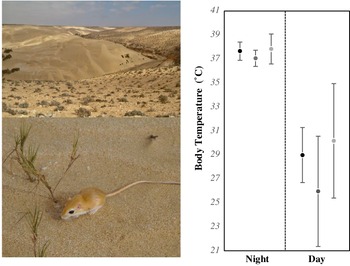
Specimen of the lesser Egyptian gerbil (Gerbillus gerbillus) captured near estuary of Oued Aoreora (Morocco; pictured). Averages of nocturnal (closed) and diurnal (open circles) body temperatures (±SD, °C) of three gerbil species: G. gerbillus, G. amoenus, and G. sp.1. (Table S1). Gerbillus sp.1 refers to a species endemic to Morocco that has not yet been formally described (Ndiaye et al. Reference Ndiaye, Bâ, Aniskin, Benazzou, Chevret, Konečný, Sembène, Tatard, Kergoat and Granjon2012, Reference Ndiaye, Chevret, Dobigny and Granjon2016). Photographs: credits to Zbyszek Boratyński.

Body temperatures (Tb) and daily heterothermy level (intra-individual temperature change) between night (Tb1) and day (Tb2) in Gerbillus species (G. gerbillus, G. amoenus, and G. sp.1 (Ndiaye et al. Reference Ndiaye, Bâ, Aniskin, Benazzou, Chevret, Konečný, Sembène, Tatard, Kergoat and Granjon2012, Reference Ndiaye, Chevret, Dobigny and Granjon2016).

During daytime, seven out of nine gerbils expressed torpor: body temperature <33°C (Tables 1 and S1). Individual body temperature changed between night and day, in average (±SD) by 8.7 (±4.2) for G. gerbillus, 11.1 (±3.0) for G. amoenus, and 7.7 (±3.3)°C for G. sp.1 (Figure 1). Body temperature might not be the best measure of torpor, its decrease is indicative of down-regulation of metabolic rate in mammals (Geiser Reference Geiser2021d). The high temperature change between active (night) and resting (day) phases of circadian rhythm was observed despite lack of strong behavioural suppression; all animals intended to bite or/and escape (upon release or handling for further study). It has to be stressed that our measurements may underestimate the level of heterothermy as we did not intend to identify the minimum daily temperature, and stress related to handling may induce arousal from torpor and rise in body temperature (Buffenstein Reference Buffenstein1985, Long et al. Reference Long, Vander and Kluger1990, Zethof et al. Reference Zethof, Van Der Heyden, Tolboom and Olivier1994). Level of heterothermy in gerbils can vary depending on ambient temperature and the exact time of measurements (Buffenstein Reference Buffenstein1985); however, these individuals demonstrated a decrease in temperature throughout the night and across different ambient temperature changes (Table S1). Level of heterothermy can also vary seasonally (Geiser Reference Geiser2021c). We surveyed body temperatures during autumn (18–30th of October) when air temperatures and primary productivity are moderate in the region. Consequently, measurements during harsher, summer seasons might indicate wider body temperature variation, and point to differences between species in heterothermy level related to environmental variation and life history strategies.
Mammals expressing high level of daily heterothermy are expected to be found in geographic areas characterised by wide daily temperature variation and wide among-years differences in primary productivity (Bastos et al. Reference Bastos, Pradhan, Tarroso, Brito and Boratyński2021), the environmental conditions typical for the study region (Sarant & McDonnell Reference Sarant and McDonnell2021). Our observations on the three gerbil rodent species inhabiting arid habitats of the Lower Drâa valley, bordering Sahara Desert, corroborate this prediction. Down-regulation of metabolic rate and body temperature in endotherms can be advantageous to survive natural disasters, increasing species chances to persist as environmental conditions become less predictable and more extreme (Geiser Reference Geiser2021b, Lovegrove Reference Lovegrove2019, Nowack et al. Reference Nowack, Levesque, Reher and Dausmann2020, Meehl et al. Reference Meehl, Zwiers, Evans, Knutson, Mearns and Whetton2000). Reporting observations of heterothermy in the wild may therefore stimulate our understanding of which mammalian and bird species could be pre-adapted to survive ongoing climatic changes.
Supplementary material
To view supplementary material for this article, please visit https://doi.org/10.1017/S0266467422000360
Acknowledgements
We thank Ahmed El Hadi and Dr. Hassan Anouzla from the Abdurrahman Al Rakkaz Center for Research and Studies (Laayoune, Morocco), Prof. Abdeljebbar Qninba (Rabat, Morocco), and local community of Aouinet Torkoz (Assa, Morocco) for support during the field work.
Financial support
This work was supported by research grants (FCT: PTDC/BIA-ECO/28158/2017; National Geographic: NGS-53336R-19).
Conflict of interest
The authors report no conflict of interest.
Ethical statement
Animal capture and handling was approved by the General Secretariat of the Department of Water and Forests of Morocco (Decision no.: 28/2021).