Introduction
In the UK in June 2011, 2.56 million people were in receipt of Incapacity Benefit (IB) or Employment and Support Allowance (ESA) (DWP, 2011; ONS, 2011). There were 180 million working days lost to sickness in the UK in 2009, an average of 6.4 days per employee, costing UK businesses £17 billion from replacement costs and lost productivity and a similar amount to the wider economy in benefit payments (CBI, 2010). Sickness absence is a problem across Europe although the proportion of individuals taking sick leave is higher in northern European countries (Gimeno et al. Reference Gimeno, Benavides, Benach and Amick2004). For example, in Norway, disability pension payments (the approximate equivalent of IB/ESA in the UK) cost the state 2.3% of the gross domestic product (Norwegian Department of Finance, 2009). The major cost implications in terms of loss of dignity and social participation (Black, Reference Black2008) should not be overlooked. Reducing sickness absence and the number of individuals dependent on welfare is a government priority (DWP, 2010; Frost & Black, Reference Frost and Black2011). At the same time there has been increasing concern about the number of young people out of work, either unemployed or on IB, as they are likely to contribute to a major proportion of working years lost.
Long-term sickness absence (LTSA) is largely attributable to symptom-based conditions such as common mental disorders and low back pain (Waddell et al. Reference Waddell, Aylward and Sawney2002, Reference Waddell, Burton and Aylward2007; DWP, 2004; Henderson et al. Reference Henderson, Glozier and Holland Elliott2005, Reference Henderson, Harvey, Overland, Mykletun and Hotopf2011; Cattrell et al. Reference Cattrell, Harris, Palmer, Kim, Aylward and Coggon2011), with the former overtaking the latter as the principal cause of LTSA in the UK (Cattrell et al. Reference Cattrell, Harris, Palmer, Kim, Aylward and Coggon2011). Studies that have assessed risk factors for LTSA have most commonly used occupational cohorts and have focused largely on occupational risk factors. Such factors undoubtedly play a role in predicting sickness absence but fewer studies have assessed the impact of individual (non-occupational) risk factors for LTSA (Henderson et al. Reference Henderson, Clark, Stansfeld and Hotopf2012a, Reference Henderson, Richards, Stansfeld and Hotopfb).
Individual employees bring with them past experiences and aspects of personality and temperament that affect the way they experience and respond to their working environment (Culpin & Smith, Reference Culpin and Smith1930). We have previously shown that aspects of temperament, measured at primary school age, predicted being ‘permanently sick or disabled’ 40 years later (Henderson et al. Reference Henderson, Hotopf and Leon2009). The possible role of individual appraisal, including health perceptions and perceptions of the role of work as a risk factor for illness, has been noted by several authors (Doll & Jones, Reference Doll and Jones1951; Karasek & Theorell, Reference Karasek and Theorell1990; Marmot et al. Reference Marmot, Feeney, Shipley, North and Syme1995; Stansfeld, Reference Stansfeld2002) but has been the subject of little systematic research.
Some studies of occupational function have included measures of self-rated health but these have either been cross-sectional or have used self-rated health as an outcome measure (Eriksson et al. Reference Eriksson, von Celsing, Wahlstrom, Janson, Zander and Wallman2008; Staland Nyman et al. Reference Staland Nyman, Andersson, Spak and Hensing2009). The few studies that have used self-rated health as a predictor of subsequent occupational function are limited by methodological issues including small sample size (Selic et al. Reference Selic, Petek, Serec and Rus-Makovec2010; Peterson et al. Reference Peterson, Bergstrom, Demerouti, Gustavsson, Asberg and Nygren2011), recall bias (Selic et al. Reference Selic, Petek, Serec and Rus-Makovec2010) and limited information on actual health problems (Lancee & Ter Hoeven, Reference Lancee and Ter Hoeven2010; Peterson et al. Reference Peterson, Bergstrom, Demerouti, Gustavsson, Asberg and Nygren2011).
In this study we pursued a life-course approach using data from the 1970 British Cohort Study (BCS70). In addition to examining self-rated health as a predictor, we were able to extend the life-course approach by including, uniquely, maternal ratings of an individual's health at age 16. This measure used the same terms as the subsequent self-rated health question. For each of these measures, we also examined the extent to which contemporaneous measures of health explain any association with later LTSA.
Our primary aim was to examine the associations between self-rated health measured at age 30, and maternal ratings of health measured at age 16, with receipt of long-term sickness benefits at age 34. We aimed then to examine the extent to which any associations could be explained by participants' reports of symptoms of depression and musculoskeletal disorders (at age 30) and maternal reports of physical and somatic symptoms (at age 16).
Method
Sample
We used data from the BCS70, a nationally representative cohort of 17 287 live births from 1 week in 1970. The cohort has been described in detail elsewhere (Elliott & Shepherd, Reference Elliott and Shepherd2006) and remains largely representative of the population born in the UK in 1970. Information was obtained from parents and participants at birth and ages 5, 10 and 16. Participant interviews were carried out at ages 26, 30 and 34. Ethics approval was not necessary because this was secondary analysis of existing data.
Outcome measure
At age 34, participants were asked detailed questions about any benefit claims. Benefits systems vary significantly between countries. In the UK, those off work sick for 4 working days in a row are entitled to ‘Statutory Sick Pay’ providing they have made sufficient National Insurance contributions. This is currently £85.85. IB (which is being replaced by ESA) is paid typically to those off work for health reasons for more than 6 months. This is currently a maximum of £105.05 per week. Those in receipt of either IB or Severe Disablement Allowance (SDA) were classified as LTSA. Both IB and SDA are payable to those off work more than 28 weeks, although SDA was discontinued for new claimants in 2001 (Jobcentre Plus, 2007).
Explanatory variables
At age 30, participants were asked to rate their overall health on a simple four-point scale: excellent/good/fair/poor. At age 16, the participants' mothers were asked to provide their overall assessment of their child's health using the same four-point scale. In this study, because of small cell sizes, the mother's rating was collapsed into excellent/good/fair or poor.
Health data were available at age 30. We included four major long-term conditions (diabetes, cancer, epilepsy and asthma) as potential predictors of LTSA. Data on the two most commonly cited health conditions, depression and musculoskeletal symptoms, were also included. Participants were asked a single question regarding the presence of back pain in the previous 12 months and completed the 12-item General Health Questionnaire (GHQ-12; Goldberg & Williams, Reference Goldberg and Williams1988). Cases of psychological distress were those participants scoring ⩾4 on the GHQ-12 (Sproston & Primatesta, Reference Sproston and Primatesta2004).
Data on parental reports of somatic and psychological symptoms were available at age 16. Parents were asked about complaints of headaches and recurrent abdominal pain in their child in the previous year. They were also asked to respond to statements about low mood (‘Your teenager often appears miserable or unhappy’) and anxiety (‘Your teenager is fearful or afraid of new things’) in the previous year with response options: ‘does not apply’, ‘applies somewhat’ and ‘certainly applies’.
Data on social class at birth were derived from the current or most recent occupation of the participant's father. Sex was recorded at birth; highest educational attainment was recorded at age 26.
Statistical analyses
Data were analysed using Stata version 9.2 (StataCorp, 2005). To minimize the possibility that any observed effects were due to continuity between childhood illness and illness in adulthood, we restricted the analyses to those who reported being in work or education or those who were at home caring for children at age 30. Univariable associations with LTSA were calculated. The number (%) classified as LTSA and odds ratios (ORs) with 95% confidence intervals (CIs) were estimated. Using multivariable logistic regression analysis, the association between self-rated health at age 30 and being LTSA at age 34 was calculated (model 1). Model 2 shows the effect of adjusting for psychological distress and back pain at age 30. The mother's rating of the participant's health was introduced in model 3, and in model 4 this was adjusted for reports of psychological and somatic symptoms at age 16.
Sample attrition
Most cohort studies suffer from loss to follow-up. This has been a particular issue for the BCS70 as the follow-up at age 16 occurred during a national teachers' strike (Elliott & Shepherd, Reference Elliott and Shepherd2006). More recently, participation rates have improved. By 2004, 800 participants had died and 451 emigrated. Excluding these and those born in Northern Ireland, those abroad at age 5 and those who never contributed any data at all, 16 875 were eligible to take part in 2004. However, full data were only available on 9656 individuals (57%). The proportion of missing data varied; earlier data were in general more complete than later data – for example, social class at birth was missing for 9% but at age 30 for 46%. To address the problem of missing data, multiple imputation (Sterne et al. Reference Sterne, White, Carlin, Spratt, Royston, Kenward, Wood and Carpenter2009) using the ice function in STATA was performed. This is a principled method of imputation that does not inflate the sample size. All the variables in the study were included in the imputation, which was restricted to those who had neither died nor emigrated by age 34. Ten cycles of imputation were run and measures were stable across these. Parameter estimates from the 10 imputations were estimated using the micombine function.
Results
Of the 16 875 eligible participants, 2770 (16%) were neither caring for a family, students, nor in work at age 30, and were excluded. Multiple imputation therefore produced a complete dataset on 14 105 individuals. One hundred and fifty-six (1.11%, 95% CI 0.95–1.29) were in receipt of work-related benefits at age 34 in 2004.
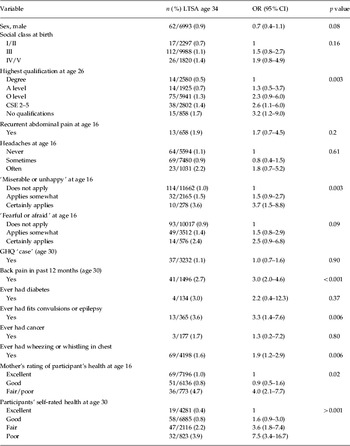
Table 1 shows the univariable associations with being long-term sick at age 34. LTSA was associated with being female and lower educational attainment. Back pain, epilepsy and asthma at age 30, but not psychological distress, were associated with LTSA at age 34. Being identified as ‘miserable’ or ‘fearful’ at 16 was associated with subsequent LTSA.
Univariable associations with long-term sickness absence (LTSA) at age 34

GHQ, General Health Questionnaire; OR, Odds ratio; CI, confidence interval.
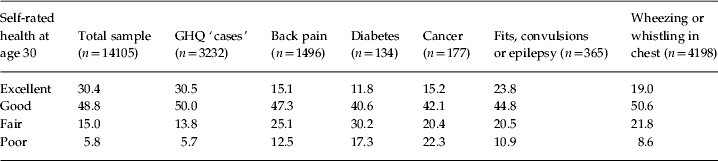
Table 2 shows the spread of responses to the self-rated health question at age 30. In addition to the total sample, the results are shown for cohort members reporting each of the health conditions included as explanatory variables.
Self-rated health at age 30
GHQ, General Health Questionnaire.
Values given as percentages.
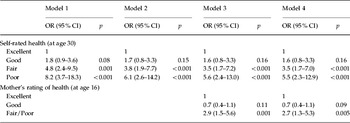
The multivariable analyses are shown in Table 3. All models were adjusted for sex, social class at birth and highest educational attainment. Model 1 shows a marked dose–response relationship between the cohort members' perception of their health, and claiming IB 4 years later. These results are adjusted for health conditions assessed at age 30. There is some attenuation of the effect size, most notably in those reporting the worst health, but a strong association remains. In model 3, model 2 is adjusted for the mothers' reports of the participants' health at age 16. There is a small attenuation in the group reporting the very worst health. Those participants whose mother reported their health to be fair or poor at age 16 had three times the odds of being on IB at age 34 and this was only slightly attenuated following adjustments for maternal reports of psychological and somatic symptoms at age 16.
Predictors of IB/SDA receipt at age 34 in the 1970 British Cohort Study

IB, Incapacity Benefit; SDA, Severe Disablement Allowance; OR, Odds ratio; CI, confidence interval.
Model 1: adjusted for sex, social class at birth and highest educational attainment.
Model 2: model 1 + adult health variables at age 30.
Model 3: model 2 + maternal rating of participant's health at age 16.
Model 4: model 3 + depression/anxiety/headache/stomach ache all measured at age 16.
We repeated our analyses on a dataset containing only those with complete data (data not shown). Self-rated health at age 30 was still strongly associated with the outcome (p < 0.001), although empty cells associated with a smaller dataset made the analysis unstable. Maternal-rated health at age 16 was not associated with LTSA at age 34 in the complete case analysis. A further sensitivity analysis was carried out excluding all those cohort members reporting long-term health conditions at age 30 (data not shown). This made no difference to our results.
Discussion
Our study of people born in the UK in 1970 included only those in work or education or caring for a family at age 30 in 2000. We have shown that self-rated health varies substantially within the population and this variation exists even among those who report having long-term health conditions. Although self-rated health is worse overall, many such individuals report surprisingly good health. Furthermore, no one condition is more predictably associated with worse self-rated health. For example, few participants with diabetes reported their health as ‘excellent’ but also very few reported it as ‘poor’. However, four times the proportion of participants with cancer reported ‘poor’ health compared to the background population.
We have shown that a simple measure of self-rated health was a strong predictor of being in receipt of IB at age 34 and this association was not explained by contemporaneous reports of psychological distress or musculoskeletal symptoms. Those reporting the worst health had the greatest odds of being on IB. A further novel finding was that those participants whose mothers reported their health to be fair or poor at age 16 had 2.7 times the odds of being on IB at age 34 even after adjustment for the mother's reports of psychological and somatic symptoms in her child and self-rated health at age 30.
This study has several strengths. The BCS70 is a nationally representative cohort with rich data on large numbers of people collected over many sweeps. Thus we were able to use contemporaneous data to investigate early life risk factors measured before the participants started work. The questions about health, temperament and benefit receipts were asked as part of a wide-ranging interview, minimizing the potential for information biases.
A key limitation of this study (like many cohort studies) is non-response, especially at age 16. The BCS70 had similar follow-up rates to the National Child Development Survey (1958 cohort) during childhood but data collection at age 16 was affected by the teachers' strike of 1986. Nonetheless, the biases so introduced are minimal (Ferri et al. Reference Ferri, Bynner and Wadsworth2003). We used multiple imputation to deal with missing data but this is unlikely to have provided complete adjustment for non-participation. It is possible that the individuals with the most severe mental disorders (who are known to have high levels of LTSA) are most likely to fail to respond (Knudsen et al. Reference Knudsen, Hotopf, Skogen, Overland and Mykletun2010). Although a large number of possible explanatory variables have been included in this study, there is likely to be residual confounding. Our analyses would be improved were we to have more detailed information on the nature and severity of the health problems reported at age 30. The information on musculoskeletal disorders was especially limited. Given the relative rarity of our outcome, a larger sample size would have allowed us greater power. In addition, our analyses will have incompletely adjusted for the effects of variables we do have. Some of the risk factors we have included will have a variable impact across the life-course and yet we have only been able to include ‘snapshots’ of them. We captured a relatively small window, age 30–34, in the lives of the cohort members. Finally, it should be noted that, although the data are representative of those born in 1970, they are less representative of the current population, which is, for example, more ethnically diverse.
The most striking finding of this study is the role played by the overall perception of the participant's health by the mother at age 16 and by the participant at age 30. It is important to recognize that the question asked was a simple one, that our data have been restricted to those in work, education or looking after a family at age 30, and have been adjusted for a wide range of potential confounding factors including a range of common physical symptoms at age 16, significant health conditions at age 30 and measures of social class and educational attainment. This result is unlikely to be explained by the impact of long-term severe conditions in childhood impacting on adult occupational functioning because we restricted the analyses to those working or in education at age 30, although we cannot entirely rule out a small effect due to this. Although we recognize that some of those on long-term sick leave at age 34 had developed new disabling medical conditions in the preceding 4 years, our findings suggest that, within the cohort, perceptual issues contributed more substantially to the shift to long-term sickness benefits.
Few studies have examined self-rated health as a predictor of future welfare claims, and none of these has used a life-course approach with data available before the participant started work, or been able to include an externally assessed report such as that of the mother. Lancee & Ter Hoeven (Reference Lancee and Ter Hoeven2010) investigated the role of civic participation in linking self-rated health and sickness absence. They showed that poor self-rated health was associated with greater levels of sickness absence over the following 12 months. This study included adult measures only and did not adjust for the presence of symptoms or disorders that might account for the participant's perception of poor health. Voss et al. (Reference Voss, Stark, Alfredsson, Vingard and Josephson2008) included a measure of self-rated health in their study of municipal workers in Sweden but the measures of sick leave were retrospective and covered only 12 months. The best evidence comes from the study by van den Berg et al. (Reference van den Berg, Schuring, Avendano, Mackenbach and Burdorf2010) of nearly 5000 older workers across 11 European countries. They showed that, after adjustment for a range of factors including the presence of chronic disease and lifestyle factors such as smoking, physical activity and alcohol use, poor self-rated health was associated with exit from the labour force either through retirement, unemployment or disability pension 2 years later. All these studies used exclusively adult data. Examining individual-level risk factors using data from assessments in adult life is open to bias from the effects of previous and current attitudes to work on the way in which questions are answered. Several studies have considered the role of early life risk factors but both Upmark et al. (Reference Upmark, Lundberg, Sadigh and Bigert2001) and Harkonmaki et al. (Reference Harkonmaki, Korkeila, Vahtera, Kivimaki, Suominen, Sillanmaki and Koskenvuo2007) relied upon recall in adult life leading to potential recall bias. Gravseth et al. (Reference Gravseth, Bjerkedal, Irgens, Aalen, Selmer and Kristensen2007) used data collected in childhood but were only able to include a limited number of factors.
There was a marked variation in the reporting of self-rated health, even in adults who reported having a long-term health problem. Three times as many participants with cancer reported poor health compared to those with asthma, but twice as many participants with a history of fits or seizures reported excellent health compared with those with diabetes. GHQ cases reported strikingly good health. This raises the question: What is self-reported health measuring? Singh-Manoux et al. (Reference Singh-Manoux, Martikainen, Ferrie, Zins, Marmot and Goldberg2006), using data from the Whitehall II and GAZEL studies, firmly concluded that self-reported health was measuring just that – health. In their study the measures of physical and mental health explained much of the variance in self-reported health whereas early life factors, family history, and what was referred to as ‘psychosocial factors’ did not. Some limitations in these analyses should be noted however. Crucially, the objective measures of ‘health’ included ‘physical tiredness’, which accounted for 80% of the variance in self-reported health. Fatigue is a complex and multi-dimensional construct that cannot easily be equated with, for example, body mass index (BMI), and might have been more appropriately placed in the psychosocial category (Wessely et al. Reference Wessely, Hotopf and Sharpe1998). A further measure included in the ‘health’ category was ‘sickness absence’, which seems rather circular and again not easily equated with BMI. We are not aware of other work that has similarly examined the construct of ‘self-reported health’.
We acknowledge that the health condition measures from the 1970 cohort are self-report and, as such, not ‘objective’ in the purest sense, but these questions were asked in a very neutral context, embedded in questions about many aspects of the cohort member's life, carry little by way of value judgement and are asking cohort members to state information that has been given to them by a third party. The question about self-rated health intrinsically asks the respondent for their own view and, as such, requires them to be interpretive. Stansfeld and co-workers previously suggested that the subjective, rather than only the objective, perceptions of the workplace might influence health outcomes (Stansfeld et al. Reference Stansfeld, North, White and Marmot1995; Stansfeld, Reference Stansfeld2002). It is in the interpretive element of the self-rated health question that we see parallels with this earlier research. We suggest that a personal perception of vulnerability will have been one of those ‘filters’ through which an individual brings their views of themselves before reporting their overall health status in a particular way.
Why should individual perceptions of their overall health, beyond the actual symptoms reported, be so powerful, even when so many potential confounders have been adjusted for? It seems probable that those who have a negative view of their health will be more likely to be concerned about the impact of work on their health and more likely to take time off as a result. Our study has shown for the first time the powerful role played by the views of the mother as to the participant's health at 16. We believe this is convincing evidence that sickness absence is a more complex phenomenon than is often portrayed and cannot be understood in terms of ‘health’ and ‘work’. Instead, it suggests that an individual's response to perceptions of ill health in the context of work might at least in part be social or cultural and to some extent be ‘learnt’, although in our final model these two risk factors seem to be independent.
Our study supports the hypothesis that early-life risk factors are important predictors of LTSA. The findings add weight to the view that sickness absence is a complex behaviour for which disease- or occupational-focused models provide an incomplete explanation. Further investigation of the ways in which occupational risk factors interact with aspects of individual temperament, personality and experience will enhance our understanding of the processes that lead to LTSA. The role of individual perceptions must be taken into account when developing strategies and interventions to tackle this growing problem. Our results suggest that simply providing more healthcare is unlikely to provide a complete response to the problem of LTSA; educational strategies and interventions aimed at supporting those with health concerns in work should also be considered.
Acknowledgements
We are grateful to all the participants in the 1970 British Birth Cohort.
Dr M. Henderson received support from a Medical Research Council Research Training Fellowship in Health Services and Health of the Public Research. He is now supported by the National Institute for Health Research (NIHR) Biomedical Research Centre (BRC) Nucleus jointly funded by the Guy's and St Thomas' Charity and the South London and Maudsley Trustees. Professor M. Hotopf is supported by the NIHR BRC for Mental Health at the South London and Maudsley National Health Service (NHS) Foundation Trust and the Institute of Psychiatry, King's College London. The funders had no role in study design, data collection and analysis, decision to publish, or preparation of the manuscript.
Declaration of Interest
None.