Word identification, which is the retrieval of the linguistic constituents (phonological, semantic) of a word, plays a central role in children's reading development. This development includes the automatization of word decoding and the attainment of fluent reading levels, both essential for skilled reading with comprehension (Perfetti, Reference Perfetti, Gough, Ehri and Treiman1992; Stanovich, Reference Stanovich2000; Verhoeven & van Leeuwe, Reference Verhoeven and van Leeuwe2009). In learning to read, children first acquire elementary decoding skills, and then gradually apply these skills with greater accuracy and speed, leading to an increasingly automated process of that recognizes multiletter units (consonant clusters, syllables, and morphemes) and whole words (Ehri, Reference Ehri2005). Automatic word recognition enables the devotion of mental resources to the meaning of a text and thus allows readers to use reading as a tool for the acquisition of new information and knowledge (Perfetti, Reference Perfetti, Reitsma and Verhoeven1998; Stanovich, Reference Stanovich2000).
Different architectures have been proposed to account for the processing of visual word forms. The central assumption underlying the so-called dual-route theories of reading is that two independent processes or routes can be followed to generate the pronunciation of a word: the lexical route or the nonlexical route. The lexical processing of a word involves access of the word's representation in the orthographic input lexicon followed by retrieval of the word's spoken form from the phonological output lexicon. The nonlexical processing of a word involves the application of a set of grapheme–phoneme correspondence (GPC) rules to the relevant string of letters and subsequent assembly of the word's phonology (e.g., Coltheart, Rastle, Perry, Langdon, & Ziegler, Reference Coltheart, Rastle, Perry, Langdon and Ziegler2001). An alternative architecture comes from parallel distributed processing (PDP) models. Central to a PDP account of word decoding is that the processing of all letter strings, regular and irregular word forms, and nonwords, is explained in terms of a single network of connections among basic units (cf. Plaut, McClelland, Seidenberg, & Patterson, Reference Plaut, McClelland, Seidenberg and Patterson1996). Instead of referring to a lexicon of stored word entries, PDP models apply a distributed representation (cf. Hinton, McClelland, & Rumelhart, Reference Hinton, McClelland, Rumelhart, Rumelhart and McClelland1986) in which word recognition emerges as the result of activation patterns over distributed units such as phonemic features. A set of units may participate in the emergence of many different words, whose similarity is reflected by the degree of overlap in their activation patterns. The quality of orthographic representations thus relates directly to the number and strength of the connections between graphemes and phonemes.
MORPHOLOGY IN READING PROCESSES
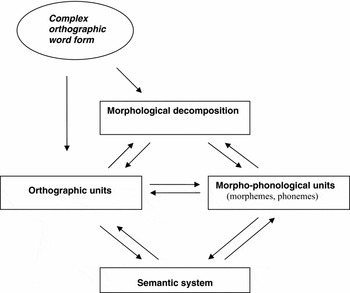
Current models of reading have focused on how letter strings are converted to phonological strings (pronunciations), essentially ignoring any internal structure that words have as morpheme units. However, reading more complex words may involve processes of morphological decomposition as well as grapheme–phoneme connections and whole-word look-up methods. Figure 1 illustrates this possibility.
The role of morphology in the identification of complex orthographic word forms.

The key idea represented in Figure 1 is that word identification may include an early phase of decomposition, in which constituent morphemes of a word are “separated.” The decomposition, according to the options of Figure 1, can occur in a rather direct manner from a word form, or indirectly from a first phase that extracts the word's orthography. The general shape of the Figure 1 scheme is in the tradition of models with a lexicon (e.g., dual route models), but with fully interactive connections between levels. It organizes the information flow possibilities that specific models would select from.
Although Figure 1 is a symbolic scheme, morphological decomposition has been proposed in nonsymbolic connectionist models. On this approach, morphological decomposition can be seen as a learned sensitivity to the systematic relationships among the surface forms of words and their meanings (cf. Plaut & Gonnerman, Reference Plaut and Gonnerman2000; Seidenberg & Gonnerman, Reference Seidenberg and Gonnerman2000). Decomposition becomes a graded rather than an all or none phenomenon of which the effects vary as a function of the degree of morphophonological and semantic transparency of words. Thus, morphology, in a connectionist view, emerges as a graded, interlevel activation pattern that reflects correlations among orthography, phonology and semantics.
Aside from models of word reading, the formal treatment of morphology usually distinguishes between derivation and inflection (see Spencer & Zwicky, Reference Spencer and Zwicky2001). The meaning changes that result from inflection (e.g., plural /s/ or past /ed/ in English) are largely constrained by the syntax of the language. Derivational morphology often (but not always) involves a change in syntactic category, for example, from noun to adjective (e.g., hope, hopeful). The meaning relations across derivations are subject to variations in transparency. In some cases, the meaning of a complex word form can easily be derived from its constituent parts (e.g., joy, joyful, joyfulness) whereas in other cases it is not (e.g., cape, caper). Words can also serve as morphological constituents in other words. Some words have a high morphological productivity, that is, they occur in many other words (e.g., the Dutch word werk [“work”] occurs in about 500 other words), whereas other words are morphologically unique. The case of productivity shows that the distinct word forms in the mental lexicon comprise a complex network. Productive word patterns are highly predictable in their form and in their meaning, which makes it plausible that some sort of morphological processes during reading may take place.
Theories of morphological processes in reading can be classified on how they explain the identification or production of polymorphemic words, varying from full listing to total decomposition. These two accounts have been combined in more interactive models, which propose a direct lexical route involving access to full-form representations along with a parsing route (cf. Caramazza, Laudanna, & Romani, Reference Caramazza, Laudanna and Romani1988; Plaut et al., Reference Plaut, McClelland, Seidenberg and Patterson1996; Schreuder & Baayen, Reference Schreuder, Baayen and Feldman1995). In such hybrid theories, a race model is often proposed with fully parallel routes. A direct route applies when a full-form representation is accessed and mapped onto its associated lemma node, which then activates the relevant semantic representations. A parallel parsing route includes segmentation and licensing processes. Segmentation implies that representations of affixes and stems are activated along with full-form representations. With the help of morphological knowledge, the constituent morphemes in polymorphemic words can be identified. Final word identification is achieved when a unique entry in the mental lexicon is activated. It then provides phonological, morphological, and semantic information associated with the lexical item.
The frequency of morphemes and their family size have a great impact on the accuracy and speed of word identification. Commonly used words are easier to access and are responded to faster than less commonly used words (Ballota & Chumbley, Reference Balota and Chumbley1985; Schilling, Rayner, & Chumbley, Reference Schilling, Rayner and Chumbley1998). It turns out that family size, which is how many words share a morpheme, plays an important role in lexical access as well. Recent studies have provided evidence that morphological productivity is a facilitating factor in lexical processing. Schreuder and Baayen (Reference Schreuder and Baayen1997) have shown that the larger the morphological family, the faster the responses of subjects on a visual lexical decision task in Dutch. Similar effects have been found for a broad variety of languages, such as Finnish (Hyönä & Pollatsek, Reference Hyönä and Pollatsek1998) and Hebrew (Feldman, Pnini, & Frost, Reference Feldman, Pnini and Frost1995). These findings can be interpreted as spreading of activation along morphological lines in that morphological family members become coactivated while reading a word. The more global activation in the mental lexicon, the easier the decision that a target word is an existing word.
Reichle and Perfetti (Reference Reichle and Perfetti2003) proposed a word-experience model that unites morphologically complex and morphological simple words in a common framework that distinguishes word familiarity (orthography) from word availability (retrieval of meaning and pronunciation). Their simulations showed that both simple and complex words are affected by frequency of encounters and by the similarity a word to other words in memory, thus providing a shared experience-based mechanism for words of all types. The model simulates basic results of research on processing morphology. Although it does not mark morphemes in its memory, the model instantiates morpheme functioning and discovers differences between inflectional and derivational morphology. For example, unlike for inflectional morphology, the availability of meaning and pronunciation of a base word (e.g., observe) is not affected by the total token frequency of its derived forms (observation, observatory) but by the number of its derivational word types, simulating experimental results (e.g., Schreuder & Baayen, Reference Schreuder and Baayen1997). One implication of the model is that skilled reading takes advantage of the form and meaning relations that are shared among words, irrespective of the kind of morphology that connects them.
ROLE OF MORPHOLOGY IN LEARNING TO READ
Morphologically complex words constitute an increasing proportion of new vocabulary encountered in the intermediate grades. There is reason to believe that an increasing attention to the relationships between orthography and meaning is mandatory for the efficient reading of derivationally complex words (cf. Mann, Reference Mann2000; Verhoeven & Carlisle, Reference Verhoeven and Carlisle2006; Verhoeven & Perfetti, Reference Verhoeven and Perfetti2003). In learning to read, children learn that word parts that are related in meaning are usually spelled consistently, despite changes in pronunciation. Thus, they learn the Isomorphism Principle, which assigns similar spellings to similar (parts of) words, as long as pronunciation allows this. Given that in many cases spelling rules are not directly governed by the phonological syllable structure, the learner must convert sounds to an underlying spelling representation with orthographic syllables reflecting morphemes (cf. Verhoeven, Schreuder, & Baayen, Reference Verhoeven, Schreuder and Baayen2003). Although a clear conceptual distinction can be made between reliance on GPC rules and the development of analogies based on morphological constituents, it has proved very difficult to discriminate between the two processes for the identification of complex words. It can be assumed that the acquisition of reading requires multiple encounters with words that build up representations that reflect word familiarity and word knowledge, and that rare or orthographically complex forms often need to be identified via parsing or the segmentation of the word in its morphological constituents. Morphological decomposition can thus be seen as self-teaching device in reading complex words via increasing lexical quality leading to instance-based learning of lexical items toward automatic recognition.
In a review, Templeton and Morris (Reference Templeton, Morris, Kamil, Rosenthal, Pearson and Barr2000) found that starting in the intermediate grades children approach new words in the vast majority of cases by analyzing these words into constituent parts. In the course of schooling, children's ability to segment and manipulate morphemes within complex words increases substantially (Anglin, Reference Anglin1993). Verhoeven, Schreuder, and Haarman (Reference Verhoeven, Schreuder and Haarman2006) showed that both children and adults were more accurate and faster in the retrieval of words with both true and phonological prefixes (corresponding orthography and phonology) compared to words with a pseudoprefix (same orthography but different phonology), which suggests that morphemic patterns play a role in word identification processes in both children and adults. Furthermore, it has been found that individual differences in word reading ability can to a large extent be attributed to the degree to which the orthographic, phonological, and semantic features that collectively define a given word are both well represented and well interlocked in memory. For children in the intermediate and upper grades, this information seems to include some tacit knowledge about morphology as was evidenced from relationships of morphological knowledge with word decoding (Leong, Reference Leong2000; Singson, Mahony, & Mann, Reference Singson, Mahony and Mann2000), spelling (Kemp, Reference Kemp2006), reading vocabulary (Nagy & Scott, 2000), and reading comprehension (Carlisle, Reference Carlisle2000; Nagy, Berninger, Abbott, Vaughan, & Vermeulen, 2004).
Much of the research on the development of children's reading and spelling to date has involved the English language, which has a highly irregular orthography with many inconsistencies and complexities, and a relatively sparse morphology. Alphabetic orthographies differ in the degree to which they deviate in a principled manner from their underlying morphophonological representations and thus in the extent to which deeper lexical/linguistic information is preserved. Recent comparisons have shown the development of word decoding to clearly differ across languages. In studies comparing the reading of words and/or nonwords in English and German (Frith, Wimmer, & Landerl, Reference Frith, Wimmer and Landerl1998), in English, Spanish, and French (Goswami, Gombert, & de Barrera, Reference Goswami, Gombert and de Barrera1998), in English and Greek (Goswami, Porpodas, & Wheelwright, Reference Goswami, Porpodas and Wheelwright1997), and in English and Dutch (Patel, Snowling, & de Jong, Reference Patel, Snowling and de Jong2004), English word decoding was found to develop more slowly and less efficiently than word decoding in other alphabetic languages. Thus, the ease of word identification and the role of morphology may vary across languages depending on their orthographic depth (Frost, Katz, & Bentin, Reference Frost, Katz and Bentin1987) and their morphological richness (Vannest, Bertram, Jävikivi, & Niemi, Reference Vannest, Bertram, Järvikivi and Niemi2002). It is by no means clear how these (quasi-) regular characteristics of diverse languages influence the acquisition of reading across languages.
THE PRESENT ISSUE: A CROSS-LANGUAGE PERSPECTIVE ON THE ROLE OF MORPHOLOGY IN READING
In the present issue, we bring together papers that help address the role of morphology in reading by providing a cross-language perspective. Our review of previous studies shows that a variety of models has been used to explain the use of morphological units in reading processes. Of course, it is not possible to reconcile the theoretical frameworks into one model. Much more research on the neurocognitive modeling of morphological decomposition processes is needed to arrive at final answers. For now, it can be claimed that morphological decomposition in reading complex words reflects a learned sensitivity to the systematic relationships among the surface forms of words and their meanings. Morphology is thus considered to be a universal response of the reader to the quasiregular characteristics in a given language. However, given that languages substantially differ in morphological richness, language-specific effects on morphological processing can also be predicted. To address the role of cross-linguistic differences, this issue compiles a set of nine research-based papers on morphological processing in word reading and spelling in two Germanic languages (English, Dutch), two Romance languages (French, Italian), Hebrew, and Finnish. Moreover, the role of morphology in word reading is also highlighted in Chinese–English, Spanish–English bilinguals, and in bilingual deaf readers of Dutch.
In the first article, Deacon, Whalen, and Kirby investigated whether Grade 4, 6, and 8 English-speaking Canadian children access the base form when reading morphologically complex words. Previous studies have demonstrated evidence for the impact of morphological structure on children's reading by manipulating features of the base form (frequency and phonological transparency). This study examined the impact of these two variables in a design that permits examinations of potential interactions between these factors, as well as with that of surface frequency. The impact of the transparency of the morphological structure (as reflected by the opacity variable) was also explored. Children were asked to read words varying systematically in the frequency of the surface and base forms and in the transparency of the base form. Both response time and accuracy data were collected. At all grade levels children were faster at reading derived words with high than low base frequencies when the words were of low surface frequency. Effects of the frequency and transparency of the base form on word reading accuracy occurred only in Grades 4 and 6. The results add to the growing body of evidence that children access the morphological structure of the words that they encounter in print.
In the following article, Verhoeven and Schreuder examined to what extent advanced and beginning readers, including dyslexic readers of Dutch make use of morphological access units in the reading of polymorphemic words. Therefore, experiments were carried out in which the role of singular root form frequency in reading plural word forms was investigated in a lexical decision task with both adults and children. Groups of adult readers, 8- and 11-year-old typically reading children, as well as 11-year-old dyslexic children, were presented with a lexical decision task in which plural word forms with a high versus low frequency of the singular root form were contrasted. For the adults, it was found that the accuracy and speed of lexical decision is determined by the surface frequency of the plural word form. The frequency of the constituent root form played a role as well, but in the low-frequency plural words only. Furthermore, a strong developmental effect as regards the accuracy and speed of reading plural word forms was found. An effect of plural word form frequency on word identification was evidenced in all groups. The singular root form frequency also had an impact of the reading of the plural word forms. Overall, constituent morphemes were found to have an impact on the reading of polymorphemic words as a function of reading skill and experience and of word and morpheme frequency.
In the next article, Casalis, Deacon, and Pacton studied the relationship between morphological awareness and spelling. They found that French children in Grades 3 and 4 appear to use morphological information in spelling; spelling of sounds for which there are several alternatives was more accurate in derived than in nonderived words. The link between morphological awareness and spelling seems to be general, given that morphological awareness correlated with multiple spelling scores, including those that did not involve morphology. Furthermore, the relationship between spelling and morphological awareness seems to be affected by both the developmental level of the child and the phonological structure of the items in the morphological awareness task. The implications of this research are discussed to clarify the relationship between morphological awareness and spelling.
In the subsequent article, Marcolini, Traficante, Zoccolotti, and Burani investigated the effects of word frequency and word length on complex word reading in Italian dyslexic and skilled readers. Prior studies had found that, similar to young and adult skilled readers, Italian developmental dyslexics read pseudowords made up of a root and a derivational suffix faster and more accurately than simple pseudowords. However, only dyslexic and reading-matched younger children benefited from morphological structure in reading words aloud. In the new study, it was shown that word frequency affects the probability of morpheme-based reading, interacting with reading ability. Young skilled readers named low- but not high-frequency morphologically complex words faster than simple words. By contrast, the advantage for morphologically complex words was present in poor readers irrespective of word frequency. Adult readers showed no facilitating effect of morphological structure. These results indicate that young readers use reading units (morphemes) that are larger than the single-grapheme grain size. It is argued that morpheme-based reading is important for obtaining reading fluency (rather than accuracy) in transparent orthographies and is useful particularly in children with limited reading ability who do not fully master whole-word processing.
In the next article, Häikiö, Bertram, and Hyönä examined the role of morphology in Finish reading development by measuring participants’ eye movements while they read sentences containing either a hyphenated (e.g., ulko-ovi “front door”) or concatenated (e.g., autopeli “racing game”) compound. The participants were Finnish second, fourth, and sixth graders. Fast second graders and all fourth and sixth graders read concatenated compounds faster than hyphenated compounds. This suggests that they resort to slower morpheme-based processing for hyphenated compounds but prefer to process concatenated compounds via whole-word representations. In contrast, slow second graders’ fixation durations were shorter for hyphenated than concatenated compounds, which seems to imply that they process all compounds via constituent morphemes and that hyphenation comes to aid in this process.
In the following article, Bar-On and Ravid examined the role of morphology in grade school children's learning to read nonpointed Hebrew. They report on two experiments testing the reading of morphologically based nonpointed pseudo words in Hebrew-speaking children and adolescents in different age groups, and a group of adults, participated in the study. Participants were administered two tasks of reading aloud nonpointed pseudowords with morphological composition: words in isolation and words in sentential context. Results pinpoint the developmental milestones on the way to efficient nonpointed word recognition in Hebrew. Starting in second grade, children learn to use morphological pattern cues to fill in missing phonological information. In subsequent grades, they learn to overcome homography by means of morphosyntactic cues, an ability that develops more gradually and over a much longer period than pattern recognition.
In the subsequent article, Cheng, Wang, and Perfetti investigated compound processing and cross-language activation in a group of Chinese–English bilingual children, and they were divided into four groups based on the language proficiency levels in their two languages. An auditory lexical decision task was designed using compound words in both languages. The compound words in one language contained two free constituent morphemes that mapped onto the desired translations in the other language. Two types of compound words were included: transparent and opaque words. Results showed that children were more accurate in judging semantically transparent compounds in English. The lexicality of translated compounds in Chinese affected lexical judgment accuracy on English compounds, independent of semantic transparency and language proficiency. Implications for compound processing and bilingual lexicon models are discussed.
In the prefinal article, Ramirez, Chen, Geva, and Luo examined the effects of first language characteristics on the development of two aspects of English morphological awareness, derivational and compound awareness in English Language Learners with Chinese or Spanish as their first language. Their study also assessed the contribution of derivational and compound awareness to word reading in the two groups of bilingual as well as in monolingual English-speaking children. Participants included 89 Spanish–English and 77 Chinese–English bilingual, and 78 monolingual English-speaking children from Grade 4 and Grade 7. Results showed that Chinese–English bilinguals performed similarly to monolingual English speakers on English compound awareness, and monolingual English speakers outperformed their Spanish–English bilingual peers. In contrast, Spanish–English bilinguals and monolinguals both outperformed Chinese–English bilinguals on derivational awareness. Another key finding was that in all three groups of children, morphological awareness made a unique contribution to word reading after controlling for nonverbal ability, maternal education, and other reading related variables.
In the final article, Van Hoogmoed, Verhoeven, Schreuder, and Knoors studied the morphological sensitivity in deaf readers of Dutch. Deaf children experience difficulties with reading comprehension that are not completely explained by their difficulties with the reading of single short words. Whether deaf children and adults lag behind in the morphological processing of longer words was therefore examined in two experiments in which the processing of prefixes by deaf versus hearing children and deaf versus hearing adults is compared. The results show that the deaf children use morphological processing but to a lesser extent than hearing children. No differences appeared between the deaf and hearing adults. Differences between deaf children with and without a cochlear implant were examined, but no firm conclusions could be drawn. The implications of the results for the reading instruction of deaf children are discussed.
Each article provides distinctive results that are bound by the languages studied, as well by the age of the readers and the tasks used. However, taken together, this work demonstrates a role for morphology in reading across a wide range of languages. Of course, it makes sense that a highly inflected language like Finnish will be different from a more sparsely inflected language like Chinese or even English. Yet the use of morphemes in some phase of reading was reported in all studies being reported. Perhaps parallel with the conclusions of the universal phonological principle (e.g., Perfetti, Reference Perfetti2003) that all writing systems support the activation of phonology at their smallest functional grapheme units, we might suggest that more cross-language work will suggest a universal morphology principle. So far, the research suggests that morphology, which is foundational for knowledge of language, is universally part of reading, subject to constraints imposed by the language and by how the writing system encodes that language.