Introduction
This article explores a critical linkage in the public policy process: the relationships between agency administrators and their elected officials. By now it is perhaps a truism among policy scholars to observe that public managers are not merely implementers, but rather independent and often highly influential actors in the public policy process. Of particular interest to scholars in recent years are agency heads. Situated above the line personnel who implement programmes and immediately below the elected officials who formally govern public organisations, agency heads are the “mezzo-level bureaucrats” that several studies have identified as influential actors in the policy process (Wirt Reference Wirt1985; Carpenter Reference Carpenter2001; Rabe Reference Rabe2004, among many others). Despite rich and extensive research on agency executives, the causes of variation in political behaviour among these bureaucrats remain elusive.
This article takes up one dimension of agency executives’ political behaviour: the frequency of interactions between bureaucrats and elected officials. Agency executive jobs are temporary matches of bureaucrats with government agencies, which form when individuals and governments connect through an employment agreement. Together, the buyers and sellers of executive labour form jobs in ways that affect bureaucratic political behaviour. Casting governments as buyers of executive labour, I argue that elected officials hire executives from outside in part because they seek innovation and/or organisational changes that are likely to require significant interactions with elected officials. Governments that promote agency executives from within are less interested in transformational leadership from their agency heads, and so will not expect as frequent interaction with elected officials. Simultaneously, individuals accept executive positions via external recruitment in part because they are comfortable with, and perhaps even relish, interactions with elected officials. Individuals who are promoted to executive jobs from within are likely to have had relatively less experience working with elected officials. In this way, the process of job formation shapes the understandings and expectations that both executives and their elected officials carry into the relationship. Consequently, agency executives hired from outside engage more frequently with their elected officials – that is, they manage more “upwardly” – than do those who were promoted from within.
The empirical subjects of this study are professional executives who lead local public education, law enforcement and water utility agencies in the United States. Analysis of comparable, independent data sets from these three very different types of agencies reveals a striking empirical consistency: executives hired from outside interact much more frequently with their elected officials than do their peers who were promoted from within. These results shed important new light on the causes of public executives’ behaviour, and also on the fundamental relationships between public managers and the governments that they serve.
This article begins with a brief review of the literature on public executives’ management behaviour. I integrate this literature with research on executive succession and career paths to advance a theory that predicts upward management activity as a function of executive job formation. The theoretical discussion culminates in a simple hypothesis, which I subject to statistical evaluation using behavioural data on three different populations of executives. After presenting the results, I close with a discussion of the study's limitations and implications for future research.
Managerial networking and the role of the executive
Public agency executives interact with their elected officials, their organisational subordinates, and broader policy networks and interest groups outside of their organisations; in Creating Public Value (1995), Moore labelled these patterns of interaction managing “upward”, “downward” and “outward”, respectively. The recognition and rigorous study of upward, downward and outward management have led to significant advances in our understanding of public management and the policy process. In particular, researchers have identified important links between these executive behaviours and organisational performance. Research to date, however, has had little to say about why different agency executives manage the ways that they do. What accounts for differences in upward, downward and/or outward management among agency executives?
In Moore's (Reference Moore1995) terms, “outward management” represents executives’ behaviours aimed at shaping the effects of external conditions on their organisations. “Downward management” represents executives’ efforts to influence their agencies’ performance through coordination and direction of organisational resources. “Upward management” is an executive's effort to influence the political officials under which an agency operates, either by shaping policies or seeking to channel resources towards or away from their organisations. Moore argued that public executives choose strategically to manage outwardly, downwardly and/or upwardly, with potentially significant implications for the performance of their organisations.
Managerial networking
In a 1999 article, O'Toole and Meier formalised and extended Moore's framework into a model that integrates all three dimensions of public management.Footnote 1 O'Toole and Meier's (Reference O'Toole and Meier1999) theory distinguished management within hierarchies (upward and downward) from management in networks (upward and outward). A literature on managerial networking has flourished in the years since. The primary theoretical aim of this line of research has been to link managerial behaviour to agency performance, with special attention to the effects of managerial behaviour on measurable performance outcomes. Along with a handful of collaborators, O'Toole and Meier followed their 1999 article with a series of studies that found significant correlations between managerial networking and agency performance in school districts (Meier and O'Toole Reference Meier and O'Toole2001, Reference Meier and O'Toole2003, Reference Meier and O'Toole2010; O'Toole et al. Reference O'Toole, Meier and Nicholson-Crotty2005; Meier et al. Reference Meier, O'Toole, Boyne and Walker2007; Hicklin et al. Reference Hicklin, O'Toole and Meier2008). Similar studies have sought to connect managerial networking to performance in American local law enforcement agencies (Nicholson-Crotty and O'Toole Reference Nicholson-Crotty and O'Toole2004), state administrative agencies (Jacobson et al. Reference Jacobson, Palus and Bowling2010), and local government in the United Kingdom (Walker et al. Reference Walker, Andrews, Boyne, Meier and O'Toole2010). Although their details differ in important ways and some caveats apply (see especially Hicklin et al. Reference Hicklin, O'Toole and Meier2008), generally these studies find that external networking, or outward management, is positively correlated with organisational performance.
Downward and upward management
The effects of downward and upward management have received comparatively less attention. Many studies of managerial networking simply exclude downward and upward management from their analyses, since their main interests are in external networking and collaboration. To the extent that downward and upward management have been analysed, the findings on their performance effects have been mixed (Nicholson-Crotty and O'Toole Reference Nicholson-Crotty and O'Toole2004; Meier et al. Reference Meier, O'Toole and Goerdel2006; Jacobson et al. Reference Jacobson, Palus and Bowling2010; Walker et al. Reference Walker, Andrews, Boyne, Meier and O'Toole2010).
Beyond investigating the performance effects of outward, upward, and downward management, McGuire (Reference McGuire2002) argued that comprehensive research on network management must also explain why public executives manage in networks at all. Since a public executive sits atop an agency's formal hierarchy, some degree of managing downward is an explicit part of his job. But managing upward and outward are inherently costly and risky. Given the risks of managing upward and the costs of managing outward, theoretically the “equilibrium” position of any public manager should be minimal upward management and zero outward management. Yet upward and outward management happen. It is tempting to explain this behaviour by assuming that executives manage upwardly and/or outwardly in pursuit of improved agency performance. But even this sanguine assumption does not explain variation in upward and outward management: if managing upward, outward, and downward have observable and predictable effects on organisational performance, why don't all agency heads behave in more or less the same ways? What accounts for differences in executives’ behaviour?
Recent research demonstrates that public executives display significant variation in managerial networking behaviour, and a remarkable proliferation of research over the past decade has answered McGuire's (Reference McGuire2002) call. Scholars have analysed the effects of institutional structure (Smith Reference Smith2009), organisational capacity (Bowman and Parsons Reference Bowman and Parsons2009a), organisational vulnerability (Bowman and Parsons Reference Bowman and Parsons2009b; McGuire and Silva Reference McGuire and Silva2010), sectoral differences (Simo and Bies Reference Simo and Bies2007; Herranz Reference Herranz2008), mandated collaboration (Rodriguez et al. Reference Rodriguez, Langley, Beland and Denis2007), and leadership style and strategy (Agranoff and McGuire Reference Agranoff and McGuire2003; Waugh and Streib Reference Waugh and Streib2006; McGuire and Silva Reference McGuire and Silva2009) on network management. However, overwhelmingly the focus of this recent explosion of research is outward management; that is, researchers have focused mainly on managers’ engagement in networks outside of the governments that they serve.
The causes of differences in executives’ upward management behaviour remain little explored and poorly understood. The depth, breadth and nature of administrators’ engagement with elected officials vary considerably. Researchers have sought to explain this variation by linking it to agency-level variables like size (Morgan and Watson Reference Morgan and Watson1992) and institutional structure (Teske and Schneider Reference Teske and Schneider1994). Other research in the “upper echelon theory” tradition (Hambrick and Mason Reference Hambrick and Mason1984) has sought to connect administrators’ upward management patterns to individual-level variables like education, experience and gender (Newell and Ammons Reference Newell and Ammons1987; Fox and Schuhmann Reference Fox and Schuhmann1999; Meier et al. Reference Meier, O'Toole and Goerdel2006; Zhang and Feiock Reference Zhang and Feiock2009).
Unfortunately, the body of empirical research on the causes of upward management suffers from two general limitations. First, rigorous, quantitative research has focused almost exclusively on city managers in the United States (see Zhang and Feiock (Reference Zhang and Feiock2009) for a review of the literature and an accompanying analysis); research on other populations are scarce. Second, much of the empirical research on upward management relies upon surveys of administrators’ attitudes and perceptions of their proper roles with respect to their elected officials, rather than their behaviour. I am aware of only two studies that analyse upward management of public executives other than city managers, using measures of behaviour, rather than attitudes; interestingly, both are studies that are focused on gender, and unfortunately they yield contradictory findings (Meier et al. Reference Meier, O'Toole and Goerdel2006; Jacobson et al. Reference Jacobson, Palus and Bowling2010).
Executive succession
A separate line of scholarship has examined executive succession and its effects on agency performance. Following Boyne and Dahya (Reference Boyne and Dahya2002), Boyne et al. (Reference Boyne, James, John and Petrovsky2011) and Hill (Reference Hill2005) each find that executive turnover affects organisational performance (albeit in different ways and under different conditions). Boyne and Meier (Reference Boyne and Meier2009) distinguish executives who were promoted from within from those who were hired from outside, and find that the former were more likely to improve the performance of poorly performing organisations. Separately, a handful of recent studies links innovation to the arrival of a new executive from outside the agency (Teodoro Reference Teodoro2009; LeRoux and Pandey Reference LeRoux and Pandey2011; Villadsen Reference Villadsen2012). The behavioural effects of executive succession – that is, the extent to which executives who were hired from outside act differently from those who were promoted from within – remain unclear.
Upward management and public policy
Understanding why executives manage upwardly more or less is important for research on the public policy process for at least two reasons. First, as noted earlier, past research has correlated agency performance with executives’ relative frequency of upward, downward, and outward management. Past research also has demonstrated links between executive succession and performance. To the extent that executives’ upward management helps predict organisational outcomes, understanding its antecedents is important for improving agency performance.
Second, theoretical claims about moral hazard in the bureaucracy rest on assumptions about the relationships between bureaucrats and elected officials, and the roles that bureaucrats are supposed to play in those relationships. As Moore's (Reference Moore1995) and subsequent work shows, upward management is a central behavioural dimension of the bureaucrat-elected official relationship. Worries about activist agency leaders run amuck (e.g. Reynolds Reference Reynolds1965; Niskanen Reference Niskanen1971) follow from concerns that bureaucrats’ aims deviate from their elected officials’ goals in important ways. Those concerns might be justified if upward management is an attempt to shield an agency from accountability. To the extent that upward management reflects responsiveness to elected officials’ demands, moral hazard concerns are assuaged. If upward management represents bureaucratic involvement in policy formation, then the theoretical implications for democracy are murkier (Aberbach et al. Reference Aberbach, Putnam and Rockman1981). Whatever its implications for democratic governance might be, explaining variation in upward management helps illuminate the bureaucratic executive's role in the policy process.
Moving in and managing up
Like all jobs in a market economy, public agency executive jobs are temporary matches of individual professionals with government employers. Executive jobs form when individuals accept governments’ offers to exchange labour for pay, and so a job is a joint function of an individual and a government agency. But these matches do not form at random; differences in the process of job formation can lead agency heads to approach their work in different ways. Elsewhere I have argued that career mobility can lead executives to introduce policy innovations to their agencies (Teodoro 2009, 2011). Building upon that career-based model, I argue that the matching processes that connect individuals to agencies can help predict upward management among public executives. If executive behaviours are linked to the job formation process, then variation in management behaviour may indicate that executives and politicians are fulfilling their mutually understood roles.
Buyers and sellers
Governments that operate bureaucratic agencies are purchasers of executive labour. When a vacancy occurs in an agency head post, a government may fill the job by promoting an internal candidate or by selecting a candidate from outside the organisation.Footnote 2 Promotion of an internal candidate tends to maintain existing organisational norms and priorities (Kaufman Reference Kaufman1960; Wilson Reference Wilson1989). Hiring an executive from outside the organisation often indicates, at some level, relative dissatisfaction with existing conditions in an organisation and a demand for change (Schall Reference Schall1997). The effects of ex ante organisational performance on the likelihood of hiring executive from outside are well-established in research on business organisations: poor organisational performance is strongly correlated with hiring executives from outside (Boeker and Goodstein Reference Boeker and Goodstein1993; Zhang and Rajagopalan Reference Zhang and Rajagopalan2004). Studies of executive succession in public agencies also find that decisions to promote from within or hire from outside reflect satisfaction or dissatisfaction with the status quo (Carlson Reference Carlson1961; Hess et al. Reference Hess, Maranto and Milliman2001; McCabe et al. Reference McCabe, Feiock, Clingermayer and Stream2008; Hamidullah et al. Reference Hamidullah, Wilkins and Meier2009; Maranto and Milliman Reference Maranto and Milliman2009; Boyne et al. Reference Boyne, James, John and Petrovsky2010).
The sellers of labour in this market, agency executives, adapt by providing governments with the services that they demand. Administrators who seek career advancement observe the behaviour of those who succeed and fail at advancing, and then mimic the behaviours that maximise their probabilities of success (March and March Reference March and March1977; DiMaggio and Powell Reference DiMaggio and Powell1983). For administrators who serve in agencies with a standard practice of internal promotion, successful adaptation means fulfilling existing requirements and adhering to existing organisational norms (Kaufman Reference Kaufman1960). Such a “maintenance strategy” is sensible for the internally promoted executive, since his promotion is, in part, an endorsement of the organisation's current performance. For the executive who is hired from outside, career advancement is in part a consequence of her reputation for facilitating change (Wilson Reference Wilson1989; Schneider et al. Reference Schneider, Teske and Mintrom1995).
Career path and the role of the administrator
Together, the buyer and seller of executive labour form a job in a way that defines the relationship between the administrator and his or her elected officials. When the executive is hired from outside, the job carries an implicit (and perhaps explicit) mandate for significant change or innovation. Such a mandate is likely to require significant engagement with elected officials in articulating priorities, developing new policies, winning support for new initiatives and buffering the agency from political pressures. In Moore's (Reference Moore1995) terms, effective policy innovation usually requires an executive to manage upwardly (see also Meier and O'Toole Reference Meier and O'Toole2001, Reference Meier and O'Toole2008). The decision to promote an internal candidate implicitly (and perhaps explicitly) indicates general satisfaction with an agency's existing processes and performance. Therefore, the agency head job is unlikely to carry a mandate for innovation when the executive was promoted from within. Although executives who were promoted from within also engage in a degree of upward management as part of their ordinary duties, executives who are not charged with orchestrating significant changes require less frequent interaction with elected officials.
Whether newly arrived executives are advocating for resources, promoting policy innovations or buffering their agencies from political pressure, the expected effect is the same. A simple hypothesis about the relationship between job formation and executive behaviour follows: executives who are hired from outside their current agencies manage upwardly more (that is, interact more frequently with their elected officials) than do executives who were promoted from within their current agencies.
Data and methods
Local government in the United States is an excellent context to study the effects of career path on executives’ management behaviour. Local agencies provide myriad services throughout the United States, and executive career paths vary considerably across both agencies and functions. Tens of thousands of American local governments provide ample variation on institutional, environmental and behavioural variables while largely controlling for cultural factors.
The present study analyses the behaviour of three distinct populations of local agency executives: school superintendents, police chiefs and water utility managers. Basic education, law enforcement and water utility services are all primarily local government functions in the United States, and all three populations of executives are appointees who lead agencies at the pleasure of their respective political superiors. Most school superintendents serve special purpose local governments, and so are hired by and report to elected boards of directors or commissioners. American municipal police agencies are parts of general purpose city governments, and so their chiefs are appointed by either mayors or city managers, depending on their municipalities’ governance structures. American public water utilities operate under both special districts and general purpose city governments. Although they are appointed by politicians and/or city managers, and their jobs are irreducibly political, all the three types of executives analysed here are professionals with careers devoted to their respective fields. Thus, these executives are not like the partisan political appointees who head state and federal agencies and whose jobs are closely tied to the electoral cycle.
Schools, law enforcement and water utilities are diverse in both the kind of services that they offer and their institutional structures. At the same time, all three are ubiquitous throughout the United States, and so offer excellent external validity, at least in the American context. Analysing executive behaviour across three very different kinds of agencies presents a robust test of the present hypothesis; findings that are consistent across these three populations offer substantial confidence in the theory advanced here.
Data
Three separate, independently gathered data sets are used in the present analysis. Data on school superintendents are drawn from Meier and O'Toole's (Reference Meier and O'Toole2007) survey of Texas school district superintendents. This paper-and-pencil survey was mailed to superintendents in 1,110 Texas school districts with a 68 per cent response rate.Footnote 3 Matching data on school district characteristics in 2007 were published by the Texas Education Agency.Footnote 4 Data on police chiefs are drawn from my 2005 survey of American municipal police chiefs (Teodoro Reference Teodoro2011). The survey was administered through telephone interviews to a randomised sample of 150 police chiefs leading municipal law enforcement agencies in the United States, stratified by agency size. A total of 81 chiefs participated for a response rate of 54 per cent. Additional agency-level data were drawn from the US Bureau of Justice Statistics’ 2000 Census of State and Local Law Enforcement Agencies and the American Community Survey. Details on the design and administration of the school superintendent and police chief surveys are reported in Meier and O'Toole (Reference Meier and O'Toole2001) and Teodoro (Reference Teodoro2011), respectively.
Data on water utility managers were drawn from an original survey of executives who lead American water utilities. A randomised sample of 300 utility executives were invited to participate in the survey, stratified by size. The survey instrument was administered through a structured telephone interview with a follow-up online questionnaire. Participants were guaranteed that their identities would be held in confidence. A total of 169 utility executives participated, for a response rate of 56.3 per cent; an appendix to this article offers additional details on survey methodology. The survey instrument captured career path data during the interview phase: respondents reported their paths to their current positions from the time that they finished school to their present jobs. Following the interview, respondents completed an online questionnaire that captured data on managerial networking behaviour using an instrument very similar to those used in the school superintendent and police chief surveys. Additional details on design and administration of the water utility manager survey are reported in Appendix A. Agency-level data for water utilities were drawn from the US Environmental Protection Agency's Safe Drinking Water Information System (SDWIS), data on water scarcity were drawn from Willmott and Matsuura's archive of the Willmott–Feddema Climatic Moisture Index (Willmott and Feddema Reference Willmott and Feddema1992),Footnote 5 and data on governance institutions were gathered independently.
Dependent variable
I measure upward management using executives’ reported frequency of contact with the political officials who have formal governance authority over their agencies, an approach that is virtually identical to the measures used in earlier studies of upward management (Meier and O'Toole Reference Meier and O'Toole2001; O'Toole et al. Reference O'Toole, Meier and Nicholson-Crotty2005; Jacobson et al. Reference Jacobson, Palus and Bowling2010). The school superintendent survey asked each respondent to report how often he or she interacts with members of his or her school board, using a six-point scale: never, yearly, monthly, weekly, more than once a week or daily. The police chief and water utility manager surveys employed a very similar five-point scale: never, one to two contacts per year, one to two contacts per month, one to two times per week, or daily. The components of upward management are somewhat different for police chiefs and water utility managers, however. For agency heads who serve city governments, upward management can include interactions with mayors and/or city managers as well as legislative councils. All of the sampled governments have elected legislatures, but some have an elected mayor, others have a city manager, and some have both a mayor and a city manager. I measure upward management for police chiefs and water utility managers as the average frequency of contact with their political superiors. In other words, if an agency has only a legislative council (as in a special district utility, for example), then its executive's upward management is simply frequency of contact with the legislative council. If an agency has a council and mayor, then upward management is the average frequency of contact with both the council and the mayor. If an agency has a council and city manager, then upward management is average frequency of contact with both the council and the city manager. If an agency has a council, mayor and city manager, then upward management is average frequency of contact with all three.
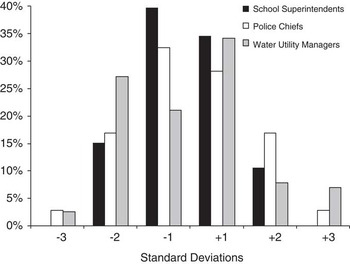
The five- and six-point scales used here can obscure the non-linear construct underlying it; the scale is ordinal, not cardinal. For example, the value of 1 indicates that a school superintendent interacts with her elected officials approximately yearly, but a value of 5 does not mean five contacts annually. Rather, 5 indicates that a superintendent interacts with her elected council more than once a week, but not daily. In order to analyse these frequency-of-contact data in linear form in a way that is comparable across all three samples, I standardised them so that each data set's mean upward management is 0, with a standard deviation of 1. Thus, the analyses reported here effectively predict an executive's upward management relative to other similar executives, not the absolute level of upward management. Figure 1 depicts the distribution of the standardised measurements of upward management for the three samples.
Distribution of upward management.

Independent variable
The key independent variable for the hypothesis evaluated here is a binary measure of executive job formation. Executives who were hired for their current positions from outside the agencies where they currently work were coded one for hired from outside; executives who were promoted to their current positions from within the agency were coded zero. The police chief and water utility manager surveys asked respondents to report their career paths directly during the telephone interview. For school superintendents, the questionnaire asked respondents to report the number of years that they had served as superintendent in their current districts, as well as the number of years that they had served as superintendent in any district. If the latter value was larger than the former, then the superintendent was coded one for hired from outside; if the two values were equal, then the superintendent was coded as zero.Footnote 6
Controls
Executive job formation occurs when a government agency and an individual connect in a labour agreement; the analyses presented here include some controls associated with each party to that agreement. At the individual level, I include controls for the executive's length of tenure in his/her current job and the length of his/her career. We might expect executives to engage in high levels of upward management immediately after being hired, both to establish a relationship with political superiors and perhaps in pursuit of policy initiatives connected to the change in leadership. If so, we would expect upward management to decline as tenure increases. Similarly, we might expect highly experienced executives to enjoy greater deference from their elected officials, reducing the need for high levels of upward management. Thus we might expect length of career to be negatively correlated with upward management, as well.
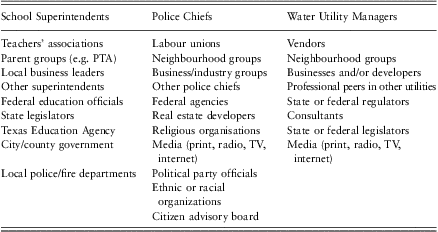
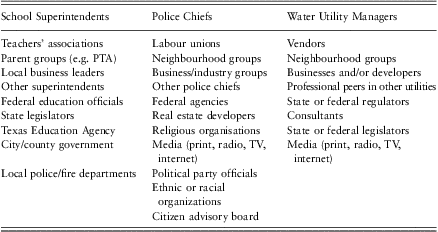
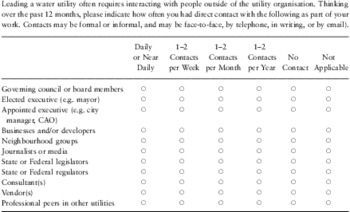
A potential problem with the measurement of upward management employed here is that an executive's frequency of contact with political superiors may be as much a measurement of general activity as it is a gauge of upward management behaviour. It is possible that agency heads who are hired from outside simply interact more frequently with all kinds of people and institutions than do agency heads who were promoted from within. Such differences may occur because executives arriving from outside seek to build relationships in their new roles. Alternatively, executives who were hired from outside simply may be more energetic and outgoing than their internally promoted peers as a matter of personality (Winter Reference Winter1996; Teodoro Reference Teodoro2011). In order to distinguish upward management from general management activity, this analysis includes controls for executives’ overall frequency of interaction with people and organisations outside of their own agencies. All three of the surveys included frequency-of-contact items that measure interactions with several kinds of people and organisations other than their political superiors. Table 1 lists the outside contacts that are included in each dataset. For each executive, I averaged all other contacts, and then include the standardised average of other outside contacts in a second set of models.
Other outside contacts
For governments, I include controls for service population. We might expect executives’ interactions with their elected officials to increase as their agencies’ sizes increase, since larger, more complex organisations likely require more frequent engagement with elected officials. Moreover, in the smallest organisations, the top executive might be engaged significantly in agency operations – police chiefs in small towns often drive patrol cars and investigate crimes, for example – and so have relatively little time for upward management. School district size is measured as student enrolment, police department size as the service area population and water utility size as total customer accounts. Each of these size metrics is entered into the models with natural logarithmic transformations.
As noted earlier, all of the school superintendents and some of the water utility managers analysed here serve independent special districts in which they report directly to elected boards, but the police chiefs and water utility managers who serve general purpose municipal governments may also report to mayors and/or city managers. These institutional differences are captured in the dependent variable measure. I also included dummies for special district and city manager forms of government as controls because they affect the channels of upward management available to an agency executive, and because these institutions may shape more generally the relationship between executives and the governments that they serve – that is, they help define the job.
Executives’ upward management might be expected to reflect the severity of the challenges they face, since environmental conditions are important constraints on both agency performance and executive behaviour (Moore Reference Moore1995; Boyne and Dahya Reference Boyne and Dahya2002). Therefore the present analysis also includes variables that attempt to measure the severity of the environmental conditions under which respondents’ agencies operate. Executives’ interactions with their elected officials might increase with problem severity, as environmental conditions prompt greater scrutiny by political overseers or drive the executive to seek additional political support. On the other hand, more severe environmental conditions might cause an executive to retreat from upward management, and instead focus his or her attention on downward management to improve organisational efficiency and outward management to buffer the agency from environmental conditions (O'Toole and Meier Reference O'Toole and Meier1999). To account for environmental conditions, I tested the effects of low-income population and per cent of the service population in poverty for the school superintendent and police chief models, but these variables had little statistical or substantive effect. State exam pass rates and per cent minority student enrolment were not statistically significant and did not significantly change parameter estimates in the superintendent models, and so these variables were also not retained in the models reported here. The water utility manager models include Willmott and Feddema's (Reference Willmott and Feddema1992) climatic moisture index as a measure of water resource scarcity. The climatic moisture index ranges from −1.0 (no climate moisture) to +1.0 (abundant climate moisture), with 0 representing perfect balance of moisture demand and availability.
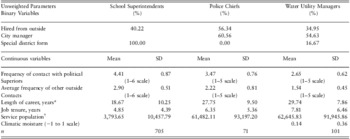
Table 2 summarises the variables used in the analyses that follow. Omitting cases with missing data on the variables of interest left 705 usable responses from school superintendents, 71 from police chiefs and 101 from water utility managers.
Summary of descriptive statistics
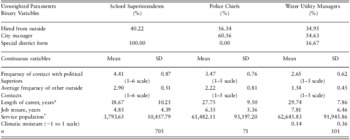
*For school superintendents, length of career is number of years since highest degree was earned.
†Service population is measured as student enrollment for school superintendents, service area population for police chiefs and customer connections for water utility managers.
Models
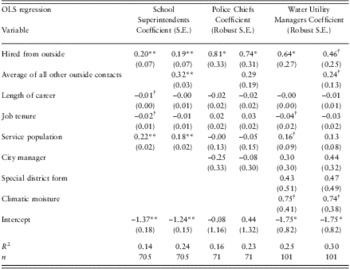
Although all three data sets are cross-sectional, they nonetheless allow valid causal inference because executive job formation (hiring from outside or promoting from within) occurs before the behavioural-dependent variable (contact with political superiors). The present analysis uses ordinary least squares regression to estimate the effects of career path on upward management. The dependent variable is standardised, and so the coefficients represent the change in upward management, measured in standard deviation units, predicted by a one-unit change in the independent variable. Because data on police chiefs and water utility managers are drawn from stratified samples, I employ post-stratification weighting and robust standard errors in their models to correct for bias introduced by the sampling method; Appendix B reports the calculation and application of these weights. Controls that were not statistically significant but improved model fits were retained in the models reported here. For each sample of executives, Table 3 reports estimates of upward management with and without average of other outside contacts included in the models.
Upward management
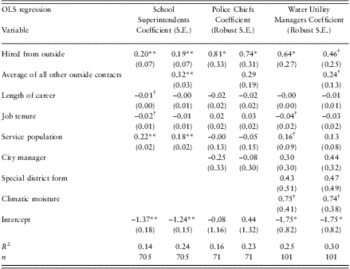
†p < 0.10; *p < 0.05; **p < 0.01.
Results and discussion
The effect of job formation on executives’ frequency of contact with their elected officials is pronounced in all six models: in each sample, executives who were hired from outside manage upwardly much more frequently than their peers who were promoted from within. In the two superintendent models, being hired from outside the current school district is associated with 0.20 and 0.19 standard deviation increases in the frequency of contact with the school board. Re-scaled to the original survey item, this result indicates that a superintendent who was promoted from within interacts with her school board approximately weekly, while one who was hired from outside interacts with the school board more than once a week, with all other variables at their means. The effects are even more distinct for the other two datasets: for the police chief models, being hired from outside is associated with 0.81 and 0.74 standard deviations’ greater upward management; for water utility managers, the effects are 0.64 and 0.46 standard deviations. Re-scaled to the original questionnaire items, these results suggest that a police chief who was hired from outside interacts with his political principals roughly one to two times per week, compared with one to two times per month for a comparable chief who was promoted from within. For water utility managers the effect suggests that an executive hired from outside interacts with her elected officials one to two times per month, while a similar executive who was promoted from within manages up closer to one to two times per year.
The effects of job formation are striking in their consistency across these three very different public management professions. The day-to-day work, client populations, labour force constraints and regulatory regimes that govern local schools, law enforcement and utilities are vastly different. Yet in all three samples, being hired from outside predicts upward management positively and statistically significantly.
As expected, all other outside contacts is positively correlated with upward management in all three models. This finding is consistent with Wilson's (Reference Wilson1989) finding that public managers have limited ability to control the outputs and outcomes of their agencies’ efforts, and so must engage in the policy process to secure resources and shield their organisations from environmental conditions (see also O'Toole and Meier Reference O'Toole and Meier1999).
As noted earlier, past research on executive succession has shown that appointment of an executive from outside the agency (as opposed to internal promotion) frequently indicates dissatisfaction with existing organisational practices or performance, and a subsequent desire for change (Carlson Reference Carlson1961; Wilson Reference Wilson1989; Boeker and Goodstein Reference Boeker and Goodstein1993; Zhang and Rajagopalan Reference Zhang and Rajagopalan2004; Hamidullah et al. Reference Hamidullah, Wilkins and Meier2009). In public agencies, forging such changes can require substantial engagement by the executive with his or her elected officials in order to secure support for innovation. In this way, the relationship between job formation and upward management revealed here may help explain Hill's (Reference Hill2005), Meier and O'Toole's (Reference Meier and O'Toole2008) and O'Toole et al. (Reference O'Toole, Meier and Nicholson-Crotty2005) findings of negative relationships between upward management and immediate or short-term organisational performance: executives’ upward management is likely an effect of poor performance, not its causeFootnote 7 – especially when the executive his hired from outside.
Limitations and directions for future research
The present analysis demonstrates a link between executives’ paths to their current jobs and their management behaviour, but there are surely many other causes of variation in upward management, and as predictors of behaviour the present models are surely under specified. As noted earlier, a handful of studies have sought to link upward management to agency-level variables like size and institutional structure, and also with individual-level variables like gender, experience and professional education. But the body of research on upward management remains thin. The analyses presented here add to this literature, but much more work is needed to flesh out and integrate our understanding of executives’ upward management.
Perhaps the most serious limitation of this study is that the data provide little leverage on the character or quality of interactions between executives and elected officials when the former manage upward. Do executives and their elected officials interact with particular aims in mind? Are interactions focused on agency processes or outcomes? Buffering or advocacy? To what extent do electoral incentives and constraints shape executives’ interactions with their political superiors? The present data and analysis are silent on these questions.
Also unclear at this point are the relationships between upward, downward, and outward management. As noted earlier, the bulk of research that engages Moore's (Reference Moore1995) tripartite framework has focused on outward management, and the present study deals with upward management. However, it is possible – indeed, it seems likely based in light of the present results – that an executive's upward, downward and outward management choices relate to each other in important ways. Carpenter (Reference Carpenter2001) and Wilson (Reference Wilson1989) argue that upward, downward and outward management serve a common strategy of building agency autonomy. Because time is a universal constraint, time allocation to upward, downward and outward management activities is necessarily a zero-sum game: time spent managing upward is time that cannot be spent managing downward or outward. But energy and motivation are neither constant nor universal, and future research might demonstrate that different executives possess these qualities in varying degrees, resulting in varying management behaviour.
Finally, as a refinement to Boyne and Dahya's (Reference Boyne and Dahya2002) theory of executive succession and an extension of my earlier study of bureaucratic ambition (Teodoro Reference Teodoro2011), the hypothesis investigated here proceeds from an assumption that executive mobility is driven in part by a demand for organisational change, and that upward management follows from that demand. The present study demonstrates that the arrival of an executive from outside results in higher levels of upward management. But does causality run the other direction, too? Does greater frequency of upward management lead to higher probabilities of executive turnover? If the job market for public agency executives tends to reward upward management with career advancement opportunities, then a clear next step is to trace the career mobility (or lack thereof) of executives who manage upward to greater or lesser degrees.
Conclusion
The analyses presented here advance our understanding of the relationships between public agency heads and their political superiors that are created when executive jobs are formed. Executives who were hired from outside manage upward significantly more than do their peers who were promoted from within. This finding is substantively and statistically significant, and robust across three independent data sets from three very different types of local government agencies. Put simply, executives who “move in” tend to “manage up”.
At least two important insights follow. First, these findings highlight the significance of the executive job – that is, the temporary relationship of an individual and a government – as a unit of analysis in public policy research. Variables like career path, salary, pensions and tenure are characteristics of jobs, not of individuals or governments, and they can have important independent and/or interactive effects on management and political behaviour. These job-related variables merit greater attention in future research, alongside more ubiquitous individual variables like age, education, race and gender, and agency-level variables like size, governance structure and environmental conditions.
Perhaps more importantly, this study has demonstrated that job formation matters a great deal in determining public executives’ behaviour. The process of job formation shapes the relationships between executives and the officials to whom they are responsible. The present results affirm that when governments hire agency heads from outside, they are buying behaviours that are markedly different from when they promote executives from within, whether they realise it or not. This result stands in contrast to Gailmard and Patty (Reference Gailmard and Patty2007), who argue that civil service systems that protect tenure help guard against moral hazard by fostering service-motivated “zealots” in the bureaucracy. Gailmard and Patty's model leaves aside the possibility that politicians might buy expert, policy-motivated executive labour – perhaps even zealots – from a competitive market. As Dewatripont et al. (Reference Dewatripont, Jewitt and Tirole1999a, Reference Dewatripont, Jewitt and Tirole1999b) have shown, bureaucratic job mobility across multiple agencies creates incentives for bureaucrats to cultivate managerial expertise and policy-making reputations pursuant to career advancement. The availability of such executives in a competitive labour market reduces the need for “home grown” bureaucratic expertise and allows governments to hire bureaucratic executives that suit their needs. Similarly, a competitive employment market allows executives who prefer more or less upward, downward and outward management to find jobs that fit their skills, preferences and ambitions.
Often, the internally promoted executive's implicit (and perhaps explicit) mandate is to maintain or make incremental changes to existing agency practices; when an executive is hired from outside to take a job, she typically arrives with a mandate to change conditions. Driving significant changes in a public agency is an inexorably political process. Viewed in this way, it is hardly surprising that the executive who “moves in” tends to “manage up”.
Acknowledgements
The author thanks Emma Eckerstrom, Lael Keiser and an anonymous reviewer for valuable ideas that contributed to this article. Thanks are also due to Ken Meier and Larry O'Toole for sharing school superintendent data. Ted Carey, Noah Goldberg, Louisa Jelaco and Onnalee Kelley provided excellent research assistance. This study was supported in part by grants from the Water Research Foundation (project No. 4342) and Colgate University. Any mistakes and shortcomings herein are the author's alone.
Appendix A: Water utility manager survey methodology
Sampling
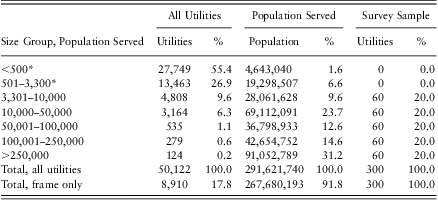
The water utility manager survey sampling frame was defined using the US Environmental Protection Agency's SDWIS. As Table A1 shows, utilities that serve more than 3,300 customers serve the overwhelming majority of the US population. However, a similarly large majority of utilities are very small, serving populations of fewer than 3,300. Simple random sampling would yield little data on executives of the medium-sized and large utilities that serve most of the US population. Therefore, stratifying to ensure inclusion of utilities of many sizes in the sample is important for drawing conclusions about the population of water utilities (Dziegielewski and Opitz Reference Dziegielewski and Opitz2004).
Sampling frame
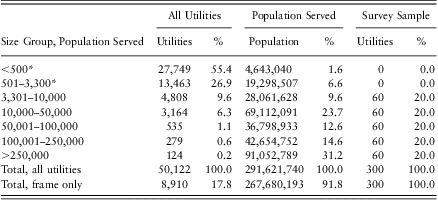
I excluded the smallest utilities (those that serve fewer than 3,300 people) from the sampling frame, and then stratified the sample, drawing 60 utilities at random from each of five remaining strata defined by SDWIS. Substantial variety across strata offered sufficient variation in size to draw valid statistical inferences about the effects of utility size on executive behaviours, while maintaining sufficient randomisation to allow for results to be generalisable.
Instrument
The survey instrument was comprised of two parts: (1) a structured telephone interview; and (2) an online questionnaire. The interview asked directly for career path information. The online questionnaire gathered behavioural data using the following scale items, modelled after similar items in Meier and O'Toole (Reference Meier and O'Toole2001, Reference Meier and O'Toole2007) and Teodoro (Reference Teodoro2011):
Administration
Since the present study employs a medium-sized sample, administrative procedures were designed to maximise response rate. Participants were guaranteed that their identities would be held in strict confidence. Administration of the survey proceeded with four steps:
1. Pre-notification. The research team mailed to each sampled executive a letter approximately one week in advance of the survey to notify them about the study and offer informed consent and appropriate disclosure information. Letters were addressed personally to each individual (not addressed generically to “General Manager” or “Director of Utilities”). Each letter was signed by the principal investigator and the researcher assigned to the specific executive. The letters were printed on custom stationery and mailed via US Postal Service in envelopes designed specifically for this study. Experimental research demonstrates that pre-notification letters generate higher response rates in telephone surveys (Traugott et al. Reference Traugott, Groves and Lepkowski1987), especially when the notification letters use a university letterhead (Brunner and Carroll Reference Brunner and Carroll1969; Fox et al. Reference Fox, Crask and Kim1988).
2. Scheduling. Approximately seven to ten business days after mailing the pre-notification letter, a member of the research team contacted each sampled executive by telephone to schedule an interview. In a few cases, the executive was immediately available to participate in the interview upon the initial contact. However, in most cases a research team member left a telephone message and/or set up an interview for a later date and time. A few sampled executives explicitly refused to participate in the study; otherwise, research team members called each sampled individual up to three times before abandoning a case.
3. Interviews. The project team conducted a telephone interview with each participant. Interviews were audio recorded for transcription.
4. Questionnaire. At the conclusion of the interview, participants were asked to complete the online questionnaire. Respondents were emailed a survey link immediately upon completing the interview; completion of the questionnaire required ∼15 minutes. Respondents were sent electronic reminders after three days if they did not complete the questionnaire.
Administration began in June 2011 and ended in August 2011. A total of over 700 telephone calls were made as part of the survey administration; an average of 2.10 calls was required for each participant.
Response
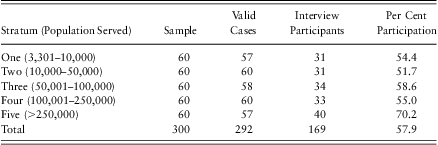
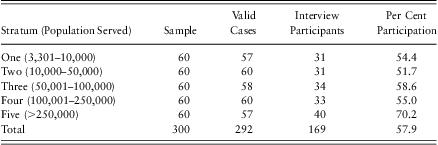
Table A.2 summarises participation in the survey. The water utility agency head position in eight of the 300 sampled utilities was vacant at the time of our contact, leaving a total of 292 valid cases. The overall response rate was 57.9 per cent of valid cases and 56.3 per cent of total cases; a total of 120 interview participants completed the online questionnaire, for a completion rate of 71.0 per cent. Response rates were non-randomly distributed, with the highest response rates among the largest utilities and lower response rates among smaller utilities. It is possible that managers of small utilities were more likely to be out of the office on field work and therefore less likely to be available for interviewing. It is also possible that the executives of medium-sized and large utilities were more familiar with the administering institution, its funding agency, and/or management research more generally and so were more likely to support the project. Vacancies appear to be randomly distributed across strata.
Summary of survey participation
Appendix B: Notes on post-stratification weighting
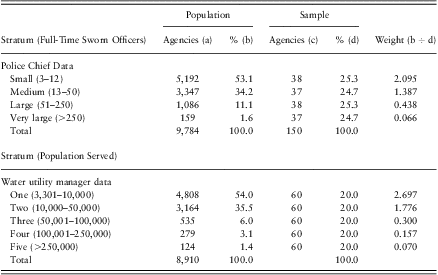
The police chief and water utility manager surveys analysed here employed stratified, randomised sampling methods that intentionally over-sampled larger agencies. Appendix A reports the procedure and rationale behind stratification for the water utility manager survey; see Teodoro (Reference Teodoro2011) for details on stratification process for the police chief data set.
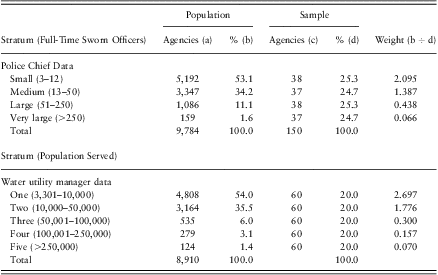
Stratification introduces sample bias to the survey because it is intentionally non-random. The standard correction for this non-randomness is to weight cases according to their strata. The present analysis uses simple population proportion weighting following the method described by Groves et al. (Reference Groves, Fowler, Couper, Lepkowski, Singer and Tourangeau2004): each stratum is assigned a weight after sampling so that the final sample represents more accurately the true population proportions. Table B.1 reports the post-stratification weights used in the police chief and water utility manager analyses, respectively, and shows how they were calculated. The statistical models reported in Table 3 apply these weights so that the manager of a water utility from stratum two (10,001–50,000 population) as 1.776 cases, while a respondent from the fourth stratum (100,001–250,000 population) is counted as just 0.157 cases. Non-response weights were not applied.
Post-stratification weights