The diet of cows is one of the most important factors influencing the composition and properties of milk, as well as its suitability for processing. Much research has been conducted to increase the content of bioactive components in milk (vitamins, unsaturated fatty acids, macronutrients and micronutrients that regulate biochemical processes in the body) and its functional (anti-carcinogenic, antioxidant, anti-sclerotic, anti-inflammatory or antibacterial) properties. Modification of the composition of milk fatty acids (FA) through diet primarily involves the introduction of various feeds or feed additives rich in fat, including sources of protected fat to avoid biohydrogenation of FA in the rumen (Woods and Fearon, Reference Woods and Fearon2009; Palmquist and Jenkins, Reference Palmquist and Jenkins2017). Due to their specific biological function, special attention has been focused on increasing the concentration of ω−3 PUFA. The content of ω−3 PUFA in milk, including CLA, can be increased by adding various vegetable or fish oils to the diet (Chouinard et al., Reference Chouinard, Corneau, Butler, Chilliard, Drackley and Bauman2001; Ferlay et al., Reference Ferlay, Glasser, Martin, Andueza and Chilliard2011) or whole oilseeds (Reklewska et al., Reference Reklewska, Oprządek, Reklewski, Panicke, Kuczyńska and Oprządek2002; Ward et al., Reference Ward, Wittenberg and Przybylski2002). Untreated vegetable oils have only a limited ability to alter milk FA composition (Jenkins and McGuire, Reference Jenkins and McGuire2006). Moreover, rumen-unprotected PUFA in the diet can lead to the formation of isomers blocking de novo synthesis of milk FA in the mammary gland (Bauman and Griinari, Reference Bauman and Griinari2003). In some studies, however, untreated oilseeds have provided protection from biohydrogenation owing to the nature of their hard husks (Glasser et al., Reference Glasser, Ferlay and Chilliard2008). Dietary supplementation with whole linseed induced favourable changes in milk fat composition expressed as increased content of CLA, EPA, DHA and vitamins A and E, as well as a decreased concentration of cholesterol (Ward et al., Reference Ward, Wittenberg and Przybylski2002). According to Reklewska et al. (Reference Reklewska, Oprządek, Reklewski, Panicke, Kuczyńska and Oprządek2002), even small doses of linseed, together with mineral supplementation, modified the milk fatty acid profile, milk fat composition and cholesterol content to a degree comparable to the changes induced by higher fat doses from other sources. Therefore, linseed is considered an excellent source of protein, energy and essential fatty acids, but there is an upper limit on its use in the diet of cows due to its high content of oil (Palmquist and Jenkins, Reference Palmquist and Jenkins2017).
In recent years, industrially rumen-protected fats, which are resistant to microbial biohydrogenation of FA, have been more commonly used than whole oilseeds (Rabiee et al., Reference Rabiee, Breinhild, Scott, Golder, Block and Lean2012). Among these, calcium salts of FA (Ca-salts) fed to cows in the amount of up to 800 g/d/head have proven effective in increasing milk production and milk efficiency and have had a positive effect on milk FA composition (Piperova et al., Reference Piperova, Moallem, Teter, Sampugna, Yurawecz, Morehouse, Luchini and Erdman2004; Jenkins and McGuire, Reference Jenkins and McGuire2006). Dietary supplementation with Ca-salts of FA from canola oil, soybean oil or linseed oil was shown to increase milk PUFA concentration, especially CLA, three to five times over the control diet (Chouinard et al., Reference Chouinard, Corneau, Butler, Chilliard, Drackley and Bauman2001). While there is considerable information regarding methods of nutritional modification of milk composition, knowledge of the effect of different fat sources used simultaneously on feed intake, milk yield and milk composition, including cholesterol, fat soluble vitamins and phospholipid classes, is still limited. We hypothesized that the use of a feed additive consisting of several components rich in fat, selected on the principle of complementarity, may positively influence mid-lactation cow performance and modify the FA composition of milk. The aim of this study was to determine the dose effect of an energy-protein feed additive containing Ca-salts from linseed and fish oil, whole linseeds and rapeseed cake on DMI and nutrient intake and on milk yield and composition in mid-lactation cows.
Materials and methods
The experimental procedures followed the Polish Law on Animal Protection and were approved by the Local Ethics Committee for Experiments on Animals in Kraków, Poland. The detailed experimental protocol is given in the online Supplementary File.
Animals and experimental design
The trial was conducted at a free-stall barn dairy farm (OHZ Osięciny Sp. z o.o., 400 cows, with average milk yield of about 11 000 kg per lactation) located in north-western Poland. Feed intake was measured using Calan gates (American Calan, New Hampshire, USA). The experimental TMR was mixed in a Super Data Ranger feeding wagon (SDR, American Calan, New Hampshire, USA). The amount of refusals was measured daily. The cows were milked twice daily in a herringbone milking parlour. The entire trial lasted 9 weeks (63 d) and consisted of a 3-week pre-treatment period and a 6-week period of data collection.
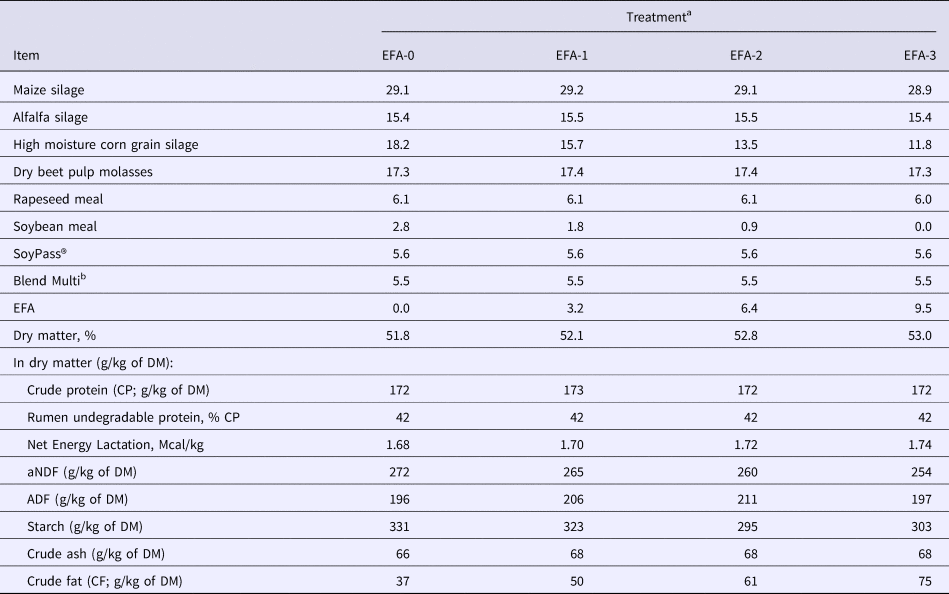
Forty multiparous Holstein-Friesian mid-lactation dairy cows were divided randomly into 4 groups of 10 cows each with average milk yield (42.2 ± 0.6 kg/d), average days in milk (67 ± 6) and average parity (3.0 ± 0.2; 2–5 min–max value). The TMR diet was formulated using CPM-Dairy software (CAHP, University of Pennsylvania, USA) based on NRC (2001) recommendations for a 670 kg cow producing 50 kg/d of milk containing 38 g/kg of milk fat and 32 g/kg crude protein. The treatments were as follows: TMR without the experimental energy-protein feed additive (EFA-0) or with 1 kg (EFA-1), 2 kg (EFA-2) or 3 kg (EFA-3) of the additive. The percentage of EFA in the dry matter of the experimental diets in the four treatments was 0, 3.2, 6.4 and 9.5%, respectively. Experimental TMR were balanced for protein and energy content using high-moisture maize silage and soybean meal (Table 1).
Ingredients (% of DM), chemical composition and nutritive value of experimental diets (TMR)

EFA, experimental feed additive; aNDF, neutral detergent fibre determined with heat-stable amylase; ADF, acid detergent fibre
a Diets without (EFA-0) or with 1 (EFA-1), 2 (EFA-2) or 3 kg/d (EFA-3) of experimental feed additive.
b Blend Multi – concentrate mixture with vitamin & mineral supplementation (%): soybean meal 43.57, urea 5.88, Farm Pack 2.94, Vitosa Biot Plus 10.59, Acid Buff 4.71, limestone 16.7, sodium chloride 5.88, magnesium sulphate 5.88, magnesium oxide 3.56, Rumex 0.29 (g in DM: CP 435, EE 14, NDF 86).
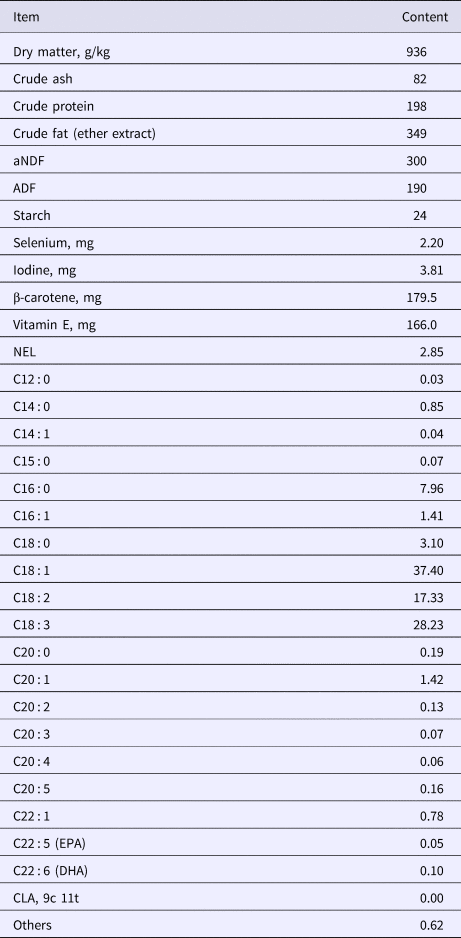
EFA contained whole linseeds of the yellow variety (30.30%), linseed and fish oil Ca-salts (1 : 1) manufactured according to our own formula (23.74%), high-fat heat-treated rapeseed cake (28.04%), wheat bran (15.82%), Blattin Lacto-Fatt (calcium salt of palm oil fatty acid; 1.68%) and mineral & vitamin mix (0.42%; in 1 kg: calcium 192 g, sodium 0.3 g, vitamin E 3700 mg, β-carotene 4000 mg, iodine as calcium iodate 70 mg, selenium as sodium selenite 50 mg). Ca-salts were considered a protected fat and a good source of PUFA available in the small intestine. EFA was in the form of a coarse meal (passed through a 4.0 mm sieve) with a pleasant vegetable smell and beige colour. Prior to being placed in the feed wagon, all concentrates were combined and then mixed with other feeds for 5 min. The content of minerals and vitamins in the EFA (Table 2) was not taken into account when balancing minerals and vitamins in the diet. The control diet met NRC (2001) requirements, while EFA-1, EFA-2 and EFA-3 diets exceeded NRC requirements for vitamin E, iodine and selenium, whose total daily intake by cows receiving 3 kg of EFA was 916.0, 23.8 and 8.8 mg, respectively.
Chemical composition (g/kg DM), net energy lactation content (NEL, Mcal/kg DM) and fatty acid profile (g/100 g FA) of experimental feed additive (EFA)

Sampling and chemical analysis
Samples of individual feeds, TMRs and refusals of each cow were collected daily, stored at +2 °C and then pooled weekly and kept frozen (−18 °C) for further analysis. Dry matter intake (DMI) was calculated from DM content determined by drying TMRs and refusals in a forced-air oven at 50 °C for 48 h. In the feed samples, TMRs and refusals (dried and ground with a Pulverisette 15 Laboratory Cutting Mill (Fritsh GMBH, Idar-Oberstein, Germany) to pass through a 1.0 mm sieve), the content of dry matter, ash, crude protein, ether extract and acid detergent fibre (ADF) were determined according to AOAC (2004) (procedure numbers 934.01, 942.05, 954.01, 920.39 and 973.18, respectively). Neutral detergent fibre (aNDF) was determined according to van Soest et al. (Reference Van Soest, Robertson and Lewis1991) using an Ankom220 Fiber Analyzer (ANKOM Technology, NY, USA) with heat-stable amylase and expressed inclusive of residual ash. Starch content was determined by an enzymatic method (Faisant et al., Reference Faisant, Planchot, Kozlowski, Pacouret, Colonna and Champ1995). The FA profile was determined using a Varian 450-GC gas chromatograph (Varian BV, Middelburg, The Netherlands) with an FID detector, equipped with a CP-SIL 88 column (FAME, length 100 m, diameter 0.25 mm).
Milk analysis
Milk was collected individually from each animal once a week during the collection period. Milk samples from morning and evening milking were pooled proportionally and stored with Microtabs II (Bentley). For determination of FA profile, cholesterol, phospholipids and fat-soluble vitamins, samples from each animal were collected only from morning milking, cooled (4 °C), and then immediately frozen.
Milk protein, fat, lactose and urea were determined with a MilkoScan FT2 (Foss Analytical). Milk FA profile was determined by gas chromatography (GC) using a Varian 450-GC apparatus (Varian BV Middelburg, The Netherlands) with an FID detector and a CP-SIL 88 column (FAME, length 100 m, diameter 0.25 mm). The sum of phospholipids in the milk fat and their individual classes were determined by high-performance liquid chromatography (HPLC) with a Dionex UltiMate 3000 apparatus (Thermo Fisher Scientific, Waltham, MA, USA) equipped with a Corona CAD detector and a Thermo Betasil DIOL 5 µm (150 × 4.6 mm) column according to Kiełbowicz et al. (Reference Kiełbowicz, Micek and Wawrzeńczyk2013). Lipids were extracted from the milk by the Folch et al. (Reference Folch, Lees and Stanley1957) method. Cholesterol content was determined by capillary GC (Trace GC Ultra (Thermo Electron Corporation) with a HP-5 column), using the method of direct saponification for the sample preparation according to Fletouris et al. (Reference Fletouris, Botsoglou, Psomas and Mantis1998). The HPLC method (Agilent 1100 apparatus (Agilent Technologies, Santa Clara, CA, USA) equipped with a Zorbax Eclipse XDB-C8 column with a diameter of 4.5 mm × 150 mm) was used for determination of fat soluble vitamins (A, D, E and K) and β-carotene. The method involved saponification at room temperature and subsequent extraction of vitamins with n-hexane. The vitamins were resolved with a C18 reversed-phase column and detected by UV spectrophotometry (Albalá-Hurtado et al., Reference Albalá-Hurtado, Novella-Rodríguez, Veciana-Nogués and Mariné-Font1997).
Statistical analysis and calculations
Data were analysed as a completely randomized design using the MIXED procedure of SAS (SAS, 2002). Dry matter and nutrient intake by dairy cows as well as milk yield data were reduced to weekly means and then analysed, whereas somatic cell counts were log-transformed prior to analysis to achieve normal distribution of the data. The statistical model included the random effect of cow and the fixed effects of time (week), treatment and the time by treatment interaction (Littell et al., Reference Littell, Henry and Ammerman1998). The time by treatment interaction for the variables analysed was not significant and is not shown in the tables. The optimal covariance structure was chosen based on Akaike's criterion. Linear, quadratic and cubic contrasts were performed for data interpretation. The significance level was set at P ≤ 0.05. Tendencies were discussed at 0.05 < P < 0.10 unless otherwise stated. All data are reported as least squares means with pooled standard error of the means.
Results
The feed additive (EFA; Table 2) had a high content of crude protein, crude fat and aNDF, and low content of starch (198, 349, 300 and 24 g/kg DM, respectively). The high net energy content (NEL 2.85 Mcal/kg DM) was primarily the result of the large concentration of fat, especially in the form of Ca-salts (CS). The considerable portion of CS, as well as the fat-rich whole raw linseeds and rapeseed cake, resulted in a high proportion of unsaturated FA in EFA, especially oleic, linoleic and linolenic acid, whose combined share in the total FA reached 83%. The high temperatures used during the preparation of the linseed/fish oil Ca-salts probably degraded nearly all of the EPA and DHA, so their content in the sum of FA in EFA was close to zero.
The TMRs used in the control and treatment groups (Table 1) had similar ash and crude protein (CP) content (in DM). The EFA diets contained more crude fat (CF) but less starch and aNDF than the control diet. The fat content increased from 37 g/kg DM in EFA-0 to 75 g/kg DM in the EFA-3 diet. The diets differed slightly in net energy content.
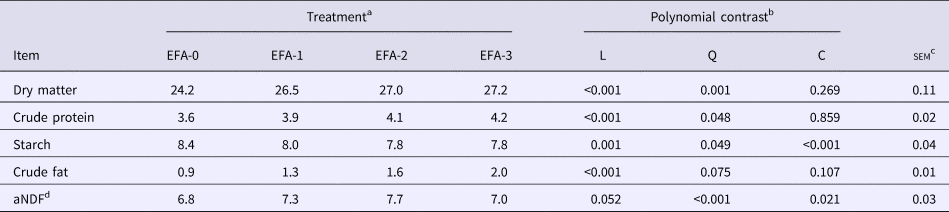
No treatment × time (week) interaction was shown for any of the parameters analysed. Increasing the inclusion rate of EFA in the diet caused a linear increase in DM, CP and CF intake (P < 0.05; Table 3). The lowest DMI was observed in the control and the highest in group EFA-3 (difference 3.0 kg DM/d, P < 0.01). With the exception of starch, intake of all nutrients was lowest in the control group. The highest intake of starch from the control diet resulted from its content of high-moisture maize grain. Cows from group EFA-3 consumed 2.0 kg/d CF, which was 1.1 kg more than in the control group.
Dry matter and nutrient intake by dairy cows (kg/d per cow)

a Diets without (EFA-0) or with 1 (EFA-1), 2 (EFA-2) or 3 kg/d (EFA-3) of experimental feed additive.
b L – linear; Q – quadratic; C – cubic.
c Standard error of the mean.
d aNDF – neutral detergent fibre determined with heat-stable amylase.
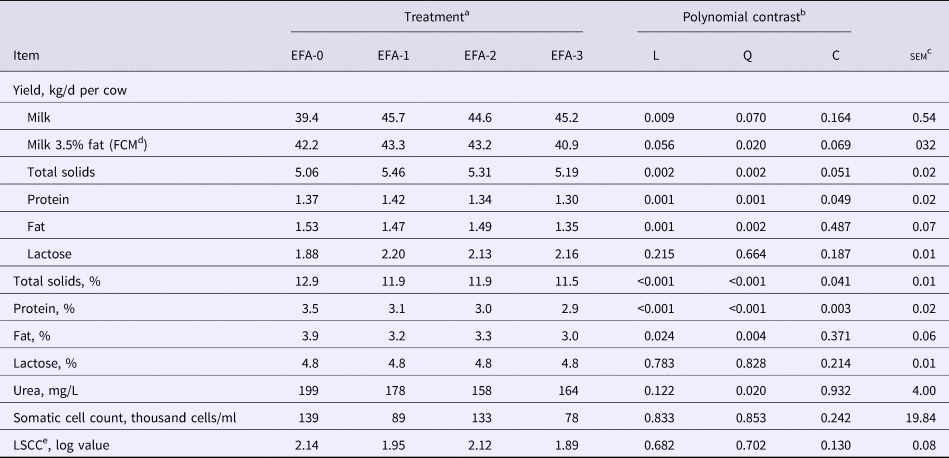
The average milk yield of cows from the treatment groups was 45.2 ± 0.6 kg/d, which was 5.8 kg higher than in the control (linear effect, P < 0.01; Table 4). The greatest difference (6.3 kg/d) was observed between EFA-0 and EFA-1. However, the differences in fat-corrected milk (3.5%) between groups EFA-0, EFA-1 and EFA-2 were much smaller, with the lowest value found for group EFA-3 (quadratic effect, P < 0.05).
Daily milk and solids yield, proximate chemical composition and somatic cell count in milk

a Diets without (EFA-0) or with 1 (EFA-1), 2 (EFA-2) or 3 kg/d (EFA-3) of experimental feed additive.
b L – linear; Q – quadratic; C – cubic.
c Standard error of the mean.
d FCM – Fat-Corrected Milk (FCM (3.5%) = 0.35M + 18.57F where M = quantity of milk in kg, F = amount of fat in kg in ‘M’ quantity of milk).
e Somatic cell count transformed to a logarithmic scale (LSCC = loge(somatic cell count × 10−3)).
The highest total solids (TS) content in the milk was found in the control group (P < 0.01; Table 4). The TS content of the milk in the treatment groups was similar, averaging 11.8%. A similar trend was observed for milk protein and milk fat content. The greater the share of EFA in the diet, the lower protein and fat content was obtained in the milk (quadratic effect, P < 0.01). However, apart from fat, the daily yield of milk solids was not negatively affected by EFA. The reduction in daily fat yield between the control and EFA-3 was 0.18 kg/d per cow (P < 0.01).
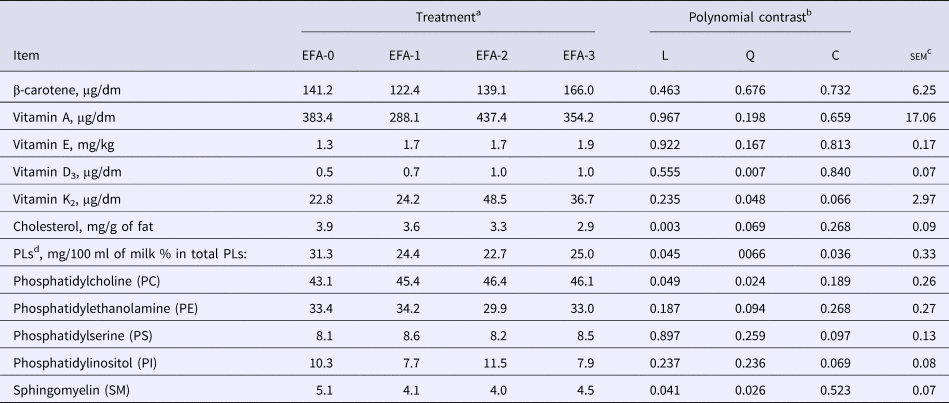
Beta-carotene and vitamin A and E concentrations in the milk were not affected by EFA (Table 5). Increasing the proportion of EFA in the diet caused an increase in the concentrations of vitamins D3 and K2 (quadratic effect, P < 0.05). The reverse trend was observed in the case of cholesterol (linear effect, P < 0.01) and PLs (cubic effect, P < 0.05). Increasing the quantity of EFA in the diet gradually decreased their content in the milk. The average content of PLs in the milk from the treatment groups was 7.3 mg/100 ml lower than in the control. Changes were also noted in the proportions of different classes of PLs in the milk. An increase in phosphatidylcholine (P < 0.05) in the total phospholipids was accompanied by a reduction in the proportion of sphingomyelin (P < 0.05).
Content of fat-soluble vitamins, cholesterol and phospholipids (PLs) in milk

a Diets without (EFA-0) or with 1 (EFA-1), 2 (EFA-2) or 3 kg/d (EFA-3) of experimental feed additive.
b L – linear; Q – quadratic; C – cubic.
c Standard error of the mean.
d PLs – phospholipids.
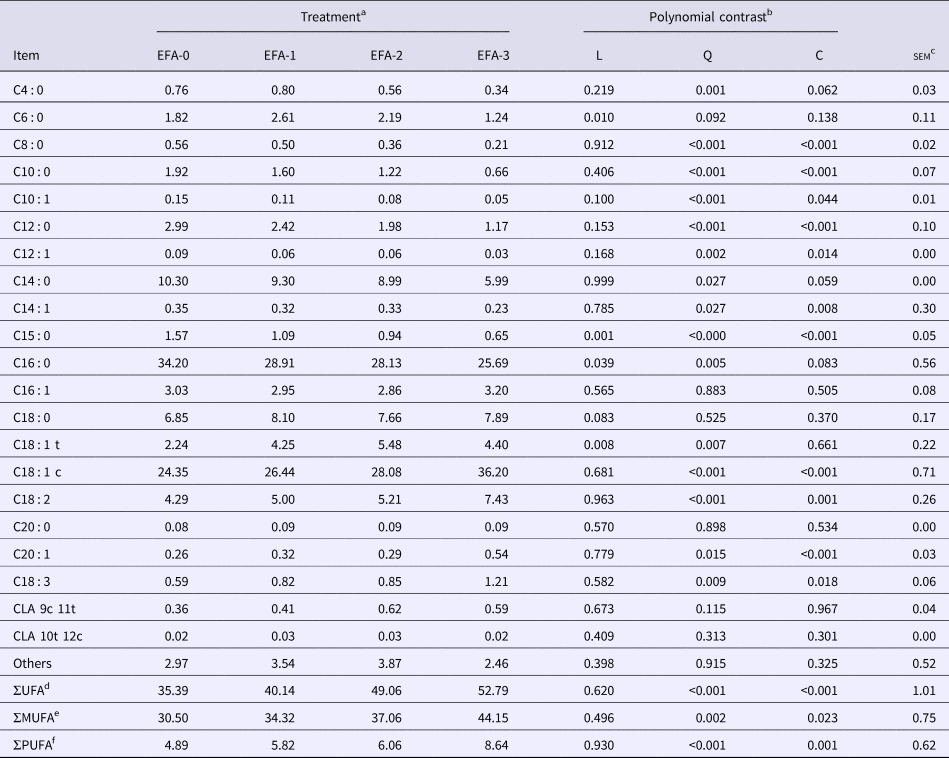
The use of EFA increased the proportion of unsaturated FA (UFA) while reducing the share of saturated FA, mainly C14 : 0 and C16 : 0 (Table 6). The differences were greater when a larger amount of EFA was included in the diet. The use of 3 kg of EFA increased PUFA content in the milk by 77% (P < 0.01) and CLA 9c11t by 64% (P > 0.05). A gradual increase in the content of C18 : 3, ω−3 by 105% between EFA-0 and EFA-3 (P < 0.01) was observed as well.
Fatty acid profile (g/100 g FA) of milk fat

a Diets without (EFA-0) or with 1 (EFA-1), 2 (EFA-2) or 3 kg/d (EFA-3) of experimental feed additive.
b L – linear; Q – quadratic; C – cubic.
c Standard error of the mean.
d Sum of unsaturated fatty acids.
e Sum of monounsaturated fatty acids.
f Sum of polyunsaturated fatty acids.
Discussion
Modern feed additives can not only increase the productivity of cows, but also affect their health and modify milk composition (Rabiee et al., Reference Rabiee, Breinhild, Scott, Golder, Block and Lean2012; Palmquist and Jenkins, Reference Palmquist and Jenkins2017). However, some of them may have negative side effects. For example, the low palatability of Ca-salts used as a feed additive may reduce the feed intake of cows (Brzóska, Reference Brzóska2006; Lounglawan et al., Reference Lounglawan, Chullanandana and Suksombat2008). The results of our research demonstrated that the higher the content of experimental feed additive (EFA) in the feed ration, the higher the DMI was. In the EFA-3 group, which received 3 kg of EFA daily, the total intake of Ca-salts exceed 750 g/d per head and did not cause a reduction in DMI as compared to the control group. In fact, EFA significantly improved the quantity of diet consumed by cows, which was accompanied by a significant (P < 0.05) increase in milk yield. Similar trends in yield were observed in an experiment conducted by Hermansen (Reference Hermansen1990), but the results of our study may have been affected not only by Ca-salts but also by the presence of other fat and protein sources used in manufacturing EFA, such as full-fat linseeds (30.30%) or high-fat heat-treated rapeseed cake (28.04%).
Many experiments based on the introduction of Ca-salts to the diet have demonstrated its positive effect on the milk yield of cows (Karcagi et al., Reference Karcagi, Gaál, Ribiczey, Huszenicza and Husvéth2010; Rabiee et al., Reference Rabiee, Breinhild, Scott, Golder, Block and Lean2012; Shelke et al., Reference Shelke, Thakur and Amrutkar2012). This is mainly due to the increase in energy concentration in the diet, which in conjunction with sufficient protein intake stimulates the synthesis of milk in the mammary gland. In this respect, the increased supply of enteric polyunsaturated fatty acids is important as well. Our results show that EFA supplementation significantly increased the milk yield of the cows. The highest average yield was recorded in the group receiving 1 kg/d EFA, while the smallest increase in average productivity was observed in group EFA-3, despite the highest DM intake. It can be hypothesized that the cows from the control group had a small energy deficit and the use of EFA in small amounts (1 kg) helped to reduce its negative effects and thus improved milk production. Increasing the amount of EFA in the diet to 2 or 3 kg/d led to an even greater increase in the energy concentration, but may at the same time have induced some disturbances in rumen function due to high fat supply (Palmquist and Jenkins, Reference Palmquist and Jenkins2017). However, some authors indicate a lack of response in cows to the use of Ca-salts (Brzóska, Reference Brzóska2006; Lounglawan et al., Reference Lounglawan, Chullanandana and Suksombat2008). The reasons for this phenomenon are not well understood, but it is probably a consequence of the use of the additive in the wrong period of lactation. Effects are usually mild in cows in late lactation, when there is virtually no energy deficit and all energy needs are fully covered by the basic ration. Although the data on this subject are not entirely consistent, in most cases a significant increase in performance has been achieved during early or peak lactation (Salem and Bouraoni, Reference Salem and Bouraoui2008; Karcagi et al., Reference Karcagi, Gaál, Ribiczey, Huszenicza and Husvéth2010; Shelke et al., Reference Shelke, Thakur and Amrutkar2012). It should also be emphasized that in the current study there were no differences in the milk FCM 3.5% yield between treatment groups receiving 1 or 2 kg of EFA. The increase in energy supply in the diet (between these groups) by EFA was probably associated with a reduction in the net energy generated from the nutrients of the basic ration in the gastrointestinal tract.
The average total solids content of milk showed a tendency to decline as the proportion of EFA in the cows’ diet increased. This effect has been shown to be caused mainly by a reduction in the protein concentration of the milk (Brzóska, Reference Brzóska2006; Salem and Bouraoni, Reference Salem and Bouraoui2008; Karcagi et al., Reference Karcagi, Gaál, Ribiczey, Huszenicza and Husvéth2010). These observations were entirely confirmed by our results. Feeding cows EFA reduced the total solids and protein content of their milk. The small differences in protein yield between experimental groups may suggest that the lower total solids content was partially due to the dilution effect associated with increased milk production.
Studies by Hermansen (Reference Hermansen1990) and Chen et al. (Reference Chen, Jan, Wen-Shyg Chiou and Yang2002) showed only a slight or no effect of Ca-salts on the protein level in milk. When this effect has been observed, the decrease in milk protein content has generally been attributed to an insufficient supply of amino acids in the diet in relation to the amount of supplied energy, but the general reasons for the reduction in milk protein content are still not fully understood. It is believed to be due to the lack of synchronization of energy and amino acid supply for protein synthesis in the mammary gland. Kowalski et al. (Reference Kowalski, Pisulewski and Spanghero1999) showed that reduced protein synthesis can be the result of changes in the source of energy supplied to the animal. The addition of protected fat means that a greater share of the energy is not derived from carbohydrates, which are the ‘fuel’ for the synthesis of bacterial protein. Glycerol and especially fatty acids are not desirable for this process, and ruminal microbes are unable to use them as efficiently as carbohydrates. Salem and Bouraoni (Reference Salem and Bouraoui2008), as well as Shelke et al. (Reference Shelke, Thakur and Amrutkar2012), demonstrated that the addition of rumen-protected or even unprotected fat to the diet, used in combination with protected amino acids (mainly lysine and methionine) as the most limiting amino acids, had a satisfactory effect on milk protein content. This was also evident in a study by Chen et al. (Reference Chen, Jan, Wen-Shyg Chiou and Yang2002), in which the use of rumen-protected soybeans increased the supply of rumen by-pass protein. In this way the negative effects of supplemental fat in the diet on the protein content in milk were mitigated.
The majority of studies (Hermansen, Reference Hermansen1990; Brzóska, Reference Brzóska2006; Salem and Bouraoni, Reference Salem and Bouraoui2008) indicate that Ca-salts significantly increase the fat content in milk. This relative increase may be due to the fact that the use of protected fat increases the energy concentration in the diet. A reduction in the consumption of glucose in the mammary gland could lead to an increase in the supply of long-chain fatty acids, which are used to a greater extent as a substrate in lipid synthesis (Woods and Fearon, Reference Woods and Fearon2009). In our study, the use of EFA in the ration was accompanied by a significant decrease in the fat content of milk. Unlike in the case of protein, the reduction in the fat concentration was so great that it was not compensated by increased milk synthesis. Therefore, we hypothesize that this effect was primarily due to the negative influences of the various forms of fat contained in EFA (protected and unprotected). This could induce some disturbance in rumen function, leading to insufficient production of acetic acid and more C18 : 1trans and CLA, which inhibit de novo synthesis of short- or medium-chain fatty acids in the mammary gland. This hypothesis may be confirmed by the significant changes in the FA profile of the milk fat. The decrease in the concentration of saturated FA (SFA) was accompanied by an increase in unsaturated FA (C18 : 1, C18 : 2 and C18 : 3, CLA 9c11t). However, this type of change may be favourable, because it reduces the energy requirements of cows, especially in the peak of lactation, and results in a healthier product for the consumer. Milk SFA, such as palmitic (C16 : 0), myristic (C14 : 0) or lauric (C12 : 0) acid, increase total plasma cholesterol content in humans, especially LDL (Ohlsson, Reference Ohlsson2010), and its diminution is considered beneficial. The health-promoting effect of EFA was also shown as a reduction in total cholesterol content in the milk and an increased vitamin D3 and K2 concentration.
Experimental feed additive did not affect the β-carotene or vitamin E concentration in the milk, but significantly modified the content and structure of PLs. The concentration of β-carotene and fat-soluble vitamins in milk depends on its dietary intake and on the fat content in milk (Schaafma, Reference Schaafma, Roginski, Fuquay and Fox2003). The reason that EFA did not affect the content of β-carotene or vitamins A and E may be the significantly lower content of fat in the milk from the treatment groups.
The use of 2 kg of EFA raised the level of vitamin D and K in the milk to its upper limit, although EFA was not supplemented with vitamin D and K. Vitamin K2 is synthesized by ruminal and intestinal bacteria, and this process is the predominant source of vitamin K in ruminants. In this context, the fluctuation observed in vitamin D and K concentrations may be at least in part associated with the impact of EFA on rumen metabolism (Schaafma, Reference Schaafma, Roginski, Fuquay and Fox2003).
PLs are the major constituents of biological membranes and are fundamental in milk for the emulsification of fat in water. Together with proteins, they are the main constituents of the milk fat globule membrane (MFGM), which encircles the lipid droplets secreted by the mammary gland (Contarini and Povolo, Reference Contarini and Povolo2013). For this reason, the PLs content in milk is associated with fat concentration, which has been shown in the present study.
The composition of PLs in milk is of considerable interest in terms of their nutritional and functional properties. They are quantitatively minor constituents of milk fat, but are of great importance because they define the structural properties of the MFGM. For this reason they influence the physical functionality of milk constituents and dairy products, and many health benefits are attributed to total PLs as a group as well as to individual compounds. Unfortunately, little is known about the factors that influence PLs concentrations in milk fat or whether its concentrations can be modified via the diet of cows. Therefore, the reasons for the changes observed in the present study in the proportion of different phospholipids classes in total PLs are difficult to explain. However, it is well confirmed that PLs content in whole milk can increase with increasing days in milk due to associated increases in milk fat content.
In conclusion, the protein-energy feed additive (EFA) containing different sources of fat improved the feed intake and milk performance of dairy cows in mid-lactation. Although DMI was the highest when EFA was administered in the amount of 3 kg/d, it is recommended that its quantity in a cow's diet should be only 1 kg, as this level resulted in the highest milk yield and the smallest drop in protein and fat concentration in the milk. Preliminary economic analysis (data not presented) confirms that this level of EFA feeding is also the most beneficial financially and results in a healthier product for the consumer. Milk from cows fed EFA diets had significantly lower cholesterol and PLs content, a higher concentration of vitamin D3 and K2, and a higher proportion of unsaturated fatty acids, including CLA, in the sum of fatty acids in the milk fat. In summary, the study has shown that the feed additive tested may improve the efficiency of milk production. However, additional research is required to characterize the effect of EFA on the suitability of the milk for processing.
Supplementary material
The supplementary material for this article can be found at https://doi.org/10.1017/S0022029919000062.
Acknowledgement
The research was financed by the project ‘BIOFOOD – innovative, functional products of animal origin’, no. POIG.01.01.02-014-090/09, funded in part by the EU from the European Regional Development Fund within the Innovative Economy Operational Programme.
Financial support
None.