Introduction
The aim of this paper is to examine the implications of assemblage thought for our understanding of medieval urbanism, through the specific study of one town, Southampton, UK, in the later medieval period. It draws upon scholarship from contemporary urban geography as well as archaeology and I propose that, by thinking relationally, prevailing economic and social narratives can be challenged, allowing us to better understand the complexity of urban settlements and how power and agency are distributed through them. As such, the paper can be situated within an emerging body of literature which questions the modernist divisions between society and nature, and human and non-human. Fruitful discussion about the implications of actor networks (Latour Reference Latour2005), assemblages (Deleuze and Guatarri Reference Deleuze and Guattari1987; DeLanda Reference DeLanda2006; Reference DeLanda2016) and meshworks (Ingold Reference Ingold2007) for archaeology has caused us to swim in a sea of manifestos for redefining our understanding of past relations with the material world (e.g. Witmore Reference Witmore2007; Webmoor Reference Webmoor2007; Olsen Reference Olsen2007; Shanks Reference Shanks2007; Hodder Reference Hodder2012; Gosden and Malafouris Reference Gosden and Malafouris2015). However, the application of such approaches to concrete archaeological case studies remains a work in progress.
Fitting into a wider ‘ontological turn’ within the social sciences, recent developments in archaeological theory utilize a variety of conceptual frameworks ranging from relational theories of actor networks and assemblages to non-Western ontology to rethink our engagement with the world (e.g. Alberti and Marshall Reference Alberti and Marshall2009; Watts Reference Watts and Watts2013). Increasingly these ideas are being put to work to address specific archaeological questions in a range of contexts from understanding Mesolithic human–environment interactions (Cobb Reference Cobb, Bonney, Franklin and Johnson2016) to prehistoric burial practices (Fowler Reference Fowler2013; Crellin Reference Crellin2017) and economic and social developments in the prehistoric, Roman and medieval periods (Jones and Sibbesson Reference Jones, Sibbesson, Alberti, Jones and Pollard2013; Harris Reference Harris and Watts2013; Van Oyen Reference Van Oyen2015; Jervis Reference Jervis2016a). These studies of archaeological material do not just allow us to utilize theoretical ideas, but provide opportunities to tackle some of the interpretive difficulties inherent within any new approach (e.g. Lucas Reference Lucas2012; Fowler and Harris Reference Fowler and Harris2015) and to develop new ideas to extend these perspectives and develop distinctively archaeological conceptual and methodological frameworks.
Defining the problem: archaeology, history and decline in later medieval Southampton
The 14th and 15th centuries were a period of turbulence across Europe. The Black Death eradicated up to half of England's population and its impact was compounded by climatic change which caused several episodes of famine (see Campbell Reference Campbell2016 for detailed analysis). Trade was disrupted by war in Europe and the English economy became increasingly reliant on trading routes to the Mediterranean. It has been commented (Platt Reference Platt2012) that archaeologists have not adequately theorized these crises in the 14th century and it is true that there are few intensive studies of the fortunes of rural (e.g. Lewis Reference Lewis2016) or urban (e.g. Astill Reference Astill and Slater2000; Jervis Reference Jervis2016b) communities in this period. It has, however, been a period of intense debate by historians, particularly within the field of economic history. Our focus here is the towns and, for brevity, it is only necessary to provide a brief summary of the key points of contention (for a more detailed review see Dyer Reference Dyer1991; Jervis Reference Jervis2016b).
The initial contention, made most strongly by Postan (Reference Postan1973), Pythian-Adams (Reference Pythian-Adams, Abrams and Wrigley1978; Reference Pythian-Adams1979) and Dobson (Reference Dobson1977) is that towns suffered economic decline and an associated decay of their fabric as a result of the disruption of the 14th century. However, the historical evidence for this ‘decline’ is extremely ambiguous. The most intensively utilized sources of evidence are tax records, which are unreliable as measures of population or wealth and can be read as providing evidence for stagnation, resilience or buoyancy (Rigby Reference Rigby2010, 410–11). Scholars such as Bridbury (Reference Bridbury1981; Reference Bridbury1984) and Tittler (Reference Tittler1984) cite evidence for urban building projects and a growth in the proportion of taxation received from towns between the 14th and 16th centuries as a sign of urban buoyancy. Comparative analyses of historical records (Saul Reference Saul1982; Bailey Reference Bailey1993; Dyer Reference Dyer1991; Reference Dyer and Slater2000) and archaeological evidence (Jervis Reference Jervis2016b; 2017) suggest that fortunes were mixed, with some towns prospering and others suffering for a variety of reasons, but particularly in relation to regional economies. The concept of decline itself can be questioned; we would expect urban populations to fall, but this need not be indicative of decline (Reynolds Reference Reynolds1980; Palliser Reference Palliser and Thompson1988, 2). Lilley (Reference Lilley and Slater2000) proposes that decay of the physical landscape need not be indicative of economic decline, urban contraction potentially being an indicator of adaptation to a new set of socio-economic circumstances (see also Lilley Reference Lilley2015). Discussing the case of Coventry, for example, he proposes that population decline had little impact on the physical landscape and that localized decay need not be indicative of a general state of decline (Lilley Reference Lilley and Slater2000, 248). Lilley (ibid., 258) goes on to suggest that we should move away from thinking in terms of an opposition between growth and decline, to thinking about change and transformation in the urban landscape, a position which forms the basis of the current paper. Furthermore, a decline in the taxable wealth of a town does not, necessarily, mean that places ceased to perform economic or administrative functions. Archaeological evidence has added little to the debate so far. Astill (Reference Astill and Slater2000) reviewed the evidence from a number of towns, showing that there are variations in fortune but that the 15th century is less visible than earlier periods due to changes in waste disposal practices, which could be related to lower population density or to a stronger concern with hygiene. We do, however, see evidence for the rebuilding of private and public buildings (Hinton Reference Hinton1990, 194–95; Johnson Reference Johnson2010; King Reference King2010), which supports recent economic analyses which suggest that even if the economy as a whole was in recession, gross domestic product per capita, a measure of individual wealth, was high, suggestive of opportunities to develop personal prosperity, achieve social mobility and increase living standards (Broadberry et al. Reference Broadberry, Campbell, Klein, Overton and van Leeuwen2015, 203). In a previous paper (Jervis Reference Jervis2017), I proposed that assemblage theory offers opportunities to rethink the question of later medieval urban fortunes by focusing on the implications of small-scale practices, and called upon us to see urbanity not as a state of being but as an unfinished state of becoming. In doing so it allows us to shift from seeing towns purely in economic terms, either as declining or growing economic units, to seeing them as bundles of interaction which are transformed by, and transform, the wider networks of social interaction of which they are a part. Critically such an approach requires a move from a general debate regarding ‘decline’ to a focus on the different forms of urbanism which emerged from specific sets of relations. Before applying this framework, it is necessary to briefly introduce the case study of Southampton, chosen as a place which was clearly unique in the way that its fortunes unfolded, within the context of this earlier work on urban fortunes.
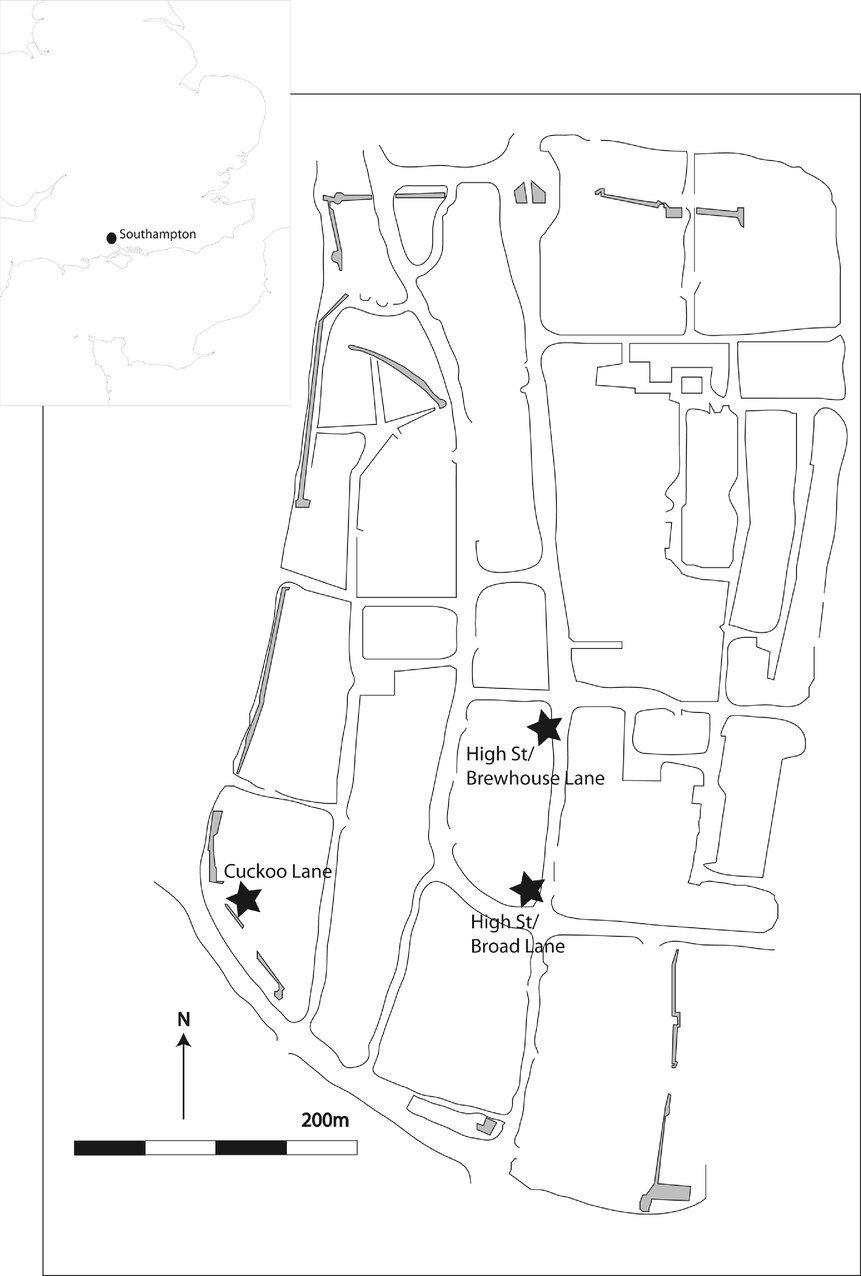
Southampton's fortunes Southampton was a major trading port throughout the Middle Ages, as well as being a point of departure for English forces fighting in France (figure 1). As tensions rose, Southampton's trade, which was largely focused on France, declined, although some salvation came from the use of the port by merchants from Florence (Ruddock Reference Ruddock1951). This disruption to trade in the mid- to late 14th century can be seen in a clear decline in the quantity of imported pottery found through archaeological excavation (Brown Reference Brown2002, 131). These tensions were pulled sharply into focus in October 1338, when French raiders attacked the town. The French raid had an immediate impact. Not only was property, principally that occupied by merchants around the waterfront, destroyed, but there was also substantial looting and royal stocks of wool and wine were lost. The historical evidence for destruction is supported by the excavated remains, with sites on English Street and French Street showing evidence of destruction and abandonment, for example in the form of deposits of burnt rubble (Platt and Coleman-Smith Reference Platt and Coleman-Smith1975, 37). The localized impact of the raid can be seen through excavations at Winkle Street in the east of the town, where there is no visible archaeological evidence of destruction (ibid., 273–75). Properties were listed as waste in rentals of 1340 and 1342 and trade dipped considerably, as Florentine merchants temporarily transferred their trade to Bristol (Platt Reference Platt1973, 110–11).
Plan of Southampton, showing the location of sites mentioned in the text. Image: the author.

If the raid had been an isolated event, Southampton would probably have recovered fairly quickly. However, like the rest of England, Southampton was hit by multiple traumas in the later 14th century; plague and war hit business confidence and disrupted trading routes. Archaeological excavations at sites on West Street and at Cuckoo Lane show that some plots were vacant before 1338, in some cases due to fire (Platt and Coleman-Smith Reference Platt and Coleman-Smith1975, 195, 289). Military demand absorbed many of the region's resources and in the 1370s there was a distinct lack of foreign merchants in the borough (Platt Reference Platt1973, 119–21). Despite this, Southampton was not stagnant. It developed a more military character as soldiers were posted there and it functioned as an embarkation point. The castle was rebuilt by 1388 and the town wall was constructed in stone fairly rapidly following the raid to secure the town (ibid., 129). This militarization of the urban landscape cut off some properties from the waterfront, perhaps causing their abandonment (Platt and Coleman-Smith Reference Platt and Coleman-Smith1975, 294–97; Brown Reference Brown2002, 143).
There is, however evidence for continuity and investment; for example, some standing buildings show evidence of late 14th-century work (Faulkner Reference Faulkner, Platt and Coleman-Smith1975). Economic recovery in the 15th century can largely be attributed to the initiative of Southampton's burgesses, who invested in the infrastructure of the port, including building new wharfage facilities, the use of which incurred tolls. Some plots left vacant after the raid and subsequent disruption were redeveloped (Platt Reference Platt1973, 141–45). When trade resumed it was largely in the hands of foreign merchants, with Southampton's burgesses having diverse portfolios, engaging in trade and redistribution, as well as hospitality. By 1449 there were at least fifty foreign merchants from the Low Countries and Italy resident in Southampton, with regular Italian trade being secured in 1421 (Platt Reference Platt1973, 152–55). This shift in the direction of trade can be seen in the sources of imported pottery, which were increasingly from Italy, Spain and the Netherlands, rather than France (Brown Reference Brown2002, 131–34). The export of English cloth drove the economy, with the port having a somewhat different function than in earlier centuries, when it was primarily a landing place for goods, particularly wine (largely for royal consumption) and a point of departure for provisions being sent to English territories in France.
The historical narrative is one of a fairly conventional economic cycle: recession followed by recovery, with a boom in the mid-15th century. Some archaeological evidence, particularly that provided by the pottery, supports this economic meta-narrative. However, archaeological excavations across the town show that different households experienced this change in different ways. Southampton did not disappear, and continued to function as a port in this period. There were certainly changes in the volume and direction of trade, and the port developed a more militarized character. However, we can question whether simply talking about a town in decline captures this diversity of activity and whether a focus on macro-economics and the international political situation really explains the situation in Southampton. Here it is proposed that assemblage theory allows us to think more deeply about these questions and to ask what it was about Southampton that changed and what remained, by seeing the town not as a purely economic and political entity, but as an entangled web of social interactions.
Approaching the problem: towns as assemblages
Assemblage thought, derived from the writing of Deleuze and Guattari (Reference Deleuze and Guattari1987) and further developed by DeLanda (Reference DeLanda2006; Reference DeLanda2016), provides a way of seeing the world as a series of connected, affective, bundles of participants which might include people, substances, objects or ideas. The idea of the town has featured heavily in the writing of DeLanda (Reference DeLanda1997; Reference DeLanda2006, 94–119; Reference DeLanda2016, 16–35) and, therefore, exploring its implications for urban archaeology is a logical step. Thinking about towns as assemblages forces us not to focus on the essence of an urban place – that is, the things which make it a town – but, rather, to think about how particular assemblages emerge, coalesce and dissolve into constellations that we identify as being similar to other processes, and through which the idea of a town might develop or be re-enforced. Critically, such an approach allows us to see towns not as stable, finished entities, but as an ongoing, unfolding process of becoming – as a set of assemblages in flux.
If, following DeLanda (see also Deleuze and Guattari 1987; Bennett Reference Bennett2010) we reject the idea of essences in order to focus on the emergent properties of assemblages, the very terms of our analysis come to be called into question. Elsewhere (Jervis Reference Jervis2016a, 382–84) I have reflected upon how the category of ‘town’ is used in medieval archaeology, following Fowler (Reference Fowler2013, 44–46) in arguing that the term is an analytical ‘black box’ or ‘circulating reference’ (see also Gaydarska Reference Gaydarska2016 for a recent consideration of the term urban in archaeology and Olsen et al. Reference Olsen, Shanks, Webmoor and Witmore2012, 166, for a similar consideration of the category ‘tomb’). What this means is that it is a term which has circulated widely, which has developed particular meanings through past action, and which carries with it certain generalized assumptions which our role, as archaeologists, is to unpack and call into question. For DeLanda (Reference DeLanda2016, 16) such terms are ‘reified generalities’ and cannot exist within an ontology built around assemblage theory. We find parallels here with Latour's (2005, 27) assertion that there is ‘no group, only group formation’. Therefore, once we appreciate towns as fluid assemblages, the category of town, city or urban must be deconstructed.
Such an approach introduces a degree of tension. We can be confident that Southampton was understood as a town in the medieval period. In the legal sense it was a borough, administered by its burgesses and guild merchants and distinctive from surrounding settlements, both those whose economy was focused on agriculture (which we would classify as rural) and the settlements which occupy a complex middle ground between town and village. Southampton's legal classification as a town had implications for its inhabitants, in terms of trading rights and rights to property, whilst civic authorities also imposed rules which restricted behaviour (see Jervis Reference Jervis, Hausmair, Jervis, Nugent and Williams2018). An assemblage approach cannot, therefore, suggest that there was not something recognized as a town in the Middle Ages; thus the category ‘town’ is meaningful in archaeological and historical research. An assemblage approach precludes us from taking this categorization for granted, instead acknowledging that ‘town’ may develop a number of different meanings and is a generalized term for what are, in reality, localized but connected performances of particular processes of ‘becoming urban’. It is by exploring these processes that we can come to terms with the fluidity of assemblages and move beyond using archaeological evidence to illustrate urban life as a singular totality but, instead, think about the implications of ongoing processes of urbanism in creating towns which are multiple in and of themselves (see Buchanan Reference Buchanan2015, 385).
Once we are able to think of the town as multiplicity, it becomes possible to rethink how we conceptualize urban space as being more than physical. Applying assemblage thought to the urban problem, McFarlane (Reference McFarlane2011c, 32) emphasizes that the city is learnt, and therefore towns and cities are relational as they are understood in relation to other places and experiences; ‘urban actors, forms or processes are defined less by a pre-given definition and more by the assemblages they enter and re-constitute’ (McFarlane Reference McFarlane2011c, 24), assemblages which overlap and influence how others surface; Southampton's administrative, economic and archaeological assemblages are at once identifiable as discrete modes of existence and inseparable from each other. Archaeological research therefore becomes one way of knowing the urban; it creates its own reified generalities through technical terms, but these should not be confused with other ways of knowing the town, which we might reveal through analysis. How, then, are we to deal with a town which can be known in different ways, that is multiple? To do so requires us to adopt an alternative understanding of urban space.
DeLanda (Reference DeLanda2016, 110) draws a contrast between extensive, or physical, boundaries and intensive ones, defined in more qualitative terms. Intensive boundaries are defined by processes, being necessarily fluid and expansive (DeLanda Reference DeLanda, Buchanan and Lambert2005, 81–82; Buchanan Reference Buchanan, Buchanan and Lambert2005, 20). If we perceive the urban as more than a singular definition or a bounded built space, but rather as processes, then towns become intensive spaces, formed of processes which are inevitably leaky. Therefore, in defining the town as an extensive form, as neatly territorialized and bounded, we lose a sense of the town as intensive form, as exceeding these boundaries as the relations which constitute the urban overflow it in ways which have implications for what lies both within and outside, a phenomenon that Deleuze and Guattari term deterritorialization. A bounded, territorialized and particular idea of the town, what Deleuze and Guattari term strata, emerges out of processes, but these processes are temporary and these towns are constantly transformed as they are acted upon and act within emergent assemblages; we might think of there not being a town, but only towns yet to come (after Harris Reference Harris, Buchanan and Lambert2005, 58). Assemblage approaches therefore shift our analytical gaze from studying the town as an example of a category of place, to understanding the processes through which that place, as a generative bundle of people, things and materials, emerged, was articulated and translated; in other words, from being urban, to becoming urban. By thinking in this way we come not to think about 15th-century urbanism in terms of decline or prosperity, but rather in terms of how processes of becoming urban changed, and were changed by, the wider socio-economic processes which define the later Middle Ages; by focusing on the town as a bundle of social interactions it becomes a more-than-spatial entity, expanding beyond its physical limits.
The distinction has already been recognized in the study of medieval towns by Christopherson (Reference Christopherson2015) (see also Jervis Reference Jervis2016a). In his analysis of towns as a form of social practice he seeks to distinguish between ‘being’ and ‘performing’ a town, arguing that ‘urbanity’ emerges from shared experiences of dwelling in urban places, allowing the development of an understanding of becoming urban as a process of learning through situated practice. A key point which comes out of his work is the identification of ‘leaking zones of contact’ (Christopherson Reference Christopherson2015, 129) as places in which new practices emerge. In the language of assemblage theory such ‘zones’ might be thought of as instances of deterritorialization and may be situations where different scales or realms of interaction may be brought into contact with each other, generating the agency for difference (as proposed by Jervis Reference Jervis2016a in relation to processes of town foundation). This realization is of vital importance for our current purpose as it demonstrates that towns are not just passive reflections of wider social and economic processes but are effective in shaping those processes from ‘the bottom up’.
‘Town’ is not the only reified generality which has circulated in discussions of urban fortunes. The concepts of decline and recession are equally demanding of deconstruction. McFarlane (Reference McFarlane2011c, 82–83) uses the term ‘data urbanism’ to describe a specific way of coming to know a city, through the analysis of data such as government statistics. We can find resonance here with Fowler's (2013, 64–65) critique of the building of archaeological interpretation, in which archaeological work becomes a process of assemblage in itself, as we seek to build connections in the present between remnants of the past (see also McFarlane and Anderson Reference McFarlane and Anderson2011, 164). Data reveal codified knowledge as flows of information are translated into documents or databases and analysed to reveal versions of a place which may not even be recognized by its inhabitants. Therefore analysis leads to the emergence of new knowledge, which becomes reified through inscription in reports and enacted in policy or through teaching. Fowler and Harris (Reference Fowler and Harris2015) describe a similar process in relation to the study of an archaeological site. Drawing on Barad (Reference Barad2007), they propose that the Neolithic monument of West Kennett long barrow is a wave, which defracts as it becomes entangled in different sets of relations, which it enters into in different forms, as books, photographs and lectures, for example. In the case of later medieval towns, it is through the analysis of tax documents, contemporary descriptions and other legal sources that a particular, and problematic, concept of urban decline has emerged to circulate through study, often becoming an explanation for a lack of archaeological evidence, rather than an object of critical analysis in itself. This is subtler than stating that the past is made in the present. Concepts such as data urbanism cause us to think about how there is not a straight line between past action and modern interpretation, but that information, be that statistical data or archaeological deposits, has passed through multiple assemblages; circulated through practices of study, dwelling and administration; and transformed, and been transformed by, our understanding of past urban worlds. Ideas therefore became mobile, as researchers, planners or policy makers learn from other cities and abstract data through analogy with other contexts. We therefore create a bricolage of data, derived from different places and created for different reasons, through which an abstract urbanism, or urbanisms, emerges. The concept of the declining late medieval town is one such urbanism, created through one set of interactions with historical sources.
This is reflected in our current understanding of medieval Southampton, a history written largely through the study of the merchants and burgesses of the town, whose fortunes are linked to a meta-narrative of social and economic history. This history might be considered, on the one hand, as a description of localized conditions and, on the other, as a case study of the local articulation of large-scale processes of royal power, international relations and economics. A single, largely economic and political, narrative is written, presenting Southampton as an example par excellence of a medieval town, resulting in a top-down history in which general ‘social’ or ‘economic’ conditions are used to explain local changes, rather than considering how small-scale, local actions might reverberate outwards. Whilst the biographical details of individuals add colour and depth, they also exclude those who do not feature in this narrative. This is made most explicit through the appendices in Platt's (1973) history, which include biographical notes on prominent burgesses and a summary of family alliances. The application of assemblage thought to the analysis of later medieval Southampton therefore has the potential to identify different sets of past interactions and to allow alternative urban worlds to emerge, ones which are not determined by large-scale abstract processes, but rather are in dialogue with the local and distant entanglements of people and things of which these processes are formed.
In order to achieve this, we need to entirely reconceptualize our interactions with the urban archaeological record. Fluidity is a fundamental element of assemblages, which are continually being produced through the interactions between their parts (McFarlane and Anderson Reference McFarlane and Anderson2011, 162; DeLanda Reference DeLanda2016, 12); one might say that urbanism, as a form of assemblage, does not exist, but occurs (McFarlane Reference McFarlane2011b, 663). It is from these interactions that the properties of an assemblage emerge, and should these interactions cease, so the assemblage dissolves. Assemblages therefore require work to persist, to maintain their emergent, contextual, properties. Various scholars have highlighted the importance of persistent materials, with slow temporalities, as anchors of continuity within assemblages (McFarlane Reference McFarlane2011a, 216). Building stones, for example, seem durable. However, even they are composed of fluid assemblages, performed at a chemical level, and are prone to erode or dissolve if not maintained (Edensor Reference Edensor2012). They do, however, highlight the complex temporalities of assemblages; what Law and Mol (Reference Law and Mol1995, 279–80) term ‘gradients of durability’; that is, that durability is a relative term which relates to the longevity of the networks and connections of which an assemblage is formed (see also Olsen et al. Reference Olsen, Shanks, Webmoor and Witmore2012, 143–45). They demonstrate this through the example of a Nazi tank trap, which is slowly decaying but outlived the Nazi network, but, as a material presence, may become something different (such as a heritage object) as it is enrolled in other sets of interactions. Therefore, just because assemblages are always in a state of flux, this does not mean that change need be instantaneous. A first step in understanding these gradients of durability is to understand the sets of relationships which were performed and persisted in the past.
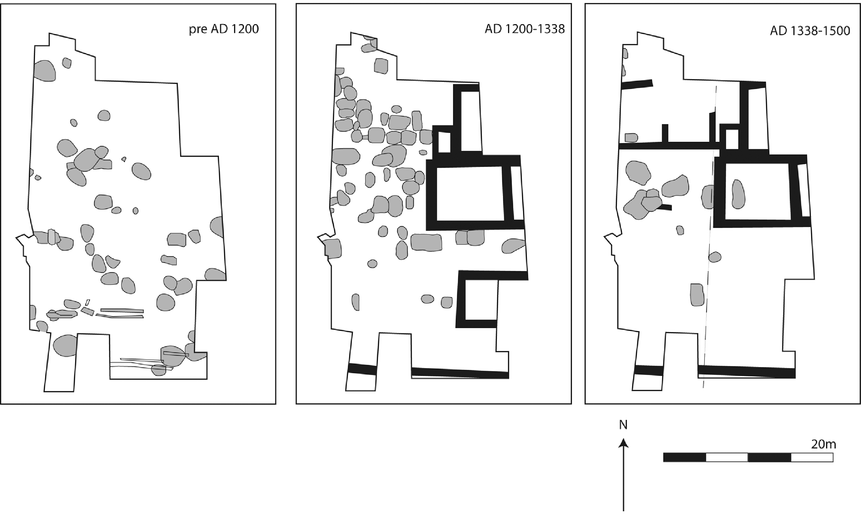
To illustrate this point, we can look at one excavated sequence from Southampton (figure 2). The occupation sequence excavated at the junction between Broad Lane and the High Street is conventionally divided into three phases (Platt and Coleman-Smith Reference Platt and Coleman-Smith1975, 232–46). The first, dating from 950–1200, is characterized by a low density of timber structures and an abundance of pits. The second, dating to 1200–1338, is characterized by stone buildings, with the phase coming to an end with the French raid. The final phase is characterized by the redevelopment of the plot with timber buildings. The phased plan of the excavations creates two illusions: of three static surfaces and of three groupings of contemporary features. These two illusions are closely linked as they relate to the temporality of the features excavated. As Olsen et al. (Reference Olsen, Shanks, Webmoor and Witmore2012, 86–90, 97) highlight, such archaeological representations are not ‘mirror copies’ of the archaeology and stand in for the physical archaeology itself. As such, they are an active part of our reflections on the past and, if we do not acknowledge their power, may impede the emergence of pasts which capture the fluidity and nuance of past urban worlds; rather than thinking about what these representations show, we can ask where they might take us (Dewsbury and Thrift Reference Dewsbury, Thrift, Buchanan and Lambert2005, 96). In Deleuzian terms, these plans can be perceived as diagrams – as emerging from a process of mapping in which they are productive rather than representational, producing space and creating opportunities to play with possibilities (Frichot Reference Frichot, Buchanan and Lambert2005, 73).
Plan of the archaeological features excavated at the High Street/Broad Lane site. Image: the author (after Platt and Coleman-Smith 1975). Note: dotted line marks approximate location of inserted boundary.

Our methods for studying the town therefore articulate the medieval town in particular ways, rather than representing it in an objective way. It is common practice in archaeological methodology to create the illusion of contemporary surfaces in phased plans, often with the enduring features from earlier phases greyed out as a residual presence, effectively placing to one side their potential to cause effect, or even to trap people into particular courses of action. In doing so, archaeologists might be accused of not engaging closely with the interpretive implications of contemporaneity, with the prevailing linear model of time essentially driving us to ‘adopt a very impoverished concept of contemporaneity’ (Lucas Reference Lucas2015, 5–6). As Lucas (ibid., 10) demonstrates, ‘an object made in the Neolithic can also irrupt into the Iron Age or in fact our own present’; everything constituting a surface is contemporary (see also Olsen et al. Reference Olsen, Shanks, Webmoor and Witmore2012, 141–43). Adopting a metaphor of a folded or scrunched handkerchief from Serres and Latour (Reference Serres and Latour1995, 60), Lucas makes the point that contemporaneity should not be clearly defined in relation to a period (as in a neatly folded handkerchief), but, rather, exists in relation to other points on the fabric (as in a scrunched handkerchief).
Thinking in this way highlights the messier reality, that from day to day, hour to hour and even minute to minute, this part of the town was in a state of flux. The pits excavated in the early phase were not contemporary; they were constantly being filled, sometimes emptied, and going out of use, with new ones being dug. Following Lucas (Reference Lucas2015, 6) they have a relationship of ‘containment’ with the buildings; that is, they exist during the life of the buildings, but were in use for a shorter time than them. The waste matter in these pits degraded, producing smells, attracting pests and requiring the deposition of material to seal these pungent deposits. The timber and thatch of the houses needed constant maintenance as it was exposed to the elements; the thatch became blackened by the smoke of the hearth. Similarly, the rebuilding in stone was a long process, probably occurring over several months, and the surviving stone buildings in the town provide evidence of continuous maintenance, rebuilding and modernization. The processes of urban life create a form of urban space–time, a formulation of the multiple temporalities and materialities which simultaneously constitute urban surfaces, communities and people and through which we come to know urban places (Greenhough Reference Greenhough, Anderson and Harrison2010, 41; McFarlane Reference McFarlane2011c, 32). It is clear, therefore, that we are not dealing with three contained phases but that we see vibrant, dynamic and emerging sets of interactions being referenced through these surviving archaeological traces; as DeLanda (DeLanda and Harman Reference DeLanda and Harman2017, 129) states, lived time is ‘a kind of continuum, as successive but overlapping presents fuse into one another’. Structures and features created in the past persisted and served to guide and constrain action, with the constraints of the urban landscape trappingFootnote 1 people into practices of pit digging and deposition and rebuilding houses on the same footprints or alignments.
This description itself has, of course, added nothing new to our understanding of medieval Southampton, but is a necessary first step in decentring the urban narratives. For Farias (Reference Farias, Farias and Benser2009, 2), the city is a decentred object ‘which is relentlessly being assembled at concrete sites of urban practice’; that is, the town or city is an assemblage of activities within a particular locale (DeLanda Reference DeLanda2016, 33). As Simone (Reference Simone2011, 355) states, the city ‘may be a familiar form, but it is also a ruse’, as it is neither constant nor stable, but rather is in a continual state of flux not immediately apparent from its concrete form. The key implication of this is that to understand the city we need to move from studying its topography, or material form, to understanding the processes and interactions which compose it; the various forms of space–time which emerge (McFarlane Reference McFarlane2011b, 667; Brantz Reference Brantz2017, 4; see also Gosden and Malafouris Reference Gosden and Malafouris2015, 713). It is only by describing the processes of which urban life is formed that we can begin to achieve this aim. Analysis of the archaeological evidence results in a thick, descriptive account of six centuries of life in this urban tenement. It uncovers the vibrancy of the material surroundings, as reactions to material changes prompted action, be it the repair of a building or the burial of pungent waste. However, it also reveals that it is impossible to talk about this sequence in passive terms; the urban landscape facilitated and constrained particular forms of behaviour and, therefore, trajectories of becoming urban. The fluidity of urban assemblages occurs across multiple scales, meaning that change can occur, and does occur, in all directions as flows working at different scales become entangled (Dovey Reference Dovey2011, 348); for example, the slow decomposition of stone, a profoundly localized process, may be entangled with a national economic recession which results in a house not being maintained and eventually collapsing. The remainder of this paper introduces and applies some concepts drawn from assemblage thought and related approaches in archaeology and urban geography which may allow us to reconceptualize the town in these terms and, therefore, provide new insights into processes of becoming (rather than staying) urban in the later Middle Ages.
Presencing the past: the archaeology of urban surfaces
The recognition of the town as a fluid assemblage, consisting of multiple temporalities and being an ongoing process of ‘becoming urban’, does not sit comfortably with the linear narratives of urban decline presented in previous studies, nor with the simplistic breaking down of archaeological sites into phases of structures and artefact assemblages which may be reflective of wider social or economic trends. Traditional approaches serve to reiterate the historical narrative, placing economic fortune and the urban structure as prior to action. Assemblage thought stimulates a rethinking of this approach, to shift our focus to processes of becoming, to think about how the town emerges from what came before, and to explore the potential ‘lines of flight’ along which the town could have developed. One way in which this can be achieved is to shift our focus from thinking about the town as a series of excavated sequences, to thinking about it as a series of unfolding surfaces.
Harrison (Reference Harrison2011), drawing on Lucas (Reference Lucas2001) and Thomas (Reference Thomas, Holtorf and Piccini2009), utilizes a metaphor of the surface, rather than that of depth, for understanding the archaeological record. The idea of stratigraphic depth closely relates to the method of excavation and promotes an evolutionary understanding of the past. Surfaces, however, provide a different perspective, emphasizing the archaeological record as a palimpsest, formed through actions which have taken place at different times, with differing levels of permanence. As such, the surface can be considered an assemblage, a collection of things gathered through historical processes (both anthropogenic and natural). If we think in this way, excavation becomes a way of simultaneously revealing and creating surfaces, as the residues of past action become enrolled in modern performances of archaeological research, development and conservation (Harrison Reference Harrison2011, 154–56). Although developed in the context of contemporary archaeology, the concept of surfaces is a valuable one for understanding the complexities of urban life in the past, and adopting the concept of surfaces as assemblages has two implications. The first is that we are able to acknowledge the persistence of past action and its implications in the present (be that through thinking about past versions of a surface or in inhabiting the surface of archaeological investigation) as everything on a surface becomes contemporary, and the second is that surfaces adopt the characteristics of an assemblage; that is, they are fluid, formed through interactions which may ‘overflow’ their apparent boundaries (deterritorialization) and are generative, the surface not a place where action takes place, but emerging with the action which constitutes it (Gregson and Rose Reference Gregson and Rose2000, 441).
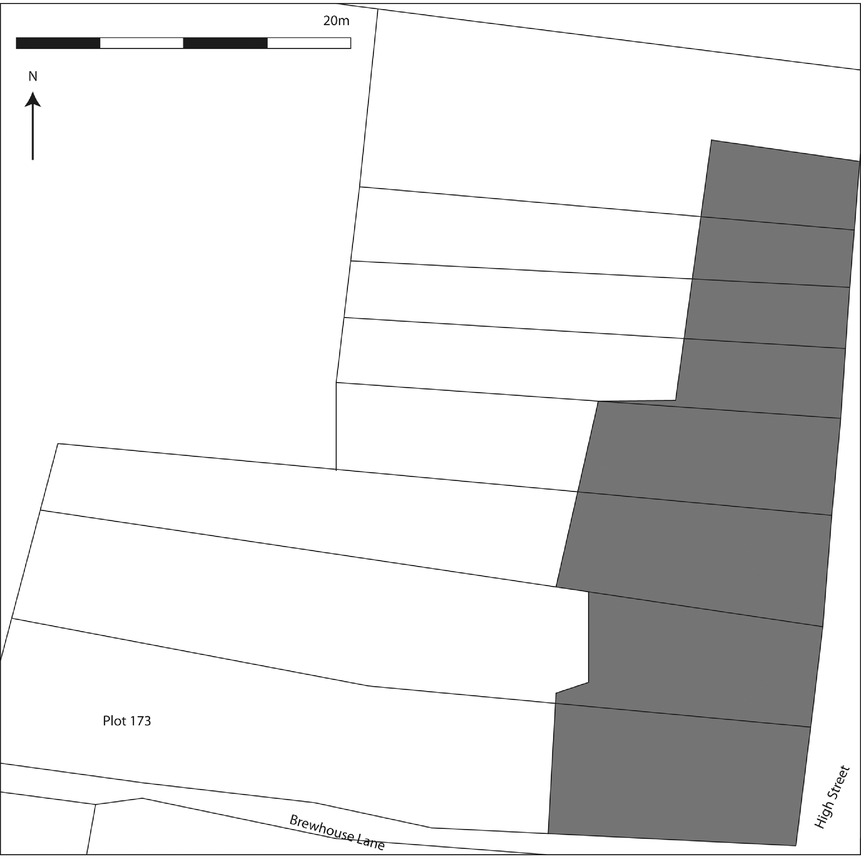
We can think about this in the context of the later medieval topography of Southampton. Looking at a map of medieval Southampton, with the streets neatly divided into tenement plots, one gets the impression that a stable framework exists, to be inhabited by the townspeople. This fixedness is an illusion; the stability apparent in the urban landscape requires persistent work. Property boundaries in much of Southampton were probably defined following the Norman Conquest (Brown and Hardy Reference Brown and Hardy2011, 8–9), and persisted into the later Middle Ages and beyond (Burgess Reference Burgess1976). These boundaries are materialized as fences, ditches or walls and constrain the building of houses, the dimensions of which are both constrained by and act to maintain property boundaries. Even though they are defined materially, these boundaries are not permanent. There is nothing to stop them being wiped away, but they are given durability by continued engagement with their material form, the maintenance of walls or the clearance of ditches, and the enrolment of documents, such as rentals and charters, in the performance of borough administration (see Jervis Reference Jervis2017). For example, in the 13th or 14th century, a cellared, timber-framed building was established on a plot (tenement 173) situated at the corner of French Street and Brewhouse Lane (Brown and Hardy Reference Brown and Hardy2011, 79–82) (figure 3). The building and the plot persist, appearing to have remained in use into the later medieval period, being the capital (principal) tenement of Nicholas Bylot, a merchant. In contrast, at the previously discussed site at Broad Lane (Platt and Coleman-Smith Reference Platt and Coleman-Smith1975, 232–46), the clearance following the raid apparently opened up the space to create a new plot, fronting onto Broad Lane, cutting through the established High Street frontages at right angles (figure 2). This building is clearly attested to in the archaeological record, with the foundations cutting earlier pits, but was listed as a vacant plot in a survey of 1454 (Burgess Reference Burgess1976). The rubble in clearance pits at this site attests to the damage of the raid and it is likely that timber outhouse structures were completely destroyed. The extent of damage to the stone houses fronting the High Street is difficult to determine, but they persisted in some form into the 18th century. It is tempting to argue for the inserted property to represent an opportunistic development, intended to capitalize on the fact that some burgesses had been left homeless by the raid. That it was vacant a century or so later may relate to the subsequent population decline, which lowered demand for small rental properties such as this.
Plots at Brewhouse Lane (shaded area marks built-up street frontage). Image: the author (after Brown and Hardy Reference Brown and Hardy2011).

Following Deleuze and Guattari, DeLanda (Reference DeLanda, Buchanan and Lambert2005) defines three spheres of reality: the virtual, intensive processes and the actual. The issue of boundaries is a useful means of illustrating this concept and of thinking about how towns might be imagined and realized. For Deleuze and Guattari, the actual, that which can be represented, and the virtual, that which cannot be represented, are both real. We can see the performance of boundaries as an intensive process of actualizing imagined divisions of urban space and with these performances realizing power over it. Even for something as basic as a fence line or wall, this process consists of an interplay between power and materiality, as a form of what Deleuze and Guattari term desiring production. In their writing, desire is a force which drives flows, and its actualization allows it to emerge as power; the power to form the unformed flows (see Gao Reference Gao2013). As such, the power of the borough authorities is not a given, but rather emerges from administrative performances; processes which actualize this virtual capacity of the assemblage, through which documents and rules are enacted and brought into play (see also Jervis Reference Jervis, Hausmair, Jervis, Nugent and Williams2018). These documents code the flows which constitute the urban assemblage, structuring the ways that they can consolidate or territorialize into an assemblage, and serve to reterritorialize (reterritorialization not being a return to a previous order but rather the way that a deterritorialized element forms a component of an emerging territory (Deleuze and Guattari 1987, 380; Buchanan Reference Buchanan, Buchanan and Lambert2005, 30)) as movements of deterritorialization, for example between political and domestic assemblages, are brought to the surface. We see, in the example from Broad Lane, how the initiative of individual burgesses may appear to bring about change, but this is reliant on a disruption of existing practices, which creates the potential for new practices and material interactions to emerge. If we see Southampton as a flat social space, the process of marking and maintaining boundaries striates it, creating barriers across which relations cannot form (Deleuze and Guattari Reference Deleuze and Guattari1987, 247), yet within the spaces between these striations potential still exists for new forms to emerge which overcode these striations. The emergence of the new plot at Broad Lane can be seen in such terms, as an overcoding of the striated space, brought about by the smoothing process of the French raid which disrupted the coding (Horvath and Maicher Reference Horvath, Maicher, Frichot, Gabrielsson and Metzger2016, 41) and reterritorializing processes at work in Southampton.
A strength of assemblage thought is that it acknowledges both depth and potentiality (McFarlane Reference McFarlane2011b, 654), and these two tenement blocks present different pictures of the persistence of urban space and the way in which it was defined through past action and opened up or constrained potential future action. Whilst the performance of boundaries at Brewhouse Lane made past processes contemporary, drawing on the past in the emergence of an urban surface, distributed between the material, textual and human realms, so the destruction of material remains at Broad Lane opened up the potential for new urban forms to emerge. They show that boundaries had a degree of longevity, but that opportunities could arise for them to be erased or altered. By seeing boundaries not as purely spatial demarcations but as processes we can see how past action surfaced through the performance of the town. The material world trapped people into particular performances of urban life, as so much has become dependent upon these materialized distinctions (see Hodder Reference Hodder2012, 67). The enacting of design ideas is an actualization of power, one which may not emerge if other forms of power emerge from relations formed through other processes; be that bureaucratic power constraining the further expansion of the kind of opportunistic development seen at Broad Lane or persistent processes of dwelling and spatial organization leading to a resistance of more wholesale replanning (a point well illustrated in the resistant practices discussed by Ryzewski (2015) in relation to urban renewal in early 20th-century Detroit). It was through a dialogue between persistent materials and the ongoing enrolment of documents in the performance of civic governance that an illusion of permanence is created when, in reality, it is only through working at connections that such continuity could be ensured. The persistence of boundaries is particularly telling in the way that plots are identified as vacant in surveys. This persistence provides clear evidence for the durability of the power structures actualized by these processes, but also for the opening of space for creativity and emergence. Rather than seeing the archaeological evidence as reflecting decline or growth, it becomes more productive to engage with them as evidence of unfolding urban surfaces, in which spaces, people and things became urban together and in which residues of past action linger, being reanimated as they are continually enrolled in and shape the unfolding of future urban worlds, which are historically contingent but have the potential to unravel in different ways.
Working across scales
We have seen that thinking about urban surfaces as assemblages allows us to understand the messiness of urban landscapes and the relations which constitute urban places, in particular the way that these processes are generative, having the potential to unsettle and disrupt unfolding urbanisms, both those which emerge from our analysis and those which emerged from dwelling in the past (see also McFarlane Reference McFarlane2011b, 654). Because assemblages are generative, instances of deterritorialization can be seen to enfold scales. Southampton, like any assemblage, is both molar, a defined bounded entity, and molecular, a fluid and unstable component of a molar whole, which, furthermore, has a molecular composition itself (see Wallenstein Reference Wallenstein, Frichot, Gabrielsson and Metzger2016, 112–14). Assemblage thought offers the potential to work across scales as deterritorialized components of assemblages become ‘assemblage convertors’, which create chains of reliance, potential and consequence between assemblages (Bennett Reference Bennett2010, 42). Critically, these assemblage convertors can cause an enfolding of scale, as localized interactions may resonate outwards and larger-scale networks may resonate downwards. Towns are assemblages of assemblages (such as households) and are also a part of larger assemblages (regions) (DeLanda Reference DeLanda2006, 104).
One element of the postprocessual critique in archaeology was a shift from large-scale global explanations towards a bottom-up approach, in which agency was ascribed to individuals. Such an approach has been positive in decolonializing the past, for example, and allowing the role of previously underdiscussed groups to be recognized, as best exemplified by feminist archaeological discourse (see Conkey and Gero Reference Conkey and Gero1997; Geller Reference Geller2009 for reviews). In his discussion of medieval towns, Christopherson (Reference Christopherson2015, 109–10) uses this contrast in approach as a starting point for his argument and advocates a focus on social practice as a means of writing an archaeology of medieval urbanism from the bottom up. In his response to Christopherson's work, Fleischer (Reference Fleischer2015, 133) takes ‘issue with how Christopherson argues that his new approach to urban practice replaces processual concerns’ and suggests that we might rather see a ‘practice approach as building out from, and at times complementing, processual concerns’.
It is these ‘processual concerns’ of large-scale power structures and economic systems which underpin previous narrative histories of Southampton as discussed above. We might write these criticisms off as being the product of a particular academic tradition. They speak, however, to a more fundamental issue in the writing of urban archaeology; that is, to varying degrees urban history and archaeology are not, actually, the history and archaeology of urbanism but, rather, an account of a particular articulation of capitalism, economic processes, politics or administration. Studies of town foundation are about the exercise of power by landowners or the church, studies of trade are studies of micro- or macro-economics, and so forth. In discussions over the application of assemblage theory in urban geography this has become a key issue at stake.
McFarlane (Reference McFarlane2011a) is criticized by Brenner, Madden and Wachsmuth (Reference Brenner, Madden and Wachsmuth2011) for ignoring abstractions such as capitalism which they believe are crucial to understanding the city. McFarlane (Reference McFarlane2011d) rightfully, in my opinion, retorts that such abstractions are themselves emergent assemblages, which do not explain the urban phenomena but emerge from the performance of urban life, whilst also impacting upon these performances, as urban assemblages are both generative and emergent from historical processes. Just as we cannot entirely dismiss these abstractions, but instead change their role in discourse, so Fleischer is, I think, arguing for something similar in regard to Christopherson's practice-based approach: a critique of the relationship between everyday practices and wider contexts. It is precisely this which assemblage theory is well placed to do by providing a mechanism to bridge scales and understand the directionality of causality, including, crucially, the ability to see agency as emerging from the collision of interactions at different scales (Jervis Reference Jervis2016a, 387). Terms such as ‘the market’, ‘capitalism’ and even ‘politics’ might be considered by DeLanda (Reference DeLanda2016, 15–16) to be reified generalities, and certainly for Latour (Reference Latour2005) it is these abstractions, ‘the social’ in particular, which should be critiqued as phenomena to be explained, rather than being explanations in themselves (see also Anderson and Harrison Reference Anderson, Harrison, Anderson and Harrison2010, 18). Assemblage thought can therefore become a useful ‘tactic’ for flattening the social so that we can analyse its composition (Acuto Reference Acuto2011, 555). It therefore turns traditional urban histories on their heads; to take the detailed descriptions and use them for their explanatory, rather than illustrative, value.
Key to this is understanding the causes of change or persistence, by revealing the ways in which power is generated by urban processes. We have already seen how power emerges out of assemblages as the actualization of desire. Whilst we can see hegemonic power structures emerging and being rearticulated through these processes, we can also observe alternative forms of power emerging from relations. For example, McFarlane (Reference McFarlane2011b, 655) uses the example of squatter settlements to show how the form and character of the city might be transformed by those dwelling in it in a way which contradicts the ideal city of the recognized authorities such as planners.
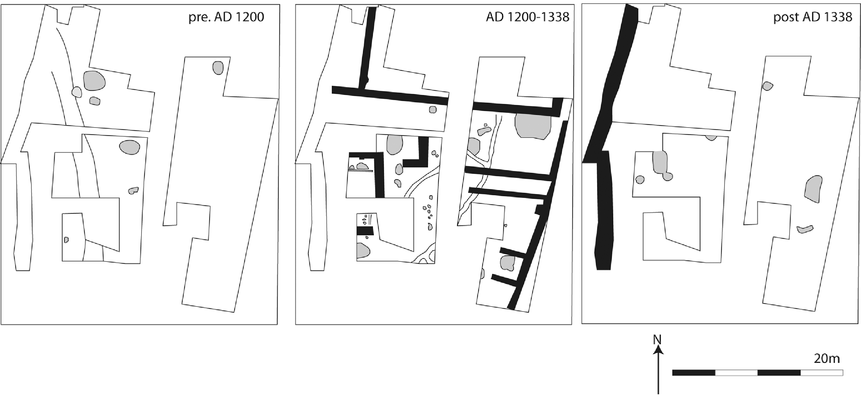
The ‘data urbanism’ which underpins previous discussions of urban decay and decline highlights vacant plots within towns as a key area of concern. These might be taken as evidence of the decay of the urban fabric and the shrinking, or decline, of the town. Excavations and historical records reveal an extensive area of open space at the south-western tip of Southampton, at Cuckoo Lane (Platt and Coleman-Smith Reference Platt and Coleman-Smith1975, 285–316; see figure 4). This was the site of a house occupied by a wealthy household in the 13th and early 14th centuries. It was redeveloped after a fire, possibly in the early 14th century, but following the French raid it was terraced and given over to gardens, leased from God's House Hospital, one of the major religious institutions in the town. It is argued that the reason why this previously desirable plot was abandoned was that the erection of the town walls cut off access to the waterfront, meaning that this was now a less desirable area for merchants to live, especially when other plots were likely to be available (Platt and Coleman-Smith Reference Platt and Coleman-Smith1975, 294). A conventional narrative therefore sees this area marginalized by the imposition of the town wall, built by royal decree in response to the perceived and actual threat of French raids. Here we see the imposition of top-down agency, with royal power being exerted over the townspeople.
Plan of archaeological features excavated at Cuckoo Lane. Image: the author (after Platt and Coleman-Smith Reference Platt and Coleman-Smith1975).

However, recent perspectives on open space in towns open the potential for alternative narratives. Discussing later medieval towns, Keith Lilley (Reference Lilley2015) proposes that open space may be indicative of replanning, the result of conscious decision making by urban authorities to adjust to smaller populations. Both Monica Smith (Reference Smith2008) and Christopherson (Reference Christopherson2015, 129) highlight the importance of open spaces as potentially productive spaces in the urban landscape, where social interaction might occur and which offer a medium for consensus building. Studying small towns in southern England, I suggested (Jervis Reference Jervis2016b) that the opening up of the urban landscape allowed for the increased spatial distinction between economic and domestic activities. There is clearly more to these spaces than being reflective of decline or effectively redundant areas. Discussing post-industrial ruins, Dawdy (Reference Dawdy2010, 772) shows how urban ruins signify failures of capitalism, contrasting narratives of expansion, the study of their ‘social lives’ being underdeveloped. A similar point can be made in relation to vacant and ruinous spaces in medieval towns, their present noted but then forgotten as they contradict teleological master narratives of urban growth or decline; by paying attention to these spaces we can understand the depth of these processes, realizing that they are not simply illustrative of failure but are productive of action and memory; there is a power to their ambiguity and a potential in them to shake up the structures of power enacted over urban space. By drawing upon McFarlane's consideration of squatter settlements and by seeing these open spaces as surface assemblages, deterritorialized into the wider assemblage of the town, alternative flows of power and sources of agency may become visible.
Towns and cities are themselves generative (Arande, Howell and Simmons Reference Arande, Howell and Simmons2002, 516) but are deterritorialized and can be acted upon. Our challenge is, therefore, to understand the implications of both the internal composition and wider deterritorialization of towns. In doing so we can view the town as a location in which we see agency as emerging through the intersection of top-down and bottom-up causality; that is, economic systems, towns and localized interactions are not explained by each other but are intimately related phenomena which are mediated across the urban assemblage through movements of deterritorialization. With this in mind we might consider where the agency for towns and cities is located; they unravel in unintentional ways and are not in control of their own destiny; they are impacted by localized interactions within them and also externalities (Lewis Reference Lewis2017). The gardens at Cuckoo Lane were not inert, open spaces but rather vibrant sites for the entanglement of flows which include royal power, local administration (the leasing of the gardens), fear of attack and trade goods.
As towns are deterritorialized into wider assemblages, for example of international politics in the case of the French raid, the potential exists for the town to be pulled apart. Southampton persisted, however, as the town is not only productive of these deterritorializing relations but also a signifier, an entity in the minds of its inhabitants, a persistent materialization of ideas and practice which means it is able to produce a limit to its deterritorialization (Wallenstein Reference Wallenstein, Frichot, Gabrielsson and Metzger2016, 118). In the spatiality of the gardens we see that the town of the past was not lost, but was reterritorialized into the emergent urban landscape, past land divisions persisting despite the change in character of this part of the town. The gardens are the materialization of an overcoding of urban space, revealing how a previously blasé attitude to defence had been replaced by a clear and present fear of further attack, but also how a fall in population had made investment in new rental property undesirable for institutions and how a fall in the quantity of goods coming into the port had reduced the area occupied by the mercantile core of burgesses. The potential for an open or garden space always existed, but this potential was not realized as the flows which are entangled through urban life were coded in specific ways by the ongoing performance of commerce. The agency for this potential to arise emerged out of a moment of deterritorialization, Southampton's reterritorialization into the assemblage of the post-raid town and also through the recoding of these flows which made other outcomes possible; we do not simply see a space becoming redundant, but rather spaces opening up as the result of forces from a variety of locations acting upon the performance of this single site. The site, therefore, is an assemblage itself but also an assemblage convertor, folded into performances of power, economy and local administration.
A garden was not the only potential outcome for this land. It could have been redeveloped in a number of different ways, requiring investment from God's House Hospital as landlord; it could have been left to become overgrown, or have been taken over as an area for industrial activities. The fact that it became a garden further demonstrates a process of deterritorialization, suggesting a concern over food security due to regional disruptions to agricultural production. As a garden, it is a space which is at odds with our preconceptions of the town as a densely occupied space, but emerged with a new way of urban living brought about by the decoding of previous iterations of urban life, being the product of historical processes and contemporary concerns.
The unfolding of this area of Southampton was historically contingent, unfolding as past processes such as attack and commerce entangled, generating the agency for this area to emerge as an open garden. In the past, action had been coded in such a way that the potential for a garden here could not be realized, but as the raid and other changes in practice smoothed these striations in this social space, behaviour was overcoded, allowing for new potential to develop. These gardens are more than a result of the imposition of top-down agency. Rather they emerged as an adaption of urban space, as Southampton was changed by and impacted upon the wider sets of relations into which it was deterritorialized. The performance of the social relations was generative, causing the urban landscape to develop in particular ways, as one component of a town being directed along a specific urban trajectory. Rather than being indicative of urban decay, these gardens reveal how processes of becoming urban were transformed as the performances which constituted the town changed.
This deterritorialization also caused the town itself to generate agency, impacting upon both its internal components and its wider hinterland (Brantz Reference Brantz2017). For example, the flow of cloth and dyestuffs through Southampton had implications for the development of other settlements in the region, as they became cloth production centres and agriculture shifted towards sheep husbandry (Hicks Reference Hicks2015; Jervis Reference Jervis2016b). By identifying towns as assemblages, therefore, it becomes impossible to see them in isolation, and we must understand how localized performances might have far-reaching, unintended and unforeseen consequences. Because towns are formed of interconnections which extend beyond their physical bounds, a focus on intensity and process makes ‘any precise distinction between “urban” and “rural” quite irrelevant’ (Frichot and Metzger Reference Frichot, Metzger, Frichot, Gabrielsson and Metzger2016, 82); at least as an a priori category the town is merely a metaphor for the intensive processes out of which it may become visible in a variety of forms.
What can assemblage urbanism do?
In closing this paper it is necessary to reflect on how an assemblage approach can enrich the study of medieval towns. The aim here has been to unsettle conventional narratives and to show how thinking through assemblages might offer fruitful lines for further enquiry. It has been proposed that rather than seeing later medieval towns as in decline, we should focus on how towns transformed, as processes of becoming urban changed. The political circumstances in Southampton are unique, but one of the key points about an assemblage approach is that it allows us to oscillate between the particular and the general, to expect and focus on difference, rather than homogeneity. In doing so, we move from seeing towns as a defined category of place, to their being processes unfolding in a particular place with their own temporality. Metaphors of surface and the employment of ideas of contemporaneity allow us to break down the necessity to focus on linear time and development and, instead, to focus upon what persists and what changes. It has been suggested that the disruption of the French raid created opportunities for the social spaces of Southampton to be smoothed, allowing persistent boundaries to be broken down and for the agency for new land uses to emerge. Rather than being reflective of prevailing economic conditions, towns are localized but deterritorialized performances, which are impacted by and impact upon performances elsewhere. As such, they are generative of agency and causality emerges through processes of deterritorialization at the intersection of spheres or scales of interaction.
Here the theoretical approach has been used to propose that for a single town we can rethink prevailing narratives, to recast the debate in terms of transformation rather than decline. There are, however, more general implications. Focusing on processes of assemblage decentres power. Rather than seeing a top-down imposition by royal or borough elites, we can begin to understand how the agency for continuity and change in urban life was distributed more widely, emerging and being re-enforced through everyday interactions. Such bottom-up agency becomes most visible in studies of revolt, but by identifying the implications of everyday actions we can reveal how power emerges in more than political ways, as the performance of commerce and dwelling reified but also created the potential to break down the structures of urban life, and allow alternative urbanisms, beyond those prescribed by urban regulations, to emerge. This may be perceived as a radical, political agenda, intended to emancipate the masses, but it is also a way of generating a more realistic understanding through interpreting the traces of past action and their implications in their own terms, rather than those created by black-boxed or reified ideas of what a town should be, whether created by our own scholarship or by the medieval urban elite.
Acknowledgements
This paper is derived from a research seminar given at the University of Bradford. I am grateful to Lindsey Büster for the invitation and the audience for challenging and expanding upon my ideas. I would also like to thank one of the anonymous reviewers for highlighting the importance of the concept of reterritorialization.