Victorian sensation literature was inextricably related to identity and the body: its primary purposes were to elicit a physical response from the senses of readers and to question “the social formation of the self” (Taylor, The Secret 2). Sensation fiction regularly relied on different, deformed, or diseased bodies to provoke fear or unease in its readers, and it created anxiety by juxtaposing the domestic with scandal, crime, and Gothicism to disturb the perceived stability of the home and social identity. Lyn Pykett argues that the genre reproduces the “real mid-nineteenth-century anxiety” that domestic selfhood “could be disrupted by danger, death or disease on the one hand, and the vagaries of the law, the banking system or the stockmarket on the other” (“Collins” 59). Nineteenth-century critics’ reactions to sensation novels connected anxieties about the body to fears about the instability of social identity: contemporary reviews described sensation literature and its works as “feverish” (Smith 141), “a collective cultural nervous disorder” (Taylor, The Secret 4), and as “symptoms of . . . social disease” (Pykett, “Collins” 51). In his 1880–81 series of essays, “Fiction Fair and Foul,” John Ruskin argues that the “[p]hysically diseased, ‘deformed,’ and ignobly dead bodies [in Collins's and Dickens's novels] are symptomatic of diseased and deformed genres, produced by morally and physically ill writers to cater to the tastes of morally and physically diseased urban readers” (Holmes, Fictions 92).Footnote 1 These extreme critical responses, as well as the extreme popularity of sensation fiction, call attention to Victorian preoccupation with the body and social identity and with the instability of both. This paper, through analyzing the instability of bodies and identities in Wilkie Collins's sensation novel No Name (Reference Collins and Blain1862) and its serial context, challenges readings by both Victorian and more recent critics that distinctly interpret diseased and disabled bodies in the novel as either symbolic of or a result of social deviance.
Scholars have analyzed No Name's representation of the body primarily from a feminist point of view that focuses on female identity alone, all but ignoring the male bodies. For example, critics such as Judy Cornes, Deirdre David, and Laurence Talairach-Vielmas argue that Mrs. Wragge's “grotesque” body acts as a symbol of the “crippling” Victorian womanhood (Talairach-Vielmas 139) that subconsciously subverts the patriarchal rule represented by Captain Wragge. The exceptions are Nicholas Rance, who associates Noel Vanstone's weak body with the “debility . . . of his class” (89), and Tamara Wagner, who discusses the feminized bodies of Noel Vanstone and Collins's other anti-heroes. Though analysis of the novel's representations of gender remains vital, by concentrating on the overtly disabled bodies of Mrs. Wragge and Noel Vanstone, these critics risk oversimplifying the role of the body in No Name. In the novel, nearly all bodies – even the apparently healthy ones – reveal themselves to be uncontrollable and atypical, and managing one's identity and body preoccupies every character. The ubiquity of uncontrollable bodies and identities in No Name blurs the border between normal and abnormal. In the novel, stable identities and healthy bodies prove to be illusory: all bodies and identities elude characters’ grasps, and attempts to pin down either through naming or narrative fail to keep their tenuous hold. Although Patrick Brantlinger argues that the sensation novel's mystery and search for identity can be “reduced to a neatly soluble puzzle” (48), in spite of an ending that superficially resolves narrative tension, No Name leaves anxieties about identity and the body unsolved.
No Name was serialized from March 1862 to January 1863 simultaneously in Charles Dickens's All The Year Round, a British weekly paper with no illustrations and few advertisements,Footnote 2 and in Harper's Weekly, an American paper that was generously illustrated and contained many advertisements.Footnote 3 Collins earned £3,000 from Sampson Low for the volume publication of the novel, the first edition of which was published in three volumes on 31 December 1862 and sold out within the first day. While textual differences between the book and serial editions of No Name are miniscule, the serials’ accompanying content and visual format – including illustrations by John McLenan in Harper's Footnote 4 – create added dimensions of meaning, tension, and historicity that bring to light further anxieties concerning corporal form as well as personal and social selfhood in No Name. Linda K. Hughes and Michael Lund note that in Victorian serials, “signs of the outer world were a part of the reader's text,” and that since “subscribers certainly read much in each issue of their favorite journal,” they would connect “in their minds not just specific continuing stories but overlapping ongoing presentations tied together by editorial principles” (9).Footnote 5 Therefore, in addition to analyzing the text of No Name, I will also examine how the serial context interplays with the novel's portrayal of identity and the body.Footnote 6 While in No Name's letterpress Collins links identity and the body in a way that reveals their slipperiness, the contextual surroundings of the serial participate in dialogue with the novel by highlighting in its articles, advertisements, and illustrations fears concerning social and physical impermanence.
No Name and its Serial Contexts
InThe Sensation Novel and the Victorian Family Magazine, Deborah Wynne argues that analyzing sensation novels in their serial environment reveals that the thrills in the genre “respon[d] to the issues of the day,” such as “anxieties surrounding shifting class identities,” “the precarious social position of single women,” and “perceptions that modernity itself was undermining domestic life” (2–3). No Name's serial contexts in both American and Britain convey just such concerns. In the American Harper's Weekly, illustrations and articles about the American Civil War, an event that “made many citizens question long-cherished beliefs about man's identity, [and] about his place in the universe” (Cornes 7), precede or follow every instalment of the serial. Indeed, Pykett argues that British sensation fiction acted in “reaction to disruptions (such as the Crimean War and the American Civil War) to the age of peace and progress which had been proclaimed in the year of the first Great Exhibition in London” (“Collins” 51). Margaret Oliphant, Collins's contemporary, associated the Civil War with sensation fiction, sarcastically claiming that while the Americans relied on war “for procuring a new sensation,” the British people turned to sensation novels for “a supply of new shocks and wonders” (564). Oliphant also equated the shift from peace to war with a displacement of humanity's identity and with a disruption of domesticity, arguing that the hostilities demote humankind from “masters of all things” to “the natural size of humanity” and made the “distant roar” of fighting a “thrilling accompaniment to the safe life we lead at home” (564). Of course, the readers of Harper's Weekly were American, and not British, but this makes the impact of the serial context more notable. To those readers, the Civil War was not a “distant roar,” but a very imminent threat to their homes, families, and society. Those who read No Name in Harper's Weekly, with its numerous illustrations and articles on combat and soldiers, would have begun each instalment of the novel after a reiteration of cultural and familial instability.
The context of the British serialization, however, focussed more on the issue of class mobility than war. While the serial context of All the Year Round's publication of No Name contains only three articles concerning the war, one entitled “Princely Travel in America” which describes Prince Napoleon's tour of America. The article places emphasis on the lack of American class distinction and implies that, should the type of “confusion of ranks, classes, and fortunes be introduced” to Europe, “the result for all parties would be an unpleasant collision from which the sincerest democrats would be the first to suffer” (177–78). It warns France in particular against quick revolutions, arguing that “[a] longer time is needed for the transformation of manners and habits than of opinions and principles” (178). The article also ridicules American-Irish Fenians and Richard Cobden, the former leader of the Anti-Corn Law League who spoke against English support of the Confederate army. This support, Nicholas Rance suggests, is linked to the assumption that the South was “rebelling against democracy” (82). The article expresses apprehension concerning the “pell-mell” lack of class distinction in America (178) and fear of a revolutionary democracy; thus it underscores Britain's own anxiety about shifting social categorization.
In addition, other works of fiction and nonfiction coinciding with No Name in All the Year Round reveal anxieties about social mobility and class identity directly in England. For example, “Coming Into a Fortune,” an epistolary short story of a woman who inherits from an Uncle with a disappointed love story, censures the social climbing and fortune seeking of the Uncle and lover while it privileges the new heiress's preference for humble living and her previous social class. Two other articles appearing alongside No Name, “Pinchback's Cottage” and “Pinchback's Amusements,” examine the home life of the working class, calling for better living conditions for the poor, and notably express concerns about class in terms of health and the body. The author reads the inner dignity of the lower classes in the workingman's corporality: “we like your red-faced, sturdy, somewhat obstinate, heavy-moving farmer servant . . . [; w]e see in him the divine soul, the human heart, the capability of all joy and all sorrow” (33). The article's appeal for more leisure activities for the working class involves shaping the body as well as the identity: “Further, the use of the rifle would soon transform the English labourer into a far brighter fellow[; h]e would grow keen, far-sighted, observant, light of foot, obedient, quick and smart” (72). Thus, the serial context of No Name in both All the Year Round and Harper's Weekly, by exposing the anxieties of selfhood brought to light by war and shifting class classifications, provided readers with a framework for the exploration of social identity within the novel.
The serial context of No Name in both Harper's Weekly and All the Year Round also vividly reiterates Victorian concerns about the shifting nature of the body. While most Harper's Weekly instalments of No Name are preceded by depictions of the Civil War, they are followed by advertisements, nearly a third of which market various methods – from clothing and prosthetics to Chinese Life Pills and phrenology – of covering, controlling, or curing the body. Laurence Talairach-Vielmas interprets the serial context and advertisements as relating to anxieties regarding female identity. She argues that the article “Paint and No Paint” published alongside No Name in All the Year Round “shows the period's anxiety with regard to women's use of makeup” (Talairach-Vielmas 135) and that “cosmetics . . . quack medicines and cure-alls . . . were largely aimed at female consumers, suggesting that their own transformation into the perfect lady was possible with the acquisition of beauty creams, hair lotions, or fashionable corsets” (Talairach-Vielmas 13). However, just as many advertisements appear in Harper's Weekly for shaping the male body. The repeated advertisement for prosthetic limbs would likely have been aimed soldiers wounded in the war. Another recurring advertisement with the headline “Do You Want Luxurious Whiskers or Mustaches?” was certainly for men. Advertisements for cure-alls mentioned male customers as well as female: one directed “To the Nervous and Debilitated” notes that “Dr. Laurie's Chinese Life Pills” have worked for “thousands of sufferers, both male and female,” and another advertises books that include lectures on the “Causes, Prevention, and Cure” of “Male and Female Complaints” (“Two Works”).
Several articles in All the Year Round, including the “Pinchback” articles mentioned above, also reveal anxieties concerning moulding and controlling the male body. “Soldiers’ Leisure,” a piece following an instalment of No Name in All the Year Round, conveys an intense anxiety about maintaining male health in an unhealthy era:
No mere drill can give these men broad chests, strong arms, or quick legs, though regular food and settled arms make them, in time, stout, red, and hearty. . . . There are wise and far-seeing doctors now living, who think that from some unknown cause our race is physically degenerating, and that our sons are growing up physically weaker and more nervous than ourselves.Footnote 7 . . . Men, apparently hearty, sink suddenly into old age. Nervous diseases increase daily. Our social hours grow every day less healthy and natural. . . . Now, as new forms of dress and diet are adopted by us all, hereditarily, irrationally, without reflection, and without any knowledge or thought of their wide-spreading results, it may be long before we learn how to stop this physical degeneracy. It is, therefore, most important that by all means we contrive to keep our soldiers strong and vigorous, whosoever else may degenerate. (127)
This particular example clearly links the physical body to identity, arguing that the body is a measure of masculine and national strength. No Name's serial context reveals that anxiety about controlling the body applied to the identity of men as well as women; one must consider the novel's representation of the body in light of this.
The Body and Identity in the Text of No Name
These many advertisements and articles referring to the body imply two beliefs: first, the need for curing or controlling the body, particularly if sick or disabled; and second, the feasibility of somatic control. No Name's letterpress, however, subverts these beliefs by presenting the healthy body as an anomaly and as unmanageable excess. In Narrative Prosthesis, David Mitchell and Sharon Snyder explain that stories frequently rely on the disability or illness of the protagonist as their narrative impetus, and that concomitant social concerns accompany perceived bodily differences. The narrative drive of these stories, then, builds up to a simultaneous resolution of both the physical and social problems through removal of the somatic aberrance by means of death, disappearance, or cure. In a sense, No Name does enact narrative prosthesis: nervous illness removes and thus resolves the social deviance of the heroine, Magdalen. As the narrative restores her health, so it does her social position and moral purity.Footnote 8 However, this restorative illness only takes place in the final chapters of the story. The impetus for No Name is not Magdalen's bodily difference in the form of excessive illness, but rather excessive health, which is highlighted by the ill-health of nearly everyone in the household, including servants. Only Magdalen and her father have health, but Mr. Vanstone ultimately loses it and his life in a train accident, which then puts the health of his wife and unborn child (and subsequently the social status and identities of his daughters) in peril. Magdalen's unique physical health is the source of her aberrance. Early in the novel she claims, “if there's anything the matter with me, I'm too well” (15; sc. 1, ch. 1), and as Pykett notes, being “too” anything is what the story resolves: “Magdalen's excess is the source of the narrative, the curtailment of that excess is its end; that is to say it is both the goal of the narrative and its closure” (Sensation Novel 25). That the narrative eventually reaches this goal through illness proves typical of Victorian fiction, in which “the narrative cure for disorder is more often than not illness itself and the therapeutic situation constructed around it” (Bailin 7). But the salient difference in No Name's version of narrative prosthesis is that it originally presents strong physical health as abnormal.
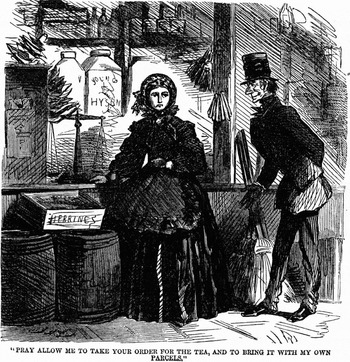
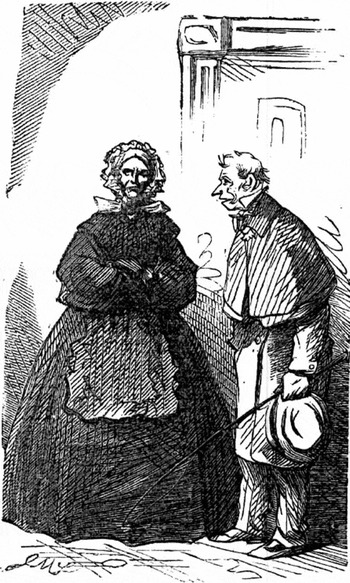
Because all bodies in No Name show themselves to be elusive and different – even the presumably healthy ones – the text repeatedly undermines the concept of a stable, healthy body. Nearly every healthy body in the text proves unstable. While Magdalen and Mrs. Lecount begin with healthy and beautiful bodies highlighted in the narration, their bodies (and Magdalen's mind) deteriorate through illness as the two undergo moral and emotional struggles. John McLenan's illustrations of Mrs. Lecount in Harper's Weekly assist in the textual destabilization of physical difference: he emphasizes her shifting body through parallel illustrations in the 26 July 1862 and 15 November 1862 issues (478, 730). In the first, a healthy, young-looking Mrs. Lecount stands to the left of Captain Wragge (Figure 10), and in the second, a haggard, white-haired Mrs. Lecount stands in a similar position to the left of the drunk coachman (Figure 11). As much as Captain Wragge insists that his wife, Matilda, correct the crooked disorder of her body, his much-emphasized “parti-coloured eyes” (188; sc. 2, ch. 1) and his aging face but youthful body (25; sc. 1, ch. 2) expose his own ambiguous physicality. The healthy body of Admiral Bartram slips out of control through somnambulism, which eventually causes his ill health and death when he catches a fatal chill. Kate Flint argues that “outside the realm of the recognisably freakish, Collins uses certain individuals in order to collapse boundaries between the able-bodied and the impaired” (154); these numerous slippery bodies in No Name serve to render indistinct the difference between healthy and unhealthy bodies and to show that the concept of a stable, healthy body is an fallacy. The pervasiveness of bodily difference in No Name demonstrates Lennard J. Davis’ epigram, “Impairment is the rule, and normalcy is the fantasy” (31).
John McLenan, “Pray Allow Me To Take Your Order For the Tea, And To Bring It With My Own Parcels.” Harper's Weekly serialization of No Name (26 July Reference Collins and Blain1862): 478. Courtesy of Lisa Surridge.

John McLenan, Chapter Heading [of an aged Mrs Lecount]. Harper's Weekly serialization of No Name (15 November 1862): 730. Courtesy of Lisa Surridge.

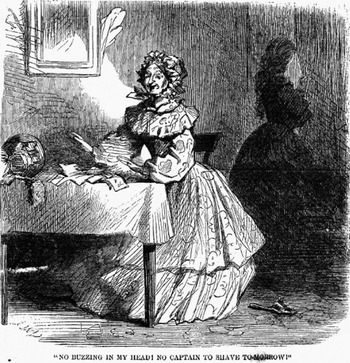
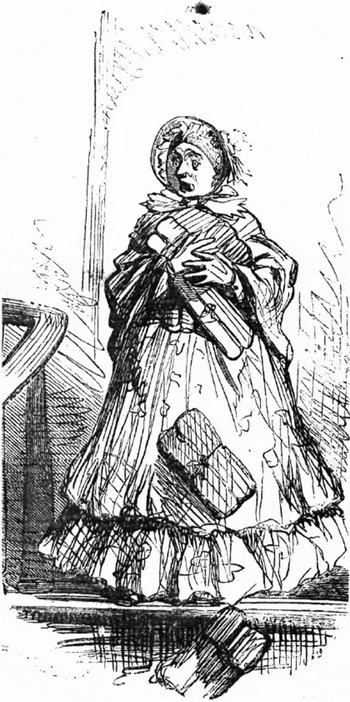
The blurring of boundaries between normal and abnormal bodies and minds is not the sole result of No Name's representation of bodies in the text and illustrations. Diane Price Herndl states that “no representation of illness [or disability] . . . is entirely clear in its ideological purpose” (15). Flint prefaces her argument about Collins's transgressive deconstruction of the divide between normal and abnormal bodies with the phrase “outside of the realm of the recognizably freakish” (154) – in other words, Collins does create characters within that realm, and the text's use of these characters indicates a reaffirmation of normality and difference, as do their illustrations. Undeniably, the giant body and confused mind of Matilda Wragge and the nervous, fragile body of Noel Vanstone stand out as embodying uncontrollable corporal deviance. Exaggerated language in the novel persistently points out their physical and mental differences. The text dehumanizes Mrs. Wragge, regularly calling her a “giantess” or “giant” and at times referring to her as a “figure” and an “it” (202; sc. 2; ch. 2). Although Cornes believes that the text's use of “it” makes Matilda “an object of scorn and ridicule on the part of her husband” (80), more importantly it presents her as an object overall because of her bodily and mental difference. The narrator also describes Noel as a “mannikin” (291; sc. 3, ch. 3) and repeatedly mentions his frailty, smallness, and delicate health. In every scene in which they appear, the narration underscores Matilda's imbecility and Noel's weak body and nature. The illustrations in Harper's Weekly highlight the textual exaggeration of Noel and Matilda's bodily difference. In every illustration of Mrs. Wragge, her face beams either with child-like glee or dumbfounded surprise (Figures 12 and 13). Noel's body either sits languidly in the illustrations, such as one depicting his fainting-fit (Figure 14), or stands on stick-thin legs supported by a cane (Figure 15). While their freakish, uncontrollable bodies act as a means of creating suspense for readers (Will Wragge and Magdalen keep Matilda from revealing their false identities? Will Mrs. Lecount's plot succeed before Noel Vanstone dies?), they also work to relieve readers’ anxiety about their own bodies. As the text and the serial illustrations “other” Matilda and Noel, readers can potentially separate themselves from the disabled identity and thus “[project] fear of becoming disabled onto the disabled person[s]” (Thomson 84). However, the ubiquity of slippery bodies belonging to apparently “normal” characters’ listed above undermines such relief and simultaneously reminds readers of their own bodies’ changeability.
John McLenan, “No Buzzing in My Head! No Captain to Shave Tomorrow!” [Mrs Wragge's glee during a vacation]. Harper's Weekly serialization of No Name (28 June 1862): 413. Courtesy of Lisa Surridge.

John McLenan, Chapter Heading [A surprised Mrs Wragge, who believes she has seen a ghost]. Harper's Weekly serialization of No Name (19 July 1862): 461. Courtesy of Lisa Surridge.

John McLenan, “If You Ever Let Him Faint You Let Him Die.” Harper's Weekly serialization of No Name (1 Nov. 1862): 702. Courtesy of Lisa Surridge.

John McLenan. “A Mystery In His Own House, Under His Own Nose! What Did It Mean!” Harper's Weekly serialization of No Name (30 Aug. 1862): 554. Courtesy of Lisa Surridge.

Moreover, by emphasizing the uncontrollability of Noel Vanstone and Mrs. Wragge's bodies, No Name uncovers methods used to shape and control bodies and identities. Disability theorist Rosemary Garland Thomson explains that the management of impaired or diseased bodies directly correlates to behavioural and social management: “[b]odies that are disabled can also seem dangerous because they are perceived as out of control[;] . . . they threaten to disrupt the ritualized behavior upon which social relations turn” (37). She argues that the disabled body acts as a corporeal affirmation of “the self gone wild,” and as proof of identity's tenuousness (43). In discussing the role of names in No Name, Philip O'Neill states that “[t]he process of naming is itself a system of understanding and control” (153). To name something is to attach a signifier in an attempt to describe, express, organize, and control it; thus, I extend the concept of naming to narration or story-telling and to clothing, which perform a similar function in creating identity and controlling the body.
Captain Wragge and Mrs. Lecount use narration and naming in their attempts to control the excessively aberrant bodies of Mrs. Wragge and Noel Vanstone. Wragge renames Matilda's identity and demands that she reshape her aberrant body: after telling her to “[s]tand straight,” he gives her a new name and another “Skin” to jump into (328; sc. 4, ch.1). In re-naming her “Julia Bygrave,” he re-narrates her body and mind, recasting it to Mrs. Lecount and Noel in terms of nervous invalidism (368; sc. 4, ch. 4). Due to her subordinate role as Noel's servant, Mrs. Lecount controls Noel's body and behaviour through maintaining the false narrative that he holds the control. She administers smelling salts and fans Noel – with less compassion and the same self-interest as a woman “rescuing a half-drowned fly from a milk-jug” (297; sc. 3, ch. 4) – moments before manipulating him. Her dominance masquerades as servile obedience, such as when she dictates his letters, saying, “shall I make a little sketch, and will you correct it afterwards? I will make a little sketch” (299; sc. 3, ch. 4). At times Noel senses her control and tries to reassert his imagined independence by saying, “I won't submit to dictation! . . . I am master, Lecount” (300; sc. 3, ch. 4) or “I won't be questioned and ordered!” (544; sc. 5, ch. 1). However, she regains her control of him by stressing the narrative of his dominance: in the first instance she tells him “You are master, sir” (300; sc. 3, ch. 4), and in the second she applies smelling salts to him and tells him that his “commands shall be obeyed” (544; sc. 5, ch. 1). Though Wragge uses naming and narrative to define and control deviance more overtly than does Mrs. Lecount, both rely on this method to manipulate the bodies and identities of these two supposedly freakish characters.
Nonetheless, the aberrant bodies and excessive personalities of Noel Vanstone and Mrs. Wragge remain ultimately uncontrollable. The Captain's attempts to contain his wife prove as futile as her own attempts to manage her body through clothing meant to make her look “[e]legant” and “very grand” (264; sc. 3, ch. 1): despite her child-like obedience to him (203; sc. 2, ch. 2), her slippery body and mind elude his control because of their excess. She reveals Magdalen's name and identity to Mrs. Lecount in spite of being confined to the house, remains continually “down at heel,” and will never fit in her Oriental Robe because, as she says, “there's half too much of me, any way” (461; sc. 4, ch. 10). Convinced of his own independence and worth, and manipulated by Captain Wragge and Magdalen as well, Noel moves out of Mrs. Lecount's power by eloping with Magdalen. His body further slips out of Mrs. Lecount's control when against her wishes he writes a letter in a passion that kills him. While minor control over Matilda and Noel occurs in their immediate responses to the narrative management Captain Wragge and Mrs. Lecount attempt, that control proves to be tenuous and slippery because their bodies remain ultimately unmanageable.
However, in No Name, Collins shows his interest in the uncontrollability of all people, and not just that of those with overtly different bodies. He makes that most clear in Miss Garth's internal monologue:
Does there exist in every human being, beneath that outward and visible character which is shaped into form by the social influences surrounding us, an inward, invisible disposition, which is part of ourselves; which education may indirectly modify, but can never hope to change? (146; sc. 1, ch. 14)
By saying, “how little I have known of my own weakness and wickedness until to-day” (147; sc. 1, ch. 14), Miss Garth hints at the answer that the rest of the novel subtly suggests: “deep down below the reach of mortal encouragement and mortal repression” (146; sc. 1, ch. 14), identities and bodies cannot be controlled by the narratives supplied by “social influences” and “education.” The entire novel consists of characters concerned with managing their bodies through narratives to create their identities, but their elusive “invisible disposition[s]” make this impossible. In one sense, the novel presents this concept in essentialist terms. It implies that characteristics like Noel's stinginess or Magdalen's “hot blood” are “inborn” (301; sc. 3, ch. 3) and “inherit[ed]” (196; sc. 2, ch. 1). It also suggests that one's “true” self, which lies beneath the surface control of education or clothing, can be spotted: Mrs. Lecount guesses Magdalen's identity by means of a passionate outburst that reveals the “inborn nobility of [Magdalen's] perverted nature” (291; sc. 3, ch. 3), and, in spite of Magdalen's disguise as a parlour maid at the Admiral's, all the female servants can sense that she “was not one of themselves” (636; sc. 7, ch. 2). But subtle subversions of this idea present themselves, such as Magdalen and Mrs. Wragge's insistence that money “make[s] a lady of you” (206; sc. 2, ch. 2) and that “[a] lady is a woman who wears a silk gown, and has a sense of her own importance” (613; sc. 6, ch. 2). Moreover, Mrs. Lecount's proof of Magdalen's “true” (corporal) identity – the moles on her neck – shocks Noel less than her evidence of Magdalen's created one – the piece of the alpaca dress she wore to disguise herself as Miss Garth; this indicates that the novel's real concern lies in the fabrication of social identities.
Through Magdalen, one can most clearly see how identities are fabricated by narrating the body. The lawyers searching for Magdalen attempt to gain control of her body and to re-establish a domestic identity for her by naming her body in the posters they exhibit in London: they catalogue her appearance as the narrator did in the beginning of the story, and they identify her according to the name on the laundry mark of her clothing, which, as she and the novel's title declare, is not truly her name. She evades their control by narrating her self and body differently with the assistance of Captain Wragge, makeup, and costumes. However, the threat producing the novel's suspense – that her body will betray the identities she creates – becomes realized: her moles terminate her identity as Susan Bygrave (545; sc. 5, ch. 1), and physical weakness keeps her from resisting Mazey when he catches her with the will at St. Crux and thus ends her identity as Louisa the maid (672; sc. 7, ch. 4). Cornes notes that, after leaving Miss Garth and Norah, “Magdalen's life has become a series of poses with no basis in reality” (85; sc. 1, ch. 9); but actually, Magdalen's life began with an identity as false as those she adopts in the company of Captain Wragge. Mr. and Mrs. Vanstone created the identities of their children by posing as a typical middle-class family when in fact they were unmarried and their children illegitimate.
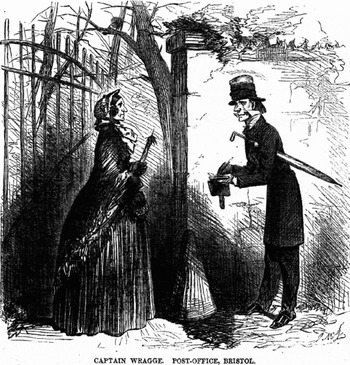
Indeed, No Name reveals that most characters’ identities are poses constructed by narration and naming. Mrs. Lecount's youthful physical appearance suggests “little less than a triumph of physical resistance to the deteriorating influence of time” (275; sc. 3, ch. 2). Her clothing, a mourning dress that speaks “a well-made compliment paid to [her former employer's] Death” (275; sc. 3, ch. 2) and an apron that “was a domestic poem in itself” (276; sc. 3, ch. 2), allows Mrs. Lecount to name her body as aligned with a domestic ideal in the same way a uniform names a body as belonging to a particular team or job. Moreover, Mrs. Lecount's body cannot remain under her own narrative hold. When in shock, she “look[s] every year of her age” in spite of sal-volatile (376; sc. 4, ch. 5). After she is outwitted by Captain Wragge into traveling to Switzerland and back, her body becomes ill and transforms beyond recognition (538; sc. 5, ch. 1). Admiral Bartram uses his dogs and his servants to preserve his self-narration as a controlled, healthy body, which is particularly important to his identity as an officer of the navy.Footnote 9 He gives his dogs food that he cannot digest but continues to order for keeping up appearances (624; sc. 7, ch. 1). His manservant Mazey sleeps on guard at his bedroom door, not just to keep the Admiral from walking in his sleep, but also to preserve his self-narrative by not locking him in his room (675; sc. 7, ch. 4) and by keeping his somnambulism a secret from others (635; sc. 7, ch. 1). Naming his own selfhood perpetually preoccupies Wragge. Emphasizing Wragge's fixation with his own identity, McLenan illustrates him writing out his name in two instalments, duplicating the composition in each to underscore the repetition of his action (Figures 16 and 17). In the second instance, when he introduces himself to Magdalen, the text explains that he literally spells his identity on his own body, “ticking off the letters persuasively on his fingers” (194; sc. 2, ch. 1). He also spells out his identity as a “Swindler” to Magdalen; but, recognizing that the honour of something exists only in its naming and not in its essence, he explains that the name “is nothing but a word of two syllables,” a pejorative title given by society to the occupation he prefers to call “moral agriculturist” (211; sc. 2, ch. 2). With his constant bookkeeping, he also methodically attempts to control his own identity; but, as with the other identities and bodies, this too eludes his control in that his false figures never actually fool Magdalen (506; sc. 4, ch. 14). Narration and naming construct each of these characters’ identities, but ultimately cannot control or preserve them.
John McLenan, “Captain Wragge. Post-Office, Bristol.” Harper's Weekly serialization of No Name (13 March 1862): 173. Courtesy of Lisa Surridge.

John McLenan, “He Tucked His Umbrella Under His Arm, And Jocosely Spelled His Name For Her Further Enlightenment.” Harper's Weekly serialization of No Name (31 May 1862): 349. Courtesy of Lisa Surridge.

The textual element that most effectively subverts control of the body and identity through naming and narrating is Wragge's Pill, “a multipurpose (and utterly purposeless) pill” (Pykett, “Collins” 60) through which Captain Wragge widens his focus of control from his wife's body to the bodies of the paying public. This pill reveals that health and illness are primarily matters of narrating the body. In changing the field of his career from “Moral Agriculture to Medical Agriculture” (709; sc. 8, ch. 2), the Captain presents illness itself as a constructed narrative, as a “field” to be “cultivate[d]” (715; sc. 8, ch. 2). By using an illustration of Matilda as the “after” picture of a Pill user “cured of indescribable agonies from every complaint under the sun” (711; sc. 8, ch. 2), he re-narrates her body once again, recasting it as a healthy, controlled body rather than as a freakish, crooked one.Footnote 10 Though Talairach-Vielmas posits that through this illustration “[Matilda's] valuable body [is] turned into a text” (144) and “is thus framed and controlled” by “medical discourse” (146), it is not Matilda's body that ends as framed and controlled, but an illustration of her body; in other words, only the narrative itself is controlled. And while Cornes believes that the illustration makes Matilda “the icon, the living symbol of what her husband has molded her into – immutable, frozen, lifeless [and n]o longer able to act” (92), only the illustrated narrative remains under control. Mrs. Wragge's body continues to defy control, being actively down at heel, and behaving with “conduct [that] isn't ladylike” (708; sc. 8, ch. 2).
Because one knows that Matilda's corporeality remains uncontrolled despite Wragge's Pill, one recognizes that the body cannot be cured by patent medicine, and that only a tenuous control over it can exist by means of narration. Like narratives of identity, Wragge's Pill acts as a placebo to convince the public of a tangible normality made possible through cure. Captain Wragge's marketing slogans, such as “A Pill in Time, saves Nine” or “Excuse me, how is your Stomach?” (710; sc. 8, ch. 2), in parodying of the types of ads that frequently follow the serial instalments of No Name in Harper's Weekly, open the false narrative nature of cure, particularly to the serial's American readers. Instalments of No Name usually appeared on the twelfth page of Harper's, immediately before the advertisements; however, the instalment containing Wragge's Pill was placed on the fourth page of the paper, the closest to the front and thus the furthest from the ads it ever appeared, perhaps indicating editorial anxieties concerning the parody (Harper's 17 Jan. 1863). With this parody's placement in a paper containing that very type of advertisement, the serial format of No Name reveals that the many slippery bodies and identities in the text serve as anxiety-inducing reminders to readers of their own social and physical instability. Flint notes that “Collins consistently makes us acknowledge and reflect on the part which our own bodies play in our interpretative strategies” (157) and that “[t]he conditions of disablement are evoked in ways which make able-bodied readers reflect on the workings of their own senses, and their deficiencies, as well as their powers” (165). The dialogic interplay of No Name and the advertisements in its American serial context supports this interrogation of the body.
The doubt that the episode of Wragge's Pill places on narratives’ ability to cure thus makes suspect the validity of the story's own narrative cure – that of Magdalen's sickness, recovery, and eventual marriage to Captain Robert Kirke, a “paragon of colonial fitness” (Taylor, The Secret 138). Kirke, whose name is Scottish for “Church” and whose ship is aptly called “Deliverance” (O'Neill 161), re-enters the plot of No Name as a deus ex machina to re-establish a deliriously ill Magdalen to a healthy, moral, and stable domestic role.Footnote 11 Bailin explains that in Victorian fiction, “[s]cenes of illness intervene when narratives reach an impasse which cannot be overcome without the violation of accepted social and formal codes” (15) and that illness “restores the desired coherence, or, at least, finds a place for it in narrative, but always . . . at the expense of those principles it attempts to shore up” (16). As I already mentioned, the text prosthetically relies on Magdalen's illness and recovery to normalize her deviant body and behaviour and to reinstate the stability of her identity, despite the subversion apparent in the rest of the text. Disability theorist Davis explains that in narratives “the quick fix, the cure, has to be repeated endlessly, like a patent medicine, because it actually cures nothing” (99). The “quick fix” provided by Magdalen's illness and recovery proves feeble: not only have Admiral Bartram and Mazey cast doubt on the navy's ability to control body and identity, but the narrative of the Pill that coincides with Magdalen's recovery also undermines the apparently cohesive ending.
Approaching No Name from the perspective of disability theory, and focusing on all bodies in the text rather than just on those which would be considered “abnormal” or on the genderedness of those bodies, opens up what the body means to the novel and to the Victorian concept of identity. Questions of identity – how it is created, whether it is controllable, what makes it alter – were deeply linked in the Victorian consciousness to the body. Collins emphasizes this correlation but problematizes it, revealing the constructed, and easily deconstructed, nature of identity and the body. He suggests this instability by presenting the healthy body as equally aberrant and uncontrollable as the disabled body, and by demonstrating how narrative is used to shape both identity and the body but cannot constrain either. The serial context of No Name, with its emphasis on shifting social identities and unstable bodies, brings to light a Victorian preoccupation with the changeability of the body and of identity, making the link between the two within the novel all the more striking. Throughout No Name, identities are created, shifted, dissembled, and disassembled; bodies are shocked, killed, disguised, and deteriorated; and the ephemeral self and body continually elude the control that naming and narration offer.