INTRODUCTION
Only about 10% of the species that occur in the Indo-Pacific are found in the Persian Gulf, and community species compositions substantially differ from assemblages that normally dominate the Indo-Pacific (Coles, Reference Coles2003). The restrictive factors are temperature fluctuations, high salinities, extremely low tides, winter macroalgal blooms, pollution (Sheppard et al., Reference Sheppard, Price and Roberts1992; Burt et al., Reference Burt, Bartholomew and Usseglio2008), and other factors which are globally prevalent. While the fishes and the corals are well documented, other groups especially invertebrates need further attention in this region. Holothuroids or sea cucumbers are an abundant diverse group of marine invertebrates; more than 1400 described and extant species constituting 160 genera occur in benthic environments (Conand, Reference Conand and Bruckner2006). Sea cucumbers are an important component of the marine ecosystem. They are distributed in all oceans the world over, generally living near corals, rocks or seaweeds in warm shallow waters (Ridzwan, Reference Ridzwan2007). We report here one sea cucumber species of the class Holothuroidea (Echinodermata) at Larak Island on the north side of the Strait of Hormuz (Persian Gulf).
MATERIALS AND METHODS
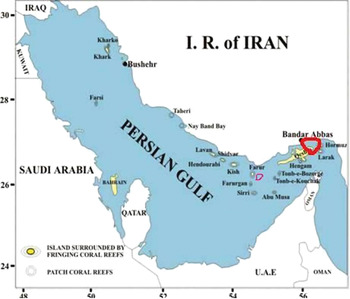
Sea cucumber samples were caught around Larak Island (26°51′52″N 56°19′32″E) in August 2011 by SCUBA diving at depths of 15 m (Figure 1). The samples were transferred to a laboratory to photograph and extract their ossicles (Hickman, Reference Hickman1998). In order to identify the species we used valid identification keys (Conand, Reference Conand1993; Samyn et al., Reference Samyn, Vandenspiegel and Massin2006). Also, for the correct identification some specimens were sent to Professor Gustav Paulay at the National Museum of Florida, United States.
Sampling site of Holothuria impatiens around Larak Island (Persian Gulf).

RESULTS AND DISCUSSION
SYSTEMATICS
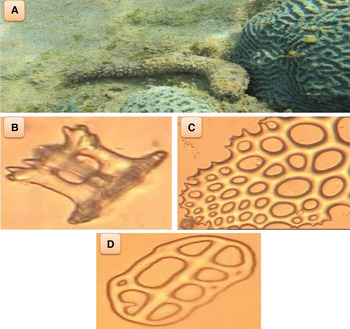
(A) Holothuria (Thymiosicia) impatiens (Forskål, 1775); (B) ossicles of dorsal tegument; (C) ossicles of the wall of a podium; (D) ossicles of ventral tegument. Scale bars: A = 12 cm; B = 20 µ; C = 60 µ; D = 20 µ.

DESCRIPTION
Ventral mouth surrounded by 20 tentacles which are in turn surrounded by a ring of very small conical papillae; anus terminal with five conical papillae. Thick Cuvierian tubules present but not readily ejected. Body wall is only a few mm thick and relatively smooth. The tube feet that stick out of verrucae are short and sparsely arranged on ambulacral and inter-ambulacral areas, both the trivium bivium. In this species the body is bottle shaped with a long neck and rough surface, sandy to touch. It is covered with conical warts from which filamentous appendages emerge. It is light brown in colour with 4–5 dark brown transverse bands on the upper side near the anterior end. Background colour beige with brown dorsal spots more or less dark. Trivium has light brown with some lighter areas corresponding to the basis of the tube feet. Bivium has somewhat darker with dark brown areas more or less connected to form transverse bands. Tentacles with curved sticks and rough to ends, the dorsal and ventral body wall with buttons, and tables to disc angular pillars topped by very short and terminated with a thorny crown. Podia with tables identical to that of the seed coat, buttons perforated elongated sticks. Spicules, a uniform layer of tables with almost squarish disc with eight large lllarginal holes and squat spire with numerous teeth on top, and an inner layer of buttons with three pairs of large holes. Species that usually lives among rocks in shallow water (0–2 m) but can be observed up to 30 m. Species widespread throughout the tropical Indo-Pacific and sub-tropical regions (including in the Red Sea and Persian Gulf) and known from the Mediterranean Sea (Samyn et al., Reference Samyn, Vandenspiegel and Massin2006).
Holothuria (Metriatyla) impatiens has long shape similar to that of H. surinamensis but more warty and rougher to the touch. When touched or disturbed, the animal very quickly contracts in size, an adaptive response to escape from predators and living in confined spaces. Colour various shades of grey and brown and it is up to 15–20 cm long (Clark, Reference Clark1942). At present it is not used for processing because it is a secretive form found under dead coral stones (James, Reference James2001). A few specimens have been taken at low tide but apparently most specimens live concealed among rocks a little deeper than most collectors are able to reach. At night it extends its anterior end from its hole to feed on nearby sediment. Holothuria (Metriatyla) impatiens was previously recorded from the Persian Gulf (Farour Island) by Heding (Reference Heding1940) but our record is a first record of this species around Larak Island.