On March 11, 2011, the northeastern coast of Japan was devastated by the Great East Japan Earthquake (GEJE) of magnitude 9.0 and the subsequent tsunami. As of October 9, 2015, there were a total of 15 893 deaths and 2567 missing people because of the GEJE, confirmed by the Japanese National Police Agency. 1 The GEJE catastrophe greatly affected mentalReference Harada, Shigemura and Taniuchi 2 , Reference Nakaya, Nakamura and Tsuchiya 3 and physical health,Reference Nozaki, Nakamura and Abe 4 as well as the socioeconomic environment including the employment status of coastal area residents, 5 resulting in a major concern for post-disaster public health.
An earlier study indicated that among chronic disease patients, those with depression were at a higher risk of withdrawing from their medical treatment.Reference Colleoni, Mandala and Peruzzotti 6 This current study examined the association between psychological distress and the risk of withdrawing from hypertension treatment (HTTx) 1 year after the earthquake disaster in coastal areas affected by the tsunami.
Methods
This study was based on a health survey as a part of the Shichigahama Health Promotion Project, in cooperation between Tohoku University and Shichigahama Town in regards to conducting health promotion activities, health surveys, and health support for the people suffering from the GEJE. The survey aimed to evaluate the current overall health and life status of community members in 5 specific seashore areas of Shichigahama Town during September 2012, where more than 10% of households were partially or totally destroyed by the GEJE and tsunami.
The entrusted survey teams visited all households in the target area and asked for participation in the survey. A form for written informed consent and the questionnaire were handed directly to the residents who express willingness to participate in the survey and subsequently collected.
First, in October 2012, a survey for residents whose homes suffered large-scale damage, followed in December 2012 by a survey of residents of the same affected seashore area whose homes underwent small-scale damage. Definition of large-scale damage was based on the criteria of “partially or totally destroyed” building damage assessment conducted by the local government of Shichigahama Town following the criteria issued by the Cabinet Office, and small-scale damage represents less or no damage due to the disaster.
Using cross-sectional data from 2012, we studied people over 20 years of age. The study protocol was reviewed and approved by the Ethics Committee of Tohoku University Graduate School of Medicine according to the revised Declaration of Helsinki (World Medical Association, 2008) and the revised Ethical Guidelines for Epidemiological Research (Japan Ministry of Education, Culture, Sports, Science and Technology/Japan Ministry of Health, Labour and Welfare, 2008).
The K6 scale was used as an indicator of psychological distress.Reference Nakaya, Nakamura and Tsuchiya 3 , Reference Kessler, Barker and Colpe 7 Survey participants were asked about their mental status over the previous month based on 6 questions, where they responded by selecting: “all of the time” (4 points), “most of the time” (3 points), “some of the time” (2 points), “little of the time” (1 point), or “none of the time” (0 points). The total scores ranged from 0 to 24. The questions were as follows: “Over the last month, how often have you felt the following: [i] nervous, [ii] hopeless, [iii] restless or fidgety, [iv] so sad that nothing could cheer you up, [v] that everything was an effort, or [vi] worthless?” K6 is based on modern psychometric theory and outperforms other scales.Reference Kessler, Barker and Colpe 7 The Japanese version of K6 was developed recently using the standard back-translation method, and it has been validated.Reference Furukawa, Kessler and Slade 8 As suggested by Kessler et al., we classified individuals with scores of ≥13/24 points as having psychological distress.Reference Nakaya, Nakamura and Tsuchiya 3 , Reference Furukawa, Kessler and Slade 8 , Reference Kuriyama, Nakaya and Ohmori-Matsuda 9
The current status of HTTx was included in this self-reported questionnaire. The subject answered by choosing one of the following items: “I have been diagnosed as having hypertension, and I am currently under treatment (‘under treatment’)”, “I have been diagnosed as having hypertension and I am currently off treatment (‘off treatment’)”, or “I have never been diagnosed as having hypertension (‘no treatment’)”. This study defined off treatment as “withdrawing” from HTTx.
Logistic regression analyses were implemented to evaluate association between psychological distress and the risk of withdrawing from HTTx. The multivariate odds ratios (ORs) have been adjusted for gender; age in years old (20-49, 50-59, 60-69, ≥70); job (employment, unemployment, unknown); experienced close relative’s death/being lost in an earthquake disaster (no, yes, unknown); social network on the Lubben Social Network Scale-6 (social isolation [score<12], without social isolation [score≥12], unknown); alcohol consumption (nondrinker, current drinker [<2 go/day, ≥2 go /day], unknown); smoking (nonsmoker, current smoker [<20 cigarettes/day, ≥20 cigarettes/day], unknown); time spent walking (<0.5 hour/day, ≥0.5 hour/day, unknown); undergoing medical treatment for physical diseases (absence, presence); and degree of housing damage (large-scale, small-scale). The level of statistical significance was set at a P value of 0.05.
Results
From the study population of 7036 participants, 6840 (97%) were contacted by the survey teams, of which 4949 (70%) completed and returned the questionnaire with their written informed consent. Of these, 3886 (55%) participants responded to the psychological distress questions that were evaluated using the K6 scale, and a total of 1014 subjects (14%) age 20 years or older were categorized as “in need of treatment for hypertension (‘under treatment’ or ‘off treatment’).” We used the data from these 1014 respondents in the following analyses.
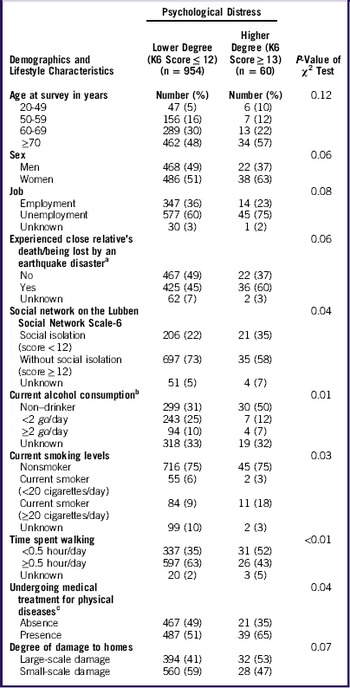
Table 1 summarizes psychological distress of the participants, along with the demographic data, lifestyle, and socioeconomic characteristics of the subjects. Non-alcohol drinkers or current smokers with ≥20 cigarettes per day experienced higher levels of psychological distress (K6 score of ≥13/24 points). Subjects who indicated social isolation, had spent less time walking, or who had undergoing medical treatment for physical diseases also suffered from psychological distress.
Participant Characteristics (Demographic Data, Lifestyle, Socioeconomic Characteristics of the Subjects) by Psychological Distress in the Shichigahama Health Promotion Project (n=1014)

a Close relative included parents, brothers/sisters, children, relatives, friends, or colleagues.
b 22.8 gram alcohol amounts to 1 go or a traditional unit of sake (180 ml), which also approximates 2 glasses of wine (200 ml) or beer (500 ml) in terms of alcohol content.
c Combination of medical treatment for physical diseases (stroke, myocardial infarction or angina, cancer, kidney disease, liver disease, diabetes mellitus, or hyperlipidemia).
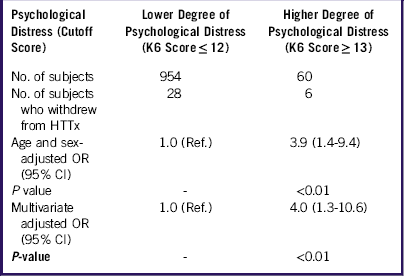
Table 2 shows the results of the multiple logistic regression analysis. In a model adjusted for age and sex, subjects with a higher degree of psychological distress had a significantly higher risk of withdrawing from HTTx when compared with subjects with a lower degree of psychological distress (odds ratio [OR]=3.9, 95% confidence interval [CI]=1.4-9.4, P<0.01). The results remained largely unchanged even after a multivariate adjusted analysis was conducted (OR=4.0, 95% CI=1.3-10.6, P<0.01).
Multivariate Adjusted Odds Ratios (ORs and 95% confidence intervals [CIs]) for psychological distress and the risk of withdrawing from HTTx 1 year after the GEJE (n=1014)

The multivariate adjusted ORs have been adjusted for gender; age in years (20-49, 50-59, 60-69, ≥70); job (employment, unemployment, unknown); experienced close relative’s death/being lost by an earthquake disaster (no, yes, unknown)a; social network on the Lubben Social Network Scale-6 (social isolation [score<12], without social isolation [score≥12], unknown); alcohol consumption (nondrinker, current drinker [<2 go/day, ≥2 go/day], unknown)b; smoking (nonsmoker, current smoker [<20 cigarettes/day, ≥20 cigarettes/day], unknown); time spent walking (<0.5 hour/day, ≥0.5 hour/day, unknown); undergoing medical treatment for physical diseases (absence, presence)c; and degree of housing damage (large-scale, small-scale).
aClose relative included parents, brothers/sisters, children, relatives, friends, or colleagues.
b22.8 gram alcohol amounts to 1 go or a traditional unit of sake (180 ml), which also approximates 2 glasses of wine (200 ml) or beer (500 ml) in terms of alcohol content.
cCombination of medical treatment for physical diseases (stroke, myocardial infarction or angina, cancer, kidney disease, liver disease, diabetes mellitus, or hyperlipidemia).
Discussion
This cross-sectional study examined the association between psychological distress and the risk of withdrawing from HTTx after the earthquake disaster. In this study, subjects with a higher degree of psychological distress exhibited a significantly higher risk of withdrawing from HTTx when compared with subjects with a lower degree of psychological distress. An earlier study indicated that among cancer patients, those with depression were at a higher risk of withdrawing from cancer treatment compared with those without depression.Reference Colleoni, Mandala and Peruzzotti 6 Our study endorsed the negative impact of mental health problems on adherence to treatment for chronic physical illness using a community-based study. In addition, previous studies have suggested that the catastrophe increased the prevalence of vascular diseases, probably because of the psychological stress caused by the disaster.Reference Aoki, Takahashi and Fukumoto 10 Our data suggested that the increased risk of withdrawing from HTTx associated with post-disaster psychological distress may underlie the increased prevalence of vascular diseases among these communities. The current study also suggested that a brief assessment of psychological distressReference Colleoni, Mandala and Peruzzotti 6 in patients with HTTx living in the disaster area may be beneficial for preventing the risk of vascular disease as a devastating consequence of withdrawing from HTTx by helping patients and health care providers to become aware of mental health care needs and adherence to HTTx.
This study had several limitations. Our sample size of 1014 may not be large enough to gain a true statistical power of the real effect of the association between psychological distress and the risk of withdrawing from HTTx. Because of its cross-sectional study design, we were unable to determine a causal relationship between psychological distress and the risk of withdrawing from HTTx.
Conclusions
This cross-sectional study examined the association between psychological distress and the risk of withdrawing from HTTx after the GEJE. Subjects with a higher degree of psychological distress (K6 score≥13) exhibited a significantly higher risk of withdrawing from HTTx, compared with subjects with a lower degree of psychological distress (K6 score≤12) (odds ratio=4.0, 95% confidence interval= 1.3-10.6, P<0.01). This study indicated that psychological distress is a risk factor for withdrawing from HTTx in post-disaster settings.
Acknowledgments
This work was supported by the MEXT Tohoku Medical Megabank Project, The Japan Agency for Medical Research and Development (AMED), and grants from the Japanese Society for the Promotion of Science (JSPS) for the Grant-in-Aid for Scientific Research (C) (No. 26350863) and the Grant-in-Aid from the Kurokawa Cancer Research Foundation.
There are no conflicts of interest to declare.