Introduction
Bipolar disorder (BD) is a major neurodevelopmental disorder characterized by fluctuation of the mood state, impulsive behaviors and social function impairment. Among these characteristics, impulsive behaviors have received more attention recently, and trait impulsivity has been suggested to be a crucial marker of BD. Early studies have demonstrated that although impulsivity is particularly high during manic episodes, it may also be found during the euthymic and other mood states among patients with BD (Swann et al. Reference Swann, Anderson, Dougherty and Moeller2001, Reference Swann, Pazzaglia, Nicholls, Dougherty and Moeller2003). A review by Najt et al. (Reference Najt, Perez, Sanches, Peluso, Glahn and Soares2007) suggested that impulsivity is not only state related but also a trait component of BD and that it is a core feature of this illness. Consistent with these suggestions, several behavioral studies have consistently demonstrated higher trait impulsivity in patients with BD (Henna et al. Reference Henna, Hatch, Nicoletti, Swann, Zunta-Soares and Soares2013; Powers et al. Reference Powers, Russo, Mahon, Brand, Braga, Malhotra and Burdick2013; Ozten et al. Reference Ozten, Erol, Karayilan, Kapudan, Orsel and Kumsar2015), adolescents with BD (Nandagopal et al. Reference Nandagopal, Fleck, Adler, Mills, Strakowski and DelBello2011) and unaffected siblings of patients with BD (Wessa et al. Reference Wessa, Kollmann, Linke, Schonfelder and Kanske2015). These findings support the hypothesis that increased trait impulsivity is an endophenotype of BD.
Understanding the neural mechanism of increased trait impulsivity in BD may elucidate the pathophysiology and improve the diagnosis and treatment of this severe illness. The high co-morbidity of trait impulsivity and BD has been attributed to the association between the biological substrates of trait impulsivity and BD (Moeller et al. Reference Moeller, Barratt, Dougherty, Schmitz and Swann2001). Previous structural imaging studies have found that in healthy individuals, higher trait impulsivity is inversely correlated with gray matter volumes of the left orbitofrontal cortex (OFC) (Schilling et al. Reference Schilling, Kuhn, Romanowski, Banaschewski, Barbot, Barker, Bruhl, Buchel, Charlet, Conrod, Czech, Dalley, Flor, Hake, Ittermann, Ivanov, Mann, Ludemann, Martinot, Palafox, Paus, Poline, Reuter, Rietschel, Robbins, Smolka, Strohle, Walaszek, Kathmann, Schumann, Heinz, Garavan and Gallinat2013b ) or bilateral OFC (Matsuo et al. Reference Matsuo, Nicoletti, Nemoto, Hatch, Peluso, Nery and Soares2009a ) by using voxel-based morphometry (VBM). A surface-based morphometry (SBM) study found a significant inverse correlation between trait impulsiveness and cortical thickness of the left superior frontal cortex in adolescents (Schilling et al. Reference Schilling, Kuhn, Paus, Romanowski, Banaschewski, Barbot, Barker, Bruhl, Buchel, Conrod, Dalley, Flor, Ittermann, Ivanov, Mann, Martinot, Nees, Rietschel, Robbins, Smolka, Strohle, Kathmann, Garavan, Heinz, Schumann and Gallinat2013a ). Another SBM study found a negative correlation between trait impulsivity and cortical thickness of the left middle frontal, superior frontal and orbitofrontal gyri (Schilling et al. Reference Schilling, Kuhn, Romanowski, Schubert, Kathmann and Gallinat2012). Few imaging studies of the structural correlates of trait impulsivity in BD have been conducted. A VBM study (Matsuo et al. Reference Matsuo, Nicoletti, Peluso, Hatch, Nemoto, Watanabe, Nery, Monkul, Zunta-Soares, Bowden and Soares2009b ) found that higher trait impulsivity was correlated with lower gray matter volume of the left rostral anterior cingulate. In summary, these structural imaging findings suggest that the prefrontal cortex is a major structural determinant of trait impulsivity, and that the neural substrates may differ in patients with BD and healthy participants. However, previously, patients with BD and healthy controls (HCs) have not been included in the same study, and differences in image acquisition and the analysis methods may contribute to the difference in structural correlates in these two groups.
This study used SBM to investigate the structural correlates of trait impulsivity measured using the Barratt Impulsiveness Scale (BIS) in HCs and patients with BD. On the basis of previous findings, we postulate two specific hypotheses: (1) the cortical thickness of the prefrontal cortex significantly correlates with the total BIS scores in HCs; and (2) patients with BD have different structural correlates of trait impulsivity.
Method
Participants
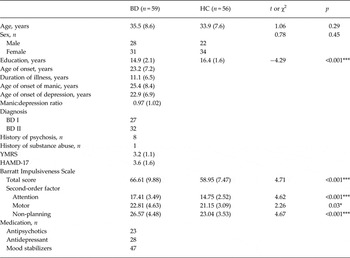
The BD group comprised 59 out-patients with a diagnosis of BD I or II from the Taipei Veterans General Hospital in Taiwan (Table 1). All patients were in the euthymic state, as defined by a score of <7 on the 17-item Hamilton Depression Rating Scale (Hamilton, Reference Hamilton1960) and a score of <7 on the Young Mania Rating Scale (Young et al. Reference Young, Biggs, Ziegler and Meyer1978). Diagnoses were confirmed through structured clinical interviews for the Diagnostic and Statistical Manual of Mental Disorders, 4th edition (First et al. Reference First, Spitzer, Gibbon and Williams1997). Participants were screened to exclude those with a history of head injury resulting in a sustained loss of consciousness and/or cognitive sequelae, neurological illness, or any disorder affecting the cerebral metabolism. These patients were receiving treatment with various atypical antipsychotics, antidepressants and mood stabilizers before participation in the experiment (Table 1). A total of 56 age-, sex- and handedness-matched HCs were recruited through advertisement. These participants were screened by using the Mini-International Neuropsychiatric Inventory Plus (Sheehan et al. Reference Sheehan, Lecrubier, Sheehan, Amorim, Janavs, Weiller, Hergueta, Baker and Dunbar1998). In addition, those having first-degree relatives with Axis I disorders, including schizophrenia, major depression, or BD, were excluded. All procedures were approved by the Institutional Review Board of the Taipei Veterans General Hospital, and all participants provided written informed consent after they were apprised of the experimental procedures.
Demographic data and behavioral results of the participants enrolled in the study

Data are given as mean (standard deviation) unless otherwise indicated.
BD, Bipolar disorder; HC, healthy control; YMRS, Young Mania Rating Scale; HAMD-17, 17-item Hamilton Depression Rating Scale.
* p < 0.05, *** p < 0.01.
Measurement of trait impulsivity
Trait impulsivity was evaluated using version 11 of the BIS (Patton et al. Reference Patton, Stanford and Barratt1995). A Chinese version (Chan et al. Reference Chan, Chen, Chan, Hung, Cheung, Law, Chan and Lam2003) of the questionnaire was used in this study. It contains 30 items, each of which is rated on a four-point Likert scale (rarely/never = 1, occasionally = 2, often = 3, and almost always/always = 4). The total scores and scores for three second-order factors, namely attentional impulsiveness, motor impulsiveness, and non-planning impulsiveness, were calculated.
Image acquisition
Images were acquired using a 3.0 T GE Discovery 750 whole-body high-speed imaging device. Head stabilization was achieved with cushioning, and all participants wore earplugs (29 dB rating) to attenuate any noise. Automated shimming procedures were performed and scout images were obtained. A high-resolution structural image was acquired in the sagittal plane by using a high-resolution sequence (repetition time = 2530 ms, echo spacing = 7.25 ms, echo time = 3 ms, flip angle = 7°) and an isotropic 1 mm voxel (field of view = 256 × 256).
Analysis of cortical thickness
All structural T1 images were analysed using FreeSurfer (version 4.0.5, http://www.nmr.mgh.harvard.edu/martinos) to create anatomical surface models and for statistical analyses (Dale et al. Reference Dale, Fischl and Sereno1999; Fischl et al. Reference Fischl, Sereno and Dale1999a ). For each participant, the processing stream included the removal of non-brain tissue, transformation to Talairach space, and segmentation of gray–white matter tissue. The thickness measurements across the cortex were computed by determining the point on the gray matter–white matter boundary surface closest to a given point on the estimated pial surface (and vice versa) and averaging these two values (Fischl & Dale, Reference Fischl and Dale2000). The accuracy of the thickness measurements derived using this technique has been validated by histological (Rosas et al. Reference Rosas, Liu, Hersch, Glessner, Ferrante, Salat, van der Kouwe, Jenkins, Dale and Fischl2002) and manual measurements (Kuperberg et al. Reference Kuperberg, Broome, McGuire, David, Eddy, Ozawa, Goff, West, Williams, van der Kouwe, Salat, Dale and Fischl2003). To map each participant to a common space, the surface representing the gray matter–white matter boundary was registered to an average cortical surface atlas by using a non-linear procedure that optimally aligned sulcal and gyral features across participants (Fischl et al. Reference Fischl, Sereno and Dale1999a ). For vertex-by-vertex cluster analysis, the thickness maps of all participants in both groups were converted to a common atlas space (Fischl et al. Reference Fischl, Sereno and Dale1999a , Reference Fischl, Sereno, Tootell and Dale b ). The data were smoothed by applying a two-dimensional Gaussian smoothing kernel of 10 mm.
Statistical analyses
A general linear model was used to analyse the correlation between cortical thickness and total BIS scores by using age and education as covariates of no interest. We used an uncorrected threshold of p < 0.01 for initial vertex-wise comparisons. To correct for multiple comparisons, we adopted the method of Monte Carlo simulations (Hagler et al. Reference Hagler, Saygin and Sereno2006). The method creates multiple simulated null datasets, and from them creates a distribution of cluster sizes, from which the cluster size corresponding to a desired corrected p can be read off. In this study, we simulated 10 000 times to create the null dataset. At the cluster level, only clusters with a significance threshold of p < 0.05 were reported. Since our major hypothesis is that patients with BD and HCs have different structural correlates for trait impulsivity, the correlation between the BIS and cortical thickness was performed separately for BD patients and HCs in the major analysis. To investigate whether differences were observed in the cortical thickness of the structures showing significant correlation with total BIS scores in patients with BD and HCs, the mean cortical thickness values of the significant clusters were extracted for each participant and compared between group using an independent t test. With regard to the clusters showing significant correlation with total BIS in patients with BD, we performed a control analysis that calculated the partial correlation coefficient between cortical thickness and BIS score after adding the use of antipsychotics, antidepressants, vaproic acid and lithium as four additional covariates of no interest to control the confound of psychotropics use. We also performed a supplementary analysis that included patients with BD and HCs in the same model to investigate the structures showing significantly different cortical thickness/BIS relationships in these two groups. In the model, cortical thickness was the dependent variable and independent factors included BIS score, diagnosis and BIS × diagnosis interaction. Age and education were also included as covariates of no interest. The structures showing significant BIS × diagnosis interaction were reported.
Results
The demographic data of participants in this study are shown in Table 1. The exact medications in patients with BD are detailed in online Supplementary Table S1. Patients with BD obtained significantly higher total BIS scores and higher BIS subscores than did the HCs. No significant difference was observed in the performance of the Wisconsin Card Sorting Test between patients with BD and healthy individuals.
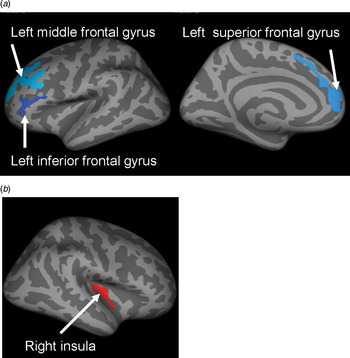
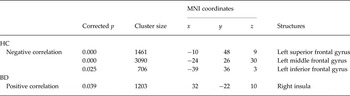
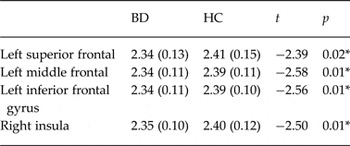
Regarding vertex-wise regression analysis, the BIS scores and the cortical thickness of the left middle, superior and inferior frontal cortices (Table 2, Fig. 1) significantly negatively correlated in HCs. In patients with BD, the total BIS scores and the cortical thickness of the right insula significantly positively correlated (Table 2, Fig. 1). The correlation was still significant (r = 0.42, p = 0.001) after controlling for the use of various psychotropics in the control analysis. The cortical thickness of these structures was extracted, and the results showed that patients with BD had a significantly thinner cortex in all these structures (Table 3).
Structural correlates of the Barratt Impulsiveness Scale in healthy controls and patients with bipolar disorder. (a) In healthy controls, the cortical thickness of the left superior, middle and inferior frontal cortex is significantly negatively correlated with total scores of the Barratt Impulsiveness Scale. (b) In patients with bipolar disorder, only the cortical thickness of the right insula is positively correlated with total scores of the Barratt Impulsiveness Scale.

Cortical regions showing a significant correlation with total scores of the Barratt Impulsiveness Scale in HCs and patients with BD

HC, Healthy controls; BD, bipolar disorder; MNI, Montreal Neurological Institute.
Cortical thickness values (mm) in the four anatomical structures showing significant correlation with the Barratt Impulsiveness Scale in HCs and patients with BD

Data are given as mean (standard deviation).
HCs, Healthy controls; BD, bipolar disorder.
* p < 0.05.
The supplementary analysis demonstrated that there was a significant BIS × diagnosis interaction in the left superior frontal gyrus, left middle frontal gyrus, left lateral orbitofrontal gyrus and right insula (online Supplementary Table S2 and Supplementary Fig. S1). The interaction was driven by the fact that the total BIS scores were negatively correlated with the cortical thickness of left prefrontal structures only in HCs, but not in patients with BD. In the contrary, the total BIS scores were positively correlated with the cortical thickness of the right insula only in patients with BD, but not in HCs. The findings are largely consistent with our major analysis.
In patients with BD, we did a further analysis to clarify the effects of psychosis history, BD subtype (I v. II), age of onset and illness duration on BIS ratings and cortical thickness of the mentioned structures in Table 2. The results demonstrated that only BD subtype had a significant effect. BD I patients showed significant lower cortical thickness in the left superior frontal gyrus (t = 2.48, p = 0.02) and the left inferior frontal cortex (t = 2.23, p = 0.03) than BD II patients, although the total BIS scores did not show significant difference between these two groups.
Discussion
In this study, we used SBM to investigate the structural correlates of trait impulsivity in HCs and patients with BD. In HCs, we found that higher trait impulsivity was associated with a thinner cortex in the left superior, middle and inferior frontal gyri. By contrast, in patients with BD, higher trait impulsivity was associated with a higher cortical thickness of the right insula. Furthermore, patients with BD showed a thinner cortex than HCs in all these four structures.
In HCs, the left middle frontal gyrus had the largest cluster size among the structures showing a significant correlation between cortical thickness and trait impulsivity. The anatomical locations of the cluster in the left middle frontal gyrus are highly consistent with those in two previous SBM studies of trait impulsivity in adults (Schilling et al. Reference Schilling, Kuhn, Romanowski, Schubert, Kathmann and Gallinat2012) and adolescents (Schilling et al. Reference Schilling, Kuhn, Paus, Romanowski, Banaschewski, Barbot, Barker, Bruhl, Buchel, Conrod, Dalley, Flor, Ittermann, Ivanov, Mann, Martinot, Nees, Rietschel, Robbins, Smolka, Strohle, Kathmann, Garavan, Heinz, Schumann and Gallinat2013a ). Furthermore, an SBM study with functional magnetic resonance imaging (MRI) imaging reported that differences in the cortical thickness of the left dorsolateral prefrontal cortex were predictive of differences in impulsivity and strategic behavior in adolescents and adults (Steinbeis et al. Reference Steinbeis, Bernhardt and Singer2012). A critical lesion study examined task-switching performance in a group of patients with left or right frontal lobe lesions considering that inhibitory mechanisms may be required for a switching task set and reported that the degree of top-down control was correlated reliably with the extent of damage to the left middle frontal gyrus (Aron et al. Reference Aron, Monsell, Sahakian and Robbins2004a ). Therefore, the vital role of the left middle frontal gyrus in behavioral control is a possible mechanism for the observed association between structural variation and trait impulsivity.
The left superior frontal gyrus is another structural correlate of trait impulsivity in HCs in our study. Fig. 1 shows that the cluster is located in the medial part of the prefrontal cortex. Although the cortical thickness of the left superior frontal cortex was also reported to be inversely correlated with trait impulsivity in previous studies on adults (Schilling et al. Reference Schilling, Kuhn, Romanowski, Schubert, Kathmann and Gallinat2012) and adolescents (Schilling et al. Reference Schilling, Kuhn, Paus, Romanowski, Banaschewski, Barbot, Barker, Bruhl, Buchel, Conrod, Dalley, Flor, Ittermann, Ivanov, Mann, Martinot, Nees, Rietschel, Robbins, Smolka, Strohle, Kathmann, Garavan, Heinz, Schumann and Gallinat2013a ), the position is located in the lateral part and may not be in total congruence with our finding. By contrast, a VBM study of BD patients (Matsuo et al. Reference Matsuo, Nicoletti, Peluso, Hatch, Nemoto, Watanabe, Nery, Monkul, Zunta-Soares, Bowden and Soares2009b ) found an inverse correlation with the left anterior cingulate, which is located in the medial part of the prefrontal cortex. In a previous functional MRI study, the medial prefrontal cortex was found to be crucial for self-initiated inhibition or withholding intended actions (Brass & Haggard, Reference Brass and Haggard2007). Our findings suggest that the medial prefrontal cortex is also vital in trait impulsivity.
The inferior frontal cortex is an important structure for response inhibition and one important hypothesis states that a dedicated neural module within the right inferior frontal cortex is dedicated to supporting motor response inhibition by down-regulating processes within the motor control areas of the brain via interactions with subcortical areas (Aron et al. Reference Aron, Robbins and Poldrack2004b ; Aron, Reference Aron2011). Hypoactivation of the inferior frontal gyrus during response inhibition in patients with BD was reported in a previous functional MRI study (Townsend et al. Reference Townsend, Bookheimer, Foland-Ross, Moody, Eisenberger, Fischer, Cohen, Sugar and Altshuler2012) and meta-analysis of 30 functional MRI studies of response inhibition found that BD patients underactivated the right inferior frontal gyrus regardless of current mood state and behavioral performance (Hajek et al. Reference Hajek, Alda, Hajek and Ivanoff2013). Furthermore, a recent functional MRI study revealed a highly specific and significant lack of recruitment of the left and right inferior frontal gyrus when inhibiting responses to fearful faces in the high-risk participants compared with control subjects (Roberts et al. Reference Roberts, Green, Breakspear, McCormack, Frankland, Wright, Levy, Lenroot, Chan and Mitchell2013). Despite inconsistency about hemispheric laterality (left or right), our finding that the left inferior frontal gyrus is a structural correlate of trait impulsivity in HCs is consistent with previous findings about the role of the inferior frontal cortex in response inhibition.
All structures showing significant negative correlations in HCs were located in the left prefrontal cortex, suggesting the cardinal role of the left prefrontal cortex in trait impulsivity in HCs. Our results, along with those of two previous SBM studies (Schilling et al. Reference Schilling, Kuhn, Romanowski, Schubert, Kathmann and Gallinat2012, Reference Schilling, Kuhn, Paus, Romanowski, Banaschewski, Barbot, Barker, Bruhl, Buchel, Conrod, Dalley, Flor, Ittermann, Ivanov, Mann, Martinot, Nees, Rietschel, Robbins, Smolka, Strohle, Kathmann, Garavan, Heinz, Schumann and Gallinat2013a ), consistently highlight the importance of the left prefrontal cortex in trait impulsivity. Patients with BD also had a thinner cortex in the three prefrontal structures, showing a negative correlation with BIS scores in HCs. We suggest that the structural deficit in the left prefrontal cortex is a potential mechanism for higher trait impulsiveness in BD. It reflects an aberrant structure–functional relationship and prefrontal dysfunction in BD.
Our study found a positive correlation between the right insula and BIS scores in patients with BD. Although our finding is different from that of a previous VBM study, which reported a negative correlation between the gray matter volume deficit in the left anterior cingulate and BIS scores in BD (Matsuo et al. Reference Matsuo, Nicoletti, Peluso, Hatch, Nemoto, Watanabe, Nery, Monkul, Zunta-Soares, Bowden and Soares2009b ), these two structures (the insula and anterior cingulate) are both crucial hubs of the salience network and are crucial in cognitive control and salience processing (Dosenbach et al. Reference Dosenbach, Fair, Miezin, Cohen, Wenger, Dosenbach, Fox, Snyder, Vincent, Raichle, Schlaggar and Petersen2007; Seeley et al. Reference Seeley, Menon, Schatzberg, Keller, Glover, Kenna, Reiss and Greicius2007). The role of the insula in trait impulsivity has also been supported by previous structural and functional imaging studies. A resting functional connectivity MRI study found that cocaine addiction, relapse risk and impulsivity were associated with reduced connectivity in putamen–posterior insula circuits (McHugh et al. Reference McHugh, Demers, Braud, Briggs, Adinoff and Stein2013). Another study observed an association between dysfunction in the insula and striatal connectivity in cocaine users, which was further linked to increased impulsivity (Wisner et al. Reference Wisner, Patzelt, Lim and MacDonald2013). A VBM study (Kaag et al. Reference Kaag, Crunelle, van Wingen, Homberg, van den Brink and Reneman2014) found that the gray matter volume of the insula was positively correlated with BIS scores in HCs but negatively correlated with BIS scores in cocaine abusers. A functional MRI study (Dambacher et al. Reference Dambacher, Sack, Lobbestael, Arntz, Brugman and Schuhmann2015) found that insula activations were associated with failed motor response inhibition measured using a go/no-go task in healthy males. Therefore, a possible explanation for the positive correlation between the cortical thickness of the right insula and total BIS scores is higher inhibition failure because of prefrontal dysfunction in BD.
A substantial limitation of this study is that the BD participants were receiving various dosages of antipsychotics and antidepressants. One study found that short-term treatment with antipsychotics was associated with a thinner prefrontal cortex, improved cognitive control and increased prefrontal functional activity (Lesh et al. Reference Lesh, Tanase, Geib, Niendam, Yoon, Minzenberg, Ragland, Solomon and Carter2015). Another study of first-episode psychosis (Ansell et al. Reference Ansell, Dwyer, Wood, Bora, Brewer, Proffitt, Velakoulis, McGorry and Pantelis2015) found that first-generation antipsychotic (FGA) and second-generation antipsychotic (SGA) treatments had divergent effects on cortical thickness. Comparisons with HCs revealed decreased cortical thickness in the FGA group, whereas the SGA group showed increases in addition to decreases. A follow-up study of drug-naive first-episode psychosis found that 8-week treatment with atypical antipsychotics (risperidone or quetiapine) increases prefrontal cortical thickness in patients with psychosis (Goghari et al. Reference Goghari, Smith, Honer, Kopala, Thornton, Su, Macewan and Lang2013). The effect of antipsychotics on cortical thickness is not totally consistent and is a possible confounder contributing to the findings of the different structure/functional relationship in this study. Compared with antipsychotics, the studies of antidepressant and mood stabilizers are less abundant. It was found that sodium valproate use in epilepsy was associated with parietal lobe thinning (Pardoe et al. Reference Pardoe, Berg and Jackson2013) and BD patients treated with lithium consistently exhibited non-significant trends for greater cortical thickness relative to lithium-free BD patients (Giakoumatos et al. Reference Giakoumatos, Nanda, Mathew, Tandon, Shah, Bishop, Clementz, Pearlson, Sweeney, Tamminga and Keshavan2015). Although the correlation between cortical thickness and BIS score was still significant in the right insula after controlling the use of various psychotropics, we cannot exclude the possibility that the effects of psychotropics contributed to our findings and should be cautious in interpreting the results in patients with BD.
In conclusion, our findings support our first hypothesis and demonstrate that the left prefrontal cortex plays a cardinal role in trait impulsivity in HCs. We also find that patients with BD have a different structural correlate of trait impulsiveness in the right insula. However, the fact that different psychotropics have complex effects on cortical thickness may limit our interpretation of BD findings.
Supplementary material
The supplementary material for this article can be found at https://doi.org/10.1017/S0033291716003299
Acknowledgements
The study was supported by grants from the Taiwan Ministry of Science and Technology (NSC 103-2314-B-075-065-MY2, NSC 102-2420-H-010-003, NSC 103-2420-H-010-001) and Taipei Veterans General Hospital (V104C-128).
Declaration of Interest
None.