Implications
Floor types which improve welfare and reduce costs of straw bedding is a continuing challenge within the beef industry. Concerns have been raised regarding the use of rubber flooring in terms of overgrown hooves and hoof health. This highlights the need for further research investigating the effect of floor type on lameness. This study found that despite greater toe net growth in bulls accommodated on rubber flooring, there was no effect on locomotion score; suggesting this degree of increased toe net growth has no impact on walking ability.
Introduction
Lameness in cattle has major economic and animal welfare implications (Bruijnis et al., Reference Bruijnis, Hogeveen and Stassen2010; Bruijnis et al., Reference Bruijnis, Beerda, Hogeveen and Stassen2012). The impact of lameness on animal welfare is usually long lasting and associated with substantial pain, resulting in premature culling and adversely affecting performance (Alban et al., Reference Alban, Agger and Lawson1996). Fully slatted flooring and bare concrete solid flooring are commonly used to accommodate cattle, due to advantages in cost-effectiveness and durability (Franck and De Belie, Reference Franck and De Belie2006). However, concrete flooring has been suggested to be a contributing factor in the development of lameness, with ~80% of dairy cows reported to be subjected to at least one or more claw disorders (Franck and De Belie, Reference Franck and De Belie2006). In a study involving dairy bred bull calves, Thomsen et al. (Reference Thomsen, Hansen, Martin and Kudahl2017) reported that calves accommodated on slatted flooring had higher odds of sole haemorrhages and severe sole haemorrhages compared with those accommodated on straw bedding. According to the Royal Society for the Prevention of Cruelty to Animals (RSPCA) welfare standards for beef cattle, indicators of a poor environment include bruised soles and joint swellings (RSPCA, 2013). Hard floor surfaces, such as fully slatted flooring, reduce the contact area of the claw, increasing pressure concentrations which can lead to abnormal pressure distribution and cause damage to the claw (van der Tol et al., Reference van der Tol, Metz, Noordhuizen-Stassen, Back, Braam and Weijs2002). Abrasive flooring can also increase wear on the sole of the hoof making it thinner; consequently the sole has less protection against uneven floor surfaces which can lead to bruising and subsequent ulceration (Gregory et al., Reference Gregory, Craggs, Hobson and Krogh2006). Graunke et al. (Reference Graunke, Telezhenko, Hessle, Bergsten and Loberg2011) reported less severe swellings at the leg joints in bulls accommodated rubber flooring compared with those accommodated on fully slatted flooring. The authors suggested that this was the effect of the softer flooring. Graunke et al. (Reference Graunke, Telezhenko, Hessle, Bergsten and Loberg2011) also suggested that these animals are likely to experience pain while standing up and lying down on fully slatted flooring, therefore making it an animal welfare concern. Cattle also have a clear preference to stand and walk on straw bedding and rubber flooring compared with concrete flooring (Lowe et al., Reference Lowe, Steen and Beattie2001; Telezhenko et al., Reference Telezhenko, Lidfors and Bergsten2007). Boyle et al. (Reference Boyle, Mee and Kiernan2007) reported that cows accommodated on concrete flooring spend more time on mattress bedded cubicles compared with those accommodated on rubber flooring. Boyle et al. (Reference Boyle, Mee and Kiernan2007) suggested that this was to relieve their feet from concrete flooring. Rubber flooring may be a suitable alternative combining ease of management and welfare (Platz et al., Reference Platz, Ahrens, Bendel, Meyer and Erhard2007b) in regions were straw availability is low and therefore uneconomically viable. However, the use of softer flooring such as rubber to accommodate cattle in terms of hoof health has been controversial (Ahrens et al., Reference Ahrens, Platz, Link, Mahling, Meyer and Erhard2011). Rubber flooring often contains grooves to reduce slipping; Platz et al. (Reference Platz, Ahrens, Bahrs, Nüske and Erhard2007a) suggested that these artificial floor structures also retain faeces and urine, increasing the level of claw disorders, particularly digital dermatitis (DD). Concerns have also been raised regarding the occurrence of overgrown claws due to insufficient hoof wear (Cozzi et al., Reference Cozzi, Tessitore, Contiero, Ricci, Gottardo and Brscic2013; Brscic et al., Reference Brscic, Ricci, Prevedello, Lonardi, De Nardi, Contiero, Gottardo and Cozzi2015). Insufficient hoof wear can have detrimental effects on animal welfare by increasing the risk of mechanical injury and allowing an entry for infection (Somers et al., Reference Somers, Schouten, Frankena, Noordhuizen-Stassen and Metz2005).
Locomotion scoring is commonly used to detect lameness through assessing an animal’s walking gait (Flower and Weary, Reference Flower and Weary2006). However, detection of lameness is often delayed due to the stoical nature of cattle (O’Callaghan et al., Reference O’Callaghan, Cripps, Downham and Murray2003). Infrared thermography has been identified as a potential non-invasive diagnostic tool, by using elevated hoof temperature for the detection of lameness associated with foot lesions (Alsaaod and Büscher, Reference Alsaaod and Büscher2012; Stokes et al., Reference Stokes, Leach, Main and Whay2012). Stokes et al. (Reference Stokes, Leach, Main and Whay2012) reported that by setting the threshold for disease at 27°C for dirty feet, IR thermography was able to identify 80% of feet with lesions, and 73% of feet without lesions correctly. The use of IR thermography has not yet been used to investigate differences in hoof temperature of beef cattle accommodated on different floor types. Research on the effect of floor type on lameness in beef cattle is limited. Cozzi et al. (Reference Cozzi, Tessitore, Contiero, Ricci, Gottardo and Brscic2013) suggested that this may be due to the costs associated with alternative floor types and the shorter production cycle of beef cattle compared with dairy cows. However, this does not justify lesser housing conditions for beef cattle compared with dairy cattle (Platz et al., Reference Platz, Ahrens, Bahrs, Nüske and Erhard2007a).
This study aimed to evaluate the effect of using different floor types to accommodate growing and finishing beef cattle on locomotion, hoof health and swelling at the leg joints. Although there is evidence that cattle have a clear preference for walking and standing on straw bedding and rubber flooring compared with concrete slats, concerns have been raised regarding insufficient hoof wear and the risk of overgrown hooves in cattle accommodated on rubber flooring. In addition, this study examined the use of IR thermography to identify differences in maximum hoof temperature of beef cattle accommodated on different floor types as an indication of hoof health.
Material and methods
Animals, pre-experimental management and diets
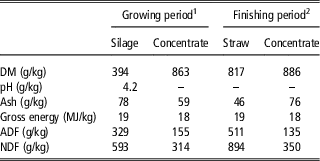
The current study was carried out at the Agri-Food and Biosciences Institute, Hillsborough, from October 2015 to May 2016. In all, 80 dairy origin bulls (46 pure Holstein, 32 Holstein (bred from Holstein cross Swedish Red cross Jersey cows) and two Limousin cross Holstein) were involved in the study. During the pre-experimental period, bulls were at pasture from June 2015 to October 2015. During the grazing period, all bulls were managed the same but divided into two separate groups according to live weight. The heaviest bulls remained in one group and the lightest bulls in another group to minimise competition and stress. Bulls were housed on 19 October 2015 (day 0) with a mean initial live weight of 224 kg (SD=28.4 kg) and an average age of 246 days (SD=20.4 days). Daily live weight gain (DLWG) for bulls accommodated on CS during the growing period was 1.37 and 1.38 kg/day for those accommodated on RS. During the finishing period, DLWG for bulls accommodated on CS was 1.62 kg/day, 1.67 kg/day for RS, 1.63 kg/day for CS-S and 1.71 kg/day for those accommodated on CS-RS. During the growing period, bulls were offered ad libitum grass silage supplemented with concentrates. During the finishing period bulls were offered concentrates supplemented with ad libitum chopped barley straw. The chemical composition of the feed offered are given in Table 1. Bulls were initially supplemented with 2 kg concentrates/head per day at the beginning of the grazing period until day 7 of the experimental period. The level of concentrates was then increased by 0.5 kg/head each week, until intake reached ad libitum. On day 161, all bulls reached ad libitum concentrate intake with an average of 12 kg concentrates/head per day. All bulls were slaughtered before they reached 16 months of age at a mean live weight of 545.7 kg (SD=36.6 kg).
Composition of feed offered to dairy origin bulls during the growing and finishing periods

DM=dry matter.
1 Growing period: days 0 to 101 of the experiment.
2 Finishing period: days 101 to 204 of the experiment.
Treatments and experimental pens
The duration of the experimental period was 204 days, which was split according to the diet offered. The first 101 days was defined as the growing period, followed by 103 days of a finishing period. Bulls were divided according to live weight and breed in 20 blocks, each of four animals. Each group was then randomly allocated to one of four treatments. Bulls on treatment one were accommodated on fully slatted flooring throughout the entire experimental period (CS), bulls on treatment two were accommodated on fully slatted flooring covered with rubber strips (Comfort Slat Mat; Irish Custom Extruders Ltd, Dublin, Ireland) for the entire experimental period (RS), bulls on treatment three were accommodated on fully slatted flooring during the growing period moving to a solid floor covered with straw bedding during the finishing period (CS-S) and bulls on treatment four were accommodated on fully slatted flooring during the growing period moving to fully slatted flooring covered with rubber strips during the finishing period (CS-RS). The fully slatted flooring pens were made of individual concrete slats and measured 3.4×2.7 m with a total drainage area of 24% (12.5 cm wide and 4 cm void). The dimensions of the rubber flooring pens were the same as the fully slatted flooring pens. However, placing rubber strips over each individual slat reduced the drainage area to 18% (13.5 cm wide and 3 cm void area) of the total area. During the finishing period, bulls on treatment three were randomly reallocated within the same social groups to a separate building with a solid floor for straw bedding. The dimensions of the solid floor pens were 3.6×4.9 m. Bulls accommodated on a solid floor were regularly bedded with unchopped barley straw, every 2 to 3 days. Straw bedding was replenished at a rate of 6.12 kg/animal per day, and completely cleaned out twice during the finishing period. In accordance with the recommendations of the Farm Quality Assurance Scheme for Northern Ireland, the space allowance for bulls accommodated on fully slatted flooring and fully slatted flooring covered with rubber strips was 2.3 m2/animal, and 4.4 m2/animal for those accommodated on a solid floor covered with straw bedding (Farm Quality Assurance Scheme, 2014).
Locomotion scoring and swelling at the leg joints
Bulls were locomotion scored fortnightly using the numerical rating system scored from 1 to 5 as reported by Flower and Weary (Reference Flower and Weary2006). A score of one was when bulls walked with a smooth and fluid movement, a score of two was given when bulls had imperfect locomotion, a score of three was when bulls ability to move freely was compromised, a score of four was when bulls ability to move was clearly diminished, and a score of five represented bulls with severely restricted movement (Flower and Weary, Reference Flower and Weary2006). Bulls with a locomotion score of three and above were defined as clinically lame. Bulls were removed within groups from each individual pen, and walked at a slow pace along a crush to be locomotion scored. Bulls which walked too closely together were scored exiting the holding pen and walking back to the pen. This was to ensure that locomotion was not affected by the gait of another bull. One observer scored all the bulls for locomotion using the method of Flower and Weary (Reference Flower and Weary2006). Preliminary scoring was carried out to verify the repeatability of the results. On the first observation the observer locomotion scored all the bulls as 1. On the second observation the same observer locomotion scored all the bulls as one except for one bull which was given a score of 1.5. The severity of swelling at the carpal and tarsal joints were scored as light, medium or severe on day 200 as described by Schulze Westerath et al. (Reference Schulze Westerath, Gygax, Mayer and Wechsler2007). Joint swellings of <2 cm were recorded as light, between 2 and 5 cm for a medium swelling and a severe swelling was recorded for those >5 cm. One observer scored all the bulls for swelling at the leg joints using the method of Schulze Westerath et al. (Reference Schulze Westerath, Gygax, Mayer and Wechsler2007). Preliminary scoring was carried out to verify the repeatability of the results. On the first observation the observer scored all the bulls as 1. On the second observation the same observer scored all the bulls as one except for one bull which was given a score of 2.
Sole bruising, claw measurements and digital dermatitis
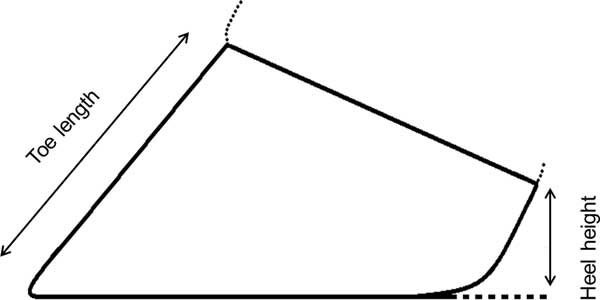
A fully qualified hoof trimmer (Dutch Diploma and member of The National Association of Cattle Foot Trimmers) examined all bulls in the week before the commencement of the study (days −4 and −3), at the end of the growing period (days 98 and 99), and again at the end of the finishing period (days 198 and 199). Each bull was restrained in a crush designed to facilitate hoof trimming, and each hoof was lifted and restrained for cleaning and inspection. The sole of each hoof was cleaned using an electric blade and a hoof trimmer’s knife was used to clean between the claws. The aim of the trimming was to only remove dirt and superficial horn layer to allow the identification of lesions and bruising. Both claws of each hoof were scored using the scoring system described by (Greenough and Vermunt, Reference Greenough and Vermunt1994). This system involved dividing the surface of the claw into six zones. Zones one, two and three represented the white line, zones four and five represented the sole and zone six represented the heel). The severity of the lesion or bruise was scored from one to three and recorded. One was recorded for a faint pink mark, two was given to a red mark and three was a haemorrhage. The extent of the lesion or bruise was also scored from one to three. One was recorded if the area affected was <10% of the hoof zone, between 10 and 50% for a two and >50% for a three. During hoof examination, toe length and heel height was also measured to the nearest millimetre according to the method of Vermunt and Greenough (Reference Vermunt and Greenough1995b) (Figure 1). During hoof examinations, DD was also recorded using a standardised scoring system, consisting of five stages of the disease (M0 to M4), according to the method of Döpfer et al. (Reference Döpfer, Koopmans, Meijer, Szakáll, Schukken, Klee, Bosma, Cornelisse, van Asten and ter Huurne1997). Bulls with DD before the commencement of the study were not used. During the experimental period, where DD was identified, the affected area was treated using Alamycin aerosol (Oxytetracycline Hydrochloride; Norbrook® Laboratories Limited, Newry, Northern Ireland) for animal welfare reasons, and also to prevent the spread of the disease to other bulls within the pen. The qualified hoof trimmer identified and scored all the bulls for lesions, sole bruising and DD. Claw measurements were also carried out by the hoof trimmer.
Illustration of measuring toe length and heel height as described by Vermunt and Greenough (Reference Vermunt and Greenough1995b).

Hoof temperature
Infrared thermography images were obtained using a FLIR E8 thermal camera (FLIR Systems, Kent, UK) according to the method of Stokes et al. (Reference Stokes, Leach, Main and Whay2012). Images were taken on the same day and at the same time monthly during the growing period and fortnightly during the finishing period. All bulls were restrained in a head crush and an image taken at the back of each hoof while resting on the ground. Ambient temperature was also recorded using a thermometer. Maximum temperature at the back of the hoof was recorded using the box measurement tool in the FLIR Tools/Tools+ software. One observer took all the IR thermal images. The distance the image was taken from the back of each hoof was standardised by using a 1 m ruler.
Statistical analysis
All analysis was carried out using Genstat release 18 statistical package (Payne et al., Reference Payne, Harding, Murray, Soutar, Baird, Glaser, Channing, Welham, Gilmour, Thompson and Webster2015). In treatment one, two bulls were removed from the study on days 175 and 196 from separate pens due to leg injuries. In treatment three, one bull was removed from the statistical analysis due to peritonitis observed at slaughter. The total number of lesions observed in the bulls during hoof examination was numerically low and therefore could not be statistically analysed. The majority of bruises were also too extensive and could not be limited to one zone. A mean locomotion score over both the growing and finishing period was calculated for each animal. Mean locomotion score was analysed using linear mixed model methodology with pen as a random effect and treatment as a fixed effect. Mean claw measurements were measured over time for each animal with a separate analysis carried out for front and hind feet and also analysed using linear mixed model methodology with pen as a random effect and treatment as a fixed effect. For each animal on each day of measurement the bruising data was transformed to binary data to give a value indicating presence or absence of bruising on front and back feet separately. Data were then analysed using linear mixed model methodology using a binomial distribution and logit link function. Pen and animal within pen were fitted as random effects and a factorial arrangement of treatment and feet as fixed effects. In addition, day 0 score was fitted as an additional fixed effect. DD and swelling at the leg joints data were analysed at animal level with 0 indicating no DD or swellings and 1 some DD or swellings. As a consequence the model employed was under the banner of generalised linear mixed model methodology using a binomial distribution and a logit link function. Pen was fitted as a random effect and treatment as a fixed effect in both analyses. In the case of hoof temperature, the unit of measurement was the temperature difference (between maximum hoof temperature and outside temperature) on the feet on a particular date. Data were analysed using a linear mixed model with pen, animal within pen and date within animal fitted as random effects and a factorial arrangement of treatment, date and feet as fixed effects. For all analyses, a P-value <0.05 was considered significant.
Results
Locomotion, digital dermatitis and swelling at the leg joints
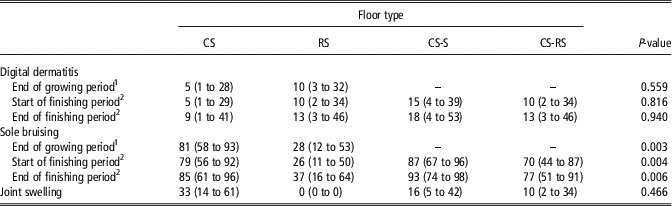
Mean locomotion score before the beginning of the experimental period was 1.00. During the growing period, there was a tendency for bulls accommodated on CS to have a higher locomotion score compared with those accommodated on RS (1.06 and 1.00, respectively) (P=0.059). Mean locomotion score over all bulls and each time they were scored was 1.03 (SD=0.15). In bulls accommodated on CS, 147 bulls had a locomotion score of one, nine had a score of 1.5, three had a score of 2 and one bull had a score of 2.5. In bulls accommodated on RS, 159 bulls had a locomotion score of one, and one bull had a score of 1.5. None of the bulls had a score of three or greater during the growing period. Floor type had no effect on locomotion score during the finishing period. During the finishing period, bulls accommodated on CS had a locomotion score of 1.05, 1.00 on RS, 1.01 on CS-S and 1.00 on CS-RS. Mean locomotion score over all bulls and each time they were scored was 1.01 (SD=0.13). In bulls accommodated on CS, 130 bulls had a locomotion score of 1, two had a score of 1.5, one had a score of 2 and three bulls had a score of 2.5. In bulls accommodated on RS, all bulls had a locomotion score of one. In bulls accommodated on CS-S, 131 bulls had a locomotion score of 1, one had a score of 1.5 and one bull had a score of 2. In bulls accommodated on CS-RS, all bulls had a locomotion score of 1. None of bulls had a score ⩾3 during the finishing period. There was also no effect of floor type on DD during the growing or finishing period (Table 2). All stages of the disease were recorded as M1. Floor type had no effect on swelling score at the leg joints (Table 2).
Effect of floor type on the probability (%) of bulls having digital dermatitis, bruising on the soles and swelling at the leg joints

CS=fully slatted flooring throughout the entire experimental period; RS=fully slatted flooring covered with rubber strips for the entire experimental period; CS-S=fully slatted flooring during the growing period and moved to a solid floor covered with straw bedding during the finishing period; CS-RS=fully slatted flooring during the growing period and moved to fully slatted flooring covered with rubber strips during the finishing period.
Probabilities (%) and 95% confidence intervals.
1 Growing period: days 0 to 101 of the experiment.
2 Finishing period: days 101 to 204 of the experiment.
Bruised soles
At the end of the growing period, bulls accommodated on CS had a greater probability of bruising on the soles compared with those accommodated on RS (Table 2). Bulls accommodated on CS-S and CS-RS at the start of the finishing period, had a similar probability of bruising compared with those accommodated on CS. At the end of the finishing period, bulls accommodated on RS had a less probability of bruising on the soles compared with those accommodated on any other floor type (Table 2).
Claw measurements
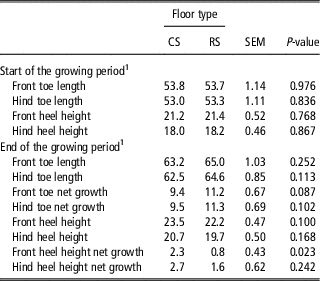
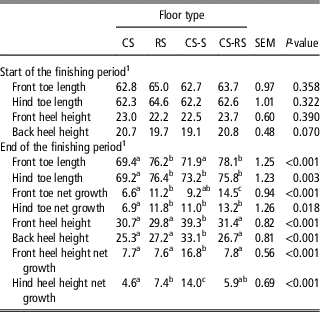
At the beginning of the growing period, there was no difference in toe length or heel height between bulls accommodated on CS or RS (Table 3). At the end of the growing period, bulls accommodated on CS had higher front heel height net growth compared with those accommodated on RS. There was also a tendency for bulls accommodated on RS to have more front toe net growth compared with those accommodated on CS (Table 3). At the start of the finishing period, there was no difference in toe length or front heel height between bulls accommodated on CS, RS, CS-S or CS-RS (Table 4). Bulls accommodated on CS-RS had the greatest front toe net growth compared with those accommodated on any other floor type. Hind toe net growth was least in bulls accommodated on CS. Heel height net growth was greatest in bulls accommodated on CS-S in both front and hind feet (Table 4).
Mean claw measurements (mm) of bulls accommodated on different floor types during the growing period

CS=fully slatted flooring throughout the entire experimental period; RS=fully slatted flooring covered with rubber strips for the entire experimental period.
1 Growing period: days 0 to 101 of the experiment.
Mean claw measurements (mm) of bulls accommodated on different floor types during the finishing period

CS=fully slatted flooring throughout the entire experimental period; RS=fully slatted flooring covered with rubber strips for the entire experimental period; CS-S=fully slatted flooring during the growing period and moved to a solid floor covered with straw bedding during the finishing period; CS-RS=fully slatted flooring during the growing period and moved to fully slatted flooring covered with rubber strips during the finishing period.
a,bMeans on the same row with the same superscript do not differ significantly (P>0.05).
1 Finishing period: days 101 to 204 of the experiment.
Hoof temperature
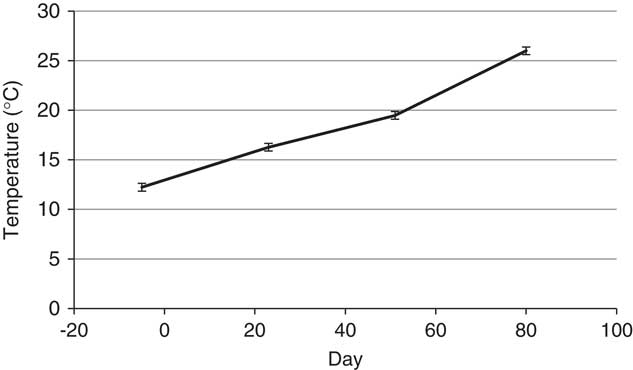
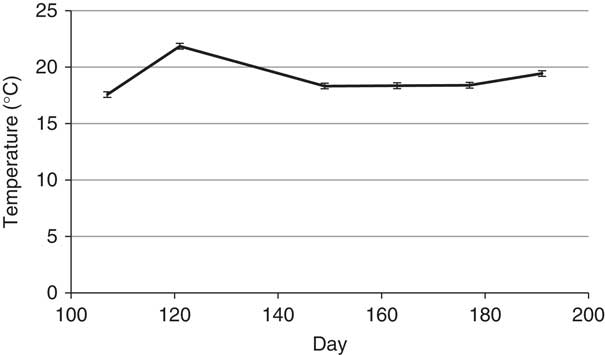
Floor type had no effect on mean maximum hoof temperature during the growing period. Mean maximum hoof temperature of bulls accommodated on CS was 18.8°C compared with 18.2°C for those accommodated on RS. There was also no difference between front (18.4°C) and hind (18.6°C) mean maximum hoof temperature. However, there was an effect of time, with mean maximum hoof temperature increasing with the length of time bulls were housed (P<0.001) (Figure 2). During the finishing period, bulls accommodated on CS-S had a lower mean maximum hoof temperature of 17°C compared with 20.3°C for those accommodated on CS, 19.2°C on RS and 19.5°C on CS-RS (P<0.001). Mean maximum front hoof temperature (18.8°C) was lower than mean maximum hind hoof temperature (19.1°C) (P<0.01), however there was no interaction between treatment and front or hind mean maximum hoof temperature. There was also an effect of time on mean maximum hoof temperature during the finishing period (P<0.001) (Figure 3).
Effect of time on mean maximum hoof temperature during the growing period.

Effect of time on mean maximum hoof temperature during the finishing period.

Discussion
An imperative aspect of normal animal behaviour is a healthy locomotor system (Somers et al., Reference Somers, Schouten, Frankena, Noordhuizen-Stassen and Metz2005). The tendency for a higher locomotion score in bulls accommodated on CS compared with those accommodated on RS during the growing period may be explained by the hard floor surface of the fully slatted flooring. Hard floor surfaces reduce the contact area of the claw, increasing pressure concentrations (van der Tol et al., Reference van der Tol, Metz, Noordhuizen-Stassen, Back, Braam and Weijs2002). These pressure concentrations could cause damage to the claw, resulting in pain and discomfort whilst walking. Another explanation could be the greater void area of the fully slatted flooring, increasing pressure on the part of the sole in contact with the floor (Mouttotou et al., Reference Mouttotou, Hatchell and Green1999). According to Bergsten (Reference Bergsten1989), lameness can also be diagnosed by signs of stiffness. van der Tol et al. (Reference van der Tol, Metz, Noordhuizen-Stassen, Back, Braam and Weijs2005) suggested that concrete floors do not provide sufficient friction to avoid slipping, resulting in cattle walking with a ‘stiff’ gait. Therefore the tendency for bulls accommodated on CS to have a higher locomotion score could also be explained by bulls having to adapt to walking on a slippery floor surface. Accommodating beef cattle on rubber flooring allows the claw to descend below the surface, reducing slipping (Platz et al., Reference Platz, Ahrens, Bahrs, Nüske and Erhard2007a).
Kremer et al. (Reference Kremer, Nueske, Scholz and Foerster2007) reported a greater incidence of DD in dairy cows accommodated on rubber flooring compared with those accommodated on fully slatted flooring. In the present study there was no effect of floor type on the prevalence of DD. Kremer et al. (Reference Kremer, Nueske, Scholz and Foerster2007) suggested that the greater prevalence of DD in cows accommodated on rubber flooring could be attributed to cleaning the floor with water and moistening the digital skin. Palmer et al. (Reference Palmer, Donnelly, Garland, Majithiya and O’Connell2013) reported that slurry increases skin permeability and contributes to DD infection. One explanation for the results observed in the present study is that the rubber strips were arched, allowing urine and faeces to drain more adequately. This could have reduced the floor moisture content and the prevalence of DD on rubber flooring (Ahrens et al., Reference Ahrens, Platz, Link, Mahling, Meyer and Erhard2011).
The greater probability of bruised soles in bulls accommodate on CS compared with those accommodated on RS could again be explained by the hard floor surface of the fully slatted flooring increasing pressure concentrations and damaging the hoof (van der Tol et al., Reference van der Tol, Metz, Noordhuizen-Stassen, Back, Braam and Weijs2002), compared with softer floor surfaces such as rubber. Another explanation could be the abrasiveness, accelerating wear on the sole, reducing the protection the corium provides for the dermis and digital cushion (Gregory et al., Reference Gregory, Craggs, Hobson and Krogh2006). Mouttotou et al. (Reference Mouttotou, Hatchell and Green1999) reported a higher prevalence of heel erosions and heel flaps in finishing pigs accommodated on fully slatted flooring compared with bare concrete solid floors. Mouttotou et al. (Reference Mouttotou, Hatchell and Green1999) explained that on fully slatted flooring the load on the hoof remains the same but the area of the sole in contact with the floor, due to a greater void area, is reduced. Therefore, by covering the fully slatted flooring with rubber strips reduced the void area from 24 to 18% of the total area, decreasing the uneven distribution of pressure on the weight bearing surface of the sole and reducing bruising. The rubber strips also provided a cushion over the angular edge of the slat, which could have also reduced impact load and damage within the foot. The greater probability of bruised soles during the finishing period in bulls accommodated on CS-S and CS-RS compared with those accommodated on RS could be explained by these bulls being accommodated on fully slatted flooring during the growing period. Sole bruising does not become visible for several weeks, and once sole bruising occurs, it is unlikely that cattle will fully recover (Agriculture and Horticulture Development Board, 2017). However, despite significant effects of floor type on bruising on the soles during the finishing period, locomotion score was not affected, indicating that the severity of the bruising was insufficient to cause clinical lameness. Livesey and Fleming (Reference Livesey and Fleming1984) reported in a study involving dairy cows, that sole bruising is a sign of subclinical laminitis, as it could not account for clinical signs observed in the study. The authors reported that in all cases the abnormal horn could be paired to expose normal horn underneath, and was therefore described as a superficial lesion as there was not sufficient damage within the foot. This would explain why despite significant effects of floor type on bruised soles, there was no effect on locomotion score. However, it is important to note that bruising on the soles can lead to subsequent ulceration. Therefore further research is needed, particularly in beef cattle with a longer production cycle.
Schulze Westerath et al. (Reference Schulze Westerath, Gygax, Mayer and Wechsler2007) reported that bulls accommodated on fully slatted flooring had the highest swelling scores at the leg joints compared with those accommodated on straw bedding, with rubber flooring being intermediate. Conversely, in the present study there was no effect of floor type on swelling at the leg joints; which may indicate that there was a large variation within the data. Graunke et al. (Reference Graunke, Telezhenko, Hessle, Bergsten and Loberg2011) reported that animals with leg swellings, particularly severe swelling experience pain while standing up and lying down, adversely affecting animal behaviour. This would merit further scientific research to more fully evaluate the impact of floor type on the behaviour of beef cattle.
In an optimal environment, growth and wear of the claw horn should occur at approximately equal rates (Vermunt and Greenough, Reference Vermunt and Greenough1995b). However, housing conditions such as floor type can negatively influence this balance impairing welfare. Despite the adverse effects of abrasive flooring, concerns have also been raised regarding insufficient hoof wear on rubber flooring and the increase risk of overgrown claws (Cozzi et al., Reference Cozzi, Tessitore, Contiero, Ricci, Gottardo and Brscic2013; Brscic et al., Reference Brscic, Ricci, Prevedello, Lonardi, De Nardi, Contiero, Gottardo and Cozzi2015). During the growing period, bulls accommodated on RS had a tendency for greater front toe net growth and significantly less front heel height net growth compared with those accommodated on CS. The tendency for greater toe net growth may be explained by the less abrasive surface of the rubber flooring. The increase in toe net growth may have also shifted the weight bearing surface of the sole increasing wear on the heel. In agreement with Platz et al. (Reference Platz, Ahrens, Bahrs, Nüske and Erhard2007a) and Brscic et al. (Reference Brscic, Ricci, Prevedello, Lonardi, De Nardi, Contiero, Gottardo and Cozzi2015), the present study found that toe net growth was greater in finishing bulls accommodated on RS and CS-RS compared with those accommodated on CS. This could also be explained by the greater wear on the sole of the hoof caused by the abrasive surface of the fully slatted flooring. The greater front toe net growth in bulls accommodated on CS-RS compared with RS could be explained by hard floor surfaces irritating the corium, increasing blood flow and accelerating hoof growth (Shearer and van Amstel, Reference Shearer and van Amstel2003). Therefore by moving cattle from fully slatted flooring to rubber flooring accelerated toe net growth compared with those accommodated on rubber flooring throughout the entire experimental period. Ahrens et al. (Reference Ahrens, Platz, Link, Mahling, Meyer and Erhard2011) reported that changing fully slatted concrete flooring to fully slatted flooring covered with rubber mats partially impaired hoof health due to a significant increase in white line fissures. However, despite greater front toe net growth in bulls accommodated on CS-RS, there was no impairment on hoof health. The similar front toe net growth in bulls accommodated on CS-S and CS could be explained by the straw bedding becoming damp due to urine and faeces, softening the soles and making them more susceptible to abrasion (Mouttotou et al., Reference Mouttotou, Hatchell and Green1999; Gregory et al., Reference Gregory, Craggs, Hobson and Krogh2006). However, this effect was not observed in the hind hooves and could be explained by the greater pressure on the front claws (Vermunt and Greenough, Reference Vermunt and Greenough1995b). The greater heel height net growth observed in finishing bulls accommodated on CS-S may be explained by the greater area of the sole in contact with the floor; providing a more even distribution of pressure on the weight bearing surface of the sole. It is important to note that none of the bulls were clinically lame and an increase in toe length or heel height had no detrimental impact on walking ability, suggesting that this level of net growth is not associated with pain or discomfort in young bulls.
Keane et al. (Reference Keane, McGee, O’Riordan, Kelly and Earley2015) reported that bulls accommodated on rubber flooring had more lesions compared with those accommodated on fully slatted flooring and suggested this was the result of overgrown claws. However, in the present study the number of lesions was numerically low. This could be explained by the higher live weight of the continental crossbred bulls used in the study of Keane et al. (Reference Keane, McGee, O’Riordan, Kelly and Earley2015). Greater toe length accompanied by a higher live weight could increase the load on the sole and consequently result in a greater number of lesions. Indeed, Pérez-Cabal and Charfeddine (Reference Pérez-Cabal and Charfeddine2016) reported that increasing BW in dairy cows was associated with a greater probability of claw disorders. Pérez-Cabal and Charfeddine (Reference Pérez-Cabal and Charfeddine2016) suggested that an animal’s BW puts substantial stress on the claw, and unbalanced weight bearing compromises hoof growth, increasing claw disorders. The full dairy bred bulls used in the present study do not have the biological potential to achieve live weights similar to those of continental breeds. Therefore, further research is required to evaluate the effect of floor type on the lameness of beef cattle with the potential to achieve higher live weights.
The present study indicates that IR thermography can be used to identify differences in maximum hoof temperature of beef cattle accommodated on different floor types. Beef cattle compared with dairy cattle are less frequently handled, and signs of lameness may not be evident until the disease is advanced. Maximum hoof temperature is therefore a potential measure of hoof health, rapidly identifying elevated hoof temperature associated with lameness and improving welfare. Although bulls accommodated on CS-S had a lower mean maximum hoof temperature compared with those accommodated on any other floor type, mean maximum hoof temperature across all treatments was below 27°C; the threshold reported by Stokes et al. (Reference Stokes, Leach, Main and Whay2012) as an indication of lesions. The higher mean maximum hoof temperature observed in bulls accommodated on CS, RS and CS-RS compared with those accommodated on CS-S could be explained by developing lesions which are not yet visible. This highlights the need for further research investigating the use of hoof temperature as a measure of hoof health in beef cattle with a longer production cycle. Another explanation for the lower mean maximum hoof temperature in bulls accommodated on CS-S could be housing design and differences in ventilation and humidity. The increasing mean maximum hoof temperature with the length of time bulls were housed during the growing period could be explained by bulls coming off pasture and differences between outdoor and indoor temperatures. The fluctuation of mean maximum hoof temperature during the finishing period was unexpected. Stokes et al. (Reference Stokes, Leach, Main and Whay2012) reported a small correlation between ambient temperature and hoof temperature. However, the authors reported that this only accounted for <10% of the explained variance in maximum hoof temperature. Therefore another possible explanation could be level of production. Alsaaod and Büscher (Reference Alsaaod and Büscher2012) reported higher hoof temperatures in cows ⩽200 days in milk compared with cows >200 days in milk. In the present study, the change in diet and increasing level of concentrates could have impacted performance causing a variation in overall mean maximum hoof temperature. Vermunt and Greenough (Reference Vermunt and Greenough1995a) reported more haemorrhages in the hind claws of dairy calves, possibly due to the hind limbs function of propulsion and the hind claws being subjected to more transitory loads associated with mounting. This could explain the greater mean maximum hoof temperature observed in the hind feet of bulls during the finishing period compared with the front feet.
Conclusion
Rubber flooring is a suitable compromise between fully slatted flooring and a solid floor covered with straw bedding for the improvement of lameness in beef cattle. Accommodating beef cattle on rubber flooring during both the growing and finishing period reduced the probability of bruised soles. In addition, despite greater toe net growth in bulls accommodated on rubber flooring there was no effect on locomotion score, indicating that this degree of increased toe net growth has no impact on walking ability. Although bulls accommodated on straw bedding during the finishing period had a lower mean maximum hoof temperature compared with those accommodated on any other floor type, there was no evidence to suggest improved hoof health. It is important to note that hoof health was generally good and none of the bulls were clinically lame. However, it is possible that greater differences could have been observed in beef cattle with the potential to achieve higher live weights or those with a longer finishing period.
Acknowledgements
This research was funded by the Department of Agriculture, Environment and Rural Affairs in Northern Ireland. The authors would like to acknowledge the Agri-Food and Biosciences Institute Sustainable Beef Unit staff.
Declaration of interest
The authors confirm that there are no conflicts of interest which could have inappropriately influenced this publication.
Ethics statement
The study was carried out under the regulations of the Department of Health, Social Services and Public Safety of Northern Ireland in accordance with the Animals (Scientific Procedures) Act 1986 (The Parliament of the United Kingdom, 1986).
Software and data repository resources
All data was stored using Excel (version 2013) on a shared server based at the Agri-Food and Biosciences Institute. Analysis was carried out using Genstat release 18 statistical package (Payne et al., 2015) which was also stored on the same shared server.