“… liberty can have nothing to fear from the judiciary alone...”
–Publius, Federalist No. 78
On June 26, 2015, the U.S. Supreme Court issued its opinion in Obergefell v. Hodges, ruling that the Fourteenth Amendment guarantees same-sex couples the right to marry. Unsurprisingly, Republican politicians were quick to condemn the decision. But the Court’s critics did not simply disagree with the ruling; they also challenged the Court’s right to decide the issue. Former Senator Rick Santorum tweeted, “Today, 5 unelected judges redefined the foundational unit of society. Now it is the people’s turn to speak.” Footnote 1 Former Governor Mike Huckabee declared, “We must reject and resist judicial tyranny,” and Governor Chris Christie said, “This is something that shouldn’t be decided by a group of lawyers, but should be decided by the people.” Footnote 2 Governor Bobby Jindal extended the argument even further: “If you want to save some money, let’s just get rid of the court.” Footnote 3
Complaints that the Supreme Court lacks democratic legitimacy predate the institution itself. In the Anti-Federalist Papers, “Brutus” predicted that “the supreme court under this constitution would be exalted above all other power in the government, and subject to no controul,” Footnote 4 and many revered presidents, including Jefferson, Lincoln, and Franklin Roosevelt, have offered similar criticisms. Footnote 5 A half-century ago, the eminent legal scholar Alexander Bickel posed this objection in its purest form. “The root difficulty,” Bickel claimed, “is that judicial review is a counter-majoritarian force in our system.” Footnote 6 At its core, the federal judiciary’s power to invalidate statutes involves an unelected group of judges with life appointments overturning policies enacted by democratically elected officials. Thus, “it is difficult to escape the conclusion that judicial review is moderately countermajoritarian, and to that extent, in tension with the principle of majority rule.” Footnote 7 For the last fifty years, Bickel’s difficulty has served as a focal point—some say an obsession Footnote 8 —of American constitutional theory as scholars search for a principled justification for the legitimacy of judicial review.
While legal theorists have been confronting Bickel’s normative dilemma, political scientists have been challenging his empirical assumptions. A rich literature now argues that the Supreme Court tends to follow public opinion, Footnote 9 yield to congressional pressure, Footnote 10 and promote the interests of the dominant governing coalition. Footnote 11 In short, the Court may generally promote majority interests, thereby rendering Bickel’s difficulty moot. But these findings raise new concerns; scholars now worry that the Court suffers from a “majoritarian difficulty” because it fails to check majority excess. Footnote 12
My goal is to reframe and potentially resolve the countermajoritarian difficulty by engaging Bickel on his own terms. That is, I proceed from the assumption that majoritarian decisions are presumptively legitimate in a democracy, and institutions that vary from the majoritarian principle must be justified as “peculiarly suited” to reliably promote a core democratic value. Footnote 13 Therefore, the task at hand is to defend American-style judicial review by identifying a democracy-reinforcing function that can be reliably performed by courts armed with the power to invalidate legislative acts. More specifically, a compelling justification for judicial review must satisfy two criteria. First, it must ascribe a realistic function to courts; i.e., it must describe a role that we can reasonably expect courts to perform based on empirical evidence. Second, it must provide a normatively attractive conception of that function; i.e., it must describe a role that is desirable based on a widely shared understanding of democratic legitimacy. Accordingly, my goal is to offer an account of judicial review in American democracy that is both empirically credible and (at least potentially) normatively attractive.
I focus on judicial review in the United States for three reasons. First, as I have indicated, the U.S. Supreme Court’s countermajoritarian influence has been the subject of extensive and persistent criticism from both politicians and academics. Second, American-style judicial review is particularly potent compared to systems of constitutional review in most other countries; therefore, its normative defense is especially challenging. Finally, my argument relies on the considerable empirical evidence that has been collected on judicial independence and implementation in the United States context. This degree of empirical evidence is not yet available for other judicial systems.
To be clear, I will not offer a positive theory of judicial behavior, nor will I suggest a prescriptive theory of constitutional interpretation. That is, I will not attempt to explain how judges behave or suggest how they should behave. To the contrary, unlike many justifications for judicial review, my argument does not depend on any particular behavior on the part of judges. Instead, I will argue that institutional characteristics limit the use and effects of judicial review in a way that makes it less problematic than is often suggested and, at least potentially, quite normatively appealing.
I base this normative theory on my recent empirical research, which finds the U.S. Supreme Court sometimes exercises countermajoritarian influence on social and political outcomes, but it generally does so only by releasing individuals from criminal and civil liability. In all other cases (those not involving government sanctions), the Court has little countermajoritarian impact because (1) it generally defers to popular and elite preferences, and (2) when it does not, its decisions are unlikely to be implemented. Based on this improved understanding of judicial independence and implementation, I propose a novel justification for judicial review, called the acquittal theory. In brief, courts can thwart majority will by insulating individuals from government penalties, but courts cannot unilaterally impose penalties. Therefore, the effect of judicial review in American democracy is to limit the imposition of government sanctions on individuals. Because sanctions are an essential tool for domination, judicial review reliably performs a core democratic function: promoting freedom from government domination.
In the sections that follow, I summarize the empirical and normative assumptions underlying the countermajoritarian difficulty and consider two potential resolutions to this dilemma: the majoritarian resolution and the enduring values resolution. I then adopt an alternative strategy for resolving the difficulty that was suggested by Bickel himself—searching for a function that is “peculiarly suited to the capabilities of the courts … [and] which will be effective when needed.” Footnote 14 After considering possible functions judicial review might serve in a democratic system, I suggest an empirically-supported function that satisfies Bickel’s criteria: acquittal from government sanctions. I argue that the nature of judicial institutions creates an asymmetric, countermajoritarian power, which ensures that judicial review reliably promotes freedom from government domination by consistently limiting government sanctions. I then discuss the democratic value of the acquittal function and consider a potential objection its use in a democracy.
I conclude with a discussion of the acquittal function and its implications for judicial review and democratic theory. My analysis challenges several of Bickel’s key points. First, when viewed in the light of modern empirical scholarship, judicial review is substantially less problematic than Bickel suggested. Second, rather than functioning as a “deviant institution,” judicial review actually promotes a core democratic value: freedom from government domination. Finally, the true normative dilemma posed by judicial review is not the countermajoritarian difficulty, but rather the Lochner problem—that is, the possibility that judicial review will tend to thwart governmental attempts to limit private domination. However, this dilemma might be partially resolved by turning to non-sanctioning government powers to address social problems.
The (Counter?)Majoritarian Difficulty
Bickel based his countermajoritarian difficulty on two propositions, the first normative and the second empirical. First, Bickel assumed “that coherent, stable—and morally supportable— government is possible only on the basis of consent, and that the secret of consent is the sense of common venture fostered by institutions that reflect and represent us and that we can call to account.” Footnote 15 Second, Bickel assumed “that when the Supreme Court declares unconstitutional a legislative act or the action of an elected executive, it thwarts the will of representatives of the actual people of the here and now; it exercises control, not in behalf of the prevailing majority, but against it.” Footnote 16 Consequently, “judicial review is a deviant institution in the American democracy.” Footnote 17 Thus, the countermajoritarian difficulty amounts to a simple, logical argument. According to Bickel, majoritarianism is the basis for democratic legitimacy, and judicial review is countermajoritarian. Therefore, judicial review is democratically illegitimate. Most scholars attempt to resolve Bickel’s difficulty by challenging one of these two propositions. Footnote 18
The first strategy, common in the political science literature, is to challenge Bickel’s empirical claim that judicial review undermines majority interests. Even before Bickel posed his difficulty, Robert Dahl rejected that premise: “except for short-lived transitional periods … the Supreme Court is inevitably a part of the dominant national alliance … [and] of course supports the major policies of the alliance.” Footnote 19 Modern “regime politics” scholars generally endorse this view, arguing that “rather than a check on majority power, the federal courts often function as arenas for extending, legitimizing, harmonizing, or protecting the policy agenda of political elites or groups within the dominant governing coalition.” Footnote 20 Due to the judicial appointment process, the various sanctioning tools available to Congress, and the judiciary’s lack of implementation powers, the Supreme Court tends to follow public opinion, Footnote 21 evade congressional rebukes, Footnote 22 and invalidate federal statutes with little congressional support. Footnote 23 Several prominent legal scholars agree that the Court tends to follow popular will. Footnote 24 Even if the justices break this trend and issue countermajoritarian decisions, those rulings may have little practical effect on social change because the Supreme Court lacks direct implementation powers. Footnote 25 Of course, if judicial review is actually majoritarian, it poses no countermajoritarian difficulty.
Alternatively, many constitutional theorists challenge the claim that majoritarianism is the basis for democratic legitimacy. Instead, they suggest that legitimacy is rooted in some alternative value, such as promoting equal moral status, Footnote 26 minimizing tyranny, Footnote 27 or encouraging political participation. Footnote 28 Others suggest legitimacy is grounded in super-majoritarianism, which the Court promotes by enforcing the dictates of formal constitutional enactments Footnote 29 or unconventional constitutional transformations Footnote 30 against contemporary majorities. These accounts expand on Bickel’s notion that “government should serve not only what we conceive from time to time as our immediate material needs but also certain enduring values.” Footnote 31 If courts tend to promote these enduring values more reliably than electoral institutions, then judicial review may be a legitimate practice.
Somewhat ironically, the two-fold assault on Bickel’s argument raises a new legitimacy problem. If our core political values require courts to sometimes act in a countermajoritarian manner, yet courts rarely, if ever, do so, our system may pose a “majoritarian difficulty.” As Michael Dorf frames the problem, “are courts that roughly follow public opinion capable of performing what is generally understood as their core counter-majoritarian function—protecting minority rights against majoritarian excesses?” Footnote 32 If the Supreme Court is majoritarian, it cannot reliably reinforce participational democracy, promote equal moral status, or hold us to originalist principles. Consequently, accepting either challenge to Bickel resolves his difficulty, but accepting both challenges raises a new legitimacy concern.
Therefore, both the empirical and normative nature of judicial review remain hotly contested. Judicial review may be majoritarian or countermajoritarian, and both possibilities may prove troubling for the institution’s legitimacy. Unfortunately, both the majoritarian and enduring values resolutions disregard critical empirical evidence and pose potential normative concerns.
The Majoritarian Resolution
One might justify judicial review by accepting majoritarianism as the basis for democratic legitimacy and accepting Dahl’s argument that the Supreme Court is, in fact, majoritarian. This strategy incorporates some empirical evidence and avoids Bickel’s difficulty. Most scholars, politicians, and citizens would balk at a theory of legitimacy that abandons all rights in favor of pure majority rule; however, majoritarian processes may actually be the best mechanism for promoting individual rights. Footnote 33 Nonetheless, the majoritarian resolution encounters empirical, normative, and conceptual problems.
Empirically, several studies find that the Supreme Court responds to public opinion; Footnote 34 however, evidence of responsiveness is tentative, Footnote 35 disputed, Footnote 36 and possibly restricted to a subset of cases. Footnote 37 Other studies confirm this skepticism, finding that U.S. Court of Appeals judges do not directly follow public opinion, Footnote 38 and only elected state judges respond to public preferences. Footnote 39 Therefore, although courts sometimes promote majority interests, they appear to do so inconsistently.
Normatively, accepting majoritarianism as the sine qui non of democratic legitimacy invites a litany of problems because numerous features of democratic institutions pose similar countermajoritarian dilemmas. For example, bicameralism, the Electoral College, the Senate, and single-member districts all undermine simple majority rule. Does democratic legitimacy also demand that we abandon all of these institutional structures? And, if the likelihood of achieving these reforms is effectively zero (as I suspect it is), must we simply accept that the U.S. constitutional system is irredeemably illegitimate? Footnote 40
Finally, the majoritarian resolution may not actually justify judicial review. The existence of a non-democratic process imposes normative costs in a democratic society. Footnote 41 Therefore, judicial review is only legitimate if the majoritarian benefits outweigh the proceduralist costs. Even if courts do follow popular preferences, what majoritarian benefits does judicial review offer compared to a system without judicial review? Jeffrey Rosen argues that “unelected Supreme Court justices sometimes express the views of popular majorities more faithfully than the people’s elected majorities,” Footnote 42 but empirical evidence suggests otherwise. In a direct comparison, Stimson, MacKuen, and Erikson find that “electorally motivated politics are more immediately responsive to public opinion than are the politics of judicial decision.” Footnote 43
One might argue that no electoral scheme can perfectly reflect majoritarian values. Therefore, it may be democratically advantageous to employ multiple policymaking procedures that adopt alternative schemes of representation. For example, Waldron suggests that a bicameral legislature promotes majoritarianism by representing people in different ways. Footnote 44 Similarly, Melissa Schwartzberg advocates a system of “complex majoritarianism,” in which procedural rules encourage delay and deliberation by requiring multiple forms of representative decision making (e.g., requiring constitutional amendments to be ratified in two different legislative sessions and then submitted to the people for ratification). Footnote 45 Accordingly, one might argue that the Court promotes majoritarianism by representing popular preferences in a unique and complementary manner.
However, this argument encounters several problems. First, the proceduralist costs associated with judicial review likely outweigh any majoritarian benefit associated with adding a fourth majoritarian representation scheme (in addition to the president and both Houses of Congress); indeed, Waldron himself opposes judicial review on these grounds. Footnote 46 Second, the analogy between judicial review and bicameralism is flawed in at least one critical respect. The public can punish a legislative chamber that rejects a popular bill, but it cannot directly punish the Court. As a result, the elected branches can enact popular legislation in order to maintain public support, while relying on their judicial appointees to invalidate the law. In other words, unlike bicameralism, judicial review creates a “nonmajoritarian difficulty,” Footnote 47 in which legislators “[shift] blame for controversial decisions to the Court and obscur[e] their own relationship to those decisions.” Footnote 48
To summarize, the majoritarian resolution disregards some empirical evidence, undermines the legitimacy of our constitutional system, and does not clearly justify judicial review. Therefore, the first strategy for resolving the (counter)majoritarian difficulty offers little solace.
The Enduring Values Resolution
Alternatively, one might defend judicial review by rejecting evidence that the Court is majoritarian and adopting a philosophy that embraces its countermajoritarian character as a mechanism to promote alternative values. Such is the approach of many constitutional theorists who suggest that democratic legitimacy is rooted in originalist principles, Footnote 49 equal moral concern, Footnote 50 or some other nonmajoritarian or supermajoritarian values. These approaches are sometimes referred to as “bulwark theories” because judicial review is thought to provide a defense against majoritarian threats. For example, judicial review might protect minority rights, Footnote 51 procedural rights, Footnote 52 the boundaries of public reason, Footnote 53 or the balance between democratic procedures and outcomes. Footnote 54 Setting aside the important differences between these theories, this general strategy has great appeal; it promises to save the narrative of a heroic, countermajoritarian Court, boldly defending our enduring values (whatever those values may be) against an intemperate and tyrannical majority. Footnote 55 Thus, judicial review may be legitimate if it reliably promotes enduring values.
The empirical literature casts serious doubt on the heroic Court narrative, but it does not necessarily disprove it. The Court may generally follow majority will and deviate from that pattern only when the majority runs afoul of its own values. Courts and legislatures may tend to agree on the application of enduring values precisely because they are fundamental; yet when courts and legislatures diverge, courts might tend to more accurately and faithfully adhere to those principles. Like Odysseus tying himself to the ship’s mast to resist the Siren’s call, the people might tie themselves to their own values through the practice of judicial review.
Unfortunately, the enduring values resolution depends on judges consistently promoting the “correct” values, whatever those values are thought to be. But, of course, judges do not agree on which values are fundamental. It is, therefore, not surprising that most constitutional theorists highlight instances when judges have issued “correct” decisions, criticize cases in which they have not, and admonish them to do better in the future. Proponents of originalism lament the Court’s frequent departures from its precepts, Footnote 56 and critics of originalism celebrate the Court’s many non-originalist decisions that promote other values. Footnote 57 But these same critics point to other decisions that depart from their preferred values. Additionally, even judges who espouse particular values fail to consistently apply those principles. For example, originalist arguments have little effect on the votes of Supreme Court justices, even those commonly described as originalists. Footnote 58 Consequently, most justifications for judicial review come with a critical disclaimer: judicial review is legitimate as long as the judges use it correctly. But it is almost universally agreed (by scholars who agree on little else) that judges often fail at that task.
Of course, judicial review may sometimes vindicate original meaning or protect minority rights. Even Barry Friedman, who rejects the claim that judicial review is generally countermajoritian, concedes that in some contexts, the Court “most unabashedly seems to take on the majority in the name of minority rights.” Footnote 59 Nonetheless, any argument that courts consistently promote enduring values faces serious empirical obstacles. If judicial review is meant to bind the people from the siren’s call, it rarely succeeds at holding them to the mast.
In other words, no matter what value one might prefer, judges at least occasionally (if not frequently) fail to promote that preferred value. Consequently, we must ask whether the occasional promotion of enduring values justifies the countermajoritian nature of the process and the effects of other ill-advised rulings. For example, John Hart Ely celebrates Reynolds v. Sims (1964) for establishing the “one person, one vote” rule and promoting equal participation, but he also laments Roe v. Wade for imposing a substantive value choice. Footnote 60 Thus, even if we accept participational democracy as our fundamental principle (and Ely’s interpretation of these decisions), we must weigh the costs of cases like Roe against the benefits of cases like Reynolds in order to evaluate the legitimacy of judicial review. Undoubtedly, weighing the relative importance of these rulings is a complicated, imprecise, and highly subjective task.
In short, the enduring values resolution falters because it depends on judges consistently promoting fundamental democratic values. Neither judges nor academics can agree on which values are fundamental, individual judges fail to consistently promote the values they espouse, and weighing the costs of inadvisable rulings against the benefits of desirable rulings is fraught with difficulties. Accordingly, the enduring values resolution is also highly problematic.
“Peculiarly Suited to the Capabilities of the Courts”
A stronger defense of judicial review would rely not on trust in judges to behave “correctly” but rather on institutional structures that account for the fact they will not. The critical step in such an argument is to demonstrate that courts—regardless of their membership or behavior—possess institutional characteristics that ensure they will reliably promote an important democratic value, without undermining that value or other values. As Bickel wisely advised, “the search must be for a function … which is peculiarly suited to the capabilities of the courts … [and] which will be effective when needed.” Footnote 61 Do courts possess a unique capacity that enables them to consistently promote a particular value with greater reliability than representative legislatures?
Bickel suggested several advantages that judges may possess compared to legislators, such as “the leisure, the training, and the insulation to follow the ways of the scholar in pursuing the ends of government.” Footnote 62 These advantages, Bickel argued, “give courts the capacity to appeal to men’s better natures, to call forth their aspirations, which may have been forgotten in the moment’s hue cry.” Footnote 63 Michael Moore offers another possibility: “judges are better positioned for … moral insight than are legislatures because judges have moral thought experiments presented to them everyday [sic] with the kind of detail and concrete personal involvement needed for moral insight.” Footnote 64 Despite their initial appeal, these arguments are ultimately unpersuasive.
First, many legislators have ample legal training. In fact, the training argument may favor legislatures. In a large legislative body, members often possess a wide variety of educational and professional backgrounds. This diversity of perspectives and combined body of knowledge should generally yield better outcomes than a small group with a single educational and professional perspective. Additionally, legislators can and often do consider statistical evidence, moral arguments, and pragmatic policy considerations that are often thought inappropriate in a judicial context.
Second, though insulation from public opinion will undoubtedly yield different outcomes than a majoritarian process, it will not necessarily yield better outcomes. To adopt such a position, one would have to believe that popular decision making tends to violate democratic values and therefore any other decision would be preferable, even a random draw. Absent this anti-majoritarian assumption, it is unclear why insulation from popular pressures alone should tend to reliably promote democratic values.
Finally, as Jeremy Waldron has adeptly argued, judges are not necessarily better positioned to make moral judgments just because they are exposed to particular cases. Footnote 65 Appellate courts generally deal with abstract principles rather than flesh-and-blood details of a particular controversy. Moreover, legislators are perfectly capable of considering specific cases and legislating based on insights from those examples.
Nonetheless, these arguments may often hold true: federal judges may tend to be more informed, independent, and morally engaged than elected officials. The degree to which judges possess these traits and, as a result, protect enduring values is an empirical question. However, all of these suggested advantages—training, insulation, and moral engagement—are, at least to some degree, characteristics of judges rather than characteristics of courts. Consequently, the strength of these arguments largely hinges on the identity and behavior of the individuals who populate the judiciary at any given time. Undoubtedly, some judges may possess remarkable expertise, spurn popular pressure, and develop moral insights through the consideration of specific controversies; but, of course, others may not. Judicial institutions may encourage these individual qualities; however, a stronger justification for judicial review would rely on immutable institutional structures rather than individual characteristics, which inherently vary across judges.
Richard Fallon offers such an argument. Footnote 66 He suggests the judiciary serves as a “third legislative chamber.” Footnote 67 Judicial review might promote enduring values even if judges possess no unique characteristics with regard to understanding and protecting rights. Instead, “legislatures and courts should both be enlisted in protecting fundamental rights, and [sic] both should have veto powers over legislation that might reasonably be thought to violate such rights.” Footnote 68 Fallon suggests that “legislative action is more likely to violate fundamental rights than legislative inaction.” Footnote 69 Consequently, any limitation on legislative productivity potentially promotes fundamental rights. Adopting judicial review adds a veto point to the system (just like bicameralism or a presidential veto) and simply makes it harder to enact laws. Therefore, judicial review may indeed promote rights at the margins by limiting legislative enactments, even if judges possess no special characteristics and generally tend to follow popular preferences.
Unfortunately, Fallon describes his argument as an “uneasy” case for judicial review because it depends on the assertion that “over-enforcing” rights is preferable to “under-enforcing” rights; i.e., it is better to invalidate too many statutes rather than too few. But, as Fallon readily acknowledges, this assumption is open to challenge. Footnote 70 Rulings such as Dred Scott v. Sanford and Lochner v. New York may evince the potential for invalidation of legislative action to severely curtail rights. At worst, the flaws in this assumption undermine the theory; at best, they suggest serious limitations in the proper use of judicial review. For example, Fallon concedes that his argument does not apply to “ordinary” Lochner-style liberty rights, cases in which the legislature creates protections for individual rights, structural constitutional norms such as federalism and the separation of powers, or cases in which fundamental rights claims are plausibly asserted on both sides. Footnote 71 Accordingly, Fallon’s approach leaves undefended a great deal of judicial review as it has been practiced in the United States. At most, Fallon’s theory might justify a very different system of judicial review than the one that exists in the United States.
Watkins and Lemieux offer a similar analysis. Footnote 72 They argue that judicial review functions as a potential veto point in the policy process, and its normative value must be determined by comparing it to other veto points. After evaluating judicial review against five democratic value criteria, the authors conclude that the institution “appears to have some modest advantages over other veto points commonly found in contemporary political systems.” Footnote 73 However, like Fallon, Watkins and Lemieux qualify their assessment, emphasizing that “judicial review’s performance against these criteria is decidedly mixed.” Footnote 74 Moreover, their analyses on several criteria do not apply to the strong form of judicial review in the United States. For example, they argue that judicial review can facilitate public contestation of government decisions, but only “in a limited set of cases … for example, in Hungary and India.” Footnote 75 Similarly, “judicial review’s likelihood to empower underrepresented and disempowered minorities will vary considerably, and it is difficult to reach general conclusions at a high level of abstraction.” Footnote 76 Accordingly, “barring a more systematic approach to empirical matters, the empirical/consequentialist element of this dispute cannot be resolved in a satisfying manner.” Footnote 77
However, both of these approaches suggest a promising avenue for establishing the legitimacy of judicial review. Rather than arguing that judges possess superior judgment with regard to democratic values, these authors focus on institutional features of judicial review that may tend to promote those values. As Watkins and Lemieux emphasize, “democratic theory must be institutional and contextual in orientation,” and “real-life consequences of institutional political arrangements are as important as their formal structures.” Footnote 78 These prior analyses offer tentative defenses of judicial review, but courts may possess other institutional features that ensure that the practice reliably promotes democratic values in real-world outcomes. If so, a focus on these other institutional features may offer a more robust defense of judicial review. If courts possess such institutional features, they should be empirically verifiable. Has the empirical study of the judiciary identified a function that is “peculiarly suited to the capabilities of the courts” and might legitimize the role of judicial review in a democracy?
The Acquittal Theory
My goal is to develop an account of judicial review that is both empirically grounded and normatively appealing. I argue that a more nuanced depiction of judicial independence and implementation reconciles conflicting accounts of judicial review and suggests a compelling normative defense of its use. In other words, a better understanding of how judicial review actually works helps resolve the (counter)majoritarian difficulty. I base my theory on my recent empirical studies of judicial independence and power. Footnote 79 In that work, I find that the U.S. Supreme Court plays two distinct roles in American politics. The Court does occasionally thwart majority will by invalidating democratically enacted statutes; however, the only significant countermajoritarian effects of judicial review tend to be the release of individuals from government sanctions (both criminal penalties and monetary damages). In all other cases, the Court tends to follow majority will, and when it does not, its decisions are often not implemented. Thus, the Court does sometimes undermine the majority, but it usually does so by acquitting individuals from government sanctions.
The acquittal theory posits the following: First, Bickel’s difficulty only arises in “vertical” cases (those involving criminal or civil liability) because these are the only cases in which courts consistently (a) defy popular and elite preferences and (b) successfully implement unpopular policies. Second, the judiciary’s influence in vertical cases is asymmetric: courts can unilaterally acquit individuals, but courts are incapable of unilaterally imposing sanctions. As a result of these two dynamics, the only consistent countermajoritarian effect of judicial review is the limitation of government sanctions. The imposition of government sanctions is often democratically legitimate; Footnote 80 however, the use of sanctions is also essential for governments to dominate individuals. Therefore, the limitation of government sanctions tends to mitigate the possibility of government domination. In short, the available empirical evidence reframes and possibly resolves the (counter)majoritarian difficulty: judicial review in the United States consistently performs a core democratic function (limiting government domination) without relying on judges to possess superior judgment with regard to democratic values.
In other words, judicial review operates as a one-way ratchet, consistently restricting the imposition of government penalties. This asymmetric power is the product of institutional mechanisms; it is truly a capability that is uniquely suited to courts, not judges. Consequently, the theory does not depend on judges adopting a particular interpretive method or behaving in a certain manner, nor does it recommend a particular theory of constitutional interpretation. Even terrible judicial rulings cannot unilaterally impose government sanctions; judges can only permit sanctions imposed by elected officials. Accordingly, the acquittal theory offers a normative justification for judicial review that depends on the institutional structure of the judiciary rather than the behavior of judges. To reiterate, the acquittal theory offers a novel understanding of judicial review and a normative defense of the practice; it does not attempt to explain why judges make the choices they do, nor does it recommend any particular interpretive method or judicial behavior.
I will now summarize my empirical research on the nature of judicial independence and power. Next, I describe the asymmetry of judicial power and its importance for the legitimacy of judicial review. Finally, I evaluate the normative value and dangers of the acquittal function.
Vertical Versus Lateral Cases
The acquittal theory hinges on my distinction between “vertical” and “lateral” cases. Footnote 81 Vertical cases involve potential penalties via criminal prosecution or civil damages. The critical feature of a vertical issue is that lower courts are inherently involved in the policy process and can, therefore, implement Supreme Court rulings. As an example, consider the Court’s ruling in Roe v. Wade, which involved potential criminal penalties for abortionists. In Roe, successful implementation simply required lower courts to acquit individuals charged under abortion statutes. Footnote 82 As a wealth of literature has demonstrated, lower court judges generally adhere to Supreme Court precedent, Footnote 83 and the Court’s “hierarchical control appears strong and effective.” Footnote 84 Consequently, when the Supreme Court issues a decision like Roe, it can generally rely on lower courts to implement its ruling. Footnote 85 Consistent with this expectation, Roe had a significant impact on the practice of abortion in the United States, Footnote 86 and the decision had far-reaching societal effects. Footnote 87
In other words, in cases that involve government penalties, courts “have direct control over some strategic incentives—they can, for instance, threaten to release prisoners if prison conditions are not improved, and they can refuse to accept confessions as evidence if police do not provide the required warnings.” Footnote 88 As a result of this institutional dynamic, courts enjoy substantial implementation power in vertical cases. In a series of empirical studies, I find that the Supreme Court’s rulings have had significant effects on behavior across a range of vertical issues, including criminal justice, gun control, and free speech. Footnote 89 Furthermore, the Court’s power in these cases does not depend on the popularity of its rulings. Roe effectively prompted behavior change, despite some strong public opposition, because the case involved a vertical issue. Lower courts could directly implement the decision and generally did so without regard to popular opinion.
Because implementation does not depend on public opinion in these cases, the Supreme Court generally disregards popular and elite preferences. In fact, a closer look at external pressures on the Court reveals that public opinion and congressional preferences have little or no influence in vertical cases. Footnote 90 Instead, the pattern of external influence on the Court is primarily driven by a small subset of salient lateral cases. In vertical cases, the Court usually makes truly independent decisions and those decisions are generally implemented irrespective of public preferences. Taken together, these findings have important implications for judicial legitimacy: by setting the standards under which individuals can be punished in lower courts, the Supreme Court can insulate minority groups from criminal and civil penalties, even in the face of majority opposition.
The nature of the judiciary’s role in vertical cases is sharply contrasted against its role in lateral cases. Lateral cases involve situations in which lower-court judges cannot directly implement a Supreme Court ruling. In these situations, the justices must rely on nonjudicial actors for the efficacy of their decisions. Consider, as an example, Brown v. Board of Education. Lower courts obviously play no inherent role in the administration of public schools. Accordingly, the actual desegregation of schools ultimately depended on the actions of local school boards and other non-judicial officials. Not surprisingly, these nonjudicial officials (who generally must stand for reelection or answer to those who do) tend to ignore or undermine unpopular rulings. Footnote 91 These actors tend to follow judicial orders only when the public supports the ruling. Therefore, only popular lateral rulings tend to be implemented. Consequently, most public schools in the Deep South remained segregated for a decade after Brown due to intense public opposition. Footnote 92 Only in the Border States, where public opposition was weaker, did the Court’s ruling prompt implementation. Footnote 93 Similar patterns appear in cases related to school prayer, censorship in school libraries, and minority set-aside programs: unpopular lateral rulings are often not implemented because lower courts are not inherently involved in the policy process, and those officials who control implementation tend to follow public preferences. Footnote 94 In contrast, Court rulings related to legislative redistricting, affirmative action programs, and minimum wages for state employees were promptly implemented because these rulings enjoyed broad popular support. Footnote 95
As many scholars have emphasized, the Court’s lack of implementation power is a compelling reason for the justices to heed external pressures. Footnote 96 But the Court only lacks implementation power in lateral cases. As a result, external pressures, such as public opinion and congressional preferences, only influence the justices in prominent lateral cases. Footnote 97 Accordingly, the Court rarely, if ever, plays a countermajoritarian role in these lateral cases; instead, the justices generally issue popular rulings and their decisions have little impact when they deviate from this trend. Thus, in lateral cases, the Court generally plays a majoritarian role.
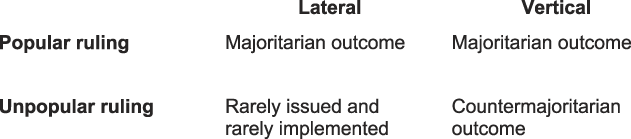
To summarize, my prior empirical research on judicial independence and implementation indicates that judicial review can be categorized into four groups based on the type and popularity of the Court’s ruling. Figure 1 presents these four categories along with the empirical findings regarding countermajoritarian outcomes in each category. When the Court issues a popular ruling (whether vertical or lateral), it obviously poses no countermajoritarian difficulty because the outcome promotes majority interests. When the Court issues an unpopular lateral ruling, it could pose a countermajoritarian problem. However, the Court rarely issues unpopular constitutional decisions in lateral cases, Footnote 98 and, when it does, those rulings have little effect on actual policy outcomes. Footnote 99 Accordingly, it is highly unlikely that judicial review will ever pose a significant countermajoritarian difficulty in lateral cases. Instead, the countermajoritarian problem only arises in one category of constitutional cases: unpopular vertical rulings.
Categories of judicial review

Unfortunately, it is neither possible nor appropriate to present all of my evidence with regard to judicial independence and implementation in this article. Therefore, I encourage skeptical readers to examine those prior studies to evaluate the merits of the empirical evidence. Footnote 100 For my purposes, I will proceed under the assumption that these empirical analyses present a reasonably accurate description of the U.S. Supreme Court’s role in American politics.
To be clear, I am not arguing that courts only issue unpopular rulings in vertical cases. The Court occasionally issues unpopular lateral rulings; however, such rulings are rare and tend to have little effect. Nor am I arguing that judges should limit judicial review to vertical issues. The decision in Brown was normatively desirable, even if its implementation was curtailed in the Deep South, because it was partially implemented in regions where it was more popular (and, therefore, not countermajoritarian). The decision may also have had political, cultural, or symbolic value beyond implementation. More generally, I am not offering any argument with regard to how judges should make decisions. The acquittal theory does not depend on judges behaving in a certain manner, so it offers no guidance on how judges ought to behave.
Instead, my empirical evidence reframes the traditional understanding of judicial review and the countermajoritarian difficulty. In lateral cases, the Court’s countermajoritarian potential is severely limited. The Court tends to avoid unpopular rulings in these cases, and when it does not, its rulings have little practical effect. In fact, the Court’s lateral rulings often bring policy into line with popular preferences. For example, the Court’s lateral rulings in the reapportionment cases were extremely popular, and those rulings were promptly implemented. Footnote 101 Therefore, the countermajoritarian difficulty is rarely, if ever, a concern in lateral cases. Judicial review does sometimes undermine the majority, but only when the majority tries to impose criminal or civil penalties on individuals. That is, Bickel’s difficulty only manifests itself in vertical cases, when the Court defies public opinion in order to relieve individuals from criminal or civil penalties.
This understanding of judicial review significantly reduces the scope of the countermajoritarian difficulty: judicial review is not generally countermajoritarian; it only prompts countermajoritarian outcomes in some vertical cases. In these cases, courts may sometimes perform their “core counter-majoritarian function—protecting minority rights against majoritarian excesses”; Footnote 102 i.e., courts can protect minorities by acquitting individuals from government sanctions, even when popular opinion supports the sanctions. Therefore, a proper analysis of the (now substantially diminished) countermajoritarian difficulty should focus on the legitimacy of judicial review in these unpopular vertical rulings.
Acquittal as an Asymmetric Function
A focus on judicial review in vertical cases highlights a function that is, to borrow Bickel’s phrase, “peculiarly suited to the capabilities of courts” Footnote 103 ; that is, courts are uniquely suited to serve a specific function in vertical cases (i.e., cases involving government sanctions). In other policy domains, judicial intervention might serve a variety of functions, depending on the nature of the decision. For example, in the context of school segregation, judicial review might promote racial integration (e.g., Brown v. Board of Education) or inhibit legislative attempts to integrate schools (e.g., Parents Involved v. Seattle School Dist. No 1.). Accordingly, we cannot say that courts are uniquely suited to promote racial integration in public schools, because the judiciary’s function in this regard depends on the justices’ choices. The judiciary does not possess any characteristic that ensures it will tend to promote a particular value in these cases. However, in the context of government sanctions, the judiciary serves a distinct role because its potential influence is asymmetric: courts can unilaterally acquit individuals of criminal and civil liability, but they cannot unilaterally impose such penalties.
The judiciary’s lack of sanctioning powers was featured in United States v. Cox. Footnote 104 In Cox, a federal district judge ordered a U.S. attorney to draft indictments charging two witnesses with perjury, but the U.S. attorney refused, believing the witnesses to be truthful. The judge attempted to hold the U.S. attorney in contempt, but the contempt citation was overturned by the Fifth Circuit Court of Appeals. The Fifth Circuit opinion highlights the asymmetry of judicial power:
Although as a member of the bar, the attorney for the United States is an officer of the court, he is nevertheless an executive official of the Government, and it is as an officer of the executive department that he exercises a discretion as to whether or not there shall be a prosecution in a particular case. It follows, as an incident of the constitutional separation of powers, that the courts are not to interfere with the free exercise of the discretionary powers of the attorneys of the United States in their control over criminal prosecutions.
As illustrated in Cox, the prosecutorial power rests solely with the executive branch; the judiciary alone cannot impose penalties. Because the judiciary’s acquittal power is asymmetric, judicial review functions only to limit the imposition of government sanctions, regardless of judicial preferences. If judges are less punitive than elected officials, they can acquit defendants; however, if judges are more punitive than lawmakers, they can do nothing to promote that preference without cooperation from those officials. Footnote 105
This acquittal function is similar to many other mechanisms in a system of separated powers. Our system of government requires an extensive list of actors to agree on the imposition of criminal sanctions: both Houses of Congress (to enact a criminal statute), the U.S. attorney (to prosecute the case), a jury (to convict), judges (to uphold the conviction), and the executive (to refrain from pardoning). Thus, the acquittal function is just one piece of a complex system designed to limit the government’s ability to impose sanctions on individuals.
Of course, acquittal is distinct from these other mechanisms because federal judges are not elected and, therefore, may be less likely to reflect majority preferences. Footnote 106 Thus, the acquittal function potentially enables relief from government sanctions, even when the imposition of those sanctions is highly popular. The Supreme Court often flouts public and elite preferences in order to shield unpopular groups from government sanctions. Prominent examples of unpopular acquittal include the Roe decision, Mapp v. Ohio, Texas v. Johnson, Ashcroft v. Free Speech Coalition, and Snyder v. Phelps, to name just a few. In these cases, the Court has unilaterally protected highly unpopular groups, including criminals, flag burners, pornographers, and protesters, from government sanctions. Moreover, the design of the federal courts make them uniquely suited to serve this function.
To summarize, the institutional structure of the judiciary makes it uniquely suited to reliably limit government sanctions. Additionally, as discussed in the previous section, limitations on government sanctions are the only rulings that raise countermajoritarian difficulties. When considered together, these two facets of the judiciary highlight a critical feature of its role in American government. Courts armed with judicial review tend to have only one consistent, countermajoritarian effect: the limitation of government sanctions. Specifically, courts are uniquely situated to acquit individuals from criminal and civil liability, even when doing so is highly unpopular.
Evaluating the Acquittal Function
The asymmetry of the acquittal function reframes the (counter)majoritarian difficulty. Courts may perform a core countermajoritarian function (limiting government sanctions) without assuming that judges possess superior judgment with regard to democratic values. This reformulation of the difficulty poses two important questions. First, why should we value the countermajortiarin influence of acquittal in the context of government sanctions, yet prefer a majoritarian process in other policy contexts? Second, might the countermajoritarian use of the acquittal function undermine democratic values if judges use it inappropriately? I consider both of these questions in turn.
The Value of Acquittal
The acquittal theory posits that judicial review only undermines majority rule by limiting government sanctions. The imposition of government sanctions is the primary mechanism through which governments interfere with social freedom by attaching specific criminal or monetary penalties to particular choices. Given their unique institutional position, courts have a remarkable capacity to stop the government from interfering with individual action; yet despite this power, courts have no means of unilaterally imposing criminal or civil liability on individuals. Consequently, judicial review is uniquely suited to limit the imposition of government sanctions.
We might then say that judicial review promotes “liberty” over majoritarianism, but only liberty in a narrow sense; that is, liberty as freedom from government interference (the liberal, negative understanding of freedom). The acquittal theory does not imply that this narrow sense of liberty encapsulates all democratic values, nor does it require that one adopt this particular understanding of freedom. Instead, the acquittal theory only requires a somewhat weak normative assumption: the imposition of fewer government sanctions tends to promote democratic values.
The democratic value of limiting government sanctions may depend, in part, on one’s particular conception of democracy. However, under most democratic theories, limits on government sanctions are highly desirable, if not absolutely essential. For example, limiting the state’s powers— particularly its punitive powers—is a defining characteristic of classic liberal democracy. Because the acquittal function is ideally suited to limit the government’s punitive powers, judicial review promotes a core value of liberal democracy. Indeed, insulation from government sanctions, such as freedom of speech, freedom of religion, and protections afforded to criminal suspects, are central to most prominent democratic theories.
More broadly, by limiting government sanctions, the acquittal function promotes opposition to government domination. Opposition to domination is central to the “democracy-against-domination” theory derived from a republican conception of freedom. Footnote 107 “Democracy-against-domination” contends that “democracy’s purpose is to avoid, prevent, lessen, or eradicate domination”; however, as Watkins and Lemieux explain, “opposition to domination is close to the heart of a number of different approaches to democracy,” including liberal democracy, deliberative democracy, and agonism. Footnote 108 To be sure, not all government sanctions constitute government domination. Footnote 109 However, the imposition of government sanctions is an almost essential tool in the process of government domination. Consequently, acquittal from government sanctions is highly effective in combating government domination. Moreover, it is almost inconceivable for acquittal to promote government domination (though it might promote private domination, a point I consider in the next section). Therefore, assuming that freedom from government domination is a core democratic value, judicial review will reliably promote that value.
Of course, the acquittal function will prove insufficient to promote other values, including some that may well be fundamental to democracy, because it lacks countermajoritarian influence in lateral cases. The judiciary cannot reliably thwart majority will in order to provide positive rights, supervise electoral institutions, or guarantee that nonjudicial government actors accord equal treatment to similarly situated individuals; e.g., judicial review proved incapable of prompting southern schools to desegregate or stop conducting devotional exercises. Footnote 110 The acquittal function alone may be incapable of ensuring a robust fulfillment of fundamental rights under many democratic theories. Therefore, one might understandably prefer a system in which the judiciary enjoys power in lateral cases so that it might promote a much broader range of values.
However, the judiciary’s inability to exercise countermajoritarian influence in lateral cases is an essential component of its desirability. Empowering the judiciary to promote a broader array of values would inevitably give judges control over various economic and administrative powers of the state, and doing so would enable judges to potentially infringe on the very values they are supposed to protect. Such an arrangement would require additional justification for why judges are particularly well suited for discerning and promoting democratic values. As discussed earlier, these justifications depend on the characteristics of judges rather than the structure of courts.
For example, if judges directly controlled public schools, they may have been better equipped to combat segregation in the 1950s and 1960s. However, that outcome depends on the particular constellation of policy preferences regarding segregated schools in that era. Had elected officials been more supportive of desegregation than judges, judicial control of public schools might have seriously hindered desegregation efforts. In other words, providing judges with greater control of policy outcomes in lateral cases would only yield desirable policy outcomes if we could trust judges to consistently make better decisions than legislators. Since we have little a priori reason to prefer the wisdom of judges, the majoritarian process may be the best possible alternative.
In contrast, the desirability of the acquittal function does not rely on the premise that judges have a superior understanding of democratic values, nor does it assume that judges will usually promote those values when they have a chance do to so. Instead, the acquittal theory only assumes that the judiciary’s power with respect to government sanctions is asymmetric. We need not trust judges to make good decisions if the only consequential countermajoritarian decisions they might make (i.e., the decision to acquit) would promote a core democratic value (i.e., freedom from government domination). At the very least, we need not worry that judges will promote government domination by unilaterally imposing government sanctions.
The Lochner Problem
The value of the acquittal function depends on the claim that the imposition of fewer government sanctions tends to promote democratic values. If freedom from government interference (in the liberal/libertarian sense) is the preeminent democratic value, then judicial review is undoubtedly legitimate; therefore, some liberal democrats and libertarians might be satisfied with the acquittal theory on its face. But proponents of other democratic theories must probe deeper. The critical question is whether the acquittal function might sometimes undermine other democratic values. If so, we may once again lapse into debates over judicial wisdom vis-a'-vis legislators and a cost-benefit analysis of judicial review.
Most theories of democracy focus on freedom from government domination, and on this front the acquittal theory is strongest: judicial review should tend to alleviate, without ever exacerbating, government domination through criminal or civil sanctions. With regard to other forms of government domination, judicial review should not substantially alter social outcomes compared to a system without judicial review because courts lack countermajoritarian power in lateral cases. However, republican theories of democratic freedom call for freedom from dominium (domination by private actors), as well as imperium (domination by the state). Footnote 111 In other words, we might also fear domination from non-state actors and, therefore, desire government protection from those private actors. In these instances, the judiciary’s acquittal power could impede the state’s protection of vulnerable groups in society. Therefore, depending on one’s particular conception of democratic values, the acquittal function might conceivably threaten those values.
I call this normative dilemma the Lochner problem because the classic case exemplifying this difficulty is Lochner v. New York. In Lochner, the Supreme Court invalidated New York’s minimum wage and maximum hour law that included criminal penalties for employers. From a libertarian perspective, the Lochner decision poses little normative concern: New York state was interfering with the freedom of private employers through the imposition of criminal sanctions, and the Court promoted their freedom by invalidating those sanctions. But, of course, the minimum wage and maximum hour laws were not intended to impose state domination on employers; they were designed to combat private domination by employers over employees. Therefore, the Court’s use of the acquittal function in Lochner may have undermined the state’s attempts to combat private domination and promote economic equality.
Similar normative problems might arise in numerous contexts. For example, lawmakers might try to promote racial and sexual equality by criminalizing sexual harassment, hate speech, or bias-motivated crimes. Judicial review could impede these policies and reinforce racial or gender hierarchies if courts acquit those charged with these crimes (e.g., R.A.V. v. City of St. Paul). Alternatively, lawmakers might seek to promote political equality by limiting the influence of money in elections. Judicial review could undermine such efforts by acquitting those charged with campaign finance laws (e.g., Citizens United v. Federal Elections Commission). More recently, the Patient Protection and Affordable Care Act employed a government sanction (whether we call it a penalty or a tax) in an effort to promote equal access to health care, and judicial review could have thwarted that effort (National Federation of Independent Business v. Sebelius). Perhaps the most extreme example arises if one adopts the view that protecting life—including the life of a fetus—is an essential egalitarian value in a democracy. If so, the use of the acquittal function in Roe v. Wade undermined that democratic value.
The common theme in each of these situations is that, depending on one’s philosophical viewpoint, a group of private actors—whites, men, the wealthy, or simply the living—is either exercising a fundamental liberty that should be protected from government interference or dominating a subordinate group by interfering with their fundamental rights. Indeed, if it were not a dominant group committing the offense, government protection would probably not be necessary. The acquittal function might, on average, favor the protection of this debatably oppressive behavior. That is, in each of these situations, the acquittal function could be used to free a member of the dominant group charged with imposing on a member of a subordinate group (e.g., a white person using a racial slur, an employer paying low wages, or a living person obtaining an abortion). Thus, while we can reliably trust the acquittal function to promote freedom from government domination, we might fear that it occasionally protects members of powerful social groups engaged in private domination. In this manner, acquittal might undermine democratic values in our society.
In many of these situations, a popular majority may be restricting its own rights in order to protect a vulnerable minority. For example, laws prohibiting racial discrimination and abortion may protect the rights of racial minorities and the unborn against the dominant majority of white/living people. However, the same issues could be framed in very different ways: civil rights laws may oppress racist business owners on behalf of a politically-correct majority; abortion restrictions may oppress women or the sexually active on behalf of a patriarchal or puritanical majority. Consequently, it is difficult to know when a majority can and cannot be trusted to handle an issue.
Nonetheless, voting majorities do sometimes use criminal sanctions to protect vulnerable minorities. Why should we value the acquittal function in these situations? In other situations a subordinate majority stands up to a dominant minority through the democratic process (e.g., criminal sanctions for violating maximum-hour laws). Why is acquittal legitimate in these cases? Why should we accept an institutional mechanism that stops a voting majority from using government sanctions to protect vulnerable groups? This Lochner problem might be addressed in three ways.
One possible response is to engage in the type of cost-benefit analysis I have previously rejected. One might argue that, on balance, equality has been well served by the acquittal function. Perhaps cases like Loving v. Virginia have done more to promote racial equality than cases like R.A.V. have done to hinder it; perhaps R.A.V. is actually an important step toward a post-racial era. A similar argument could be made for sexual equality (e.g., Taylor v. Louisiana; cf. United States v. Morrison). An argument in the context of economic equality might be more difficult. But all of these arguments depend on highly subjective evaluations of a particular decision’s correctness, importance, and impact. Accordingly, I doubt such an approach would yield widely persuasive conclusions.
A second possible response is that the acquittal function (and judicial review, more generally) is compatible with freedom from government domination but not freedom from private domination. Stated differently, judicial review may promote a narrow conception of freedom at the expense of social and economic equality. This conclusion may be unsurprising from a historical perspective; after all, American-style judicial review was created in a time with very little social or economic equality as part of a constitutional system that lacked any equality protection based on race or sex, much less economic status or sexual orientation. Equality proponents might simply conclude that judicial review is undesirable because it undermines equalizing legislation.
In fact, some proponents of social equality have criticized specific acts of judicial review on precisely these grounds. For example, Catherine MacKinnon argues that
[the framers’] posture to freedom of speech tends to presuppose that whole segments of the population are not systematically silenced, socially, prior to government action. If everyone’s power were equal to theirs, if this were a non-hierarchical society, that might make sense. But the place of pornography in the inequality of the sexes makes that assumption of equal power untrue … Classically, opposition to censorship has involved keeping government off the backs of people. Our [proposed] law is about getting some people off the backs of other people. Footnote 112
For MacKinnon, the basic problem with judicial review in the context of free speech and pornography is that it undermines society’s ability to combat private domination over disadvantaged groups. This argument can be generalized to judicial review across contexts, particularly the acquittal function. On this account, the acquittal theory highlights the real normative dilemma associated with judicial review: it systematically limits government domination, but protects private domination.
However, this argument may prove too much. The acquittal function does limit the government’s ability to impose sanctions—including those designed to promote social equality. But the same is true of the pardon. In fact, the acquittal function is not unlike the pardon power in the hands of a second-term or lame duck president: a democratically unaccountable institution is allowed to unilaterally free individuals from government sanctions. The unanimity rule on juries and the executive’s non-prosecution power Footnote 113 also bias outcomes toward acquittal. More generally, any institutional structure that makes it harder to enact statutes, by definition, makes it more difficult to pass equalizing legislation. Thus, bicameralism, the filibuster, and the veto also tend to hinder government action and protect dominant groups from laws that penalize oppressive behavior. This point is far from hypothetical. The filibuster was used to obstruct civil rights legislation during the 1960s, and the veto played the same role during the 1860s.
Viewed in this light, judicial review raises some normative difficulties with respect to social equality. But in that way, it is perfectly consistent with the entire scheme of American constitutional government. Far from a “deviant institution in the American democracy,” it is simply one more cog in a complex machine designed to systematically stifle government action and promote freedom from government domination. Thus, the institution of judicial review may not survive this normative critique; but, in failing to do so, it finds itself in good company. Any charge against judicial review on these grounds must be leveled against the entire Madisonian system. Footnote 114
However, I suggest a third response to the Lochner problem, which is potentially more appealing and undoubtedly more pragmatic: the dangers of acquittal may be partially alleviated by avoiding the use of punitive measures and, instead, relying on non-punitive government action. To be sure, criminal and civil penalties are among the strongest tools at the state’s disposal. But the routine employment of criminal and civil sanctions to solve social problems should cause concern in a free society (especially one with a litigious culture and a huge prison population). Criminal penalties are especially strong medicine and should be avoided whenever possible, especially if a goal of democracy is to minimize government domination. Furthermore, history suggests that sanctions are not the only tools available to the state for the promotion of social and economic equality. Even those laws that rely heavily on criminal sanctions to promote equality (e.g., the Civil Rights Act of 1964, the Violence Against Women Act) also include numerous non-sanctioning provisions (e.g., grant programs, training programs, prohibitions against discrimination in government employment, etc.). The use of these tools minimizes the possibility of judicial obstruction.
For example, if a popular majority wishes to promote economic equality, it should avoid legislative strategies that utilize criminal or civil penalties to do so. Judicial review can frustrate economic policies that employ government sanctions, as it did in Lochner. But a majority coalition can promote economic equality through many non-punitive policies. The government could cut taxes for the working poor (including refundable tax credits) or create welfare programs to compensate for their low wages. The government could also refuse to do business with companies that fail to adopt their preferred policies or provide financial support to those who do.
As another example, if a majority wishes to combat a particular type of discrimination, it can do so without the use of sanctions. The government could prohibit such discrimination in government hiring, withhold grants and contracts from organizations that allow discrimination, or fund educational, training, and civic programs that promote awareness and equality. Of course, these programs would probably not eliminate all discrimination. Nonetheless, the considerable resources of the state can certainly eliminate many, if not most, instances of discrimination and (perhaps more importantly) promote a culture that strongly discourages the practice.
In both examples, the Court might try to obstruct these non-punitive policies; however, in lateral cases the justices tend to follow popular preferences and generally fail to influence outcomes when they buck popular opinion. Footnote 115 Thus, if majorities promote equality without imposing criminal or civil sanctions, they should generally succeed, regardless of judicial attempts at obstruction. Moreover, if freedom from government interference or domination is a core democratic value, then the government should exhaust these non-sanctioning options before resorting to civil and criminal penalties, and doing so would avoid the dangers of acquittal. In this manner, judicial review actually limits government interference—above and beyond the sanctions that courts strike down—by incentivizing legislators to avoid the use of sanctions in the first place.
Accordingly, acquittal might frustrate specific attempts to promote social, political, or economic equality; courts might use the acquittal power to undermine criminal statutes that are intended to protect vulnerable groups. However, legislative majorities possess a variety of governing tools with which to promote equality that do not involve criminal or civil sanctions. Undoubtedly, criminal penalties are sometimes the most direct and effective policy tools, but they are rarely the only possible tools available to combat private domination. Because courts are severely limited in their ability to obstruct non-punitive policy measures, determined majorities should be able to reliably promote social and economic equality, regardless of judicial obstructionism. Therefore, the Lochner problem does not necessarily undermine the legitimacy of judicial review.
This third response may leave unresolved some normative concerns. Judicial review in the context of contract and property law, as well as other types of civil suits, undoubtedly raises some difficult complexities. However, this third response offers a plausible and (most importantly) pragmatic avenue for those who remain troubled by judicial review in light of the acquittal theory. A constitutional amendment banning judicial review is highly unlikely; even more unlikely may be the day when a Court majority shares your particular values. But non-punitive policy strategies are usually available, and these alternative strategies avoid the Lochner problem.
More generally, the acquittal theory acknowledges and embraces the fact that the acquittal function empowers unelected judges to exercise truly countermajoritarian influence. Although these situations may be limited in nature, the judiciary’s influence may still raise democratic concerns. In some contexts, such as abortion, pornography, and gay rights, unpopular rulings may have significant effects on the character and development of the society. My empirical research on judicial power focuses narrowly on the behavioral responses of state and private actors to judicial rulings; however, judicial decisions may have a myriad of broader effects on law-related perceptions and norms, the legal environment, and professional networks. Footnote 116 Courts may also shape popular attitudes, Footnote 117 the nature of public debate, Footnote 118 or the legitimacy of particular policies. Footnote 119 Critics of judicial review may well question the legitimacy of such influence. However, at the end of the day, truly determined majorities possess countless political, economic, social, and cultural mechanisms to shape society without resorting to government sanctions. When the majority fails to secure its goals, such failure usually indicates that the majority is ambivalent (as in the case of abortion), disingenuous (as in the case of pornography), or quickly losing its majority status (as in the case of gay rights).
Conclusion
Alexander Bickel’s countermajoritarian difficulty relied on a simplistic understanding of the judiciary’s function in American politics. Bickel assumed that judicial review necessarily “thwarts the will of representatives of the actual people of the here and now”; Footnote 120 thus, judicial review is a deviant institution because it prioritizes the values of unaccountable elites over those of popular majorities. This countermajoritarian difficulty seems especially troubling because prioritizing elite preferences over popular will inherently lies in tension with democratic values. Attempts to resolve Bickel’s difficulty have generally yielded dissatisfying normative conclusions.
However, recent empirical studies on judicial independence and implementation provide invaluable insight into the debate over judicial review’s legitimacy. Courts do sometimes exercise countermajoritarian influence, but they can only reliably use this influence to acquit individuals from criminal or civil penalties. In this manner, judicial review promotes freedom from government domination, while posing minimal threat to other democratic values. The normative problem posed by judicial review is not Bickel’s countermajoritarian difficulty. The critical normative dilemma is the Lochner problem: by undermining the government’s use of sanctions to promote social equality, judicial review systematically prioritizes freedom from government domination over freedom from private domination. The acquittal theory suggests that future scholarship on judicial review should focus on this normative dilemma. However, on its face, the Lochner problem is substantially less problematic than Bickel’s difficulty for at least three reasons.
First, contrary to Bickel’s claims, judicial review only thwarts majority will when the Court issues an unpopular ruling and that ruling is actually implemented. Moreover, judicial review only protects private domination when the Court invalidates legislative attempts to combat private domination and promote social equality. Therefore, unlike Bickel’s difficulty, which is associated with every use of judicial review, the Lochner problem only appears in certain cases.
Second, unlike the promotion of elite preferences, freedom from government domination lies at the heart of most democratic theories. Therefore, judicial review is hardly a deviant institution in a democracy. In fact, the acquittal function is similar to numerous features of democratic institutions. Of course, judicial review is similar to institutions like the filibuster, the veto, and bicameralism, because all of these institutions potentially undermine majority rule by biasing outcomes toward the status quo. However, the acquittal theory emphasizes the similarity between judicial review and the presidential pardon, the executive non-prosecution power, and the unanimity rule on juries, which all bias outcomes against government sanctions.
Third, the Lochner problem may be (at least partially) resolved by the use of non-sanctioning legislative tools. The degree to which popular majorities can effectively promote social equality through non-sanctioning legislation is an empirical question that I cannot fully resolve. But the extensive political, economic, social, and cultural tools at the state’s disposal suggest that majorities can reliably combat private domination without resorting to the use of government sanctions.
The acquittal theory provides a normative defense of judicial review’s legitimacy; however, it does not prescribe a mode of constitutional interpretation. Theories like originalism both justify judicial review and advocate a particular style of judicial decision making. This dual feature is both an asset and a weakness: originalism offers advice about appropriate legal reasoning; however, if judges fail to follow this advice, their use of judicial review is no longer legitimate from an originalist perspective. In contrast, the acquittal theory does not depend on any particular behavior on the part of judges; indeed, the acquittal theory would justify judicial review even if judges were, on average, less likely than legislators to protect democratic values. Instead, the acquittal theory relies on the institutional powers and constraints inherent to the judiciary, regardless of the choices judges make. This theory does not advocate the acquittal of every person charged with a crime; obviously, some people should go to jail. Nor does the theory discourage the use of judicial review in lateral cases; lateral rulings can promote desirable outcomes if they are popular, and even decisions that are not implemented might have persuasive or symbolic value. Because the theory assumes nothing about judicial behavior, it does not prescribe any particular interpretive method.
Instead, the acquittal theory challenges conventional understandings of judicial review’s role in democratic systems of government. Judicial review is commonly viewed as an entrenchment mechanism that can be used to preserve certain policies, practices, or values against future revision. The entrenchment function is often credited with giving rise to systems of judicial review in the first place. For example, Tom Ginsburg argues that self-interested, risk-averse politicians establish and empower constitutional courts as an insurance mechanism to protect constitutional bargains in the face of electoral uncertainty. Footnote 121 Similarly, Ran Hirschl contends that self-interested lawmakers empower courts through constitutional reforms in order to entrench their values in case they lose power. Footnote 122 The acquittal theory suggests that these political actors fundamentally misunderstand judicial review’s capacity to resist majority pressures. Specifically, judicial review may not be equally capable of entrenching all political values. Instead, judicial review may be uniquely suited for promoting freedom from government domination, but ultimately fail to protect other political goals. However, these conclusions ultimately depend on the institutional structures that shape judicial independence and implementation in the specific political context.
Finally, the acquittal theory reframes the normative debate over judicial review. Bickel’s difficulty depicts a basic tension between elite wisdom (embodied by judicial review) and majoritarian democracy (embodied by the electoral and legislative processes). In contrast, the acquittal theory highlights the unique institutional capacity of courts to promote freedom from government domination, without seriously threatening other democratic values. Rather than a presumptively deviant institution that must be justified, judicial review promotes a core democratic function: freedom from government domination. Courts are uniquely suited to this task because they can directly release individuals from criminal and civil penalties, yet they lack the power to independently impose sanctions. In other words, as Alexander Hamilton predicted, courts are “the bulwarks of a limited Constitution against legislative encroachments,” and “the general liberty of the people can never be endangered from that quarter” (at least not directly); thus, “liberty can have nothing to fear from the judiciary alone” (Federalist No. 78). However, judicial review may undermine legislative attempts to combat private forms of domination. Therefore, judicial review essentially prioritizes freedom from government domination over freedom from private domination, and its normative legitimacy ultimately depends on justifying that ordering of democratic values.