INTRODUCTION
The range of non-human primates (NHPs), overlaps with areas where Plasmodium infection is endemic in humans. This has led to concerns that NHPs may represent a source of infection for humans (Prugnolle et al. Reference Prugnolle, Durand, Ollomo, Duval, Ariey, Arnathau, Gonzalez, Leroy and Renaud2011a ; Rayner et al. Reference Rayner, Liu, Peeters, Sharp and Hahn2011; Sundararaman et al. Reference Sundararaman, Liu, Keele, Learn, Bittinger, Mouacha, Ahuka-Mundeke, Manske, Sherrill-Mix, Li, Malenke, Delaporte, Laurent, Mpoudi Ngole, Kwiatkowski, Shaw, Rayner, Peeters, Sharp, Bushman and Hahn2013). Until recently, only three Plasmodium species (Plasmodium reichenowi, Plasmodium rodhaini and Plasmodium schwetzi) were known to infect chimpanzees and gorillas (Blacklock and Adler, Reference Blacklock and Adler1922; Adler, Reference Adler1923), and among them P. reichenowi was the only one genetically characterized (Escalante and Ayala, Reference Escalante and Ayala1994). However, newly introduced non-invasive fecal sampling combined with molecular diagnostics allows straightforward detection of circulating Plasmodium species and the study of their genetic diversity (Kaiser et al. Reference Kaiser, Löwa, Ulrich, Ellerbrok, Goffe, Blasse, Zommers, Couacy-Hymann, Babweteera, Zuberbühler, Metyger, Geidel, Boesch, Gillespies and Leendertz2010; Liu et al. Reference Liu, Li, Learn, Rudicell, Robertson, Keele, Ndjango, Sanz, Morgan, Locatelli, Gonder, Kranzusch, Walsh, Delaporte, Mpoudi-Ngole, Georgiev, Muller, Shaw, Peeters, Sharp, Rayner and Hahn2010; Prugnolle et al. Reference Prugnolle, Durand, Neel, Ollomo, Ayala, Arnathau, Etienne, Mpoudi-Ngole, Nkoghe, Leroy, Delaporte, Peeters and Renaud2010). Latest studies have shown that a remarkably diverse array of Plasmodium species are widely distributed in NHPs in Africa (Duval and Ariey, Reference Duval and Ariey2012; Verhulst et al. Reference Verhulst, Smallegange and Takken2012).
Based on phylogenetic analysis of mitochondrial, apicoplast and nuclear genes of plasmodium species detected in gorillas and chimpanzees, six well defined host specific lineages are known to them. These lineages have been shown to belong in the subgenus Laverania (Liu et al. Reference Liu, Li, Learn, Rudicell, Robertson, Keele, Ndjango, Sanz, Morgan, Locatelli, Gonder, Kranzusch, Walsh, Delaporte, Mpoudi-Ngole, Georgiev, Muller, Shaw, Peeters, Sharp, Rayner and Hahn2010). Among them, Plasmodium adleri, Plasmodium praefalciparum, and Plasmodium blacklocki have so far only been reported from gorillas. Plasmodium praefalciparum is of exceptional interest, as it is currently considered to be the direct predecessor of P. falciparum, the most pathogenic species in humans (Krief et al. Reference Krief, Escalante, Pacheco, Mugisha, André, Halbwax, Fischer, Krief, Kasenene, Crandfield, Cornejo, Chavatte, Lin, Letourneur, Grüner, McCutchan, Rénia and Snounou2010; Rayner et al. Reference Rayner, Liu, Peeters, Sharp and Hahn2011; Verhulst et al. Reference Verhulst, Smallegange and Takken2012; Sundararaman et al. Reference Sundararaman, Liu, Keele, Learn, Bittinger, Mouacha, Ahuka-Mundeke, Manske, Sherrill-Mix, Li, Malenke, Delaporte, Laurent, Mpoudi Ngole, Kwiatkowski, Shaw, Rayner, Peeters, Sharp, Bushman and Hahn2013). Moreover, a single non-Laverania species, Plasmodium vivax, has also been reported from gorillas (Liu et al. Reference Liu, Li, Learn, Rudicell, Robertson, Keele, Ndjango, Sanz, Morgan, Locatelli, Gonder, Kranzusch, Walsh, Delaporte, Mpoudi-Ngole, Georgiev, Muller, Shaw, Peeters, Sharp, Rayner and Hahn2010, Reference Liu, Li, Shaw, Learn, Plenderleith, Malenke, Sundararaman, Ramirez, Crystal, Smith, Bibollet-Ruche, Ayouba, Locatelli, Esteban, Mouacha, Guichet, Butel, Ahuka-Mundeke, Inogwabini, Ndjango, Speede, Sanz, Morgan, Gonder, Kranzusch, Walsh, Georgiev, Muller, Piel and Stewart2014; Prugnolle et al. Reference Prugnolle, Rougeron, Becquart, Berry, Makanga, Rahola, Arnathau, Ngoubangoye, Menard, Willaume, Ayala, Fontenille, Ollomo, Durand, Paupy and Renaud2013; Sundararaman et al. Reference Sundararaman, Liu, Keele, Learn, Bittinger, Mouacha, Ahuka-Mundeke, Manske, Sherrill-Mix, Li, Malenke, Delaporte, Laurent, Mpoudi Ngole, Kwiatkowski, Shaw, Rayner, Peeters, Sharp, Bushman and Hahn2013). Although an impressive amount of information about genetic diversity and distribution of Plasmodium species among NHPs has been obtained within the last few years, additional data on their biology and ecology and their interaction with their respective hosts is needed (Chapman et al. Reference Chapman, Gillespie and Goldberg2005; Prugnolle et al. Reference Prugnolle, Durand, Ollomo, Duval, Ariey, Arnathau, Gonzalez, Leroy and Renaud2011a ). To date, only one study on chimpanzees has addressed the influence of a hosts ecology in determining their risk of infection with Plasmodium (De Nys et al. Reference De Nys, Calvignac-Spencer, Thiesen, Boesch, Wittig, Mundry and Leendertz2013). No such study has been conducted on the other species of NHP.
Western lowland gorillas have been habituated for the purpose of both research and eco-tourism (Blom et al. Reference Blom, Cipolletta, Brunsting and Prins2004; Doran-Sheehy et al. Reference Doran-Sheehy, Derby, Greer and Mongo2007). However, during the habituation process, individual behaviour (Klailova et al. Reference Klailova, Hodgkinson and Lee2010) and physiological wellbeing could be altered (Morton et al. Reference Morton, Todd, Lee and Masi2013). Moreover, prolonged exposure of primates to humans may result in chronic stress, causing a reduction in immunity and increase the risk of pathogen transmission (Kalema-Zikusoka et al. Reference Kalema-Zikusoka, Rothman and Fox2005; Shutt et al. Reference Shutt, Heistermann, Kasim, Todd, Kalousova, Profosouva, Petrzelkova, Fuh, Dicky, Bopalanzognako and Setchell2014). Field sites with habituated groups of NHPs offer a unique opportunity to study various aspects of their infectious diseases. Since 2007, as a part of the health monitoring efforts in Dzanga-Sangha Protected Areas (DSPA), we have been systemically surveying humans, gorillas and other wildlife for a broad spectrum of pathogens in order to assess their prevalence and cross-transmission (Sak et al. Reference Sak, Petrzelkova, Kvetonova, Mynarova, Shutt, Pomajbikova, Kalousova, Modry, Benavides, Todd and Kvac2013; Hasegawa et al. Reference Hasegawa, Modrý, Kitagawa, Shutt, Todd, Kalousová, Profousová and Petrželková2014; Janatova et al. Reference Janatova, Albrechtova, Petrzelkova, Dolejska, Papousek, Masarikova, Cizek, Todd, Shutt, Kalousova, Profousova-Psenkova, Modry and Literak2014; Shutt et al. Reference Shutt, Heistermann, Kasim, Todd, Kalousova, Profosouva, Petrzelkova, Fuh, Dicky, Bopalanzognako and Setchell2014). DSPA is the first places to successfully habituate western lowland gorillas, this site is unique in its relatively dense gorilla population and of the number of groups under different stages of habituation. Two gorilla groups, named Makumba and Mayele, were added to the habituation programme in 2000 and 2005, respectively (Masi, Reference Masi2009). Two other groups (Mata and Wonga) are under the process of habituation, and other unhabituated gorillas inhabit the same area. Data on the prevalence and genetic diversity of Plasmodium in gorillas at DSPA were discussed in the previous study (Liu et al. Reference Liu, Li, Learn, Rudicell, Robertson, Keele, Ndjango, Sanz, Morgan, Locatelli, Gonder, Kranzusch, Walsh, Delaporte, Mpoudi-Ngole, Georgiev, Muller, Shaw, Peeters, Sharp, Rayner and Hahn2010), but without addressing the ecological aspects of this causative agent of malaria.
To answer some of these arising questions, we carried out a cross-sectional molecular survey to: (i) estimate the prevalence of Plasmodium among gorilla groups at different levels of habituation, (ii) to infer the genetic diversity of these Plasmodium, (iii) assess the possibilities of gorilla-human Plasmodium cross-transmission, and (iv) to investigate the effect of sex and age on the incidence of malarial infections in habituated lowland gorillas.
MATERIALS AND METHODS
Ethics statement
The research complied with the legal requirements of the Central African Republic (CAR) and adhered to the research protocol of DSPA. Collection of fecal samples from gorillas was non-invasive and did not cause any distress to the animals. The collection of human samples was approved by the Ethical Committee of the Biology Centre of the Czech Academy of Sciences (approval number: 1/2012). Import of samples into the EU was approved by the State Veterinary Authority of the Czech Republic.
Field site
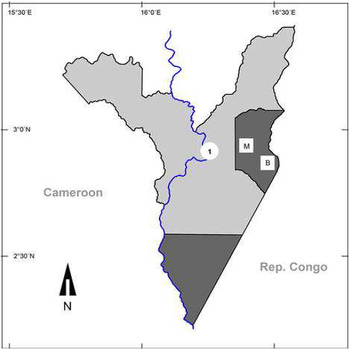
This study was conducted in DSPA in the CAR (Fig. 1) and is co-managed by the CAR government and World Wildlife Fund (WWF). The complex is comprised of the strictly protected Dzanga-Ndoki National park (1222 km2) and the multi-use Dzanga-Sangha Dense Forest Special Reserve (3159 km2), where human activities are governed. Human population density in DSPA is low and estimated at around 6000 inhabitants (Remis and Jost Robinson, Reference Remis and Jost Robinson2012). Estimated average rainfall is ~1400 mm year−1 with long rainy season intervals (March–May and August–November) and shorter dry seasons (Remis and Jost Robinson, Reference Remis and Jost Robinson2012). In 1997, the primate habituation programme (PHP) was launched to habituate western lowland gorillas for tourism, at the same time providing researchers a unique opportunity to follow the gorillas on a daily basis and collect longitudinal sets of data from identified individuals within the habituated groups.
Map of study site in Dzanga-Sangha Protected Areas, Central African Republic. Dzanga and Ndoki Sectors of the protected Dzanga Ndoki National Park (dark grey), Dzanga Sangha Dense Forest Special Reserve (light grey ); location of villages Bayanga (1), Mossapoula and Yandumbé; research camp Mongambe (M ); research camp Bai Hokou (B ).

Sample collection
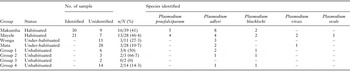
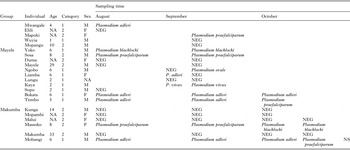
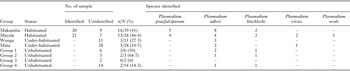
Sampling was carried out around the permanent PHP camps at Bai Hokou (33N 663109, 316187 UTM) and Mongambe (33N 654357, 322606 UTM). In total, 131 fecal samples were collected (Table 1), between August and October 2012. All fecal samples were immediately preserved in RNAlater, stored in a freezer and subsequently shipped to Czech Republic, where they were kept at −20 °C until DNA extraction. The samples were collected from animals under different levels of habituation as shown below:
Number of fecal samples collected and the identified Plasmodium spp.
Habituated
Samples were collected from 9 and 13 individuals from two groups Makumba and Mayele, respectively. Both groups are regularly followed by two teams of BaAka trackers; approximately three trackers per team, Bantu assistants, as well as foreign researchers. Samples from identified individuals within habituated groups were collected on a monthly basis (16 individuals were sampled more than once), however, some samples were also collected from night nests and marked as unidentified in order to enable comparison of the occurrence of malaria infection in both under habituation and unhabituated groups.
Under-habituation
Two groups were also included in this study: the approximate number of individuals in the Mata group was eight and in the Wonga group there was 10–15, however we collected 28 and 11 fecal samples from Mata and Wonga group, respectively. Due to limited contact, samples were collected only from night nests. The Mata group was sampled three times, whereas the Wonga group was sampled only once. All the samples were marked as unidentified.
Unhabituated
The range of several unhabituated gorilla groups surrounded the research stations. We successfully sampled four of the unhabituated groups there, the group composition was unknown (samples collected: group 1, n = 6; group 2, n = 3; group 3, n = 2; group 4, n = 9). Sampling was carried out only once from night nests and all samples were marked as unidentified.
Blood samples
As part of a long-term health monitoring programme, 95 human blood samples were collected from residents of the local village of Bayanga, approximately 10 km outside of the National Park, including PHP trackers and assistants as well as park eco-guards; these samples were preserved in 96% ethanol and stored in a mobile freezer.
DNA extraction
Prior to DNA extraction, all fecal samples were processed in an equipped P3 laboratory, to remove RNAlater as described elsewhere (Keele et al. Reference Keele, Van Heuverswyn, Li, Bailes, Takehisa, Santiago, Bibollet-Ruche, Chen, Wain, Liegeois, Loul, Ngole, Bienvenue, Delaporte, Brookfield, Sharp, Shaw, Peeters and Hann2006), and the extraction was performed with QIAamp DNA Stool Mini Kit (Qiagen, Germany) according to the manufacturer's instructions. Total DNA was measured by Fluorometry, using a Qubit (Invitrogen Carlsbad CA). Genomic DNA from the human blood samples was extracted using the DNeasy blood & tissue kit (Qiagen) according to the manufacturer's instructions.
PCR and sequencing
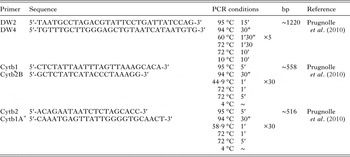
For diagnostic purposes, a previously described nested PCR protocol was followed (Prugnolle et al. Reference Prugnolle, Durand, Neel, Ollomo, Ayala, Arnathau, Etienne, Mpoudi-Ngole, Nkoghe, Leroy, Delaporte, Peeters and Renaud2010). However, the second PCR reaction, designed to produce a ~930 bp fragment of the Plasmodium cytochrome b (cytB) gene was modified. A pair of internal primers amplifying two overlapping fragments (516 and 558 bp) of the same region of cytB was designed. Details of the primers used, fragment lengths and the modified PCR conditions are included in Table 2. For the first PCR, ca 2–50 ng of template DNA was used in a 25 μL reaction, containing 12·5 μL of PCR mix (Qiagen), 2·5 μL of solution Q (Qiagen) and 0·2 μL of each primer (DW2 and DW4) in 10 pmol concentration. For the second PCR, 3 μL of the first PCR product was used as a template in a 25 μL reaction mixture, also containing 12·5 μL common Master Mix (Top-Bio, Czech Republic) and 1 μL of each primer at the same concentration as in the first PCR reaction. The amplified products were subjected to 2% agarose gel electrophoresis in TAE buffer, excised, gel-purified using QIAquick gel extraction kit (Qiagen) and commercially sequenced in both directions by Macrogen. Human blood samples served as templates for the same cytB PCR reaction as that used for gorilla fecal samples.
Primer name, sequence and amplicons size
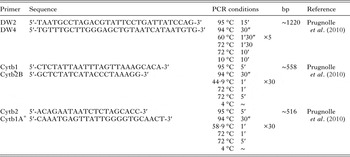
Cytb2B* primer designed in this study, amplifying first overlapping fragment.
Cytb1A+ primer designed in this study, amplifying second overlapping fragment.
Phylogenetic analyses
All sequences were manually checked using Chromas Pro 1.5 software (Technelysium, Ltd). Sequences were compared with previously published sequences using NCBI BLAST. Sequences were aligned using the ClustalW multiple alignment tool implemented in Bioedit Sequence Alignment Editor V.7.0.9.1. The best fitting model for maximum likelihood (ML) was general time reversible plus gamma distribution (GTR+Г) for nucleotide as determined by jModelTest. A phylogenetic tree was constructed by ML and the corresponding bootstrap support values were obtained by PhyML software freely available at the ATGC bioinformatics platform (http://www.atgc-montpellier.fr/).
Statistical analyses
To determine general Plasmodium prevalence among gorillas and humans, the rate of infection was calculated as a simple ratio, a 95% CI was estimated based on two methods as described previously (Newcombe, Reference Newcombe1998). Plasmodium species prevalence in gorillas was calculated based on the proportion of positive fecal samples, while in humans the value was calculated based on the proportion of positive individuals. Gorilla sample data was analysed from two perspectives: (i) to compare malaria prevalence rate between groups that differ in levels of habituation, and (ii) the effect of sex and age on the probability of Plasmodium infection. For the effect of habituation and individual traits, we fitted two generalized linear mixed models (GLMM) with a binomial distribution. In the first model we used unidentified fecal samples collected from the night nests just once (n = 16 habituated, n = 19 under-habituation and n = 25 unhabituated) in order to compare the prevalence of Plasmodium species among gorillas according to their habituation status. Samples were categorized according to the groups (Makumba, Mayele, Mata, Wonga and unhabituated groups 1–4) and level of human-ape contact (habituated under-habituation and unhabituated). The random factor ‘group’ was nested into the fixed factor level of human-ape contact. In the second model; created in order to determine individual-trait factors that may underlay the incidence of malaria in gorillas, we included only identified samples from the two habituated groups collected during close follows of the animals (Makumba and Mayele) as sex and age of habituated animals are known. We treated group (fixed: Makumba, Mayele), sex (fixed: male, female), age (fixed, categories: infant/juvenile vs sub-adult/adult) and ‘individual’ (random effect). Age-classes were verified based on previously suggested categorization (Breuer et al. Reference Breuer, Hockemba, Olejniczak, Parnell and Stokes2008). Due to the limited number of groups and the restricted number of individuals within each age class, age was pooled and categorized as young (infant/juvenile) vs old (sub-adult/adult). All statistical analyses were conducted in R (v. 2.13.1; R Development Core Team 2011).
RESULTS
Detection of Plasmodium DNA and species identification
In total, we examined 131 gorilla fecal samples and 95 human blood samples; Plasmodium spp. DNA was detected via PCR in 42 gorilla samples with an overall prevalence of 32%. According to the level of habituation, there were 4/16 (25%), 4/19 (21%) and 7/25 (28%) positive fecal samples from habituated, under-habituation and unhabituated groups, respectively. Habituation status had no effect on detection rate (GLMM: z = 0·277, P = 0·871). The results using Cytochrome b gene PCR-assay, also revealed high prevalence in human of 43·1% (n = 41/95).
We retrieved 41 unambiguous sequences out of 42 PCR amplicons. All Laverania species previously reported from lowland gorillas were detected from fecal samples in this study. Plasmodium adleri was most frequent (n = 21; 51%) followed by P. praefalciparum (n = 9; 21·9%) and P. blacklocki (n = 7; 17%). Plasmodium praefalciparum was present only in fecal samples collected from habituated individuals from both the Makumba and Mayele groups. In comparison, 38 sequences out of 41 PCR amplicons from human samples were unambiguously identified as P. falciparum with 99% similarity to KC175316 sequence from GenBank™. Sequences retrieved from both gorillas and humans were deposited in GenBank™ under these accession numbers (KM527127–KM527176).
Four samples containing cytB of non-Laverania species, namely P. vivax (n = 3; 7%) and P. ovale (n = 1; 2·4%) were also found. Both species were identified in the Mayele group, whereas only a single P. vivax case was found in the Mata group. One of the two samples containing P. vivax collected from the infant/juvenile Kaya (Mayele group) was shown to have 100% identity with KF618566 and AY791614 sequences obtained from human blood, as well as with KC140105 derived from Anopheles vinckei. The other sample was collected from an unidentified individual (Mata group) and shown to be identical with KF618562 from gorilla faeces (Cameroon) and KF591835 and JQ240429 from human blood. Due to poor quality of the third sequence we did not include it in further analysis. The single sample positive for P. ovale was collected from the infant/juvenile Ngobo (Mayele group) is characterized by 99% similar to HQ712053 from the human blood (tropical and subtropical regions), and GQ231520 and KC175307 from human blood (Cameroon).
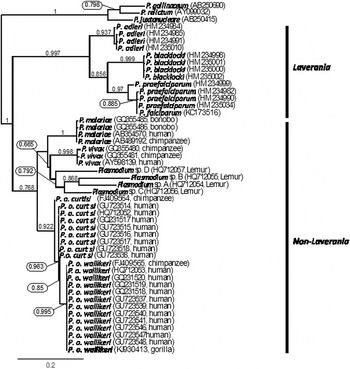
The presence of this P. ovale sequence in G. g. gorilla was confirmed twice by using independent DNA extraction and PCRs. The dendogram (Fig. 2) shows the phylogenetic relationship of the newly obtained cytB sequence of P. ovale with relevant sequences of P. ovale from human and other Plasmodium species. Consistent topology was obtained by both maximum likelihood and Bayesian methods. The bootstrap value (96%) unequivocally support the placement of the P. ovale sequence into the Plasmodium ovale wallikeri clade, forming a monophyletic group together with sequences derived from humans, lemurs and chimpanzees.
Maximum likelihood (ML) phylogenetic tree of Plasmodium mitochondrial cytochrome b sequences (634bp). Numbers above branches denoted for bootstrap values with 1000 replicates. Newly identified sequences in this study are in bold.

Patterns of malaria infections in habituated gorillas
Fifty one fecal samples from 22 identified individuals from the habituated groups (Makumba, n = 9 and Mayele, n = 13) were collected and analysed (Table 3). Plasmodium DNA was detected in 25 samples (49%), of which 24 yielded a sequence that allowed determination of the Plasmodium species (Table 3). GLMM showed that age was the only significant factor influencing Plasmodium incidence (treatment contrasts given, infant/juvenile vs sub-adult/adult: z = 1·965, P = 0·049), while no effect of sex (treatment contrasts given: males vs females: z = −0·883, P = 0·377) or group (treatment contrasts given: Makumba vs Mayele: z = 0·315, P = 0·753) were observed. Throughout the sampling time, from all 22 habituated individuals, 11 gorillas were free of infection, whereas 11 individuals were positive at least once. Interestingly, fecal samples from individuals Ngobo and Liamba from the Mayele group changed in infection status over time. Additionally, infection with P. adleri following an infection with P. praefalciparum or vice versa was observed in samples collected from the individuals Tembo, Mobangi and Massoko from the Makumba group.
Patterns of Plasmodium spp. infection among individuals within habituated groups
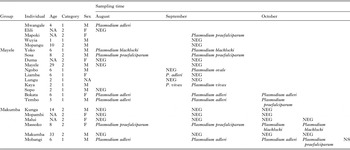
NEG, negative samples; NA, sex /age not available; NS, PCR positive but sequence was not obtained; 1, infant/juvenile; 2, sub-adult/adult.
DISCUSSION
Early studies in the first half of the 20th century reported several malaria parasites in African NHPs (Blacklock and Adler, Reference Blacklock and Adler1922; Adler, Reference Adler1923; Rodhain, Reference Rodhain1939; Garnham et al. Reference Garnham, Lainson and Gunders1956). Due to the highly endangered status of wild NHPs and ethical issues, further invasive studies are at present limited. Non-invasive approaches and the application of molecular methods, however, have dramatically improved our understanding of Plasmodium infections in terms of their prevalence and genetic diversity (Ollomo et al. Reference Ollomo, Durand, Prugnolle, Douzery, Arnathau, Nkoghe, Leroy and Renaud2009; Duval et al. Reference Duval, Fourment, Nerrienet, Rousset, Sadeuh, Goodman, Andriaholinirina, Randrianarivelojosia, Paul, Robert, Ayala and Ariey2010; Krief et al. Reference Krief, Escalante, Pacheco, Mugisha, André, Halbwax, Fischer, Krief, Kasenene, Crandfield, Cornejo, Chavatte, Lin, Letourneur, Grüner, McCutchan, Rénia and Snounou2010; Liu et al. Reference Liu, Li, Learn, Rudicell, Robertson, Keele, Ndjango, Sanz, Morgan, Locatelli, Gonder, Kranzusch, Walsh, Delaporte, Mpoudi-Ngole, Georgiev, Muller, Shaw, Peeters, Sharp, Rayner and Hahn2010; Prugnolle et al. Reference Prugnolle, Durand, Neel, Ollomo, Ayala, Arnathau, Etienne, Mpoudi-Ngole, Nkoghe, Leroy, Delaporte, Peeters and Renaud2010). DSPA in the CAR is a key site for the habituation of western lowland gorillas and associated research, including studies of their (infectious) diseases (Cipolletta, Reference Cipolletta2003; Blom et al. Reference Blom, Cipolletta, Brunsting and Prins2004; Masi, Reference Masi2009; Masi et al. Reference Masi, Cipolletta and Robbins2009; Klailova et al. Reference Klailova, Hodgkinson and Lee2010; Sak et al. Reference Sak, Petrzelkova, Kvetonova, Mynarova, Shutt, Pomajbikova, Kalousova, Modry, Benavides, Todd and Kvac2013; Hasegawa et al. Reference Hasegawa, Modrý, Kitagawa, Shutt, Todd, Kalousová, Profousová and Petrželková2014; Janatova et al. Reference Janatova, Albrechtova, Petrzelkova, Dolejska, Papousek, Masarikova, Cizek, Todd, Shutt, Kalousova, Profousova-Psenkova, Modry and Literak2014; Shutt et al. Reference Shutt, Heistermann, Kasim, Todd, Kalousova, Profosouva, Petrzelkova, Fuh, Dicky, Bopalanzognako and Setchell2014). Following the results from Liu et al. (Reference Liu, Li, Learn, Rudicell, Robertson, Keele, Ndjango, Sanz, Morgan, Locatelli, Gonder, Kranzusch, Walsh, Delaporte, Mpoudi-Ngole, Georgiev, Muller, Shaw, Peeters, Sharp, Rayner and Hahn2010), we conducted this study on the occurrence and diversity of malaria parasites among several groups of gorillas under different habituation levels, in order to investigate the impact of sex and age on infection. The cytB PCR assays identified a relatively high prevalence of Plasmodium spp. among the studied gorilla groups. As the detection of Plasmodium from fecal samples is less sensitive than from blood (Prugnolle et al. Reference Prugnolle, Durand, Neel, Ollomo, Ayala, Arnathau, Etienne, Mpoudi-Ngole, Nkoghe, Leroy, Delaporte, Peeters and Renaud2010), the actual prevalence would be expected to be higher. A 32% rate of infection in fecal samples reported herein is in agreement with previous finding from the same location (Liu et al. Reference Liu, Li, Learn, Rudicell, Robertson, Keele, Ndjango, Sanz, Morgan, Locatelli, Gonder, Kranzusch, Walsh, Delaporte, Mpoudi-Ngole, Georgiev, Muller, Shaw, Peeters, Sharp, Rayner and Hahn2010). In contrast, gorillas from Cameroon and Gabon were found to have 21 and 11% prevalence, respectively (Duval et al. Reference Duval, Fourment, Nerrienet, Rousset, Sadeuh, Goodman, Andriaholinirina, Randrianarivelojosia, Paul, Robert, Ayala and Ariey2010; Prugnolle et al. Reference Prugnolle, Durand, Neel, Ollomo, Ayala, Arnathau, Etienne, Mpoudi-Ngole, Nkoghe, Leroy, Delaporte, Peeters and Renaud2010). Differences between the study sites could be attributed to small sample size bias, seasonality, sample group age composition, differential exposure to the appropriate vectors and other ecological factors (Verhulst et al. Reference Verhulst, Smallegange and Takken2012).
Lowland gorillas are known to host P. praefalciparum, P. adleri and P. blacklocki, as well as a P. vivax-like isolate that belongs to the non-Laverania species (Liu et al. Reference Liu, Li, Learn, Rudicell, Robertson, Keele, Ndjango, Sanz, Morgan, Locatelli, Gonder, Kranzusch, Walsh, Delaporte, Mpoudi-Ngole, Georgiev, Muller, Shaw, Peeters, Sharp, Rayner and Hahn2010; Prugnolle et al. Reference Prugnolle, Rougeron, Becquart, Berry, Makanga, Rahola, Arnathau, Ngoubangoye, Menard, Willaume, Ayala, Fontenille, Ollomo, Durand, Paupy and Renaud2013). All Laverania species known from gorillas were detected in our study site, with P. adleri being the most prevalent. The relatively high frequency of P. adleri may be attributed to mosquito host preference (Rayner et al. Reference Rayner, Liu, Peeters, Sharp and Hahn2011; Verhulst et al. Reference Verhulst, Smallegange and Takken2012), and also to varying exposure to different Anopheles mosquitoes transmitting Plasmodium species (Bray, Reference Bray1958; Collins, Reference Collins2012). The switching of infections observed among samples from three habituated individuals from Makumba group indicates that gorillas are infected with one or more Plasmodium species simultaneously and PCR will detect the species with the highest level of parasitaemia (Mueller et al. Reference Mueller, Zimmerman and Reeder2007). Interestingly, partial cytB sequences from three samples obtained from habituated and under-habituation groups were identical to P. vivax or 99% similar to P. ovale. Previously, a P. vivax-like sequence has been reported from gorillas at DSPA (Liu et al. Reference Liu, Li, Learn, Rudicell, Robertson, Keele, Ndjango, Sanz, Morgan, Locatelli, Gonder, Kranzusch, Walsh, Delaporte, Mpoudi-Ngole, Georgiev, Muller, Shaw, Peeters, Sharp, Rayner and Hahn2010), however, to our knowledge, this is the first molecular evidence of P. ovale sequence from a gorilla. Since our P. vivax and P. ovale sequences were retrieved from gorilla groups that have close contact with humans, additional sequence information is needed to clarify the exact phylogenetic relationship with corresponding human Plasmodium species (Prugnolle et al. Reference Prugnolle, Durand, Ollomo, Duval, Ariey, Arnathau, Gonzalez, Leroy and Renaud2011a ; Rayner et al. Reference Rayner, Liu, Peeters, Sharp and Hahn2011; Verhulst et al. Reference Verhulst, Smallegange and Takken2012).
Indeed, applying the phylogenetic concept of species has a potential to define cryptic taxa in morphologically indistinguishable organisms, either in situations when morphological data are unavailable or hardly obtainable, as in the case of Plasmodium spp. from NHPs. Currently there are two non-recombinant forms of P. ovale, described using the phylogenomics: P. o. curtisi (classical type) and P. o. wallikeri (variant type) (for more details about proposed taxonomy see (Win et al. Reference Win, Jalloh, Tantular, Tsuboi, Ferreira, Kimura and Kawamoto2004; Sutherland et al. Reference Sutherland, Tanomsing, Nolder, Oguike, Jennison, Pukrittayakamee, Dolecek, Hien, do Rosário, Arez, Pinto, Michon, Escalante, Nosten, Burke, Lee, Blaze, Otto, Barnwell, Pain, Williams, White, Day, Snounou, Lockhart, Chiodini, Imwong and Polley2010). These two forms have been identified from humans (Win et al. Reference Win, Jalloh, Tantular, Tsuboi, Ferreira, Kimura and Kawamoto2004; Sutherland et al. Reference Sutherland, Tanomsing, Nolder, Oguike, Jennison, Pukrittayakamee, Dolecek, Hien, do Rosário, Arez, Pinto, Michon, Escalante, Nosten, Burke, Lee, Blaze, Otto, Barnwell, Pain, Williams, White, Day, Snounou, Lockhart, Chiodini, Imwong and Polley2010) and chimpanzees (Duval et al. Reference Duval, Nerrienet, Rousset, Mba, Houze, Fourment, Le Bras, Robert and Ariey2009), however, they have not yet been recorded from gorillas. So far, most of the described diversity of Plasmodium in NHPs refers to subgenus Laverania, showing several strictly host specific species/genotypes, closely related to P. falciparum (Liu et al. Reference Liu, Li, Learn, Rudicell, Robertson, Keele, Ndjango, Sanz, Morgan, Locatelli, Gonder, Kranzusch, Walsh, Delaporte, Mpoudi-Ngole, Georgiev, Muller, Shaw, Peeters, Sharp, Rayner and Hahn2010; Pacheco et al. Reference Pacheco, Cranfield, Cameron and Escalante2013; Sundararaman et al. Reference Sundararaman, Liu, Keele, Learn, Bittinger, Mouacha, Ahuka-Mundeke, Manske, Sherrill-Mix, Li, Malenke, Delaporte, Laurent, Mpoudi Ngole, Kwiatkowski, Shaw, Rayner, Peeters, Sharp, Bushman and Hahn2013).
On the contrary, only limited diversity was described within the subgenus Plasmodium (often referred to as non-Laverania species), including P. vivax and P. ovale in gorilla and chimpanzee (Liu et al. Reference Liu, Li, Learn, Rudicell, Robertson, Keele, Ndjango, Sanz, Morgan, Locatelli, Gonder, Kranzusch, Walsh, Delaporte, Mpoudi-Ngole, Georgiev, Muller, Shaw, Peeters, Sharp, Rayner and Hahn2010; Prugnolle et al. Reference Prugnolle, Rougeron, Becquart, Berry, Makanga, Rahola, Arnathau, Ngoubangoye, Menard, Willaume, Ayala, Fontenille, Ollomo, Durand, Paupy and Renaud2013) and possibly an accidental finding of Plasmodium malariae in a chimpanzee imported to Japan (Hayakawa et al. Reference Hayakawa, Arisue, Udono, Hirai, Sattabongkot, Toyama, Tsuboi, Horii and Tanabe2009). The P. ovale sequence obtained in our study nested within the P. o. wallikeri clade together with GenBank sequences from human and chimpanzee. This might indicate that humans are the source of infection of both gorillas and chimpanzee. However, it is also possible, that thorough investigation of diversity of non-Laverania species would reveal the existence of host specific lineages, similar to Laverania.
Close contact between humans and wildlife may facilitate transmission of a range of pathogens, ranging from respiratory viruses (Köndgen et al. Reference Köndgen, Kühl, N'Goran, Walsh, Schenk, Ernst, Biek, Formenty, Mätz-Rensing, Schweiger, Junglen, Ellerbrok, Nitsche, Briese, Lipkin, Pauli, Boesch and Leendertz2008), to protists Giardia intestinalis (Sak et al. Reference Sak, Petrzelkova, Kvetonova, Mynarova, Shutt, Pomajbikova, Kalousova, Modry, Benavides, Todd and Kvac2013) and helminths Necator americanus (Hasegawa et al. Reference Hasegawa, Modrý, Kitagawa, Shutt, Todd, Kalousová, Profousová and Petrželková2014) and malaria should not be an exception (Baird, Reference Baird2009; Prugnolle et al. Reference Prugnolle, Ollomo, Durand, Yalcindag, Arnathau, Elguero, Berry, Pourrut, Gonzalez, Nkoghe, Akiana, Verrier, Leroy, Ayala and Renaud2011b ). Furthermore, the recent finding of chloroquine resistance P. falciparum strain in chimpanzees, suggest that NHPs may act as a natural reservoir of human malaria (Pacheco et al. Reference Pacheco, Cranfield, Cameron and Escalante2013). The increased level of NHP-human contact, over the course of habituation likely increases chronic stress, compromising immune function and making individuals more vulnerable to infectious diseases (Kalema-Zikusoka et al. Reference Kalema-Zikusoka, Rothman and Fox2005; Rothman et al. Reference Rothman, Dierenfeld, Hintz and Pell2008; Shutt et al. Reference Shutt, Heistermann, Kasim, Todd, Kalousova, Profosouva, Petrzelkova, Fuh, Dicky, Bopalanzognako and Setchell2014). However, although it was recently shown that habituated and individuals undergoing habituation have higher levels of fecal glucocorticoid metabolites (implying increased level of stress hormones (Shutt et al. Reference Shutt, Heistermann, Kasim, Todd, Kalousova, Profosouva, Petrzelkova, Fuh, Dicky, Bopalanzognako and Setchell2014)), we did not find any effect of habituation on the incidence of malaria infections.
Parasite distribution may be affected by a range of host characteristics such as age, sex and peculiarities of parasite life cycles (Schmid-Hempel and Koella, Reference Schmid-Hempel and Koella1994; Müller-Graf et al. Reference Müller-Graf, Collins and Woolhouse1996). The habituation of the Makumba and Mayele groups began in 2000 and 2005, respectively. Empirical data (age, sex etc.) on the identified group members provides a unique opportunity to evaluate the effect of these epidemiological drivers on malaria infections. Previous studies of human malaria have provided some contradictory results in this respect, as some have reported a positive association between males and infection (Wildling et al. Reference Wildling, Winkler, Kremsner, Brandts, Jenne and Wernsdorfer1995; Pathak et al. Reference Pathak, Rege, Gogtay, Aigal, Sharma, Valecha, Bhanot, Kshirsagar and Sharma2012), while others have shown females to be more infected (Goselle et al. Reference Goselle, Onwuliri and Onwuliri2009). Consistent with the recent findings from wild chimpanzees (De Nys et al. Reference De Nys, Calvignac-Spencer, Thiesen, Boesch, Wittig, Mundry and Leendertz2013), we revealed no effect of host sex on the occurrence of malaria infection.
In humans, the pattern of malaria infection differs by age (Doolan et al. Reference Doolan, Dobano and Baird2009; De Beaudrap et al. Reference De Beaudrap, Nabasumba, Grandesso, Turyakira, Schramm, Boum and Etard2011). The only study that addressed the effect of age on malaria infection in wild chimpanzees showed that young individuals are more susceptible (De Nys et al. Reference De Nys, Calvignac-Spencer, Thiesen, Boesch, Wittig, Mundry and Leendertz2013), which agrees with the results from studies on humans (De Beaudrap et al. Reference De Beaudrap, Nabasumba, Grandesso, Turyakira, Schramm, Boum and Etard2011) and semi-captive orangutans (Reid et al. Reference Reid, Ursic, Cooper, Nazzari, Griffiths, Galdikas, Garriga, Skinner and Lowenberger2006). In agreement with these findings, we also found young gorillas were more likely to be infected with Plasmodium spp. than older individuals. However, such higher prevalence in young animals may also be explained by a higher parasitaemia leading to an increased chance of fecal detection.
The potential risk of cross-transmission of Plasmodium infections between humans and NHPs has been highlighted in previous studies (Duval et al. Reference Duval, Fourment, Nerrienet, Rousset, Sadeuh, Goodman, Andriaholinirina, Randrianarivelojosia, Paul, Robert, Ayala and Ariey2010; Liu et al. Reference Liu, Li, Learn, Rudicell, Robertson, Keele, Ndjango, Sanz, Morgan, Locatelli, Gonder, Kranzusch, Walsh, Delaporte, Mpoudi-Ngole, Georgiev, Muller, Shaw, Peeters, Sharp, Rayner and Hahn2010; Prugnolle et al. Reference Prugnolle, Durand, Neel, Ollomo, Ayala, Arnathau, Etienne, Mpoudi-Ngole, Nkoghe, Leroy, Delaporte, Peeters and Renaud2010, Reference Prugnolle, Ollomo, Durand, Yalcindag, Arnathau, Elguero, Berry, Pourrut, Gonzalez, Nkoghe, Akiana, Verrier, Leroy, Ayala and Renaud2011b ; Sundararaman et al. Reference Sundararaman, Liu, Keele, Learn, Bittinger, Mouacha, Ahuka-Mundeke, Manske, Sherrill-Mix, Li, Malenke, Delaporte, Laurent, Mpoudi Ngole, Kwiatkowski, Shaw, Rayner, Peeters, Sharp, Bushman and Hahn2013), although such a transmission has never been proven. Since the data from gorillas and chimpanzees is limited, more elaborate longitudinal studies joining the diversity of Plasmodium spp. in humans and great apes living in sympatry together with vector feeding ecology is mandatory to sort out the role of humans/NHPs as a reservoir of P. ovale (Baird, Reference Baird2009; Rayner et al. Reference Rayner, Liu, Peeters, Sharp and Hahn2011; Duval and Ariey, Reference Duval and Ariey2012; Krief et al. Reference Krief, Levrero, Krief, Thanapongpichat, Imwong, Snounou, Kasenene, Cibot and Gantier2012; Pacheco et al. Reference Pacheco, Cranfield, Cameron and Escalante2013). In our study, none of the sequences obtained from gorillas were identified as P. falciparum and similarly we did not identify any primate Laverania species from humans. The detection in four samples of partial cytB sequences identical to P. vivax and P. ovale calls for further exploration.
Our inability to quantify the degree of infection, our poor understanding of the origin and relevance of Plasmodium DNA in faeces, together with a high risk of false negativity confounds stronger conclusions. Similarly, the assessment of the fine nuances in the health status of free ranging gorillas and/or chimpanzees makes evaluation of the real impact of malaria on infected individuals rather elusive. Still, long term monitoring of habituated individuals, systematic recording of behavioural health data, including non-invasive body temperature measurement (Jensen et al. Reference Jensen, Mundry, Nunn, Boesch and Leendertz2009) and identification of mosquito vectors in their natural habitat are factors of significance that will undoubtedly improve our understanding of the ecology of their malaria.
ACKNOWLEDGEMENTS
The authors are grateful to the Ministre de l'Education Nationale, de l'Alphabetisation, de l'Enseignement, Superieur et de la Recherche of the Central African Republic for providing the research permits required to conduct this research; World Wildlife Fund and DSPA administration for granting research approval and assistance with obtaining permits; and the Primate Habituation Programme for providing logistical support in the field. The authors would like to thank the staff of DSPA, assistants and BaAka trackers, and Petr Lany for access to the P3 laboratory. The authors greatly appreciated help from Erhan Yalcindag and Sebastian Calvignac-Spencer during optimization of our PCR protocol. We would like to thank Peter Stuart for proofreading the manuscript.
FINANCIAL SUPPORT
This work was funded by IGA 1230-21-IG 121 231, grant of the Czech Academy of Sciences M200961204 and the EurNegVec COST Action TD1303. This project was further co-financed from European Social Fund and state budget of the Czech Republic (project OPVK CZ.1.07/2.3.00/20.0300). M.A.Q., was supported by project OPVK CZ.1.07/2.3.00/30.0014. J.L., who is a fellow of the Canadian Institute for Advanced Research, was supported by the Praemium Academiae award.