INTRODUCTION
Mild traumatic brain injuries (TBI) are common in children and adolescents. As many as 500,000 youth under the age of 15 years sustain TBI that require hospital-based medical care each year in the United States, and the large majority of these injuries are mild in severity (Bazarian et al., Reference Bazarian, McClung, Shah, Cheng, Flesher and Kraus2005; Kraus, Reference Kraus, Broman and Michel1995). As hospitalization rates for children with mild TBI decrease (Thurman & Guerrero, Reference Thurman and Guerrero1999), health care professionals need guidance to make informed decisions regarding the management of mild TBI in children (American Academy of Pediatrics, 1999). Research is therefore needed to identify children who are at risk for negative outcomes following mild TBI.
The outcomes of mild TBI in children and adolescents are controversial. Both parents and children frequently report somatic, cognitive, and emotional symptoms following mild TBI (Mittenberg, Wittner, & Miller, Reference Mittenberg, Wittner and Miller1997; Rivara et al., Reference Rivara, Jaffe, Polissar, Fay, Martin, Shurtleff and Liao1994; Yeates et al., Reference Yeates, Luria, Bartkowski, Rusin, Martin and Bigler1999), yet these postconcussive symptoms (PCS) often occur in the absence of objective evidence of brain injury, such as abnormal neuroimaging findings or deficits on standardized cognitive testing (Asarnow, et al., Reference Asarnow, Satz, Light, Zaucha, Lewis, McCleary, Michel and Broman1995; Bijur, Haslum, & Golding, Reference Bijur, Haslum and Golding1990; Fay et al., Reference Fay, Jaffe, Polissar, Liao, Martin and Shurtleff1993; Satz, Reference Satz2001; Satz, Zaucha, McCleary, Light, & Asarnow, Reference Satz, Zaucha, McCleary, Light and Asarnow1997). These apparently contradictory findings have engendered disputes about whether the etiology of PCS reflects “psychogenesis” or “physiogenesis” (Alexander, Reference Alexander1997; Lishman, Reference Lishman1988). Psychogenesis refers to the assertion that PCS reflect premorbid or post-injury psychological factors rather than any alteration in brain function, whereas physiogenesis is based on the argument that mild TBI can result in significant neuropathology that engenders PCS (Alexander, Reference Alexander1997). However, these explanations are not mutually exclusive. Research is needed to identify both injury and noninjury related factors that predict the risk of persistent PCS (Satz, Reference Satz2001; Yeates & Taylor, Reference Yeates and Taylor2005).
Injury severity is one factor that is potentially related to the occurrence of PCS following mild TBI in children and adolescents. Williams, Levin, & Eisenberg (Reference Williams, Levin and Eisenberg1990) suggested that the presence of abnormal findings on neuroimaging, also referred to as “complicated” mild TBI, may help to improve the classification of mild TBI and prediction of outcomes. In a recent study, Levin et al. (Reference Levin, Hanten, Roberson, Xiaoqi, Ewing-Cobbs and Dennis2008) compared adolescents with complicated versus uncomplicated mild TBI and found that neuropsychological performance during the first year post injury was poorer among children with complicated mild TBI, despite a nearly equivalent incidence of loss of consciousness in the two groups. Recently, we showed that children with more severe mild TBI display different trajectories of PCS than children with less severe mild TBI or orthopedic injuries not involving the head (Yeates et al., Reference Yeates, Taylor, Rusin, Bangert, Dietrich and Nuss2009).
One noninjury related factor that may moderate the outcomes of mild TBI is reserve capacity, which encompasses both the passive capacity of the brain (i.e., brain reserve capacity) and the active capacity in the individual (i.e., cognitive reserve capacity) to cope with neurological insults (Dennis, Yeates, Taylor, & Fletcher, Reference Dennis, Yeates, Taylor, Fletcher and Stern2006; Katzman, Reference Katzman1993; Satz, Reference Satz1993; Stern, Reference Stern2002). Brain reserve capacity is a hypothetical construct that refers to the neural substrates of brain function, such as brain size, differences in brain structure, or the number or density of neurons or synapses, with functional deficits occurring when the pathology burden is such that the brain substance is reduced below a critical threshold (Dennis et al., Reference Dennis, Yeates, Taylor, Fletcher and Stern2006; Satz, Reference Satz1993). Cognitive reserve capacity refers to individual differences in recruiting the same or alternative substrates and focuses on the functionality of brain processes (Dennis et al., Reference Dennis, Yeates, Taylor, Fletcher and Stern2006; Stern, Reference Stern2002). This concept is not measured directly, but can be estimated by proxies such as pre-injury academic functioning and intelligence, post-insult cognitive ability, level of education (in adults), socioeconomic status, and family functioning. Premorbid learning problems are another proxy for cognitive reserve, and increase the risk of memory deficits following TBI in children (Farmer et al., Reference Farmer, Kanne, Haut, Williams, Johnstone and Kirk2002). Developmental research shows that children of higher cognitive ability consistently demonstrate better outcomes or resilience against adversity (Masten, Reference Masten2001), and childhood IQ has been shown to predict the risk of adult mental disorder (Koenen et al., Reference Koenen, Moffitt, Roberts, Martin, Kubzansky and Harrington2009). However, cognitive reserve has not been examined as a moderator of PCS in children with mild TBI. The current study examined a proxy of cognitive reserve capacity using measures of cognitive abilities administered within 3 weeks post injury.
The overall purpose of the current study was to determine whether the relationship between mild TBI and PCS is moderated by cognitive reserve. The study relied on data collected as part of a larger 5-year project focused on the neurobehavioral outcomes of mild TBI in children and adolescents (Taylor et al., in press; Yeates & Taylor, Reference Yeates and Taylor2005; Yeates et al., Reference Yeates, Taylor, Rusin, Bangert, Dietrich and Nuss2009). Participants were recruited prospectively and included children with mild TBI and a comparison group of children with mild orthopedic injuries (OI), ranging from 8 to 15 years of age when injured. Mild TBI were classified as complicated or uncomplicated depending on whether they were associated with trauma-related intracranial abnormalities on magnetic resonance imaging (MRI). Assessments of PCS were completed within 3 weeks of injury, and again at 1, 3, and 12 months post injury. Because little evidence exists for persistent cognitive deficits following mild TBI (Asarnow et al., Reference Asarnow, Satz, Light, Zaucha, Lewis, McCleary, Michel and Broman1995; Bijur et al., Reference Bijur, Haslum and Golding1990; Fay et al., Reference Fay, Jaffe, Polissar, Liao, Martin and Shurtleff1993; Satz, Reference Satz2001; Satz et al., Reference Satz, Zaucha, McCleary, Light and Asarnow1997), cognitive reserve capacity was assessed using standardized measures of cognitive ability administered within 3 weeks post injury. The primary study hypothesis was that cognitive ability would moderate the occurrence of PCS following mild TBI, such that differences between the mild TBI and OI groups in the severity of PCS would be greater for children of lower cognitive ability than for those with higher cognitive ability. The secondary hypothesis was that the moderating effects of cognitive reserve would be most apparent in children with complicated mild TBI. Because research has demonstrated that most PCS that occur after mild TBI tend to resolve by about 3 months post injury (Satz et al., Reference Satz, Zaucha, McCleary, Light and Asarnow1997; Yeates et al., Reference Yeates, Armstrong, Janusz, Taylor, Wade, Stancin and Drotar2005), we also expected group differences in PCS to be more pronounced earlier in time, and hence to find more evidence of moderation at earlier occasions post injury.
METHOD
Participants
All children between 8 to 15 years of age who presented to the Emergency Departments of Nationwide Children’s Hospital in Columbus, Ohio and Rainbow Babies and Children’s Hospital in Cleveland, Ohio with head trauma or orthopedic trauma were screened on a daily basis to determine if they met criteria for participation. Children were included in the mild TBI group if they sustained a blunt head trauma resulting in an observed loss of consciousness not exceeding 30 minutes or a Glasgow Coma Scale (Teasdale & Jennett, Reference Teasdale and Jennett1974) score of 13 or 14, or if they displayed at least two acute signs or symptoms of concussion as noted by medical personnel (i.e., transient neurological deficits, persistent post-traumatic amnesia, vomiting, nausea, headache, diplopia, dizziness, disorientation, or other mental status changes). Children were excluded from the mild TBI group if they displayed delayed neurological deterioration, but not if they required hospitalization or demonstrated intracranial lesions or skull fractures on acute computerized tomography.
Inclusion criteria for the OI group consisted of upper or lower extremity fractures that were associated with an Abbreviated Injury Scale (AIS; American Association for the Advancement of Automotive Medicine, 1990) score of 3 or less. The AIS is a widely used scoring system that assesses the severity of injuries to specific anatomic regions on a scale of 1 to 6. Children were excluded from the OI group if they displayed any evidence of head injury or symptoms of concussion.
Additional exclusion criteria for children in both groups included: (a) any injury that required surgical or neurosurgical intervention; (b) any associated injury with an AIS score greater than 3; (c) any injury that interfered with neuropsychological testing (e.g., fracture of preferred upper extremity); (d) hypoxia, hypotension, or shock associated with the injury; (e) ethanol or drug ingestion involved with the injury; (f) documented history of previous head trauma requiring medical treatment; (g) premorbid neurological disorder or mental retardation; (h) any injury resulting from child abuse or assault; (i) history of severe psychiatric disorder requiring hospitalization; or (j) any medical contraindication to MRI. Children were not excluded for premorbid learning difficulties or attention problems. The mild TBI and OI groups did not differ on retrospective parent ratings of premorbid school performance or attention problems.
Among children meeting inclusion criteria, participation rates were 35% in the OI group and 48% in the mild TBI group. Participants and nonparticipants did not differ in age, sex, ethnic/racial minority status, or in census tract measures of socioeconomic status (i.e., mean family income, percentage of minority heads of household, and percentage of households below the poverty line). The final sample included 186 children with mild TBI and 99 children with OI. Recreational and sports related injuries were the most common mechanism of injury in both groups. Transportation related injuries were more common in the mild TBI group.
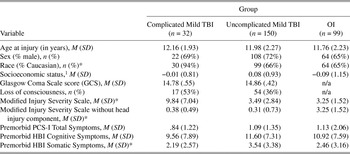
Among the children with mild TBI, 32 (18%) showed trauma-related intracranial abnormalities on MRI, and were classified as having complicated mild TBI, with the rest classified as having an uncomplicated mild TBI. Four children from the mild TBI group could not complete the MRI and were excluded from this study. Children with complicated mild TBI, uncomplicated mild TBI, and OI did not differ in age at injury, sex, or socioeconomic status (SES; see Table 1). As expected, the complicated mild TBI group displayed greater overall injury severity than the other two groups as measured by the Modified Injury Severity Scale (MISS), which is an overall index derived from AIS scores, calculated as the sum of the squares of the three most severely injured body areas (Mayer, Matlak, Johnson, & Walker, Reference Mayer, Matlak, Johnson and Walker1980). However, when the contribution of the head injury to MISS scores was omitted, the OI group had the highest mean score. Unexpectedly, the complicated mild TBI group included significantly fewer minority children than children in the other two groups (see Table 1). The groups did not differ on parents’ retrospective ratings on two out of three measures of premorbid symptoms; they did differ on ratings of premorbid somatic symptoms, with somewhat higher ratings in the uncomplicated mild TBI group.
Sample characteristics

Note
MRI = magnetic resonance imaging; PCS-I = Postconcussive Symptom Interview; HBI = Health and Behavior Inventory; TBI = traumatic brain injury; OI = orthopedic injury.
1 Socioeconomic status was assessed by averaging sample z scores for years of maternal education, median family income for census tract, and the Duncan Socioeconomic Index, which is a measure of occupational prestige.
* Groups differ significantly, p < .05.
Procedure and Attrition
The research was approved by the appropriate institutional review boards, and informed parental consent and child assent were obtained in writing prior to participation. Children who met all inclusion/exclusion criteria and whose parents agreed to participate were scheduled for an initial assessment no later than 3 weeks post injury, with 80% completed between 1 and 2 weeks post injury (M = 11.35 days, SD = 3.42). Parents and children rated current PCS at the initial assessment and again at 1, 3, and 12 months post injury. At the initial assessment, parents also completed a retrospective report of pre-injury symptoms, prior to reporting current symptoms. Additionally, children with mild TBI completed standardized testing of cognitive skills, as well as MRI of the brain.
Of 285 children who completed the initial assessment, 280 (98%) completed the assessment at 1-month post injury, 268 (94%) completed the 3-month assessment, and 253 (89%) completed the 12-month assessment. The groups did not differ in the proportion of missed assessments. At each assessment, children who did and did not return did not display any significant differences in demographic or clinical variables (i.e., SES, age at injury, severity of injury, or initial PCS), except for the 12-month assessment, when children who did not return had lower SES and were more likely to be of minority race.
Magnetic Resonance Imaging
The MRI pulse sequence included sagittal T1-weighted spin echo images, axial T2-weighted and proton density fast spin echo images, coronal 2-dimensional gradient echo images, coronal fluid attenuated inversion recovery (FLAIR) images, and axial diffusion-weighted echo planar images. Board-certified radiologists reviewed each MRI using a standard protocol, unaware of the results of any other assessments. Each MRI was scored dichotomously in terms of whether it contained trauma-related intracranial abnormalities.
Measures
Cognitive ability
Children were administered the Wechsler Abbreviated Scale of Intelligence (WASI; Wechsler, Reference Wechsler1999). The Wide-Range Achievement Test–Third Edition (WRAT-3; Wilkinson, Reference Wilkinson1993) was administered to assess spelling, word reading, and math calculation skills. The California Verbal Learning Test–Children’s Version (CVLT-C; Delis, Kramer, Kaplan, & Ober, Reference Delis, Kramer, Kaplan and Ober1994) was administered to assess verbal memory, and the Developmental Test of Visual-Motor Integration (VMI; Beery & Beery, Reference Beery and Beery2004) was administered to examine visuomotor skills. The test battery also included three subtests from the Cambridge Neuropsychological Testing Automated Battery (CANTAB; Sahakian & Owen, Reference Sahakian and Owen1992): Pattern Recognition Memory, Stockings of Cambridge, and Spatial Working Memory. These subtests assess recognition memory for visual patterns, planning and spatial problem solving, and retention and manipulation of spatial information, respectively.
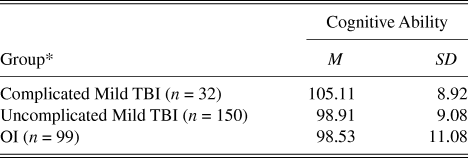
Exploratory factor analyses of age-based standard scores indicated that the cognitive tests could be represented by two highly correlated factors (r = .50), one constituted primarily by verbal or crystallized skills and another constituted primarily by nonverbal or fluid skills. Thus, for the sake of parsimony, cognitive ability was represented in a single overall composite score. The use of a single cognitive composite resulted in increased power and decreased likelihood of Type I error, because it resulted in fewer analyses. Composite scores for each child were computed by transforming all cognitive variables to standard scores with a mean of 100 and a standard deviation of 15, and then taking the mean score across all cognitive tests. The mild TBI and OI groups did not differ on any of the individual cognitive measures, except for small differences on one CANTAB subtest favoring the complicated mild TBI group. The mean scores for the cognitive ability composite differed significantly between the OI and mild TBI groups, with the complicated mild TBI group showing a higher mean score on the cognitive ability composite than the other two groups (see Table 2). We should note that all hierarchical linear modeling analyses reported below were repeated for the separate cognitive factors. Results were essentially the same as those found when using a single overall composite score.
Mean scores on the Cognitive Ability Composite by group

Note
TBI = Traumatic Brain Injury; OI = Orthopedic Injury.
* Groups differ significantly, p < .05.
Postconcussuve symptoms
Postconcussuve symptoms (PCS) were assessed using two measures, the Postconcussive Symptom Interview (PCS-I; Mittenberg et al., Reference Mittenberg, Wittner and Miller1997) and the Health and Behavior Inventory (HBI; Yeates et al., Reference Yeates, Luria, Bartkowski, Rusin, Martin and Bigler1999). The parent and child forms of both measures are worded slightly differently to be age-appropriate and to reflect first- versus third-person perspectives. The PCS-I is administered orally, and asks children and their parents to report the presence or absence of 15 postconcussive symptoms over the past week. The symptoms include cognitive, somatic, and emotional difficulties, similar to those listed in the research diagnostic criteria for postconcussional disorder in the Diagnostic and Statistical Manual of Mental Disorders, Fourth Edition (DSM-IV; American Psychiatric Association, 1994) and for postconcussion syndrome in the International Classification of Diseases (World Health Organization, 1993). The total number of symptoms was used as the measure of PCS, and displayed satisfactory internal consistency at each of the four assessments (Cronbach’s alpha from .78 to .82 for parents’ ratings and from .70 to .77 for children’s ratings).
The HBI is a 50-item self-report questionnaire that includes a variety of cognitive, somatic, emotional, and behavioral symptoms. The questionnaire requires parents and children to rate the frequency of occurrence of each symptom over the past week on a four-point scale, ranging from “never” to “often.” Cognitive and somatic symptom dimensions of the HBI were used as measures of PCS, based on a recent factor analytic study showing substantial agreement between parents and children for those symptom dimensions as compared to emotional and behavioral symptom dimensions (Ayr, Yeates, Taylor, & Browne, Reference Ayr, Yeates, Taylor and Browne2009). Total scores for each dimension were used as measures of PCS and displayed satisfactory internal consistency across all four assessments (Cronbach’s alpha from .83 to .95 for parents’ ratings and from .86 to .91 for children’s ratings).
Data Analysis
Hierarchical linear modeling was used to examine child and parent ratings of PCS longitudinally (Burchinal, Bailey, & Snyder, Reference Burchinal, Bailey and Snyder1994; Jennrich & Schluchter, Reference Jennrich and Schluchter1986). The analyses involved a group × cognitive ability × time design. Three groups (complicated mild TBI, uncomplicated mild TBI, and OI) were entered into the analyses using dummy variables contrasting each of the mild TBI groups with the OI group. Analyses were conducted for six dependent variables (PCS-I total score, HBI cognitive score, and HBI somatic score, based on parent and child ratings). Intraindividual growth curves (i.e., Level 1 models) were characterized using intercept, slope, and acceleration/deceleration terms (i.e., linear and quadratic change). For all analyses, time post injury was centered at 90 days post injury because research suggests that PCS often resolve around 3 months after mild TBI (Satz et al., Reference Satz, Zaucha, McCleary, Light and Asarnow1997; Yeates & Taylor, Reference Yeates and Taylor2005). Thus, the intercept parameter for the Level 1 models represented the expected level of PCS at 3 months post injury, and the linear change parameter represented the linear rate of change in PCS at 3 months post injury. Because data were available for four time points (i.e., initial assessment and 1, 3, and 12 months follow-ups), the model included a quadratic parameter representing the rate of deceleration/acceleration in PCS across time.
Each analysis consisted of two steps. In the first step, unconditional Level 1 models were estimated for each dependent variable to examine the mean and variance of the growth curve parameters. In the second step, Level 2 models were tested to assess the contributions of specific predictor variables to the number of PCS at 3 months post injury, the rate of change at that time point, and the degree of curvature in the growth curve across the first year post injury. Race (white vs. nonwhite), SES, and age at injury were included as covariates in all models. Because ratings of premorbid symptoms were obtained from the parents at the initial assessment, analyses of parent-rated PCS also included the ratings of premorbid symptoms as covariates. Children did not complete ratings of premorbid symptoms, and so analyses of their ratings were not adjusted for premorbid functioning. All continuous predictors (i.e., SES, age at injury, premorbid PCS, cognitive ability) were centered for the analyses.
The central hypotheses were tested by including interaction terms to examine the moderating influence of cognitive ability on severity of injury (i.e., complicated mild TBI, uncomplicated mild TBI, and OI) in PCS over time. Interaction terms that were not significant were eliminated from each analysis and the models were re-estimated without them. For all significant effects involving group, cognitive ability, and their interaction, the percentage of parameter variance explained by each effect was estimated using the method described by Raudenbush and Bryk (Reference Raudenbush and Bryk2002).
RESULTS
Level 1 Unconditional Models
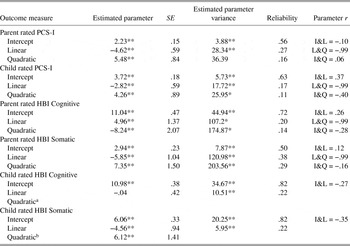
The results of the Level 1 unconditional models are summarized in Table 3. As expected, the estimated mean intercepts were significantly different from 0 for all six measures of PCS. Additionally, five of the six linear change parameters and five of the six quadratic change parameters had an estimated mean significantly different from 0. The estimated true parameter variance was significant for all intercepts and linear change parameters, and three out of six quadratic change (i.e., curvature) parameters. Thus, children displayed significant variation in the number of PCS at 3 months post injury and in the rate of linear change in PCS for all measures, as well as in the rate of acceleration/deceleration across the first year post injury for the child-rated PCS-I score, parent-rated HBI cognitive symptom score, and parent-rated HBI somatic symptom score. The linear and quadratic change parameters were consistently very highly correlated. Based on tests of the quadratic change parameter’s mean and variance, it was removed from the Level 1 models involving child-rated cognitive symptoms on the HBI and was treated as nonrandomly varying for Level 1 models involving child-rated somatic symptoms on the HBI.
Results of Level 1 unconditional models

Note
The intercept represents the average performance at 3 months post injury. The linear terms represents that average amount of change (per year) at 3 months post injury, and the quadratic term represents the degree of curvature across 1 yea r post injury. Reliability reflects the percentage of parameter variance that is potentially explainable by predictors in the Level 2 models. Parameter r is the estimate of the correlations between the Intercept (I), Linear (L), and Quadratic (Q) change parameters.
a The parameter was deleted from the model.
b The parameter was retained but treated as nonrandomly varying in conditional models (i.e., residual variance was constrained to zero).
*p < .05, **p < .01.
Level 2 Conditional Models
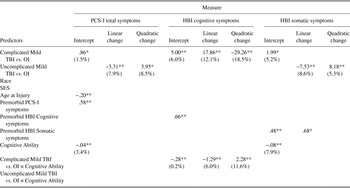
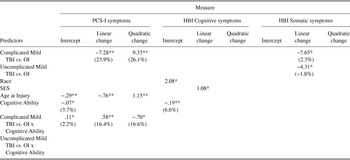
The results of the Level 2 models are summarized in Tables 4 (for parent ratings) and 5 (for child ratings). For each dependent variable, the tables list the individual predictors that contributed significantly to each outcome, along with the estimated coefficients for these predictors.
Significant parameter estimates (and variance explained) in Level 2 conditional models for parent-rated PCS

Note
PCS-I = Postconcussive Symptom Interview; HBI = Health and Behavior Inventory; TBI = traumatic brain injury; OI = orthopedic injury.
**p < .01, *p < .05.
Significant parameter estimates (and variance explained) in Level 2 conditional models for child-rated PCS

Note
PCS-I = Postconcussive Symptom Interview; HBI = Health and Behavior Inventory; TBI = traumatic brain injury; OI = orthopedic injury.
**p < .01, *p < .05.
Parent-rated PCS-I total score
None of the interaction terms involving group and cognitive ability was significant for the parent-rated PCS-I total score. Significant main effects were obtained for group and cognitive ability, with small to medium effect sizes (see Table 4). The complicated mild TBI group demonstrated higher total scores on the PCS-I than the OI group at 3 months post injury. In addition, children with lower cognitive ability had higher total scores at 3 months. The uncomplicated mild TBI group showed a more rapid rate of decline in the total score at 3 months post injury compared to the OI group. Injury severity was also a significant predictor of the quadratic parameter, so that the uncomplicated mild TBI group showed an even more rapid decline in symptoms acutely, and eventual leveling off, compared to the OI group.
Parent-rated HBI cognitive symptoms
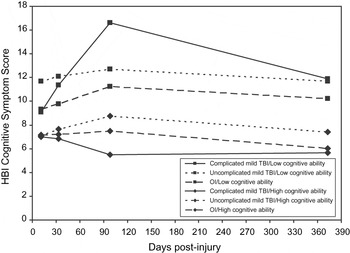
Significant interactions between group and cognitive ability were found for parent-rated cognitive symptoms on the HBI, ranging from small to large in magnitude (see Table 4). To help illustrate the interactions, children were dichotomized into high and low cognitive ability groups (<105 standard score = low cognitive ability; ≥105 standard score = high cognitive ability). The dichotomization was strictly for the purposes of illustrating the interactions; cognitive ability was treated as continuous in the actual analyses. The cutoff point was selected to maximize the number of children in each of the complicated mild TBI subgroups, making the estimation of means more reliable for graphing purposes. The mean fitted values from the final model were graphed for each group relative to the number of days post injury (see Figure 1).
Parent-rated HBI cognitive symptoms by cognitive ability and group.

Figure 1 shows that children with complicated mild TBI and lower cognitive ability did not differ when compared to the other low cognitive ability groups at the initial assessment, but then demonstrated a rapid increase in cognitive symptoms across the first 3 months post injury. Higher cognitive ability appeared to protect against the development of cognitive symptoms, as all three high cognitive ability groups demonstrated relatively few symptoms across time, and did not differ from one another.
Parent-rated HBI somatic symptoms
None of the interactions between group and cognitive ability were significant for parent-rated somatic symptoms on the HBI. Group differences accounted for a significant variance in the intercept parameters, with a medium effect size (see Table 4). The complicated mild TBI group demonstrated more somatic symptoms than the OI group at 3 months post injury. A significant positive curvature of medium to large magnitude indicated a rapid rate of decline in parent-rated somatic symptoms acutely for the uncomplicated mild TBI group, with the rate of decline slowing after 90 days post injury. Cognitive ability also accounted for significant variance in the intercept parameter, again of medium to large magnitude, with children with higher cognitive ability demonstrating less parent-rated somatic symptoms at 3 months post injury.
Child-rated PCS-I total score
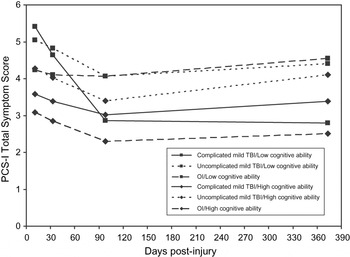
Significant interactions involving group and cognitive ability were found for the child-rated PCS-I total score, ranging from small to large in magnitude. The interaction involving the contrast between the complicated mild TBI and OI groups and cognitive ability was a significant predictor of the intercept, linear, and quadratic parameters (see Table 5). Figure 2 shows that children with complicated mild TBI and lower cognitive ability had higher child-rated PCS-I total scores at the initial assessment, and then showed a rapid decrease in symptoms, so that by 3 months post injury, they did not differ from the children with complicated mild TBI and higher cognitive ability. The uncomplicated mild TBI group with low cognitive ability also showed high total scores at the initial and 1-month assessment, and then at 3 months post injury began to follow the same trend as the OI group with low cognitive ability. Higher cognitive ability appeared to help protect against the development of PCS, as children with high cognitive ability in all three groups demonstrated relatively few PCS across time.
Child-rated total symptoms on the PCS-I by cognitive ability and group.

Child-rated HBI cognitive symptoms
No interactions involving group and cognitive ability were significant for child-rated cognitive symptoms on the HBI. Group differences also did not account for significant variance in the intercept or linear change parameters (see Table 5). Cognitive ability was a significant predictor of the intercept parameter, with a medium effect size. Children with lower cognitive ability reported more cognitive symptoms at 3 months than children of higher cognitive ability.
Child-rated HBI somatic symptoms
Although the interactions of group and cognitive ability were not significant for child-rated somatic symptoms on the HBI, group differences accounted for a small but significant amount of variance in the linear and quadratic change parameters. Children with complicated mild TBI showed the most rapid rate of decline in child-rated somatic symptoms at 3 months post injury and different curvature over time compared to the OI group (see Table 5).
Covariates
Parent-rated premorbid PCS was consistently related to parent-rated post injury PCS symptoms, with more premorbid PCS predicting higher PCS at 3 months post injury (see Table 4). Age at injury was a significant predictor of the intercept parameter for both the parent- and child-rated total PCS-I score (see Tables 4 and 5). Younger children consistently were rated as showing more PCS at 3 months post injury than older children. Race was a significant predictor of the intercept parameter for child-rated cognitive symptoms on the HBI, with white children reporting fewer symptoms relative to nonwhite children at 3 months (see Table 5). SES was a significant predictor of the linear change parameter for child-rated cognitive symptoms on the HBI (see Table 5). Children from lower SES households reported less rapid change in cognitive symptoms at 3 months post injury relative to children from higher SES backgrounds.
DISCUSSION
The primary goal of the current study was to determine whether the relationship between mild TBI and PCS is moderated by cognitive ability. The findings are consistent with the hypothesis that mild TBI are more likely to result in PCS, relative to OI, among children of lower cognitive ability than among children of higher cognitive ability. This was especially true for children with complicated mild TBI. Thus, cognitive ability moderated PCS in the complicated mild TBI group on both the child-rated PCS-I total score and parent-rated HBI cognitive symptom score.
On the PCS-I measure, which includes a mixture of cognitive, somatic, and emotional symptoms, children with low cognitive ability and a complicated mild TBI endorsed the most symptoms at baseline relative to all other groups, but then showed a rapid linear decrease in symptoms to 3 months post injury. In contrast, children with complicated mild TBI but high cognitive ability endorsed relatively few symptoms across time. Parent ratings of cognitive symptoms on the HBI demonstrated a more pronounced pattern of increased vulnerability to mild TBI among children with low cognitive ability. More specifically, children with low cognitive ability and complicated mild TBI showed significant increases in cognitive symptoms to 3 months post injury, and the largest group differences relative to children with OI were apparent for children of low cognitive ability with complicated mild TBI.
At first glance, the nature of these two interactions may appear somewhat contradictory. Children with low cognitive ability and complicated mild TBI reported more PCS initially, followed by a rapid decline, whereas their parents reported an increase specifically in cognitive symptoms. However, the findings probably reflect differences between the outcome measures in terms of the types of symptoms they assess, as well as their relative sensitivity for parents versus children. The PCS-I consists of a mixture of different types of PCS, so it is difficult to know whether its moderation by cognitive reserve reflects specific types of symptoms (i.e., cognitive, somatic, emotional). In contrast, the HBI assesses specific dimensions of PCS, and evidence of moderation was apparent only for cognitive symptoms. However, the PCS-I may be a more sensitive measure for children than the HBI, and vice versa for parents, because previous analyses have found larger group differences for parents on the HBI scales, whereas for children group differences are largest on the PCS-I (Taylor et al., Reference Taylor, Dietrich, Nuss, Wright, Rusin, Bangert, Minich and Yeatesin press). The format of the PCS-I, which involves oral administration and simple yes/no responses, may be easier for children to complete than that of the HBI, which involves written administration and a four-point rating scale. In contrast, parents may provide more refined estimates of specific symptom types using the HBI.
Thus, a possible explanation for the current pattern of findings is that children who are vulnerable because of low cognitive ability report a general increase in PCS immediately after complicated mild TBI that they perceive resolves fairly quickly, but their parents become more aware of persisting cognitive symptoms over time, perhaps as the effects of inattention, forgetfulness, and distractibility begin to impact the child’s school work or abilities to function at home. Notably, no significant interactions were found for the HBI somatic symptom rating, for either parent or child ratings. This may be because somatic symptoms are not particularly susceptible to moderation by cognitive reserve. Cognitive symptoms may be more susceptible to moderation because they are more closely linked to cognitive reserve, and parents may be better able to distinguish these symptoms than the children themselves. Indeed, group contrasts were significant for children’s ratings of somatic, but not cognitive symptoms, but were significant for parent ratings of both types of symptoms.
In summary, we believe the presence of two significant interactions argues strongly for the existence of a complex interplay between cognitive ability and injury severity during recovery from mild TBI, especially given the low probability of detecting interactions in nonexperimental research designs (McClelland & Judd, Reference McClelland and Judd1993). Finding moderation effects for both child and parent ratings of PCS also helps to bolster confidence in the results. Thus, the findings provide support for reserve capacity theory (Dennis et al., Reference Dennis, Yeates, Taylor, Fletcher and Stern2006; Satz, Reference Satz1993; Stern, Reference Stern2002). Children with high cognitive ability and thus higher reserve may be somewhat protected from the effects of complicated mild TBI, while those with less reserve (i.e., low cognitive ability) demonstrate greater vulnerability to the development of PCS immediately after and up to 3 months post injury. These findings are consistent with previous research in children with moderate to severe TBI (Farmer et al., Reference Farmer, Kanne, Haut, Williams, Johnstone and Kirk2002), as well as in children at risk for reasons other than TBI (Masten, Reference Masten2001). However, cognitive ability has not been investigated previously as a moderator of PCS after mild TBI. The mechanism by which cognitive ability acts as a moderator of PCS is unclear. Higher cognitive ability could be reflected in the individual’s active capacity to cope with neurological insults. However, higher cognitive ability could also be linked to the passive capacity of the brain to adapt to brain injury, given the correlations between cognitive ability and brain structure and function (Choi et al., Reference Choi, Shamosh, Cho, DeYoung, Lee and Lee2008; McDaniel, Reference McDaniel2005).
Although the key findings from this study indicate that cognitive ability moderates PCS following mild TBI, the results also indicate that cognitive ability predicts PCS generally after minor injuries. That is, lower cognitive ability predicted more PCS at 3 months post injury for all groups. We believe this is the first time that a general effect of cognitive ability on PCS in children with minor injuries has been demonstrated. Injury severity was also a significant independent predictor, such that complicated mild TBI predicted higher levels of PCS at 3 months post injury. This finding is consistent with previous studies showing an increased risk of poor outcomes after a complicated mild TBI (Levin et al., Reference Levin, Hanten, Roberson, Xiaoqi, Ewing-Cobbs and Dennis2008). Despite an increased risk of PCS, children with complicated mild TBI also were more likely to display a rapid decrease in symptoms following high acute levels. This is encouraging, as many of these children are likely to show a long-term course of recovery similar to children with uncomplicated mild TBI (Ponsford et al., Reference Ponsford, Wilmott, Rothwell, Cameron, Ayton and Nelms1999; Yeates et al., Reference Yeates, Taylor, Rusin, Bangert, Dietrich and Nuss2009).
Retrospective ratings of premorbid symptoms by parents also were positively related to reports of PCS at 3 months on all parent-rated measures. Past research has noted the effects of premorbid behavior problems on outcome after mild TBI (Asarnow et al., Reference Asarnow, Satz, Light, Zaucha, Lewis, McCleary, Michel and Broman1995; Levin et al., Reference Levin, Hanten, Roberson, Xiaoqi, Ewing-Cobbs and Dennis2008; Mittenberg et al., Reference Mittenberg, Wittner and Miller1997; Ponsford et al., Reference Ponsford, Wilmott, Rothwell, Cameron, Ayton and Nelms1999). The severity of PCS clearly is related to the severity of premorbid symptoms, which should be taken into consideration when evaluating the effects of mild TBI.
Thus, the current results indicate that the occurrence of PCS after mild TBI is multidetermined. Research with children and adults indicates that both injury characteristics and noninjury related variables help explain outcomes after mild TBI, offering tentative support for both physiogenic and psychogenic explanations of PCS (Luis, Vanderploeg, & Curtiss, Reference Luis, Vanderploeg and Curtiss2003; Ponsford et al., Reference Ponsford, Wilmott, Rothwell, Cameron, Ayton and Nelms1999). The current study adds to this literature by showing that PCS following mild TBI are predicted by premorbid symptoms, cognitive ability, and severity of injury, as well as the joint interaction of the latter two risk factors.
The current study has several limitations. The complicated mild TBI group had a higher mean score than the uncomplicated mild TBI and OI groups on the cognitive ability composite. A possible explanation for this finding is that the complicated mild TBI group consisted of fewer children from minority backgrounds who may have been at greater sociodemographic disadvantage compared to the other two groups. Although race was covaried in all analyses and the groups did not differ in SES, the differences in cognitive ability may have affected the results unexpectedly.
Another potential limitation was the use of a single composite measure based on cognitive tests administered post injury to represent premorbid cognitive ability. However, the groups did not differ on any post injury cognitive measure, and analyses using separate cognitive factors resulted in identical findings. Nevertheless, procuring a measure of premorbid functioning based on ratings of school performance or results of achievement tests prior to injury may be desirable in future studies. Future studies also would benefit from the inclusion of more detailed information regarding premorbid conditions such as attention-deficit/hyperactivity disorder and specific learning disabilities, both of which may serve as proxies of cognitive reserve (Farmer et al., Reference Farmer, Kanne, Haut, Williams, Johnstone and Kirk2002; Yeates et al., Reference Yeates, Armstrong, Janusz, Taylor, Wade, Stancin and Drotar2005).
Another shortcoming is that parents’ ratings of premorbid symptoms were obtained retrospectively and may have been biased by post injury functioning. Studies that include pre-injury assessments of symptoms would provide greater insight into the relationships between premorbid functioning and PCS after mild TBI. However, the contemporaneous measurement of pre-injury symptoms is not likely to be feasible. A further limitation is that the recruitment rates for the mild TBI and OI groups were both below 50%. However, nonparticipants did not differ from participants demographically. Attrition may also have introduced bias, although the analyses included all children with at least one assessment of PCS. Children who did not return for the 1-year follow-up had significantly lower SES than those who did return. Although SES was covaried in the analyses, the findings may underestimate PCS in both groups, because children of lower SES were at higher risk for symptoms.
Despite these limitations, the current study provides support for the hypothesis that the severity of PCS after a complicated mild TBI is moderated by cognitive ability. Given these results, physicians and other health care professionals working with children who sustain mild TBI may be better able to identify children at risk of developing significant PCS after mild TBI, and focus prevention and intervention efforts on children with abnormal neuroimaging results and lower cognitive ability. Further research is needed to identify the entire range of factors that place children with mild TBI at risk for persistent PCS and to thereby improve their clinical care.
ACKNOWLEDGMENTS
The research reported here served as the basis for a dissertation submitted by the first author to The Ohio State University in partial fulfillment of the requirements for a doctoral degree. Portions of the research were presented at the annual meeting of the International Neuropsychological Society, Waikoloa, Hawaii, February, 2008. The larger study on which the research was based was supported by grants R01 HD39834 and K02 HD44099 from the National Institute of Child Health and Human Development and the National Center for Medical Rehabilitation Research to Keith Owen Yeates. The authors wish to acknowledge the contributions of Lauren Ayr, Anne Birnbaum, Amy Clemens, Kalaichelvi Ganesalingham, Christine Hajek, Amanda Lininger, Melissa Ginn, Katie Pestro, Elizabeth Roth, Elizabeth Shaver, and Heidi Walker in conducting the study.